brake CHEVROLET KODIAK 2007 Workshop Manual
[x] Cancel search | Manufacturer: CHEVROLET, Model Year: 2007, Model line: KODIAK, Model: CHEVROLET KODIAK 2007Pages: 430, PDF Size: 6.06 MB
Page 222 of 430
Skidding
In a skid, a driver can lose control of the vehicle.
Defensive drivers avoid most skids by taking
reasonable care suited to existing conditions,
and by not overdriving those conditions.
But skids are always possible.
The three types of skids correspond to your
vehicle’s three control systems. In the braking skid,
your wheels are not rolling. In the steering or
cornering skid, too much speed or steering in a
curve causes tires to slip and lose cornering force.
And in the acceleration skid, too much throttle
causes the driving wheels to spin.
A cornering skid is best handled by easing your
foot off the accelerator pedal.
If you have the Traction Control System (TCS),
remember: It helps avoid only the acceleration
skid. SeeTraction Control System (TCS) on
page 216. If you do not have this system, or if
the system is off, then an acceleration skid is
also best handled by easing your foot off
the accelerator pedal.Of course, traction is reduced when water, snow,
ice, gravel, or other material is on the road.
For safety, you will want to slow down and adjust
your driving to these conditions. It is important
to slow down on slippery surfaces because
stopping distance will be longer and vehicle control
more limited.
While driving on a surface with reduced traction, try
your best to avoid sudden steering, acceleration,
or braking, including reducing vehicle speed by
shifting to a lower gear. Any sudden changes could
cause the tires to slide. You may not realize the
surface is slippery until your vehicle is skidding.
Learn to recognize warning clues — such as
enough water, ice, or packed snow on the road to
make a mirrored surface — and slow down when
you have any doubt.
If you have the Anti-Lock Brake System (ABS),
remember: It helps avoid only the braking skid.
If you do not have ABS, then in a braking
skid, where the wheels are no longer rolling,
release enough pressure on the brakes to get
the wheels rolling again. This restores steering
control. Push the brake pedal down steadily
when you have to stop suddenly. As long as the
wheels are rolling, you will have steering control.
222
Page 225 of 430
The heavier the rain, the harder it is to see.
Even if your windshield wiper blades are in good
shape, a heavy rain can make it harder to see
road signs and traffic signals, pavement markings,
the edge of the road, and even people walking.
It is wise to keep your wiping equipment in
good shape and keep your windshield washer fluid
reservoir filled with washer fluid. Replace your
windshield wiper inserts when they show signs
of streaking or missing areas on the windshield,
or when strips of rubber start to separate from
the inserts.
{CAUTION:
Wet brakes can cause accidents. They
may not work as well in a quick stop and
may cause pulling to one side. You could
lose control of the vehicle.
After driving through a large puddle of
water or a vehicle wash, apply your brake
pedal lightly until your brakes work
normally.Driving too fast through large water puddles
or even going through some vehicle washes can
cause problems, too. The water may affect
your brakes. Try to avoid puddles. But if you
cannot, try to slow down before you hit them.
Hydroplaning
Hydroplaning is dangerous. So much water can
build up under your tires that they can actually ride
on the water. This can happen if the road is wet
enough and you are going fast enough. When your
vehicle is hydroplaning, it has little or no contact
with the road.
Hydroplaning does not happen often. But it can
if your tires do not have much tread or if the
pressure in one or more is low. It can happen if
a lot of water is standing on the road. If you
can see reflections from trees, telephone poles,
or other vehicles, and raindrops dimple the
water’s surface, there could be hydroplaning.
Hydroplaning usually happens at higher speeds.
There just is not a hard and fast rule about
hydroplaning. The best advice is to slow down
when it is raining.
225
Page 230 of 430
Hill and Mountain Roads
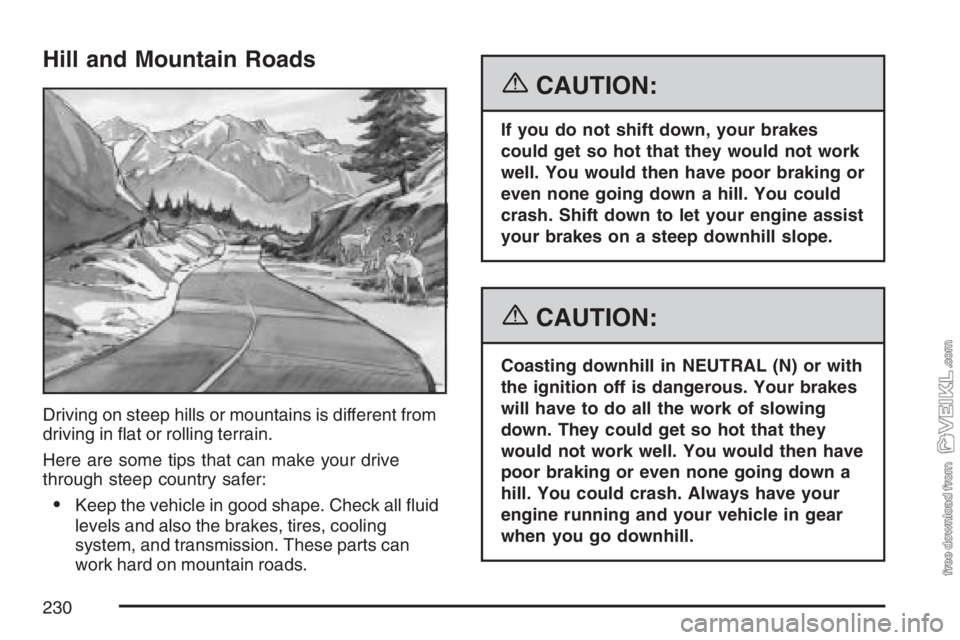
Driving on steep hills or mountains is different from
driving in flat or rolling terrain.
Here are some tips that can make your drive
through steep country safer:
•Keep the vehicle in good shape. Check all fluid
levels and also the brakes, tires, cooling
system, and transmission. These parts can
work hard on mountain roads.
{CAUTION:
If you do not shift down, your brakes
could get so hot that they would not work
well. You would then have poor braking or
even none going down a hill. You could
crash. Shift down to let your engine assist
your brakes on a steep downhill slope.
{CAUTION:
Coasting downhill in NEUTRAL (N) or with
the ignition off is dangerous. Your brakes
will have to do all the work of slowing
down. They could get so hot that they
would not work well. You would then have
poor braking or even none going down a
hill. You could crash. Always have your
engine running and your vehicle in gear
when you go downhill.
230
Page 233 of 430
If you have a four-wheel-drive vehicle, shift into
4HI. SeeFour-Wheel Drive on page 119.
If you have the Traction Control System (TCS),
it will improve your ability to accelerate when
driving on a slippery road. But you can turn the
TCS off if you ever need to. You should turn
the system off if your vehicle ever gets stuck in
sand, mud, ice, or snow. SeeIf Your Vehicle
is Stuck in Sand, Mud, Ice, or Snow on page 236.
Even though your vehicle has TCS, you will
want to slow down and adjust your driving to the
road conditions. Under certain conditions, you may
want to turn the TCS off, such as when driving
through deep snow and loose gravel, to help
maintain vehicle motion at lower speeds. See
Traction Control System (TCS) on page 216.
If you do not have TCS, accelerate gently. Try not
to break the fragile traction. If you accelerate
too fast, the drive wheels will spin and polish the
surface under the tires even more.
Unless you have the Anti-Lock Brake System
(ABS), you will want to brake very gently, too. If you
do have ABS, seeAnti-Lock Brake System (ABS)
on page 212. ABS improves your vehicle’s stability
when you make a hard stop on a slippery road.Whether you have ABS or not, you will want to
begin stopping sooner than you would on dry
pavement. Without ABS, if you feel your vehicle
begin to slide, let up on the brakes a little. Push the
brake pedal down steadily to get the most traction
you can.
Remember, unless you have ABS, if you brake so
hard that your wheels stop rolling, you will just
slide. Brake so your wheels always keep rolling
and you can still steer.
•Whatever your braking system, allow greater
following distance on any slippery road.
•Watch for slippery spots. The road might be
fine until you hit a spot that is covered with
ice. On an otherwise clear road, ice patches
may appear in shaded areas where the
sun cannot reach, such as around clumps of
trees, behind buildings, or under bridges.
Sometimes the surface of a curve or an
overpass may remain icy when the
surrounding roads are clear. If you see a
patch of ice ahead of you, brake before you
are on it. Try not to brake while you are
actually on the ice, and avoid sudden
steering maneuvers.
233
Page 240 of 430
Adding a Snow Plow or Similar
Equipment
If you will be installing a snow plow on your
vehicle, we recommend that the vehicle have
the snow plow prep package (RPO ANQ).
Before installing a snow plow, see your dealer
for information on other recommended optional
equipment and vehicle weight restrictions.
Notice:The payload your vehicle can carry
will be reduced when a snow plow is installed.
Your vehicle can be damaged if either the
front or rear axle ratings, or the GVW,
are exceeded. See your dealer for more
information.
{CAUTION:
On some vehicles that have certain front
mounted equipment, such as a snow
plow, it may be possible to load the front
axle to the front gross axle weight rating
(GAWR) but not have enough weight
on the rear axle to have proper braking
performance. If your brakes can not work
properly, you could have a crash. To help
your brakes work properly when a snow
plow is installed, always follow the
snow plow manufacturer or installer’s
recommendation for rear ballast to ensure
a proper front and rear weight distribution
ratio, even though the actual front weight
may be less than the front GAWR, and the
total vehicle weight is less than the gross
vehicle weight rating (GVWR). Maintaining
a proper front and rear weight distribution
ratio is necessary to provide proper
braking performance.
240
Page 241 of 430
Towing
Towing Your Vehicle
Consult your dealer or a professional towing service
if you need to have your disabled vehicle towed.
SeeRoadside Assistance Program on page 408.
Releasing Air-Operated Parking Brakes
If your vehicle has air brakes, you could have a
special towing problem. If your vehicle has to
be towed because of a complete loss of air
pressure from both systems, the parking brakes
will have automatically engaged. The tow operator
can release the brakes manually by using the
following steps. Then your vehicle can be towed
with all wheels or only the rear wheels on
the ground.
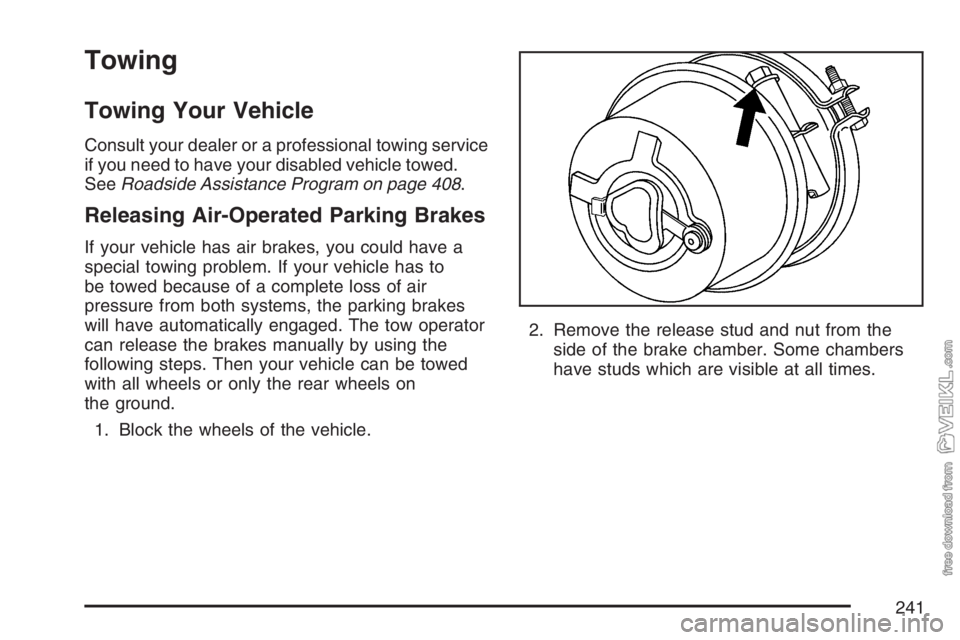
1. Block the wheels of the vehicle.2. Remove the release stud and nut from the
side of the brake chamber. Some chambers
have studs which are visible at all times.
241
Page 242 of 430
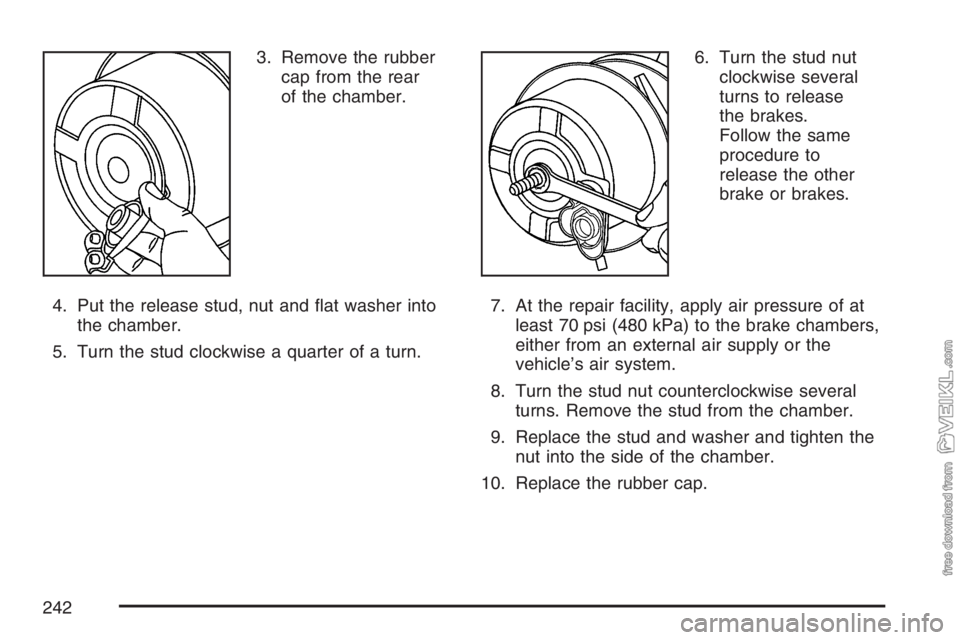
3. Remove the rubber
cap from the rear
of the chamber.
4. Put the release stud, nut and flat washer into
the chamber.
5. Turn the stud clockwise a quarter of a turn.6. Turn the stud nut
clockwise several
turns to release
the brakes.
Follow the same
procedure to
release the other
brake or brakes.
7. At the repair facility, apply air pressure of at
least 70 psi (480 kPa) to the brake chambers,
either from an external air supply or the
vehicle’s air system.
8. Turn the stud nut counterclockwise several
turns. Remove the stud from the chamber.
9. Replace the stud and washer and tighten the
nut into the side of the chamber.
10. Replace the rubber cap.
242
Page 243 of 430
Trailer Connections
Heavy-Duty Trailer Wiring Package
Your vehicle may be equipped with an eight-wire
trailer towing harness. This harness, with a
seven-pin universal heavy-duty trailer connector,
is attached to a bracket on the platform hitch.
The Center High-Mounted Stoplamp (CHMSL)
wire is tied next to the trailer wiring harness for
use with a trailer.
The eight-wire harness contains the following
trailer circuits:
•Yellow: Left Stop/Turn Signal
•Dark Green: Right Stop/Turn Signal
•Brown: Taillamps
•White: Ground
•Light Green: Back-up Lamps
•Light Blue: CHMSL
•Red: Battery Feed
•Dark Blue: Trailer Brake
Trailer Connections
(C7/C8 Models Only)
If your vehicle has these trailer connections, they
are located at the rear of the cab for a tractor
and at the rear of the chassis when towing
a trailer. There will be an air connection and an
electrical connection.
Be sure that the couplings to the trailer are
made correctly.
Air Connections
If you are not connecting the trailer air line
connections to another piece of equipment,
be sure to replace their protective caps.
Electrical Connections
This system is a seven-wire cable that will
connect to the trailer, supplying power to the
trailer’s lighting system. When not in use, it
is stored in the trailer air-hose storage bracket.
243
Page 246 of 430
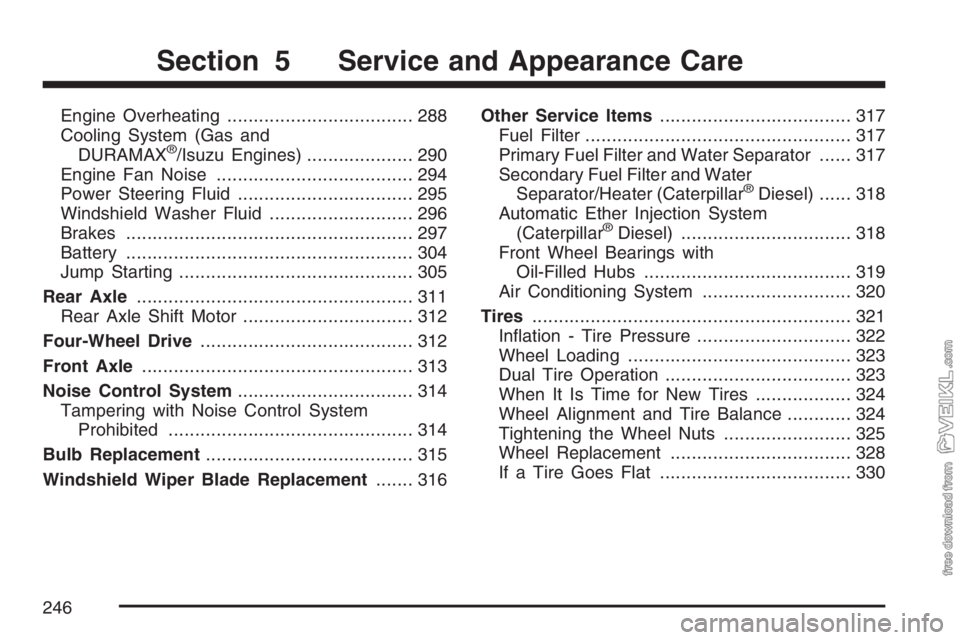
Engine Overheating................................... 288
Cooling System (Gas and
DURAMAX
®/Isuzu Engines).................... 290
Engine Fan Noise..................................... 294
Power Steering Fluid................................. 295
Windshield Washer Fluid........................... 296
Brakes...................................................... 297
Battery...................................................... 304
Jump Starting............................................ 305
Rear Axle.................................................... 311
Rear Axle Shift Motor................................ 312
Four-Wheel Drive........................................ 312
Front Axle................................................... 313
Noise Control System................................. 314
Tampering with Noise Control System
Prohibited.............................................. 314
Bulb Replacement....................................... 315
Windshield Wiper Blade Replacement....... 316Other Service Items.................................... 317
Fuel Filter.................................................. 317
Primary Fuel Filter and Water Separator...... 317
Secondary Fuel Filter and Water
Separator/Heater (Caterpillar
®Diesel)...... 318
Automatic Ether Injection System
(Caterpillar
®Diesel)................................ 318
Front Wheel Bearings with
Oil-Filled Hubs....................................... 319
Air Conditioning System............................ 320
Tires............................................................ 321
Inflation - Tire Pressure............................. 322
Wheel Loading.......................................... 323
Dual Tire Operation................................... 323
When It Is Time for New Tires.................. 324
Wheel Alignment and Tire Balance............ 324
Tightening the Wheel Nuts........................ 325
Wheel Replacement.................................. 328
If a Tire Goes Flat.................................... 330
Section 5 Service and Appearance Care
246
Page 257 of 430
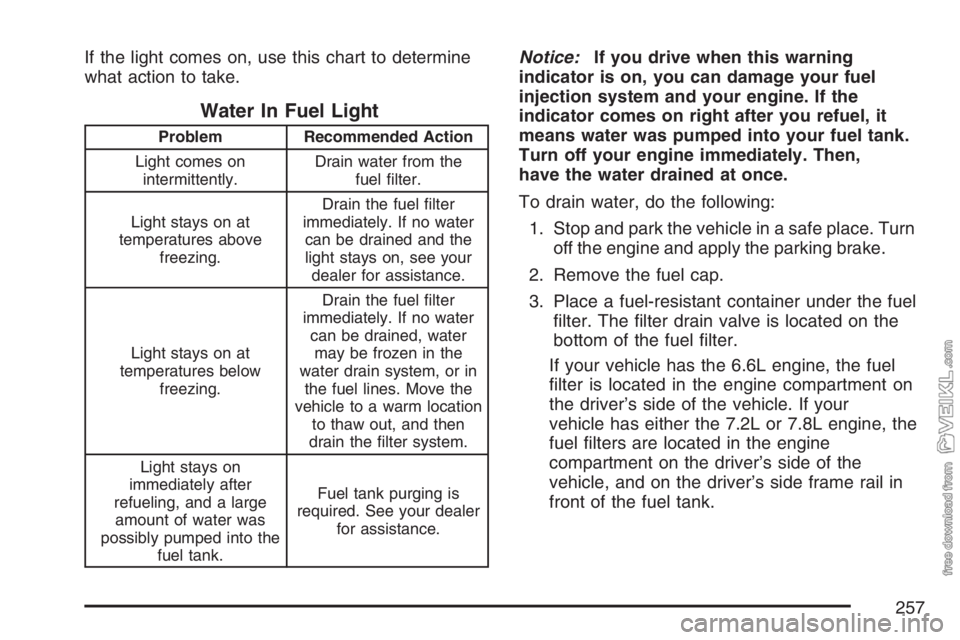
If the light comes on, use this chart to determine
what action to take.
Water In Fuel Light
Problem Recommended Action
Light comes on
intermittently.Drain water from the
fuel filter.
Light stays on at
temperatures above
freezing.Drain the fuel filter
immediately. If no water
can be drained and the
light stays on, see your
dealer for assistance.
Light stays on at
temperatures below
freezing.Drain the fuel filter
immediately. If no water
can be drained, water
may be frozen in the
water drain system, or in
the fuel lines. Move the
vehicle to a warm location
to thaw out, and then
drain the filter system.
Light stays on
immediately after
refueling, and a large
amount of water was
possibly pumped into the
fuel tank.Fuel tank purging is
required. See your dealer
for assistance.
Notice:If you drive when this warning
indicator is on, you can damage your fuel
injection system and your engine. If the
indicator comes on right after you refuel, it
means water was pumped into your fuel tank.
Turn off your engine immediately. Then,
have the water drained at once.
To drain water, do the following:
1. Stop and park the vehicle in a safe place. Turn
off the engine and apply the parking brake.
2. Remove the fuel cap.
3. Place a fuel-resistant container under the fuel
filter. The filter drain valve is located on the
bottom of the fuel filter.
If your vehicle has the 6.6L engine, the fuel
filter is located in the engine compartment on
the driver’s side of the vehicle. If your
vehicle has either the 7.2L or 7.8L engine, the
fuel filters are located in the engine
compartment on the driver’s side of the
vehicle, and on the driver’s side frame rail in
front of the fuel tank.
257