belt CHEVROLET KODIAK 2009 Workshop Manual
[x] Cancel search | Manufacturer: CHEVROLET, Model Year: 2009, Model line: KODIAK, Model: CHEVROLET KODIAK 2009Pages: 376, PDF Size: 5.39 MB
Page 174 of 376
Care of the Cassette Tape Player
A tape player that is not cleaned regularly can cause
reduced sound quality, ruined cassettes, or a damaged
mechanism. Cassette tapes should be stored in their
cases away from contaminants, direct sunlight and
extreme heat. If they are not properly stored, they may
not operate properly or may cause failure of the
tape player.
The tape player should be cleaned regularly after
every 50 hours of use. The radio may display CLN to
indicate that the tape player has been used for 50 hours
without resetting the tape clean timer. If this message
appears on the display, the cassette tape player
needs to be cleaned. It will still play tapes, but it should
be cleaned as soon as possible to prevent damage
to the tapes and player. If there is a reduction in sound
quality, try a known good cassette to see if the tape
or the tape player is at fault. If this other cassette has no
improvement in sound quality, clean the tape player.
For best results, use a scrubbing action, non-abrasive
cleaning cassette with pads which scrub the tape
head as the hubs of the cleaner cassette turn. The
recommended cleaning cassette is available through
your dealer/retailer.The cut tape detection feature of the cassette tape player
may identify the cleaning cassette as a damaged tape.
To prevent the cleaning cassette from being ejected,
use the following steps:
1. Turn the ignition on.
2. Turn the radio off.
3. Press and hold the TAPE button for two seconds
until the radio produces one beep. CAS will flash
on the display for five seconds.
4. Insert the scrubbing action cleaning cassette.
5. Eject the cleaning cassette after the manufacturer’s
recommended cleaning time.
After the cleaning cassette is ejected, the cut tape
detection feature will be active again.
A non-scrubbing action, wet-type cleaner which uses a
cassette with a fabric belt to clean the tape head can be
used. This type of cleaning cassette will not eject on its
own. A non-scrubbing action cleaner may not clean as
thoroughly as the scrubbing type cleaner. The use of a
non-scrubbing action, dry-type cleaning cassette is not
recommended.
After the player is cleaned, press and hold the eject
button for three seconds to reset the CLN indicator. The
radio will display --- to show the indicator was reset.
Cassettes are subject to wear and the sound quality may
degrade over time. Always make sure the cassette
tape is in good condition before the tape player
is serviced.
3-56
Page 178 of 376
Your Driving, the Road, and
the Vehicle
Driving for Better Fuel Economy
Driving habits can affect fuel mileage. Here are some
driving tips to get the best fuel economy possible.
•Avoid fast starts and accelerate smoothly.
•Brake gradually and avoid abrupt stops.
•Avoid idling the engine for long periods of time.
•When road and weather conditions are appropriate,
use cruise control, if equipped.
•Always follow posted speed limits or drive more
slowly when conditions require.
•Keep vehicle tires properly inflated.
•Combine several trips into a single trip.
•Replace the vehicle’s tires with the same TPC Spec
number molded into the tire’s sidewall near the size.
•Follow recommended scheduled maintenance.
Defensive Driving
Defensive driving means “always expect the
unexpected.” The first step in driving defensively is to
wear your safety belt — SeeSafety Belts: They Are for
Everyone on page 1-11.
{CAUTION:
Assume that other road users (pedestrians,
bicyclists, and other drivers) are going to be
careless and make mistakes. Anticipate what they
might do and be ready. In addition:
•Allow enough following distance between you
and the driver in front of you.
•Focus on the task of driving.
Driver distraction can cause collisions resulting in
injury or possible death. These simple defensive
driving techniques could save your life.
4-2
Page 186 of 376
Steering in Emergencies
There are times when steering can be more effective
than braking. For example, you come over a hill and find
a truck stopped in your lane, or a car suddenly pulls
out from nowhere, or a child darts out from between
parked cars and stops right in front of you. These
problems can be avoided by braking — if you can stop
in time. But sometimes you cannot stop in time
because there is no room. That is the time for evasive
action — steering around the problem.
The vehicle can perform very well in emergencies like
these. First apply the brakes. SeeBraking on page 4-4.
It is better to remove as much speed as possible
from a collision. Then steer around the problem, to the
left or right depending on the space available.
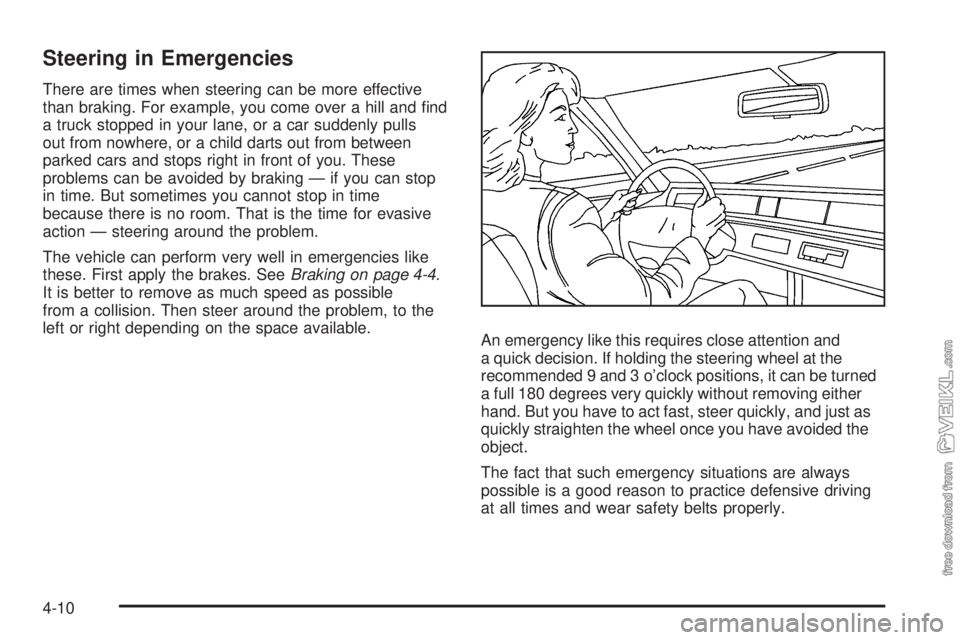
An emergency like this requires close attention and
a quick decision. If holding the steering wheel at the
recommended 9 and 3 o’clock positions, it can be turned
a full 180 degrees very quickly without removing either
hand. But you have to act fast, steer quickly, and just as
quickly straighten the wheel once you have avoided the
object.
The fact that such emergency situations are always
possible is a good reason to practice defensive driving
at all times and wear safety belts properly.
4-10
Page 204 of 376
Windshield Wiper Blade Replacement..............5-71
Other Service Items........................................5-72
Fuel Filter....................................................5-72
Primary Fuel Filter and Water Separator..........5-73
Secondary Fuel Filter and Water Separator/
Heater (Caterpillar Diesel)............................5-74
Front Wheel Bearings with
Oil-Filled Hubs..........................................5-75
Tires..............................................................5-76
Inflation - Tire Pressure.................................5-77
Wheel Loading.............................................5-78
Dual Tire Operation.......................................5-78
When It Is Time for New Tires.......................5-78
Buying New Tires.........................................5-79
Wheel Alignment and Tire Balance..................5-80
Tightening the Wheel Nuts.............................5-80
Wheel Replacement......................................5-84
If a Tire Goes Flat........................................5-85
Appearance Care............................................5-87
Interior Cleaning...........................................5-87
Fabric/Carpet...............................................5-88
Instrument Panel, Vinyl, and Other
Plastic Surfaces........................................5-89
Care of Safety Belts......................................5-89
Weatherstrips...............................................5-89
Washing Your Vehicle...................................5-90Cleaning Exterior Lamps/Lenses.....................5-90
Finish Care..................................................5-90
Windshield and Wiper Blades.........................5-91
Aluminum or Chrome-Plated Wheels
and Trim..................................................5-92
Tires...........................................................5-92
Sheet Metal Damage.....................................5-93
Finish Damage.............................................5-93
Underbody Maintenance................................5-93
Chemical Paint Spotting.................................5-93
Vehicle Identification
......................................5-94
Vehicle Identification Number (VIN).................5-94
Service Parts Identification Label.....................5-94
Electrical System............................................5-95
Add-On Electrical Equipment..........................5-95
Headlamp Wiring..........................................5-95
Windshield Wiper Fuses................................5-95
Fusible Links................................................5-95
Power Windows and Other Power Options..........5-96
Fuses and Circuit Breakers............................5-96
Instrument Panel Fuse Block..........................5-96
Underhood Fuse Block..................................5-99
Capacities and Specifications........................5-102
Normal Maintenance Replacement Parts.........5-108
Maintenance Replacement Parts...................5-108
Engine Drive Belt Routing............................5-110
Section 5 Service and Appearance Care
5-2
Page 206 of 376
Aftermarket Engine Performance
Enhancement Products and
Modifications
Some aftermarket engine performance products and
modifications promise a way to increase the horsepower
and torque levels of the vehicle’s powertrain. You should
be aware that these products could have harmful effects
on the performance and life of the engine, exhaust
emission system, transmission, and drivetrain. The
engines, transmissions, and drivetrains have been
designed and built to offer industry leading durability and
performance in the most demanding applications. Engine
power enhancement products may enable the engine to
operate at horsepower and torque levels that could
damage, create failure, or reduce the life of the engine,
engine emission system, transmission, and drivetrain.
Damage, failure, or reduced life of the engine,
transmission, emission system, drivetrain, or other
vehicle components caused by aftermarket engine
performance enhancement products or modifications
might not be covered under the vehicle warranty.
California Proposition 65 Warning
Most motor vehicles, including this one, contain and/or
emit chemicals known to the State of California to cause
cancer and birth defects or other reproductive harm.
Engine exhaust, many parts and systems (including
some inside the vehicle), many fluids, and some
component wear by-products contain and/or emit
these chemicals.
California Perchlorate Materials
Requirements
Certain types of automotive applications, such as airbag
initiators, seat belt pretensioners, and lithium batteries
contained in remote keyless transmitters, may contain
perchlorate materials. Special handling may be
necessary. For additional information, see
www.dtsc.ca.gov/hazardouswaste/perchlorate.
5-4
Page 281 of 376
If your vehicle has four-wheel drive, the axle differentials,
propshafts, and transfer case may be damaged if tires
of different sizes, brands or tread types are installed
on the front and rear axles. That damage would not be
covered under your warranty.
Buying New Tires
GM has developed and matched specific tires for your
vehicle. If you need replacement tires, GM strongly
recommends that you get tires that are the same size,
brand, load range, speed rating, and construction type
(radial and bias-belted tires) as your vehicle’s original
tires. This way, your vehicle will continue to have tires
that are designed to give the same performance and
vehicle safety, during normal use, as the original tires.
GM recommends replacing tires in sets of six or eight as
applicable. This is because uniform tread depth on all
tires will help keep your vehicle performing most like it did
when the tires were new. Replacing less than a full set of
tires can affect the braking and handling performance of
your vehicle.
{CAUTION:
Mixing tires could cause you to lose control
while driving. If you mix tires of different
sizes, brands, or types (radial and bias-belted
tires) the vehicle may not handle properly,
and you could have a crash. Using tires of
different sizes, brands, or types may also
cause damage to your vehicle. Be sure to
use the correct size, brand, and type of tires
on your vehicle’s wheels.
{CAUTION:
If you use bias-ply tires on the vehicle, the
wheel rim flanges could develop cracks after
many miles of driving. A tire and/or wheel
could fail suddenly, causing a crash. Use
only radial-ply tires with the wheels on the
vehicle.
5-79
Page 291 of 376
If any of the soil remains, a commercial fabric cleaner
or spot lifter may be necessary. When a commercial
upholstery cleaner or spot lifter is to be used, test
a small hidden area for colorfastness first. If the locally
cleaned area gives any impression that a ring
formation may result, clean the entire surface.
After the cleaning process has been completed, a paper
towel can be used to blot excess moisture from the
fabric or carpet.
Instrument Panel, Vinyl, and Other
Plastic Surfaces
A soft cloth dampened with water may be used to
remove dust. If a more thorough cleaning is necessary,
a clean soft cloth dampened with a mild soap solution
can be used to gently remove dust and dirt. Never use
spot lifters or removers on plastic surfaces. Many
commercial cleaners and coatings that are sold to
preserve and protect soft plastic surfaces may
permanently change the appearance and feel of the
interior and are not recommended. Do not use silicone
or wax-based products, or those containing organic
solvents to clean the vehicle’s interior because they can
alter the appearance by increasing the gloss in a
non-uniform manner.Some commercial products may increase gloss on the
instrument panel. The increase in gloss may cause
annoying reflections in the windshield and even make it
difficult to see through the windshield under certain
conditions.
Care of Safety Belts
Keep belts clean and dry.
{CAUTION:
Do not bleach or dye safety belts. It may severely
weaken them. In a crash, they might not be able
to provide adequate protection. Clean safety belts
only with mild soap and lukewarm water.
Weatherstrips
Silicone grease on weatherstrips will make them last
longer, seal better, and not stick or squeak. Apply silicone
grease with a clean cloth. During very cold, damp
weather frequent application may be required. SeePart
C: Recommended Fluids and Lubricants on page 6-31.
5-89
Page 312 of 376
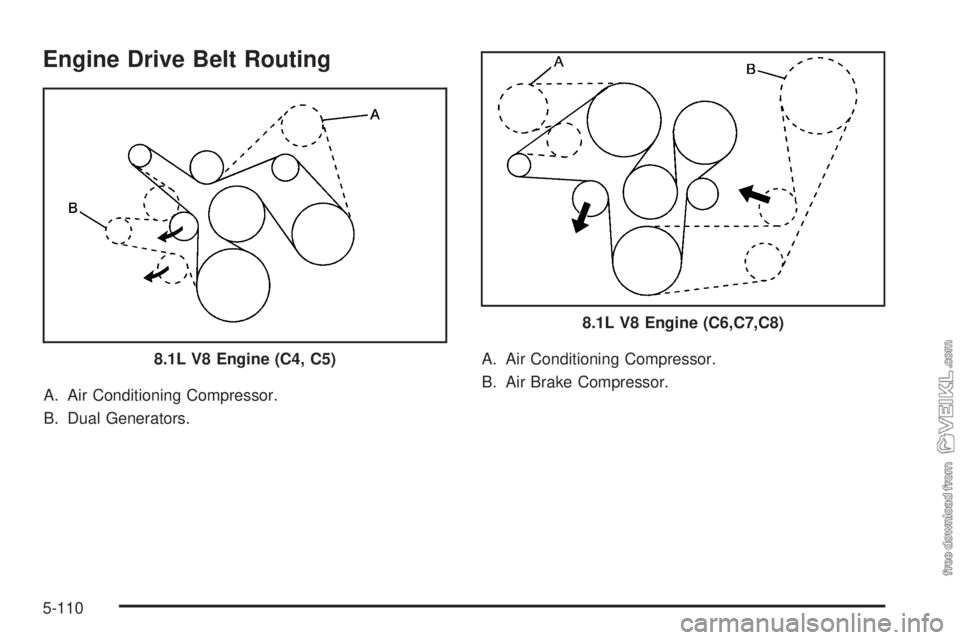
Engine Drive Belt Routing
A. Air Conditioning Compressor.
B. Dual Generators.A. Air Conditioning Compressor.
B. Air Brake Compressor. 8.1L V8 Engine (C4, C5)
8.1L V8 Engine (C6,C7,C8)
5-110
Page 323 of 376

❑Diesel Engine: Inspect engine air cleaner filter change
indicator. If necessary, replace the filter. If vehicle is
driven in dusty/dirty conditions, inspect filter change
indicator at every engine oil change. SeeEngine Air
Cleaner/Filter on page 5-38for more information.
❑Diesel Only: Replace fuel filter (or every 750 hours of
engine operation, whichever occurs first).
❑Chassis lubrication service (or every 6 months,
whichever occurs first).(11)
❑Gasoline Engine Only: Replace fuel filter(s) (or every
12 months, whichever occurs first).(2)
❑Check restraint system.(40)
❑Steering system service.(12)
❑Front and rear suspension service.(13)
❑Spring-to-axle U-bolts and shackle bolts service.(15)
❑Exhaust system service (or every 6 months, whichever
occurs first).(2) (3) (16)
❑Wheel bearing (grease type) service (and whenever
hubs are removed).(22) (36)
❑Wheels and tires service.(14)
❑Hydraulic brake service (or every 6 months, whichever
occurs first).(6) (36)
❑Parking brake service (or every 6 months, whichever
occurs first).(21)❑Air brake service (or every 6 months, whichever
occurs first).(32)
❑Air brake automatic slack adjuster service (or every
500 hours, whichever occurs first).(33)
❑Check air brake relay valve operation and check for
leaks (or every month, or every 300 hours, whichever
occurs first).
❑Clean air brake application valve (or every 3 months,
or every 300 hours, whichever occurs first). Lubricate
linkage.
❑Air brake chamber service (or every 2 months,
whichever occurs first).(34)
❑Air compressor dry element pleated paper air strainer
service (or every 2 months, or every 800 hours,
whichever occurs first).
❑C600, C700, and C800 Gasoline Engines Only:
Engine drive belts service (or every 12 months,
whichever occurs first.)(17)
❑Thermostatically controlled engine cooling fan
service.(3) (19)
❑Shields and underhood insulation service.(3) (4) (20)
❑Gasoline Engine: Air compressor remote mounted air
filter dry element pleated paper air strainer service (or
every 6 months or every 1800 hours, whichever
occurs first).
6-9
Page 327 of 376

❑Gasoline Engine: Inspect engine air cleaner filter.
If necessary, replace the filter. If vehicle is driven in
dusty/dirty conditions, inspect filter at every engine oil
change. SeeEngine Air Cleaner/Filter on page 5-38
for more information.
❑Diesel Engine: Inspect engine air cleaner filter change
indicator. If necessary, replace the filter. If vehicle is
driven in dusty/dirty conditions, inspect filter change
indicator at every engine oil change. SeeEngine Air
Cleaner/Filter on page 5-38for more information.
❑Diesel Only: Replace fuel filter (or every 750 hours of
engine operation, whichever occurs first).
❑Chassis lubrication service (or every 6 months,
whichever occurs first).(11)
❑Gasoline Engine Only: Replace fuel filter(s) (or every
12 months, whichever occurs first).(2)
❑Inspect door hinge pins and bushings and replace as
necessary.
❑Check restraint system.(40)
❑Steering system service.(12)
❑Front and rear suspension service.(13)
❑Spring-to-axle U-bolts and shackle bolts service.(15)
❑Exhaust system service (or every 6 months, whichever
occurs first).(2) (3) (16)
❑Wheel bearing (grease type) service (and whenever
hubs are removed).(22) (36)❑Wheels and tires service.(14)
❑Isuzu Diesel Engine Only: Adjust valve lash (or every
2,625 hours of engine operation, whichever occurs
first).(18)
❑Hydraulic brake service (or every 6 months, whichever
occurs first).(6) (36)
❑Parking brake service (or every 6 months, whichever
occurs first).(21)
❑Air brake service (or every 6 months, whichever
occurs first).(32)
❑Air brake automatic slack adjuster service (or every
500 hours, whichever occurs first).(33)
❑Check air brake relay valve operation and check for
leaks (or every month, or every 300 hours, whichever
occurs first).
❑Clean air brake application valve (or every 3 months,
or every 300 hours, whichever occurs first). Lubricate
linkage.
❑Air brake chamber service (or every 2 months,
whichever occurs first).(34)
❑Air compressor dry element pleated paper air strainer
service (or every 2 months, or every 800 hours,
whichever occurs first).
❑C600, C700, and C800 Gasoline Engines Only:
Engine drive belts service (or every 12 months,
whichever occurs first).(17)
6-13