wheel CHEVROLET KODIAK 2009 Workshop Manual
[x] Cancel search | Manufacturer: CHEVROLET, Model Year: 2009, Model line: KODIAK, Model: CHEVROLET KODIAK 2009Pages: 376, PDF Size: 5.39 MB
Page 287 of 376
Using wheels and tires with higher load-carrying limits
than the original wheels and tires does not change
the Gross Axle Weight Rating (GAWR) or the Gross
Vehicle Weight Rating (GVWR) of your vehicle.
SeeLoading the Vehicle on page 4-20for more
information.
Notice:The wrong wheel can cause trouble in
bearing life, brake cooling, speedometer/odometer
calibration, headlamp aim, bumper height, vehicle
ground clearance, stopping distance and tire
clearance to the body and chassis. You could also
have other problems like a tire air-out.
Used Replacement Wheels
{CAUTION:
Putting a used wheel on the vehicle is dangerous.
You cannot know how it has been used or how far
it has been driven. It could fail suddenly and
cause a crash. If you have to replace a wheel, use
a new GM original equipment wheel.
If a Tire Goes Flat
It is unusual for a tire to blowout while you are driving,
especially if you maintain your tires properly. If air
goes out of a tire, it is much more likely to leak out
slowly. But if you should ever have a blowout, here are
a few tips about what to expect and what to do:
If a front tire fails, the flat tire will create a drag that
pulls the vehicle toward that side. Take your foot off the
accelerator pedal and grip the steering wheel firmly.
Steer to maintain lane position, and then gently brake to
a stop well out of the traffic lane.
A rear blowout, particularly on a curve, acts much like a
skid and may require the same correction you would
use in a skid. In any rear blowout, remove your foot from
the accelerator pedal. Get the vehicle under control
by steering the way you want the vehicle to go. It may
be very bumpy and noisy, but you can still steer. Gently
brake to a stop –– well off the road if possible.
5-85
Page 288 of 376
If a tire goes flat, avoid further tire and wheel damage
by driving slowly to a level place and turn on your
hazard warning flashers. SeeHazard Warning Flashers
on page 3-6.
{CAUTION:
Your vehicle, when new, did not include tire
changing equipment or a place to store a tire in
the vehicle. Special tools and procedures are
required if a tire needs to be serviced. If these
tools and procedures are not used, you or others
could be injured or killed while trying to change or
service a truck tire.
Your truck, when new, did not include tire changing
equipment or a place to store a tire in the vehicle. Few
drivers of these vehicles have the necessary equipment
aboard to be able to change a flat tire safely. For
example, you would need a truck jack that can lift several
thousand pounds and a torque wrench that can generate
several hundred foot-pounds (Y) of twisting force.
{CAUTION:
If you try to put air back into a tire that has run
flat, even a tire that was extremely low on air, the
tire can have a sudden air-out. This could cause
you to lose control of the vehicle and have a
serious crash. Do not refill a flat or very low tire
with air without first having the tire taken off the
wheel and checked for damage.
So if you are stopped somewhere by a flat or damaged
tire or wheel, you should get expert help. See
Roadside Assistance Program on page 7-5.
5-86
Page 294 of 376
Aluminum or Chrome-Plated Wheels
and Trim
The vehicle may be equipped with either aluminum or
chrome-plated wheels.
Keep the wheels clean using a soft clean cloth with mild
soap and water. Rinse with clean water. After rinsing
thoroughly, dry with a soft clean towel. A wax may then
be applied.
Notice:If you use strong soaps, chemicals,
abrasive polishes, cleaners, brushes, or cleaners
that contain acid on aluminum or chrome-plated
wheels, you could damage the surface of the
wheel(s). The repairs would not be covered by your
warranty. Use only GM-approved cleaners on
aluminum or chrome-plated wheels.
The surface of these wheels is similar to the painted
surface of your vehicle. Do not use strong soaps,
chemicals, abrasive polishes, abrasive cleaners,
cleaners with acid, or abrasive cleaning brushes on
them because you could damage the surface. Do not
use chrome polish on aluminum wheels.Notice:Using chrome polish on aluminum wheels
could damage the wheels. The repairs would not
be covered by the warranty. Use chrome polish on
chrome wheels only.
Use chrome polish only on chrome-plated wheels, but
avoid any painted surface of the wheel, and buff off
immediately after application.
Tires
To clean the tires, use a stiff brush with tire cleaner.
Notice:Using petroleum-based tire dressing
products on the vehicle may damage the paint finish
and/or tires. When applying a tire dressing, always
wipe off any overspray from all painted surfaces
on the vehicle.
5-92
Page 299 of 376
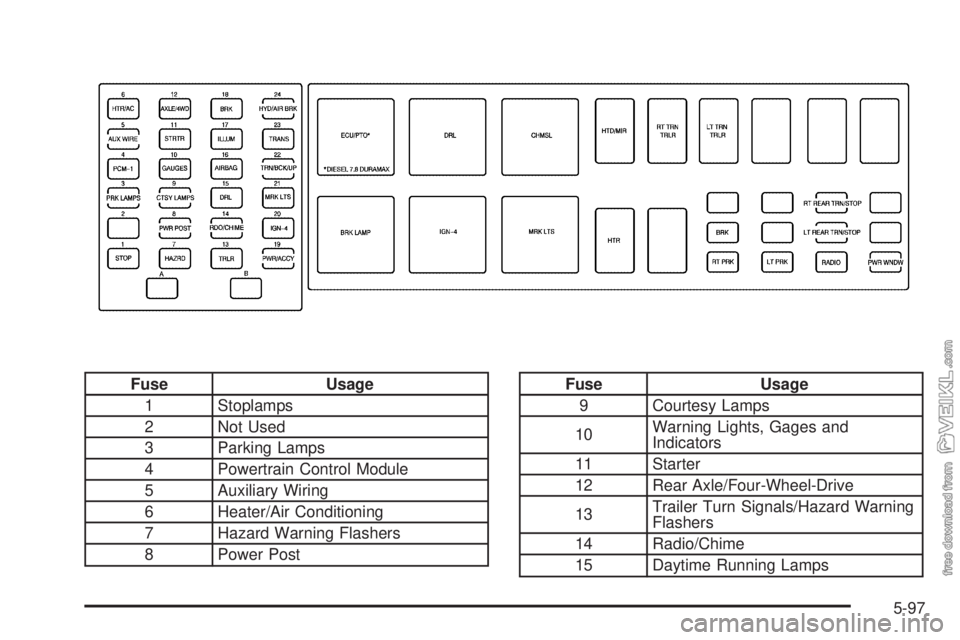
Fuse Usage
1 Stoplamps
2 Not Used
3 Parking Lamps
4 Powertrain Control Module
5 Auxiliary Wiring
6 Heater/Air Conditioning
7 Hazard Warning Flashers
8 Power PostFuse Usage
9 Courtesy Lamps
10Warning Lights, Gages and
Indicators
11 Starter
12 Rear Axle/Four-Wheel-Drive
13Trailer Turn Signals/Hazard Warning
Flashers
14 Radio/Chime
15 Daytime Running Lamps
5-97
Page 308 of 376
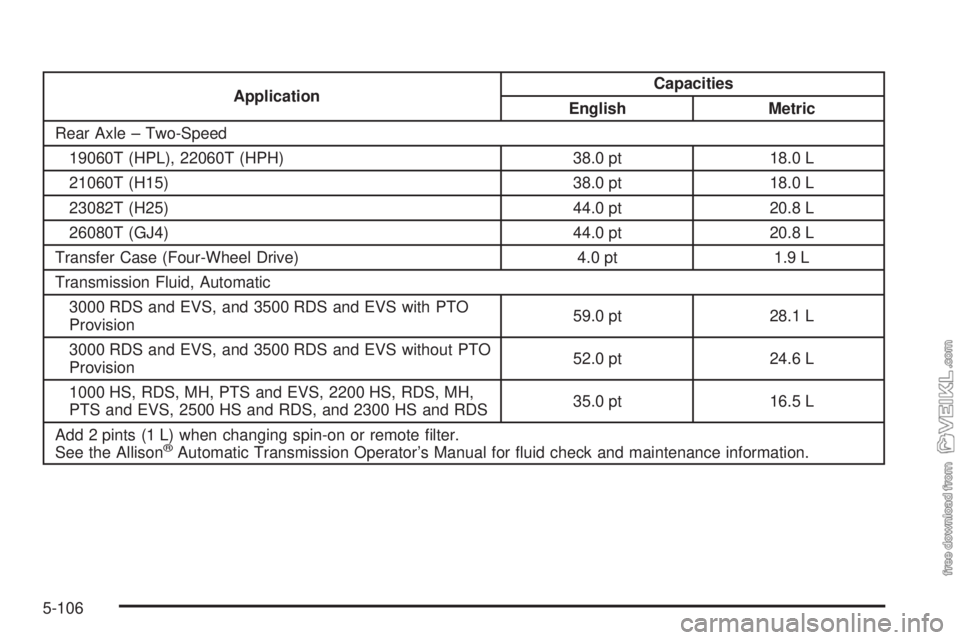
ApplicationCapacities
English Metric
Rear Axle – Two-Speed
19060T (HPL), 22060T (HPH) 38.0 pt 18.0 L
21060T (H15) 38.0 pt 18.0 L
23082T (H25) 44.0 pt 20.8 L
26080T (GJ4) 44.0 pt 20.8 L
Transfer Case (Four-Wheel Drive) 4.0 pt 1.9 L
Transmission Fluid, Automatic
3000 RDS and EVS, and 3500 RDS and EVS with PTO
Provision59.0 pt 28.1 L
3000 RDS and EVS, and 3500 RDS and EVS without PTO
Provision52.0 pt 24.6 L
1000 HS, RDS, MH, PTS and EVS, 2200 HS, RDS, MH,
PTS and EVS, 2500 HS and RDS, and 2300 HS and RDS35.0 pt 16.5 L
Add 2 pints (1 L) when changing spin-on or remote filter.
See the Allison
®Automatic Transmission Operator’s Manual for fluid check and maintenance information.
5-106
Page 319 of 376
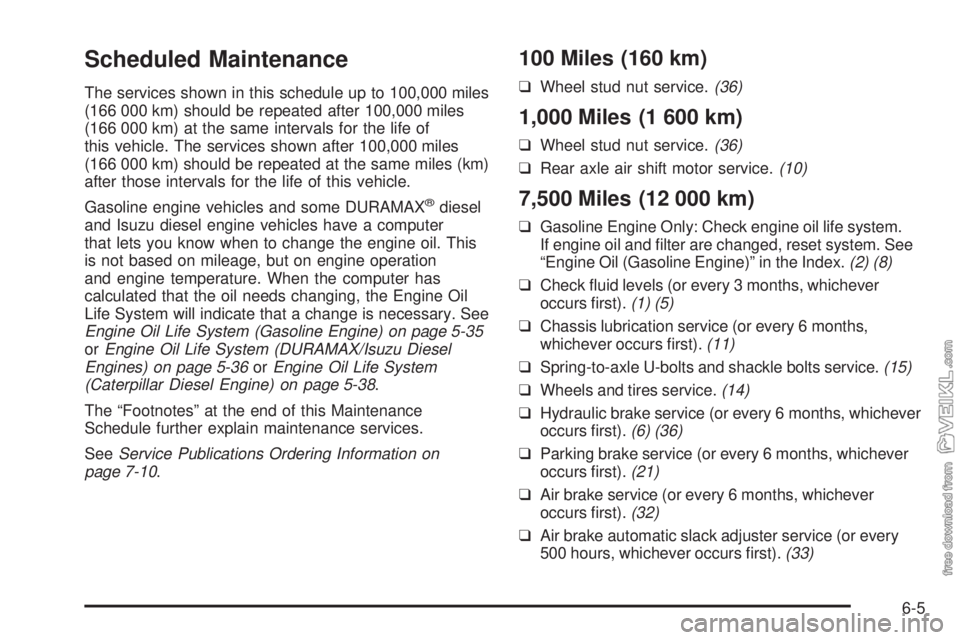
Scheduled Maintenance
The services shown in this schedule up to 100,000 miles
(166 000 km) should be repeated after 100,000 miles
(166 000 km) at the same intervals for the life of
this vehicle. The services shown after 100,000 miles
(166 000 km) should be repeated at the same miles (km)
after those intervals for the life of this vehicle.
Gasoline engine vehicles and some DURAMAX
®diesel
and Isuzu diesel engine vehicles have a computer
that lets you know when to change the engine oil. This
is not based on mileage, but on engine operation
and engine temperature. When the computer has
calculated that the oil needs changing, the Engine Oil
Life System will indicate that a change is necessary. See
Engine Oil Life System (Gasoline Engine) on page 5-35
orEngine Oil Life System (DURAMAX/Isuzu Diesel
Engines) on page 5-36orEngine Oil Life System
(Caterpillar Diesel Engine) on page 5-38.
The “Footnotes” at the end of this Maintenance
Schedule further explain maintenance services.
SeeService Publications Ordering Information on
page 7-10.
100 Miles (160 km)
❑Wheel stud nut service.(36)
1,000 Miles (1 600 km)
❑Wheel stud nut service.(36)
❑Rear axle air shift motor service.(10)
7,500 Miles (12 000 km)
❑Gasoline Engine Only: Check engine oil life system.
If engine oil and filter are changed, reset system. See
“Engine Oil (Gasoline Engine)” in the Index.(2) (8)
❑Check fluid levels (or every 3 months, whichever
occurs first).(1) (5)
❑Chassis lubrication service (or every 6 months,
whichever occurs first).(11)
❑Spring-to-axle U-bolts and shackle bolts service.(15)
❑Wheels and tires service.(14)
❑Hydraulic brake service (or every 6 months, whichever
occurs first).(6) (36)
❑Parking brake service (or every 6 months, whichever
occurs first).(21)
❑Air brake service (or every 6 months, whichever
occurs first).(32)
❑Air brake automatic slack adjuster service (or every
500 hours, whichever occurs first).(33)
6-5
Page 320 of 376

❑Check air brake relay valve operation and check for
leaks (or every month, or every 300 hours, whichever
occurs first).
❑Clean air brake application valve (or every 3 months,
or every 300 hours, whichever occurs first). Lubricate
linkage.
❑Air brake chamber service (or every 2 months,
whichever occurs first).(34)
15,000 Miles (24 000 km)
❑Gasoline Engine Only: Check engine oil life system.
If engine oil and filter are changed, reset system. See
“Engine Oil (Gasoline Engine)” in the Index.(2) (8)
❑DURAMAX/Isuzu Diesel Without Engine Oil Life
System Only: Change engine oil and filter (or every
12 months, or every 750 hours of engine operation,
whichever occurs first).(2) (39)
❑DURAMAX/Isuzu Diesel With Engine Oil Life System
Only: Check oil life system. If engine oil and filter are
changed, reset system. See “Engine Oil (DURAMAX/
Isuzu Diesel)” in the Index.(2) (9)
❑Chassis lubrication service (or every 6 months,
whichever occurs first).(11)
❑Check fluid levels (or every 3 months, whichever
occurs first).(1) (5)❑Gasoline Engine: Inspect engine air cleaner filter.
If necessary, replace the filter. If vehicle is driven in
dusty/dirty conditions, inspect filter at every engine oil
change. SeeEngine Air Cleaner/Filter on page 5-38
for more information.
❑Diesel Engine: Inspect engine air cleaner filter change
indicator. If necessary, replace the filter. If vehicle is
driven in dusty/dirty conditions, inspect filter change
indicator at every engine oil change. SeeEngine Air
Cleaner/Filter on page 5-38for more information.
❑Diesel Only: Replace fuel filter (or every 750 hours of
engine operation, whichever occurs first).
❑Steering system service.(12)
❑Front and rear suspension service.(13)
❑Spring-to-axle U-bolts and shackle bolts service.(15)
❑Exhaust system service (or every 6 months, whichever
occurs first).(2) (3) (16)
❑Wheels and tires service.(14)
❑Hydraulic brake service (or every 6 months, whichever
occurs first).(6) (36)
❑Parking brake service (or every 6 months, whichever
occurs first).(21)
6-6
Page 321 of 376

❑Air brake service (or every 6 months, whichever
occurs first).(32)
❑Air brake automatic slack adjuster service (or every
500 hours, whichever occurs first).(33)
❑Check air brake relay valve operation and check for
leaks (or every month, or every 300 hours, whichever
occurs first).
❑Clean air brake application valve (or every 3 months,
or every 300 hours, whichever occurs first). Lubricate
linkage.
❑Air brake chamber service (or every 2 months,
whichever occurs first).(34)
❑Air compressor dry element pleated paper air strainer
service (or every 2 months, or every 800 hours,
whichever occurs first).
❑Thermostatically controlled engine cooling fan
service.(3) (19)
❑Shields and underhood insulation service.(3) (4) (20)
❑Gasoline Engine: Air compressor remote mounted air
filter dry element pleated paper air strainer service (or
every 6 months or every 1800 hours, whichever
occurs first).22,500 Miles (36 000 km)
❑Gasoline Engine Only: Check engine oil life system. If
engine oil and filter are changed, reset system. See
“Engine Oil (Gasoline Engine)” in the Index.(2) (8)
❑Check fluid levels (or every 3 months, whichever
occurs first).(1) (5)
❑Chassis lubrication service (or every 6 months,
whichever occurs first).(11)
❑Inspect door hinge pins and bushings and replace as
necessary.
❑Cooling system service. Clean the cooling system filter
cap with clean water, clean the core, pressure test the
cap and the system for proper pressure capability, and
inspect condition of cooling and heater hoses and
clamps. Replace hoses if cracked, swollen, or
damaged.
❑Wheels and tires service.(14)
❑Hydraulic brake service (or every 6 months, whichever
occurs first).(6) (36)
❑Parking brake service (or every 6 months, whichever
occurs first).(21)
6-7
Page 323 of 376

❑Diesel Engine: Inspect engine air cleaner filter change
indicator. If necessary, replace the filter. If vehicle is
driven in dusty/dirty conditions, inspect filter change
indicator at every engine oil change. SeeEngine Air
Cleaner/Filter on page 5-38for more information.
❑Diesel Only: Replace fuel filter (or every 750 hours of
engine operation, whichever occurs first).
❑Chassis lubrication service (or every 6 months,
whichever occurs first).(11)
❑Gasoline Engine Only: Replace fuel filter(s) (or every
12 months, whichever occurs first).(2)
❑Check restraint system.(40)
❑Steering system service.(12)
❑Front and rear suspension service.(13)
❑Spring-to-axle U-bolts and shackle bolts service.(15)
❑Exhaust system service (or every 6 months, whichever
occurs first).(2) (3) (16)
❑Wheel bearing (grease type) service (and whenever
hubs are removed).(22) (36)
❑Wheels and tires service.(14)
❑Hydraulic brake service (or every 6 months, whichever
occurs first).(6) (36)
❑Parking brake service (or every 6 months, whichever
occurs first).(21)❑Air brake service (or every 6 months, whichever
occurs first).(32)
❑Air brake automatic slack adjuster service (or every
500 hours, whichever occurs first).(33)
❑Check air brake relay valve operation and check for
leaks (or every month, or every 300 hours, whichever
occurs first).
❑Clean air brake application valve (or every 3 months,
or every 300 hours, whichever occurs first). Lubricate
linkage.
❑Air brake chamber service (or every 2 months,
whichever occurs first).(34)
❑Air compressor dry element pleated paper air strainer
service (or every 2 months, or every 800 hours,
whichever occurs first).
❑C600, C700, and C800 Gasoline Engines Only:
Engine drive belts service (or every 12 months,
whichever occurs first.)(17)
❑Thermostatically controlled engine cooling fan
service.(3) (19)
❑Shields and underhood insulation service.(3) (4) (20)
❑Gasoline Engine: Air compressor remote mounted air
filter dry element pleated paper air strainer service (or
every 6 months or every 1800 hours, whichever
occurs first).
6-9
Page 324 of 376

37,500 Miles (60 000 km)
❑Gasoline Engine Only: Check engine oil life system. If
engine oil and filter are changed, reset system. See
“Engine Oil (Gasoline Engine)” in the Index.(2) (8)
❑Check fluid levels (or every 3 months, whichever
occurs first).(1) (5)
❑Chassis lubrication service (or every 6 months,
whichever occurs first).(11)
❑Wheels and tires service.(14)
❑Hydraulic brake service (or every 6 months, whichever
occurs first).(6) (36)
❑Parking brake service (or every 6 months, whichever
occurs first).(21)
❑Air brake service (or every 6 months, whichever
occurs first).(32)
❑Air brake automatic slack adjuster service (or every
500 hours, whichever occurs first).(33)
❑Check air brake relay valve operation and check for
leaks (or every month, or every 300 hours, whichever
occurs first).
❑Clean air brake application valve (or every 3 months,
or every 300 hours, whichever occurs first). Lubricate
linkage.
❑Air brake chamber service (or every 2 months,
whichever occurs first).(34)
45,000 Miles (72 000 km)
❑Gasoline Engine Only: Check engine oil life system.
If engine oil and filter are changed, reset system. See
“Engine Oil (Gasoline Engine)” in the Index.(2) (8)
❑DURAMAX/Isuzu Diesel Without Engine Oil Life
System Only: Change engine oil and filter (or every
12 months, or every 750 hours of engine operation,
whichever occurs first).(2) (39)
❑DURAMAX/Isuzu Diesel With Engine Oil Life System
Only: Check oil life system. If engine oil and filter are
changed, reset system. See “Engine Oil (DURAMAX/
Isuzu Diesel)” in the Index.(2) (9)
❑Check fluid levels (or every 3 months, whichever
occurs first).(1) (5)
❑Gasoline Engine: Replace engine air cleaner filter.
SeeEngine Air Cleaner/Filter on page 5-38for more
information.
❑Diesel Engine: Inspect engine air cleaner filter change
indicator. If necessary, replace the filter. If vehicle is
driven in dusty/dirty conditions, inspect filter change
indicator at every engine oil change. SeeEngine Air
Cleaner/Filter on page 5-38for more information.
❑Diesel Only: Replace fuel filter (or every 750 hours of
engine operation, whichever occurs first).
❑Chassis lubrication service (or every 6 months,
whichever occurs first).(11)
6-10