maintenance schedule CHEVROLET KODIAK 2009 Owners Manual
[x] Cancel search | Manufacturer: CHEVROLET, Model Year: 2009, Model line: KODIAK, Model: CHEVROLET KODIAK 2009Pages: 376, PDF Size: 5.39 MB
Page 1 of 376
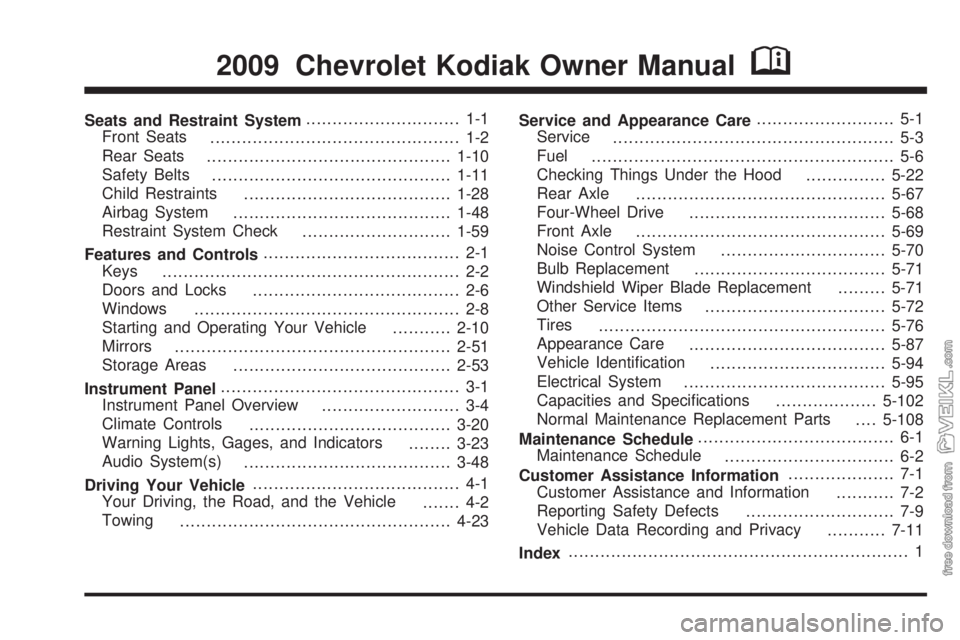
Seats and Restraint System............................. 1-1
Front Seats
............................................... 1-2
Rear Seats
..............................................1-10
Safety Belts
.............................................1-11
Child Restraints
.......................................1-28
Airbag System
.........................................1-48
Restraint System Check
............................1-59
Features and Controls..................................... 2-1
Keys
........................................................ 2-2
Doors and Locks
....................................... 2-6
Windows
.................................................. 2-8
Starting and Operating Your Vehicle
...........2-10
Mirrors
....................................................2-51
Storage Areas
.........................................2-53
Instrument Panel............................................. 3-1
Instrument Panel Overview
.......................... 3-4
Climate Controls
......................................3-20
Warning Lights, Gages, and Indicators
........3-23
Audio System(s)
.......................................3-48
Driving Your Vehicle....................................... 4-1
Your Driving, the Road, and the Vehicle
....... 4-2
Towing
...................................................4-23Service and Appearance Care.......................... 5-1
Service
..................................................... 5-3
Fuel
......................................................... 5-6
Checking Things Under the Hood
...............5-22
Rear Axle
...............................................5-67
Four-Wheel Drive
.....................................5-68
Front Axle
...............................................5-69
Noise Control System
...............................5-70
Bulb Replacement
....................................5-71
Windshield Wiper Blade Replacement
.........5-71
Other Service Items
..................................5-72
Tires
......................................................5-76
Appearance Care
.....................................5-87
Vehicle Identification
.................................5-94
Electrical System
......................................5-95
Capacities and Specifications
...................5-102
Normal Maintenance Replacement Parts
....5-108
Maintenance Schedule..................................... 6-1
Maintenance Schedule
................................ 6-2
Customer Assistance Information.................... 7-1
Customer Assistance and Information
........... 7-2
Reporting Safety Defects
............................ 7-9
Vehicle Data Recording and Privacy
...........7-11
Index................................................................ 1
2009 Chevrolet Kodiak Owner ManualM
Page 63 of 376
Q:Because I have a disability, I have to get my
vehicle modified. How can I find out whether
this will affect my airbag system?
A:If you have questions, call Customer Assistance.
The phone numbers and addresses for Customer
Assistance are in Step Two of the Customer
Satisfaction Procedure in this manual. See
Customer Satisfaction Procedure on page 7-2.
In addition, your dealer/retailer and the service manual
have information about the location of the airbag sensors,
sensing and diagnostic module and airbag wiring.
Restraint System Check
Checking the Restraint Systems
Safety Belts
Now and then, check the safety belt reminder light,
safety belts, buckles, latch plates, retractors, and
anchorages are all working properly.
Look for any other loose or damaged safety belt system
parts that might keep a safety belt system from doing
its job. See your dealer/retailer to have it repaired.Torn or frayed safety belts may not protect you in a
crash. They can rip apart under impact forces. If a belt
is torn or frayed, get a new one right away.
Make sure the safety belt reminder light is working. See
Safety Belt Reminders on page 3-26for more
information.
Keep safety belts clean and dry. SeeCare of Safety
Belts on page 5-89.
Airbags
The airbag system does not need regularly scheduled
maintenance or replacement. Make sure the airbag
readiness light is working. SeeAirbag Readiness Light
on page 3-27for more information.
Notice:If an airbag covering is damaged, opened,
or broken, the airbag may not work properly. Do
not open or break the airbag coverings. If there are
any opened or broken airbag covers, have the
airbag covering and/or airbag module replaced. For
the location of the airbag modules, seeWhat
Makes an Airbag Inflate? on page 1-53. See your
dealer/retailer for service.
1-59
Page 104 of 376
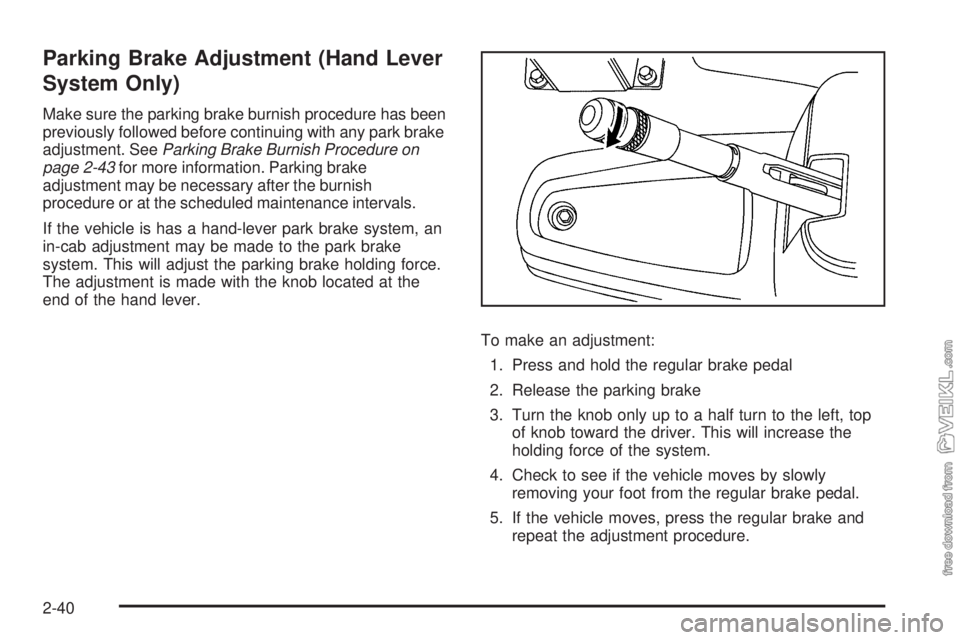
Parking Brake Adjustment (Hand Lever
System Only)
Make sure the parking brake burnish procedure has been
previously followed before continuing with any park brake
adjustment. SeeParking Brake Burnish Procedure on
page 2-43for more information. Parking brake
adjustment may be necessary after the burnish
procedure or at the scheduled maintenance intervals.
If the vehicle is has a hand-lever park brake system, an
in-cab adjustment may be made to the park brake
system. This will adjust the parking brake holding force.
The adjustment is made with the knob located at the
end of the hand lever.
To make an adjustment:
1. Press and hold the regular brake pedal
2. Release the parking brake
3. Turn the knob only up to a half turn to the left, top
of knob toward the driver. This will increase the
holding force of the system.
4. Check to see if the vehicle moves by slowly
removing your foot from the regular brake pedal.
5. If the vehicle moves, press the regular brake and
repeat the adjustment procedure.
2-40
Page 105 of 376
Notice:Over-tightening the park brake lever can
cause damage to the park brake system.
Over-tightening is possible by turning the knob
more than half a turn.
Over-tightening is similar to driving down the road with
your regular brakes applied. If the park brake system
is over-tightened the vehicle may seem sluggish
to accelerate, and/or the park brake hand lever maybe
very hard to pull up and apply the park brake.
If the park brake is over-tightened turn the knob to the
right until it stops and follow the parking brake
adjustment procedure.
Vehicles with a foot-pedal park brake system must be
serviced to make this adjustment. SeeScheduled
Maintenance on page 6-5for more information.Parking Brake (With Air Brakes)
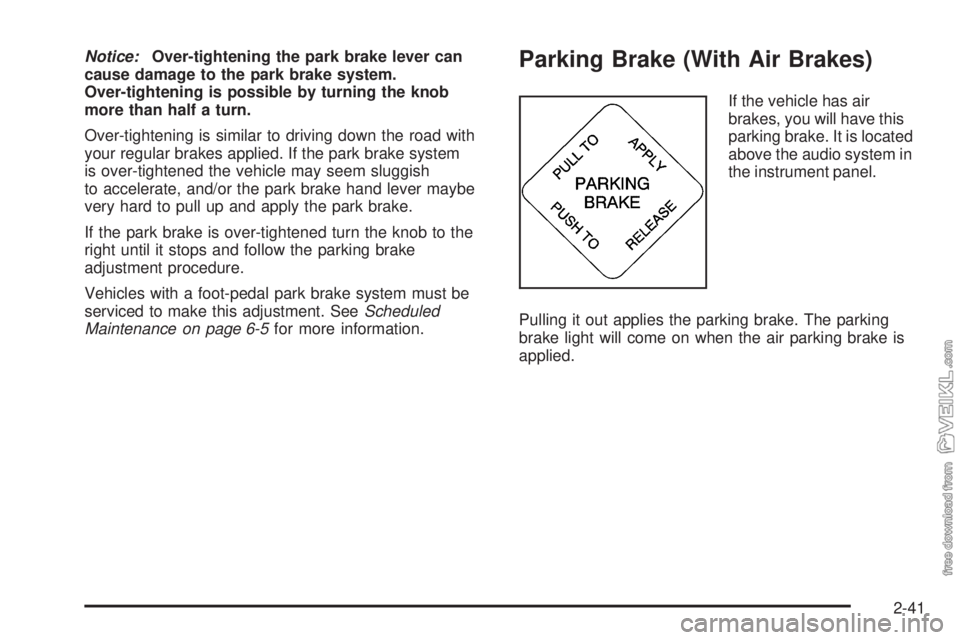
If the vehicle has air
brakes, you will have this
parking brake. It is located
above the audio system in
the instrument panel.
Pulling it out applies the parking brake. The parking
brake light will come on when the air parking brake is
applied.
2-41
Page 156 of 376
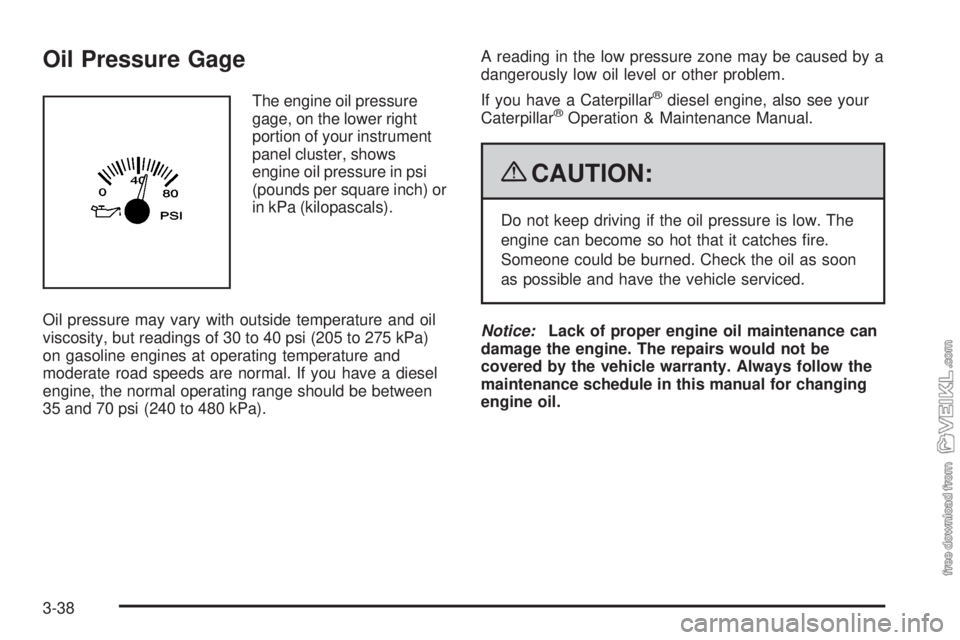
Oil Pressure Gage
The engine oil pressure
gage, on the lower right
portion of your instrument
panel cluster, shows
engine oil pressure in psi
(pounds per square inch) or
in kPa (kilopascals).
Oil pressure may vary with outside temperature and oil
viscosity, but readings of 30 to 40 psi (205 to 275 kPa)
on gasoline engines at operating temperature and
moderate road speeds are normal. If you have a diesel
engine, the normal operating range should be between
35 and 70 psi (240 to 480 kPa).A reading in the low pressure zone may be caused by a
dangerously low oil level or other problem.
If you have a Caterpillar®diesel engine, also see your
Caterpillar®Operation & Maintenance Manual.
{CAUTION:
Do not keep driving if the oil pressure is low. The
engine can become so hot that it catches fire.
Someone could be burned. Check the oil as soon
as possible and have the vehicle serviced.
Notice:Lack of proper engine oil maintenance can
damage the engine. The repairs would not be
covered by the vehicle warranty. Always follow the
maintenance schedule in this manual for changing
engine oil.
3-38
Page 157 of 376
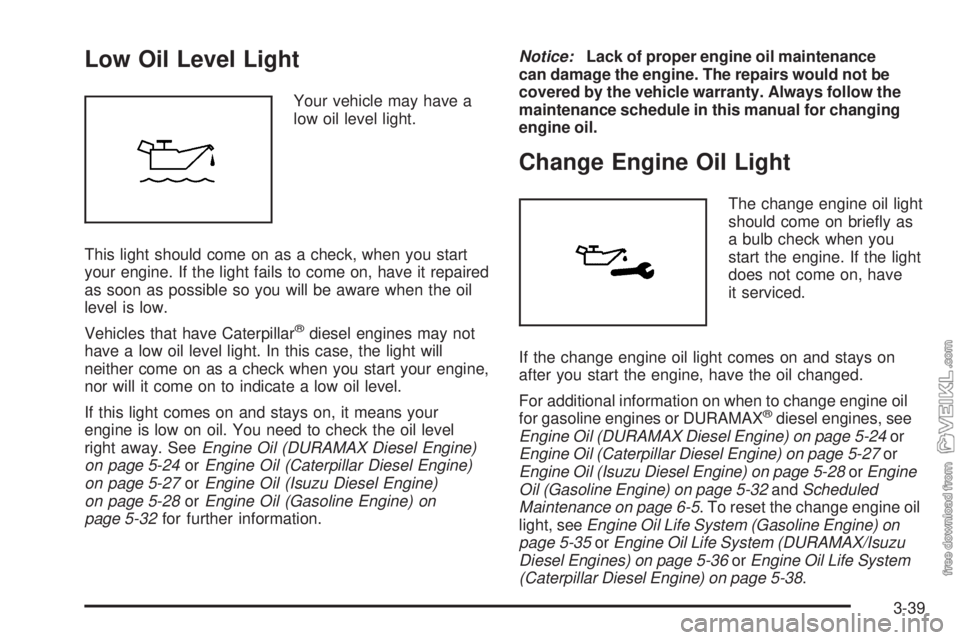
Low Oil Level Light
Your vehicle may have a
low oil level light.
This light should come on as a check, when you start
your engine. If the light fails to come on, have it repaired
as soon as possible so you will be aware when the oil
level is low.
Vehicles that have Caterpillar
®diesel engines may not
have a low oil level light. In this case, the light will
neither come on as a check when you start your engine,
nor will it come on to indicate a low oil level.
If this light comes on and stays on, it means your
engine is low on oil. You need to check the oil level
right away. SeeEngine Oil (DURAMAX Diesel Engine)
on page 5-24orEngine Oil (Caterpillar Diesel Engine)
on page 5-27orEngine Oil (Isuzu Diesel Engine)
on page 5-28orEngine Oil (Gasoline Engine) on
page 5-32for further information.Notice:Lack of proper engine oil maintenance
can damage the engine. The repairs would not be
covered by the vehicle warranty. Always follow the
maintenance schedule in this manual for changing
engine oil.
Change Engine Oil Light
The change engine oil light
should come on briefly as
a bulb check when you
start the engine. If the light
does not come on, have
it serviced.
If the change engine oil light comes on and stays on
after you start the engine, have the oil changed.
For additional information on when to change engine oil
for gasoline engines or DURAMAX
®diesel engines, see
Engine Oil (DURAMAX Diesel Engine) on page 5-24or
Engine Oil (Caterpillar Diesel Engine) on page 5-27or
Engine Oil (Isuzu Diesel Engine) on page 5-28orEngine
Oil (Gasoline Engine) on page 5-32andScheduled
Maintenance on page 6-5. To reset the change engine oil
light, seeEngine Oil Life System (Gasoline Engine) on
page 5-35orEngine Oil Life System (DURAMAX/Isuzu
Diesel Engines) on page 5-36orEngine Oil Life System
(Caterpillar Diesel Engine) on page 5-38.
3-39
Page 178 of 376
Your Driving, the Road, and
the Vehicle
Driving for Better Fuel Economy
Driving habits can affect fuel mileage. Here are some
driving tips to get the best fuel economy possible.
•Avoid fast starts and accelerate smoothly.
•Brake gradually and avoid abrupt stops.
•Avoid idling the engine for long periods of time.
•When road and weather conditions are appropriate,
use cruise control, if equipped.
•Always follow posted speed limits or drive more
slowly when conditions require.
•Keep vehicle tires properly inflated.
•Combine several trips into a single trip.
•Replace the vehicle’s tires with the same TPC Spec
number molded into the tire’s sidewall near the size.
•Follow recommended scheduled maintenance.
Defensive Driving
Defensive driving means “always expect the
unexpected.” The first step in driving defensively is to
wear your safety belt — SeeSafety Belts: They Are for
Everyone on page 1-11.
{CAUTION:
Assume that other road users (pedestrians,
bicyclists, and other drivers) are going to be
careless and make mistakes. Anticipate what they
might do and be ready. In addition:
•Allow enough following distance between you
and the driver in front of you.
•Focus on the task of driving.
Driver distraction can cause collisions resulting in
injury or possible death. These simple defensive
driving techniques could save your life.
4-2
Page 229 of 376
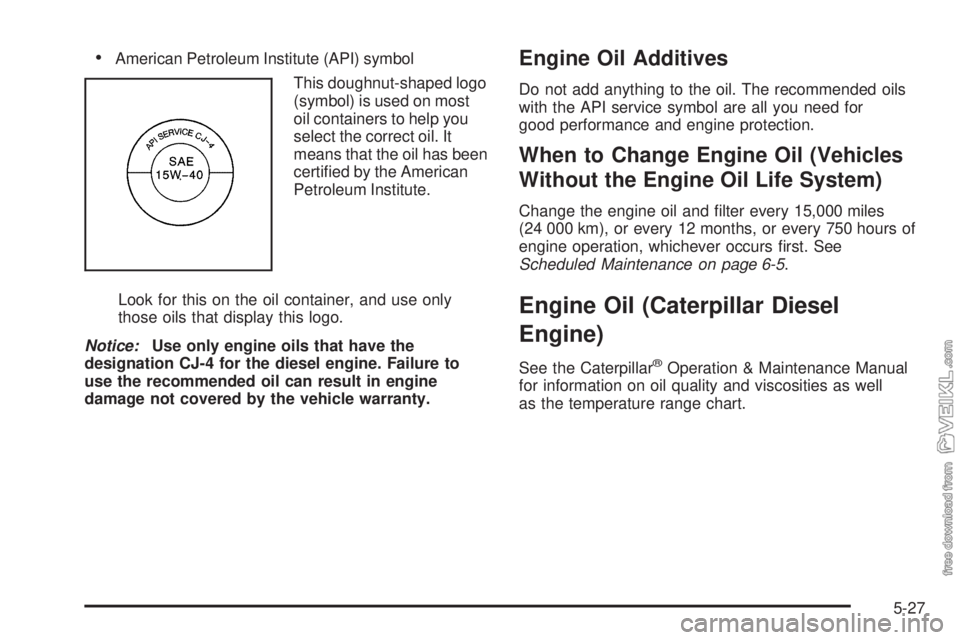
•American Petroleum Institute (API) symbol
This doughnut-shaped logo
(symbol) is used on most
oil containers to help you
select the correct oil. It
means that the oil has been
certified by the American
Petroleum Institute.
Look for this on the oil container, and use only
those oils that display this logo.
Notice:Use only engine oils that have the
designation CJ-4 for the diesel engine. Failure to
use the recommended oil can result in engine
damage not covered by the vehicle warranty.Engine Oil Additives
Do not add anything to the oil. The recommended oils
with the API service symbol are all you need for
good performance and engine protection.
When to Change Engine Oil (Vehicles
Without the Engine Oil Life System)
Change the engine oil and filter every 15,000 miles
(24 000 km), or every 12 months, or every 750 hours of
engine operation, whichever occurs first. See
Scheduled Maintenance on page 6-5.
Engine Oil (Caterpillar Diesel
Engine)
See the Caterpillar®Operation & Maintenance Manual
for information on oil quality and viscosities as well
as the temperature range chart.
5-27
Page 233 of 376
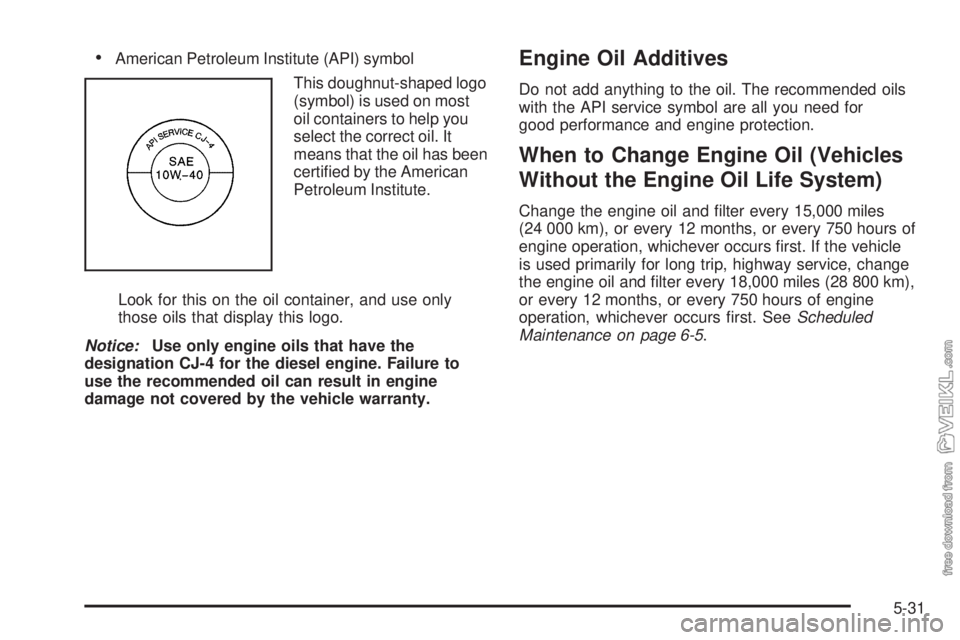
•American Petroleum Institute (API) symbol
This doughnut-shaped logo
(symbol) is used on most
oil containers to help you
select the correct oil. It
means that the oil has been
certified by the American
Petroleum Institute.
Look for this on the oil container, and use only
those oils that display this logo.
Notice:Use only engine oils that have the
designation CJ-4 for the diesel engine. Failure to
use the recommended oil can result in engine
damage not covered by the vehicle warranty.Engine Oil Additives
Do not add anything to the oil. The recommended oils
with the API service symbol are all you need for
good performance and engine protection.
When to Change Engine Oil (Vehicles
Without the Engine Oil Life System)
Change the engine oil and filter every 15,000 miles
(24 000 km), or every 12 months, or every 750 hours of
engine operation, whichever occurs first. If the vehicle
is used primarily for long trip, highway service, change
the engine oil and filter every 18,000 miles (28 800 km),
or every 12 months, or every 750 hours of engine
operation, whichever occurs first. SeeScheduled
Maintenance on page 6-5.
5-31
Page 244 of 376
Automatic Transmission Fluid
When to Check
A good time to check your automatic transmission fluid
level is when the engine oil is checked. See your
Allison Automatic Transmission Operator’s Manual to
find out when to change your transmission fluid
and filters.
How to Check and What to Use
The Allison Automatic Transmission Operator’s Manual
that came with the vehicle shows how to check the
automatic transmission fluid and what fluid to use.
Automatic Transmission External Filter
Your automatic transmission filter requires periodic
replacement.
Consult the Allison Automatic Transmission Operator’s
Manual that came with the vehicle for proper change
intervals.
Manual Transmission Fluid
When to Check
A good time to have it checked is when the engine oil is
checked. Refer to the Maintenance Schedule to find out
when to check and change your manual transmission
fluid. SeeScheduled Maintenance on page 6-5.
How to Check and What to Use
Check the fluid level only when your engine is off, the
vehicle is parked on a level place, and the transmission
is cool enough for you to rest your fingers on the
transmission case.
To check the transmission fluid level, do the following:
1. Remove the filler plug.
2. Check to be sure that the lubricant level is up
to the bottom of the fill opening. On heavy duty
transmissions, an inch of oil level equals about
one gallon of fluid.
3. If the fluid level is good, reinstall the plug and be
sure it is fully seated. If the fluid level is low, add
more fluid as described in the next steps. Refer to
the Maintenance Schedule to determine what
kind of fluid to use. SeePart C: Recommended
Fluids and Lubricants on page 6-31.
5-42