maintenance CHEVROLET OPTRA 5 2007 1.G User Guide
[x] Cancel search | Manufacturer: CHEVROLET, Model Year: 2007, Model line: OPTRA 5, Model: CHEVROLET OPTRA 5 2007 1.GPages: 422, PDF Size: 2.39 MB
Page 265 of 422
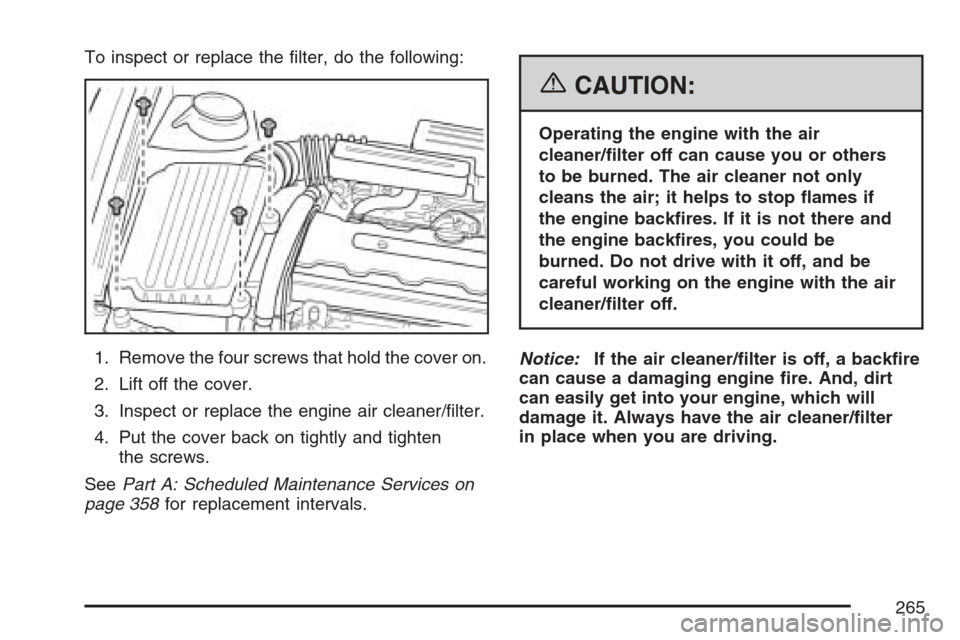
To inspect or replace the filter, do the following:
1. Remove the four screws that hold the cover on.
2. Lift off the cover.
3. Inspect or replace the engine air cleaner/filter.
4. Put the cover back on tightly and tighten
the screws.
SeePart A: Scheduled Maintenance Services on
page 358for replacement intervals.
{CAUTION:
Operating the engine with the air
cleaner/lter off can cause you or others
to be burned. The air cleaner not only
cleans the air; it helps to stop ames if
the engine backres. If it is not there and
the engine backres, you could be
burned. Do not drive with it off, and be
careful working on the engine with the air
cleaner/lter off.
Notice:If the air cleaner/lter is off, a backre
can cause a damaging engine re. And, dirt
can easily get into your engine, which will
damage it. Always have the air cleaner/lter
in place when you are driving.
265
Page 267 of 422
It is not necessary to regularly check the fluid
unless you suspect there is a leak in the system.
Adding fluid will not correct a leak.
A fluid loss in this system could indicate a
problem. Have the system inspected and repaired.
When to Check and What to Use
Refer to the Maintenance Schedule to determine
how often you should check the fluid level in
your master cylinder reservoir and for the proper
fluid. SeePart B: Owner Checks and Services
on page 374andPart D: Recommended Fluids
and Lubricants on page 382.
How to Check and Add Fluid
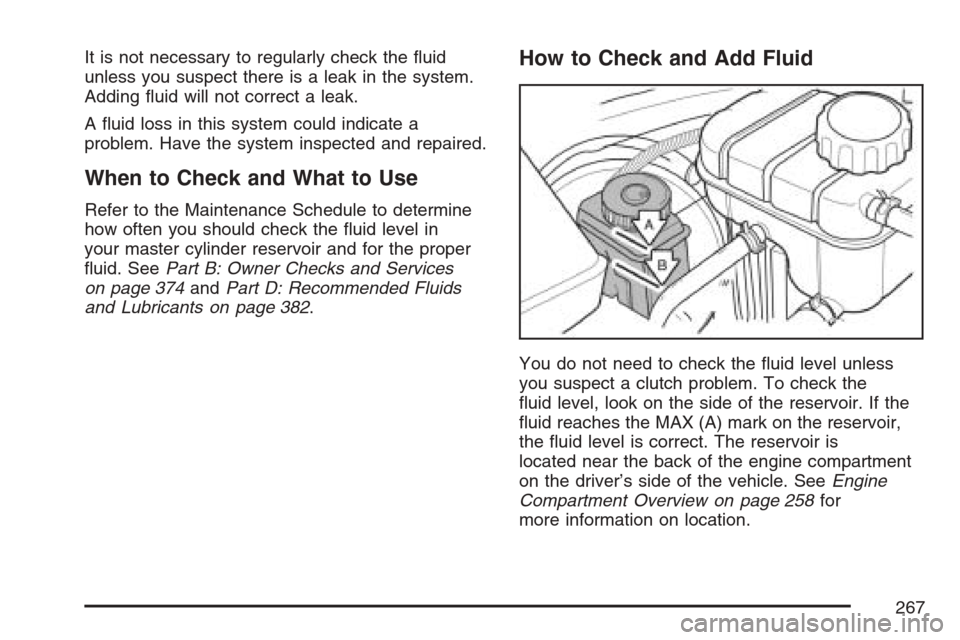
You do not need to check the fluid level unless
you suspect a clutch problem. To check the
fluid level, look on the side of the reservoir. If the
fluid reaches the MAX (A) mark on the reservoir,
the fluid level is correct. The reservoir is
located near the back of the engine compartment
on the driver’s side of the vehicle. SeeEngine
Compartment Overview on page 258for
more information on location.
267
Page 268 of 422
Engine Coolant
The cooling system in your vehicle is filled with
DEX-COOL®engine coolant. This coolant is
designed to remain in your vehicle for five years
or 150,000 miles (240 000 km), whichever
occurs first, if you add only DEX-COOL
®extended
life coolant.
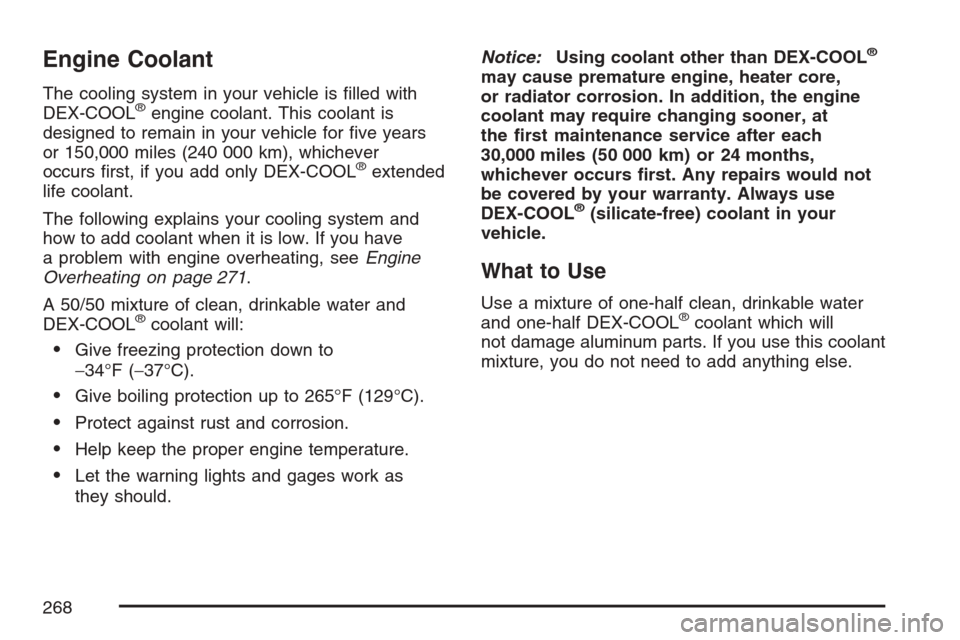
The following explains your cooling system and
how to add coolant when it is low. If you have
a problem with engine overheating, seeEngine
Overheating on page 271.
A 50/50 mixture of clean, drinkable water and
DEX-COOL
®coolant will:
•Give freezing protection down to
−34°F (−37°C).
•Give boiling protection up to 265°F (129°C).
•Protect against rust and corrosion.
•Help keep the proper engine temperature.
•Let the warning lights and gages work as
they should.Notice:Using coolant other than DEX-COOL
®
may cause premature engine, heater core,
or radiator corrosion. In addition, the engine
coolant may require changing sooner, at
the rst maintenance service after each
30,000 miles (50 000 km) or 24 months,
whichever occurs rst. Any repairs would not
be covered by your warranty. Always use
DEX-COOL
®(silicate-free) coolant in your
vehicle.
What to Use
Use a mixture of one-half clean, drinkable water
and one-half DEX-COOL®coolant which will
not damage aluminum parts. If you use this coolant
mixture, you do not need to add anything else.
268
Page 284 of 422
Replacing Brake System Parts
The braking system on a vehicle is complex.
Its many parts have to be of top quality and work
well together if the vehicle is to have really
good braking. Your vehicle was designed and
tested with top-quality GM brake parts. When you
replace parts of the braking system — for
example, when the brake linings wear down and
you need new ones put in — be sure you get new
approved GM replacement parts. If you do not,
the brakes might not work properly. For example,
if someone puts in brake linings that are wrong
for your vehicle, the balance between the front
and rear brakes can change — for the worse.
The braking performance you have come to expect
can change in many other ways if someone
puts in the wrong replacement brake parts.
Battery
Your vehicle has a maintenance free battery.
When it is time for a new battery, get one that has
the replacement number shown on the original
battery’s label. SeeEngine Compartment Overview
on page 258for battery location.Warning:Battery posts, terminals, and related
accessories contain lead and lead compounds,
chemicals known to the State of California
to cause cancer and reproductive harm.
Wash hands after handling.
Vehicle Storage
If you are not going to drive your vehicle for
25 days or more, remove the black, negative (−)
cable from the battery. This will help keep
your battery from running down.
{CAUTION:
Batteries have acid that can burn you and
gas that can explode. You can be badly
hurt if you are not careful. SeeJump
Starting on page 285for tips on working
around a battery without getting hurt.
284
Page 302 of 422
Windshield Wiper Blade
Replacement
Windshield wiper blades should be inspected for
wear or cracking. See “Wiper Blade Check”
for more information.
Replacement blades come in different types and
are removed in different ways. For the proper type,
seeNormal Maintenance Replacement Parts on
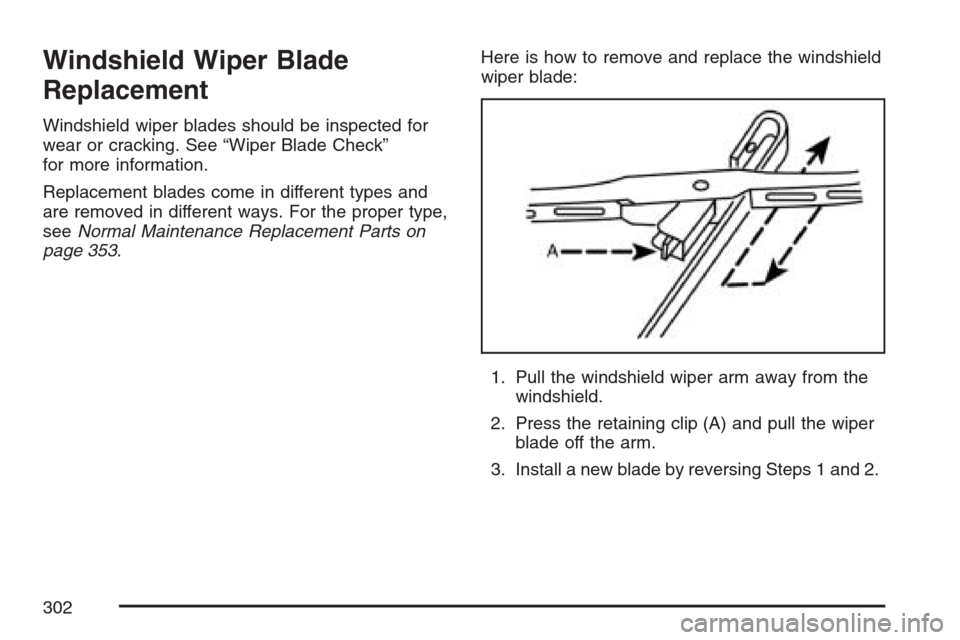
page 353.Here is how to remove and replace the windshield
wiper blade:
1. Pull the windshield wiper arm away from the
windshield.
2. Press the retaining clip (A) and pull the wiper
blade off the arm.
3. Install a new blade by reversing Steps 1 and 2.
302
Page 313 of 422
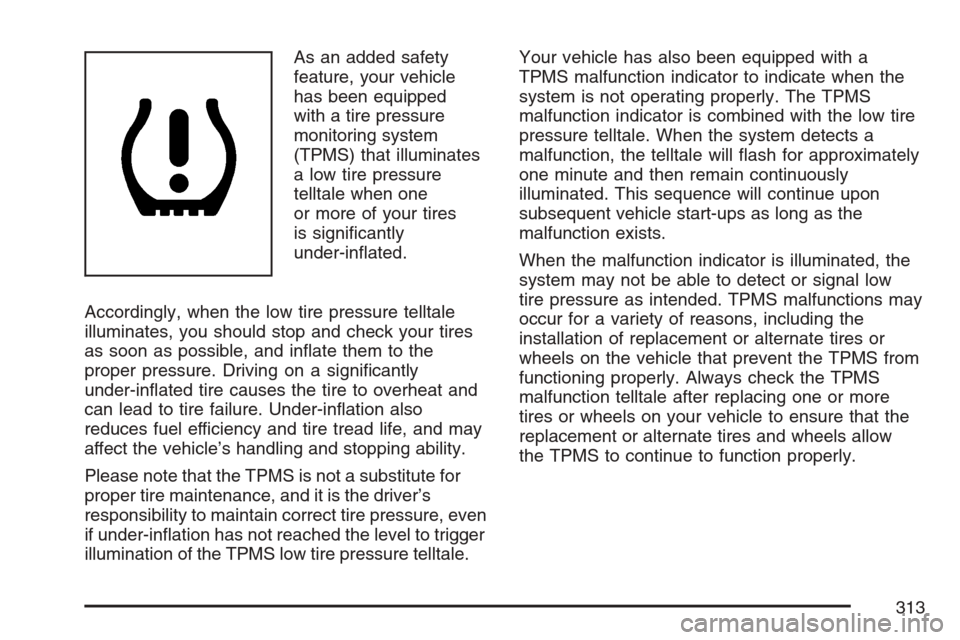
As an added safety
feature, your vehicle
has been equipped
with a tire pressure
monitoring system
(TPMS) that illuminates
a low tire pressure
telltale when one
or more of your tires
is significantly
under-inflated.
Accordingly, when the low tire pressure telltale
illuminates, you should stop and check your tires
as soon as possible, and inflate them to the
proper pressure. Driving on a significantly
under-inflated tire causes the tire to overheat and
can lead to tire failure. Under-inflation also
reduces fuel efficiency and tire tread life, and may
affect the vehicle’s handling and stopping ability.
Please note that the TPMS is not a substitute for
proper tire maintenance, and it is the driver’s
responsibility to maintain correct tire pressure, even
if under-inflation has not reached the level to trigger
illumination of the TPMS low tire pressure telltale.Your vehicle has also been equipped with a
TPMS malfunction indicator to indicate when the
system is not operating properly. The TPMS
malfunction indicator is combined with the low tire
pressure telltale. When the system detects a
malfunction, the telltale will flash for approximately
one minute and then remain continuously
illuminated. This sequence will continue upon
subsequent vehicle start-ups as long as the
malfunction exists.
When the malfunction indicator is illuminated, the
system may not be able to detect or signal low
tire pressure as intended. TPMS malfunctions may
occur for a variety of reasons, including the
installation of replacement or alternate tires or
wheels on the vehicle that prevent the TPMS from
functioning properly. Always check the TPMS
malfunction telltale after replacing one or more
tires or wheels on your vehicle to ensure that the
replacement or alternate tires and wheels allow
the TPMS to continue to function properly.
313
Page 314 of 422
When a low tire pressure condition is detected,
the TPMS illuminates the low tire pressure warning
symbol on the instrument panel cluster.
The low tire pressure warning symbol comes on at
each ignition cycle until the tires are inflated to
the correct inflation pressure.
The tire pressure warning light may come on in
cool weather when the vehicle is first started, and
then turn off as you start to drive. This could
be an early indicator that the tire pressures are
getting low and need to be inflated to the
proper pressure.
A Tire and Loading Information label, attached to
your vehicle, shows the size of your vehicle’s
original equipment tires and the correct inflation
pressure for your vehicle’s tires when they
are cold. SeeLoading Your Vehicle on page 236,
for an example of the tire information label and
its location on your vehicle. Also seeInflation - Tire
Pressure on page 311.Your vehicle’s TPMS system can warn you about
a low tire pressure condition but it does not
replace normal tire maintenance. SeeTire
Inspection and Rotation on page 316andTires
on page 303.
Notice:Do not use a tire sealant if your
vehicle has Tire Pressure Monitors. The liquid
sealant can damage the tire pressure monitor
sensors.
The TPMS will not function properly if one or more
of the TPMS sensors are missing or inoperable.
See your dealer for service if all TPMS sensors are
installed and the low tire pressure warning light
comes on and stays on.
314
Page 316 of 422
Tire Inspection and Rotation
Tires should be rotated every 5,000 to 8,000 miles
(8 000 to 13 000 km).
Any time you notice unusual wear, rotate your
tires as soon as possible and check wheel
alignment. Also check for damaged tires or wheels.
SeeWhen It Is Time for New Tires on page 317
andWheel Replacement on page 322for
more information.
The purpose of regular rotation is to achieve more
uniform wear for all tires on the vehicle. The
first rotation is the most important. SeePart A:
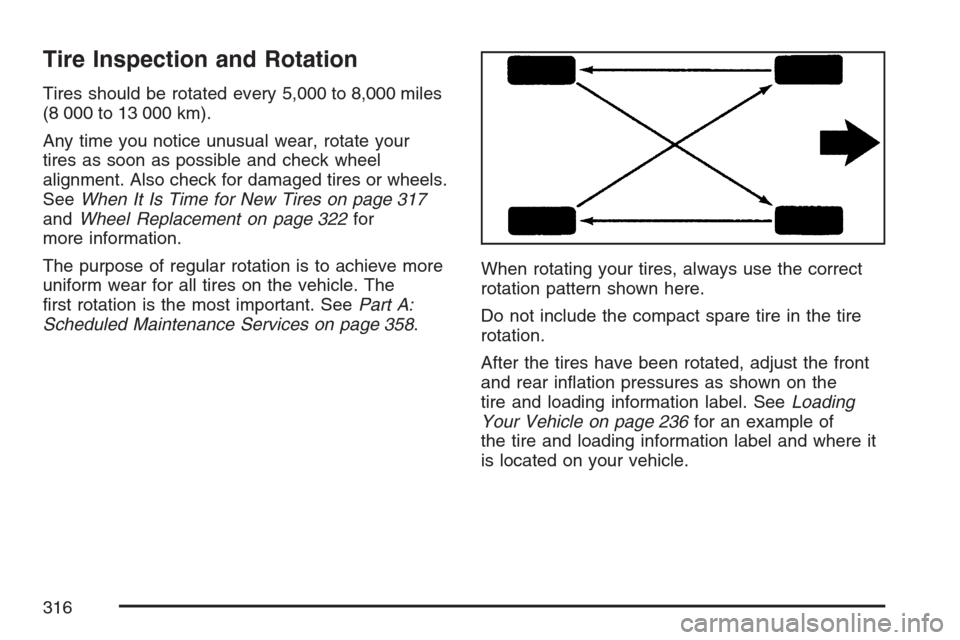
Scheduled Maintenance Services on page 358.When rotating your tires, always use the correct
rotation pattern shown here.
Do not include the compact spare tire in the tire
rotation.
After the tires have been rotated, adjust the front
and rear inflation pressures as shown on the
tire and loading information label. SeeLoading
Your Vehicle on page 236for an example of
the tire and loading information label and where it
is located on your vehicle.
316
Page 324 of 422
If a Tire Goes Flat
It is unusual for a tire to blowout while you are
driving, especially if you maintain your vehicle’s
tires properly. If air goes out of a tire, it is
much more likely to leak out slowly. But if you
should ever have a blowout, here are a few tips
about what to expect and what to do:
If a front tire fails, the flat tire will create a drag
that pulls the vehicle toward that side. Take your
foot off the accelerator pedal and grip the
steering wheel firmly. Steer to maintain lane
position, and then gently brake to a stop well out
of the traffic lane.
A rear blowout, particularly on a curve, acts much
like a skid and may require the same correction
you would use in a skid. In any rear blowout
remove your foot from the accelerator pedal. Get
the vehicle under control by steering the way
you want the vehicle to go. It may be very bumpy
and noisy, but you can still steer. Gently brake
to a stop, well off the road if possible.{CAUTION:
Lifting a vehicle and getting under it to do
maintenance or repairs is dangerous
without the appropriate safety equipment
and training. The jack provided with your
vehicle is designed only for changing a
at tire. If it is used for anything else, you
or others could be badly injured or killed
if the vehicle slips off the jack. Use the
jack provided with your vehicle only for
changing a at tire.
If a tire goes flat, the next part shows how to use the
jacking equipment to change a flat tire safely.
Changing a Flat Tire
If a tire goes flat, avoid further tire and wheel
damage by driving slowly to a level place.
Turn on your hazard warning flashers.
324
Page 342 of 422
Tires
To clean the tires, use a stiff brush with tire
cleaner.
Notice:Using petroleum-based tire dressing
products on your vehicle may damage the
paint nish and/or tires. When applying a tire
dressing, always wipe off any overspray
from all painted surfaces on your vehicle.
Sheet Metal Damage
If the vehicle is damaged and requires sheet metal
repair or replacement, make sure the body
repair shop applies anti-corrosion material to parts
repaired or replaced to restore corrosion
protection.
Original manufacturer replacement parts will
provide the corrosion protection while maintaining
the warranty.
Finish Damage
Any stone chips, fractures or deep scratches in
the finish should be repaired right away. Bare
metal will corrode quickly and may develop into
major repair expense.
Minor chips and scratches can be repaired with
touch-up materials available from your dealer.
Larger areas of finish damage can be corrected in
your dealer’s body and paint shop.
Underbody Maintenance
Chemicals used for ice and snow removal and
dust control can collect on the underbody. If these
are not removed, corrosion and rust can develop
on the underbody parts such as fuel lines, frame,
floor pan, and exhaust system even though
they have corrosion protection.
342