engine CHEVROLET TRACKER 1994 Owner's Guide
[x] Cancel search | Manufacturer: CHEVROLET, Model Year: 1994, Model line: TRACKER, Model: CHEVROLET TRACKER 1994Pages: 258, PDF Size: 14.43 MB
Page 126 of 258

Towing a Trailer
NOTICE:
Pulling a trailer improperly can dam-
age your vehicle and result in costly
repairs not covered by your warranty,
To pull a trailer correctly, follow the
advice in this section, and see your
Geo dealer for important information
about towing a trailer with your
vehicle. Your
vehicle can tow a trailer. To identify
what the vehicle trailering capacity
is for
your vehicle,
you should read the
information in “Weight
of the Trailer” that
appears later in this section.
But trailering
is different than just driving your vehicle
by itself. Trailering means changes in
handling, durability, and fuel economy.
Successful, safe trailering takes correct
equipment, and it has to be used properly.
That’s the reason for this section.
In it are
many time-tested, important trailering
tips and safety rules. Many of these are
important for your safety and that of your
passengers.
So please read this section
carefully before you pull a trailer.
Load-pulling components such as the
engine, transmission, wheel assemblies,
and tires are forced to work harder against
the drag of the added weight. The engine
is required to operate at relatively higher
speeds and under greater loads,
generating extra heat. What’s more, the
trailer adds considerably to wind
resistance, increasing the pulling
requirements.
If You Do Decide to Pull a Trailer
If you do, here are some important points.
There are many different laws having
to do with trailering. Make sure your
rig will be legal, not only where you
live but also where you’ll be driving.
A good source for this information
can be state or provincial police.
Consider using a sway control. You
can ask a hitch dealer about sway
controls.
Don’t tow a trailer at all during the
first
500 miles (800 km) your new
vehicle is driven. Your engine, axle or
other parts could be damaged.
Then, during the first
500 miles (800
km) that you tow a trailer, don’t drive
over
50 mph (80 km/h) and don’t
make starts at
full throttle. This helps
your engine and other parts
of your
vehicle wear in at the heavier loads.
125 ...
ProCarManuals.com
Page 129 of 258

Your Driving and the Road
passed vehicle before vou can return to
your lane.
Backing Up
Hold the bottom of the steering wheel
with one hand. Then, to move the trailer
to the left, just move that hand to the left.
To move
the trailer to the right, move
your hand to the right. Always back up
slowly and,
if possible, have someone
guide you.
Making Turns
When you’re turning with a trailer, make
wider turns than normal.
Do this so your
trailer won’t strike soft shoulders, curbs,
road signs, trees, or other objects. Avoid
jerky or sudden maneuvers. Signal well
in
advance.
Turn Signals When Towing a Trailer
When you tow a trailer, your vehicle has
to have a different turn signal flasher and
extra wiring. The green arrows on your
instrument panel will flash whenever you
signal a turn or lane change. Properly
hooked up, the trailer lights will also
flash, telling other drivers you’re about to
turn, change lanes or stop. When towing
a trailer, the green arrows
on your instrument panel will flash for
turns even
if the bulbs on the trailer are
burned out. Thus, you may think drivers
behind you are seeing your signal when
they are not. It’s important to check
occasionally to be sure the trailer bulbs
are still working.
Driving on Grades
Reduce speed and shift to a lower gear
before you start down a long or steep
downgrade. If you don’t shift down, you
might have to use your brakes
so much
that they would get hot and no longer
work well.
On a long uphill grade, shift down and
reduce your speed to around
45 mph
(70 km/h) to reduce the possibility of
engine and transmission overheating.
If
you are towing a trailer and you have
a manual transmission with fifth gear,
you may prefer not
to use fifth gear. Just
drive in fourth gear (or, as
you need to,
.a lower gear).
Parking on Hills
You really should not park your vehicle,
with a trailer attached, on a hill. If
something goes wrong, your
rig could start
to move. People can be injured, and
both your vehicle and the trailer can be
damaged.
But if you ever have to park
your rig on a
hill, here’s how to do it:
1. Apply your regular brakes, but don’t
shift into
“F’” (Park) yet, or into gear
for a manual transmission.
2. Have someone place chocks under the
3. When the wheel chocks are in place,
release the regular brakes until the
chocks absorb the load.
trailer wheels.
4. Reapply the regular brakes.
Then
apply your parking brake, and then
shift to
‘T” (Park), or “R” (Reverse)
for a manual transmission.
5. If you have a four-wheel-drive
vehicle, be sure the transfer case is
in
a drive gear - not in “N” (Neutral).
6. Release the regular brakes.
. .-’ . 1 28
ProCarManuals.com
Page 130 of 258
When You Are Ready to Leave after
Parking
on a Hill
1. Apply your regular brakes and hold
the pedal down while you:
Start your engine;
Shift into a gear; and
0 Release the parking brake.
2. Let up on the brake pedal.
3. Drive slowly until the trailer is clear
4. Stop and have someone pick up and
of the chocks.
store the chocks.
Maintenance When Trailer Towing
Your vehicle will need service more often
when you're pulling
a trailer. See the
Maintenance Schedule for more
on this.
rhings that are especially important in
:railer operation are automatic
.ransmission lluid (don't overfill), engine
oil? axle lubricant, belts, cooling system,
and brake adjustment. Each of these
is
covered in this manual, and the Index will
help you find them quickly. If you're
trailering, it's a good idea to review these
sections before you start
your trip.
Check periodically
to see that all hitch
nuts and bolts are tight.
I
I
Recreational Vehicle
To wing
There may be times when you want to
:ow your Geo behind another vehicle for
Jse at your destination. Be sure to use the
proper towing equipment designed for
-ecreational towing. Follow the Instructions for the towing equipment.
rowing Your Geo from the Rear
rhe best way to tow your Geo is from the
-ear. Follow these steps:
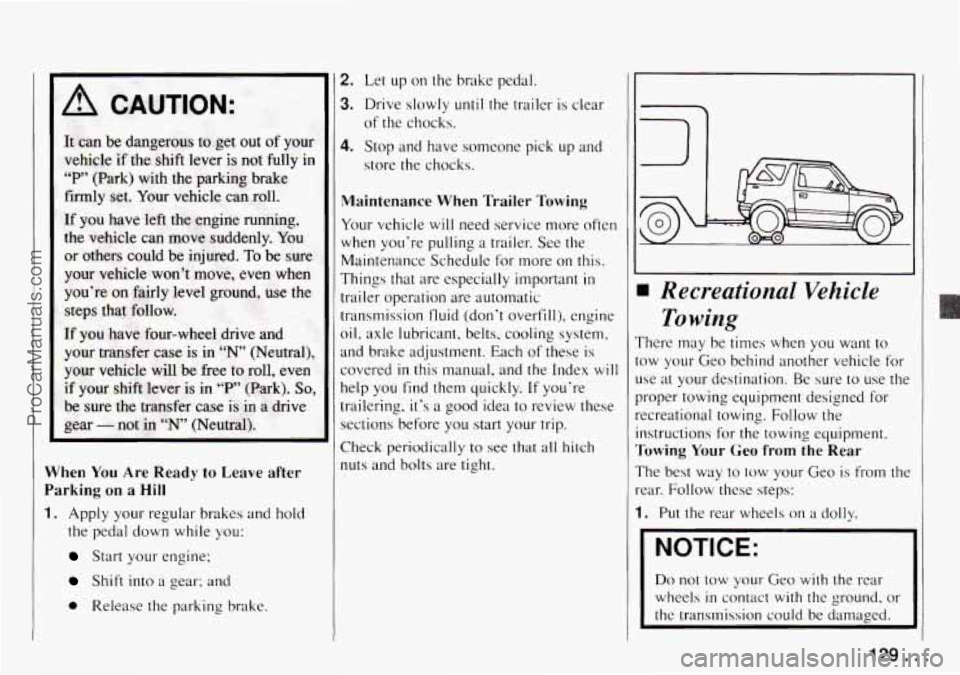
1. Put the rear wheels on a dolly.
I NOTICE:
I
Do not tow your Geo with the rear
wheels
in contact with the ground. or
the transmission could be damaged. 1
.. 129. ProCarManuals.com
Page 131 of 258

Your Driving and the Road
2. Set the parking brake.
3. If your Geo is a four-wheel-drive
vehicle, set your manual freewheeling
hubs
to ”FREE” or unlock your
automatic I‘reewheeling hubs. See “Four-wheel Drive”
in the Index.
4. Turn the ignilion key to ”ACC’‘ to
unlock the steering wheel.
5. Clamp the steering wheel in a
straight-ahead position, with a
clamping device designed for towing.
6. Release the parking brake.
I NOTICE:
I
Make sure that the towing speed does
not exceed
55 mph (90 km/h), or
your Geo could be badly damaged.
~~
Towing Your Geo from the Front
NOTICE:
If your vehicle has automatic free-
wheeling hubs
or two-wheel drive,
do not tow
it on all four wheels. If
you do, your transmission could be
damaged.
If you have a four-wheel-drive vehicle
with manual freewheeling hubs, it can be
towed from the front with
all four wheels
on the ground. Follow these steps:
1. Set the parking brake.
2. Turn the ignition key to “ACC” to
unlock the steering wheel.
3. Shift your automatic transmission into
“P” (Park), or your manual
transmission into “2” (Second).
4. Shift the transfer case to “N”
(Neutral).
“Four-wheel Drive”
in the Index.
5. Set the hubs to “FREE.” See
6. Reledse the parking brake,
Stop towing every 200 miles
(300 km)
and start the engine. Leave the transfer
case shift lever
in ”N” (Neutral). Shift
your automatic transmission
to “D”
(Drive); leave a manual transmission
in
“2” (Second) and release the clutch. Run
the engine
at medium speed for one
minute to circulate the oil in the transfer
case. Turn the ignition key to
“ACC.”
Now, you can continue towing your Geo.
I
NOTICE:
I
Make sure the towing speed does not
exceed
SO mph (80 km/h), or your
Geo could be badly damaged.
I
. . .130
ProCarManuals.com
Page 132 of 258
D
It /A
Here you'll find what to do
about some problems that can
occur on the road.
I
Part 5
Problems on the Road
Hazard Warning Flashers ............ ............................ 132
JumpStarting .................................................... 133
Towing Yourvehicle .............................................. 136
Engine Overheating ............................................... 140
If a Tire Goes Flat ................................................ I46
If You're Stuck: In Sand, Mud, Ice or Snow ............................ IS3
131 ... ProCarManuals.com
Page 135 of 258
Problems on the Road
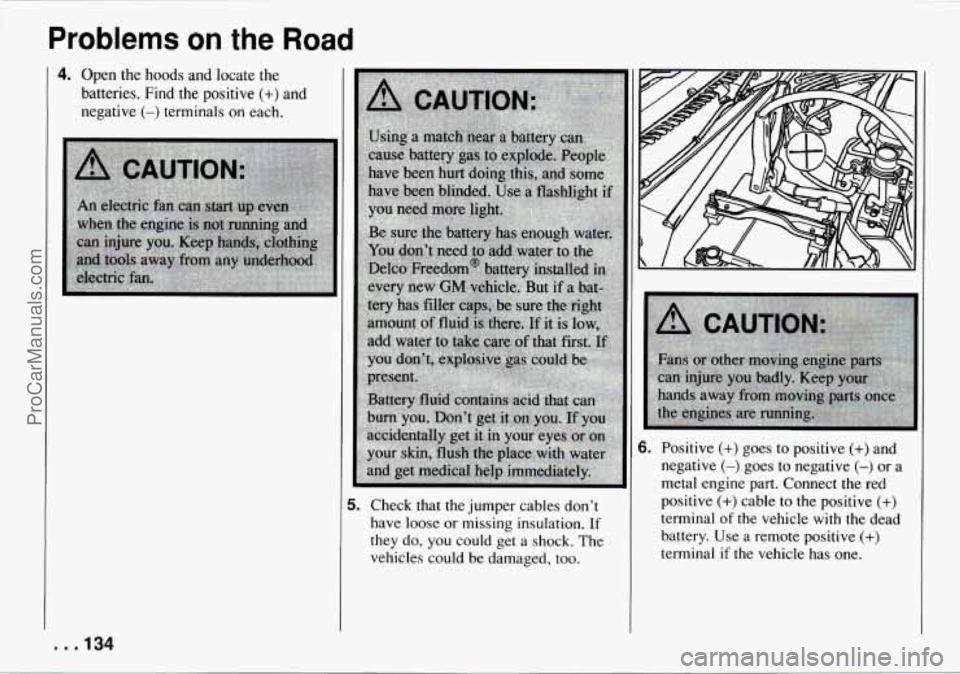
4. Open the hoods and locate the
batteries. Find the positive
(+) and
negative
(-) terminals on each.
. . .134
1 5. Check that the jumper cables don’t
have loose or missing insulation. If
they do, you could get a shock. The
vehicles could be damaged, too.
6. Positive (+) goes to positive (+) and
negative
(-) goes to negative (-) or a
metal engine part. Connect the red
positive
(+) cable to the positive (+)
terminal of the vehicle with the dead
battery. Use a remote positive
(+)
terminal if the vehicle has one.
ProCarManuals.com
Page 136 of 258

7. Don't let the other end touch metal.
Connect
it to the positive (+) terminal
of the good battery. Use a remote
positive
(+) terminal if the vehicle
has one.
8. Now connect the black negative (-)
cable to the good battery's
negative
(-) terminal. Don't let the
other end touch anything
until the next
step.
9. 'The other end of the negative cable
doesn't
go to the dead battery. It goes
to a heavy, unpainted metal part on
the engine
of the vehicle with the
dead battery. Attach the cable at least
18 inches (45 cm) away from the
tiead battery. but not near engine
parts
that move. The electrical
connection
is just as good there. but
the chance of sparks getting back to
the battery is much less.
10. Now start the vehicle with the good
bartcry
~lnd run the engine for a
while.
11. Try to start the vehicle with the dead
battery.
If it won't start after a few
tries.
it probably needs service.
135..
ProCarManuals.com
Page 137 of 258
Problems on the Road
h I B
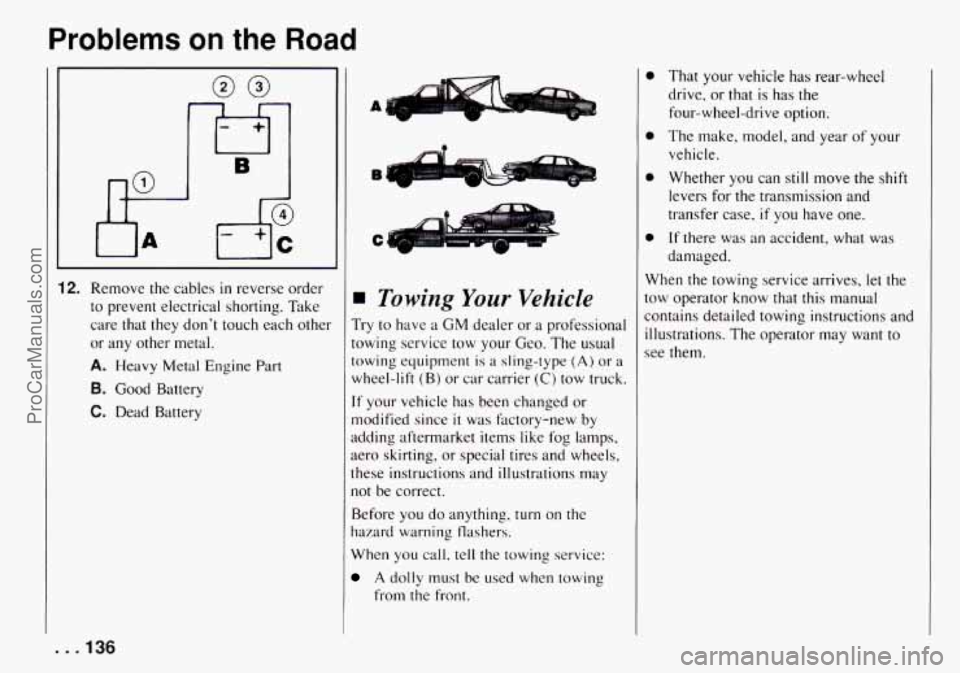
2. Remove the cables in reverse order
to prevent electrical shorting. Take
care that they don't touch each other
or any other metal.
A. Heavy Metal Engine Part
B. Good Battery
C. Dead Battery
C
Towing Your Vehicle
Try to have a GM dealer or a professional
towing service tow your Geo. The usual
towing equipment
is a sling-type (A) or a
wheel-lift (B) or car carrier (C) tow truck.
If your vehicle has been changed or
modified since
it was factory-new by
adding aftermarket items like fog lamps,
aero skirting, or special tires and wheels,
these instructions and illustrations may
not be correct.
Before you do anything, turn
on the
hazard warning flashers.
When you
call, tell the towing service:
A dolly must be used when towing
from the front.
0
e
e
That your vehicle has rear-wheel
drive, or that is has the
four-wheel-drive option.
The make, model, and year
of your
vehicle.
Whether you
can still move the shift
levers for the transmission and
transfer case,
if you have one.
If there was an accident, what was
damaged.
When the towing service arrives,
let the
tow operator know that this manual
contains detailed towing instructions and
illustrations. The operator may want to
see them.
. .I36
ProCarManuals.com
Page 141 of 258

Problems on the Road
Engine Overheating
You will find a coolant temperature gage
on your Geo instrument panel.
If Steam Is Coming from Your Engine:
NOTICE:
If your engine catches fire because
you keep driving with no coolant,
your vehicle can be badly damaged.
The costly repairs would not be cov-
ered by your warranty.
If No Steam Is Coming from Your
Engine:
If you get the overheat warning but see or
hear no steam, the problem may not be
too serious. Sometimes the engine can get
a little too hot when you:
0 Climb a long hill on a hot day.
0 Stop after high speed driving.
Idle for long periods in traffic.
Tow a trailer.
If you get the overheat warning with no
sign of steam, try this
for a minute or so:
1.
If you have an air conditioner, turn it
off.
2. Turn on your heater to full hot at the
highest fan speed and open the
window as necessary.
(Neutral).
3. If you’re in a traffic jam, shift to “N”
. . .140
ProCarManuals.com
Page 142 of 258

If you no longer have the overheat
warning, you can drive. Just to be safe,
drive slower for about
ten minutes. If the
warning doesn’t come back on,
you can
drive normally.
If the warning continues, pull over, stop,
and park your vehicle right away.
If there’s still no sign
of steam, you can
idle the engine for two or three minutes
while you’re parked, to see if the warning
stops. But then, if you still have the
warning, TURN
OFF THE ENGINE
AND GET EVERYONE OUT OF THE
VEHICLE until it cools down.
You may decide not to lift the hood but to
get service help right away.
2ooling System
Vhen you decide it’s safe to lift the hood,
lere’s what you’ll see on the 8-valve
mgine:
I. Coolant Recovery Tank
!. Radiator Pressure Cap
1. Electric Engine Fan lere’s
what you’ll see on the 16-valve
:ngine:
I. Coolant Recovery Tank
!. Radiator Pressure Cap
I. Electric Engine Fan
141 . . .
ProCarManuals.com