engine CHEVROLET TRACKER 1994 Repair Manual
[x] Cancel search | Manufacturer: CHEVROLET, Model Year: 1994, Model line: TRACKER, Model: CHEVROLET TRACKER 1994Pages: 258, PDF Size: 14.43 MB
Page 174 of 258

Power Steering FJuid
How to Check Power Steering Fluid:
Unscrew the cap and wipe the dipstick
with
a clean rag. Replace the cap and
completely tighten
it. Then remove the
cap again and look at the fluid level on
the dipstick.
D When the engine compartment is hot,
the level should
be at the “MAX”
mark.
D When the engine compartment is cool
the level should be at
the “MIN”
mark.
‘hat to Add:
:fer to the Maintenance Schedule to
terrnine what kind of fluid to use. See
[ecornmended Fluids and Lubricants”
in
2 Index.
NOTICE:
When adding power steering fluid or
making
a complete fluid change,
always use
the proper fluid. Failure
to use the proper fluid can cause
leaks and damage hoses and seals.
173 ...
ProCarManuals.com
Page 176 of 258
correct a leak. If you add fluid when your
linings are worn, then you’ll have too
much fluid when you get new brake
linings. You should add (or remove)
brake fluid, as necessary, only when work
is done on the brake hydraulic system.
Refer to the Maintenance Schedple to
determine when to check
yoqr drake
fluid. See “Periodic Maintenance
Inspections” in the Index.
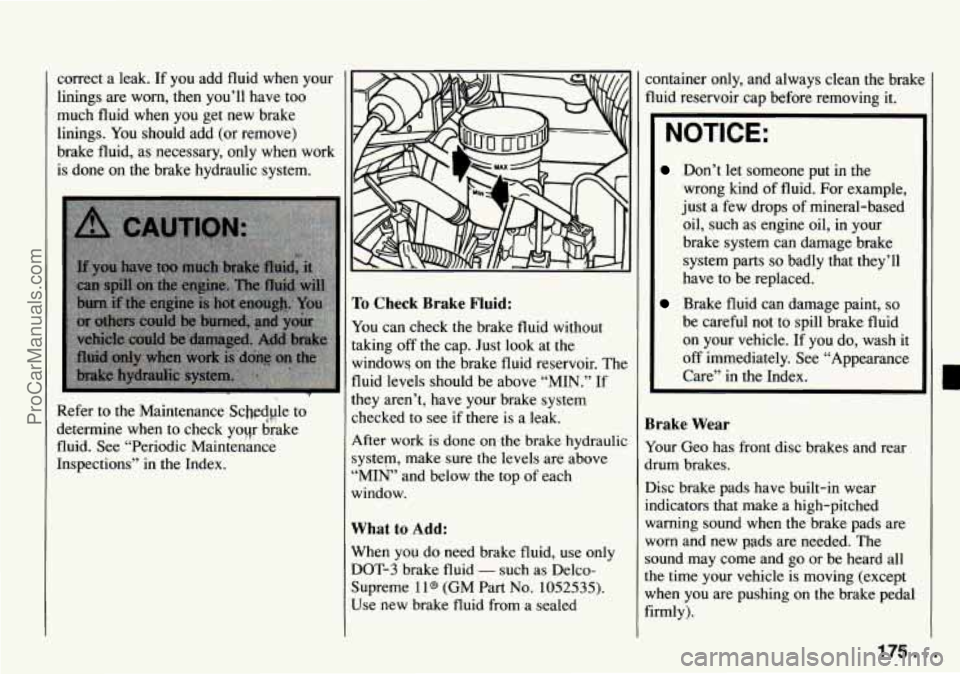
To Check Brake Fluid:
You can check the brake fluid without
taking
off the cap. Just look at the
windows on the brake fluid reservoir. The
fluid levels should be above “MIN.” If
they aren’t, have your brake system
checked to see if there is a leak.
After work is done
on the brake hydraulic
system, make sure the levels are above
“MIN’ and below the top
of each
window.
What to Add:
When you do need brake fluid, use only
DOT-3 brake fluid
- such as Delco-
Supreme 11s (GM Part
No. 1052535).
Use new brake fluid from a sealed container
only, and always clean the brakl
fluid reservoir cap before removing it.
NOTICE:
Don’t let someone put in the
wrong kind of fluid. For example,
just a few drops of mineral-based
oil, such as engine oil, in your
brake system can damage brake system parts
so badly that they’ll
have to be replaced.
Brake fluid can damage paint, so
be careful not to spill brake fluid
on your vehicle. If
you do, wash it
off immediately. See “Appearance
Care” in the Index.
Brake Wear
Your Geo has front disc brakes and rear
drum brakes.
Disc brake pads have built-in wear
indicators that make a high-pitched
warning sound when the brake pads are
worn and new pads are needed. The
sound may come and
go or be heard all
the time your vehicle is moving (except
when you are pushing on the brake pedal
firmly).
175 ...
ProCarManuals.com
Page 197 of 258

Service and Appearance Care
Vehicle Identification
Number
(VZN)
rhis is the legal identifier for your Geo. I
lppears on a plate in the front corner of
he instrument panel, on the driver’s side.
fou can see it
if you look through the
windshield from outside your vehicle.
he VIN also appears
on the Vehicle
ktification and Service Parts labels and
he certificates
of title and registration.
Engine Identification
rhe eighth character in your VIN is the
:ngine code.
This code will help you
denti€y your engine, specifications, and
meplacement parts.
. .I96
9
1
I
il
1
t
Service Parts
Identification Label
You’ll find this label inside the glove box
m the door. It’s very helpful if you ever
need to order parts.
On this label is:
B -your VIN,
the model designation,
B paint information, and
a list of all production options and
special equipment.
Be sure that this label is not removed
From the vehicle.
Add-on Electrical
Equipment
NOTICE:
Don’t add anything electrical to your
Geo unless you check with your
dealer first. Some electrical equip-
ment can damage your vehicle and
the damage wouldn’t be covered by
your warranty. Some add-on electri-
cal equipment can keep other compo-
nents from working as they should.
I.
Fuses and Circuit
Breakers
The wiring circuits in your vehicle are
protected from short circuits by fuses,
circuit breakers and thermal
links in the
wiring itself. This greatly reduces the
chance
of fires caused by electrical
problems.
The main
fuse box is in your engine
compartment
OR the right side. It protects
all electrical loads.
ProCarManuals.com
Page 200 of 258

Replacement Bulbs
Back-up ........................................................ 1156
Dome
...................................................... 96051559
Center High-Mounted Stop
........................................... 921
Front Parking and
Turn Signal .................................... 1157 NA
Headlight (Halogen) ............................................... 9004
Heater
or Air Conditioning Control ............................... 96052599
Charging System
............................................ 9433 184
Engine Oil Pressure
.......................................... 9433 184
4WD
...................................................... 9433184
Headlight High Beam
......................................... 9433 184
Instrument Cluster
............................................. 9605 156
Rear Defogger Switch ......................................... 9606 1736
Rear Hazard and
Turn Signal ........................................ 1156
Rear Wipermasher Switch
..................................... 9606 1736
Indicator and Warning
Brake
..................................................... 9433184
CheckEngine
............................................... 9433184
SafetyBelt
................................................. 9433184
Turnsignal
................................................. 9433184
Licenseplate
..................................................... 194
Lighter
...................................................... 9433184
Rearparkingandstop
............................................. 1157
Sidemarker ......................................... ............ 194
199 ...
ProCarManuals.com
Page 201 of 258
Service and Appearance Care
..........
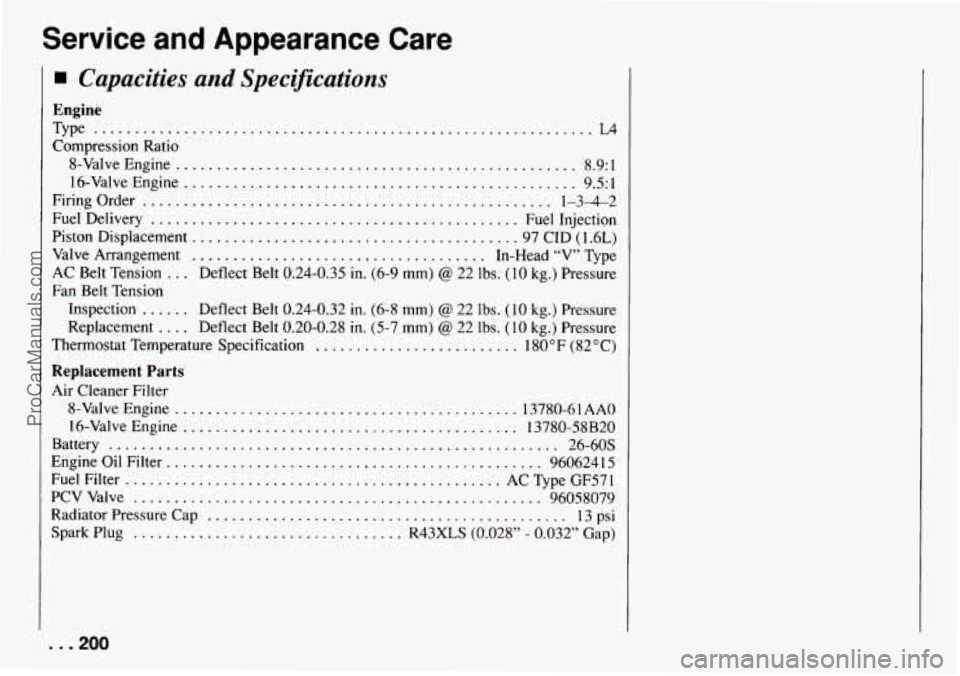
Capacities and Specifications
Engine
Type .......................................... . * L4
Compression Ratio 8-Valve Engine
................................................. 8.9: 1
16-Valve Engine ................................................ 9.5: 1
Fuel Delivery
............................................. Fuel Injection
Piston Displacement
........................................ 97 CID (1.6L)
Valve Arrangement
.................................... In-Head “V” Type
Firingorder
.................................................. 1-342
AC Belt Tension ... Deflect
Belt 0.24-0.35 in. (6-9 mm) @I 22 lbs. (10 kg.) Pressure
Fan Belt Tension
Inspection
...... Deflect Belt 0.24-0.32 in. (6-8 mm) @ 22 lbs. (10 kg.) Pressure
Replacement
.... Deflect Belt 0.20-0.28 in. (5-7 mm) @ 22 lbs. (10 kg.) Pressure
Thermostat Temperature Specification
......................... 180°F (82°C)
Replacement Parts
Air Cleaner Filter
8-Valve Engine
.......................................... 13780-6 1 AAO
16-Valve Engine ......................................... 13780-58B20
Engine
Oil Filter .............................................. 9606241 5
Radiator Pressure Cap ............................................ 13 psi
Spark Plug ................................. R43XLS (0.028” - 0.032” Gap)
Battery
....................................................... 26-60s
Fuel Filter
.............................................. AC Type GF571
PCVValve
.................................................. 96058079
.. .200
ProCarManuals.com
Page 202 of 258
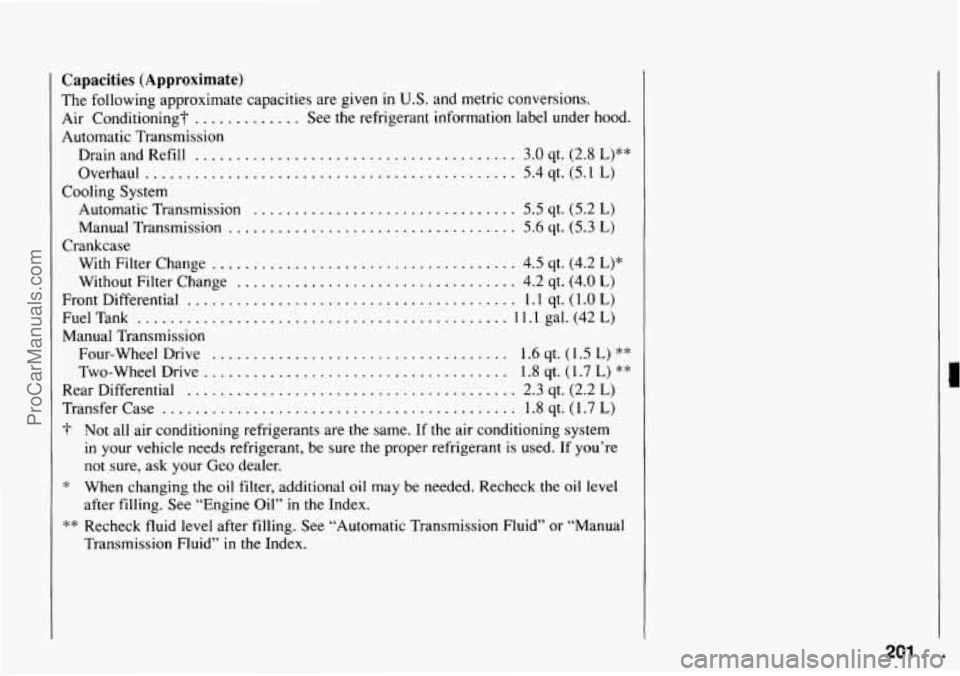
Capacities (Approximate)
The following approximate capacities are given in U.S. and metric conversions.
Air Conditioning”
............. See the refrigerant information label under hood.
Automatic Transmission Drain and Refill
....................................... 3.0 qt. (2.8 L)**
Overhaul ............................................. 5.4 qt. (5.1 L)
Automatic Transmission ................................ 5.5 qt. (5.2 L)
Manual Transmission ................................... 5.6 qt. (5.3 L)
With Filter Change ..................................... 4.5 qt. (4.2 L)*
Without Filter Change .................................. 4.2 qt. (4.0 L)
Front Differential ........................................ 1.1 qt. (1 .O L)
Fuel Tank ............................................. 11.1 gal. (42 L)
Manual Transmission
Cooling System
Crankcase
Four-wheel Drive
.................................... 1.6 qt. ( 1.5 L) **
Two-Wheel Drive ..................................... 1.8 qt. (1.7 L) **
Rear Differential ........................................ 2.3 qt. (2.2 L)
Transfer Case ........................................... 1.8 qt. ( 1.7 L)
T Not all air conditioning refrigerants are the same. If the air conditioning system
in your vehicle needs refrigerant, be sure the proper refrigerant is used. If you’re
not sure, ask your Geo dealer.
* When changing the oil filter, additional oil may be needed. Recheck the oil level
after filling. See “Engine Oil”
in the Index.
** Recheck fluid level after filling. See “Automatic Transmission Fluid” or “Manual
Transmission Fluid”
in the Index.
201 ...
ProCarManuals.com
Page 204 of 258

.
IMPORTANT:
KEEP THE ENGINE OIL
AT THE PROPER
LEVEL AND CHANGE AS
RECOMMENDED
This part covers the
maintenance required
for your
Geo . Your vehicle needs these
services to retain its safety.
dependability and emission
control performance
.
Maintenance Schec
Section
Introduction: A Word about Maintenance ........................
A .
B .
C .
D .
E .
Your Vehicle and the Environment .........................
How This Part Is Organized ............................
Scheduled Maintenance Services ........................
Using Your Maintenance Schedule .......................
Selecting the Right Schedule ............................
Schedule1 .......
Schedule11 ............................................
Owner Checks and Services .........
At Each Fuel Fill .......
At Least Once a Month .................. .......
At Least Twice a Year .........
AtLeastOnceaYear ..................................
Periodic Maintenance Inspections ...........................
Recommended Fluids and Lubricants ........................
MaintenanceRecord ......................................
................................
Explanation of Scheduled Maintenance Services ..............
....................
.........................
...................
ule
Protection
Plan
Have you purchased the GM Protection Plan? The Plan
supplements
your new car warranties .
See your GM dealer for details .
204
204
204
205
205
205
206
210
214
218
218 219
219 220
223
225
228
203 ...
ProCarManuals.com
Page 206 of 258
“Section C: Periodic Maintenance
Inspections” explains important inspections that your Geo dealer’s service
department or another qualified service
center should perform.
“Section
D: Recommended Fluids and
Lubricants” lists some products GM
recommends to help keep your vehicle
properly maintained. These products, or
their equivalents, should be used whether
you do the work yourself or have it done.
“Section
E: Maintenance Record”
provides a place for you to record the
maintenance performed on your vehicle.
Whenever any maintenance is performed,
be sure to write it down in this section.
This will help you determine when your
next maintenance should be done.
In
addition, it is a good idea to keep your
maintenance receipts. They may be
needed to qualify your vehicle for
warranty repairs.
Section A: Scheduled
Maintenance Services
Using Your Maintenance
Schedules
This section tells you the maintenance
services you should have done and when
you should schedule them. Your Geo
dealer knows your vehicle best and wants
you to be happy with
it. If you go to your
dealer for your service needs, you’ll knoN
that GM-trained and supported service
people will perform the work using
genuine GM parts.
These schedules are for vehicles that:
carry passengers and cargo within
recommended limits. You will find
these limits on your vehicle’s
Tire-Loading Information label. See
“Loading Your Vehicle” in the Index.
are driven on reasonable road surfaces
within legal driving limits.
use the recommended unleaded fuel.
See “Fuel” in the Index.
I
Selecting the Right Schedule
First you’ll need to decide which of the
two schedules is right for your vehicle.
Here’s how to decide which schedule to
follow:
Schedule
I
Is any one of these true for your vehicle?
Most trips are less than 4 miles (6 km).
Most trips are less than 10 miles
(1
6 km) when outside temperatures are
below freezing.
The engine is at low speed most of the
time (as in door-to-door delivery, or in
stop-and-go traffic).
You operate your vehicle in dusty
areas or off-road frequently.
D You tow a trailer.
[f any one (or more) of these is true for
your driving, follow Schedule I.
Schedule
I1
Follow Schedule I1 on& if none of the
lbove conditions
is true.
205. . .
ProCarManuals.com
Page 207 of 258
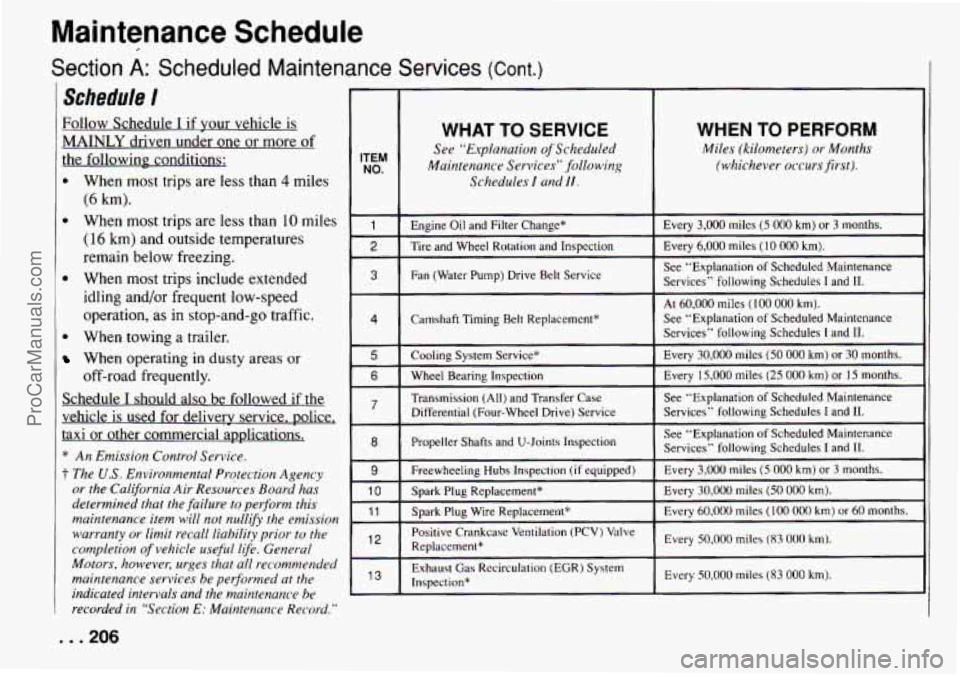
Maintenance Schedule
Section A: Scheduled Maintenance Services (Cont.)
Schedule l
Follow Schedule I if your vehicle is
MAINLY driven under one or more of
the following conditions:
e
a
a
a
When most trips are less than 4 miles
(6 km).
When most trips are less than
10 miles
(16 km) and outside temperatures
remain below freezing.
When most trips include extended
idling and/or frequent low-speed
operation, as in stop-and-go traffic.
When towing
a trailer.
When operating in dusty areas or
off-road frequently.
Schedule
I should also be followed if the
taxi or other commercial applications.
* An Emission Control Service.
t The U.S. Environmental Protection Agency
or the California Air Resources Board has
determined that the failure to perform this
maintenance item will not
nullify the emission
warranty or limit recall liability prior
to the
completion
of vehicle useful lfc. General
Morors, howeve); urges that all recommended
maintenance services be performed at the
indicated intervals and the maintenance
be
recorded in “Section E: Maintenance Record.”
9%
. . .206
ITEM NO.
-
1
2
3
-
4
5
6
7
-
-
-
8
-
9
10
11
-
-
7
12
13
WHAT TO SERVICE
See “E,xplanation of Scheduled
Maintenance Services” following
Schedules
I und 11.
Engine OTI and Filter Change*
Tire and Wheel Rotation and Inspection
Fan (Water Pump) Drive Belt Service
Camshaft Timing Belt Replacement*
Cooling System Service”
Wheel Bearine Insuection
Transmission
(All) and Transfer Case
Differential (Four-wheel Drive) Service
Propeller Shafts and
U-Joints Inspection
Freewheeling Hubs Inspection
(if equipped)
Spark Plug Replacement*
Spark Plug Wire Replacement”
Positive Crankcase Ventilation (PCV) Valve
Reulacement*
Exhaust Gas Recirculation
(EGR) System
Inspection*
WHEN TO PERFORM
Miles (kilomerers) or Months
(whichever occursfirst).
Every 3,000 miles (5 000 km) or 3 months.
Every
6,000 miles (10 000 km).
See “Explanation of Scheduled Maintenance
Services” following Schedules
I and 11.
At 60,000 miles (100 000 km).
See “Explanation of Scheduled Maintenance
Services” following Schedules
I and 11.
Every 30,000 miles (50 000 krn) or 30 months.
Every 15,000 miles
(25 000 km) or 15 rnonlhs.
See “Explanation of Scheduled Maintenance
Services” following Schedules
I and 11.
See “Explanation of Scheduled Maintenance
Services” following Schedules
I and 11.
Every 3,000 miles (5 000 km) or 3 months.
Every 30,000 miles (50
000 km).
Every
60,000 miles (100 000 km) or 60 months.
Every 50.000 miles
(X3 000 km).
Every 50,000 miles (83 000 km).
ProCarManuals.com
Page 209 of 258

Maintenance Schedule
Section A: Scheduled Maintenance Services (cont.)
Schedule / (Cont.)
* An Emission Control Service.
t The US. Environmental Protection Agency
or the California Air Resources Board has
determined that the failure to perform this
maintenance item will
not nullify the emission
warranty or limit recall liability prior to the
completion
of vehicle useful life. General
Motors, however, urges that all recommended
maintenance services be performed at the
indicated intervals and the maintenance be
recorded in “Section E: Maintenance Record.”
WHAT TO SERVICE
See “Explanation of Scheduled
Schedules
I and 11.
ITEM NO. Maintenance Services” following
WHEN TO PERFORM
Miles (kilometers) or Months
(whichever occurs first).
14
Air Cleaner Filter Replacement* See “Explanation of Scheduled
Maintenance
Services” following Schedules
I and 11.
15 I Fuel Tank, Cap and Lines Inspection*t I
See “Explanation of Scheduled Maintenance
Services” following Schedules
I and 11.
16
Every
80,000 miles (133 000 km). Heated
Oxygen Sensor Replacement*
18 Every
100,000 miles
(166 000 km).
Fuel Injector Inspection”
17 Every
30,000 miles (50 000 km)
or 30 months. Fuel Filter Replacement*
l9 I
Evaporative Emissions Canister
Replacement* I Every 100,000 miles (166 000 km).
Engine Control Module (ECM) and 2o Associated Sensors Inspection* Every 100,000 miles (1 66 000 km).
21 Every
100,000 miles (166 000 kml
Three Wav Catalvtic Converter Inspection* 22
Every 60,000 miles (100 000 km). Emission
System Hoses Inspection*
~~ I - \--- ~~
23 I Engine Timing and Distributor Check* I Every 60,000 miles (100 000 km).
24
Every 60,000 miles (100 000 km). Brake Fluid
Service 28
Every 60,000 miles (100 000 km) or 60 months.
Wiring Harness and Connectors Inspection* 27
Every 7,500 miles (12 500 km) or 7.5 months.
Power Steering System Inspection 26
Every 15,000 miles (25 000 km).
Valve Lash (Clearance) Inspection* 25
Every 15,000 miles (25 000 km).
Engine Idle Speed Check*?
. . ,208
ProCarManuals.com