engine CHEVROLET TRACKER 1994 Workshop Manual
[x] Cancel search | Manufacturer: CHEVROLET, Model Year: 1994, Model line: TRACKER, Model: CHEVROLET TRACKER 1994Pages: 258, PDF Size: 14.43 MB
Page 164 of 258
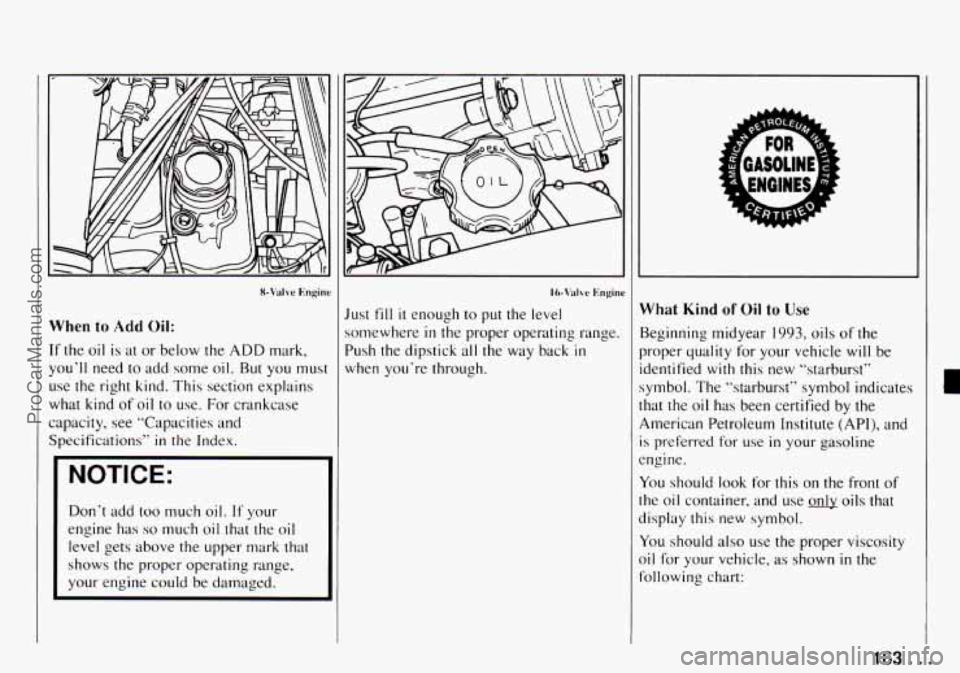
X-Valve Engine
When to Add Oil:
If the oil is at or below the ADD mark,
you’ll need
to add some oil. But you must
use
the right kind. This section explains
what kind
of oil to use. For crankcase
capacity, see “Capacities and
Specifications”
in the Index.
NOTICE:
Donl add too tnuch oil. If your
engine has
so much oil that the oil
level gets above the upper mark that
shows the proper operating range,
your engine
could be damaged.
IO-Valve Engine
Just fill it enough to put the level
somewhere
in the proper operating range.
Push
the dipstick all the way back in
when you‘re through.
What Kind of Oil to Use
Beginning midyear 1993, oils of the
proper quality for your vehicle will be
identified with this new “starburst”
symbol. The “starburst” symbol indicates
that the
oil has been certified by the
American Petroleum Institute (API), and
is preferred for use in your gasoline
engine.
You should look for this on the front of
the oil container, and use o& oils that
display this new symbol.
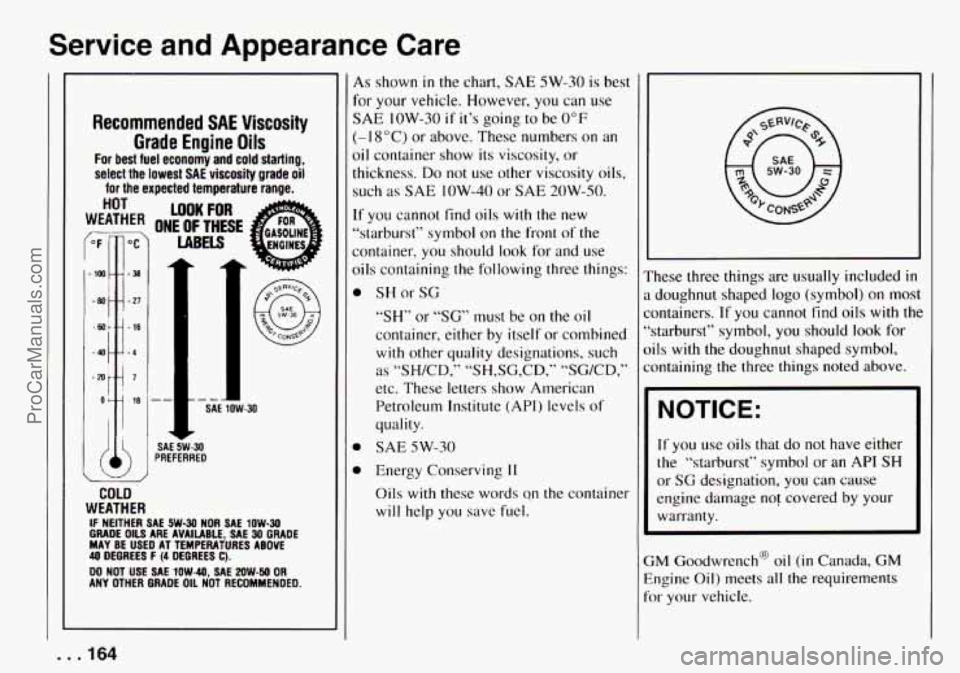
You should also use the proper viscosity
oil for your vehicle, as shown in the
following chart:
163 ... ProCarManuals.com
Page 165 of 258
Service and Appearance Care
Recommended SAE Viscosity
Grade Engine Oils
For best fuel economy and cold starting,
select the
lowest SAE viscosity grade oil
for the expected temperature range.
HOT
WEATHER
-80 -27
SAE 5W-30 PREFERRED
COLD
WEATHER
IF NEITHER SAE 5W-30 NOR SAE 1OW-30 GRADE OILS ARE AVAILABLE, SAE 30 GRADE
MAY BE USED AT TEMPERATURES ABOVE 40 DEGREES F (4 DEGREES C).
DO NOT USE SAE 1OW-40, SAE 2OW-50 OR ANY OTHER GRAOE OIL NOT RECOMMENDED.
As shown in the chart, SAE SW-30 is best
for your vehicle. However, you can use
SAE IOW-30 if it’s going to be 0°F
(-1 8°C) or above. These numbers on an
oil container show its viscosity, or
thickness.
Do not use other viscosity oils,
such
as SAE IOW-40 or SAE 2OW-SO.
If you cannot find oils with the new
“starburst” symbol on the front of the
container,
you should look for and use
oils containing the following three things:
Ski or SG
“SH” or “SG” must be on the oil
container, either
by itself or combined
with other quality designations, such
as
“SHKD,” “SH,SG,CD,” “SGKD,”
etc. These letters show American
Petroleum Institute (API) levels of
quality.
SAE SW-30
Energy Conserving I1
Oils with these words on the container
will help you save fuel.
These three things are usually included in
1 doughnut shaped logo (symbol) on most
Zontainers.
If you cannot find oils with the
“starburst” symbol, you should
look for
lils with the doughnut shaped symbol,
;.ontaining the three things noted above.
NOTICE:
If you use oils that do not have either
the “starburst” symbol or
an API SH
or SG designation, you can cause
engine damage not covered
by your
warranty.
3M Goodwrench” oil (in Canada, GM
Engine Oil) meets
all the requirements
[or your vehicle.
. . .164 ProCarManuals.com
Page 166 of 258

Engine Oil Additives
Don’t add anything to your oil. Your Geo
dealer is ready to advise
if you think
something should be added.
When to Change Engine Oil
See if any one of these is true for you:
Most trips are less than 4 miles (6 km).
It’s below freezing outside and most
trips are less than 10 miles (1 6 km).
The engine is at low speed most of the
time (as
in door-to-door delivery, or
stop-and-go traffic).
You tow a trailer often.
Most trips are through dusty places.
The vehicle is frequently operated
If any one of these is true for your
vehicle, then you need to change your
and filter every
3,000 miles (5 000 km) or
3 months - whichever comes first.
If none of them is true, change oil and
filter every
7,500 miles (1 2 500 km) or
7.5 months - whichever comes first.
off-road.
Engine
Coolant Heater (Engine Block
Heater)
An engine coolant heater can be a big
help
if you have to park outside in very
cold weather,
0°F (-I 8°C) or colder. If
your vehicle has this option, see “Engine
Coolant Heater”
in the Index.
What to Do with Used Oil
Did you know that used engine oil
contains elements that may be unhealthy
for your skin and could even cause
cancer? Don’t let used oil stay on your
skin for very long. Clean your skin and
nails
with soap and water, or a good hand
cleaner. Wash or properly throw away
clothing or rags containing used engine
oil. (See the manufacturer’s warnings
about
the use and disposal of oil products.)
Used oil can
be a real threat to the
environment.
If you change your own oil,
be sure
to drain all free-tlowing oil from
the filter before disposal. Don’t ever
dispose of oil by putting
it in the trash,
pouring
it on the ground, into sewers, or
into streams or bodies
of water. Instead.
recycle
it by taking it to a place that
collects used
oil. If you have a problem
properly disposing.
of your used oil, ask
your dealer,
a service station or a local
recycling center for help.
Air Cleaner
Refer to the Maintenance Schedule to
detertnine when to replace the
air filter.
See “Scheduled Maintenance Services“
ir
the Index.
A CAUTION:
Operating the engine with the air
cleaner off can cause you or others to
be burned. The air cleaner not only.
cleans the air,
it stops flame if the
engine backfires.
If it isn’t there, and
the engine backfires, you could be
burned. Don’t drive with it
off, and
be careful working
on the engine
with the
air cleaner off.
165.
ProCarManuals.com
Page 167 of 258
Service and Appearance Care
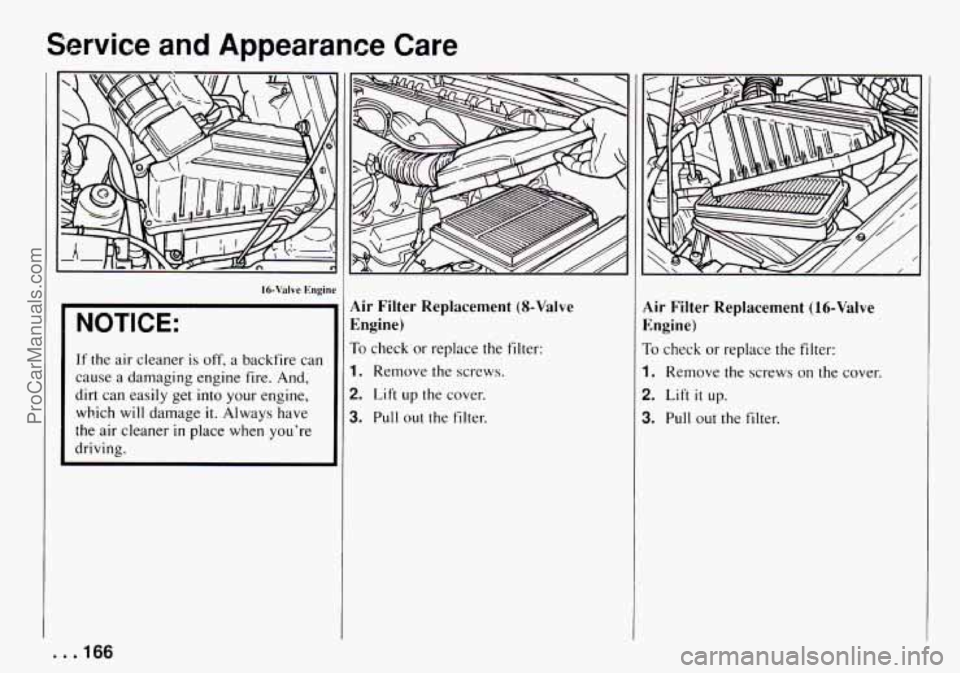
16-Valve Engine
I NOTICE:
If the air cleaner is off, a backfire can
cause
a damaging engine fire. And,
dirt can easily get into your engine,
which
will damage it. Always have
the air cleaner
in place when you’re
driving.
Air Filter Replacement (8-Valve
Engine)
To check or replace the filter:
1. Remove the screws.
2. Lift up the cover.
3. Pull out the filter.
Air Filter Replacement (16-Valve
Engine)
To check or replace the filter:
1. Remove the screws on the cover.
2. Lift it up.
3. Pull out the filter.
. . .I66
ProCarManuals.com
Page 168 of 258
I A utomatic Transmission FIuid
When to Check and Change
A good time to check your automatic
transmission fluid level
is when the
engine
oil is changed. Refer to the
Maintenance Schedule to determine when
to change your fluid. See “Scheduled
Maintenance Services”
in the Index.
How to Check
Because this operation can be a little
difficult, you may choose to have
this
done at your Geo dealership Service
Department.
If you do
it yourself, be sure to follow all
the instructions here, or you could get a
false reading on the dipstick.
NOTICE:
Too much or too little tluid can
damage your transmission.
Too much
can mean that some of the fluid could
come out and fall on hot engine parts
or exhaust system parts, starting
a fire.
Be sure to get an accurate reading
if
you check your transmission tluid. Wait
at least 30 minutes before checking
the transmission fluid level
if you have
been driving:
0 When outside temperatures are above
0 At high speed for quite a while.
0 In heavy traffic - especially in hot
While pulling a trailer.
To get the right reading, the fluid should
be at normal operating temperature,
which is 180°F to 200°F
(82°C to 93°C).
To check transmission fluid hot: Get the
vehicle warmed
up by driving about IS
miles (24 km) when outside temperatures
are above 50°F
( 10°C). If it’s colder than
50°F (IOOC), drive the vehicle in “D”
(Third Gear) until the engine temperature
gage moves
and then remains steady for
ten minutes. Then follow the hot check
procedures.
To check transmission fluid cold: A cold
check is made after the vehicle has been
sitting for eight hours or more
with the
engine off
and is used only as a reference.
Let
the engine run at idle for five minutes
if outside temperatures are 50°F (10°C)
or more. If it’s colder than 50°F (IO’C),
you
may have to idle the engine longer.
90°F (32°C).
weather. Should
the
fluid level be low during a
cold check, you must perform a hot check
before adding fluid. This will give you a
more accurate reading
of the fluid level.
To check the fluid hot or cold
0 Park your vehicle on a level place.
0 With the parking brake applied, place
0 With your foot on the brake pedal,
Keep the
engine running.
the shift lever
in “P’ (Park).
move the shift lever through each gear
range, pausing for about three seconds
in each range. Then, position the shift
lever
in “P” (Park).
minutes or more.
0 Let the engine run at idle for three
167.,
ProCarManuals.com
Page 169 of 258
Service and Appearance Care
Then, without shutting off the engine,
follow these steps:
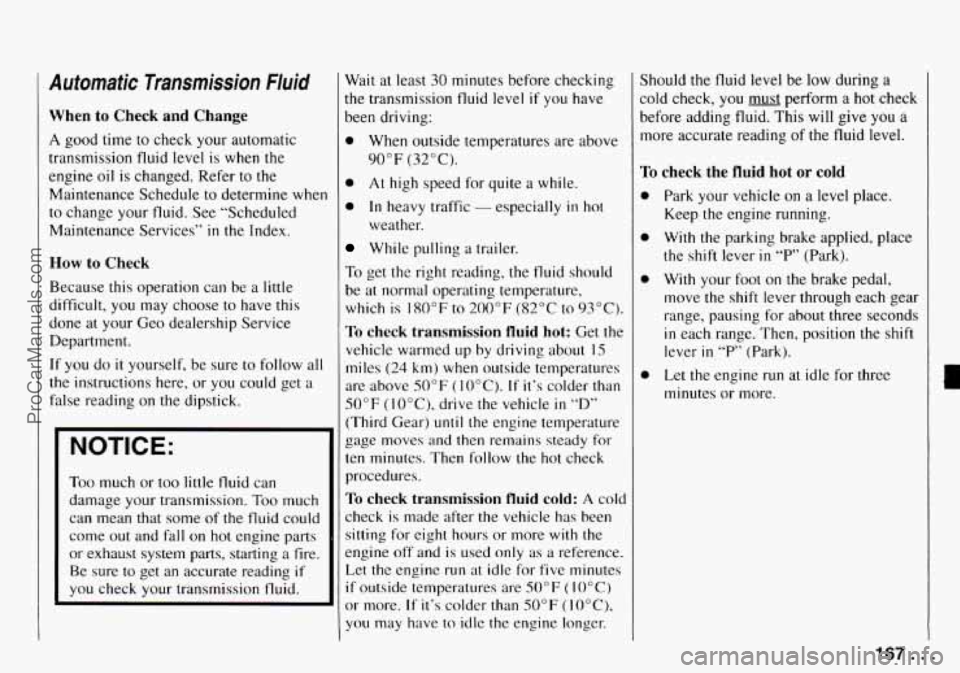
1. Pull out the dipstick and wipe it with a
clean rag or paper towel.
2. Push it back in all the way, wait three
seconds and then pull it back out
again.
. . .I68
~
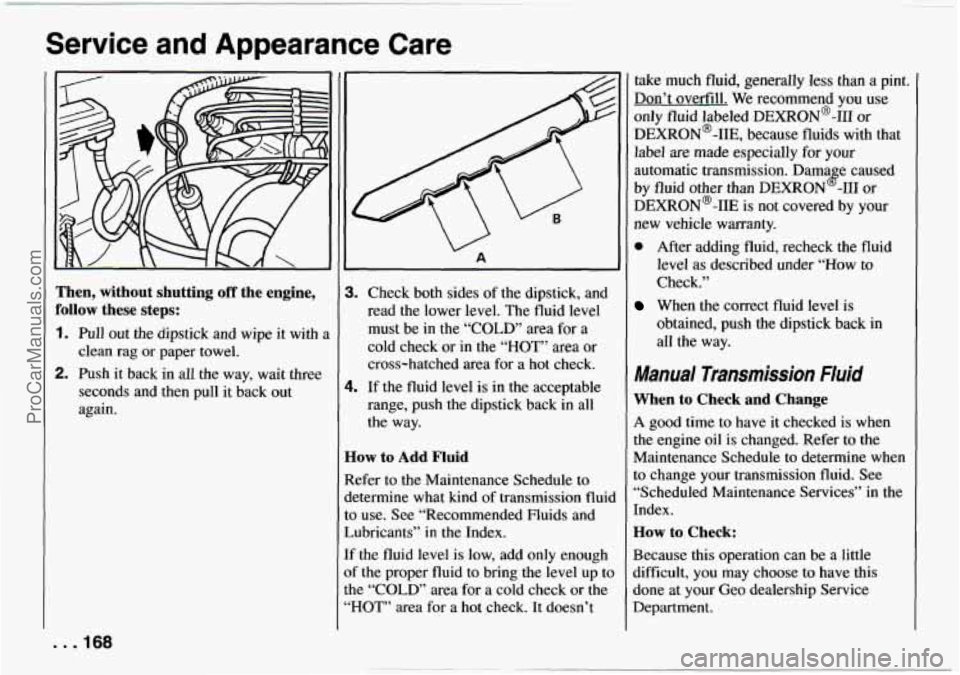
3. Check both sides of the dipstick, and
read the lower level. The fluid level
must be in the “COLD’ area for a
cold check or
in the “HOT” area or
cross-hatched area for a hot check.
4. If the fluid level is in the acceptable
range, push the dipstick back
in all
the way.
How to Add Fluid
Refer to the Maintenance Schedule to
determine what kind of transmission fluid
to use. See “Recommended Fluids and
Lubricants”
in the Index.
[f the fluid level is low, add only enough
of the proper fluid to bring the level up to
the “COLD” area for a cold check or the
“HOT” area for a hot check. It doesn’t take
much fluid, generally less than a
pint.
Don’t overfill. We recommend you use
only fluid labeled DEXRON@-III
or
DEXRON@-IIE, because fluids with that
label are made especially for
your
automatic transmission. Dama e caused
by fluid other than DEXRON
8 -m or
DEXRON@-IIE is not covered by your
new vehicle warranty.
0 After adding fluid, recheck the fluid
level as described under “How to
Check.”
obtained, push
the dipstick back in
all the way.
When the correct fluid level is
Manual Transmission Fluid
When to Check and Change
A good time to have it checked is when
the engine oil is changed. Refer to the
Maintenance Schedule to determine when
to change your transmission fluid. See
“Scheduled Maintenance Services”
in the
Index.
How to Check:
Because this operation can be a little
difficult, you may choose to have this
done at your Geo dealership Service
Department.
ProCarManuals.com
Page 170 of 258

If you do it yourself, be sure to follow all
the instructions here, or you could get a
false reading.
NOTICE:
Too much or too little fluid can
darnage your transmission.
Too much
can mean that some of the tluid could
come out and Pall on hot engine parts
or exhaust system parts, starting a
fire. Be sure to get an accurate read-
ing
if you check your transmission
fluid.
Check the fluid level only when your
engine is
off, the vehicle is parked on a
level place and the transmission is cool
enough for
you to rest your fingers on the
transmission case.
Then, follow these steps:
1. Remove the filler plug.
2. Check that the lubricant level is up to
the bottom
of the filler plug hole.
3. If the fluid level is good, install the
plug and
be sure it is fully seated. If
the fluid level is low, add more fluid
as described in the next steps.
How to Add Fluid:
Here’s how to add tluid. Refer to the
Maintenance Schedule to determine what
kind
of tluid to use. See “Recommended
Fluids and Lubricants”
in the Index.
1. Rernove the filler plug.
2. Add tluid at the filler plug hole. Add
only enough fluid to bring the fluid
level
LIP to the bottom of the filler
plug hole.
3. Install the filler plug. Be sure the plug
is
fully seated.
CIutch Adjustment
The clutch linkage in your vehicle
should be checked
as recommended in
your Maintenance Schedule. To check,
push the clutch pedal down
with your
hand
until you feel some resistance to
movement of the pedal.
If the pedal
moves freely up to an inch
(25 mm) or
so before you feel resistance to the travel,
adjustment isn’t needed.
If there is no free travel or very little
(less than
S/8 of an inch), see your dealer
for adjustment.
Rear Axle
WheR to Check and Change Lubricant
Refer to the Maintenance Schedule to
determine how often to check
the
lubricant and when to change it. See
“Periodic Maintenance Inspections” and
“Scheduled Maintenance Services”
in the
Index.
How to Check Lubricant
If the level is below the bottom of the
filler plug hole, you’ll need to add some
lubricant. Add enough lubricant
to raise
the level
to the bottom of the filler plug
hole.
What to Use:
Refer to the Maintenance Schedule to
determine what
kind 01‘ lubricant to use.
See “Recommended Fluids and
Lubricants”
in the Index.
169 ...
ProCarManuals.com
Page 171 of 258
~~
~~ ~ ~~~~ ~ Service and Appearance Care
Four- Wheel Drive
Most
lubricant checks in this section also
apply to four-wheel-drive vehicles.
However, they have
two additional
systems that need lubricatiog.
Transfer Case
When to Check qnd Change Lubricant
Refer to the Maintenance Schedule to
determine how often to check the
lubricant and when to change
it. See
“Scheduled Maintenance Services”
in the
Index.
How to Check Lubricant
If the level is below the bottom of the
filler plug hole, you’ll need to add some
lubricant. Add enough lubricant to raise
the level to the bottom of the filler plug
hole.
What to Use
Refer to the Maintenance Schedule to
determine what kind of lybricant to use.
See “Recommended Fluids and
Lubricants”
in the Index.
Front Axle
When
to Check and Change Lubricant
Refer to the Maintenance Schedule to a
determine how often to check the
lubricant and when to change it. See
“Periodic Maintenance Inspections” and
“Scheduled Maintenance Services”
in the
Index.
How to Check Lubricant
If the level is below the bottom of the
filler plug hole, you’ll need to add some
lubricant.
If the differential is at operating
temperature (warm), add enough lubricant
to raise the level to the bottom of the filler
plug hole.
If the differential
is cold, add enough
lubricant to raise the level to
1/2 inch (12
mm) below the filler plug hole.
What to Use
Refer to the Maintenance Schedule to
determine
what kind of lubricant to use.
See “Recommended Fluids and
Lubricants”
in the Index.
Engine Coolant
The following explains your cooling
system and how to add coolant when it is
low. If you have a problem with engine
overheating, see “Engine Overheating”
in
the Index.
The proper coolant for your Geo will:
Give freezing protection down to
-20°F (-29”C), or -34°F (-37°C)
in
Canada and for vehicles with the cold
climate option.
Give boiling protection up to 258°F
(125°C).
Protect against rust and corrosion.
Help keep the proper engine
temperature.
Let the warning lights work as they
should.
What to Use:
Use a mixture of one-half clean water
(preferably distilled) and one-half
antifreeze that meets “GM Specification
6038-M,” which won’t damage aluminum
parts.
You can also use a recycled coolant
conforming to
“GM Specification
6038-M”
with a complete coolant flush
. . .I70
ProCarManuals.com
Page 172 of 258
and refill. If you use this mixture. you
don't need to add anything else.
A CAUTION:
Adding only plain water to your
cooling system can
be dangerous.
Plain water, or some other
liquid like
alcohol, can
boil before the proper
coolant mix will. Your vehicle's
cool-
ant warning system is set for the
proper coolant
mix. With plain water
or the wrong mix, your engine could
get too hot but you wouldn't get the
overheat warning. Your engine could
catch fire and you or others could be
burned. Use a 50/50 mix of clean
water and a proper antifreeze.
NOTICE:
If you use an improper coolant mix,
your engine could overheat and be
badly damaged. The repair cost
wouldn't be covered by your war-
ranty.
Too much water in the mix can
freeze and crack the engine, radiator,
heater core and other parts. Some conditions, such
as air
trapped in
the cooling system, can af't'ect the coolant
level
in the radiator. Check the coolant
level when the engine is cold and follow
the steps under "Adding Coolant" for the
proper way
to add coolant.
If you have to add coolant Inore than four
times
a year. have your dealer check your
cooling system.
NOTICE:
If you use the proper coolant. you
don't have to add extra inhibitors
or
additives which claim to improve thc
system. These can
be harmful.
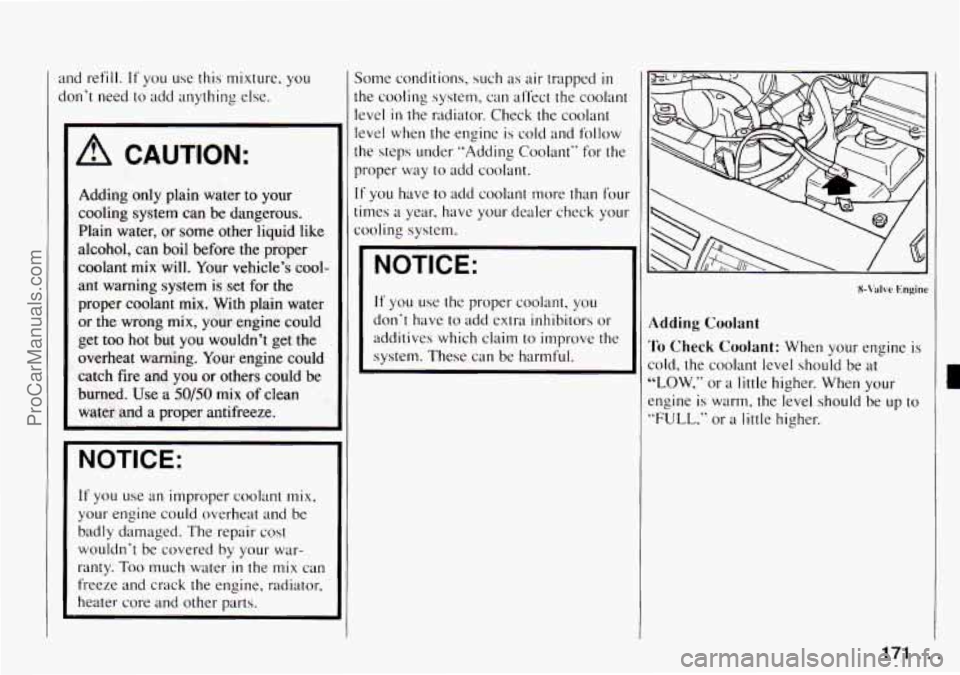
%-Valve Engine
Adding Coolant
To Check Coolant: When your engine is
cold.
the coolant level should be at
"LOW," or a little higher. When your
engine
is warm. the level should be up to
"FULL." or a little higher.
171 ..
ProCarManuals.com
Page 173 of 258

Service and Appearance Care
Radiator Pressure Cap
16-Valve Engine
To Add Coo1ant:If you need to add more
coolant, add the proper mix
qt the coolant
recovery tank. Add
coolant
mix at the recovery tank, but
be careful not to spill it.
NOTICE:
Your radiator cap is a 13 psi (90 kPa)
pressure-type cap and must be tightly
installed to prevent coolant loss and
possible engine damage
from over-
heating.
Be sure the amows on the
cap line up with the overflow tube
on the radiator filler neck.
When you replace
your radiator pressure
zap, an
AC@ cap is recommended.
Thermostat
Engine coolant temperature is controlled
by a thermostat in the engine coolant
system. The thermostat stops the
flow of
coolant through the radiator until the
coolant reaches a preset temperature.
When you replace your thermostat,
an
Ace' thermostat is recommended.
. . .172
ProCarManuals.com