battery CHEVROLET VOLT 2011 User Guide
[x] Cancel search | Manufacturer: CHEVROLET, Model Year: 2011, Model line: VOLT, Model: CHEVROLET VOLT 2011Pages: 516, PDF Size: 6.61 MB
Page 44 of 516

Black plate (8,1)Chevrolet Volt Owner Manual - 2011
2-8 Keys, Doors and Windows
Remote Start
This feature starts the heating or
air conditioning systems and rear
window defogger from outside the
vehicle. Use remote start to heat or
cool the interior when the vehicle
plugged in to maximize the electric
range by utilizing electricity from the
electrical outlet. Normal operation
of the system will return after the
vehicle has been turned on.
B(Remote Start):This button is
on the RKE transmitter.
During remote start:
.The climate control system
will typically default to the last
climate settings. If Fan Off or
Fan Only were selected, the
air conditioning or heat will turn
on as needed. See Automatic
Climate Control System on
page 8‑1 for more information.
.If the vehicle has heated
seats, and this feature has
been enabled through vehicle
personalization, the heated
seats will turn on during
colder outside temperatures.
See“Remote Start Heated
Seats” underHeated Front
Seats on page 3‑6 andVehicle
Personalization on page 5‑53
for additional information.
.The rear defogger will turn
on during colder outside
temperatures.
.Selecting1during colder
outside temperatures before
shutting the vehicle off will
help windshield clearing.
.Shutting the vehicle off in ECO
Mode without
1selected will
minimize the impact to electric
range. Shutting the vehicle off
in other modes will maximize
heating or air conditioning.
.The engine may start to provide
energy for heating and cooling,
independent of the vehicle being
plugged in or completely
charged.
.Vehicle range may decrease
if the vehicle is not plugged
into an electrical outlet. If the
vehicle is plugged in, much of
the energy needed to support
this feature will be provided from
the utility, not from the high
voltage battery.
Laws in some communities
may restrict the use of features
that remotely start the engine.
For example, some laws may
require a person using the remote
start feature to have the vehicle in
view when doing so. Check local
regulations for any requirements
on remote starting of vehicles.
Page 46 of 516

Black plate (10,1)Chevrolet Volt Owner Manual - 2011
2-10 Keys, Doors and Windows
Conditions in Which Remote
Start May Not Work
Conditions in which a remote start
may not occur include:
.An open hood.
.Vehicle propulsion system
fault conditions, including an
emission control system
malfunction.
.High voltage battery fault
conditions.
A second remote start or extension
will not occur if the fuel level is low.
During a remote start, conditions
in which a remote start may be
canceled include:
.Vehicle propulsion system
or high voltage battery fault
conditions.
.Low engine oil pressure.
.Engine coolant temperature that
is too high.
Door Locks
{WARNING
Unlocked doors can be
dangerous.
.Passengers, especially
children, can easily open the
doors and fall out of a moving
vehicle. The chance of being
thrown out of the vehicle in
a crash is increased if the
doors are not locked. So, all
passengers should wear
safety belts properly and
the doors should be locked
whenever the vehicle is
driven. (Continued)
WARNING (Continued)
.Young children who get into
unlocked vehicles may be
unable to get out. A child can
be overcome by extreme heat
and can suffer permanent
injuries or even death from
heat stroke. Always lock the
vehicle whenever leaving it.
.Outsiders can easily enter
through an unlocked door
when slowing or stopping
the vehicle. Lock the doors
to help prevent this from
happening.
To lock or unlock the door, use
the Remote Keyless Entry (RKE)
transmitter or the key from outside
the vehicle. Use the door lock knob
or switch from inside the vehicle.
Page 54 of 516
Black plate (18,1)Chevrolet Volt Owner Manual - 2011
2-18 Keys, Doors and Windows
Express‐Down/Up Windows
Windows with an express-down
or up feature allow the window
to be lowered or raised without
holding the switch. The driver
window has express-down and up;
the passenger and rear windows
have only express-down.
Pull a window switch up or push
it down all the way, release it,
and the window goes up or down
automatically. Stop the window
by pushing or pulling the switch.
Express Window Anti-Pinch
Feature
If any object is in the path of the
window when the express-up is
active, the window will stop at the
obstruction and auto-reverse to apreset factory position. Weather
conditions such as severe icing
may also cause the window to
auto-reverse. The window will
return to normal operation once the
obstruction or condition is removed.
Express Window Anti-Pinch
Override
In an emergency, the anti-pinch
feature can be overridden in a
supervised mode. Hold the window
switch all the way up to the second
position. The window will rise for
as long as the switch is held. Once
the switch is released, the express
mode is re-activated.
In this mode, the window can still
close on an object in its path. Use
care when using the override mode.
Programming the Power
Windows
Programming the power windows
may be necessary if the 12-volt
battery has been disconnected or
discharged.
To program the window:
1. Close all doors with the
vehicle on, or when Retained
Accessory Power (RAP) is
active. See Retained Accessory
Power (RAP) on page 9‑22.
2. Pull the window switch to completely close the window.
Continue to hold the window
switch two seconds after the
window is closed.
3. Repeat for each window.
Page 94 of 516
Black plate (38,1)Chevrolet Volt Owner Manual - 2011
3-38 Seats and Restraints
Servicing the
Airbag-Equipped Vehicle
Airbags affect how the vehicle
should be serviced. There are
parts of the airbag system in
several places around the vehicle.
Your dealer and the service manual
have information about servicing
the vehicle and the airbag system.
To purchase a service manual,
seeService Publications Ordering
Information on page 13‑12.
{WARNING
For up to 10 seconds after the
vehicle is turned off and the
12‐volt battery is disconnected,
an airbag can still inflate during
improper service. You can be
injured if you are close to an
airbag when it inflates. Avoid
yellow connectors. They are
probably part of the airbag
system. Be sure to follow proper
service procedures, and make
sure the person performing work
for you is qualified to do so.
Adding Equipment to the
Airbag-Equipped Vehicle
Q: Is there anything I might add
to or change about the vehicle
that could keep the airbags
from working properly?
A: Yes. If you add things that
change the vehicle's frame,
bumper system, height, front end
or side sheet metal, they may
keep the airbag system from
working properly. Changing or
moving any parts of the front
seats, safety belts, the airbag
sensing and diagnostic module,
steering wheel, instrument
panel, roof-rail airbag modules,
ceiling headliner or pillar garnish
trim, overhead console, front
sensors, side impact sensors,
rollover sensor module, or airbag
wiring can affect the operation of
the airbag system.
Page 121 of 516
Black plate (1,1)Chevrolet Volt Owner Manual - 2011
Instruments and Controls 5-1
Instruments and
Controls
Instrument Panel Overview
Instrument Panel Overview . . . . 5-4
Controls
Steering Wheel Adjustment . . . 5-6
Steering Wheel Controls . . . . . . 5-6
Horn . . . . . . . . . . . . . . . . . . . . . . . . . . 5-7
Windshield Wiper/Washer . . . . . 5-7
Power Outlets . . . . . . . . . . . . . . . . . 5-8
Warning Lights, Gauges, and
Indicators
Warning Lights, Gauges, andIndicators . . . . . . . . . . . . . . . . . . . . 5-9
Instrument Cluster . . . . . . . . . . . . 5-9
Speedometer . . . . . . . . . . . . . . . . 5-15
Odometer . . . . . . . . . . . . . . . . . . . . 5-15
Trip Odometer . . . . . . . . . . . . . . . 5-15
Compass . . . . . . . . . . . . . . . . . . . . 5-16 Battery Gauge (High
Voltage) . . . . . . . . . . . . . . . . . . . . 5-16
Fuel Gauge . . . . . . . . . . . . . . . . . . 5-16
Driver Efficiency Gauge . . . . . . 5-17
Total Vehicle Range . . . . . . . . . 5-17
Safety Belt Reminders . . . . . . . 5-18
Airbag Readiness Light . . . . . . 5-19
Passenger Airbag Status Indicator . . . . . . . . . . . . . . . . . . . . 5-20
Charging System Light (12-Volt Battery) . . . . . . . . . . . . 5-21
Malfunction Indicator Lamp . . . . . . . . . . . . . 5-21
Brake System Warning Light . . . . . . . . . . . . . . . . . . . . . . . 5-24
Electric Parking Brake Light . . . . . . . . . . . . . . . . . . . . . . . 5-25
Service Electric Parking Brake Light . . . . . . . . . . . . . . . . . . . . . . . 5-25
Antilock Brake System (ABS) Warning Light . . . . . . . . . . . . . . 5-26
Sport Mode Light . . . . . . . . . . . . 5-26
Mountain Mode Light . . . . . . . . 5-26 Traction Control System
(TCS)/StabiliTrak
®Light . . . . 5-27
Engine Coolant Temperature Warning Light . . . . . . . . . . . . . . 5-27
Tire Pressure Light . . . . . . . . . . 5-27
Engine Oil Pressure Light . . . . 5-28
Low Fuel Warning Light . . . . . . 5-28
Security Light . . . . . . . . . . . . . . . . 5-29
High-Beam On Light . . . . . . . . . 5-29
Lamps On Reminder . . . . . . . . . 5-29
Cruise Control Light . . . . . . . . . 5-29
Door, Hood, or Hatch Open
Light . . . . . . . . . . . . . . . . . . . . . . . 5-30
Information Displays
Center Stack Display . . . . . . . . 5-31
Power Flows . . . . . . . . . . . . . . . . . 5-31
Charging . . . . . . . . . . . . . . . . . . . . . 5-33
Energy Information . . . . . . . . . . 5-41
Clock . . . . . . . . . . . . . . . . . . . . . . . . 5-42
Driver InformationCenter (DIC) . . . . . . . . . . . . . . . 5-43
Page 122 of 516

Black plate (2,1)Chevrolet Volt Owner Manual - 2011
5-2 Instruments and Controls
Vehicle Messages
Vehicle Messages . . . . . . . . . . . 5-45
Battery and ChargingMessages . . . . . . . . . . . . . . . . . . 5-45
Brake System Messages . . . . 5-46
Cruise Control Messages . . . . 5-46
Door Ajar Messages . . . . . . . . . 5-46
Drive Mode Messages . . . . . . . 5-47
Electric Drive Unit Messages . . . . . . . . . . . . . . . . . . 5-47
Engine Cooling System Messages . . . . . . . . . . . . . . . . . . 5-47
Engine Oil Messages . . . . . . . . 5-48
Fuel System Messages . . . . . . 5-48
Key and Lock Messages . . . . . 5-48
Lamp Messages . . . . . . . . . . . . . 5-49
Object Detection System Messages . . . . . . . . . . . . . . . . . . 5-49
Propulsion Power Messages . . . . . . . . . . . . . . . . . . 5-50 Ride Control System
Messages . . . . . . . . . . . . . . . . . . 5-50
Airbag System Messages . . . . 5-51
Anti-theft Alarm System Messages . . . . . . . . . . . . . . . . . . 5-51
Service Vehicle Messages . . . 5-51
Starting the Vehicle Messages . . . . . . . . . . . . . . . . . . 5-52
Tire Messages . . . . . . . . . . . . . . . 5-52
Vehicle Speed Messages . . . . 5-53
Washer Fluid Messages . . . . . 5-53
Vehicle Personalization
Vehicle Personalization . . . . . . 5-53
Universal Remote System
Universal Remote System . . . 5-60
Universal Remote System Programming . . . . . . . . . . . . . . . 5-60
Universal Remote System Operation . . . . . . . . . . . . . . . . . . 5-63
Page 129 of 516
Black plate (9,1)Chevrolet Volt Owner Manual - 2011
Instruments and Controls 5-9
Remove the cover to access and
replace when not in use.
Certain accessory plugs may
not be compatible with the
accessory power outlet and
could overload vehicle or adapter
fuses. If a problem is experienced,
see your dealer.
When adding electrical equipment,
be sure to follow the installation
instructions included with the
equipment. SeeAdd-On Electrical
Equipment on page 9‑63.
Notice: Hanging heavy
equipment from the power
outlet can cause damage not
covered by the vehicle warranty.
The power outlets are designed
for accessory power plugs only,
such as cell phone charge cords.Warning Lights,
Gauges, and
Indicators
Warning lights and gauges can
signal that something is wrong
before it becomes serious enough
to cause an expensive repair or
replacement. Paying attention to
the warning lights and gauges
could prevent injury.
Warning lights come on when there
could be a problem with a vehicle
function. Some warning lights come
on briefly when the propulsion
system is started to indicate they
are working.
Gauges can indicate when there
could be a problem with a vehicle
function. Often gauges and warning
lights work together to indicate a
problem with the vehicle. When one of the warning lights
comes on and stays on while
driving, or when one of the gauges
shows there may be a problem,
check the section that explains what
to do. Waiting to do repairs can be
costly and even dangerous.
Instrument Cluster
The instrument cluster displays a
preview of information that includes
electric range, charging, odometer,
and battery status. This happens
upon entry when the driver door is
opened, and following the welcome
animation, before starting the
vehicle.
A CHARGING OVERRIDE/
INTERRUPTION OCCURRED
message may display on the lower
left of the screen. This indicates that
an override of the charge settings
by the owner via OnStar has
occurred.
Page 133 of 516
Black plate (13,1)Chevrolet Volt Owner Manual - 2011
Instruments and Controls 5-13
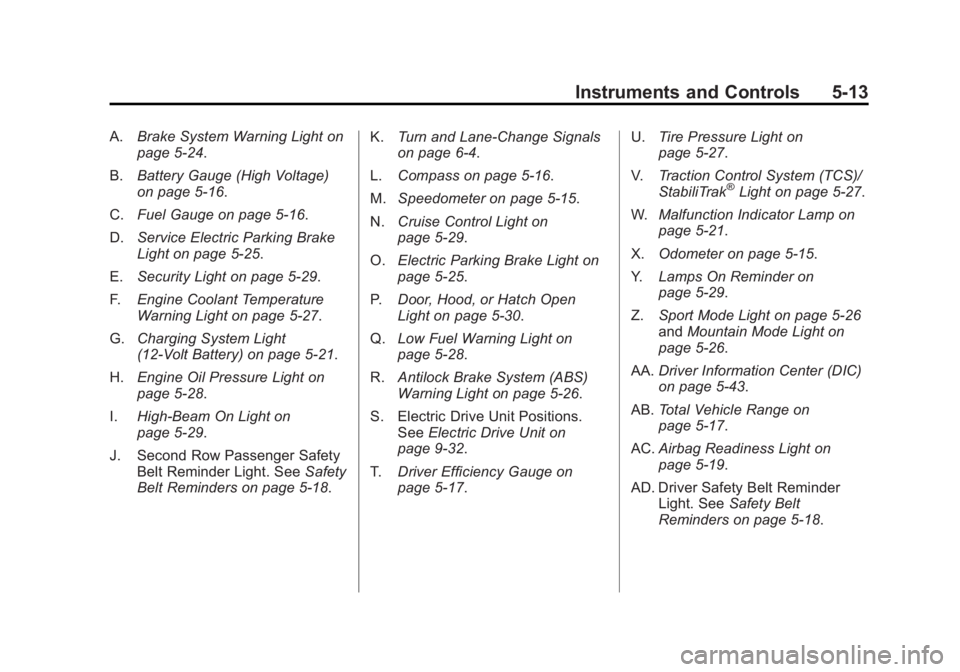
A.Brake System Warning Light on
page 5‑24.
B. Battery Gauge (High Voltage)
on page 5‑16.
C. Fuel Gauge on page 5‑16.
D. Service Electric Parking Brake
Light on page 5‑25.
E. Security Light on page 5‑29.
F. Engine Coolant Temperature
Warning Light on page 5‑27.
G. Charging System Light
(12-Volt Battery) on page 5‑21.
H. Engine Oil Pressure Light on
page 5‑28.
I. High-Beam On Light on
page 5‑29.
J. Second Row Passenger Safety Belt Reminder Light. See Safety
Belt Reminders on page 5‑18. K.
Turn and Lane-Change Signals
on page 6‑4.
L. Compass on page 5‑16.
M. Speedometer on page 5‑15.
N. Cruise Control Light on
page 5‑29.
O. Electric Parking Brake Light on
page 5‑25.
P. Door, Hood, or Hatch Open
Light on page 5‑30.
Q. Low Fuel Warning Light on
page 5‑28.
R. Antilock Brake System (ABS)
Warning Light on page 5‑26.
S. Electric Drive Unit Positions. See Electric Drive Unit on
page 9‑32.
T. Driver Efficiency Gauge on
page 5‑17. U.
Tire Pressure Light on
page 5‑27.
V. Traction Control System (TCS)/
StabiliTrak
®Light on page 5‑27.
W. Malfunction Indicator Lamp on
page 5‑21.
X. Odometer on page 5‑15.
Y. Lamps On Reminder on
page 5‑29.
Z. Sport Mode Light on page 5‑26
and Mountain Mode Light on
page 5‑26.
AA. Driver Information Center (DIC)
on page 5‑43.
AB. Total Vehicle Range on
page 5‑17.
AC. Airbag Readiness Light on
page 5‑19.
AD. Driver Safety Belt Reminder Light. See Safety Belt
Reminders on page 5‑18.
Page 136 of 516
Black plate (16,1)Chevrolet Volt Owner Manual - 2011
5-16 Instruments and Controls
Compass
The vehicle has a compass display
in the instrument cluster above
the speedometer. The compass
receives its heading and other
information from the Global
Positioning System (GPS) antenna
and vehicle speed information.
The compass system has automatic
calibration and zone adjustment
features.
Avoid covering the GPS antenna
for long periods of time with objects
that may interfere with the antenna's
ability to receive a satellite signal.
SeeMulti-Band Antenna on
page 7‑18 for the location of the
vehicle's antenna. The compass
system is designed to operate for a
certain number of miles or degrees
of turn before needing a signal from
the GPS satellites. The compass
system will automatically determine
when a GPS signal is restored and
provide a heading.
Battery Gauge
(High Voltage)
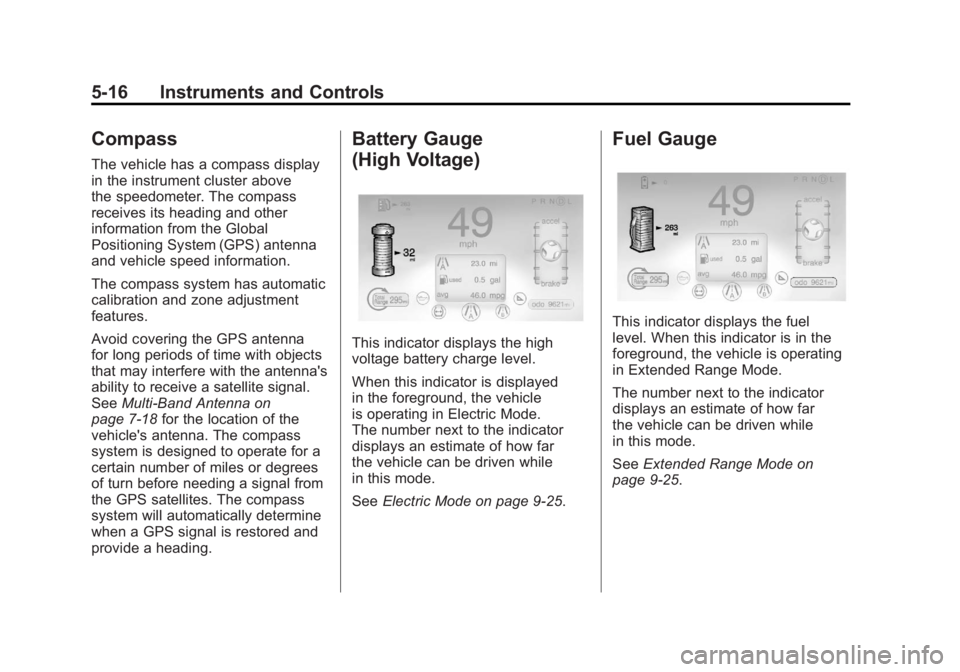
This indicator displays the high
voltage battery charge level.
When this indicator is displayed
in the foreground, the vehicle
is operating in Electric Mode.
The number next to the indicator
displays an estimate of how far
the vehicle can be driven while
in this mode.
See Electric Mode on page 9‑25.
Fuel Gauge
This indicator displays the fuel
level. When this indicator is in the
foreground, the vehicle is operating
in Extended Range Mode.
The number next to the indicator
displays an estimate of how far
the vehicle can be driven while
in this mode.
SeeExtended Range Mode on
page 9‑25.
Page 141 of 516
Black plate (21,1)Chevrolet Volt Owner Manual - 2011
Instruments and Controls 5-21
If, after several seconds, both
status indicator lights remain on,
or if there are no lights at all, there
may be a problem with the lights
or the passenger sensing system.
See your dealer for service.
{WARNING
If the airbag readiness light ever
comes on and stays on, it means
that something may be wrong
with the airbag system. To help
avoid injury to yourself or others,
have the vehicle serviced right
away. SeeAirbag Readiness
Light on page 5‑19 for more
information, including important
safety information.
Charging System Light
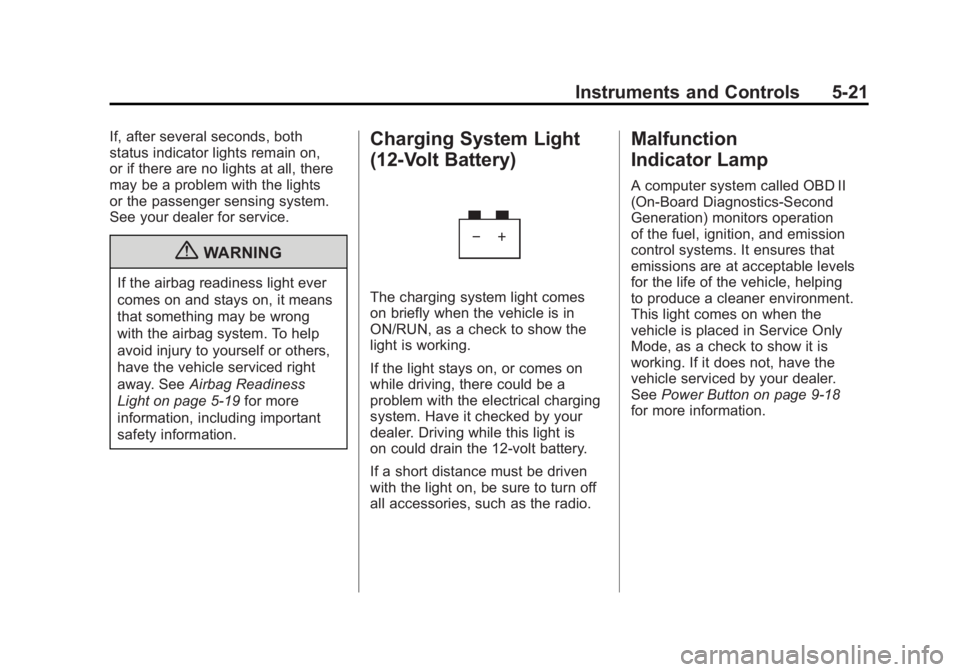
(12-Volt Battery)
The charging system light comes
on briefly when the vehicle is in
ON/RUN, as a check to show the
light is working.
If the light stays on, or comes on
while driving, there could be a
problem with the electrical charging
system. Have it checked by your
dealer. Driving while this light is
on could drain the 12‐volt battery.
If a short distance must be driven
with the light on, be sure to turn off
all accessories, such as the radio.
Malfunction
Indicator Lamp
A computer system called OBD II
(On-Board Diagnostics-Second
Generation) monitors operation
of the fuel, ignition, and emission
control systems. It ensures that
emissions are at acceptable levels
for the life of the vehicle, helping
to produce a cleaner environment.
This light comes on when the
vehicle is placed in Service Only
Mode, as a check to show it is
working. If it does not, have the
vehicle serviced by your dealer.
See Power Button on page 9‑18
for more information.