lock CHRYSLER 300 2005 1.G Repair Manual
[x] Cancel search | Manufacturer: CHRYSLER, Model Year: 2005, Model line: 300, Model: CHRYSLER 300 2005 1.GPages: 374, PDF Size: 6.8 MB
Page 196 of 374

Mode Selection
The mode selector (the right rotary
knob) can be placed in several posi-
tions. Dots between each of the mode
selections identify intermediate modes
that allow the occupants to fine tune
airflow distribution.
Defrost
Air is directed to the windshield through the
outlets at the base of the windshield. Air is also
directed to the front door windows through the side
window demister grilles.
NOTE:
To improve fuel economy, leave in defrost only
when necessary.
Defrost/Floor
Air flows through the front and rear floor outlets
and the outlets at the base of the windshield. Air
is also directed to the front door windows
through the side window demister grilles.Floor
Air flows through the floor outlets located under
the instrument panel and into the rear seating
area through vents under the front seats.
Bi-Level
Air flows both through the outlets located in the
instrument panel and those located on the floor.
Air flows through the registers in the back of the
center console to the rear seat passengers. These
registers can be closed to partially block airflow.
Panel
Air flows through the outlets located in the instru-
ment panel. Air flows through the registers in the
back of the center console to the rear seat passengers.
These registers can be closed to block airflow.
Recirculation
The recirculation feature can be selected with
the mode control knob. You may choose
between Bi-Level Recirculation and Panel
Recirculation air outlets while in this mode.
Normally, air enters from outside the vehicle. How-
ever, when in Recirculation mode air inside the vehicle
196 UNDERSTANDING YOUR INSTRUMENT PANEL
Page 197 of 374

is re-used. Use this mode to rapidly cool the inside of
the vehicle. The Recirculation mode can also be used
to temporarily block out outside odors, smoke, and
dust.
Window Fogging
Interior fogging on the windshield can be quickly re-
moved by turning the mode selector to Defrost. The
Defrost/Floor mode can be used to maintain a clear
windshield and provide sufficient heating. If side win-
dow fogging becomes a problem increase blower speed.
Vehicle windows tend to fog on the inside in mild but
rainy or humid weather.
NOTE:Recirculate without A/C should not be used for
long periods as fogging may occur.
Automatic Temperature Control Ð If Equipped
The Infrared Dual-Zone Climate Control System auto-
matically maintains the interior comfort level desired by
the driver and passenger. This is accomplished by a dual
sun-sensor in the top of the instrument panel, and an
infrared sensor located in the face of the control unit.
There are also various sensors monitored by this system
which take account for vehicle speed, A/C pressure,outside temperature, and engine cooling temperature.
The infrared sensor independently measures the surface
temperature of the driver and passenger. Based on the
sensor input, the system automatically adjusts the air
flow temperature, the air flow volume, and amount of
outside air recirculation. This maintains a comfortable
temperature even under changing conditions.
Operation of the system is quite simple. Begin by turning
the right mode knob to AUTO, and place the blower
control (left knob) to either LO AUTO or HI AUTO. The
UNDERSTANDING YOUR INSTRUMENT PANEL 197
4
Page 201 of 374

The operator can override the AUTO mode setting and
select the direction of the air by rotating the right mode
knob to one of the following positions.
²Defrost
Air is directed to the windshield through the
outlets at the base of the windshield. Air is
also directed to the front door windows through the
side window demister grilles.
²
Defrost/Floor
Air flows through the front and rear floor
outlets and the outlets at the base of the
windshield. Air is also directed to the front
door windows through the side window demister
grilles.
²
Floor
Air flows through the floor outlets located
under the instrument panel and into the rear
seating area through vents under the front seats.
²
Bi-Level
Air flows both through the outlets located in
the instrument panel and those located on thefloor. Air flows through the registers in the back of
the center console to the rear seat passengers. These
registers can be closed to block airflow.
²
Panel
Air flows through the outlets located in the
instrument panel. Air flows through the regis-
ters in the back of the center console to the rear seat
passengers. These registers can be closed to block
airflow.
Depress this button to turn on and off the air
conditioning during manual operation only. Con-
ditioned outside air is then directed through the
outlets selected on the mode control dial. The button
includes an LED that illuminates when manual operation
is selected, and will cause an audible beep.
NOTE:To manually control the air conditioning the
mode selector must be moved out of the AUTO position.
Press this button to turn on the rear window
defroster and the heated side mirrors (if
equipped). An LED in the button will illuminate and an
audible beep indicates that the rear window defroster is
UNDERSTANDING YOUR INSTRUMENT PANEL 201
4
Page 202 of 374

ON. The defroster automatically turns off after approxi-
mately 10 minutes of operation for the first push of the
button, and will turn off after approximately 5 minutes
for the second push of the button.
CAUTION!
To avoid damaging the electrical conductors of the
rear window defroster, do not use scrapers, sharp
instruments, or abrasive window cleaners on the
interior surface of the window.
Labels can be peeled off after soaking with warm
water.
This button can be used to block out smoke,
odors, dust, high humidity, or if rapid cooling
is desired. The recirculation mode should only
be used temporarily. The button includes an
LED that illuminates, and an audible beep indicates that
the recirculation mode is active. You may use this feature
separately.
NOTE:Extended use of recirculation may cause the
windows to fog. If the interior of the windows begins to
fog, press the ªRecirculateº icon button to return to
outside air. Some temp./humidity conditions will cause
captured interior air to condense on windows and ham-
per visibility. For this reason, the system will not allow
ªRecirculateº to be selected while in the defrost or
defrost/floor modes. Attempting to use the recirculation
while in these modes will cause the LED in the button to
blink and then turn off.
Summer Operation
The engine cooling system in air conditioned vehicles
must be protected with a high-quality antifreeze coolant
to provide proper corrosion protection and to protect
against engine overheating. A 50% solution of ethylene
glycol antifreeze coolant in water is recommended. Refer
to section 7, Maintenance Procedures, of this manual for
proper coolant selection.
202 UNDERSTANDING YOUR INSTRUMENT PANEL
Page 205 of 374

STARTING AND OPERATING
CONTENTS
mStarting Procedures....................207
NNormal Starting......................207
mEngine Block Heater Ð If Equipped........209
mTransmission Shifting...................209
N4 Speed Automatic Transmission..........209
N5 Speed Automatic Transmission..........214
NAutomatic Transmission Ð General
Information.........................219
mAutoStick Ð If Equipped................222
NAutoStick Operation...................222
mParking Brake.........................222
mBrake System.........................224NAnti-Lock Brake System................225
mPower Steering........................227
mTire Safety Information..................228
NTire Markings........................228
NTire Identification Number (TIN)..........231
NTire Loading And Tire Pressure...........232
mTiresÐGeneral Information...............236
NTire Pressure.........................236
NTire Inflation Pressures.................237
NRadial-Ply Tires......................239
NCompact Spare Tire Ð If Equipped.........239
NTire Spinning........................240
5
Page 207 of 374
STARTING PROCEDURES
CAUTION!
Long periods of engine idling, especially at high
engine speeds, can cause excessive exhaust tempera-
tures which can damage your vehicle. Do not leave
your vehicle unattended with the engine running.
WARNING!
Do not leave animals or children inside parked
vehicles in hot weather; interior heat build up may
cause serious injury or death.
The gear selector must be in the NEUTRAL or PARK
position before you can start the engine. Apply the brakes
before shifting into any driving gear.
Normal Starting
Normal Startingof either a cold or a warm engine is
obtained without pumping or depressing the accelerator
pedal. Turn the key to the ªSTARTº position and release
when the engine starts. If the engine has not started
within 3 seconds, slightly depress the accelerator pedal
while continuing to crank. If the engine fails to start
within 15 seconds, turn the key to the ªOFFº position,
wait 10 to 15 seconds, then repeat the normal starting
procedure.
Extremely Cold Weather(below220ÉF or229ÉC) To
insure reliable starting at these temperatures, use of an
externally powered electric engine block heater (available
from your dealer) is recommended.
STARTING AND OPERATING 207
5
Page 209 of 374
After Starting
The idle speed will automatically decrease as the engine
warms up.
ENGINE BLOCK HEATER Ð IF EQUIPPED
The engine block heater warms engine coolant and
permits quicker starts in cold weather. Connect the cord
to a standard 110-115 volt AC electrical outlet with a
grounded, three-wire extension cord.
The engine block heater cord is routed under the hood on
the driver side of the vehicle. It has a removable cap that
is located on the driver side of the Integrated Power
Module.
WARNING!
Remember to disconnect the cord before driving.
Damage to the 110-115 volt electrical cord could
cause electrocution.
TRANSMISSION SHIFTING
4 Speed Automatic Transmission
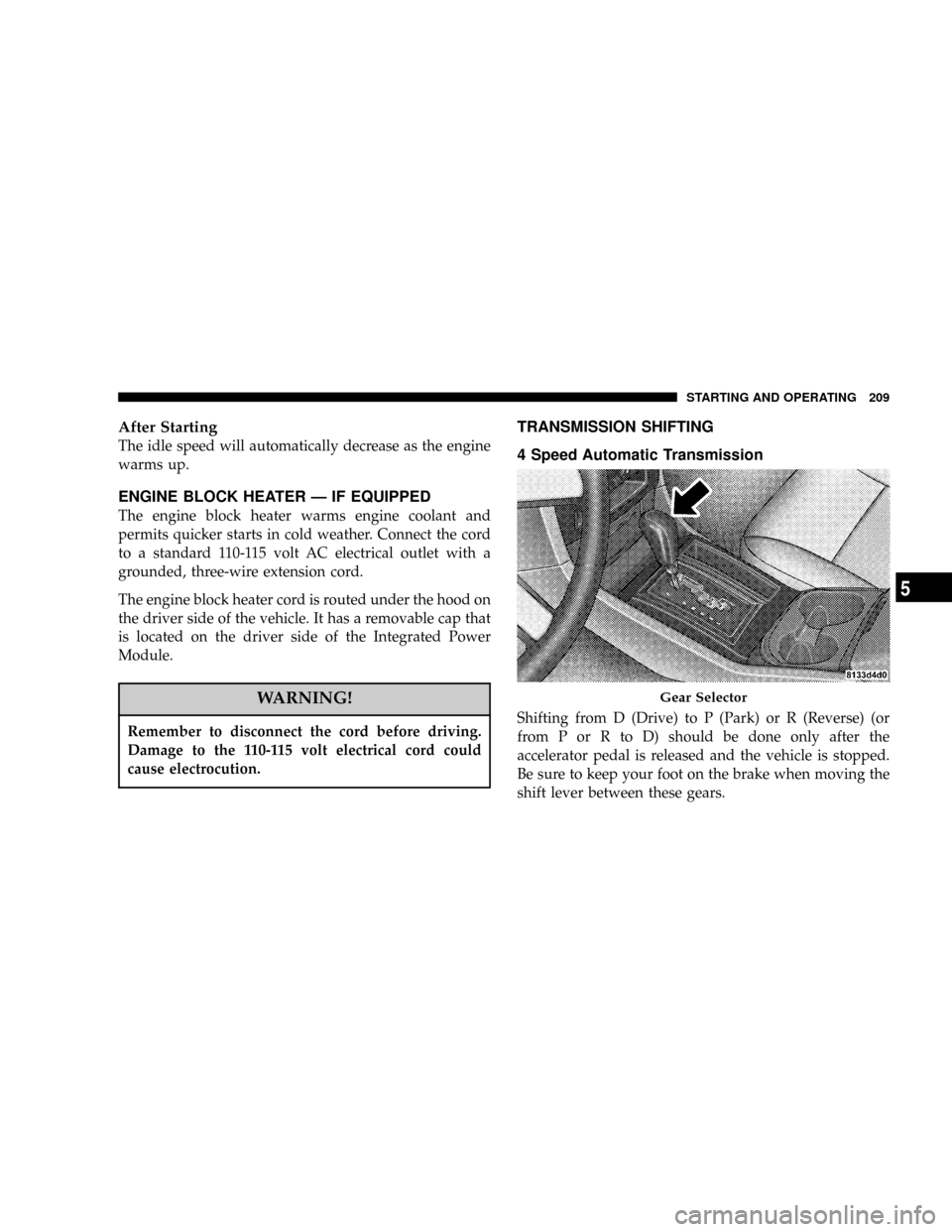
Shifting from D (Drive) to P (Park) or R (Reverse) (or
from P or R to D) should be done only after the
accelerator pedal is released and the vehicle is stopped.
Be sure to keep your foot on the brake when moving the
shift lever between these gears.
Gear Selector
STARTING AND OPERATING 209
5
Page 210 of 374
WARNING!
It is dangerous to shift the selector lever out of ªPº or
ªNº if the engine speed is higher than idle speed. If
your foot is not firmly on the brake pedal, the
vehicle could accelerate quickly forward or in re-
verse. You could lose control of the vehicle and hit
someone or something. Only shift into gear when
the engine is idling normally and when your right
foot is firmly on the brake pedal.
Gear Ranges
P (Park)
Supplements the parking brake by locking the trans-
mission. The engine can be started in this range. Never
use P (Park) while the vehicle is in motion. Apply the
parking brake when leaving the vehicle in this range.
Always apply the parking brake first, and then place
the selector in P (Park) position.
WARNING!
Unintended movement of a vehicle could injure
those in and near the vehicle. As with all vehicles,
you should never exit a vehicle while the engine is
running. Before exiting a vehicle, you should always
shift the vehicle into P (Park), remove the key from
the ignition, and apply the parking brake. Once the
key is removed from the ignition, the transmission
shift lever is locked in the P (Park) position, securing
the vehicle against unwanted movement. Further-
more, you should never leave children unattended
inside a vehicle.
The following indicators should be used to ensure that
you have engaged the transmission shift lever into the P
(Park) position:
²When shifting into P (Park) move the lever all the way
forward until it stops, and is fully seated.
²Look at the shift indicator display on the instrument
panel to ensure it is in the P (Park) position.
210 STARTING AND OPERATING
Page 211 of 374
CAUTION!
Before moving the shift lever out of P (Park), you
must turn the ignition from LOCK to ON so the shift
lever is released. Otherwise, damage to the shifter
could result.
R (Reverse)
For moving the vehicle rearward. Always stop before
moving the lever to R (Reverse), except when rocking
the vehicle.
N (Neutral)
Engine may be started in this range.
WARNING!
Do not coast in N (Neutral) and never turn off the
ignition to coast down a hill. These are unsafe
practices that limit your response to changing traffic
or road conditions. You might lose control of the
vehicle.
D (Overdrive)
This range should be used for most city and highway
driving. It provides smoothest up shifts and down
shifts and best fuel economy. Select the ª3º range
when frequent transmission shifting occurs when us-
ing the Overdrive range, such as when operating the
vehicle under heavy loading conditions (in hilly ter-
rain, traveling into strong head winds, or while tow-
ing heavy trailers.
NOTE:
If the vehicle is started in cold outside tempera-
tures, shifts into Overdrive may be delayed. Normal
Overdrive and shifting operation will resume when the
temperature of the transmission reaches the appropriate
temperature. Refer to the ªNoteº under ªTorque Con-
verter Clutchº later in this section.
If the transmission temperature gets too hot, the
transmission may downshift out of Overdrive or en-
gage overdrive at higher vehicle speeds until the
transmission cools down. After cooldown, Overdrive
will resume normal operation.
STARTING AND OPERATING 211
5
Page 213 of 374

NOTE:
²
The torque converter clutch will not engage until the
transmission fluid and engine coolant is warm (usu-
ally after 1±3 miles (1.6±4.8 km) of driving). Because
engine speed is higher when the torque converter
clutch is not engaged, it may seem as if the transmis-
sion is not shifting into ªOverdriveº when cold. This is
considered a normal condition. Pulling the shift lever
into the ª3º position will show that the transmission is
able to shift into and out of ªOverdrive.º
²If the vehicle has not been driven for several days, the
first few seconds of operation after shifting the trans-
mission into gear may seem sluggish. This is due to the
transmission fluid partially draining from the torque
converter into the transmission. This is considered a
normal condition and will not cause damage to the
transmission. The torque converter will refill within 5
seconds of shifting from P (Park) into any other gear
position.
Transmission Limp Home Mode
The transmission is monitored for abnormal conditions.
If a condition is detected that could cause damage, the
transmission automatically shifts into second gear. The
transmission remains in second gear despite the forward
gear selected. Park (P), Reverse (R), and Neutral (N) will
continue to operate. This Reset feature allows the vehicle
to be driven to a dealer for service without damaging the
transmission.
If the problem has been momentary, the transmission can
be reset to regain all forward gears.
²Stop the vehicle and shift into PARK (P).
²Turn the key to LOCK then start the engine.
²Shift into ªDº and resume driving.
NOTE:Even if the transmission can be reset, we
recommend that you visit a dealer at your earliest
possible convenience. Your dealer has diagnostic equip-
ment to determine if the problem could recur.
If the transmission cannot be reset, dealer service is
required.
STARTING AND OPERATING 213
5