service CHRYSLER VOYAGER 1996 Service Manual
[x] Cancel search | Manufacturer: CHRYSLER, Model Year: 1996, Model line: VOYAGER, Model: CHRYSLER VOYAGER 1996Pages: 1938, PDF Size: 55.84 MB
Page 427 of 1938
VEHICLE SPEED CONTROL SYSTEM
CONTENTS
page
GENERAL INFORMATION
INTRODUCTION........................ 1
GENERAL INFORMATION
INTRODUCTION
This group covers both Left-Hand Drive (LHD) and
Right-Hand Drive (RHD) versions of this model.
Whenever feasible, the RHD versions of affected
vehicle components have been constructed as mirror-
image of the LHD versions. While most of the illus-
trations used in this group represent only the LHD
version, the diagnostic and service procedures out-
lined can generally be applied to either version.
Exceptions to this rule have been clearly identified as
LHD or RHD, if a special illustration or procedure
was/is required.
The speed control system used with the 2.5L diesel
engine is basically identical to the system used with
gasoline powered engines. Features unique to the
diesel engine will be covered in this section.
²Models equipped with the 2.5L diesel engine do
not use a vacuum reservoir to retain engine vacuum
for speed control operation. There are no vaccum-op-
erated speed control servos used in vehicles with the
2.5L diesel engine.
²The range of the speed control system operation
is restricted to speeds between 56 km/h (35 MPH) to
145 km/h (90 MPH).
²Inputs to the MSA that allow speed control oper-
ation are from the vehicle speed sensor and the
Speed Control Switch.²Two separate speed control switch modules are
mounted on the steering wheel to the left and right
side of the driver's airbag module. Switch features
are:
a. Within the two switch modules, fivemomen-
tarycontact switches, supporting seven different
speed control functions are used.
b. The outputs from these switches are filtered
into one input. The MSA determines which output
has been applied throughresistive multiplexing.
The input circuit voltage is measured by the MSA
to determine which switch function has been
selected.
c. A speed control indicator lamp, located on the
instrument panel cluster is energized by the MSA
via the CCD Bus. This occurs when speed control
system power has been turned ON, and the engine
is running.
d. The two switch modules are labeled: ON/OFF,
SET, RESUME/ACCEL, CANCEL and COAST.
Refer to the owner's manual for more information
on speed control switch functions and setting pro-
cedures. The individual switches cannot be
repaired. If one individual switch fails, the switch
module must be replaced.
NS/GSVEHICLE SPEED CONTROL SYSTEM 8H - 1
Page 439 of 1938
REMOVAL AND INSTALLATION
MULTI-FUNCTION SWITCH
WARNING: BEFORE SERVICING A STEERING COL-
UMN EQUIPPED WITH AN AIRBAG REFER TO
GROUP 8M, RESTRAINT SYSTEMS FOR PROPER
AND SAFE SERVICE PROCEDURES.
REMOVAL
(1) Release hood latch and open hood.
(2) Disconnect and isolate battery negative cable.
(3) Remove upper and lower steering column
shrouds, refer to Group 19, Steering for proper pro-
cedures.
(4) Disconnect wire connector from back of turn
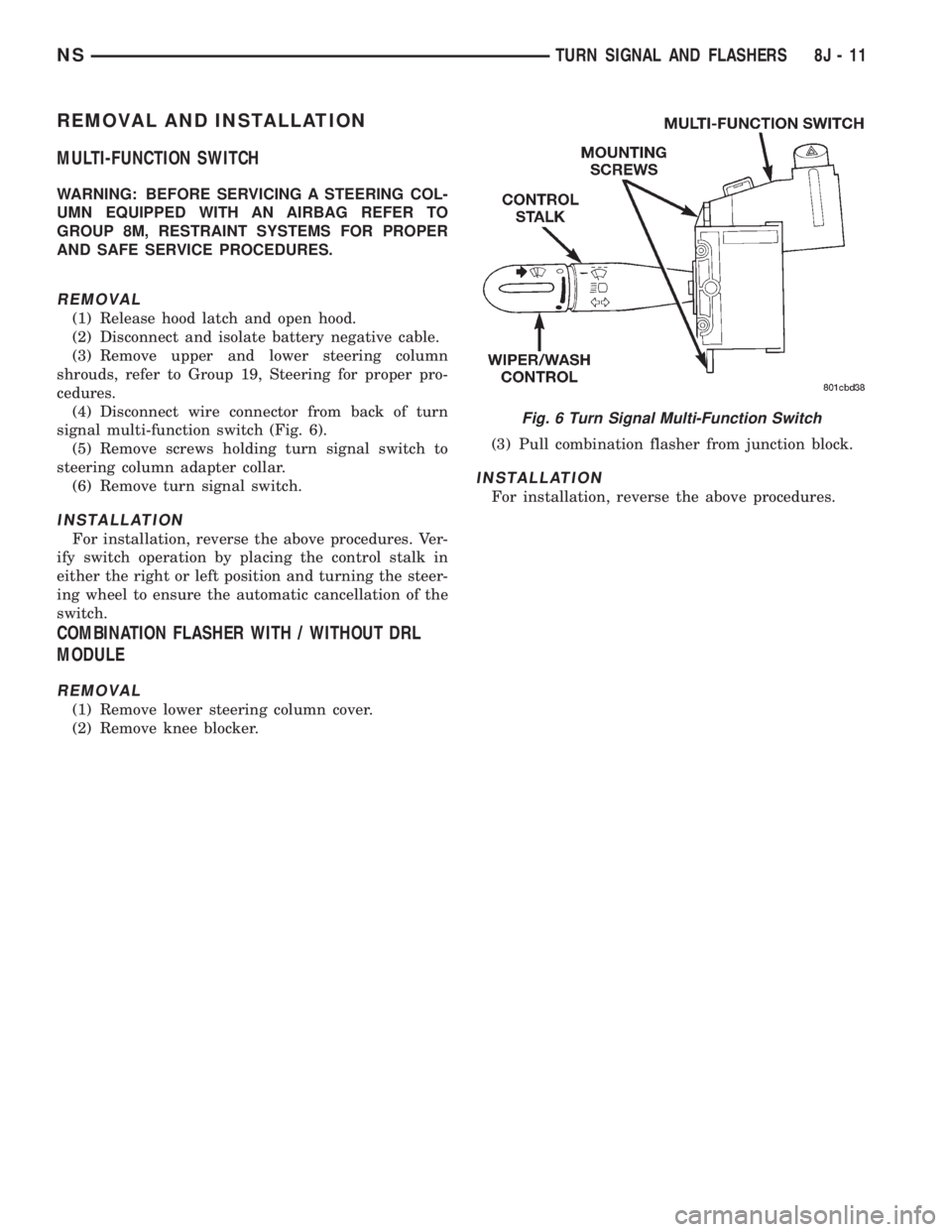
signal multi-function switch (Fig. 6).
(5) Remove screws holding turn signal switch to
steering column adapter collar.
(6) Remove turn signal switch.
INSTALLATION
For installation, reverse the above procedures. Ver-
ify switch operation by placing the control stalk in
either the right or left position and turning the steer-
ing wheel to ensure the automatic cancellation of the
switch.
COMBINATION FLASHER WITH / WITHOUT DRL
MODULE
REMOVAL
(1) Remove lower steering column cover.
(2) Remove knee blocker.(3) Pull combination flasher from junction block.
INSTALLATION
For installation, reverse the above procedures.
Fig. 6 Turn Signal Multi-Function Switch
NSTURN SIGNAL AND FLASHERS 8J - 11
Page 444 of 1938
MULTI-FUNCTION SWITCH
To test the windshield wiper and washer portion of
the multi-function switch:
(1) Remove the multi-function switch, refer to
removal procedures.
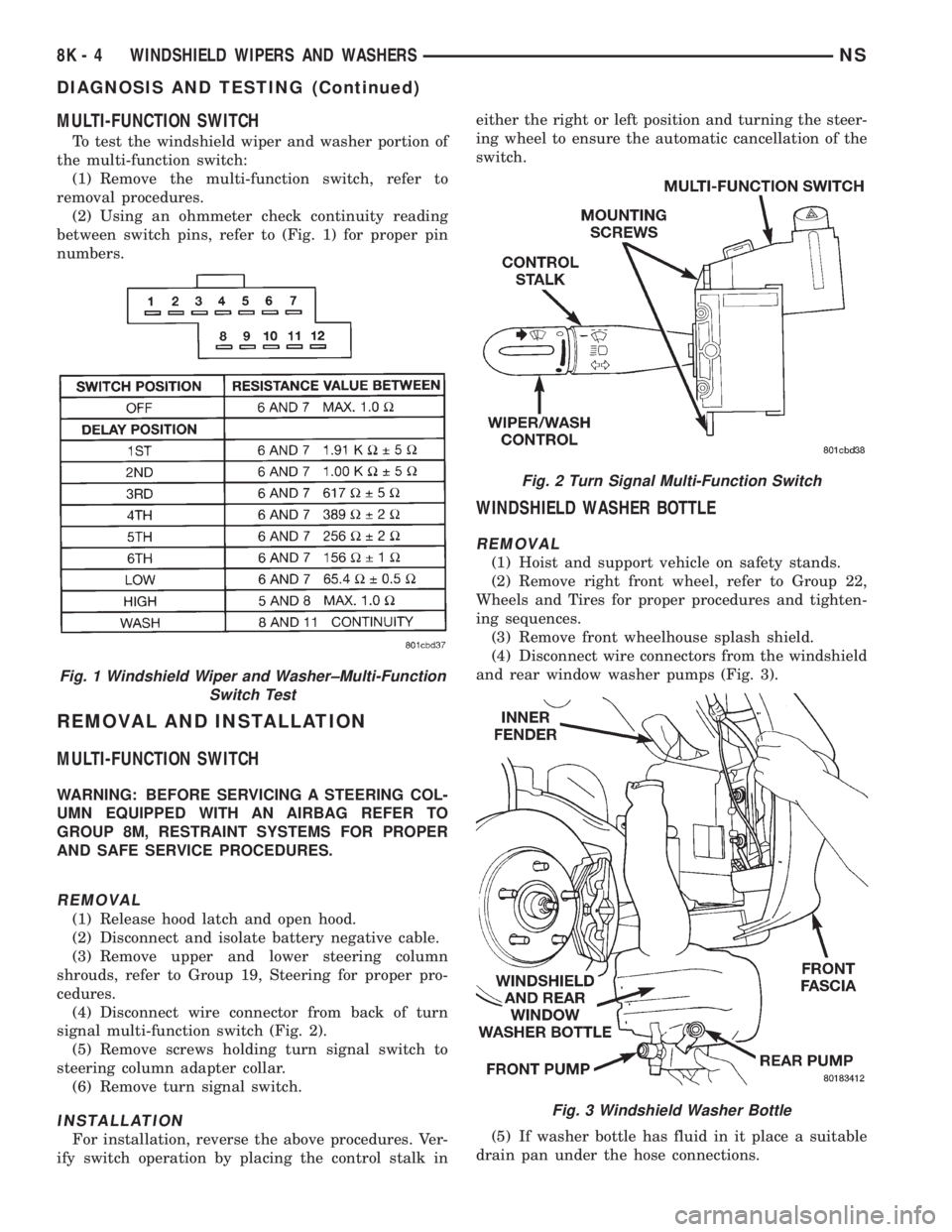
(2) Using an ohmmeter check continuity reading
between switch pins, refer to (Fig. 1) for proper pin
numbers.
REMOVAL AND INSTALLATION
MULTI-FUNCTION SWITCH
WARNING: BEFORE SERVICING A STEERING COL-
UMN EQUIPPED WITH AN AIRBAG REFER TO
GROUP 8M, RESTRAINT SYSTEMS FOR PROPER
AND SAFE SERVICE PROCEDURES.
REMOVAL
(1) Release hood latch and open hood.
(2) Disconnect and isolate battery negative cable.
(3) Remove upper and lower steering column
shrouds, refer to Group 19, Steering for proper pro-
cedures.
(4) Disconnect wire connector from back of turn
signal multi-function switch (Fig. 2).
(5) Remove screws holding turn signal switch to
steering column adapter collar.
(6) Remove turn signal switch.
INSTALLATION
For installation, reverse the above procedures. Ver-
ify switch operation by placing the control stalk ineither the right or left position and turning the steer-
ing wheel to ensure the automatic cancellation of the
switch.
WINDSHIELD WASHER BOTTLE
REMOVAL
(1) Hoist and support vehicle on safety stands.
(2) Remove right front wheel, refer to Group 22,
Wheels and Tires for proper procedures and tighten-
ing sequences.
(3) Remove front wheelhouse splash shield.
(4) Disconnect wire connectors from the windshield
and rear window washer pumps (Fig. 3).
(5) If washer bottle has fluid in it place a suitable
drain pan under the hose connections.
Fig. 1 Windshield Wiper and Washer±Multi-Function
Switch Test
Fig. 2 Turn Signal Multi-Function Switch
Fig. 3 Windshield Washer Bottle
8K - 4 WINDSHIELD WIPERS AND WASHERSNS
DIAGNOSIS AND TESTING (Continued)
Page 449 of 1938
REAR WIPER AND WASHER
INDEX
page page
DESCRIPTION AND OPERATION
INTRODUCTION......................... 9
REAR WINDOW WIPER/WASHER SWITCHES . . . 9
DIAGNOSIS AND TESTING
DIAGNOSTIC PROCEDURES................ 9
REMOVAL AND INSTALLATION
REAR GLASS RUBBER GROMMET........... 9REAR WINDOW WIPER MOTOR............ 10
REAR WIPER ARM...................... 10
REAR WIPER BLADE ELEMENT............ 10
REAR WIPER BLADE..................... 10
DESCRIPTION AND OPERATION
INTRODUCTION
When continuous rear wiper operation is required,
the Body Control Module (BCM) will provide ignition
ON voltage to the rear wiper motor. When the wiper
switch is turned OFF, the BCM provides circuit
ground to operate the motor until the wipe cycle is
complete and the wiper arm returns to the base of
the rear window.
When intermittent rear wiper mode is selected, the
wiper motor will cycle every 7 seconds. The intermit-
tent delay time is also adjusted based upon vehicle
speed. With the vehicle traveling greater at 50 mph,
the cycle changes to every 5 seconds.
REAR WINDOW WIPER/WASHER SWITCHES
The rear window wiper/washer switches are incor-
porated into the HVAC switch panel. Refer to Group
8E, Instrument Panel for proper service procedures.
DIAGNOSIS AND TESTING
DIAGNOSTIC PROCEDURES
The rear window wiper system operates in several
modes:
²Continuous wipe
²Intermittent wipe
²Wash
²Wipe after wash
The windshield wiper circuits are continuously
monitored and controlled by the Body Control Mod-
ule (BCM). If a problem occurs in the electronic com-
ponents, wiring, switch (except integral motor park
switch) and wiper motor a Diagnostic Trouble Code
(DTC) will be stored in the BCM memory. The
DTC(s) can be retrieved using a scan tool (DRB).
Refer to proper Body Diagnostic Procedures manual
for DTC descriptions and retrieval information.
REMOVAL AND INSTALLATION
REAR GLASS RUBBER GROMMET
REMOVAL
(1) Remove rear window wiper motor.
(2) Peel wiper pivot seal grommet from rear glass.
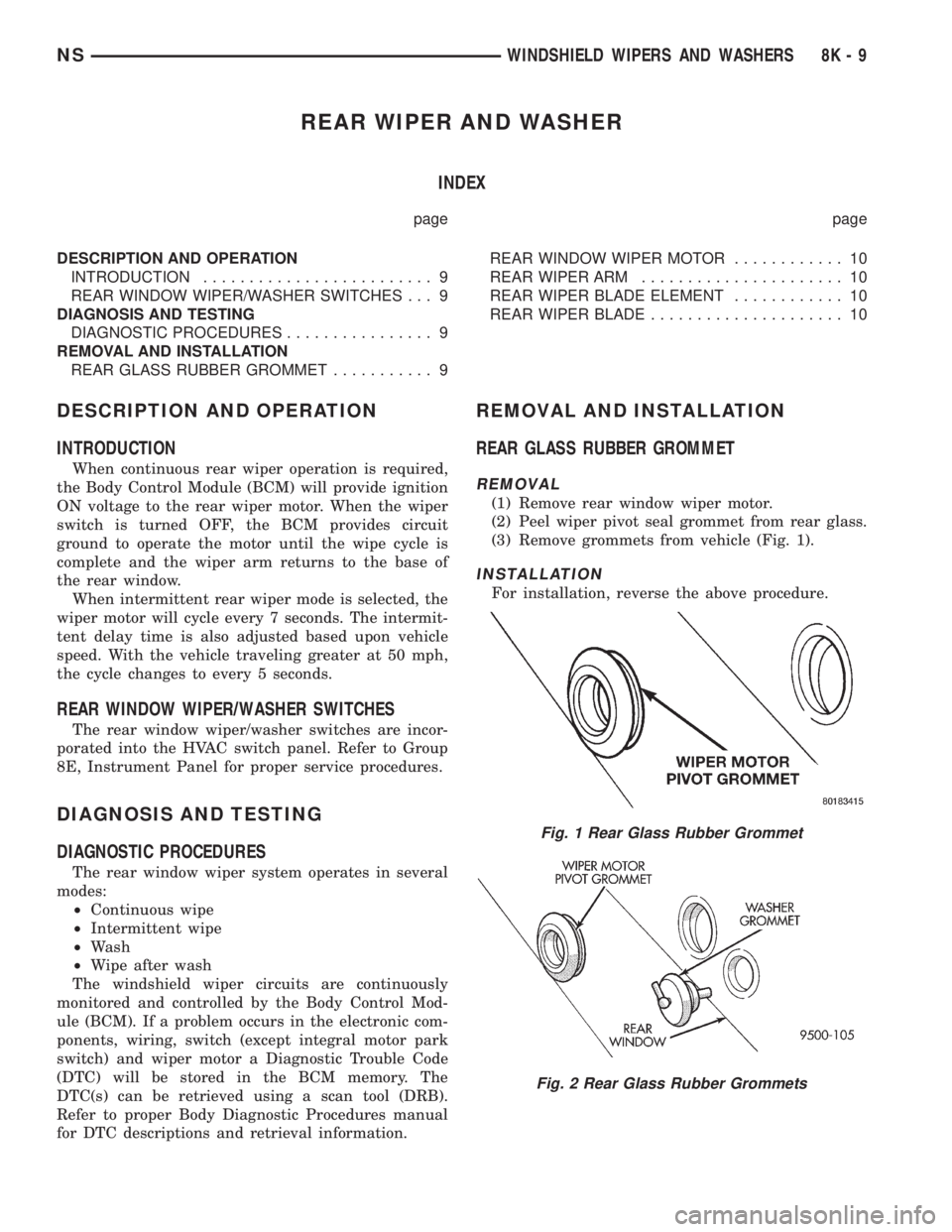
(3) Remove grommets from vehicle (Fig. 1).
INSTALLATION
For installation, reverse the above procedure.
Fig. 1 Rear Glass Rubber Grommet
Fig. 2 Rear Glass Rubber Grommets
NSWINDSHIELD WIPERS AND WASHERS 8K - 9
Page 453 of 1938

LAMPS
CONTENTS
page page
BULB APPLICATION...................... 25
EXTERIOR LAMP BULB SERVICE............ 9
EXTERIOR LAMP SERVICE................. 14HEADLAMP ALIGNMENT................... 5
INTERIOR LAMPS........................ 18
LAMP DIAGNOSIS........................ 1
LAMP DIAGNOSIS
INDEX
page page
GENERAL INFORMATION
ELECTRONIC DAYTIME RUNNING LIGHT (DRL).1
GENERAL INFORMATION.................. 1SAFETY PRECAUTIONS................... 1
DIAGNOSIS AND TESTING
DIAGNOSTIC PROCEDURES................ 2
GENERAL INFORMATION
GENERAL INFORMATION
NS vehicles use lighting on the interior and exte-
rior of the vehicle for illuminating and indicating
purposes. Lighting circuits are protected by fuses.
Lighting circuits require an overload protected power
source, on/off device, lamps and body ground to oper-
ate properly. Plastic lamps require a wire in the har-
ness to supply body ground to the lamp socket.
Replace sockets and bulbs that are corroded.
Some of the interior and exterior lighting functions
are governed by the body controller. The headlamp,
dome, and the door ajar switches provide signals to
the body controller. The body controller in turn acti-
vates relay(s) in order to provide either a ground or
feed line to the appropriate lamp(s).
Wire connectors can make intermittent contact or
become corroded. Before coupling wire connectors,
inspect the terminals inside the connector. Male ter-
minals should not be bent or disengaged from the
insulator. Female terminals should not be sprung
open or disengaged from the insulator. Bent and
sprung terminals can be repaired using needle nose
pliers and pick tool. Corroded terminals appear
chalky or green. Corroded terminals should be
replaced to avoid recurrence of the problem symp-
toms.
Begin electrical system failure diagnosis by testing
related fuses in the fuse block and power distribution
center. Verify that bulbs are in good condition andtest continuity of the circuit ground. Refer to Group
8W, Wiring Diagrams, for component location and cir-
cuit information.SAFETY PRECAUTIONS
WARNING: EYE PROTECTION SHOULD BE USED
WHEN SERVICING GLASS COMPONENTS. PER-
SONAL INJURY CAN RESULT.
CAUTION: Do not touch the glass of halogen bulbs
with fingers or other possibly oily surface, reduced
bulb life will result.
Do not use bulbs with higher candle power than
indicated in the Bulb Application table at the end of
this group. Damage to lamp and/or Daytime Run-
ning Lamp Module can result.
Do not use fuses, circuit breakers or relays hav-
ing greater amperage value than indicated on the
fuse panel or in the Owners Manual.
When it is necessary to remove components to ser-
vice another, it should not be necessary to apply
excessive force or bend a component to remove it.
Before damaging a trim component, verify hidden
fasteners or captured edges are not holding the com-
ponent in place.
ELECTRONIC DAYTIME RUNNING LIGHT (DRL)
The Combination Flasher/DRL is a module provid-
ing turn signal, hazard warning, and daytime run-
NSLAMPS 8L - 1
Page 457 of 1938
HEADLAMP ALIGNMENT
INDEX
page page
GENERAL INFORMATION
HEADLAMP ALIGNMENT................... 5
SERVICE PROCEDURES
HEADLAMP ALIGNMENT PREPARATION....... 5ADJUSTMENTS
HEADLAMP/FOG LAMP ADJUSTMENT USING
ALIGNMENT SCREEN.................... 5
GENERAL INFORMATION
HEADLAMP ALIGNMENT
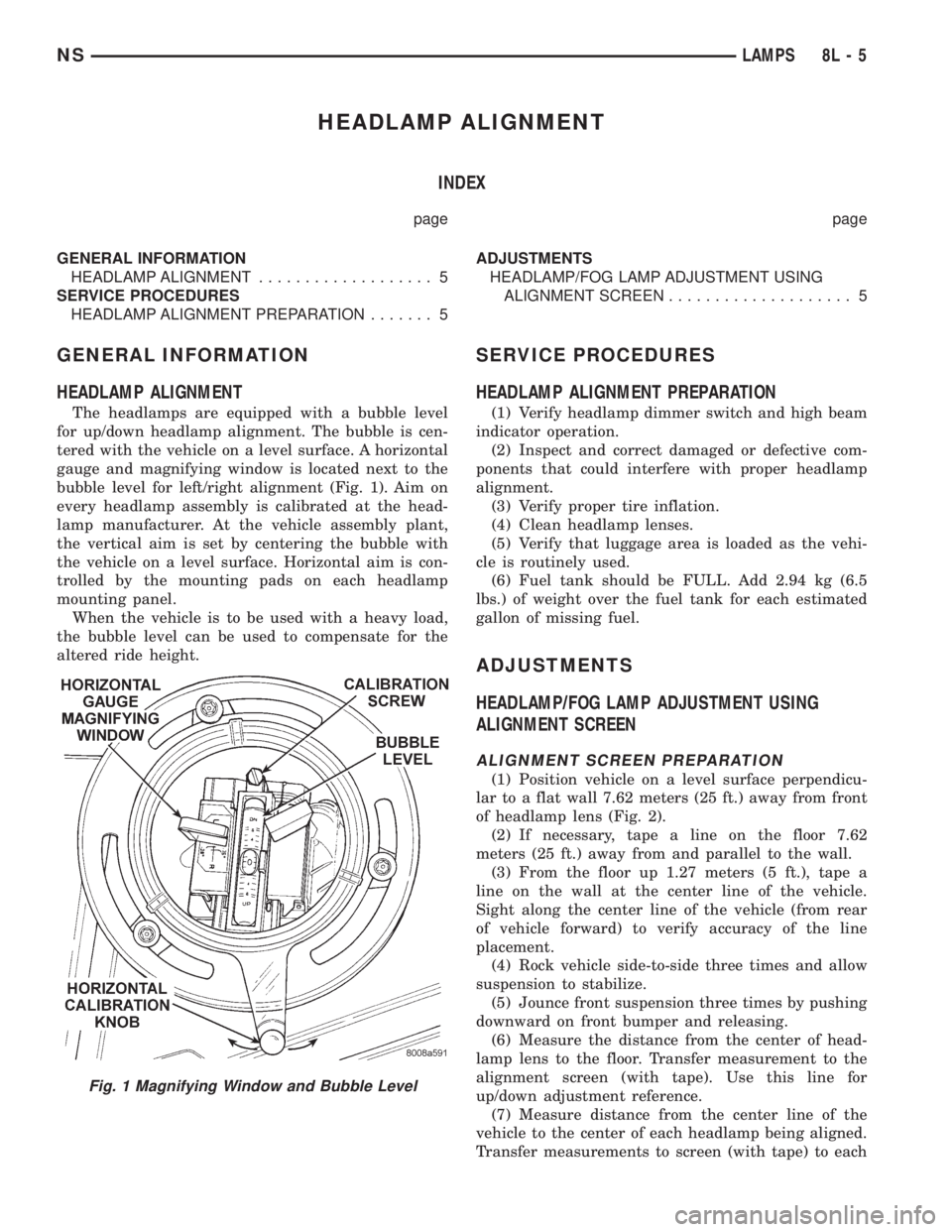
The headlamps are equipped with a bubble level
for up/down headlamp alignment. The bubble is cen-
tered with the vehicle on a level surface. A horizontal
gauge and magnifying window is located next to the
bubble level for left/right alignment (Fig. 1). Aim on
every headlamp assembly is calibrated at the head-
lamp manufacturer. At the vehicle assembly plant,
the vertical aim is set by centering the bubble with
the vehicle on a level surface. Horizontal aim is con-
trolled by the mounting pads on each headlamp
mounting panel.
When the vehicle is to be used with a heavy load,
the bubble level can be used to compensate for the
altered ride height.
SERVICE PROCEDURES
HEADLAMP ALIGNMENT PREPARATION
(1) Verify headlamp dimmer switch and high beam
indicator operation.
(2) Inspect and correct damaged or defective com-
ponents that could interfere with proper headlamp
alignment.
(3) Verify proper tire inflation.
(4) Clean headlamp lenses.
(5) Verify that luggage area is loaded as the vehi-
cle is routinely used.
(6) Fuel tank should be FULL. Add 2.94 kg (6.5
lbs.) of weight over the fuel tank for each estimated
gallon of missing fuel.
ADJUSTMENTS
HEADLAMP/FOG LAMP ADJUSTMENT USING
ALIGNMENT SCREEN
ALIGNMENT SCREEN PREPARATION
(1) Position vehicle on a level surface perpendicu-
lar to a flat wall 7.62 meters (25 ft.) away from front
of headlamp lens (Fig. 2).
(2) If necessary, tape a line on the floor 7.62
meters (25 ft.) away from and parallel to the wall.
(3) From the floor up 1.27 meters (5 ft.), tape a
line on the wall at the center line of the vehicle.
Sight along the center line of the vehicle (from rear
of vehicle forward) to verify accuracy of the line
placement.
(4) Rock vehicle side-to-side three times and allow
suspension to stabilize.
(5) Jounce front suspension three times by pushing
downward on front bumper and releasing.
(6) Measure the distance from the center of head-
lamp lens to the floor. Transfer measurement to the
alignment screen (with tape). Use this line for
up/down adjustment reference.
(7) Measure distance from the center line of the
vehicle to the center of each headlamp being aligned.
Transfer measurements to screen (with tape) to each
Fig. 1 Magnifying Window and Bubble Level
NSLAMPS 8L - 5
Page 461 of 1938
EXTERIOR LAMP BULB SERVICE
INDEX
page page
REMOVAL AND INSTALLATION
CENTER HIGH MOUNTED STOP LAMP
(CHMSL) BULB........................ 13
FOG LAMP BULB ± TOWN and COUNTRY..... 11
FOG LAMP BULB........................ 10
FRONT PARKING AND TURN SIGNAL LAMP
BULB ± TOWN and COUNTRY............ 12
FRONT SIDE MARKER LAMP BULB TOWN and
COUNTRY............................ 11HEADLAMP BULB ± TOWN & COUNTRY....... 9
HEADLAMP BULB........................ 9
LICENSE PLATE LAMP BULB.............. 13
PARKING AND TURN SIGNAL BULB......... 11
TAIL, STOP, TURN SIGNAL AND BACK-UP
LAMP BULB.......................... 12
REMOVAL AND INSTALLATION
HEADLAMP BULB
REMOVAL
(1) Release hood latch and open hood.
(2) From behind radiator closure panel, disconnect
wire connector from back of headlamp bulb base.
(3) Rotate headlamp bulb retaining ring counter-
clockwise.
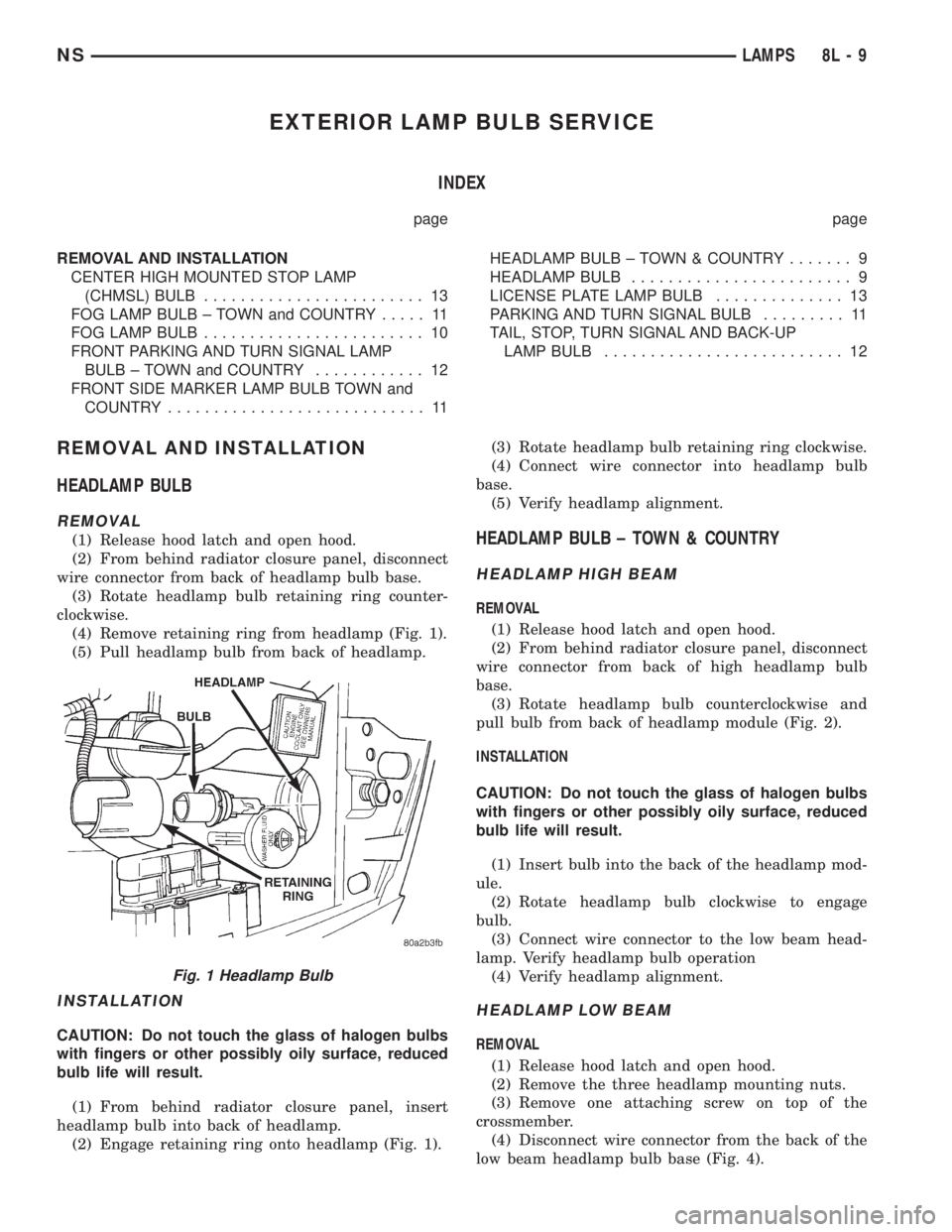
(4) Remove retaining ring from headlamp (Fig. 1).
(5) Pull headlamp bulb from back of headlamp.
INSTALLATION
CAUTION: Do not touch the glass of halogen bulbs
with fingers or other possibly oily surface, reduced
bulb life will result.
(1) From behind radiator closure panel, insert
headlamp bulb into back of headlamp.
(2) Engage retaining ring onto headlamp (Fig. 1).(3) Rotate headlamp bulb retaining ring clockwise.
(4) Connect wire connector into headlamp bulb
base.
(5) Verify headlamp alignment.
HEADLAMP BULB ± TOWN & COUNTRY
HEADLAMP HIGH BEAM
REMOVAL
(1) Release hood latch and open hood.
(2) From behind radiator closure panel, disconnect
wire connector from back of high headlamp bulb
base.
(3) Rotate headlamp bulb counterclockwise and
pull bulb from back of headlamp module (Fig. 2).
INSTALLATION
CAUTION: Do not touch the glass of halogen bulbs
with fingers or other possibly oily surface, reduced
bulb life will result.
(1) Insert bulb into the back of the headlamp mod-
ule.
(2) Rotate headlamp bulb clockwise to engage
bulb.
(3) Connect wire connector to the low beam head-
lamp. Verify headlamp bulb operation
(4) Verify headlamp alignment.
HEADLAMP LOW BEAM
REMOVAL
(1) Release hood latch and open hood.
(2) Remove the three headlamp mounting nuts.
(3) Remove one attaching screw on top of the
crossmember.
(4) Disconnect wire connector from the back of the
low beam headlamp bulb base (Fig. 4).
Fig. 1 Headlamp Bulb
NSLAMPS 8L - 9
Page 466 of 1938
EXTERIOR LAMP SERVICE
INDEX
page page
GENERAL INFORMATION
HEADLAMP DIMMER SWITCH.............. 14
HEADLAMP MODULE.................... 14
HEADLAMP SWITCH..................... 14
REMOVAL AND INSTALLATION
CENTER HIGH MOUNTED STOP LAMP
(CHMSL)............................. 17
FOG LAMP ± TOWN and COUNTRY......... 15
FOG LAMP............................. 14FRONT PARKING AND TURN SIGNAL LAMP ±
TOWN and COUNTRY.................. 15
FRONT SIDE MARKER LAMP TOWN and
COUNTRY............................ 15
HEADLAMP MODULE.................... 14
LICENSE PLATE LAMP................... 16
TAIL, STOP, TURN SIGNAL AND BACK-UP
LAMP............................... 16
GENERAL INFORMATION
HEADLAMP MODULE
Minor amounts of fogging may occur around the
edges of the headlamp lens when exposed to humid
conditions. This is considered normal. The fogging
will dissipate with increased ambient temperature or
headlamp usage.
HEADLAMP SWITCH
Service procedures for the headlamp switch can be
found in Group 8E, Instrument Panel and Gauges.
More information can be found in Group 8W, Wiring
Diagrams.
HEADLAMP DIMMER SWITCH
The headlamp dimmer switch is incorporated into
the multi-function (turn signal) switch. Proper proce-
dures can be found in Group 8J, Turn Signal and
Flashers. More information can be found in Group
8W, Wiring Diagrams.
REMOVAL AND INSTALLATION
HEADLAMP MODULE
REMOVAL
(1) Release hood latch and open hood.
(2) From inside engine compartment, remove nuts
holding headlamp module to radiator closure panel.
(3) Remove screw holding top of module to closure
panel.
(4) Remove headlamp module from radiator clo-
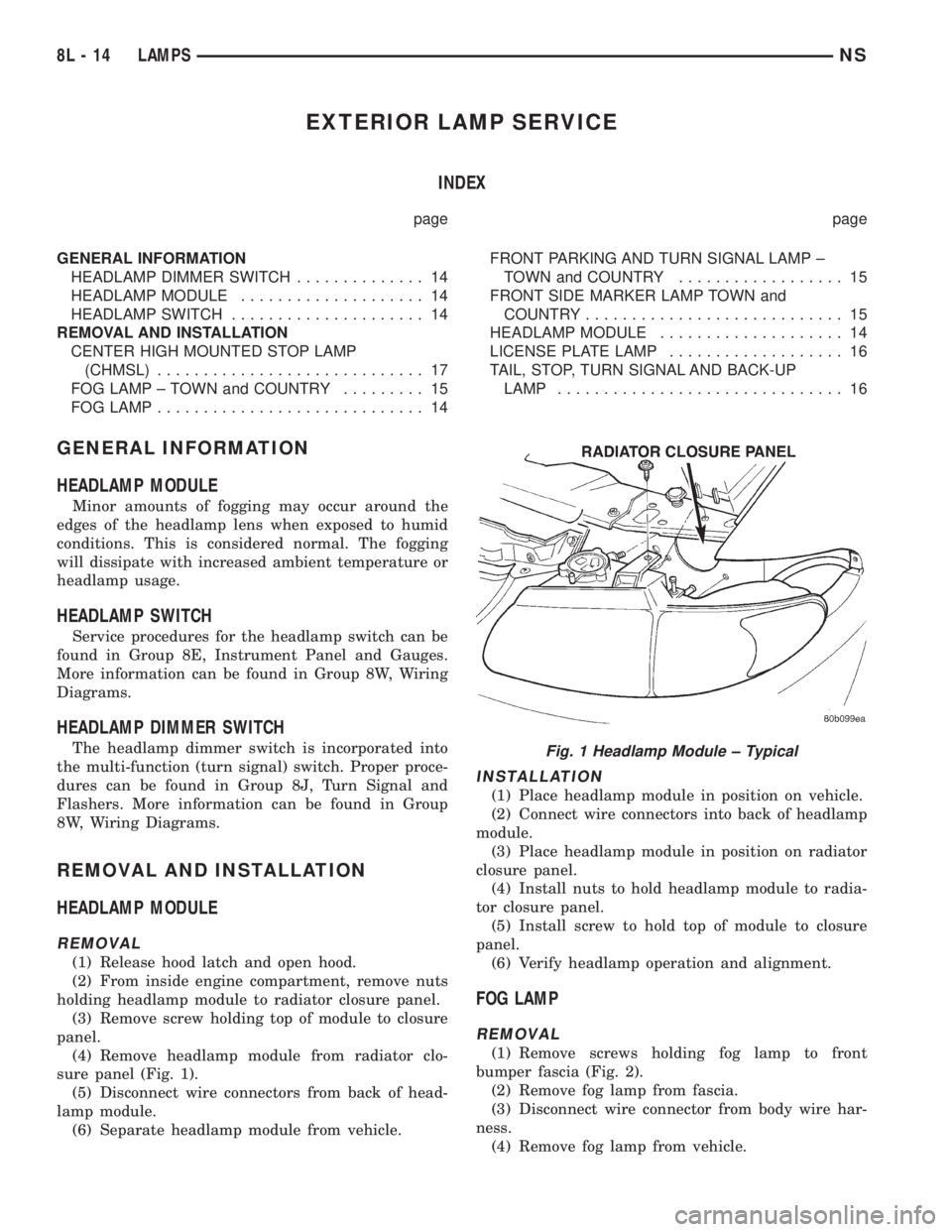
sure panel (Fig. 1).
(5) Disconnect wire connectors from back of head-
lamp module.
(6) Separate headlamp module from vehicle.
INSTALLATION
(1) Place headlamp module in position on vehicle.
(2) Connect wire connectors into back of headlamp
module.
(3) Place headlamp module in position on radiator
closure panel.
(4) Install nuts to hold headlamp module to radia-
tor closure panel.
(5) Install screw to hold top of module to closure
panel.
(6) Verify headlamp operation and alignment.
FOG LAMP
REMOVAL
(1) Remove screws holding fog lamp to front
bumper fascia (Fig. 2).
(2) Remove fog lamp from fascia.
(3) Disconnect wire connector from body wire har-
ness.
(4) Remove fog lamp from vehicle.
Fig. 1 Headlamp Module ± Typical
8L - 14 LAMPSNS
Page 479 of 1938
LAMPS
CONTENTS
page page
BULB APPLICATION..................... 17
HEADLAMP ALIGNMENT.................. 5
LAMP BULB SERVICE.................... 8LAMP DIAGNOSIS....................... 1
LAMP SERVICE........................ 13
LAMP DIAGNOSIS
INDEX
page page
GENERAL INFORMATION
HEADLAMP LEVELING MOTOR............. 2
INTRODUCTION........................ 1SAFETY PRECAUTIONS.................. 1
DIAGNOSIS AND TESTING
DIAGNOSTIC PROCEDURES.............. 2
GENERAL INFORMATION
INTRODUCTION
GS vehicles use lighting on the interior and exte-
rior of the vehicle for illuminating and indicating
purposes. Lighting circuits are protected by fuses.
Lighting circuits require an overload protected power
source, on/off device, lamps and body ground to oper-
ate properly. Plastic lamps require a wire in the har-
ness to supply body ground to the lamp socket.
Replace sockets and bulbs that are corroded.
Some of the interior and exterior lighting functions
are governed by the body controller. The headlamp,
dome, and the door ajar switches provide signals to
the body controller. The body controller in turn acti-
vates relay(s) in order to provide either a ground or
feed line to the appropriate lamp(s).
Wire connectors can make intermittent contact or
become corroded. Before coupling wire connectors,
inspect the terminals inside the connector. Male ter-
minals should not be bent or disengaged from the
insulator. Female terminals should not be sprung
open or disengaged from the insulator. Bent and
sprung terminals can be repaired using needle nose
pliers and pick tool. Corroded terminals appear
chalky or green. Corroded terminals should be
replaced to avoid recurrence of the problem symp-
toms.Begin electrical system failure diagnosis by testing
related fuses in the fuse block and power distribution
center. Verify that bulbs are in good condition and
test continuity of the circuit ground. Refer to Group
8W, Wiring Diagrams, for component location and cir-
cuit information.
SAFETY PRECAUTIONS
WARNING: EYE PROTECTION SHOULD BE USED
WHEN SERVICING GLASS COMPONENTS. PER-
SONAL INJURY CAN RESULT.
CAUTION: Do not touch the glass of halogen bulbs
with fingers or other possibly oily surface, reduced
bulb life will result.
Do not use bulbs with higher candle power than
indicated in the Bulb Application table at the end of
this group. Damage to lamp and/or Daytime Run-
ning Lamp Module can result.
Do not use fuses, circuit breakers or relays hav-
ing greater amperage value than indicated on the
fuse panel or in the Owners Manual.
When it is necessary to remove components to ser-
vice another, it should not be necessary to apply
excessive force or bend a component to remove it.
Before damaging a trim component, verify hidden
fasteners or captured edges are not holding the com-
ponent in place.
NS/GSLAMPS 8L - 1
Page 483 of 1938
HEADLAMP ALIGNMENT
INDEX
page page
SERVICE PROCEDURES
HEADLAMP ALIGNMENT PREPARATION...... 5ADJUSTMENTS
HEADLAMP/FOG LAMP ADJUSTMENT USING
ALIGNMENT SCREEN.................. 5
SERVICE PROCEDURES
HEADLAMP ALIGNMENT PREPARATION
(1) Verify headlamp dimmer switch and high beam
indicator operation.
(2) Verify that the headlamp leveling switch is in
the ª0º position.
(3) Inspect and correct damaged or defective com-
ponents that could interfere with proper headlamp
alignment.
(4) Verify proper tire inflation.
(5) Clean headlamp lenses.
(6) Verify that luggage area is loaded as the vehi-
cle is routinely used.
(7) Fuel tank should be FULL. Add 2.94 kg (6.5
lbs.) of weight over the fuel tank for each estimated
gallon of missing fuel.
ADJUSTMENTS
HEADLAMP/FOG LAMP ADJUSTMENT USING
ALIGNMENT SCREEN
ALIGNMENT SCREEN PREPARATION
(1) Position vehicle on a level surface perpendicu-
lar to a flat wall 10 meters (32.8 ft.) away from front
of headlamp lens (Fig. 1).
(2) Place 75 kg in the driver's seat to simulate the
ride height of the vehicle when driven.
(3) If necessary, tape a line on the floor 10 meters
(32.8 ft) away from and parallel to the wall.
(4) From the floor up 1.27 meters (5 ft), tape a line
on the wall at the centerline of the vehicle. Sight
along the centerline of the vehicle (from rear of vehi-
cle forward) to verify accuracy of the line placement.
NS/GSLAMPS 8L - 5