service CHRYSLER VOYAGER 1996 Service Manual
[x] Cancel search | Manufacturer: CHRYSLER, Model Year: 1996, Model line: VOYAGER, Model: CHRYSLER VOYAGER 1996Pages: 1938, PDF Size: 55.84 MB
Page 558 of 1938
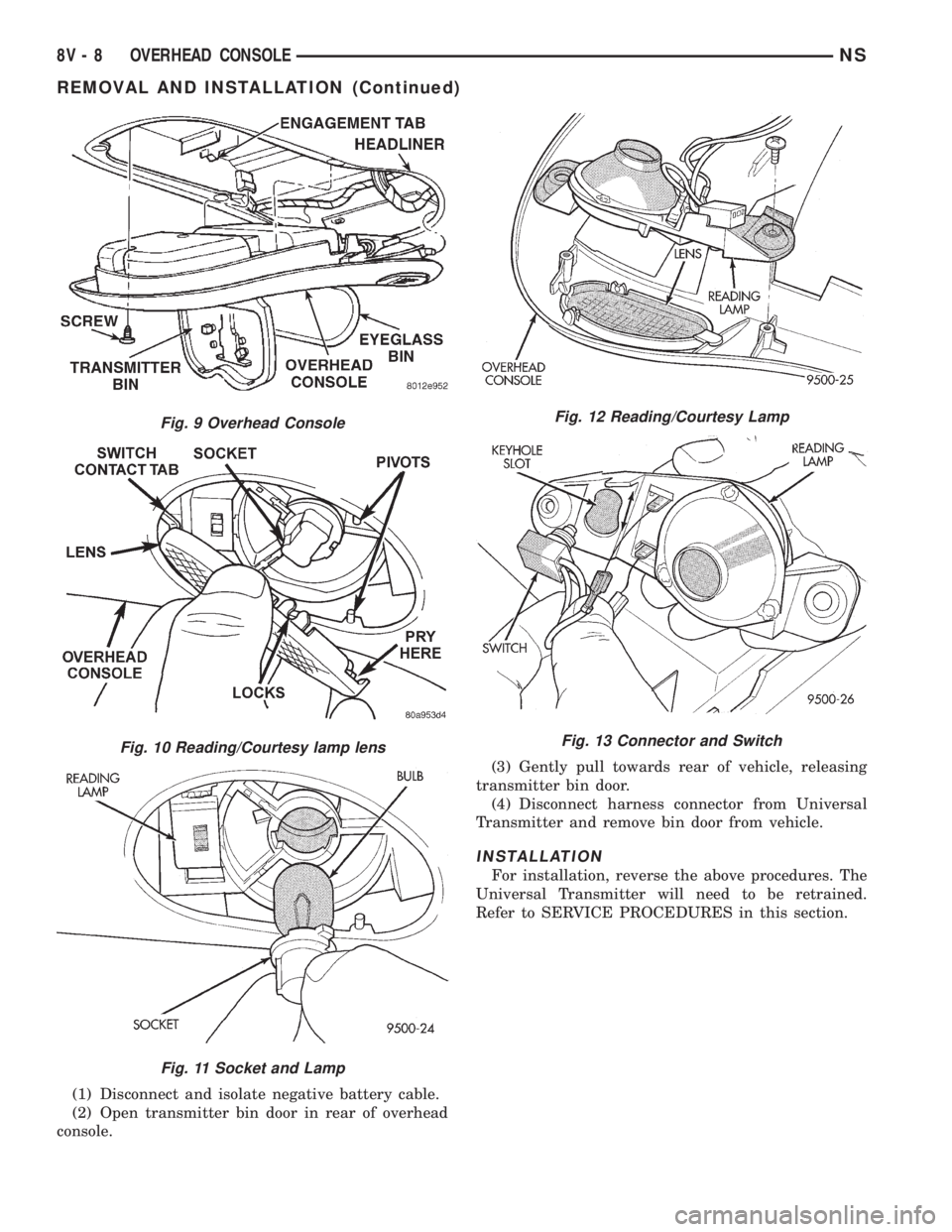
(1) Disconnect and isolate negative battery cable.
(2) Open transmitter bin door in rear of overhead
console.(3) Gently pull towards rear of vehicle, releasing
transmitter bin door.
(4) Disconnect harness connector from Universal
Transmitter and remove bin door from vehicle.
INSTALLATION
For installation, reverse the above procedures. The
Universal Transmitter will need to be retrained.
Refer to SERVICE PROCEDURES in this section.
Fig. 9 Overhead Console
Fig. 10 Reading/Courtesy lamp lens
Fig. 11 Socket and Lamp
Fig. 12 Reading/Courtesy Lamp
Fig. 13 Connector and Switch
8V - 8 OVERHEAD CONSOLENS
REMOVAL AND INSTALLATION (Continued)
Page 563 of 1938
8W-01 GENERAL INFORMATION
INDEX
page page
DESCRIPTION AND OPERATION
CIRCUIT FUNCTIONS..................... 4
CIRCUIT INFORMATION................... 4
CONNECTOR INFORMATION............... 7
ELECTROSTATIC DISCHARGE (ESD)
SENSITIVE DEVICES.................... 8
INTRODUCTION......................... 1
NOTES, CAUTIONS, and WARNINGS......... 7
POSITIVE TEMPERATURE COEFFICIENT...... 8
SECTION IDENTIFICATION................. 5
SPLICE LOCATIONS...................... 7
SYMBOLS.............................. 5
TAKE OUTS............................. 8
TERMINOLOGY.......................... 7
DIAGNOSIS AND TESTING
INTERMITTENT AND POOR CONNECTIONS.... 9TROUBLESHOOTING TESTS................ 9
TROUBLESHOOTING TOOLS............... 8
TROUBLESHOOTING WIRING PROBLEMS.... 10
SERVICE PROCEDURES
CONNECTOR AND TERMINAL REPLACEMENT . 12
CONNECTOR REPLACEMENT.............. 11
DIODE REPLACEMENT................... 14
TERMINAL REPLACEMENT................ 13
TERMINAL/CONNECTOR REPAIR- AUGAT
CONNECTORS........................ 12
TERMINAL/CONNECTOR REPAIR-MOLEX
CONNECTORS........................ 11
WIRING REPAIR........................ 10
SPECIAL TOOLS
WIRING/TERMINAL...................... 14
DESCRIPTION AND OPERATION
INTRODUCTION
Chrysler wiring diagrams are designed to provide
information regarding the vehicles wiring content. In
order to effectively use Chrysler wiring diagrams to
diagnose and repair a Chrysler vehicle, it is impor-
tant to understand all of their features and charac-
teristics.
Diagrams are arranged such that the power (B+)
side of the circuit is placed near the top of the page,
and the ground (B-) side of the circuit is placed near
the bottom of the page.
All switches, components, and modules are shown
in the at rest position with the doors closed and the
key removed from the ignition.Components are shown two ways. A solid line
around a component indicates that the component is
complete. A dashed line around a component indi-
cates that the component being shown is not com-
plete. Incomplete components have a reference
number to indicate the page where the component is
shown complete.
It is important to realize that no attempt is made
on the diagrams to represent components and wiring
as they appear on the vehicle. For example, a short
piece of wire is treated the same as a long one. In
addition, switches and other components are shown
as simply as possible, with regard to function only.
NS/GS8W-01 GENERAL INFORMATION 8W - 01 - 1
Page 569 of 1938
TERMINOLOGY
This a list of terms with there definitions used in
the wiring diagrams.
Built-Up-Export.........Vehicles Built For Sale In
Markets Other Than North America
Except-Built-Up-Export.....Vehicles Built For Sale
In North America
LHD..................Left Hand Drive Vehicles
RHD.................Right Hand Drive Vehicles
ATX . . . .Automatic Transmission-Front Wheel Drive
MTX......Manual Transmission-Front Wheel Drive
AT......Automatic Transmission-Rear Wheel Drive
MT .......Manual Transmission-Rear Wheel Drive
SOHC.............Single Over Head Cam Engine
DOHC.............Dual Over Head Cam Engine
CONNECTOR INFORMATION
CAUTION: Not all connectors are serviced. Some
connectors are serviced only with a harness. A typ-
ical example might be the Supplemental Restraint
System connectors. Always check parts availability
before attempting a repair.
IDENTIFICATION
In-line connectors are identified by a number, as
follows:
²In-line connectors located on theengine com-
partment harnessareC100series numbers.
²Connectors located on theinstrument panel
harnessareC200series numbers.
²Connectors located on thebody harnessare
C300series numbers.
²Jumper harness connectorsareC400series
numbers.
²Grounds and ground connectorsare identi-
fied with aªGºand follow the same series number-
ing as the in-line connector.
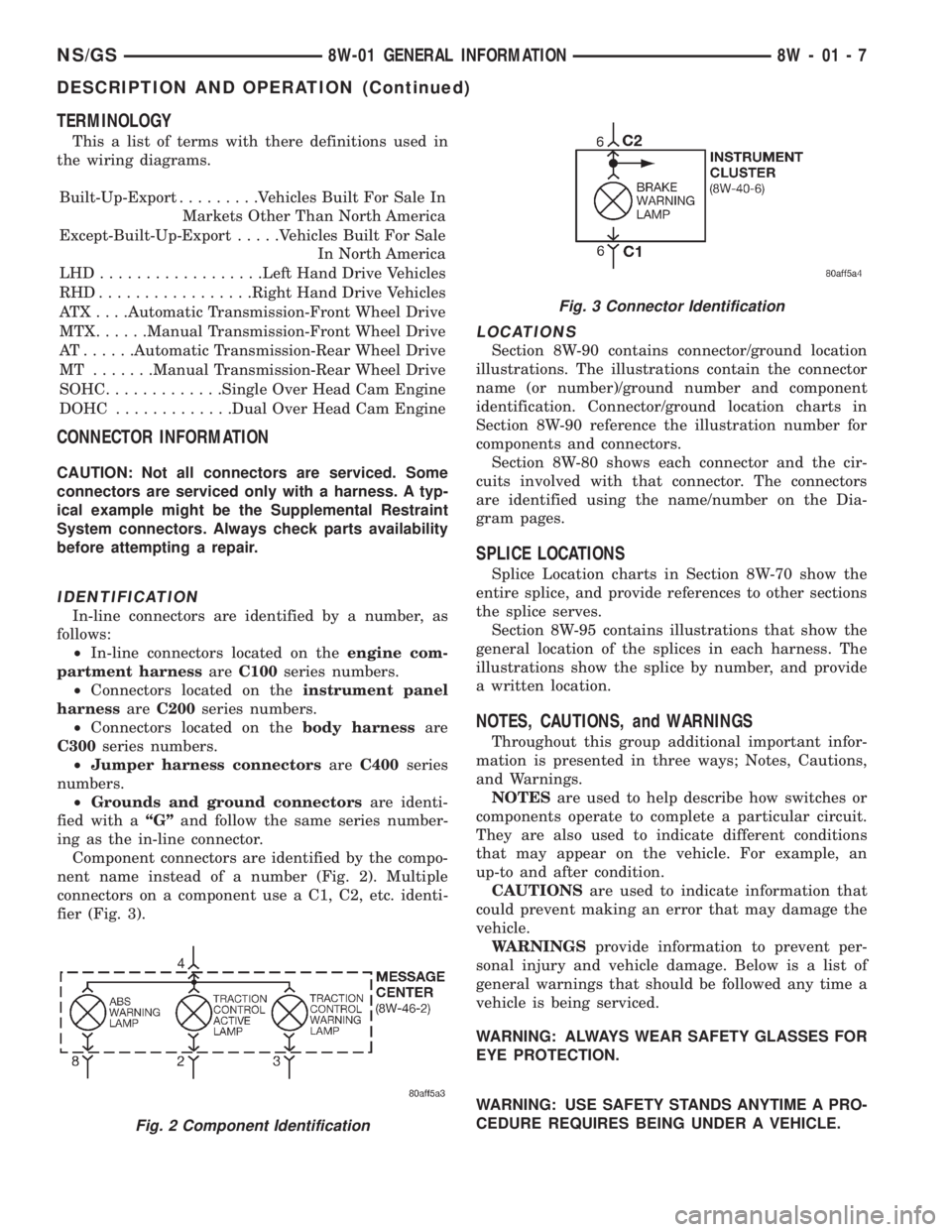
Component connectors are identified by the compo-
nent name instead of a number (Fig. 2). Multiple
connectors on a component use a C1, C2, etc. identi-
fier (Fig. 3).
LOCATIONS
Section 8W-90 contains connector/ground location
illustrations. The illustrations contain the connector
name (or number)/ground number and component
identification. Connector/ground location charts in
Section 8W-90 reference the illustration number for
components and connectors.
Section 8W-80 shows each connector and the cir-
cuits involved with that connector. The connectors
are identified using the name/number on the Dia-
gram pages.
SPLICE LOCATIONS
Splice Location charts in Section 8W-70 show the
entire splice, and provide references to other sections
the splice serves.
Section 8W-95 contains illustrations that show the
general location of the splices in each harness. The
illustrations show the splice by number, and provide
a written location.
NOTES, CAUTIONS, and WARNINGS
Throughout this group additional important infor-
mation is presented in three ways; Notes, Cautions,
and Warnings.
NOTESare used to help describe how switches or
components operate to complete a particular circuit.
They are also used to indicate different conditions
that may appear on the vehicle. For example, an
up-to and after condition.
CAUTIONSare used to indicate information that
could prevent making an error that may damage the
vehicle.
WARNINGSprovide information to prevent per-
sonal injury and vehicle damage. Below is a list of
general warnings that should be followed any time a
vehicle is being serviced.
WARNING: ALWAYS WEAR SAFETY GLASSES FOR
EYE PROTECTION.
WARNING: USE SAFETY STANDS ANYTIME A PRO-
CEDURE REQUIRES BEING UNDER A VEHICLE.
Fig. 2 Component Identification
Fig. 3 Connector Identification
NS/GS8W-01 GENERAL INFORMATION 8W - 01 - 7
DESCRIPTION AND OPERATION (Continued)
Page 572 of 1938
(3) Starting at the fuse block, wiggle the wiring
harness about six to eight inches apart and watch
the voltmeter/test lamp.
(4) If the voltmeter registers voltage or the test
lamp glows, there is a short to ground in that gen-
eral area of the wiring harness.
TESTING FOR A SHORT TO GROUND ON
FUSES POWERING SEVERAL LOADS
(1) Refer to the wiring diagrams and disconnect or
isolate all items on the suspected fused circuits.
(2) Replace the blown fuse.
(3) Supply power to the fuse by turning ON the
ignition switch or re-connecting the battery.
(4) Start connecting the items in the fuse circuit
one at a time. When the fuse blows the circuit with
the short to ground has been isolated.
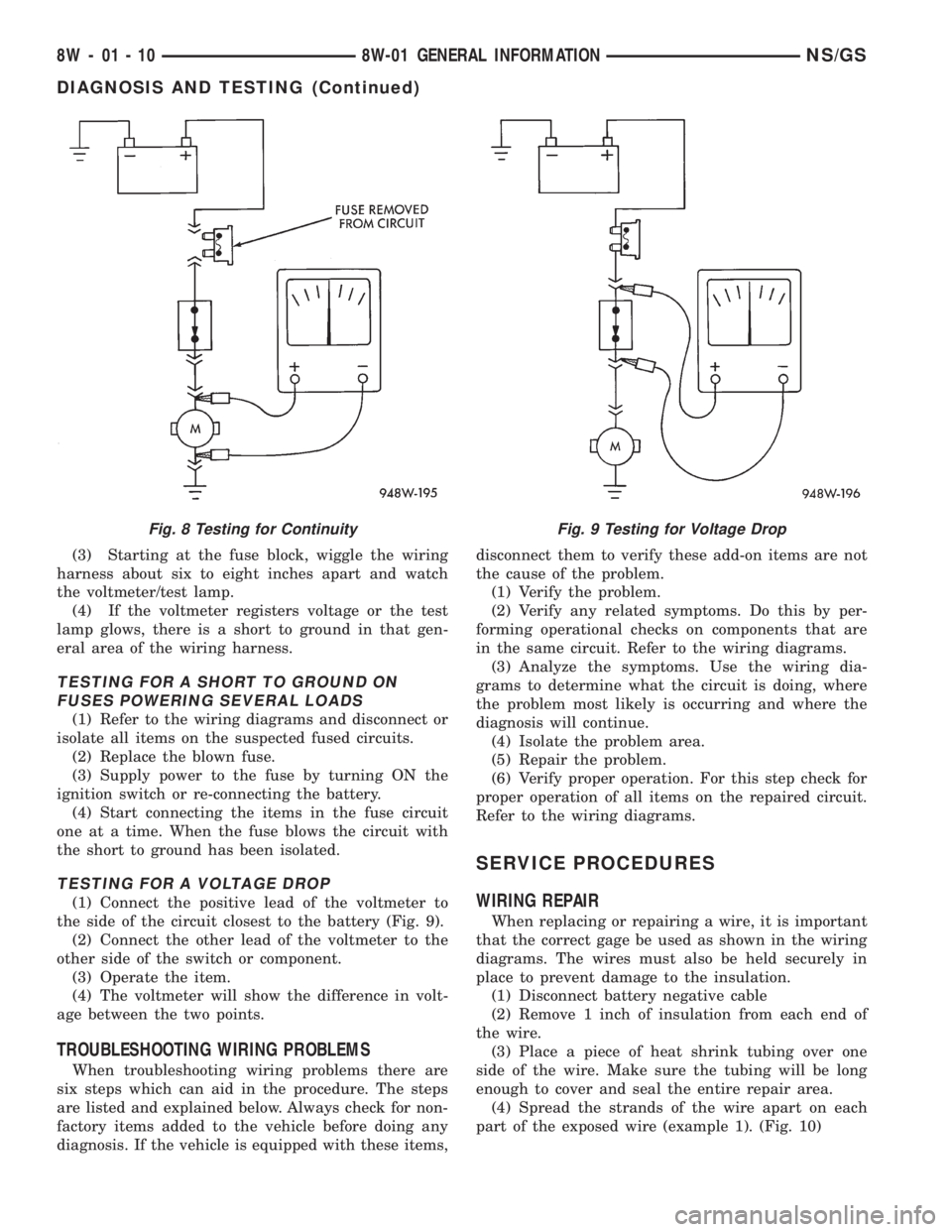
TESTING FOR A VOLTAGE DROP
(1) Connect the positive lead of the voltmeter to
the side of the circuit closest to the battery (Fig. 9).
(2) Connect the other lead of the voltmeter to the
other side of the switch or component.
(3) Operate the item.
(4) The voltmeter will show the difference in volt-
age between the two points.
TROUBLESHOOTING WIRING PROBLEMS
When troubleshooting wiring problems there are
six steps which can aid in the procedure. The steps
are listed and explained below. Always check for non-
factory items added to the vehicle before doing any
diagnosis. If the vehicle is equipped with these items,disconnect them to verify these add-on items are not
the cause of the problem.
(1) Verify the problem.
(2) Verify any related symptoms. Do this by per-
forming operational checks on components that are
in the same circuit. Refer to the wiring diagrams.
(3) Analyze the symptoms. Use the wiring dia-
grams to determine what the circuit is doing, where
the problem most likely is occurring and where the
diagnosis will continue.
(4) Isolate the problem area.
(5) Repair the problem.
(6) Verify proper operation. For this step check for
proper operation of all items on the repaired circuit.
Refer to the wiring diagrams.
SERVICE PROCEDURES
WIRING REPAIR
When replacing or repairing a wire, it is important
that the correct gage be used as shown in the wiring
diagrams. The wires must also be held securely in
place to prevent damage to the insulation.
(1) Disconnect battery negative cable
(2) Remove 1 inch of insulation from each end of
the wire.
(3) Place a piece of heat shrink tubing over one
side of the wire. Make sure the tubing will be long
enough to cover and seal the entire repair area.
(4) Spread the strands of the wire apart on each
part of the exposed wire (example 1). (Fig. 10)
Fig. 8 Testing for ContinuityFig. 9 Testing for Voltage Drop
8W - 01 - 10 8W-01 GENERAL INFORMATIONNS/GS
DIAGNOSIS AND TESTING (Continued)
Page 573 of 1938
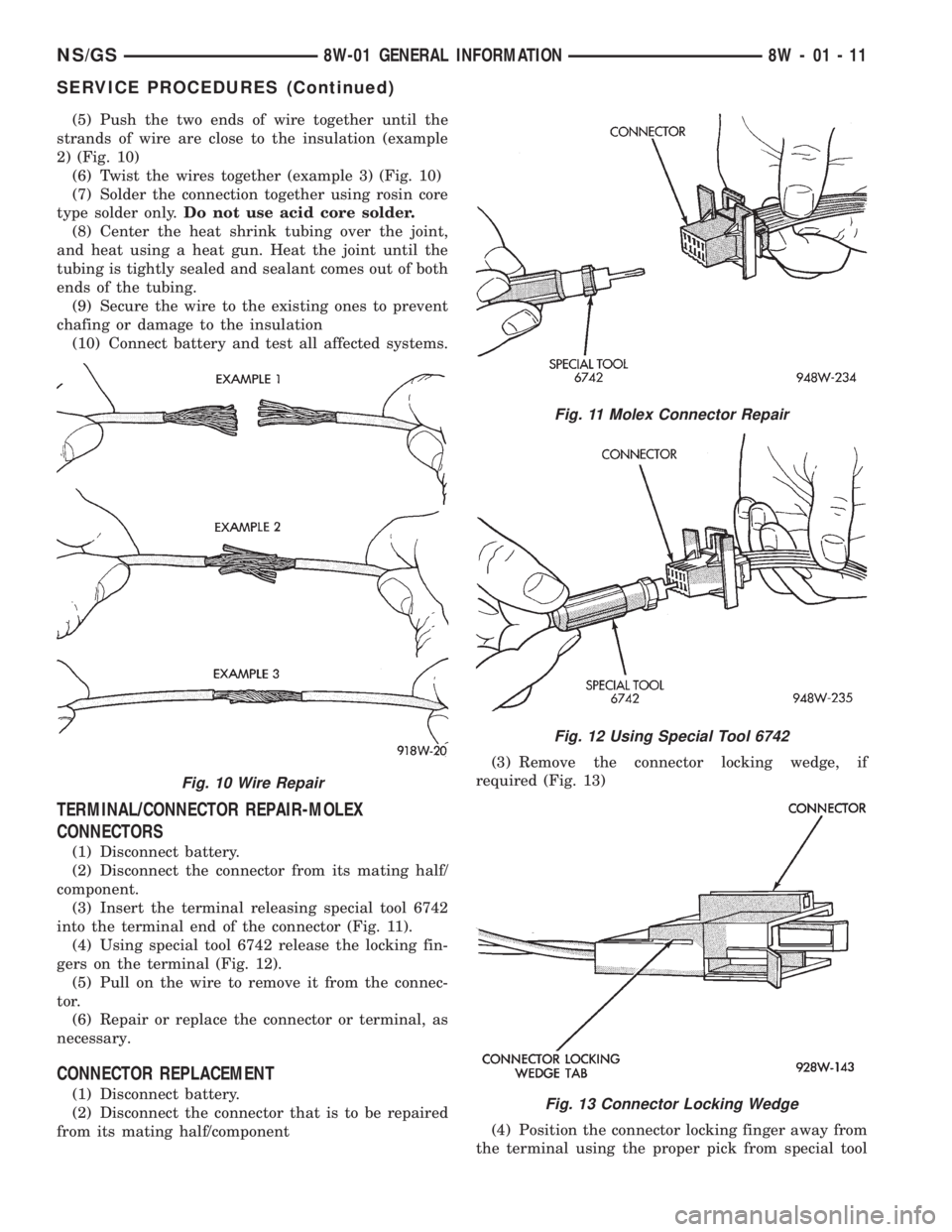
(5) Push the two ends of wire together until the
strands of wire are close to the insulation (example
2) (Fig. 10)
(6) Twist the wires together (example 3) (Fig. 10)
(7) Solder the connection together using rosin core
type solder only.Do not use acid core solder.
(8) Center the heat shrink tubing over the joint,
and heat using a heat gun. Heat the joint until the
tubing is tightly sealed and sealant comes out of both
ends of the tubing.
(9) Secure the wire to the existing ones to prevent
chafing or damage to the insulation
(10) Connect battery and test all affected systems.
TERMINAL/CONNECTOR REPAIR-MOLEX
CONNECTORS
(1) Disconnect battery.
(2) Disconnect the connector from its mating half/
component.
(3) Insert the terminal releasing special tool 6742
into the terminal end of the connector (Fig. 11).
(4) Using special tool 6742 release the locking fin-
gers on the terminal (Fig. 12).
(5) Pull on the wire to remove it from the connec-
tor.
(6) Repair or replace the connector or terminal, as
necessary.
CONNECTOR REPLACEMENT
(1) Disconnect battery.
(2) Disconnect the connector that is to be repaired
from its mating half/component(3) Remove the connector locking wedge, if
required (Fig. 13)
(4) Position the connector locking finger away from
the terminal using the proper pick from special tool
Fig. 10 Wire Repair
Fig. 11 Molex Connector Repair
Fig. 12 Using Special Tool 6742
Fig. 13 Connector Locking Wedge
NS/GS8W-01 GENERAL INFORMATION 8W - 01 - 11
SERVICE PROCEDURES (Continued)
Page 574 of 1938
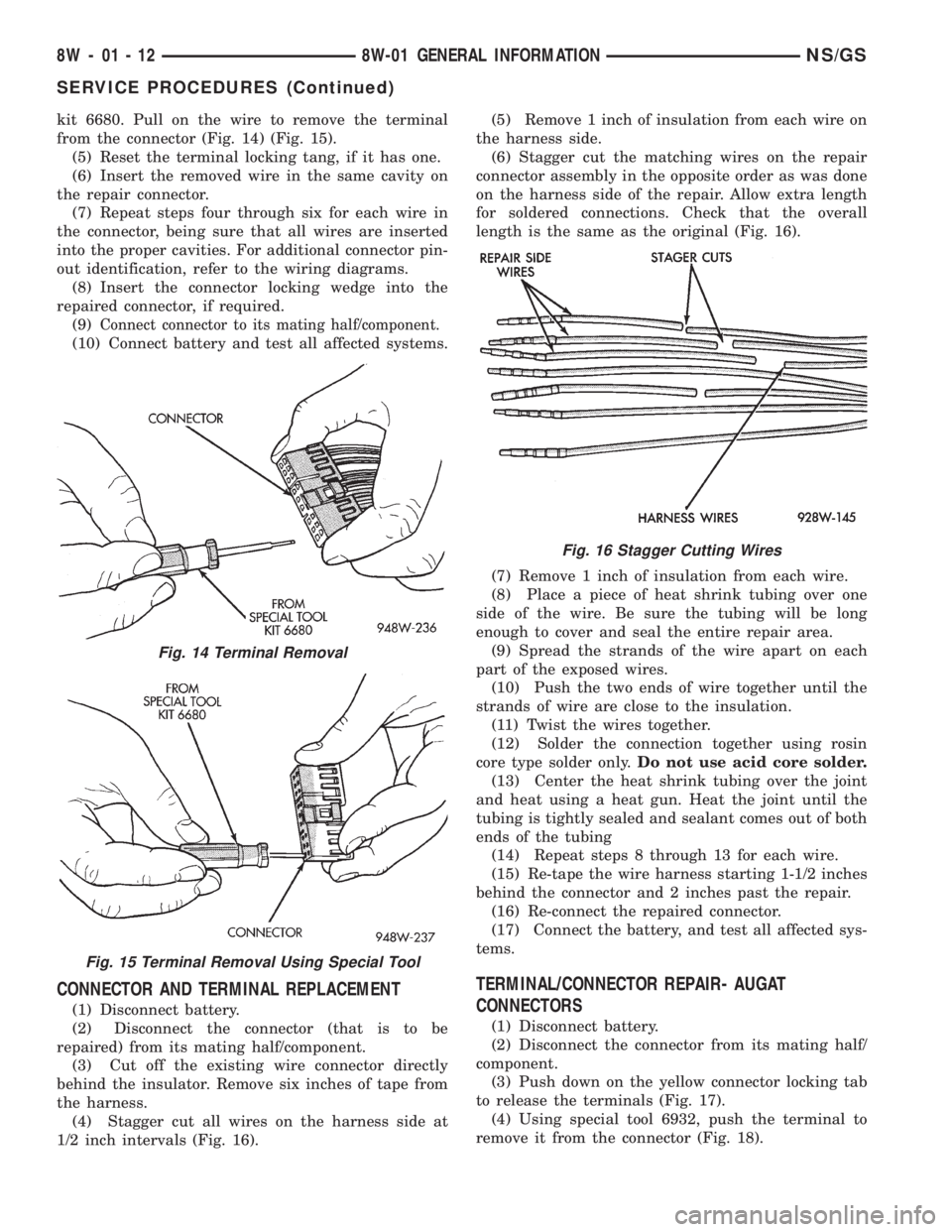
kit 6680. Pull on the wire to remove the terminal
from the connector (Fig. 14) (Fig. 15).
(5) Reset the terminal locking tang, if it has one.
(6) Insert the removed wire in the same cavity on
the repair connector.
(7) Repeat steps four through six for each wire in
the connector, being sure that all wires are inserted
into the proper cavities. For additional connector pin-
out identification, refer to the wiring diagrams.
(8) Insert the connector locking wedge into the
repaired connector, if required.
(9)
Connect connector to its mating half/component.
(10) Connect battery and test all affected systems.
CONNECTOR AND TERMINAL REPLACEMENT
(1) Disconnect battery.
(2) Disconnect the connector (that is to be
repaired) from its mating half/component.
(3) Cut off the existing wire connector directly
behind the insulator. Remove six inches of tape from
the harness.
(4) Stagger cut all wires on the harness side at
1/2 inch intervals (Fig. 16).(5) Remove 1 inch of insulation from each wire on
the harness side.
(6) Stagger cut the matching wires on the repair
connector assembly in the opposite order as was done
on the harness side of the repair. Allow extra length
for soldered connections. Check that the overall
length is the same as the original (Fig. 16).
(7) Remove 1 inch of insulation from each wire.
(8) Place a piece of heat shrink tubing over one
side of the wire. Be sure the tubing will be long
enough to cover and seal the entire repair area.
(9) Spread the strands of the wire apart on each
part of the exposed wires.
(10) Push the two ends of wire together until the
strands of wire are close to the insulation.
(11) Twist the wires together.
(12) Solder the connection together using rosin
core type solder only.Do not use acid core solder.
(13) Center the heat shrink tubing over the joint
and heat using a heat gun. Heat the joint until the
tubing is tightly sealed and sealant comes out of both
ends of the tubing
(14) Repeat steps 8 through 13 for each wire.
(15) Re-tape the wire harness starting 1-1/2 inches
behind the connector and 2 inches past the repair.
(16) Re-connect the repaired connector.
(17) Connect the battery, and test all affected sys-
tems.
TERMINAL/CONNECTOR REPAIR- AUGAT
CONNECTORS
(1) Disconnect battery.
(2) Disconnect the connector from its mating half/
component.
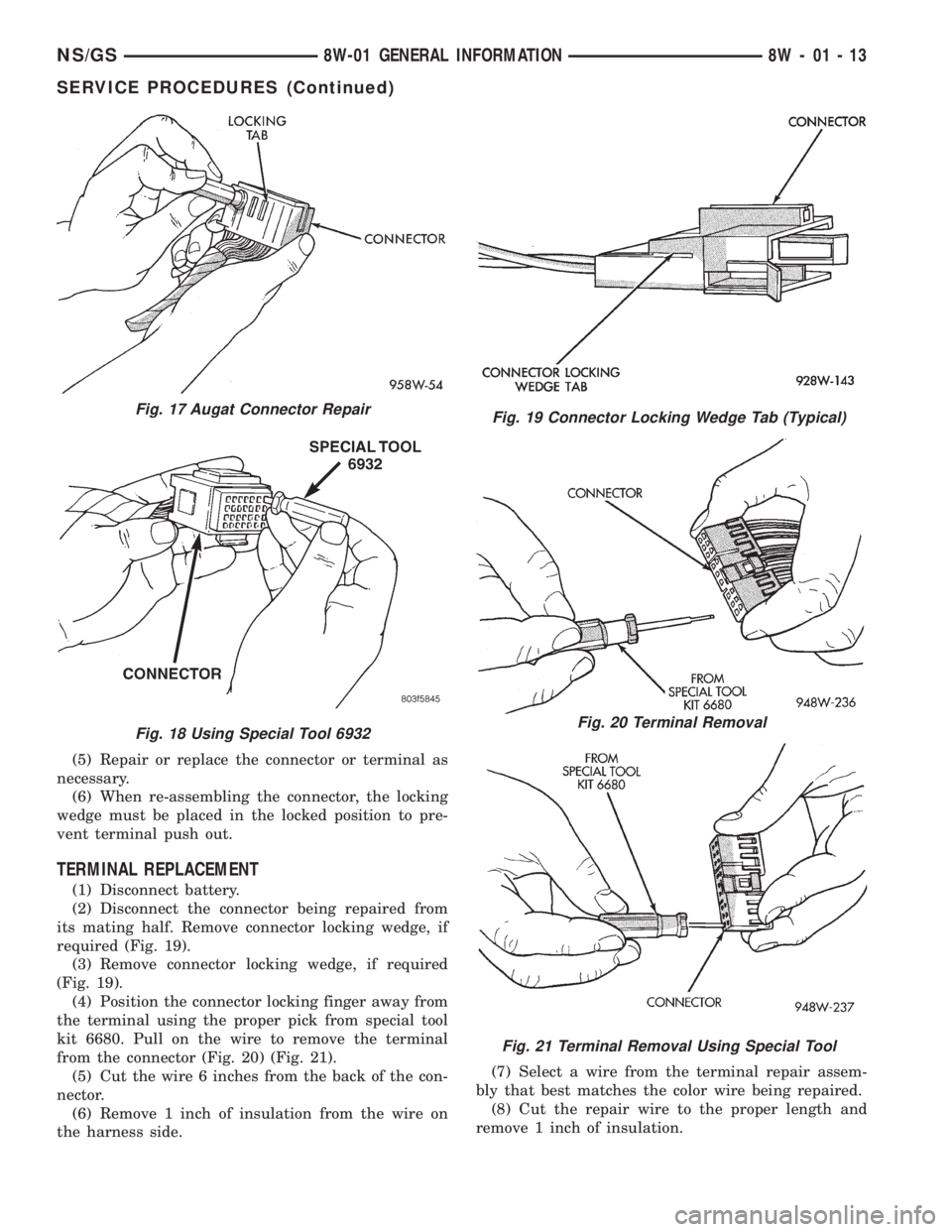
(3) Push down on the yellow connector locking tab
to release the terminals (Fig. 17).
(4) Using special tool 6932, push the terminal to
remove it from the connector (Fig. 18).
Fig. 14 Terminal Removal
Fig. 15 Terminal Removal Using Special Tool
Fig. 16 Stagger Cutting Wires
8W - 01 - 12 8W-01 GENERAL INFORMATIONNS/GS
SERVICE PROCEDURES (Continued)
Page 575 of 1938
(5) Repair or replace the connector or terminal as
necessary.
(6) When re-assembling the connector, the locking
wedge must be placed in the locked position to pre-
vent terminal push out.
TERMINAL REPLACEMENT
(1) Disconnect battery.
(2) Disconnect the connector being repaired from
its mating half. Remove connector locking wedge, if
required (Fig. 19).
(3) Remove connector locking wedge, if required
(Fig. 19).
(4) Position the connector locking finger away from
the terminal using the proper pick from special tool
kit 6680. Pull on the wire to remove the terminal
from the connector (Fig. 20) (Fig. 21).
(5) Cut the wire 6 inches from the back of the con-
nector.
(6) Remove 1 inch of insulation from the wire on
the harness side.(7) Select a wire from the terminal repair assem-
bly that best matches the color wire being repaired.
(8) Cut the repair wire to the proper length and
remove 1 inch of insulation.
Fig. 17 Augat Connector Repair
Fig. 18 Using Special Tool 6932
Fig. 19 Connector Locking Wedge Tab (Typical)
Fig. 20 Terminal Removal
Fig. 21 Terminal Removal Using Special Tool
NS/GS8W-01 GENERAL INFORMATION 8W - 01 - 13
SERVICE PROCEDURES (Continued)
Page 576 of 1938
(9) Place a piece of heat shrink tubing over one
side of the wire. Make sure the tubing will be long
enough to cover and seal the entire repair area.
(10) Spread the strands of the wire apart on each
part of the exposed wires.
(11) Push the two ends of wire together until the
strands of wire are close to the insulation.
(12) Twist the wires together.
(13) Solder the connection together using rosin
core type solder only.Do not use acid core solder.
(14) Center the heat shrink tubing over the joint
and heat using a heat gun. Heat the joint until the
tubing is tightly sealed and sealant comes out of both
ends of the tubing.
(15) Insert the repaired wire into the connector.
(16) Install the connector locking wedge, if
required, and reconnect the connector to its mating
half/component.
(17) Re-tape the wire harness starting 1-1/2 inches
behind the connector and 2 inches past the repair.
(18) Connect battery, and test all affected systems.
DIODE REPLACEMENT
(1) Disconnect the battery.
(2) Locate the diode in the harness, and remove
the protective covering.
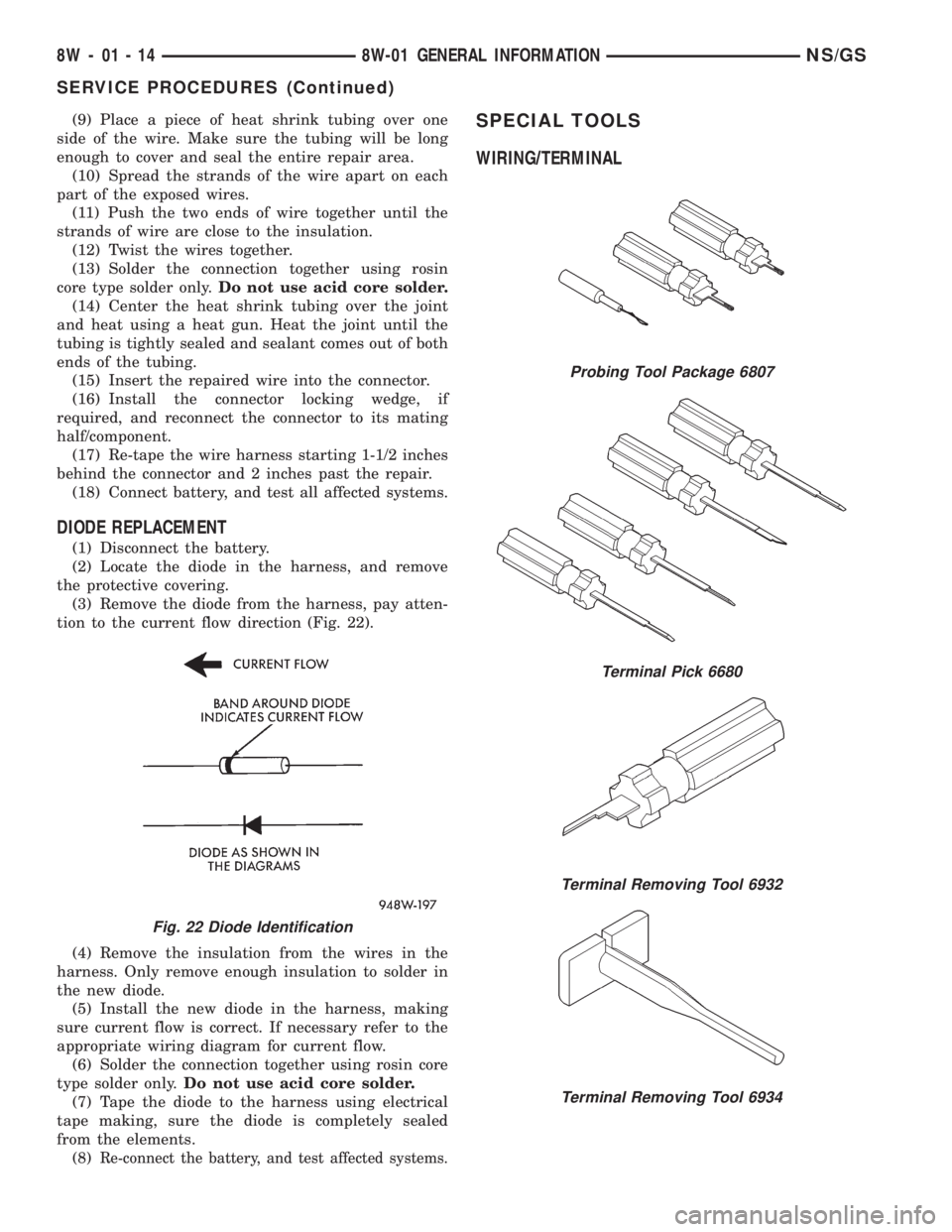
(3) Remove the diode from the harness, pay atten-
tion to the current flow direction (Fig. 22).
(4) Remove the insulation from the wires in the
harness. Only remove enough insulation to solder in
the new diode.
(5) Install the new diode in the harness, making
sure current flow is correct. If necessary refer to the
appropriate wiring diagram for current flow.
(6) Solder the connection together using rosin core
type solder only.Do not use acid core solder.
(7) Tape the diode to the harness using electrical
tape making, sure the diode is completely sealed
from the elements.
(8)
Re-connect the battery, and test affected systems.
SPECIAL TOOLS
WIRING/TERMINAL
Fig. 22 Diode Identification
Probing Tool Package 6807
Terminal Pick 6680
Terminal Removing Tool 6932
Terminal Removing Tool 6934
8W - 01 - 14 8W-01 GENERAL INFORMATIONNS/GS
SERVICE PROCEDURES (Continued)
Page 579 of 1938
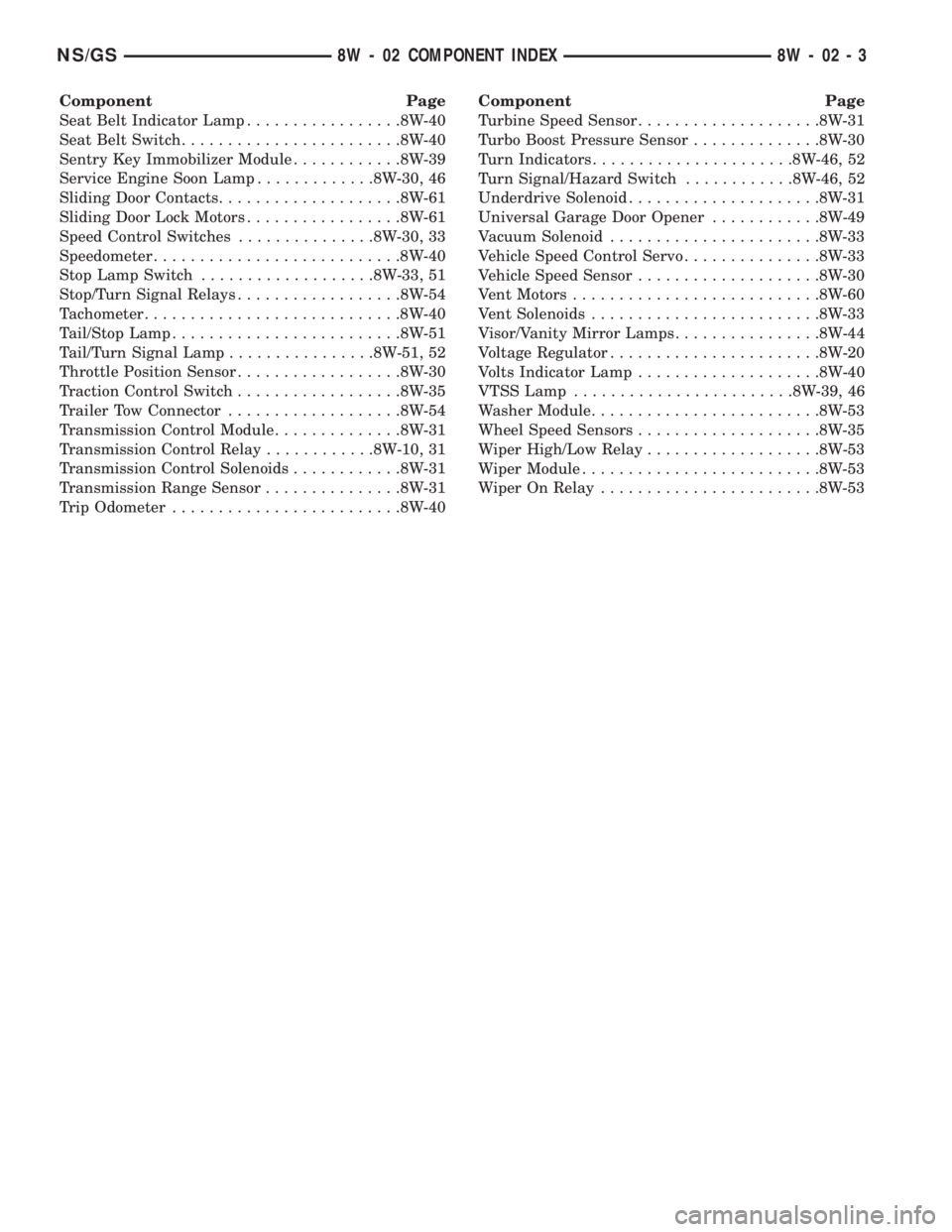
Component Page
Seat Belt Indicator Lamp.................8W-40
Seat Belt Switch........................8W-40
Sentry Key Immobilizer Module............8W-39
Service Engine Soon Lamp.............8W-30, 46
Sliding Door Contacts....................8W-61
Sliding Door Lock Motors.................8W-61
Speed Control Switches...............8W-30, 33
Speedometer...........................8W-40
Stop Lamp Switch...................8W-33, 51
Stop/Turn Signal Relays..................8W-54
Tachometer............................8W-40
Tail/Stop Lamp.........................8W-51
Tail/Turn Signal Lamp................8W-51, 52
Throttle Position Sensor..................8W-30
Traction Control Switch..................8W-35
Trailer Tow Connector...................8W-54
Transmission Control Module..............8W-31
Transmission Control Relay............8W-10, 31
Transmission Control Solenoids............8W-31
Transmission Range Sensor...............8W-31
Trip Odometer.........................8W-40Component Page
Turbine Speed Sensor....................8W-31
Turbo Boost Pressure Sensor..............8W-30
Turn Indicators......................8W-46, 52
Turn Signal/Hazard Switch............8W-46, 52
Underdrive Solenoid.....................8W-31
Universal Garage Door Opener............8W-49
Vacuum Solenoid.......................8W-33
Vehicle Speed Control Servo...............8W-33
Vehicle Speed Sensor....................8W-30
Vent Motors...........................8W-60
Vent Solenoids.........................8W-33
Visor/Vanity Mirror Lamps................8W-44
Voltage Regulator.......................8W-20
Volts Indicator Lamp....................8W-40
VTSS Lamp........................8W-39, 46
Washer Module.........................8W-53
Wheel Speed Sensors....................8W-35
Wiper High/Low Relay...................8W-53
Wiper Module..........................8W-53
Wiper On Relay........................8W-53
NS/GS8W - 02 COMPONENT INDEX 8W - 02 - 3
Page 665 of 1938
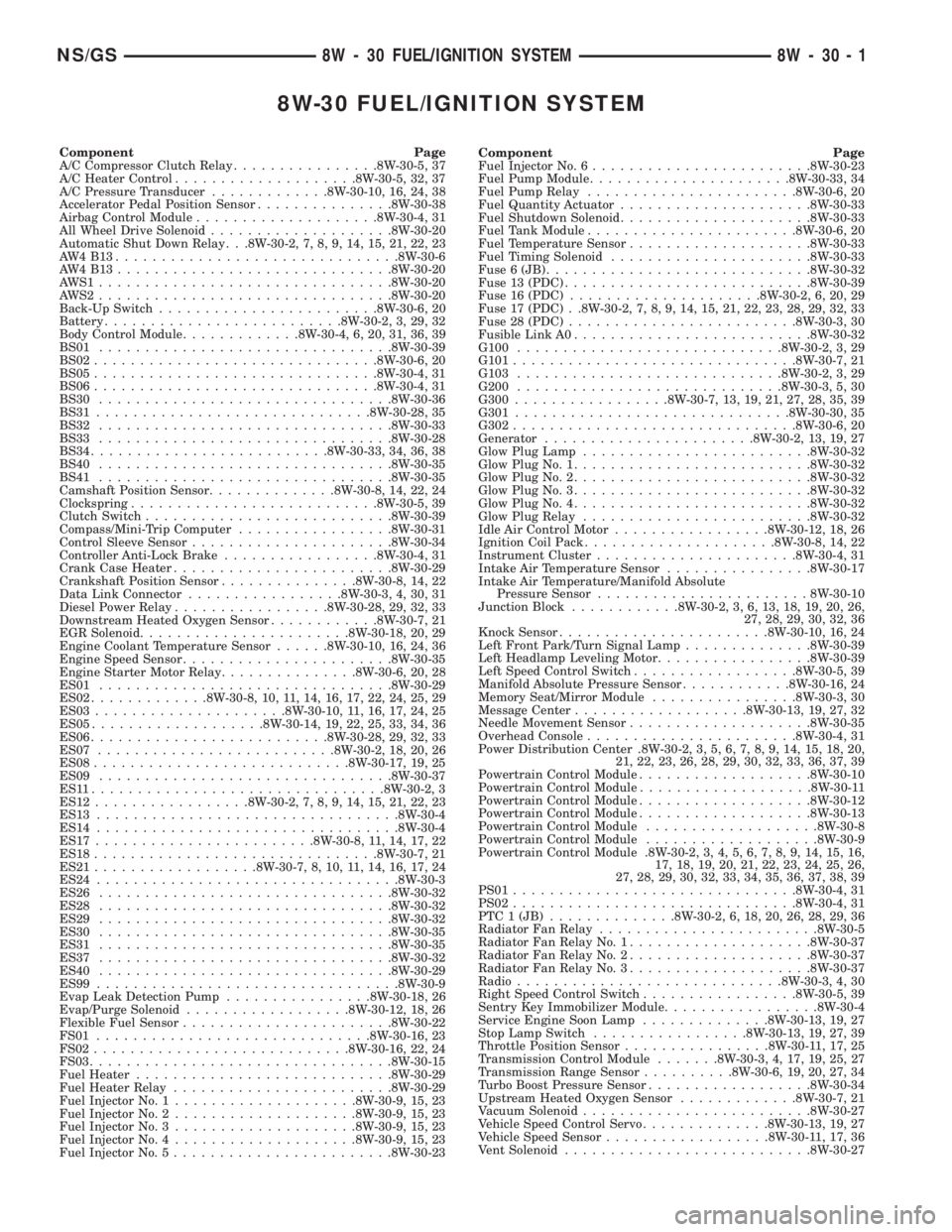
8W-30 FUEL/IGNITION SYSTEM
Component Page
A/C Compressor Clutch Relay................8W-30-5, 37
A/C Heater Control....................8W-30-5, 32, 37
A/C Pressure Transducer.............8W-30-10, 16, 24, 38
Accelerator Pedal Position Sensor...............8W-30-38
Airbag Control Module....................8W-30-4, 31
All Wheel Drive Solenoid....................8W-30-20
Automatic Shut Down Relay . . .8W-30-2, 7, 8, 9, 14, 15, 21, 22, 23
AW4B13...............................8W-30-6
AW4B13..............................8W-30-20
AWS1................................8W-30-20
AWS2................................8W-30-20
Back-Up Switch........................8W-30-6, 20
Battery..........................8W-30-2, 3, 29, 32
Body Control Module.............8W-30-4, 6, 20, 31, 36, 39
BS01................................8W-30-39
BS02...............................8W-30-6, 20
BS05...............................8W-30-4, 31
BS06...............................8W-30-4, 31
BS30................................8W-30-36
BS31..............................8W-30-28, 35
BS32................................8W-30-33
BS33................................8W-30-28
BS34..........................8W-30-33, 34, 36, 38
BS40................................8W-30-35
BS41................................8W-30-35
Camshaft Position Sensor..............8W-30-8, 14, 22, 24
Clockspring...........................8W-30-5, 39
Clutch Switch...........................8W-30-39
Compass/Mini-Trip Computer.................8W-30-31
Control Sleeve Sensor......................8W-30-34
Controller Anti-Lock Brake.................8W-30-4, 31
Crank Case Heater........................8W-30-29
Crankshaft Position Sensor...............8W-30-8, 14, 22
Data Link Connector.................8W-30-3, 4, 30, 31
Diesel Power Relay.................8W-30-28, 29, 32, 33
Downstream Heated Oxygen Sensor............8W-30-7, 21
EGR Solenoid.......................8W-30-18, 20, 29
Engine Coolant Temperature Sensor......8W-30-10, 16, 24, 36
Engine Speed Sensor.......................8W-30-35
Engine Starter Motor Relay...............8W-30-6, 20, 28
ES01................................8W-30-29
ES02.............8W-30-8, 10, 11, 14, 16, 17, 22, 24, 25, 29
ES03.....................8W-30-10, 11, 16, 17, 24, 25
ES05...................8W-30-14, 19, 22, 25, 33, 34, 36
ES06..........................8W-30-28, 29, 32, 33
ES07..........................8W-30-2, 18, 20, 26
ES08............................8W-30-17, 19, 25
ES09................................8W-30-37
ES11................................8W-30-2, 3
ES12.................8W-30-2, 7, 8, 9, 14, 15, 21, 22, 23
ES13.................................8W-30-4
ES14.................................8W-30-4
ES17........................8W-30-8, 11, 14, 17, 22
ES18...............................8W-30-7, 21
ES21..................8W-30-7, 8, 10, 11, 14, 16, 17, 24
ES24.................................8W-30-3
ES26................................8W-30-32
ES28................................8W-30-32
ES29................................8W-30-32
ES30................................8W-30-35
ES31................................8W-30-35
ES37................................8W-30-32
ES40................................8W-30-29
ES99.................................8W-30-9
Evap Leak Detection Pump................8W-30-18, 26
Evap/Purge Solenoid..................8W-30-12, 18, 26
Flexible Fuel Sensor.......................8W-30-22
FS01..............................8W-30-16, 23
FS02............................8W-30-16, 22, 24
FS03.................................8W-30-15
Fuel Heater............................8W-30-29
Fuel Heater Relay........................8W-30-29
Fuel Injector No. 1....................8W-30-9, 15, 23
Fuel Injector No. 2....................8W-30-9, 15, 23
Fuel Injector No. 3....................8W-30-9, 15, 23
Fuel Injector No. 4....................8W-30-9, 15, 23
Fuel Injector No. 5........................8W-30-23Component Page
Fuel Injector No. 6........................8W-30-23
Fuel Pump Module......................8W-30-33, 34
Fuel Pump Relay.......................8W-30-6, 20
Fuel Quantity Actuator.....................8W-30-33
Fuel Shutdown Solenoid.....................8W-30-33
Fuel Tank Module.......................8W-30-6, 20
Fuel Temperature Sensor....................8W-30-33
Fuel Timing Solenoid......................8W-30-33
Fuse 6 (JB).............................8W-30-32
Fuse 13 (PDC)...........................8W-30-39
Fuse 16 (PDC).....................8W-30-2, 6, 20, 29
Fuse 17 (PDC) . .8W-30-2, 7, 8, 9, 14, 15, 21, 22, 23, 28, 29, 32, 33
Fuse 28 (PDC).........................8W-30-3, 30
Fusible Link A0..........................8W-30-32
G100.............................8W-30-2, 3, 29
G101...............................8W-30-7, 21
G103.............................8W-30-2, 3, 29
G200.............................8W-30-3, 5, 30
G300.................8W-30-7, 13, 19, 21, 27, 28, 35, 39
G301..............................8W-30-30, 35
G302...............................8W-30-6, 20
Generator.......................8W-30-2, 13, 19, 27
Glow Plug Lamp.........................8W-30-32
Glow Plug No. 1..........................8W-30-32
Glow Plug No. 2..........................8W-30-32
Glow Plug No. 3..........................8W-30-32
Glow Plug No. 4..........................8W-30-32
Glow Plug Relay.........................8W-30-32
Idle Air Control Motor.................8W-30-12, 18, 26
Ignition Coil Pack.....................8W-30-8, 14, 22
Instrument Cluster......................8W-30-4, 31
Intake Air Temperature Sensor................8W-30-17
Intake Air Temperature/Manifold Absolute
Pressure Sensor.......................8W-30-10
Junction Block............8W-30-2, 3, 6, 13, 18, 19, 20, 26,
27, 28, 29, 30, 32, 36
Knock Sensor.......................8W-30-10, 16, 24
Left Front Park/Turn Signal Lamp..............8W-30-39
Left Headlamp Leveling Motor.................8W-30-39
Left Speed Control Switch..................8W-30-5, 39
Manifold Absolute Pressure Sensor............8W-30-16, 24
Memory Seat/Mirror Module................8W-30-3, 30
Message Center...................8W-30-13, 19, 27, 32
Needle Movement Sensor....................8W-30-35
Overhead Console.......................8W-30-4, 31
Power Distribution Center .8W-30-2, 3, 5, 6, 7, 8, 9, 14, 15, 18, 20,
21, 22, 23, 26, 28, 29, 30, 32, 33, 36, 37, 39
Powertrain Control Module...................8W-30-10
Powertrain Control Module...................8W-30-11
Powertrain Control Module...................8W-30-12
Powertrain Control Module...................8W-30-13
Powertrain Control Module...................8W-30-8
Powertrain Control Module...................8W-30-9
Powertrain Control Module .8W-30-2, 3, 4, 5, 6, 7, 8, 9, 14, 15, 16,
17, 18, 19, 20, 21, 22, 23, 24, 25, 26,
27, 28, 29, 30, 32, 33, 34, 35, 36, 37, 38, 39
PS01...............................8W-30-4, 31
PS02...............................8W-30-4, 31
PTC 1 (JB)..............8W-30-2, 6, 18, 20, 26, 28, 29, 36
Radiator Fan Relay........................8W-30-5
Radiator Fan Relay No. 1....................8W-30-37
Radiator Fan Relay No. 2....................8W-30-37
Radiator Fan Relay No. 3....................8W-30-37
Radio.............................8W-30-3, 4, 30
Right Speed Control Switch.................8W-30-5, 39
Sentry Key Immobilizer Module.................8W-30-4
Service Engine Soon Lamp..............8W-30-13, 19, 27
Stop Lamp Switch.................8W-30-13, 19, 27, 39
Throttle Position Sensor................8W-30-11, 17, 25
Transmission Control Module.......8W-30-3, 4, 17, 19, 25, 27
Transmission Range Sensor..........8W-30-6, 19, 20, 27, 34
Turbo Boost Pressure Sensor..................8W-30-34
Upstream Heated Oxygen Sensor.............8W-30-7, 21
Vacuum Solenoid.........................8W-30-27
Vehicle Speed Control Servo..............8W-30-13, 19, 27
Vehicle Speed Sensor..................8W-30-11, 17, 36
Vent Solenoid...........................8W-30-27
NS/GS8W - 30 FUEL/IGNITION SYSTEM 8W - 30 - 1