heater CHRYSLER VOYAGER 1996 User Guide
[x] Cancel search | Manufacturer: CHRYSLER, Model Year: 1996, Model line: VOYAGER, Model: CHRYSLER VOYAGER 1996Pages: 1938, PDF Size: 55.84 MB
Page 228 of 1938
RADIATOR COOLANT FLOW TEST
To determine whether coolant is flowing through
the cooling system, use the following procedure:
(1) If engine is cold, idle engine until normal oper-
ating temperature is reached. Then feel the upper
radiator hose. If it is hot, coolant is circulating.
WARNING: DO NOT REMOVE RADIATOR PRES-
SURE CAP WITH THE SYSTEM HOT AND UNDER
PRESSURE BECAUSE SERIOUS BURNS FROM
COOLANT CAN OCCUR.
(2) Remove radiator pressure cap when engine is
cold, idle engine until thermostat opens, you should
observe coolant flow while looking down the filler
neck. Once flow is detected install radiator pressure
cap.
RADIATOR FAN CONTROL
Fan control is accomplished two ways. A pressure
transducer on the compressor discharge line sends a
signal to the Powertrain Control Module (PCM)
which will activate the fan. In addition to this con-
trol, the fan is turned on by the temperature of the
coolant which is sensed by the coolant temperature
sensor which sends the message to the PCM. The fan
will not run during cranking until the engine starts
no matter what the coolant temperature is.
CAUTION: The solid state fan relay is attached to
the left frame rail near the lower radiator support.
The relay bracket, and fastener are used to dissi-
pate heat from the relay. Ensure the relay is prop-
erly attached to prevent the following:
²Intermittent engine overheating.
²Relay ªthermalº shutdown, or relay damage.
ELECTRIC FAN MOTOR TEST
Refer to Powertrain Diagnostic Manual for proce-
dure.
TESTING COOLING SYSTEM FOR LEAKS
With engine not running, wipe the radiator filler
neck sealing seat clean. The radiator should be full.
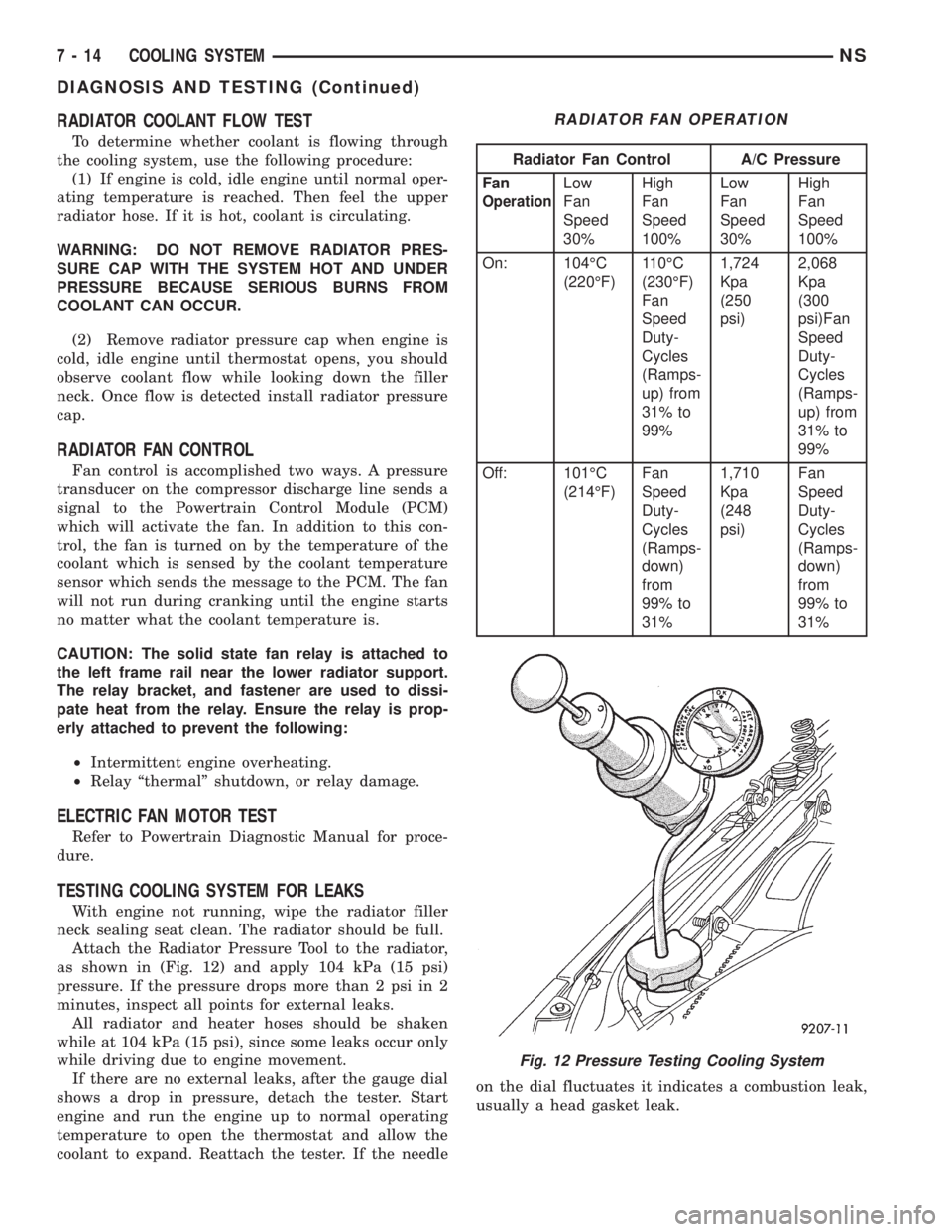
Attach the Radiator Pressure Tool to the radiator,
as shown in (Fig. 12) and apply 104 kPa (15 psi)
pressure. If the pressure drops more than 2 psi in 2
minutes, inspect all points for external leaks.
All radiator and heater hoses should be shaken
while at 104 kPa (15 psi), since some leaks occur only
while driving due to engine movement.
If there are no external leaks, after the gauge dial
shows a drop in pressure, detach the tester. Start
engine and run the engine up to normal operating
temperature to open the thermostat and allow the
coolant to expand. Reattach the tester. If the needleon the dial fluctuates it indicates a combustion leak,
usually a head gasket leak.
RADIATOR FAN OPERATION
Radiator Fan Control A/C Pressure
Fan
Operation
Low
Fan
Speed
30%High
Fan
Speed
100%Low
Fan
Speed
30%High
Fan
Speed
100%
On: 104ÉC
(220ÉF)110ÉC
(230ÉF)
Fan
Speed
Duty-
Cycles
(Ramps-
up) from
31% to
99%1,724
Kpa
(250
psi)2,068
Kpa
(300
psi)Fan
Speed
Duty-
Cycles
(Ramps-
up) from
31% to
99%
Off: 101ÉC
(214ÉF)Fan
Speed
Duty-
Cycles
(Ramps-
down)
from
99% to
31%1,710
Kpa
(248
psi)Fan
Speed
Duty-
Cycles
(Ramps-
down)
from
99% to
31%
Fig. 12 Pressure Testing Cooling System
7 - 14 COOLING SYSTEMNS
DIAGNOSIS AND TESTING (Continued)
Page 230 of 1938

at running operating temperature the high pressure
inlet tank runs full and the low pressure outlet tank
drops:
²Transmission oil will become hotter.
²High reading shown on the temperature gauge.
²Air in the coolant can cause loss of flow through
the heater.
²Exhaust gas leaks into the coolant also can
cause the same problems.
DEAERATION
Air can only be removed from the system by gath-
ering under the pressure cap. On the next heat up it
will be pushed past the pressure cap into the CRS
tank by thermal expansion of the coolant. It then
escapes to the atmosphere in the CRS tank and is
replaced with solid coolant on cool down.
TEMPERATURE GAUGE INDICATION
At idle with Air Conditioning off the temperature
gauge will rise slowly to about 5/8 gauge travel, the
fan will come on and the gauge will quickly drop to
about 1/2 gauge travel. This is normal.
SERVICE PROCEDURES
COOLANT LEVEL CHECKÐROUTINE
Do not remove radiator cap for routine cool-
ant level inspections.
The coolant reserve system provides a quick visual
method for determining the coolant level without
removing the radiator cap.With the engine cold
and not running,simply observe the level of the
coolant in the reserve tank (Fig. 3). The coolant level
should be between the minimum and maximum
marks.
COOLANTÐADDING ADDITIONAL
The radiator cap should not be removed.
When additional coolant is needed to maintain this
level, it should be added to the coolant reserve tank.
Use only 50/50 mix of ethylene glycol type antifreeze
and water.
CAUTION: Do not use well water, or suspect water
supply in cooling system. A 50/50 ethylene glycol
and distilled water mix is recommended.
COOLANT LEVEL SERVICE
The cooling system is closed and designed to main-
tain coolant level to the top of the radiator.
When servicing requires a coolant level check in
the radiator, the engine must beoffandnotunder
pressure. Drain several ounces of coolant from the
radiator draincock while observing the CoolantRecovery System (CRS) Tank. Coolant level in the
CRS tank should drop slightly. Then remove the radi-
ator cap. The radiator should be full to the top. If
not, and the coolant level in the CRS tank is at the
MIN mark there is an air leak in the CRS system.
Check hose or hose connections to the CRS tank,
radiator filler neck or the pressure cap seal to the
radiator filler neck for leaks.
COOLING SYSTEMÐDRAINING
Without removing radiator pressure cap and
with system not under pressure,shut engine off
and open draincock. The coolant reserve tank should
empty first, then remove radiator pressure cap. (if
not, see Testing Cooling System for leaks). To vent
2.4L engine remove the coolant temperature sensor
located above water outlet housing (Fig. 15). The 3.0/
3.3/3.8L engines have an air bleed vent on the ther-
mostat.
Removal of a sensor is required because the ther-
mostat does not have an air vent. Sensor removal
allows an air bleed for coolant to drain from the
engine block.
COOLING SYSTEMÐREFILLING
First clean system to remove old coolant, see Cool-
ing System Cleaning.
Fill the system, using the correct antifreeze as
described in the Coolant Section. Fill the system to
50 percent of its capacity with 100 percent glycol.
Then complete filling system with water. The 2.4L
engine requires venting by removal of the coolant
sensor on top of the water outlet connector (Fig. 15).
When coolant reaches this hole:
²Install coolant sensor and tighten to 7 N´m (60
in. lbs.) for 2.4L Engines.
Fig. 15 Coolant Temperature SensorÐ2.4L Engine
Drain/Fill
7 - 16 COOLING SYSTEMNS
DIAGNOSIS AND TESTING (Continued)
Page 231 of 1938
Continue filling system until full, this provides bet-
ter heater performance.Be careful not to spill
coolant on drive belts or the generator.
Fill coolant reserve system to at least the MAX
mark with 50/50 solution. It may be necessary to add
coolant to the reserve tank after three or four warm
up/cool down cycles to maintain coolant level between
the MAX and MIN mark. This will allow trapped air
to be removed from the system.
REMOVAL AND INSTALLATION
WATER PUMPÐ2.4L ENGINE
REMOVAL
(1) Disconnect negative cable from battery.
(2) Raise vehicle on a hoist. Remove right inner
splash shield.
(3) Remove accessory drive belts. Refer to Acces-
sory Drive Belt service in this section.
(4) Drain cooling system. Refer to Cooling System
Draining in this section.
(5) Support engine from the bottom and remove
right engine mount.
(6) Remove right engine mount bracket.
(7) Remove timing belt. Refer to Group 9, Engine
for procedure.
(8) Remove timing belt idler pulley.
(9) Hold camshaft sprocket with Special tool
C-4687 and adaptor C-4687-1 while removing bolt.
Remove both cam sprockets.
(10) Remove rear timing belt cover.
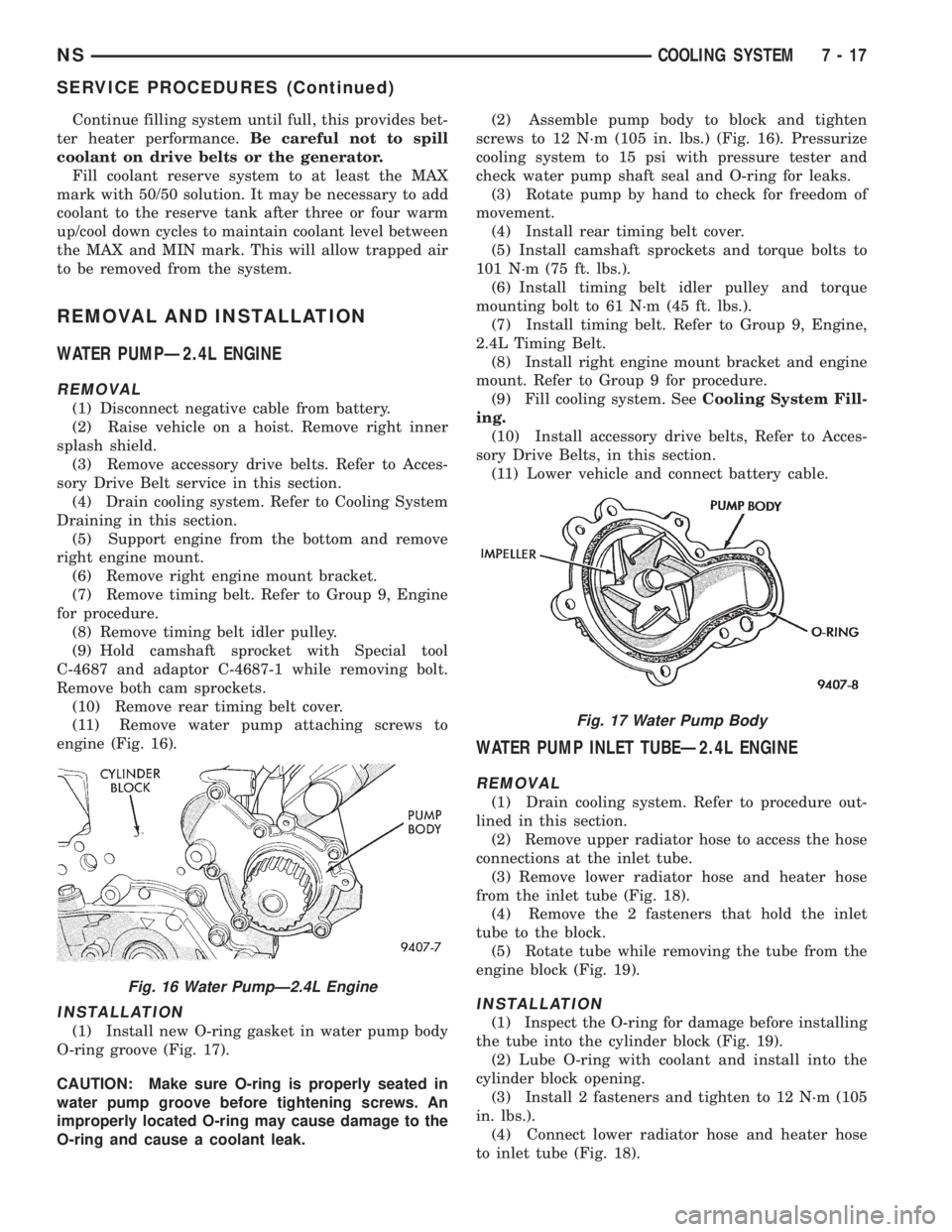
(11) Remove water pump attaching screws to
engine (Fig. 16).
INSTALLATION
(1) Install new O-ring gasket in water pump body
O-ring groove (Fig. 17).
CAUTION: Make sure O-ring is properly seated in
water pump groove before tightening screws. An
improperly located O-ring may cause damage to the
O-ring and cause a coolant leak.(2) Assemble pump body to block and tighten
screws to 12 N´m (105 in. lbs.) (Fig. 16). Pressurize
cooling system to 15 psi with pressure tester and
check water pump shaft seal and O-ring for leaks.
(3) Rotate pump by hand to check for freedom of
movement.
(4) Install rear timing belt cover.
(5) Install camshaft sprockets and torque bolts to
101 N´m (75 ft. lbs.).
(6) Install timing belt idler pulley and torque
mounting bolt to 61 N´m (45 ft. lbs.).
(7) Install timing belt. Refer to Group 9, Engine,
2.4L Timing Belt.
(8) Install right engine mount bracket and engine
mount. Refer to Group 9 for procedure.
(9) Fill cooling system. SeeCooling System Fill-
ing.
(10) Install accessory drive belts, Refer to Acces-
sory Drive Belts, in this section.
(11) Lower vehicle and connect battery cable.
WATER PUMP INLET TUBEÐ2.4L ENGINE
REMOVAL
(1) Drain cooling system. Refer to procedure out-
lined in this section.
(2) Remove upper radiator hose to access the hose
connections at the inlet tube.
(3) Remove lower radiator hose and heater hose
from the inlet tube (Fig. 18).
(4) Remove the 2 fasteners that hold the inlet
tube to the block.
(5) Rotate tube while removing the tube from the
engine block (Fig. 19).
INSTALLATION
(1) Inspect the O-ring for damage before installing
the tube into the cylinder block (Fig. 19).
(2) Lube O-ring with coolant and install into the
cylinder block opening.
(3) Install 2 fasteners and tighten to 12 N´m (105
in. lbs.).
(4) Connect lower radiator hose and heater hose
to inlet tube (Fig. 18).
Fig. 16 Water PumpÐ2.4L Engine
Fig. 17 Water Pump Body
NSCOOLING SYSTEM 7 - 17
SERVICE PROCEDURES (Continued)
Page 235 of 1938
INSTALLATION
(1) Place a new gasket (dipped in water) on the
thermostat housing surface, center thermostat into
opening in the intake manifold water box.
(2) Place housing and gasket over the thermostat,
making sure thermostat is in the recess provided
(Fig. 28).
(3) Bolt housing to intake manifold, tighten bolts
to 28 N´m (250 in. lbs.).
(4) Refill the cooling system to the proper level.
Refer to Cooling System Refilling outlined in this sec-
tion for procedure.
RADIATOR
REMOVAL
(1) Disconnect negative cable from battery.
WARNING: DO NOT REMOVE THE CYLINDER
BLOCK PLUG OR THE RADIATOR DRAINCOCK
WITH THE SYSTEM HOT AND UNDER PRESSURE
BECAUSE SERIOUS BURNS FROM COOLANT CAN
OCCUR.
(2) Drain cooling system. Refer to Draining Cool-
ing System of this section.
(3) Remove air intake resonator.
(4) Remove coolant reserve system tank to filler
neck tube hose.
(5) Disconnect fans from the connector located on
the left side of the fan module.
(6) Remove the Coolant Recovery System (CRS)
tank retaining screw from the upper radiator closure
panel crossmember.
(7) Disconnect the upper radiator mounting
screws from the crossmember. Disconnect the engine
block heater wire if equipped.
(8) Remove the upper radiator closure panel
crossmember. Refer to Group 23 Body for procedure.
(9) Remove air cleaner assembly.
(10) Disconnect automatic transmission oil cooler
lines at radiator and plug.
(11) Disconnect inlet and outlet hoses from the
radiator. Remove the lower hose clip from the fan
module.
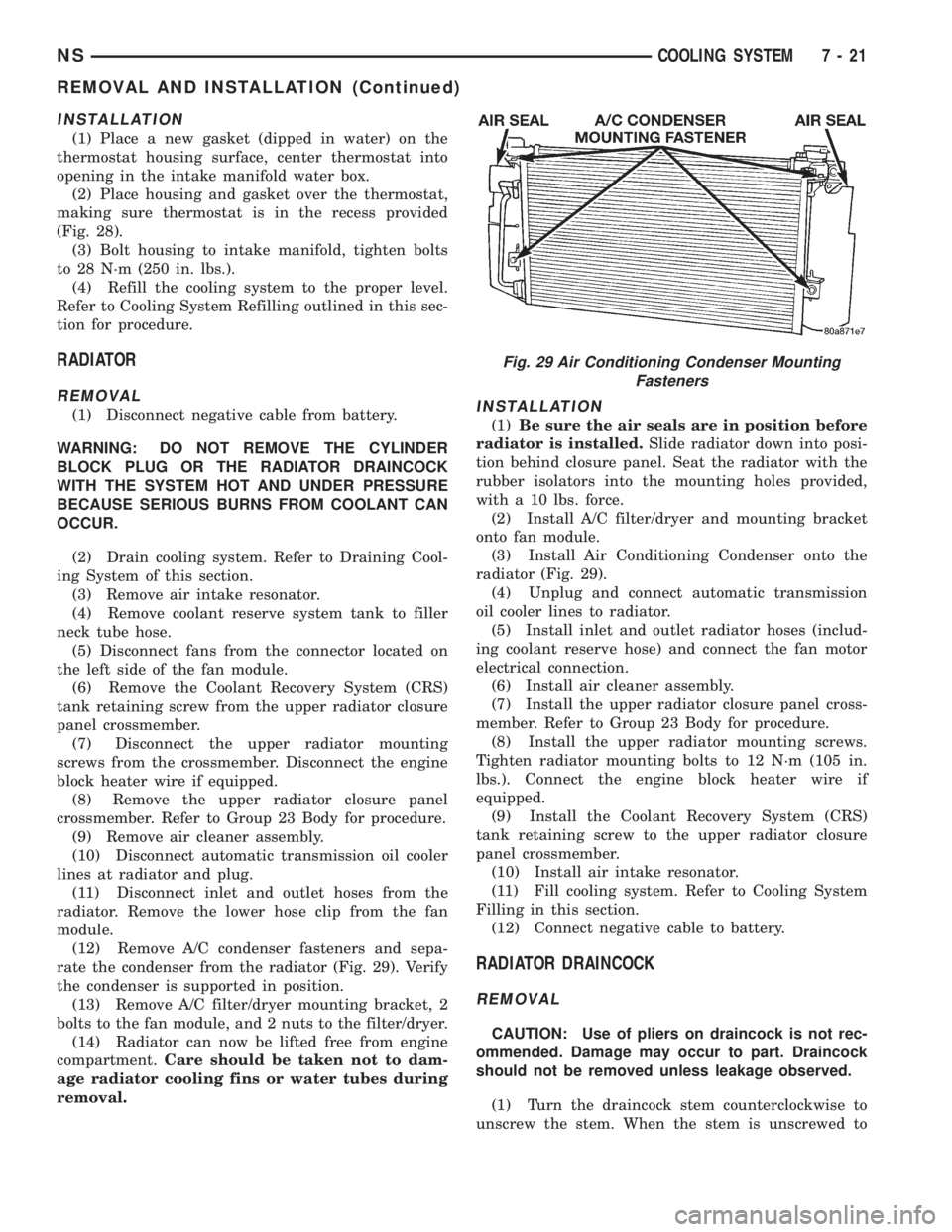
(12) Remove A/C condenser fasteners and sepa-
rate the condenser from the radiator (Fig. 29). Verify
the condenser is supported in position.
(13) Remove A/C filter/dryer mounting bracket, 2
bolts to the fan module, and 2 nuts to the filter/dryer.
(14) Radiator can now be lifted free from engine
compartment.Care should be taken not to dam-
age radiator cooling fins or water tubes during
removal.INSTALLATION
(1)Be sure the air seals are in position before
radiator is installed.Slide radiator down into posi-
tion behind closure panel. Seat the radiator with the
rubber isolators into the mounting holes provided,
with a 10 lbs. force.
(2) Install A/C filter/dryer and mounting bracket
onto fan module.
(3) Install Air Conditioning Condenser onto the
radiator (Fig. 29).
(4) Unplug and connect automatic transmission
oil cooler lines to radiator.
(5) Install inlet and outlet radiator hoses (includ-
ing coolant reserve hose) and connect the fan motor
electrical connection.
(6) Install air cleaner assembly.
(7) Install the upper radiator closure panel cross-
member. Refer to Group 23 Body for procedure.
(8) Install the upper radiator mounting screws.
Tighten radiator mounting bolts to 12 N´m (105 in.
lbs.). Connect the engine block heater wire if
equipped.
(9) Install the Coolant Recovery System (CRS)
tank retaining screw to the upper radiator closure
panel crossmember.
(10) Install air intake resonator.
(11) Fill cooling system. Refer to Cooling System
Filling in this section.
(12) Connect negative cable to battery.
RADIATOR DRAINCOCK
REMOVAL
CAUTION: Use of pliers on draincock is not rec-
ommended. Damage may occur to part. Draincock
should not be removed unless leakage observed.
(1) Turn the draincock stem counterclockwise to
unscrew the stem. When the stem is unscrewed to
Fig. 29 Air Conditioning Condenser Mounting
Fasteners
NSCOOLING SYSTEM 7 - 21
REMOVAL AND INSTALLATION (Continued)
Page 237 of 1938
(13) Raise the vehicle. Install the lower auxiliary
transmission cooler lines to the retaining clips on the
fan module shroud, if equipped.
(14) Install outlet hose retainer clip to the shroud.
Install the radiator outlet hose to the retaining clip.
(15) Lower the vehicle.
ENGINE BLOCK HEATER
REMOVAL
(1) Drain coolant from radiator and cylinder block.
Refer to Cooling System Drain, Clean, Flush and
Refill of this section for procedure.
(2) Remove power cord plug from heater.
(3) Loosen screw in center of heater. Remove
heater assembly.
INSTALLATION
(1) Thoroughly clean core hole and heater seat.
(2) Insert heater assembly with element loop posi-
tionedupward.
(3) With heater seated, tighten center screw
securely to assure a positive seal.
(4) Fill cooling system with coolant to the proper
level, vent air, and inspect for leaks. Pressurize sys-
tem with Radiator Pressure Tool before looking for
leaks.
(5) Install power cord plug to heater.
ACCESSORY DRIVE BELTSÐ2.4L
REMOVAL/INSTALLATION-ADJUST
GENERATOR AND AIR CONDITIONING
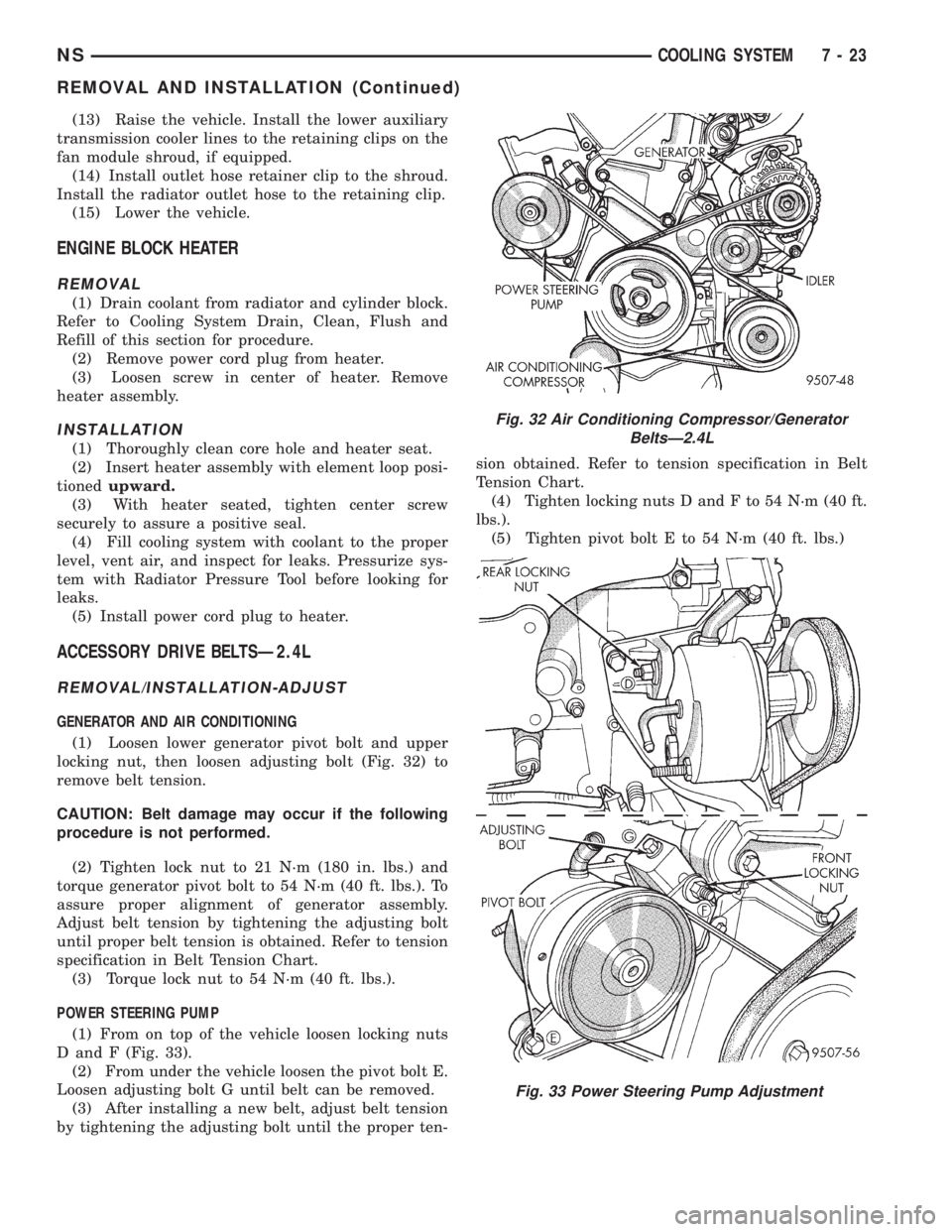
(1) Loosen lower generator pivot bolt and upper
locking nut, then loosen adjusting bolt (Fig. 32) to
remove belt tension.
CAUTION: Belt damage may occur if the following
procedure is not performed.
(2) Tighten lock nut to 21 N´m (180 in. lbs.) and
torque generator pivot bolt to 54 N´m (40 ft. lbs.). To
assure proper alignment of generator assembly.
Adjust belt tension by tightening the adjusting bolt
until proper belt tension is obtained. Refer to tension
specification in Belt Tension Chart.
(3) Torque lock nut to 54 N´m (40 ft. lbs.).
POWER STEERING PUMP
(1) From on top of the vehicle loosen locking nuts
D and F (Fig. 33).
(2) From under the vehicle loosen the pivot bolt E.
Loosen adjusting bolt G until belt can be removed.
(3) After installing a new belt, adjust belt tension
by tightening the adjusting bolt until the proper ten-sion obtained. Refer to tension specification in Belt
Tension Chart.
(4) Tighten locking nuts D and F to 54 N´m (40 ft.
lbs.).
(5) Tighten pivot bolt E to 54 N´m (40 ft. lbs.)
Fig. 32 Air Conditioning Compressor/Generator
BeltsÐ2.4L
Fig. 33 Power Steering Pump Adjustment
NSCOOLING SYSTEM 7 - 23
REMOVAL AND INSTALLATION (Continued)
Page 240 of 1938
and the remove the splash shield to gain access to
the drive belts.
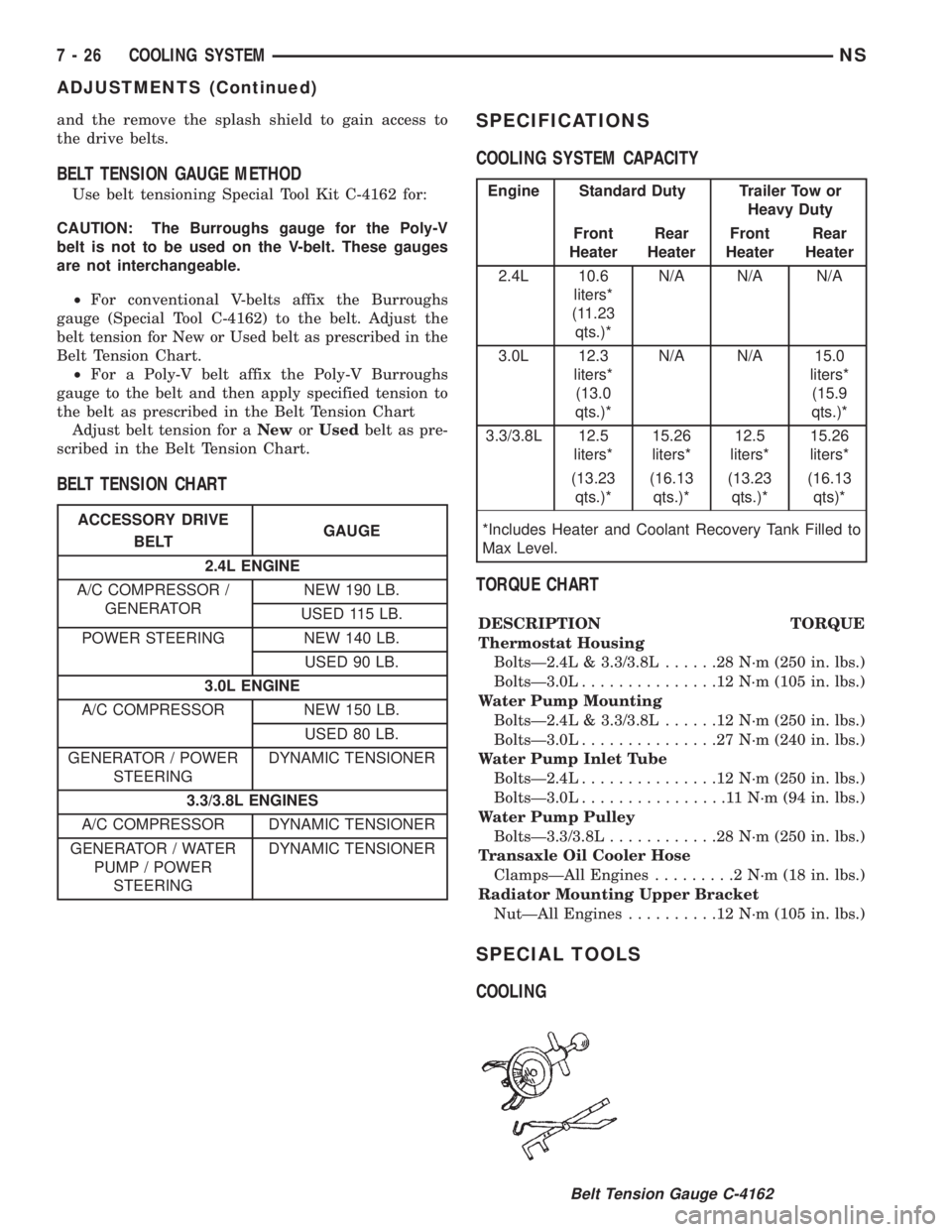
BELT TENSION GAUGE METHOD
Use belt tensioning Special Tool Kit C-4162 for:
CAUTION: The Burroughs gauge for the Poly-V
belt is not to be used on the V-belt. These gauges
are not interchangeable.
²For conventional V-belts affix the Burroughs
gauge (Special Tool C-4162) to the belt. Adjust the
belt tension for New or Used belt as prescribed in the
Belt Tension Chart.
²For a Poly-V belt affix the Poly-V Burroughs
gauge to the belt and then apply specified tension to
the belt as prescribed in the Belt Tension Chart
Adjust belt tension for aNeworUsedbelt as pre-
scribed in the Belt Tension Chart.
BELT TENSION CHARTSPECIFICATIONS
COOLING SYSTEM CAPACITY
TORQUE CHART
DESCRIPTION TORQUE
Thermostat Housing
BoltsÐ2.4L & 3.3/3.8L......28N´m(250 in. lbs.)
BoltsÐ3.0L...............12N´m(105 in. lbs.)
Water Pump Mounting
BoltsÐ2.4L & 3.3/3.8L......12N´m(250 in. lbs.)
BoltsÐ3.0L...............27N´m(240 in. lbs.)
Water Pump Inlet Tube
BoltsÐ2.4L...............12N´m(250 in. lbs.)
BoltsÐ3.0L................11N´m(94in.lbs.)
Water Pump Pulley
BoltsÐ3.3/3.8L............28N´m(250 in. lbs.)
Transaxle Oil Cooler Hose
ClampsÐAll Engines.........2N´m(18in.lbs.)
Radiator Mounting Upper Bracket
NutÐAll Engines..........12N´m(105 in. lbs.)
SPECIAL TOOLS
COOLING
ACCESSORY DRIVE
BELTGAUGE
2.4L ENGINE
A/C COMPRESSOR /
GENERATORNEW 190 LB.
USED 115 LB.
POWER STEERING NEW 140 LB.
USED 90 LB.
3.0L ENGINE
A/C COMPRESSOR NEW 150 LB.
USED 80 LB.
GENERATOR / POWER
STEERINGDYNAMIC TENSIONER
3.3/3.8L ENGINES
A/C COMPRESSOR DYNAMIC TENSIONER
GENERATOR / WATER
PUMP / POWER
STEERINGDYNAMIC TENSIONER
Engine Standard Duty Trailer Tow or
Heavy Duty
Front
HeaterRear
HeaterFront
HeaterRear
Heater
2.4L 10.6
liters*
(11.23
qts.)*N/A N/A N/A
3.0L 12.3
liters*
(13.0
qts.)*N/A N/A 15.0
liters*
(15.9
qts.)*
3.3/3.8L 12.5
liters*15.26
liters*12.5
liters*15.26
liters*
(13.23
qts.)*(16.13
qts.)*(13.23
qts.)*(16.13
qts)*
*Includes Heater and Coolant Recovery Tank Filled to
Max Level.
Belt Tension Gauge C-4162
7 - 26 COOLING SYSTEMNS
ADJUSTMENTS (Continued)
Page 241 of 1938

COOLING SYSTEM
CONTENTS
page page
GENERAL INFORMATION
COOLANT PRESSURE BOTTLE............ 1
COOLING SYSTEM Ð 2.0L GASOLINE...... 1
COOLING SYSTEM Ð 2.5L VM DIESEL..... 1
LOW COOLANT LEVEL SENSOR........... 1
RADIATOR............................ 2
DESCRIPTION AND OPERATION
AUTOMATIC BELT TENSIONER............ 6
BELT TENSION......................... 5
COOLANT PERFORMANCE............... 5
PRESSURE/VENT CAP................... 4
THERMOSTAT OPERATION............... 4
THERMOSTAT......................... 6
WATER PUMP......................... 3
SERVICE PROCEDURES
ADDING ADDITIONAL COOLANT........... 7
DRAINING COOLING SYSTEM............. 7
REFILLING COOLING SYSTEM............ 7
REMOVAL AND INSTALLATION
ENGINE THERMOSTATÐ 2.0L GASOLINE . . . 9GENERATOR/POWER STEERING BELT Ð 2.5L
VM DIESEL......................... 10
RADIATOR Ð 2.5L VM DIESEL........... 9
THERMOSTAT Ð 2.5L VM DIESEL......... 9
WATER PUMP BELT Ð 2.5L VM DIESEL . . . 10
WATER PUMP Ð 2.0L GASOLINE......... 7
WATER PUMP Ð 2.5L VM DIESEL........ 8
CLEANING AND INSPECTION
WATER PUMP........................ 10
ADJUSTMENTS
BELT TENSION CHART................. 11
BELT TENSION GAUGE METHOD......... 11
SPECIFICATIONS
COOLING SYSTEM CAPACITY............ 12
TORQUE CHART...................... 12
SPECIAL TOOLS
COOLING............................ 12
GENERAL INFORMATION
COOLING SYSTEM Ð 2.0L GASOLINE
The 2.0L gasoline engine cooling system consists of
an engine cooling module, thermostat, coolant, a
water pump to circulate the coolant. The engine cool-
ing module may consist of a radiator, electric fan
motors, fan, shroud, coolant reserve system, hoses,
clamps, air condition condenser.
²When the Engine is cold: The thermostat is
closed; the cooling system has no flow through the
radiator. The coolant flows through the engine,
heater system and bypass.
²When the Engine is warm: Thermostat is open;
the cooling system has flow through radiator, engine,
heater system and bypass.
COOLING SYSTEM Ð 2.5L VM DIESEL
The cooling system has a radiator, coolant, electric
fan motors, shroud, pressure cap, thermostat, coolant
pressure bottle, hoses, a water pump to circulate the
coolant, to complete the circuit. Coolant flow for the
VM diesel engine is shown in (Fig. 1).
COOLANT PRESSURE BOTTLE
2.5L VM DIESEL
This system works with the pressure cap to use
thermal expansion and contraction of the coolant to
keep the coolant free of trapped air. It provides some
reserve coolant to cover minor leaks and evaporation
or boiling losses. The coolant pressure bottle location
for 2.5L diesel is above the cylinder head cover (Fig.
2).
LOW COOLANT LEVEL SENSOR
The low coolant level sensor checks for low coolant
level in the coolant tank. A signal will be sent from
this sensor to the Body Control Module (BCM). When
the BCM determines low coolant level for 30 contin-
uous seconds, the instrument panel mounted low
coolant level warning lamp will be illuminated. The
sensor is located on the front side of the coolant tank
(Fig. 4). For information, refer to Group 8E, Instru-
ment Panel and Gauges.
If this lamp is illuminated, it indicates the need to
fill the coolant tank and check for leaks.
NS/GSCOOLING SYSTEM 7 - 1
Page 246 of 1938
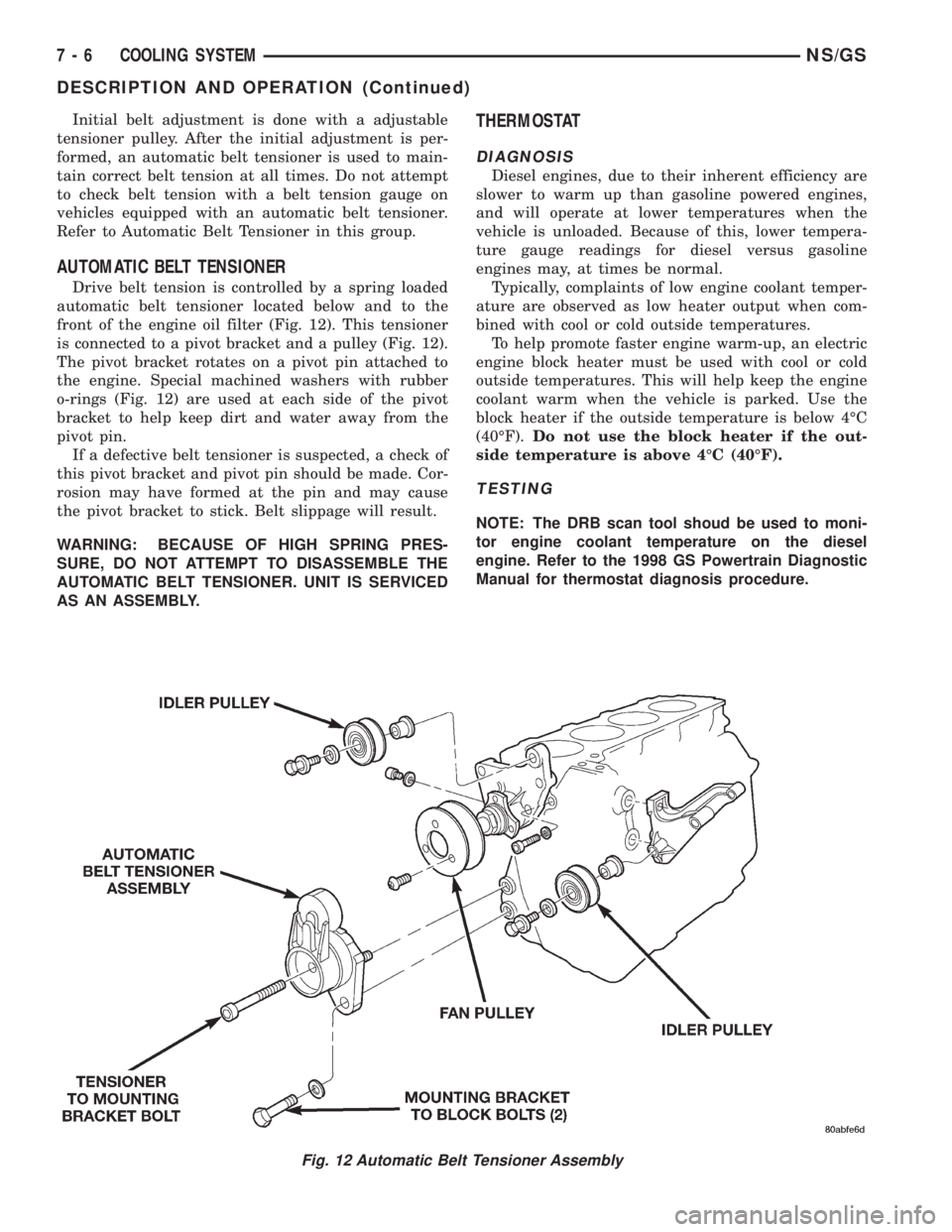
Initial belt adjustment is done with a adjustable
tensioner pulley. After the initial adjustment is per-
formed, an automatic belt tensioner is used to main-
tain correct belt tension at all times. Do not attempt
to check belt tension with a belt tension gauge on
vehicles equipped with an automatic belt tensioner.
Refer to Automatic Belt Tensioner in this group.
AUTOMATIC BELT TENSIONER
Drive belt tension is controlled by a spring loaded
automatic belt tensioner located below and to the
front of the engine oil filter (Fig. 12). This tensioner
is connected to a pivot bracket and a pulley (Fig. 12).
The pivot bracket rotates on a pivot pin attached to
the engine. Special machined washers with rubber
o-rings (Fig. 12) are used at each side of the pivot
bracket to help keep dirt and water away from the
pivot pin.
If a defective belt tensioner is suspected, a check of
this pivot bracket and pivot pin should be made. Cor-
rosion may have formed at the pin and may cause
the pivot bracket to stick. Belt slippage will result.
WARNING: BECAUSE OF HIGH SPRING PRES-
SURE, DO NOT ATTEMPT TO DISASSEMBLE THE
AUTOMATIC BELT TENSIONER. UNIT IS SERVICED
AS AN ASSEMBLY.
THERMOSTAT
DIAGNOSIS
Diesel engines, due to their inherent efficiency are
slower to warm up than gasoline powered engines,
and will operate at lower temperatures when the
vehicle is unloaded. Because of this, lower tempera-
ture gauge readings for diesel versus gasoline
engines may, at times be normal.
Typically, complaints of low engine coolant temper-
ature are observed as low heater output when com-
bined with cool or cold outside temperatures.
To help promote faster engine warm-up, an electric
engine block heater must be used with cool or cold
outside temperatures. This will help keep the engine
coolant warm when the vehicle is parked. Use the
block heater if the outside temperature is below 4ÉC
(40ÉF).Do not use the block heater if the out-
side temperature is above 4ÉC (40ÉF).
TESTING
NOTE: The DRB scan tool shoud be used to moni-
tor engine coolant temperature on the diesel
engine. Refer to the 1998 GS Powertrain Diagnostic
Manual for thermostat diagnosis procedure.
Fig. 12 Automatic Belt Tensioner Assembly
7 - 6 COOLING SYSTEMNS/GS
DESCRIPTION AND OPERATION (Continued)
Page 247 of 1938
SERVICE PROCEDURES
ADDING ADDITIONAL COOLANT
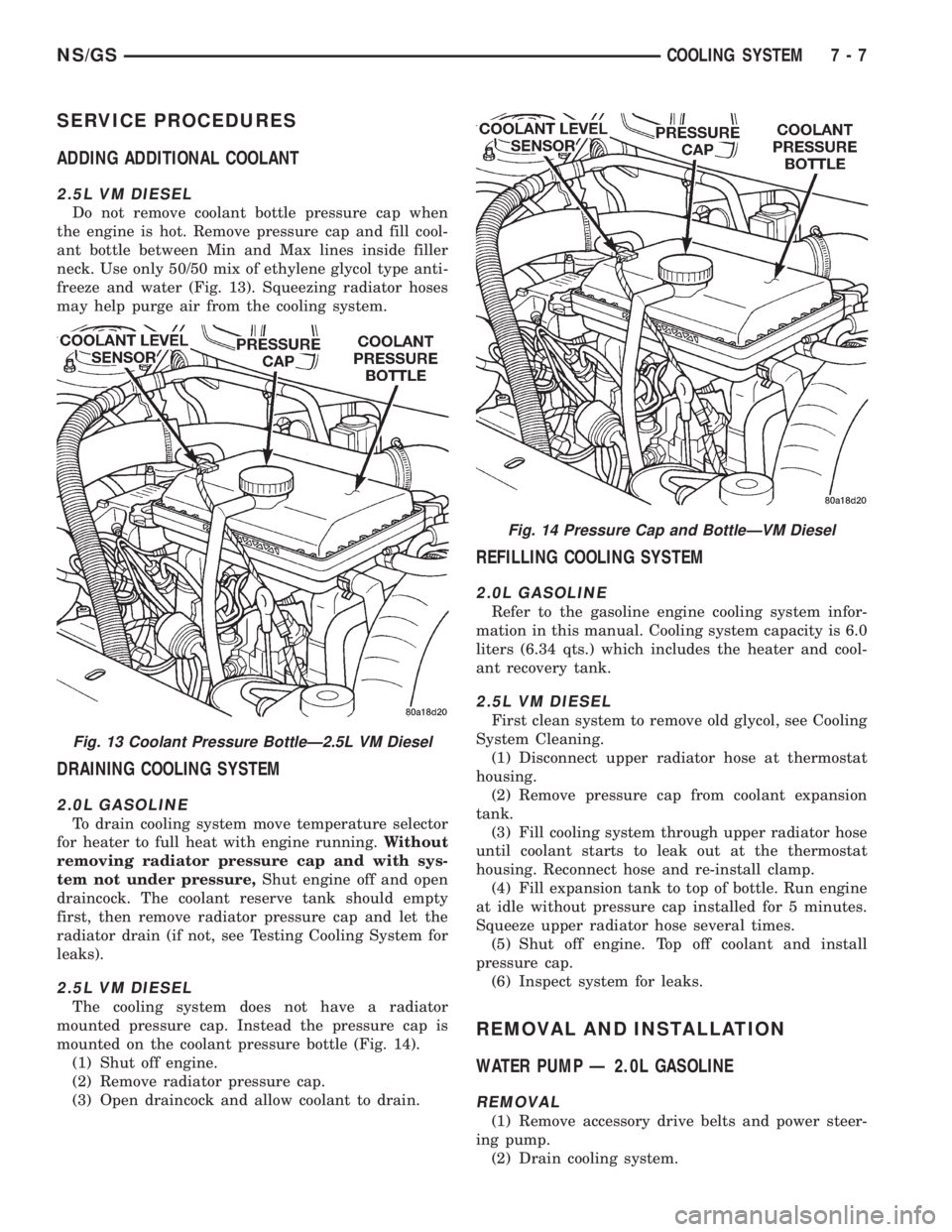
2.5L VM DIESEL
Do not remove coolant bottle pressure cap when
the engine is hot. Remove pressure cap and fill cool-
ant bottle between Min and Max lines inside filler
neck. Use only 50/50 mix of ethylene glycol type anti-
freeze and water (Fig. 13). Squeezing radiator hoses
may help purge air from the cooling system.
DRAINING COOLING SYSTEM
2.0L GASOLINE
To drain cooling system move temperature selector
for heater to full heat with engine running.Without
removing radiator pressure cap and with sys-
tem not under pressure,Shut engine off and open
draincock. The coolant reserve tank should empty
first, then remove radiator pressure cap and let the
radiator drain (if not, see Testing Cooling System for
leaks).
2.5L VM DIESEL
The cooling system does not have a radiator
mounted pressure cap. Instead the pressure cap is
mounted on the coolant pressure bottle (Fig. 14).
(1) Shut off engine.
(2) Remove radiator pressure cap.
(3) Open draincock and allow coolant to drain.
REFILLING COOLING SYSTEM
2.0L GASOLINE
Refer to the gasoline engine cooling system infor-
mation in this manual. Cooling system capacity is 6.0
liters (6.34 qts.) which includes the heater and cool-
ant recovery tank.
2.5L VM DIESEL
First clean system to remove old glycol, see Cooling
System Cleaning.
(1) Disconnect upper radiator hose at thermostat
housing.
(2) Remove pressure cap from coolant expansion
tank.
(3) Fill cooling system through upper radiator hose
until coolant starts to leak out at the thermostat
housing. Reconnect hose and re-install clamp.
(4) Fill expansion tank to top of bottle. Run engine
at idle without pressure cap installed for 5 minutes.
Squeeze upper radiator hose several times.
(5) Shut off engine. Top off coolant and install
pressure cap.
(6) Inspect system for leaks.
REMOVAL AND INSTALLATION
WATER PUMP Ð 2.0L GASOLINE
REMOVAL
(1) Remove accessory drive belts and power steer-
ing pump.
(2) Drain cooling system.
Fig. 13 Coolant Pressure BottleÐ2.5L VM Diesel
Fig. 14 Pressure Cap and BottleÐVM Diesel
NS/GSCOOLING SYSTEM 7 - 7
Page 252 of 1938
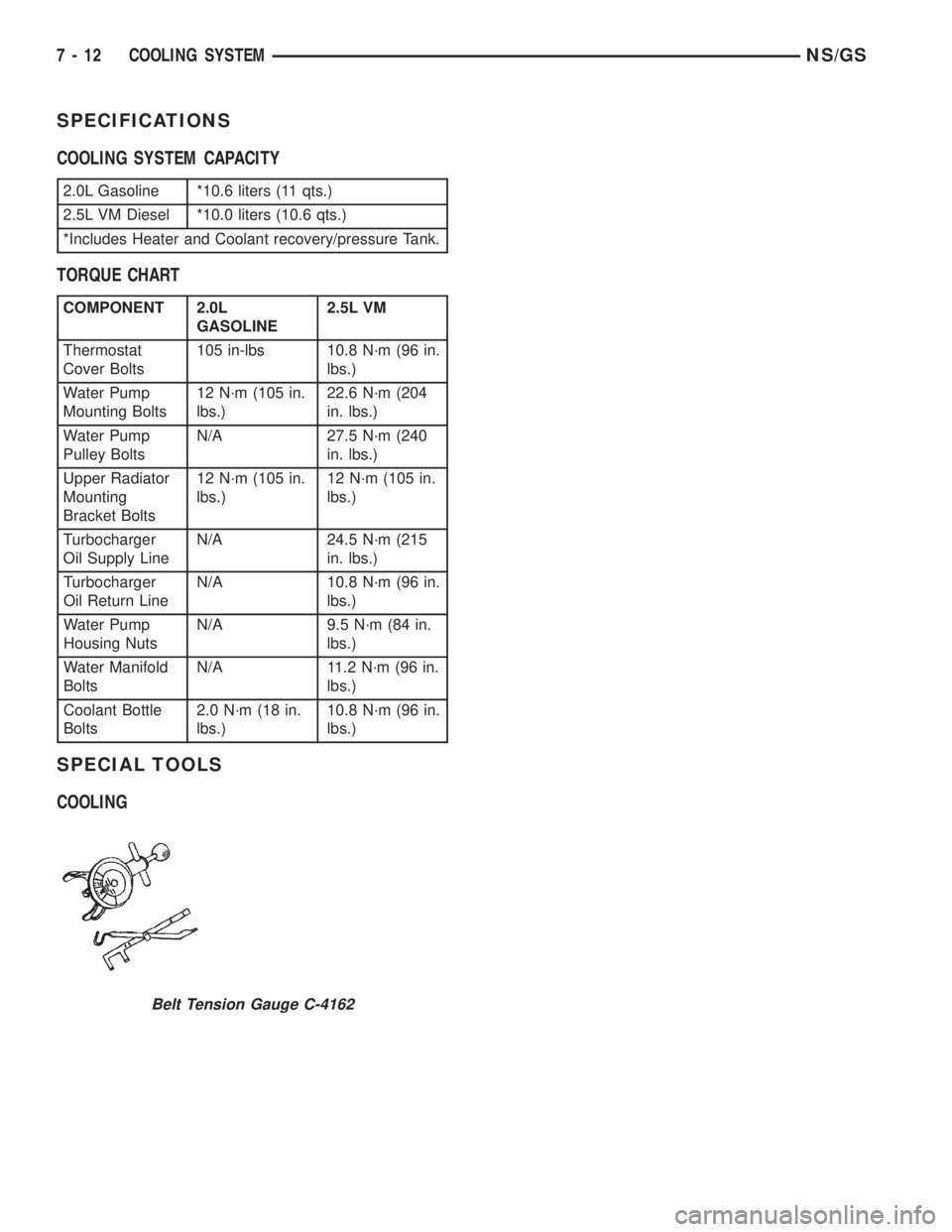
SPECIFICATIONS
COOLING SYSTEM CAPACITY
TORQUE CHART
SPECIAL TOOLS
COOLING
2.0L Gasoline *10.6 liters (11 qts.)
2.5L VM Diesel *10.0 liters (10.6 qts.)
*Includes Heater and Coolant recovery/pressure Tank.
COMPONENT 2.0L
GASOLINE2.5L VM
Thermostat
Cover Bolts105 in-lbs 10.8 N´m (96 in.
lbs.)
Water Pump
Mounting Bolts12 N´m (105 in.
lbs.)22.6 N´m (204
in. lbs.)
Water Pump
Pulley BoltsN/A 27.5 N´m (240
in. lbs.)
Upper Radiator
Mounting
Bracket Bolts12 N´m (105 in.
lbs.)12 N´m (105 in.
lbs.)
Turbocharger
Oil Supply LineN/A 24.5 N´m (215
in. lbs.)
Turbocharger
Oil Return LineN/A 10.8 N´m (96 in.
lbs.)
Water Pump
Housing NutsN/A 9.5 N´m (84 in.
lbs.)
Water Manifold
BoltsN/A 11.2 N´m (96 in.
lbs.)
Coolant Bottle
Bolts2.0 N´m (18 in.
lbs.)10.8 N´m (96 in.
lbs.)
Belt Tension Gauge C-4162
7 - 12 COOLING SYSTEMNS/GS