shaft CHRYSLER VOYAGER 1996 Service Manual
[x] Cancel search | Manufacturer: CHRYSLER, Model Year: 1996, Model line: VOYAGER, Model: CHRYSLER VOYAGER 1996Pages: 1938, PDF Size: 55.84 MB
Page 36 of 1938
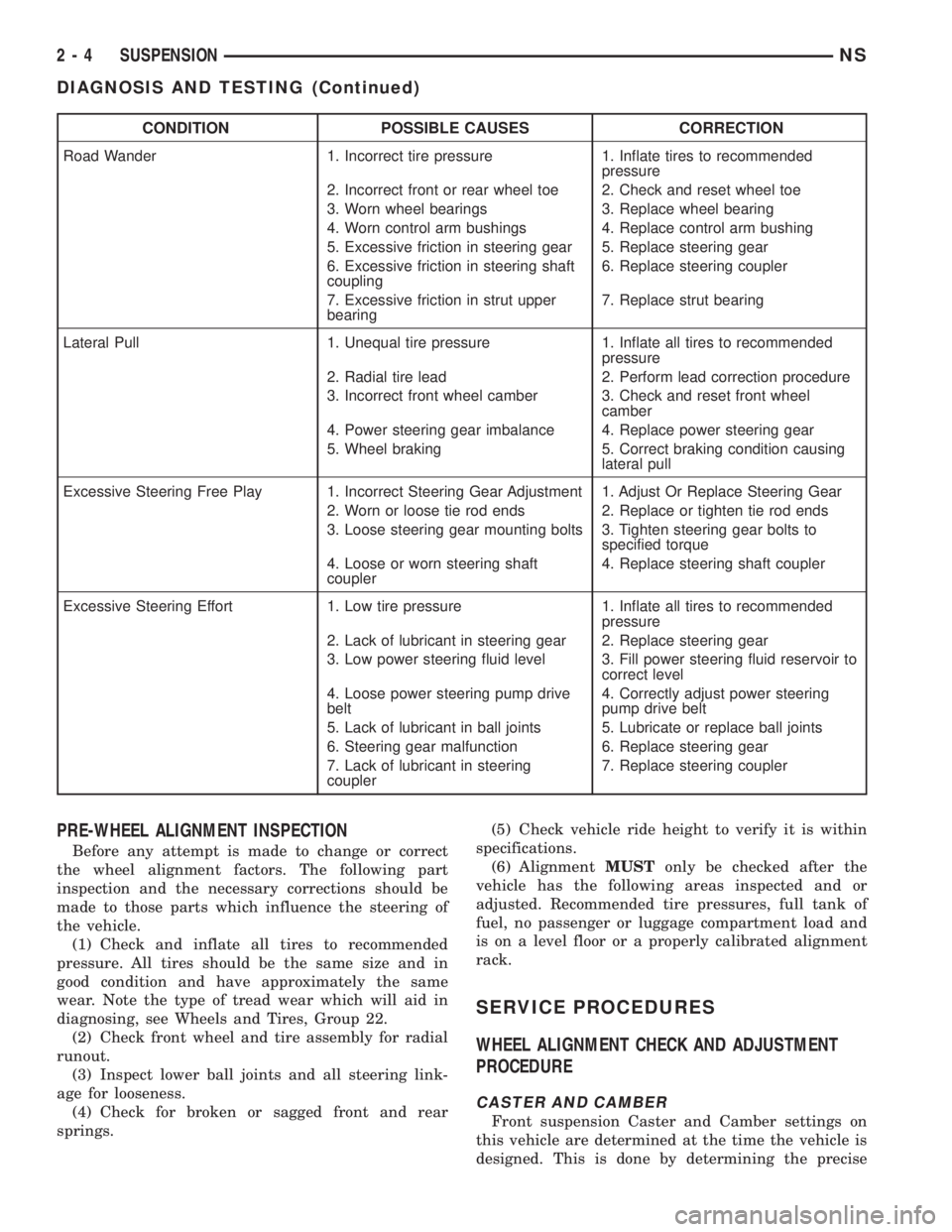
CONDITION POSSIBLE CAUSES CORRECTION
Road Wander 1. Incorrect tire pressure 1. Inflate tires to recommended
pressure
2. Incorrect front or rear wheel toe 2. Check and reset wheel toe
3. Worn wheel bearings 3. Replace wheel bearing
4. Worn control arm bushings 4. Replace control arm bushing
5. Excessive friction in steering gear 5. Replace steering gear
6. Excessive friction in steering shaft
coupling6. Replace steering coupler
7. Excessive friction in strut upper
bearing7. Replace strut bearing
Lateral Pull 1. Unequal tire pressure 1. Inflate all tires to recommended
pressure
2. Radial tire lead 2. Perform lead correction procedure
3. Incorrect front wheel camber 3. Check and reset front wheel
camber
4. Power steering gear imbalance 4. Replace power steering gear
5. Wheel braking 5. Correct braking condition causing
lateral pull
Excessive Steering Free Play 1. Incorrect Steering Gear Adjustment 1. Adjust Or Replace Steering Gear
2. Worn or loose tie rod ends 2. Replace or tighten tie rod ends
3. Loose steering gear mounting bolts 3. Tighten steering gear bolts to
specified torque
4. Loose or worn steering shaft
coupler4. Replace steering shaft coupler
Excessive Steering Effort 1. Low tire pressure 1. Inflate all tires to recommended
pressure
2. Lack of lubricant in steering gear 2. Replace steering gear
3. Low power steering fluid level 3. Fill power steering fluid reservoir to
correct level
4. Loose power steering pump drive
belt4. Correctly adjust power steering
pump drive belt
5. Lack of lubricant in ball joints 5. Lubricate or replace ball joints
6. Steering gear malfunction 6. Replace steering gear
7. Lack of lubricant in steering
coupler7. Replace steering coupler
PRE-WHEEL ALIGNMENT INSPECTION
Before any attempt is made to change or correct
the wheel alignment factors. The following part
inspection and the necessary corrections should be
made to those parts which influence the steering of
the vehicle.
(1) Check and inflate all tires to recommended
pressure. All tires should be the same size and in
good condition and have approximately the same
wear. Note the type of tread wear which will aid in
diagnosing, see Wheels and Tires, Group 22.
(2) Check front wheel and tire assembly for radial
runout.
(3) Inspect lower ball joints and all steering link-
age for looseness.
(4) Check for broken or sagged front and rear
springs.(5) Check vehicle ride height to verify it is within
specifications.
(6) AlignmentMUSTonly be checked after the
vehicle has the following areas inspected and or
adjusted. Recommended tire pressures, full tank of
fuel, no passenger or luggage compartment load and
is on a level floor or a properly calibrated alignment
rack.
SERVICE PROCEDURES
WHEEL ALIGNMENT CHECK AND ADJUSTMENT
PROCEDURE
CASTER AND CAMBER
Front suspension Caster and Camber settings on
this vehicle are determined at the time the vehicle is
designed. This is done by determining the precise
2 - 4 SUSPENSIONNS
DIAGNOSIS AND TESTING (Continued)
Page 42 of 1938
Mc PHERSON STRUT ASSEMBLY
The front suspension of the vehicle is supported by
coil springs positioned around the strut assembly.
The springs are contained between an upper seat,
located just below the top strut mount assembly and
a lower spring seat on the strut fluid reservoir.
The top of each strut assembly is bolted to the
upper fender reinforcement (strut tower) through a
rubber isolated mount.
The bottom of the strut assembly attaches to the
steering knuckle with two through bolts. Caster is a
fixed setting on all vehicles and is not adjustable
when an alignment is performed. In the event the
camber setting on a vehicle requires adjustment, a
service strut is available which will provide a method
by which the camber can be adjusted.
The strut assemblies on this vehicle are inter-con-
nected by the front stabilizer bar through 2 link
assemblies attaching the struts to the stabilizer bar.
STEERING KNUCKLE
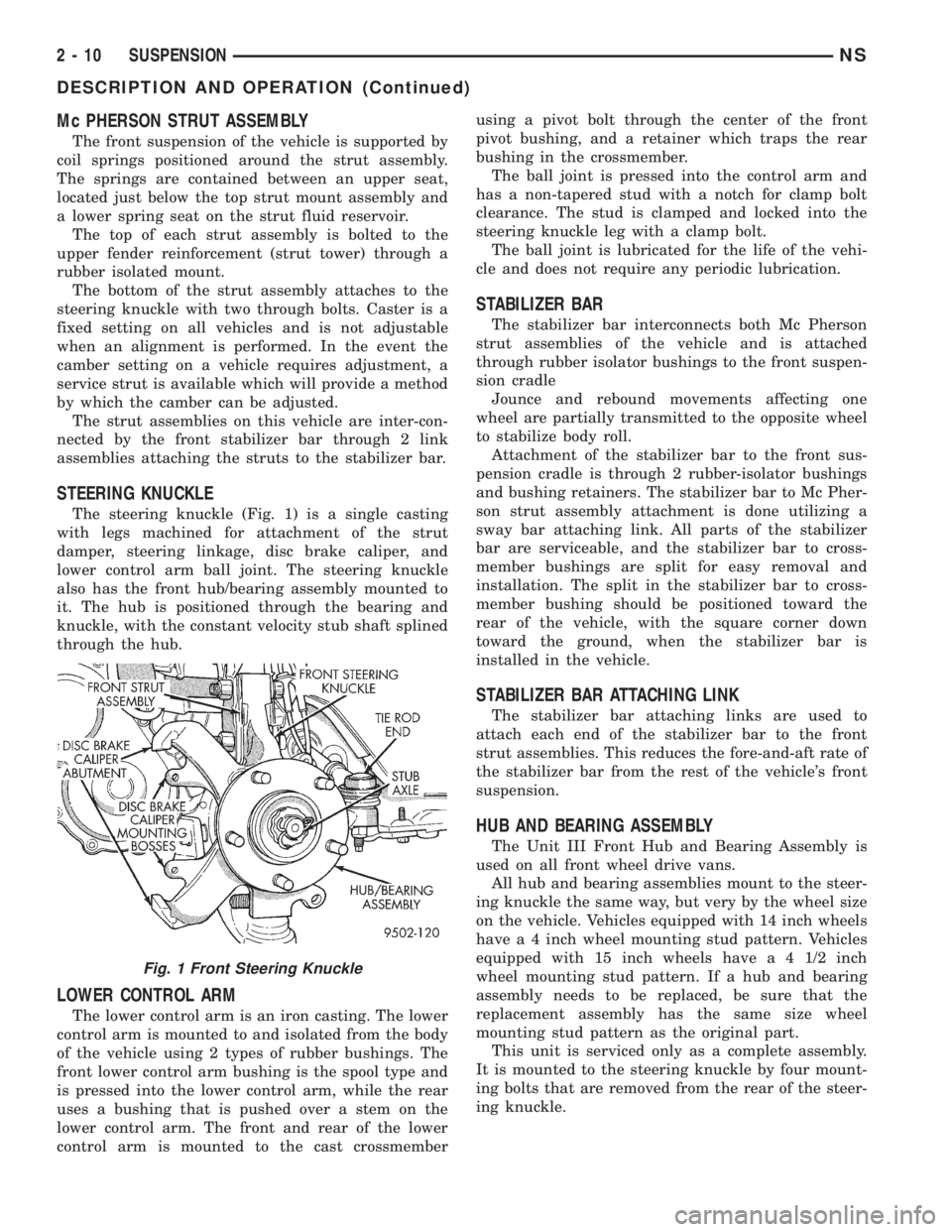
The steering knuckle (Fig. 1) is a single casting
with legs machined for attachment of the strut
damper, steering linkage, disc brake caliper, and
lower control arm ball joint. The steering knuckle
also has the front hub/bearing assembly mounted to
it. The hub is positioned through the bearing and
knuckle, with the constant velocity stub shaft splined
through the hub.
LOWER CONTROL ARM
The lower control arm is an iron casting. The lower
control arm is mounted to and isolated from the body
of the vehicle using 2 types of rubber bushings. The
front lower control arm bushing is the spool type and
is pressed into the lower control arm, while the rear
uses a bushing that is pushed over a stem on the
lower control arm. The front and rear of the lower
control arm is mounted to the cast crossmemberusing a pivot bolt through the center of the front
pivot bushing, and a retainer which traps the rear
bushing in the crossmember.
The ball joint is pressed into the control arm and
has a non-tapered stud with a notch for clamp bolt
clearance. The stud is clamped and locked into the
steering knuckle leg with a clamp bolt.
The ball joint is lubricated for the life of the vehi-
cle and does not require any periodic lubrication.
STABILIZER BAR
The stabilizer bar interconnects both Mc Pherson
strut assemblies of the vehicle and is attached
through rubber isolator bushings to the front suspen-
sion cradle
Jounce and rebound movements affecting one
wheel are partially transmitted to the opposite wheel
to stabilize body roll.
Attachment of the stabilizer bar to the front sus-
pension cradle is through 2 rubber-isolator bushings
and bushing retainers. The stabilizer bar to Mc Pher-
son strut assembly attachment is done utilizing a
sway bar attaching link. All parts of the stabilizer
bar are serviceable, and the stabilizer bar to cross-
member bushings are split for easy removal and
installation. The split in the stabilizer bar to cross-
member bushing should be positioned toward the
rear of the vehicle, with the square corner down
toward the ground, when the stabilizer bar is
installed in the vehicle.
STABILIZER BAR ATTACHING LINK
The stabilizer bar attaching links are used to
attach each end of the stabilizer bar to the front
strut assemblies. This reduces the fore-and-aft rate of
the stabilizer bar from the rest of the vehicle's front
suspension.
HUB AND BEARING ASSEMBLY
The Unit III Front Hub and Bearing Assembly is
used on all front wheel drive vans.
All hub and bearing assemblies mount to the steer-
ing knuckle the same way, but very by the wheel size
on the vehicle. Vehicles equipped with 14 inch wheels
have a 4 inch wheel mounting stud pattern. Vehicles
equipped with 15 inch wheels have a 4 1/2 inch
wheel mounting stud pattern. If a hub and bearing
assembly needs to be replaced, be sure that the
replacement assembly has the same size wheel
mounting stud pattern as the original part.
This unit is serviced only as a complete assembly.
It is mounted to the steering knuckle by four mount-
ing bolts that are removed from the rear of the steer-
ing knuckle.
Fig. 1 Front Steering Knuckle
2 - 10 SUSPENSIONNS
DESCRIPTION AND OPERATION (Continued)
Page 43 of 1938
COIL SPRING
Coil springs are rated separately for each corner or
side of the vehicle depending on optional equipment
and type of vehicle service. During service procedures
when both springs are removed, mark springs to
ensure installation in original position. Each coil
spring comes with a plastic sleeve on the second coil
of the spring. This plastic sleeve is a noise insulator
for the coil spring.
NOTE: If coil springs require replacement, be sure
that the springs needing replacement, are replaced
with springs meeting the correct load rating for the
vehicle and its specific options.
BALL JOINT
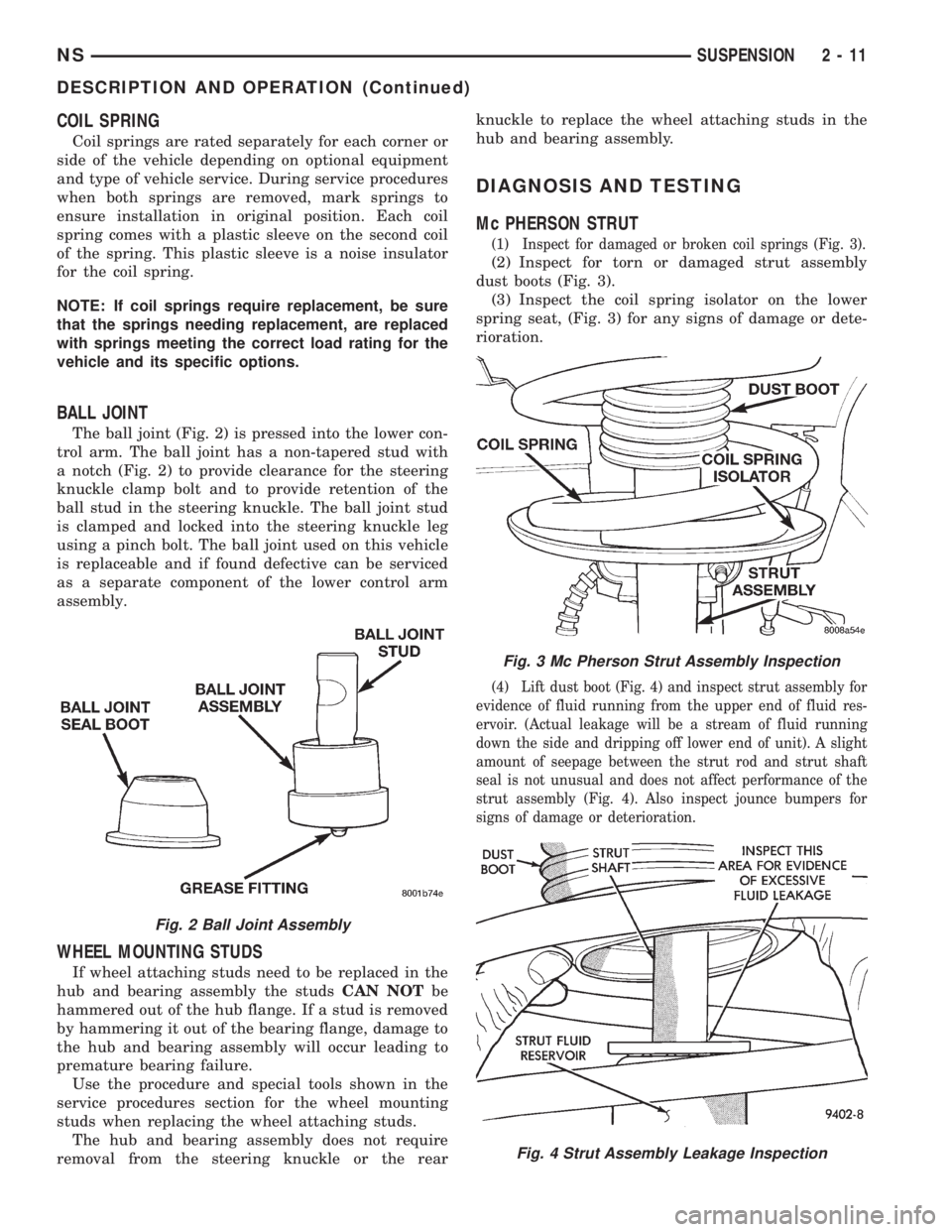
The ball joint (Fig. 2) is pressed into the lower con-
trol arm. The ball joint has a non-tapered stud with
a notch (Fig. 2) to provide clearance for the steering
knuckle clamp bolt and to provide retention of the
ball stud in the steering knuckle. The ball joint stud
is clamped and locked into the steering knuckle leg
using a pinch bolt. The ball joint used on this vehicle
is replaceable and if found defective can be serviced
as a separate component of the lower control arm
assembly.
WHEEL MOUNTING STUDS
If wheel attaching studs need to be replaced in the
hub and bearing assembly the studsCAN NOTbe
hammered out of the hub flange. If a stud is removed
by hammering it out of the bearing flange, damage to
the hub and bearing assembly will occur leading to
premature bearing failure.
Use the procedure and special tools shown in the
service procedures section for the wheel mounting
studs when replacing the wheel attaching studs.
The hub and bearing assembly does not require
removal from the steering knuckle or the rearknuckle to replace the wheel attaching studs in the
hub and bearing assembly.
DIAGNOSIS AND TESTING
Mc PHERSON STRUT
(1) Inspect for damaged or broken coil springs (Fig. 3).
(2) Inspect for torn or damaged strut assembly
dust boots (Fig. 3).
(3) Inspect the coil spring isolator on the lower
spring seat, (Fig. 3) for any signs of damage or dete-
rioration.
(4) Lift dust boot (Fig. 4) and inspect strut assembly for
evidence of fluid running from the upper end of fluid res-
ervoir. (Actual leakage will be a stream of fluid running
down the side and dripping off lower end of unit). A slight
amount of seepage between the strut rod and strut shaft
seal is not unusual and does not affect performance of the
strut assembly (Fig. 4). Also inspect jounce bumpers for
signs of damage or deterioration.
Fig. 2 Ball Joint Assembly
Fig. 3 Mc Pherson Strut Assembly Inspection
Fig. 4 Strut Assembly Leakage Inspection
NSSUSPENSION 2 - 11
DESCRIPTION AND OPERATION (Continued)
Page 49 of 1938
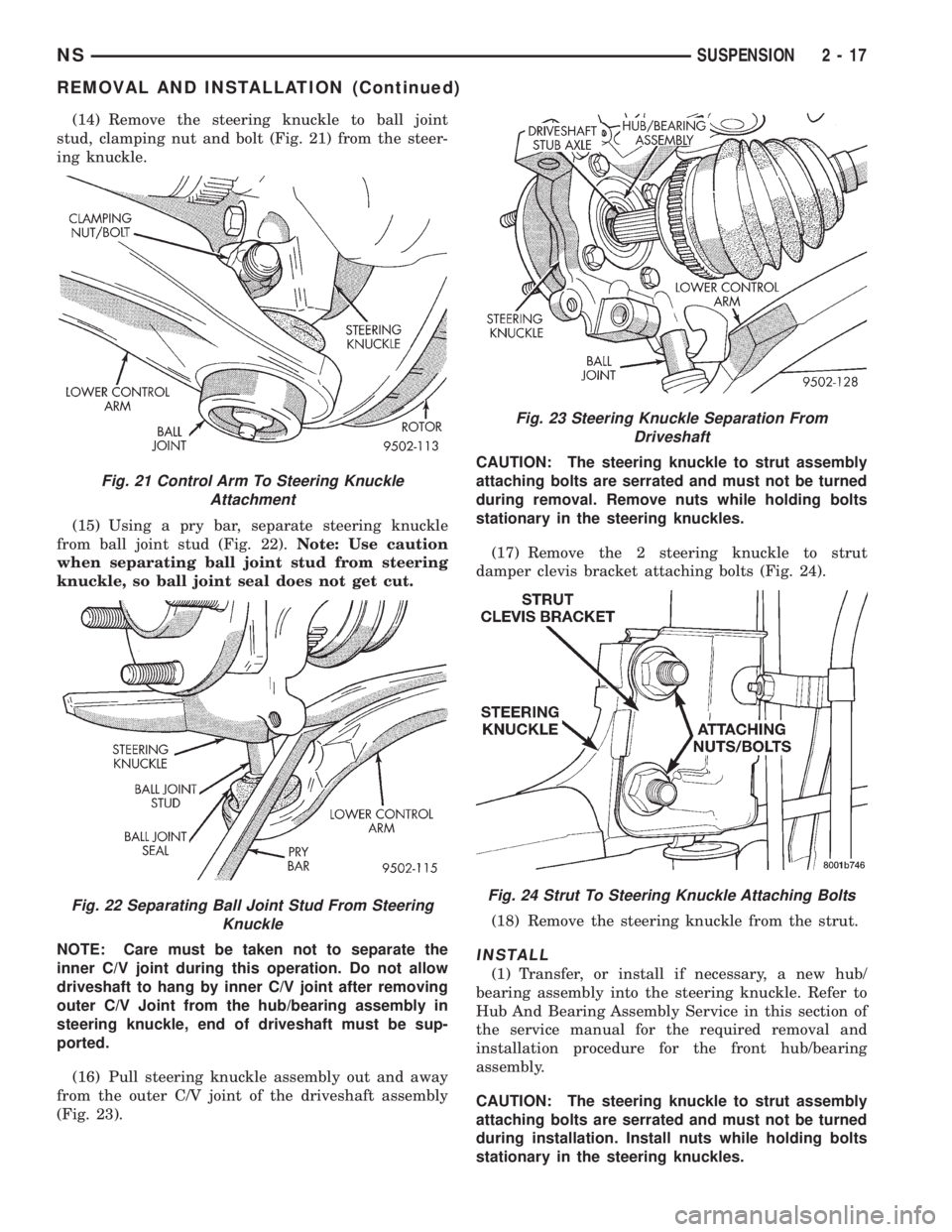
(14) Remove the steering knuckle to ball joint
stud, clamping nut and bolt (Fig. 21) from the steer-
ing knuckle.
(15) Using a pry bar, separate steering knuckle
from ball joint stud (Fig. 22).Note: Use caution
when separating ball joint stud from steering
knuckle, so ball joint seal does not get cut.
NOTE: Care must be taken not to separate the
inner C/V joint during this operation. Do not allow
driveshaft to hang by inner C/V joint after removing
outer C/V Joint from the hub/bearing assembly in
steering knuckle, end of driveshaft must be sup-
ported.
(16) Pull steering knuckle assembly out and away
from the outer C/V joint of the driveshaft assembly
(Fig. 23).CAUTION: The steering knuckle to strut assembly
attaching bolts are serrated and must not be turned
during removal. Remove nuts while holding bolts
stationary in the steering knuckles.
(17) Remove the 2 steering knuckle to strut
damper clevis bracket attaching bolts (Fig. 24).
(18) Remove the steering knuckle from the strut.
INSTALL
(1) Transfer, or install if necessary, a new hub/
bearing assembly into the steering knuckle. Refer to
Hub And Bearing Assembly Service in this section of
the service manual for the required removal and
installation procedure for the front hub/bearing
assembly.
CAUTION: The steering knuckle to strut assembly
attaching bolts are serrated and must not be turned
during installation. Install nuts while holding bolts
stationary in the steering knuckles.
Fig. 21 Control Arm To Steering Knuckle
Attachment
Fig. 22 Separating Ball Joint Stud From Steering
Knuckle
Fig. 23 Steering Knuckle Separation From
Driveshaft
Fig. 24 Strut To Steering Knuckle Attaching Bolts
NSSUSPENSION 2 - 17
REMOVAL AND INSTALLATION (Continued)
Page 50 of 1938
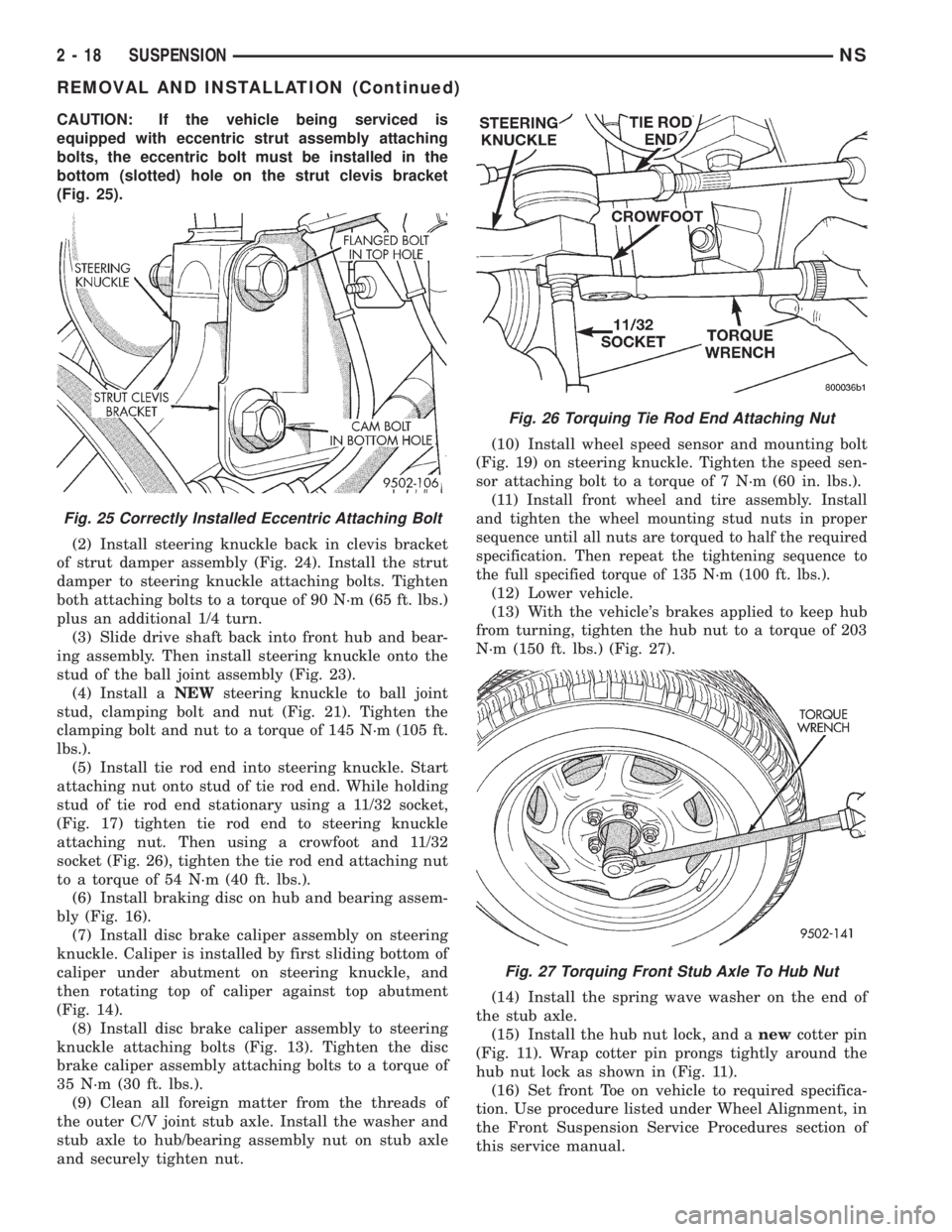
CAUTION: If the vehicle being serviced is
equipped with eccentric strut assembly attaching
bolts, the eccentric bolt must be installed in the
bottom (slotted) hole on the strut clevis bracket
(Fig. 25).
(2) Install steering knuckle back in clevis bracket
of strut damper assembly (Fig. 24). Install the strut
damper to steering knuckle attaching bolts. Tighten
both attaching bolts to a torque of 90 N´m (65 ft. lbs.)
plus an additional 1/4 turn.
(3) Slide drive shaft back into front hub and bear-
ing assembly. Then install steering knuckle onto the
stud of the ball joint assembly (Fig. 23).
(4) Install aNEWsteering knuckle to ball joint
stud, clamping bolt and nut (Fig. 21). Tighten the
clamping bolt and nut to a torque of 145 N´m (105 ft.
lbs.).
(5) Install tie rod end into steering knuckle. Start
attaching nut onto stud of tie rod end. While holding
stud of tie rod end stationary using a 11/32 socket,
(Fig. 17) tighten tie rod end to steering knuckle
attaching nut. Then using a crowfoot and 11/32
socket (Fig. 26), tighten the tie rod end attaching nut
to a torque of 54 N´m (40 ft. lbs.).
(6) Install braking disc on hub and bearing assem-
bly (Fig. 16).
(7) Install disc brake caliper assembly on steering
knuckle. Caliper is installed by first sliding bottom of
caliper under abutment on steering knuckle, and
then rotating top of caliper against top abutment
(Fig. 14).
(8) Install disc brake caliper assembly to steering
knuckle attaching bolts (Fig. 13). Tighten the disc
brake caliper assembly attaching bolts to a torque of
35 N´m (30 ft. lbs.).
(9) Clean all foreign matter from the threads of
the outer C/V joint stub axle. Install the washer and
stub axle to hub/bearing assembly nut on stub axle
and securely tighten nut.(10) Install wheel speed sensor and mounting bolt
(Fig. 19) on steering knuckle. Tighten the speed sen-
sor attaching bolt to a torque of 7 N´m (60 in. lbs.).
(11)
Install front wheel and tire assembly. Install
and tighten the wheel mounting stud nuts in proper
sequence until all nuts are torqued to half the required
specification. Then repeat the tightening sequence to
the full specified torque of 135 N´m (100 ft. lbs.).
(12) Lower vehicle.
(13) With the vehicle's brakes applied to keep hub
from turning, tighten the hub nut to a torque of 203
N´m (150 ft. lbs.) (Fig. 27).
(14) Install the spring wave washer on the end of
the stub axle.
(15) Install the hub nut lock, and anewcotter pin
(Fig. 11). Wrap cotter pin prongs tightly around the
hub nut lock as shown in (Fig. 11).
(16) Set front Toe on vehicle to required specifica-
tion. Use procedure listed under Wheel Alignment, in
the Front Suspension Service Procedures section of
this service manual.
Fig. 25 Correctly Installed Eccentric Attaching Bolt
Fig. 26 Torquing Tie Rod End Attaching Nut
Fig. 27 Torquing Front Stub Axle To Hub Nut
2 - 18 SUSPENSIONNS
REMOVAL AND INSTALLATION (Continued)
Page 51 of 1938
LOWER CONTROL ARM
REMOVE
(1) Raise vehicle on jack stands or centered on a
frame contact type hoist. See Hoisting in the Lubri-
cation and Maintenance section of this manual, for
the required lifting procedure to be used for this
vehicle.
(2) Remove wheel and tire assembly from the side
of vehicle requiring service to the lower control arm.
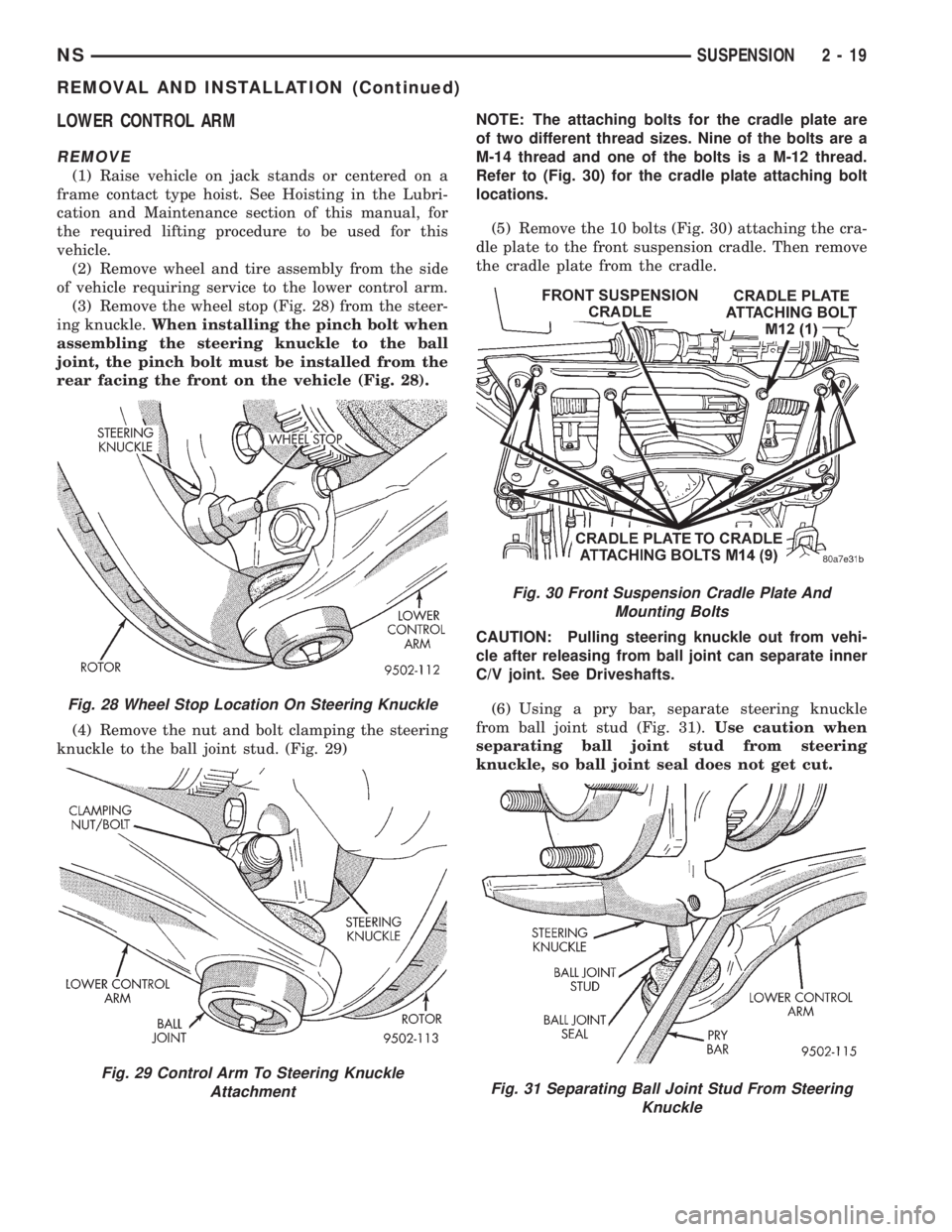
(3) Remove the wheel stop (Fig. 28) from the steer-
ing knuckle.When installing the pinch bolt when
assembling the steering knuckle to the ball
joint, the pinch bolt must be installed from the
rear facing the front on the vehicle (Fig. 28).
(4) Remove the nut and bolt clamping the steering
knuckle to the ball joint stud. (Fig. 29)NOTE: The attaching bolts for the cradle plate are
of two different thread sizes. Nine of the bolts are a
M-14 thread and one of the bolts is a M-12 thread.
Refer to (Fig. 30) for the cradle plate attaching bolt
locations.
(5) Remove the 10 bolts (Fig. 30) attaching the cra-
dle plate to the front suspension cradle. Then remove
the cradle plate from the cradle.
CAUTION: Pulling steering knuckle out from vehi-
cle after releasing from ball joint can separate inner
C/V joint. See Driveshafts.
(6) Using a pry bar, separate steering knuckle
from ball joint stud (Fig. 31).Use caution when
separating ball joint stud from steering
knuckle, so ball joint seal does not get cut.
Fig. 28 Wheel Stop Location On Steering Knuckle
Fig. 29 Control Arm To Steering Knuckle
Attachment
Fig. 30 Front Suspension Cradle Plate And
Mounting Bolts
Fig. 31 Separating Ball Joint Stud From Steering
Knuckle
NSSUSPENSION 2 - 19
REMOVAL AND INSTALLATION (Continued)
Page 58 of 1938
CAUTION: Wheel bearing damage will result if
after loosening hub nut, vehicle is rolled on the
ground or the weight of the vehicle is allowed to be
supported by the tires.
(3) With the aid of a helper applying the brakes to
keep the front hub from turning,loosen but do not
removethe hub nut.The hub and driveshaft are
splined together through the knuckle (bearing)
and retained by the hub nut.
(4) Raise vehicle on jack stands or centered on a
frame contact type hoist. See Hoisting in the Lubri-
cation and Maintenance section of this manual, for
the required lifting procedure to be used for this
vehicle.
(5) Remove wheel lug nuts, and front tire and
wheel assembly.
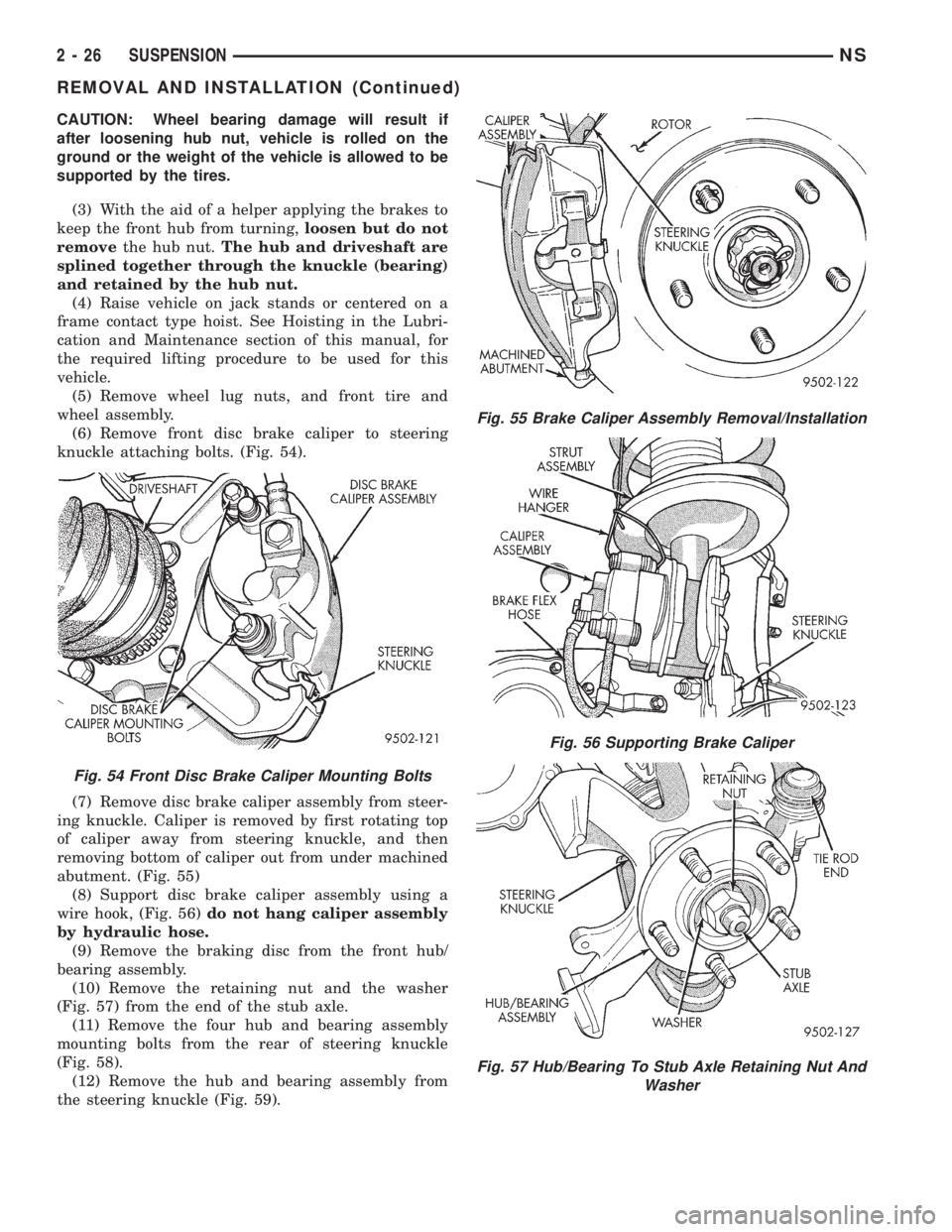
(6) Remove front disc brake caliper to steering
knuckle attaching bolts. (Fig. 54).
(7) Remove disc brake caliper assembly from steer-
ing knuckle. Caliper is removed by first rotating top
of caliper away from steering knuckle, and then
removing bottom of caliper out from under machined
abutment. (Fig. 55)
(8) Support disc brake caliper assembly using a
wire hook, (Fig. 56)do not hang caliper assembly
by hydraulic hose.
(9) Remove the braking disc from the front hub/
bearing assembly.
(10) Remove the retaining nut and the washer
(Fig. 57) from the end of the stub axle.
(11) Remove the four hub and bearing assembly
mounting bolts from the rear of steering knuckle
(Fig. 58).
(12) Remove the hub and bearing assembly from
the steering knuckle (Fig. 59).
Fig. 54 Front Disc Brake Caliper Mounting Bolts
Fig. 55 Brake Caliper Assembly Removal/Installation
Fig. 56 Supporting Brake Caliper
Fig. 57 Hub/Bearing To Stub Axle Retaining Nut And
Washer
2 - 26 SUSPENSIONNS
REMOVAL AND INSTALLATION (Continued)
Page 59 of 1938
INSTALL
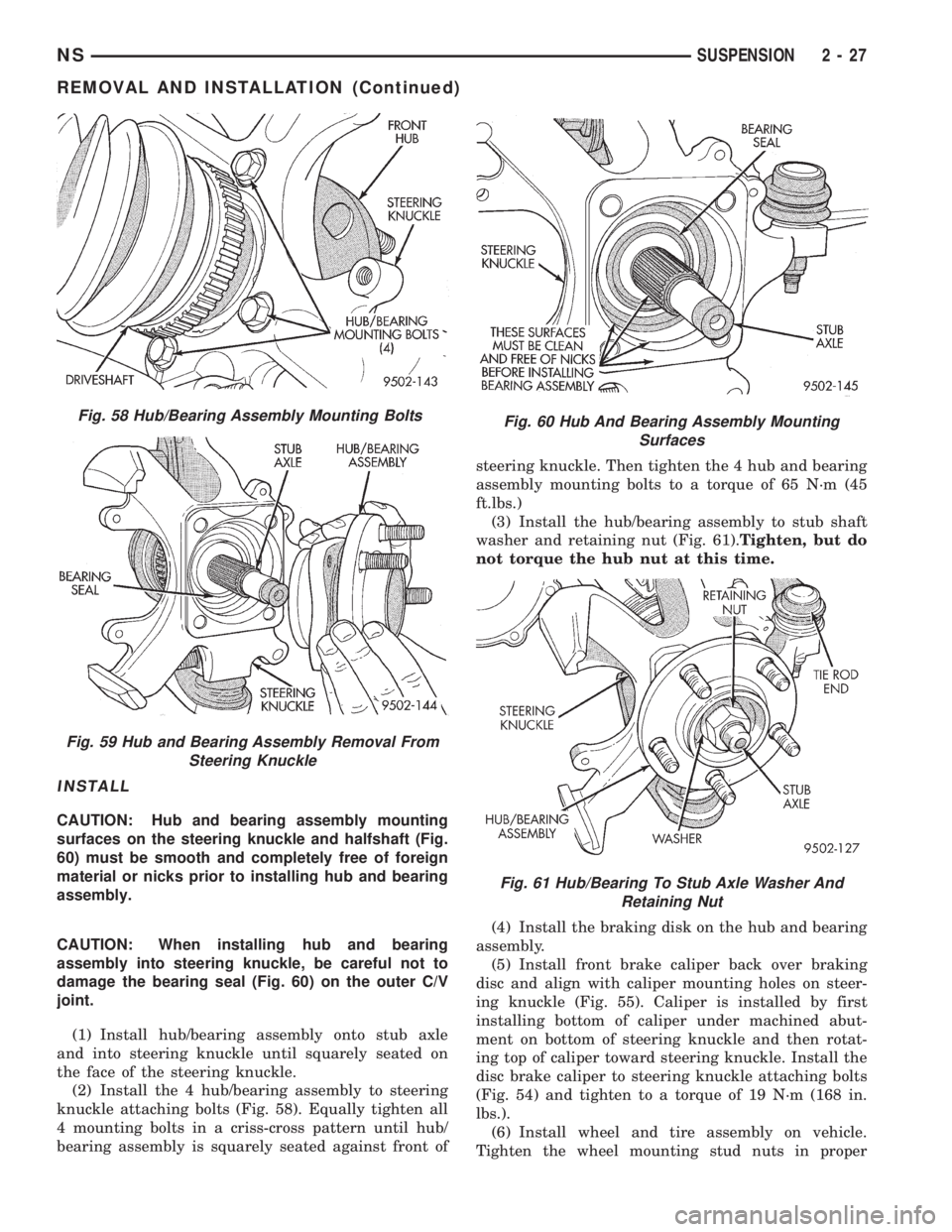
CAUTION: Hub and bearing assembly mounting
surfaces on the steering knuckle and halfshaft (Fig.
60) must be smooth and completely free of foreign
material or nicks prior to installing hub and bearing
assembly.
CAUTION: When installing hub and bearing
assembly into steering knuckle, be careful not to
damage the bearing seal (Fig. 60) on the outer C/V
joint.
(1) Install hub/bearing assembly onto stub axle
and into steering knuckle until squarely seated on
the face of the steering knuckle.
(2) Install the 4 hub/bearing assembly to steering
knuckle attaching bolts (Fig. 58). Equally tighten all
4 mounting bolts in a criss-cross pattern until hub/
bearing assembly is squarely seated against front ofsteering knuckle. Then tighten the 4 hub and bearing
assembly mounting bolts to a torque of 65 N´m (45
ft.lbs.)
(3) Install the hub/bearing assembly to stub shaft
washer and retaining nut (Fig. 61).Tighten, but do
not torque the hub nut at this time.
(4) Install the braking disk on the hub and bearing
assembly.
(5) Install front brake caliper back over braking
disc and align with caliper mounting holes on steer-
ing knuckle (Fig. 55). Caliper is installed by first
installing bottom of caliper under machined abut-
ment on bottom of steering knuckle and then rotat-
ing top of caliper toward steering knuckle. Install the
disc brake caliper to steering knuckle attaching bolts
(Fig. 54) and tighten to a torque of 19 N´m (168 in.
lbs.).
(6) Install wheel and tire assembly on vehicle.
Tighten the wheel mounting stud nuts in proper
Fig. 58 Hub/Bearing Assembly Mounting Bolts
Fig. 59 Hub and Bearing Assembly Removal From
Steering Knuckle
Fig. 60 Hub And Bearing Assembly Mounting
Surfaces
Fig. 61 Hub/Bearing To Stub Axle Washer And
Retaining Nut
NSSUSPENSION 2 - 27
REMOVAL AND INSTALLATION (Continued)
Page 60 of 1938
sequence until all nuts are torqued to half specifica-
tion. Then repeat the tightening sequence to the full
specified torque of 129 N´m (95 ft. lbs.).
(7) Lower vehicle to the ground.
CAUTION: When tightening hub/bearing assembly
to stub shaft retaining nut, do not exceed the max-
imum torque of 244 N´m (180 ft. lbs.).
(8) With vehicle brakes applied to keep vehicle
from moving, torque stub shaft to hub/bearing assem-
bly retaining nut to 244 N´m (180 ft. lbs.).
(9) Check the Toe setting on the vehicle and reset
if not within specifications.
FRONT WHEEL MOUNTING STUDS
REMOVE
CAUTION: If a wheel attaching stud needs to be
replaced in the hub and bearing assembly the studs
CAN NOT be hammered out of the hub flange. If a
stud is removed by hammering it out of the bearing
flange, damage to the hub and bearing assembly
will occur leading to premature bearing failure.
The following procedure and special tools shown
MUST BEused when replacing wheel attaching
studs.
The hub and bearing assembly does not require
removal from the steering knuckle to replace wheel
attaching studs in the hub and bearing assembly.
(1) Raise vehicle on jackstands or centered on a
frame contact type hoist. See Hoisting in the Lubri-
cation and Maintenance section of this manual for
the required lifting procedure to be used for this
vehicle.
(2) Remove the front wheel and tire assembly from
the vehicle.
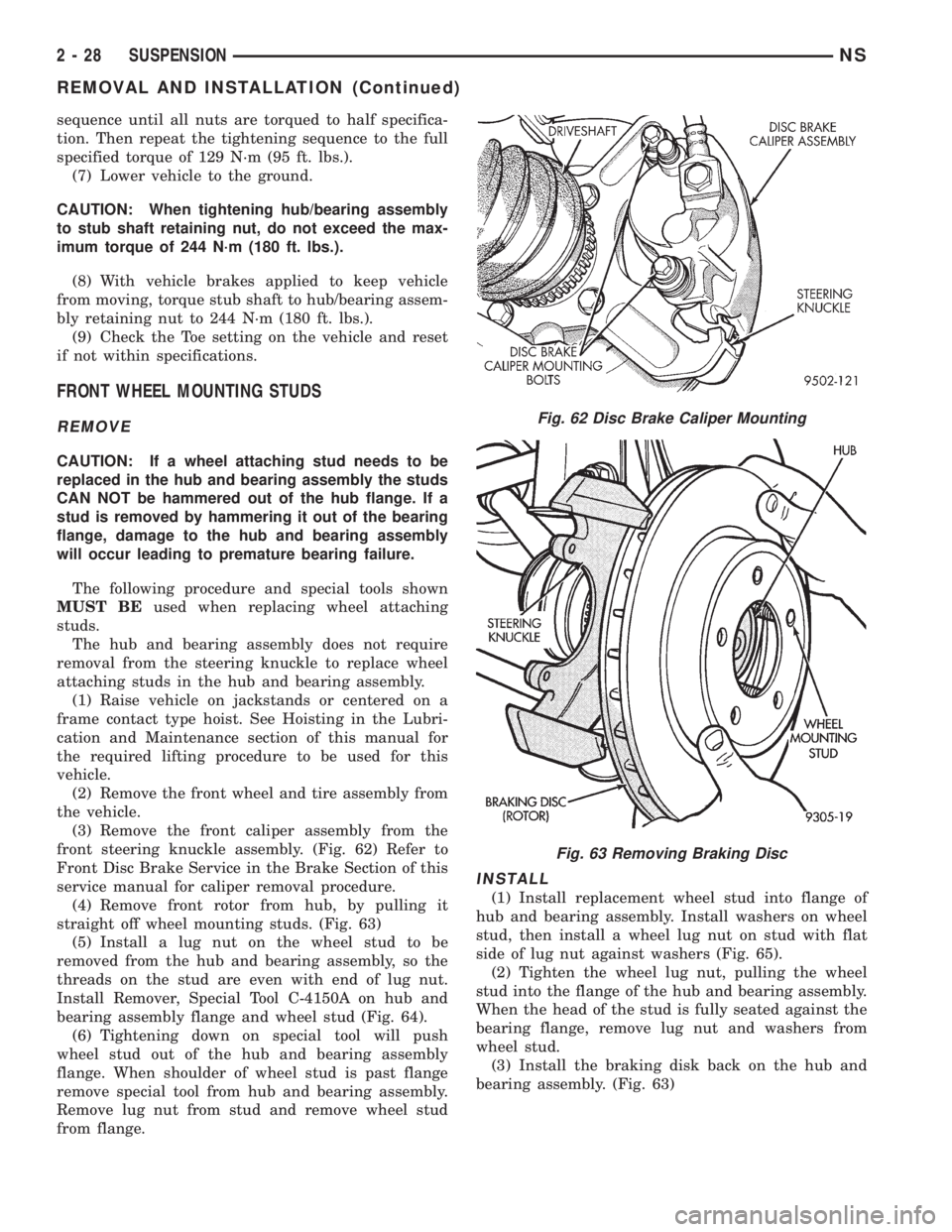
(3) Remove the front caliper assembly from the
front steering knuckle assembly. (Fig. 62) Refer to
Front Disc Brake Service in the Brake Section of this
service manual for caliper removal procedure.
(4) Remove front rotor from hub, by pulling it
straight off wheel mounting studs. (Fig. 63)
(5) Install a lug nut on the wheel stud to be
removed from the hub and bearing assembly, so the
threads on the stud are even with end of lug nut.
Install Remover, Special Tool C-4150A on hub and
bearing assembly flange and wheel stud (Fig. 64).
(6) Tightening down on special tool will push
wheel stud out of the hub and bearing assembly
flange. When shoulder of wheel stud is past flange
remove special tool from hub and bearing assembly.
Remove lug nut from stud and remove wheel stud
from flange.
INSTALL
(1) Install replacement wheel stud into flange of
hub and bearing assembly. Install washers on wheel
stud, then install a wheel lug nut on stud with flat
side of lug nut against washers (Fig. 65).
(2) Tighten the wheel lug nut, pulling the wheel
stud into the flange of the hub and bearing assembly.
When the head of the stud is fully seated against the
bearing flange, remove lug nut and washers from
wheel stud.
(3) Install the braking disk back on the hub and
bearing assembly. (Fig. 63)
Fig. 62 Disc Brake Caliper Mounting
Fig. 63 Removing Braking Disc
2 - 28 SUSPENSIONNS
REMOVAL AND INSTALLATION (Continued)
Page 62 of 1938
(3) Install the rear brake drum on the hub and
bearing assembly.
(4) Install wheel and tire assembly on vehicle.
Tighten the wheel mounting stud nuts in proper
sequence until all nuts are torqued to half specifica-
tion. Then repeat the tightening sequence to the full
specified torque of 129 N´m (95 ft. lbs.).
(5) Lower vehicle to the ground.
DISASSEMBLY AND ASSEMBLY
Mc PHERSON STRUT
DISASSEMBLY
The Mc Pherson Strut must be remove from the
vehicle for it to be disassembled and assembled.
Refer to Mc Pherson Strut in the Removal And
Installation Section in this group of the service man-
ual for the required procedure to remove and install
the Mc Pherson Strut.
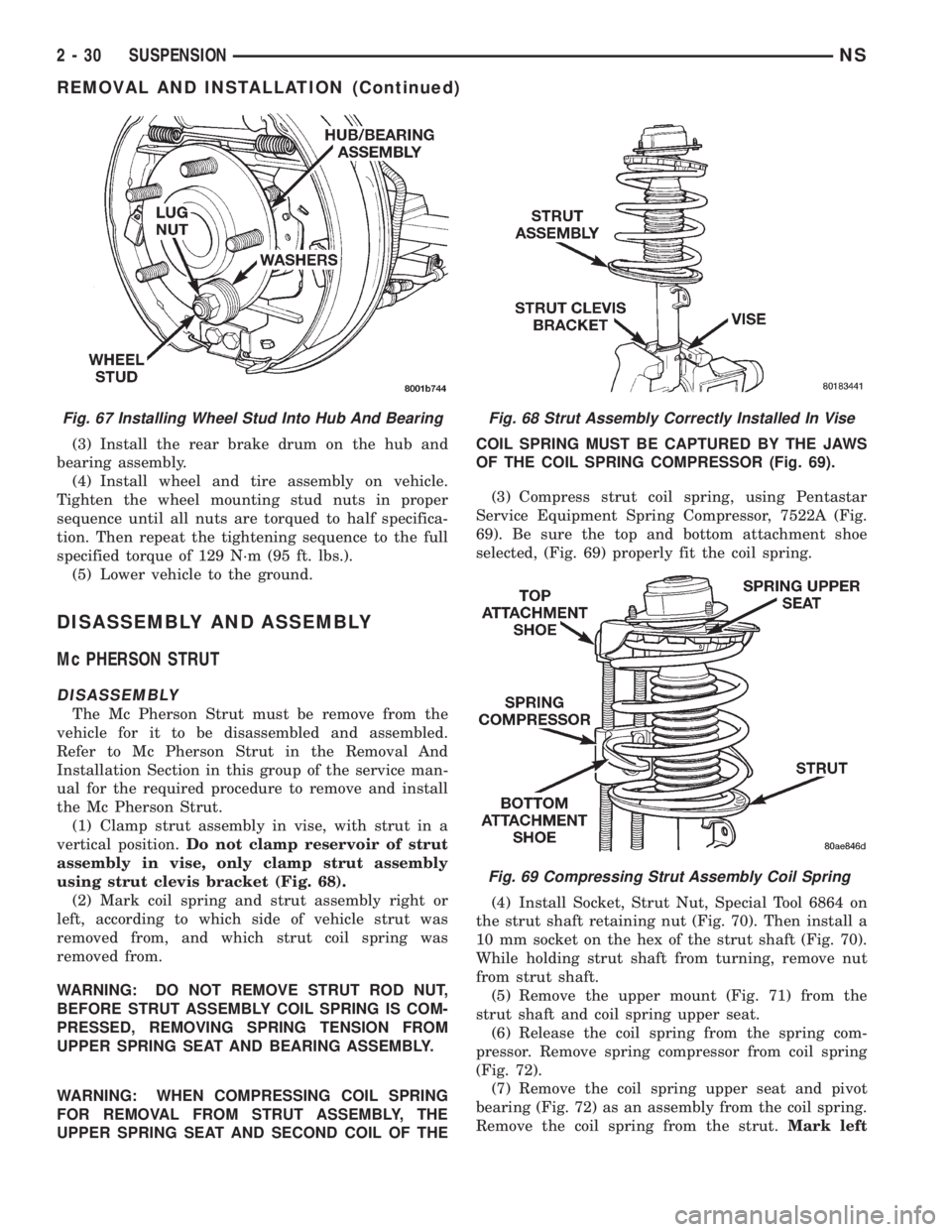
(1) Clamp strut assembly in vise, with strut in a
vertical position.Do not clamp reservoir of strut
assembly in vise, only clamp strut assembly
using strut clevis bracket (Fig. 68).
(2) Mark coil spring and strut assembly right or
left, according to which side of vehicle strut was
removed from, and which strut coil spring was
removed from.
WARNING: DO NOT REMOVE STRUT ROD NUT,
BEFORE STRUT ASSEMBLY COIL SPRING IS COM-
PRESSED, REMOVING SPRING TENSION FROM
UPPER SPRING SEAT AND BEARING ASSEMBLY.
WARNING: WHEN COMPRESSING COIL SPRING
FOR REMOVAL FROM STRUT ASSEMBLY, THE
UPPER SPRING SEAT AND SECOND COIL OF THECOIL SPRING MUST BE CAPTURED BY THE JAWS
OF THE COIL SPRING COMPRESSOR (Fig. 69).
(3) Compress strut coil spring, using Pentastar
Service Equipment Spring Compressor, 7522A (Fig.
69). Be sure the top and bottom attachment shoe
selected, (Fig. 69) properly fit the coil spring.
(4) Install Socket, Strut Nut, Special Tool 6864 on
the strut shaft retaining nut (Fig. 70). Then install a
10 mm socket on the hex of the strut shaft (Fig. 70).
While holding strut shaft from turning, remove nut
from strut shaft.
(5) Remove the upper mount (Fig. 71) from the
strut shaft and coil spring upper seat.
(6) Release the coil spring from the spring com-
pressor. Remove spring compressor from coil spring
(Fig. 72).
(7) Remove the coil spring upper seat and pivot
bearing (Fig. 72) as an assembly from the coil spring.
Remove the coil spring from the strut.Mark left
Fig. 67 Installing Wheel Stud Into Hub And BearingFig. 68 Strut Assembly Correctly Installed In Vise
Fig. 69 Compressing Strut Assembly Coil Spring
2 - 30 SUSPENSIONNS
REMOVAL AND INSTALLATION (Continued)