maintenance CHRYSLER VOYAGER 1996 Owner's Guide
[x] Cancel search | Manufacturer: CHRYSLER, Model Year: 1996, Model line: VOYAGER, Model: CHRYSLER VOYAGER 1996Pages: 1938, PDF Size: 55.84 MB
Page 190 of 1938

INSTALL
CAUTION: Proper installation of wheel speed sen-
sor cables is critical to continued system operation.
Be sure that cables are installed in retainers. Fail-
ure to install cables in retainers as shown in this
section may result in contact with moving parts
and/or over extension of cables, resulting in an
open circuit.
(1) Install wheel speed sensor head. Note, the plas-
tic anti rotation pin must be fully seated prior to
installing the attaching bolt.
CAUTION: Prior to installing the speed sensor
head attaching bolt, the plastic anti-rotation pin
must be fully seated into the bearing flange.
(2) Install the wheel speed sensor head to bearing
flange attaching bolt (Fig. 42). Tighten the attaching
bolt to a torque 12 N´m (105 in. lbs.)
(3) Check the air gap between the face of the
wheel speed sensor and the top surface of the tone-
wheel. Air gap must be less then the maximum
allowable tolerance of 1.2 mm (.047 in.).
(4) Install the 2 routing brackets attaching the
speed sensor cable and brake tube to the rear axle
(Fig. 41).The rear wheel speed sensor cable
should be routed under the rear brake tube
(Fig. 41).
CAUTION: When installing rear wheel speed sen-
sor cable in the routing clips on rear brake flex
hose, be sure not to damage the routing clips.
Routing clips are molded onto the hose and will
require replacement of the brake flex hose if dam-
aged during installation of the wheel speed sensor
cable.(5) Install speed sensor cable into routing clips on
rear brake flex hose (Fig. 41).
(6) If installing a right rear speed sensor cable,
install the speed sensor cable grommet on the axle
brake flex hose bracket (Fig. 40).
CAUTION: The wheel speed sensor cable connec-
tors for the left and right rear wheel speed sensors
are keyed differently. Therefore, when connecting a
wheel speed sensor cable to the vehicle wiring har-
ness, do not force the connectors together. If the
connectors are forced together, damage to the con-
nectors will occur.
(7) Plug speed sensor cable connector into vehicle
wiring harness (Fig. 38).Be sure speed sensor
cable connector is fully seated and locked into
vehicle wiring harness connector.
(8) Install the speed sensor cable grommet into the
body, being sure the grommet is fully seated into the
body hole.
(9) Install the tire and wheel assembly on vehicle.
(10) Road test vehicle to ensure proper operation
of the base and ABS braking systems.
WHEEL SPEED SENSOR (REAR AWD)
REMOVE
(1) Raise vehicle on jack stands or centered on a
frame contact type hoist. See Hoisting in the Lubri-
cation and Maintenance section of this manual, for
the required lifting procedure to be used for this
vehicle.
(2) Remove the tire and wheel assembly from the
vehicle.
CAUTION: When unplugging speed sensor cable
from vehicle wiring harness be careful not to dam-
age pins on the electrical connectors. Also inspect
connectors for any signs of previous damage.
(3) Remove grommet from floor pan of vehicle and
unplug speed sensor cable connector from vehicle
wiring harness (Fig. 43).
CAUTION: When removing rear wheel speed sen-
sor cable from routing clips on rear brake flex hose,
be sure not to damage the routing clips. Routing
clips are molded onto the hose and will require
replacement of the brake flex hose if damaged dur-
ing removal of the speed sensor cable.
Fig. 42 Rear Wheel Speed Sensor Attaching Bolt
5 - 108 BRAKESNS
REMOVAL AND INSTALLATION (Continued)
Page 192 of 1938

(2) Install the wheel speed sensor head attaching
bolt (Fig. 46). Tighten the attaching bolt to a torque
12 N´m (105 in. lbs.)
(3) Check the air gap between the face of the
wheel speed sensor and the top surface of the tone-
wheel. Air gap must be less then the maximum
allowable tolerance of 1.2 mm (.047 in.).
(4) Install the routing brackets attaching the speed
sensor cable and brake tube to the rear axle (Fig.
45).The rear wheel speed sensor cable should
be routed under the rear brake tube (Fig. 45).
CAUTION: When installing rear wheel speed sen-
sor cable in the routing clips on rear brake flex
hose, be sure not to damage the routing clips.
Routing clips are molded onto the hose and will
require replacement of the brake flex hose if dam-
aged during installation of the wheel speed sensor
cable.
(5) Install speed sensor cable into routing clips on
rear brake flex hose (Fig. 44).
CAUTION: The wheel speed sensor cable connec-
tors for the left and right rear wheel speed sensors
are keyed differently. Therefore, when connecting a
wheel speed sensor cable to the vehicle wiring har-
ness, do not force the connectors together. If the
connectors are forced together, damage to the con-
nectors will occur.
(6) Plug speed sensor cable connector into vehicle
wiring harness (Fig. 43).Be sure speed sensor
cable connector is fully seated and locked into
vehicle wiring harness connector.
(7) Install the speed sensor cable grommet into the
body, being sure the grommet is fully seated into the
body hole.
(8) Install the tire and wheel assembly on vehicle.
(9) Road test vehicle to ensure proper operation of
the base and ABS braking systems.
TONE WHEEL (REAR FWD)
REMOVE
(1) Raise vehicle on jackstands or centered on a
frame contact type hoist. See Hoisting in the Lubri-
cation and Maintenance section of this service man-
ual for required lifting procedure.
(2) Remove the wheel and tire assembly.
(3) Remove rear brake drum from the hub/bearing
assembly.
(4) Remove the rear wheel speed sensor from the
rear hub/bearing flange (Fig. 47). This will prevent
damage to the speed sensor during removal and
installation of the hub/bearing assembly.(5) Remove the 4 bolts (Fig. 48) attaching the hub/
bearing assembly to the flange of the rear axle.
(6) Remove the hub/bearing assembly from the
rear axle and brake support plate (Fig. 49).
Fig. 47 Rear Wheel Speed Sensor
Fig. 48 Rear Hub/Bearing Mounting Bolts
Fig. 49 Removing Rear Hub/Bearing From Axle
5 - 110 BRAKESNS
REMOVAL AND INSTALLATION (Continued)
Page 199 of 1938
CLUTCH
CONTENTS
page page
GENERAL INFORMATION
CLUTCH COMPONENTS.................. 1
CLUTCH DISC AND COVER APPLICATION . . . 3
CLUTCH REPLACEMENT................. 3
DESCRIPTION AND OPERATION
CLUTCH PEDAL POSITION SWITCH........ 4
CLUTCH RELEASE SYSTEM.............. 4
DIAGNOSIS AND TESTING
CLASH±INTO±REVERSE
COMPLAINTS........................ 8
CLUTCH CHATTER COMPLAINTS.......... 8
CLUTCH COVER AND DISC RUNOUT....... 8
CLUTCH DIAGNOSIS.................... 6
CLUTCH PEDAL POSITION SWITCH........ 4
DRIVE PLATE MISALIGNMENT............ 7
REMOVAL AND INSTALLATION
CLUTCH ASSEMBLY (2.5L DIESEL)....... 13
CLUTCH CABLE SYSTEM Ð LHD.......... 8
CLUTCH PEDAL POSITION SWITCH....... 10CLUTCH RELEASE BEARING AND FORK . . . 14
HYDRAULIC CLUTCH LINKAGE SYSTEM Ð
RHD ............................... 11
MASTER CYLINDER SYSTEM
Ð RHD ............................ 12
MODULAR CLUTCH ASSEMBLY (2.0L AND
2.4L GASOLINE)..................... 13
QUICK CONNECT COUPLING
Ð RHD ............................ 12
SLAVE CYLINDER ASSEMBLY
Ð RHD ............................ 12
CLEANING AND INSPECTION
CLEANING PRECAUTIONS............... 15
CLUTCH CONTAMINATION.............. 15
ADJUSTMENTS
CLUTCH CABLE Ð LHD................ 16
CLUTCH PEDAL POSITION SWITCH....... 16
SPECIFICATIONS
CLUTCH TIGHTENING REFERENCE........ 16
GENERAL INFORMATION
CLUTCH COMPONENTS
The clutch used in the 2.0 liter and 2.4 liter gaso-
line engine is a single, dry-disc modular clutch
assembly. The modular clutch assembly combines the
pressure plate cover, pressure plate, disc, and fly-
wheel into one unit. The unit rides on the input shaft
of the transmission and is bolted to the drive plate
mounted on the rear of the crankshaft. The clutch
used in the 2.5 liter diesel engine is a conventional
clutch and pressure plate arrangement.
CLUTCH CABLE AND PEDAL Ð LHD
The clutch cable has a unique self-adjuster mecha-
nism built into the cable which compensates for
clutch disc wear. The cable requires no maintenance
or lubrication. There are no serviceable components
on the cable assembly.The clutch pedal is connected to the cable through
a plastic spacer (Fig. 1). The upper end of the clutch
pedal pivots in the pedal bracket on two nylon bush-
ings and a shaft (Fig. 2). These bushings are greased
during assembly and do not require periodic lubrica-
tion.
Fig. 1 Upstop/Spacer and Cable Ð LHD
NS/GSCLUTCH 6 - 1
Page 200 of 1938
The clutch pedal on the 2.0L is fitted with a return
spring (Fig. 3). The spring hook that attaches to the
pedal is coated with nylon. Push the hook all the way
through the hole in the pedal to prevent it from
walking out. No service lubrication is required.
The clutch pedal on the 2.4L and 2.5L VM diesel is
fitted with an assist spring (Fig. 4) to reduce clutch
pedal effort. The assist spring has two plastic end fit-
tings which locate to pins on the clutch pedal and
bracket. The plastic which the fittings are made of
includes PTFE lubricant. No service lubrication is
required.
HYDRAULIC LINKAGE AND COMPONENTS Ð
RHD
The hydraulic clutch linkage is a prefilled system
free of air, contamination, and leaks. There is no rou-
tine maintenance required. The hydraulic clutch link-
age is serviced as an assembly and the individual
components cannot be overhauled or serviced sepa-
rately. The hydraulic linkage consists of a clutch
master cylinder with integral reservoir, a clutch slave
cylinder and an interconnecting fluid line with quick
disconnect coupling (Fig. 5).
The clutch master cylinder push rod is connected
to the clutch pedal (Fig. 6). The clutch pedal is fitted
with a return spring. The spring hook that attaches
to the pedal is coated with nylon. No service lubrica-
tion is necessary. The slave cylinder push rod is con-
nected to the clutch release fork (Fig. 5).
Fig. 2 Clutch Pedal Components Ð LHD
Fig. 3 Clutch Pedal Return Spring Ð 2.0L LHD
Fig. 4 Assist Spring Ð 2.4L and 2.5L VM Diesel LHD
6 - 2 CLUTCHNS/GS
GENERAL INFORMATION (Continued)
Page 209 of 1938
HYDRAULIC CLUTCH LINKAGE SYSTEM Ð RHD
CAUTION: Do not actuate the master cylinder or
step on the clutch pedal before the quick connect
coupling is joined or an over pressure condition
could result in damage to the master cylinder, the
quick connect coupling, or the dash panel.
NOTE: The hydraulic clutch linkage system is pre-
filled by the supplier who warrants the system to be
free of air, contamination, and leaks. No routine
maintenance is required. Except for the self-retain-
ing snap-on master cylinder pushrod bushing, the
hydraulic system is serviced only as a complete
assembly and individual components cannot be
overhauled or replaced.
REMOVAL
1. Disconnect the quick connect coupling to facili-
tate the removal of the master cylinder assembly and
slave cylinder assembly separately (Fig. 14). Refer to
the removal and installation procedure in this section
for detailed instructions on disconnecting and con-
necting the quick connect coupling.
2. Remove the master cylinder assembly (Fig. 15).
Refer to the master cylinder removal and installation
procedure in this section for detailed instructions on
removal of the master cylinder assembly.3. Remove the slave cylinder assembly. Refer to
the slave cylinder removal and installation procedure
in this section for detailed instructions on removal
and installation of the slave cylinder.
INSTALLATION
1. For installation of the hydraulic clutch linkage
system, reverse the above procedure.
Fig. 14 Hydraulic Clutch Linkage System Ð RHD
Fig. 15 Self-Retaining Snap-on Bushing Ð RHD
NS/GSCLUTCH 6 - 11
REMOVAL AND INSTALLATION (Continued)
Page 253 of 1938

BATTERY
CONTENTS
page page
GENERAL INFORMATION
INTRODUCTION......................... 1
SAFETY PRECAUTIONS AND WARNINGS..... 1
DESCRIPTION AND OPERATION
BATTERY IGNITION OFF DRAW (IOD)........ 1
CHARGING TIME REQUIRED............... 2
DIAGNOSIS AND TESTING
BATTERY BUILT-IN TEST INDICATOR........ 2
BATTERY IGNITION OFF DRAW (IOD)........ 3
BATTERY LOAD TEST..................... 4
BATTERY OPEN CIRCUIT VOLTAGE TEST..... 6SERVICE PROCEDURES
BATTERY CHARGING..................... 6
CHARGING COMPLETELY DISCHARGED
BATTERY............................. 7
VISUAL INSPECTION..................... 7
REMOVAL AND INSTALLATION
BATTERY TRAY.......................... 9
BATTERY............................... 8
SPECIFICATIONS
BATTERY SPECIFICATIONS............... 10
TORQUE.............................. 10
GENERAL INFORMATION
INTRODUCTION
The battery stores, stabilizes, and delivers electri-
cal current to operate various electrical systems in
the vehicle. The determination of whether a battery
is good or bad is made by its ability to accept a
charge. It also must supply high-amperage current
for a long enough period to be able to start the vehi-
cle. The capability of the battery to store electrical
current comes from a chemical reaction. This reac-
tion takes place between the sulfuric acid solution
(electrolyte) and the lead +/- plates in each cell of the
battery. As the battery discharges, the plates react
with the acid from the electrolyte. When the charging
system charges the battery, the water is converted to
sulfuric acid in the battery. The concentration of acid
in the electrolyte is measured as specific gravity
using a hydrometer. The original equipment (OE)
battery is equipped with a hydrometer (test indica-
tor) built into the battery cover. The specific gravity
indicates the battery's state-of-charge. The OE bat-
tery is sealed and water cannot be added.
The battery is vented to release gases that are cre-
ated when the battery is being charged and dis-
charged. The battery top, posts, and terminals should
be cleaned when other under hood maintenance is
performed.
When the electrolyte level is below the top of the
plates, Clear in the test Indicator, the battery must
be replaced. The battery must be completely charged,
and the battery top, posts, and cable clamps must be
cleaned before diagnostic procedures are performed.
SAFETY PRECAUTIONS AND WARNINGS
WARNING: DO NOT ALLOW JUMPER CABLE
CLAMPS TO TOUCH EACH OTHER WHEN CON-
NECTED TO A BOOSTER SOURCE. DO NOT USE
OPEN FLAME NEAR BATTERY. REMOVE METALLIC
JEWELRY WORN ON HANDS OR WRISTS TO AVOID
INJURY BY ACCIDENTAL ARCING OF BATTERY
CURRENT.
WHEN USING A HIGH OUTPUT BOOSTING DEVICE,
DO NOT ALLOW THE DISABLED VEHICLE'S BAT-
TERY TO EXCEED 16 VOLTS. PERSONAL INJURY
OR DAMAGE TO ELECTRICAL SYSTEM CAN
RESULT.
TO PROTECT THE HANDS FROM BATTERY ACID, A
SUITABLE PAIR OF HEAVY DUTY RUBBER
GLOVES, NOT THE HOUSEHOLD TYPE, SHOULD
BE WORN WHEN REMOVING OR SERVICING A
BATTERY. SAFETY GLASSES ALSO SHOULD BE
WORN.
DESCRIPTION AND OPERATION
BATTERY IGNITION OFF DRAW (IOD)
A completely normal vehicle will have a small
amount of current drain on the battery with the key
out of the ignition. It can range from 5 to 25 milli-
amperes after all the modules time out. If a vehicle
will not be operated for approximately a 20 days, the
IOD fuse should be pulled to eliminate the vehicle
electrical drain on the battery. The IOD fuse is
NSBATTERY 8A - 1
Page 255 of 1938

use. Refer to Causes of Battery Discharging in this
Group for more information.
NOTE: CLEAR COLOR = Replace Battery
WARNING: DO NOT CHARGE, ASSIST BOOST,
LOAD TEST, OR ADD WATER TO THE BATTERY
WHEN CLEAR COLOR DOT IS VISIBLE. PERSONAL
INJURY MAY OCCUR.
A clear color dot shows electrolyte level in battery
is below the test indicator (Fig. 1). Water cannot be
added to a maintenance free battery. The battery
must be replaced. A low electrolyte level may be
caused by an over charging condition. Refer to Gen-
erator Test Procedures on Vehicle.
CAUSES OF BATTERY DISCHARGING
It is normal to have a small 5 to 25 milliamperes
continuous electrical draw from the battery. This
draw will take place with the ignition in the OFF
position, and the courtesy, dome, storage compart-
ments, and engine compartment lights OFF. The con-
tinuous draw is due to various electronic features or
accessories that require electrical current with the
ignition OFF to function properly. When a vehicle is
not used over an extended period of approximately 20
days the IOD fuse should be pulled. The fuse is
located in the power distribution center. Disconnec-
tion of this fuse will reduce the level of battery dis-
charge. Refer to Battery Diagnosis and Testing table
and to the proper procedures.
ABNORMAL BATTERY DISCHARGING
²Corroded battery posts, cables or terminals.
²Loose or worn generator drive belt.
²Electrical loads that exceed the output of the
charging system due to equipment or accessories
installed after delivery.
²Slow driving speeds in heavy traffic conditions
or prolonged idling with high-amperage electrical
systems in use.²Defective electrical circuit or component causing
excess Ignition Off Draw (IOD). Refer to Battery
Ignition Off Draw (IOD).
²Defective charging system.
²Defective battery.
BATTERY IGNITION OFF DRAW (IOD)
High current draw on the battery with the ignition
OFF will discharge a battery. After a dead battery is
serviced the vehicle Ignition Off Draw (IOD) should
be checked. Determine if a high current draw condi-
tion exists first check the vehicle with a test lamp.
(1) Verify that all electrical accessories are OFF.
²Remove key from ignition switch
²Turn off all lights
²Liftgate and glove box door is closed
²Sun visor vanity lights are OFF
²All doors are closed
²Allow the Illuminated Entry System to time out
in approximately 30 seconds, if equipped.
²During Transmission Control Module (TCM)
power down there will be 500 milliamperes present
for 20 minutes. Afterwards less than 1.0 milliampere.
(2) Disconnect battery negative cable (Fig. 4).
CAUTION: Always disconnect the meter before
opening a door.
(3) Using an multimeter, that has least a milliam-
pere range of 200 mA. Set meter to the highest mA
range. Install meter between the battery negative
cable and battery negative post (Fig. 5). Carefully
remove the test lamp without disconnecting the
meter. After all modules time-out the total vehicle
IOD should be less than 25 milliamperes. If ignition
off draw is more than 25 milliamperes go to Step 4.
(4) Each time the test lamp or milliampere meter
is disconnected and connected, all electronic timer
functions will be activated for approximately one
minute. The Body Control Module (BCM) ignition off
draw can reach 90 milliamperes.
(5) Remove the PDC fuses:
²Interior lamps
²Brake lamp
²IOD
(6) If there is any reading, with fuses removed
there is a short circuit in the wiring. Refer to Group
8W, wiring diagrams. If reading is less than 25 mA
go to Step 8.
(7) Install all fuses. After installing fuse, the cur-
rent can reach 90 mA. After time-out the reading
should not exceed 25 mA. If OK go to. If not, discon-
nect:
²Radio
²Body Control Module
²Remote Keyless Entry Module
Fig. 3 Test Indicator
NSBATTERY 8A - 3
DIAGNOSIS AND TESTING (Continued)
Page 263 of 1938
BATTERY
CONTENTS
page page
GENERAL INFORMATION
INTRODUCTION........................ 1
SAFETY PRECAUTIONS AND WARNINGS.... 1
DESCRIPTION AND OPERATION
BATTERY IGNITION OFF DRAW (IOD)....... 2
CHARGING TIME REQUIRED.............. 2
DIAGNOSIS AND TESTING
BATTERY DISCHARGING................. 3
BATTERY IGNITION OFF DRAW............ 3
BATTERY LOAD TEST................... 5
BATTERY OPEN CIRCUIT VOLTAGE TEST.... 6SERVICE PROCEDURES
BATTERY CHARGING.................... 6
CHARGING COMPLETELY DISCHARGED
BATTERY............................ 7
VISUAL INSPECTION.................... 7
REMOVAL AND INSTALLATION
BATTERY............................. 8
BATTERY TRAY........................ 9
SPECIFICATIONS
BATTERY SPECIFICATIONS............... 9
TORQUE............................. 10
GENERAL INFORMATION
INTRODUCTION
The battery stores, stabilizes, and delivers electri-
cal current to operate various electrical systems in
the vehicle (Fig. 1). The determination of whether a
battery is good or bad is made by its ability to accept
a charge. It also must supply high-amperage current
for a long enough period to be able to start the vehi-
cle. The capability of the battery to store electrical
current comes from a chemical reaction. This reac-
tion takes place between the sulfuric acid solution
(electrolyte) and the lead +/- plates in each cell of the
battery. As the battery discharges, the plates react
with the acid from the electrolyte. When the charging
system charges the battery, the water is converted to
sulfuric acid in the battery. The concentration of acid
in the electrolyte is measured as specific gravity
using a hydrometer. The specific gravity indicates the
battery's state-of-charge.
The battery is vented to release gases that are cre-
ated when the battery is being charged and dis-
charged.
The battery top, posts, and terminals should be
cleaned when other under hood maintenance is per-
formed.
The battery top, posts, cable clamps must be
cleaned and battery must be completely charged
before diagnostic procedures are performed.
SAFETY PRECAUTIONS AND WARNINGS
WARNING:
DO NOT ALLOW JUMPER CABLE CLAMPS TO
TOUCH EACH OTHER WHEN CONNECTED TO A
BOOSTER SOURCE.
DO NOT USE OPEN FLAME NEAR BATTERY.
REMOVE METALLIC JEWELRY WORN ON
HANDS OR WRISTS TO AVOID INJURY BY ACCI-
DENTAL ARCING OF BATTERY CURRENT.
WHEN USING A HIGH OUTPUT BOOSTING
DEVICE, DO NOT ALLOW THE DISABLED VEHI-
CLE'S BATTERY TO EXCEED 16 VOLTS. PER-
SONAL INJURY OR DAMAGE TO ELECTRICAL
SYSTEM CAN RESULT.
TO PROTECT THE HANDS FROM BATTERY
ACID, A SUITABLE PAIR OF HEAVY DUTY RUB-
Fig. 1 Battery Construction
NS/GSBATTERY 8A - 1
Page 299 of 1938

IGNITION SYSTEM
CONTENTS
page page
GENERAL INFORMATION................... 1
2.4L ENGINE............................ 16
3.0L ENGINE............................ 233.3/3.8L ENGINE........................ 28
IGNITION SWITCH AND LOCK CYLINDER..... 35
GENERAL INFORMATION
INDEX
page page
GENERAL INFORMATION
AUTOMATIC SHUTDOWN (ASD) RELAY....... 4
CAMSHAFT POSITION SENSOR............. 5
CRANKSHAFT POSITION SENSOR........... 5
ENGINE COOLANT TEMPERATURE (ECT)
SENSOR.............................. 6
IGNITION COIL.......................... 4
IGNITION SYSTEM....................... 2
INTRODUCTION......................... 1
KNOCK SENSOR......................... 7
LOCK KEY CYLINDER..................... 7
MANIFOLD ABSOLUTE PRESSURE (MAP)
SENSOR.............................. 6
POWERTRAIN CONTROL MODULE........... 1
SPARK PLUG CABLE...................... 3
SPARK PLUGSÐ2.4/3.0L................... 2
SPARK PLUGSÐ3.3/3.8L................... 2
THROTTLE POSITION SENSOR (TPS)........ 7DIAGNOSIS AND TESTING
CAMSHAFT POSITION SENSOR AND
CRANKSHAFT POSITION SENSOR......... 11
CHECK COIL TESTÐ2.4L.................. 9
CHECK COIL TESTÐ3.3/3.8L................ 9
ENGINE COOLANT TEMPERATURE SENSOR . . 11
FAILURE TO START TEST................. 10
IGNITION TIMING PROCEDURE............ 11
INTAKE AIR TEMPERATURE SENSOR........ 11
MANIFOLD ABSOLUTE PRESSURE (MAP)
SENSOR TEST........................ 11
SPARK PLUG CONDITION................. 11
TESTING FOR SPARK AT COILÐ2.4/3.3/3.8L
ENGINES............................. 8
TESTING FOR SPARK AT COILÐ3.0L......... 8
THROTTLE POSITION SENSOR............ 13
SERVICE PROCEDURES
IGNITION TIMING PROCEDURE............ 15
POWERTRAIN CONTROL MODULE.......... 13
SPARK PLUG GAP ADJUSTMENT........... 13
GENERAL INFORMATION
INTRODUCTION
This group describes the ignition systems for the
2.4, 3.0, and 3.3/3.8L engines.
On Board Diagnostics is described in Group 25 -
Emission Control Systems.
Group 0 - Lubrication and Maintenance, contains
general maintenance information for ignition related
items. The Owner's Manual also contains mainte-
nance information.
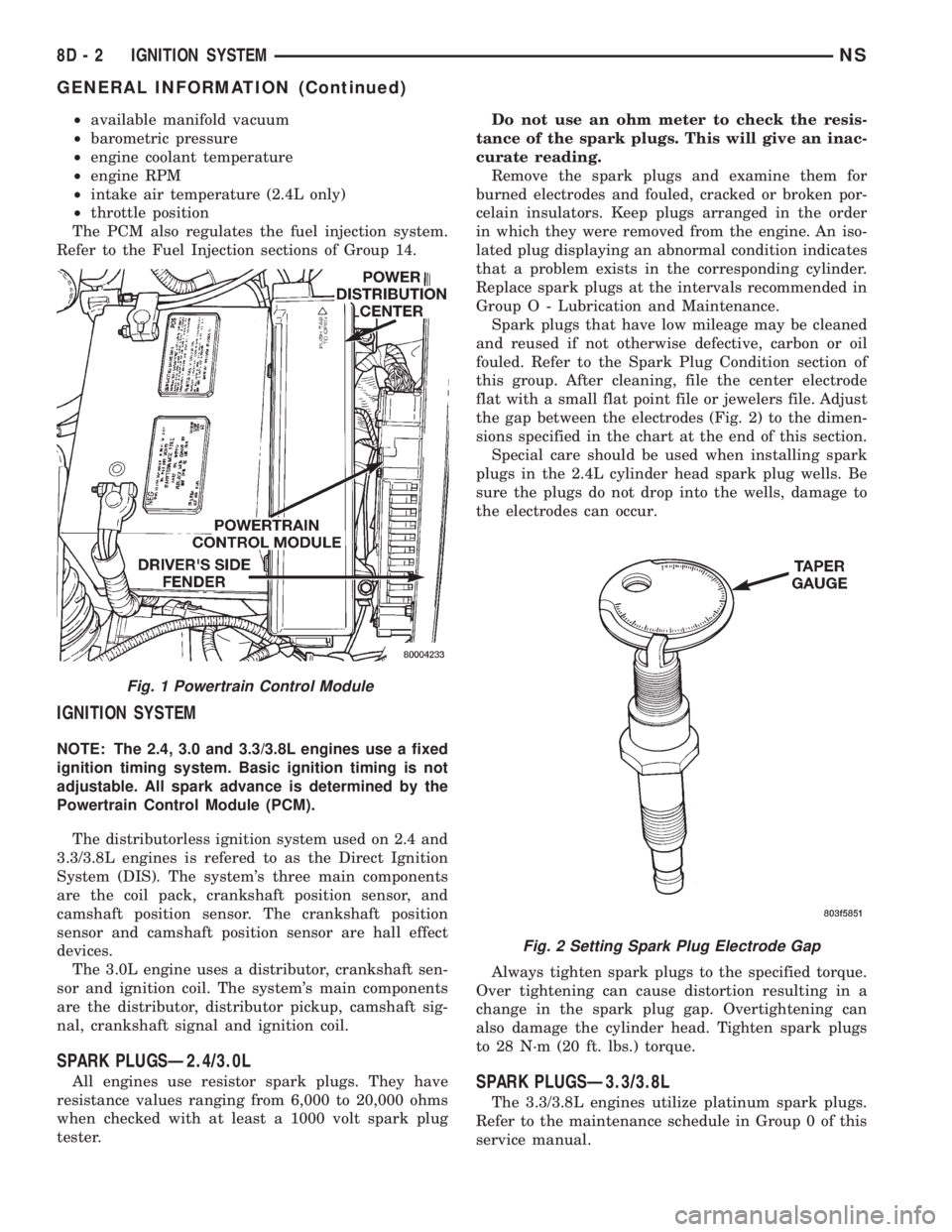
POWERTRAIN CONTROL MODULE
The ignition system is regulated by the Powertrain
Control Module (PCM) (Fig. 1). The PCM supplies
battery voltage to the ignition coil through the Auto
Shutdown (ASD) Relay. The PCM also controls
ground circuit for the ignition coil. By switching the
ground path for the coil on and off, the PCM adjusts
ignition timing to meet changing engine operating
conditions.
During the crank-start period the PCM advances
ignition timing a set amount. During engine opera-
tion, the amount of spark advance provided by the
PCM is determined by the following input factors:
NSIGNITION SYSTEM 8D - 1
Page 300 of 1938
²available manifold vacuum
²barometric pressure
²engine coolant temperature
²engine RPM
²intake air temperature (2.4L only)
²throttle position
The PCM also regulates the fuel injection system.
Refer to the Fuel Injection sections of Group 14.
IGNITION SYSTEM
NOTE: The 2.4, 3.0 and 3.3/3.8L engines use a fixed
ignition timing system. Basic ignition timing is not
adjustable. All spark advance is determined by the
Powertrain Control Module (PCM).
The distributorless ignition system used on 2.4 and
3.3/3.8L engines is refered to as the Direct Ignition
System (DIS). The system's three main components
are the coil pack, crankshaft position sensor, and
camshaft position sensor. The crankshaft position
sensor and camshaft position sensor are hall effect
devices.
The 3.0L engine uses a distributor, crankshaft sen-
sor and ignition coil. The system's main components
are the distributor, distributor pickup, camshaft sig-
nal, crankshaft signal and ignition coil.
SPARK PLUGSÐ2.4/3.0L
All engines use resistor spark plugs. They have
resistance values ranging from 6,000 to 20,000 ohms
when checked with at least a 1000 volt spark plug
tester.Do not use an ohm meter to check the resis-
tance of the spark plugs. This will give an inac-
curate reading.
Remove the spark plugs and examine them for
burned electrodes and fouled, cracked or broken por-
celain insulators. Keep plugs arranged in the order
in which they were removed from the engine. An iso-
lated plug displaying an abnormal condition indicates
that a problem exists in the corresponding cylinder.
Replace spark plugs at the intervals recommended in
Group O - Lubrication and Maintenance.
Spark plugs that have low mileage may be cleaned
and reused if not otherwise defective, carbon or oil
fouled. Refer to the Spark Plug Condition section of
this group. After cleaning, file the center electrode
flat with a small flat point file or jewelers file. Adjust
the gap between the electrodes (Fig. 2) to the dimen-
sions specified in the chart at the end of this section.
Special care should be used when installing spark
plugs in the 2.4L cylinder head spark plug wells. Be
sure the plugs do not drop into the wells, damage to
the electrodes can occur.
Always tighten spark plugs to the specified torque.
Over tightening can cause distortion resulting in a
change in the spark plug gap. Overtightening can
also damage the cylinder head. Tighten spark plugs
to 28 N´m (20 ft. lbs.) torque.SPARK PLUGSÐ3.3/3.8L
The 3.3/3.8L engines utilize platinum spark plugs.
Refer to the maintenance schedule in Group 0 of this
service manual.
Fig. 1 Powertrain Control Module
Fig. 2 Setting Spark Plug Electrode Gap
8D - 2 IGNITION SYSTEMNS
GENERAL INFORMATION (Continued)