service CHRYSLER VOYAGER 1996 Workshop Manual
[x] Cancel search | Manufacturer: CHRYSLER, Model Year: 1996, Model line: VOYAGER, Model: CHRYSLER VOYAGER 1996Pages: 1938, PDF Size: 55.84 MB
Page 74 of 1938
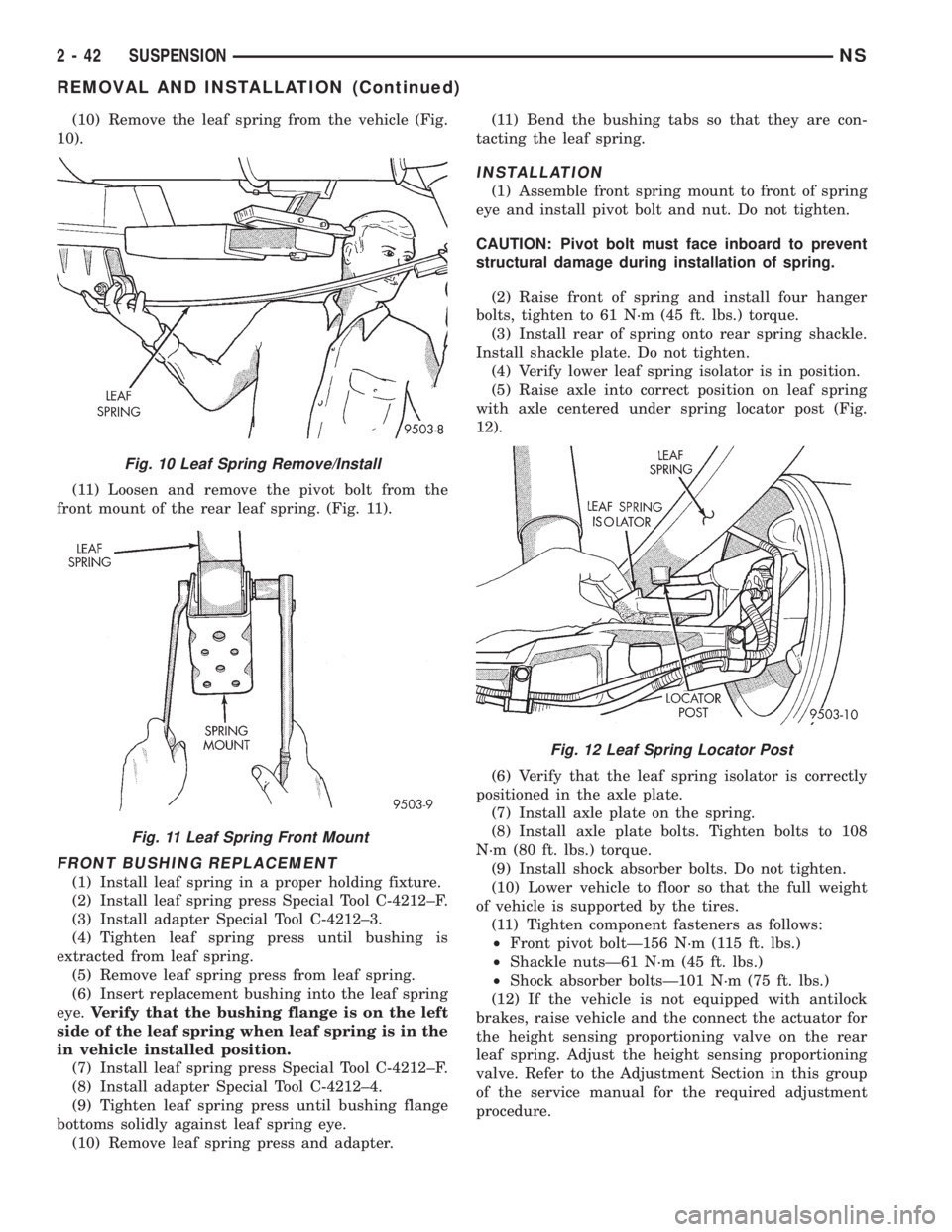
(10) Remove the leaf spring from the vehicle (Fig.
10).
(11) Loosen and remove the pivot bolt from the
front mount of the rear leaf spring. (Fig. 11).
FRONT BUSHING REPLACEMENT
(1) Install leaf spring in a proper holding fixture.
(2) Install leaf spring press Special Tool C-4212±F.
(3) Install adapter Special Tool C-4212±3.
(4) Tighten leaf spring press until bushing is
extracted from leaf spring.
(5) Remove leaf spring press from leaf spring.
(6) Insert replacement bushing into the leaf spring
eye.Verify that the bushing flange is on the left
side of the leaf spring when leaf spring is in the
in vehicle installed position.
(7) Install leaf spring press Special Tool C-4212±F.
(8) Install adapter Special Tool C-4212±4.
(9) Tighten leaf spring press until bushing flange
bottoms solidly against leaf spring eye.
(10) Remove leaf spring press and adapter.(11) Bend the bushing tabs so that they are con-
tacting the leaf spring.
INSTALLATION
(1) Assemble front spring mount to front of spring
eye and install pivot bolt and nut. Do not tighten.
CAUTION: Pivot bolt must face inboard to prevent
structural damage during installation of spring.
(2) Raise front of spring and install four hanger
bolts, tighten to 61 N´m (45 ft. lbs.) torque.
(3) Install rear of spring onto rear spring shackle.
Install shackle plate. Do not tighten.
(4) Verify lower leaf spring isolator is in position.
(5) Raise axle into correct position on leaf spring
with axle centered under spring locator post (Fig.
12).
(6) Verify that the leaf spring isolator is correctly
positioned in the axle plate.
(7) Install axle plate on the spring.
(8) Install axle plate bolts. Tighten bolts to 108
N´m (80 ft. lbs.) torque.
(9) Install shock absorber bolts. Do not tighten.
(10) Lower vehicle to floor so that the full weight
of vehicle is supported by the tires.
(11) Tighten component fasteners as follows:
²Front pivot boltÐ156 N´m (115 ft. lbs.)
²Shackle nutsÐ61 N´m (45 ft. lbs.)
²Shock absorber boltsÐ101 N´m (75 ft. lbs.)
(12) If the vehicle is not equipped with antilock
brakes, raise vehicle and the connect the actuator for
the height sensing proportioning valve on the rear
leaf spring. Adjust the height sensing proportioning
valve. Refer to the Adjustment Section in this group
of the service manual for the required adjustment
procedure.
Fig. 10 Leaf Spring Remove/Install
Fig. 11 Leaf Spring Front Mount
Fig. 12 Leaf Spring Locator Post
2 - 42 SUSPENSIONNS
REMOVAL AND INSTALLATION (Continued)
Page 75 of 1938
REAR SPRINGS (AWD)
REMOVE
(1) Raise vehicle on frame contact hoist to a com-
fortable working position.
(2) Remove the driveshaft from the side of the
vehicle that requires the removal of the leaf spring.
Refer to Group 3 Driveline in this service manual for
the procedure covering the removal of the rear drive-
shafts.
(3) Support axle with a jack stand. Pad should just
contact axle.
NOTE: If shock absorber bolt deflects upward dur-
ing removal, raise axle by adjusting support jack. If
shock absorber bolt deflects downward during
removal, lower axle by adjusting support jack (or by
pulling on axle).
(4) Begin removal of the shock absorber lower
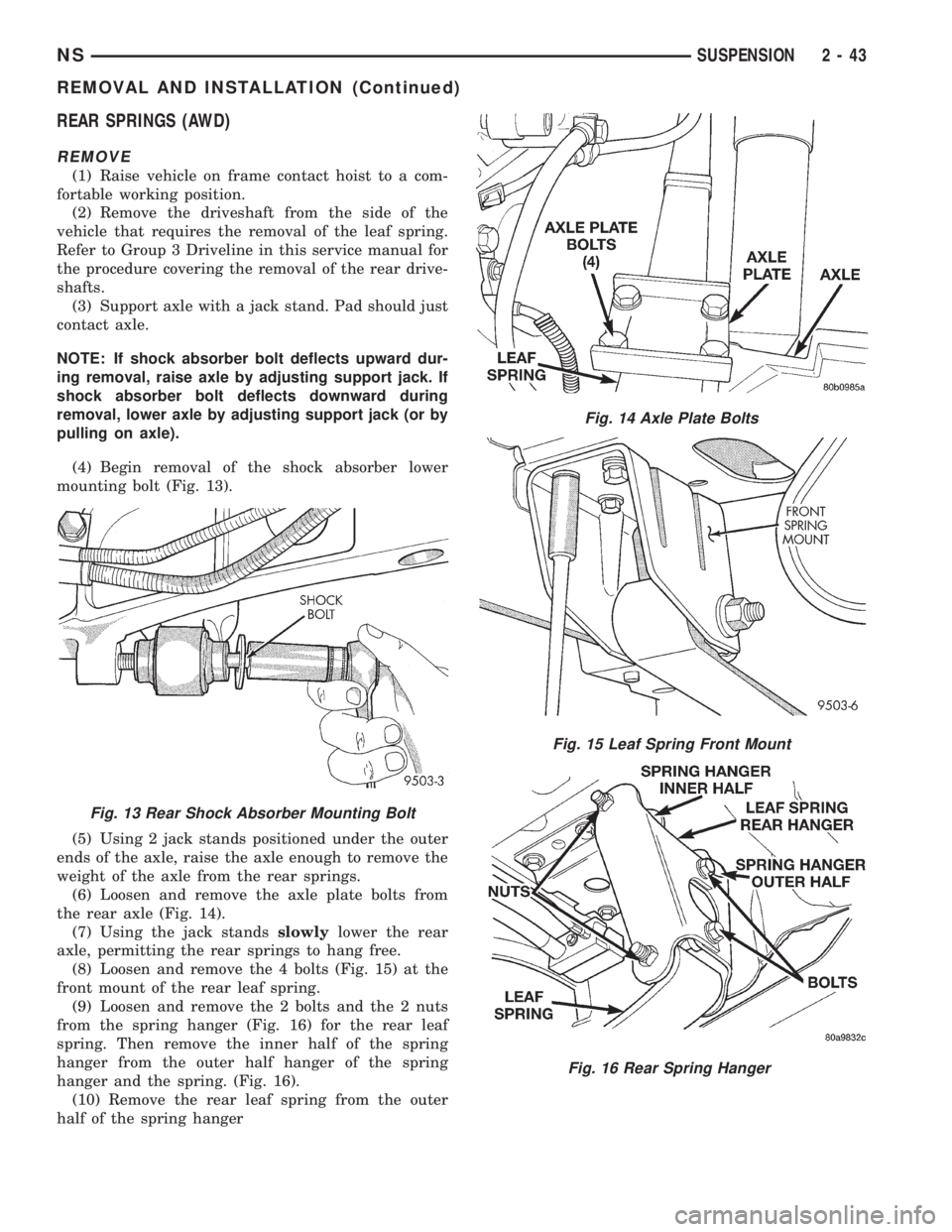
mounting bolt (Fig. 13).
(5) Using 2 jack stands positioned under the outer
ends of the axle, raise the axle enough to remove the
weight of the axle from the rear springs.
(6) Loosen and remove the axle plate bolts from
the rear axle (Fig. 14).
(7) Using the jack standsslowlylower the rear
axle, permitting the rear springs to hang free.
(8) Loosen and remove the 4 bolts (Fig. 15) at the
front mount of the rear leaf spring.
(9) Loosen and remove the 2 bolts and the 2 nuts
from the spring hanger (Fig. 16) for the rear leaf
spring. Then remove the inner half of the spring
hanger from the outer half hanger of the spring
hanger and the spring. (Fig. 16).
(10) Remove the rear leaf spring from the outer
half of the spring hanger
Fig. 13 Rear Shock Absorber Mounting Bolt
Fig. 14 Axle Plate Bolts
Fig. 15 Leaf Spring Front Mount
Fig. 16 Rear Spring Hanger
NSSUSPENSION 2 - 43
REMOVAL AND INSTALLATION (Continued)
Page 76 of 1938
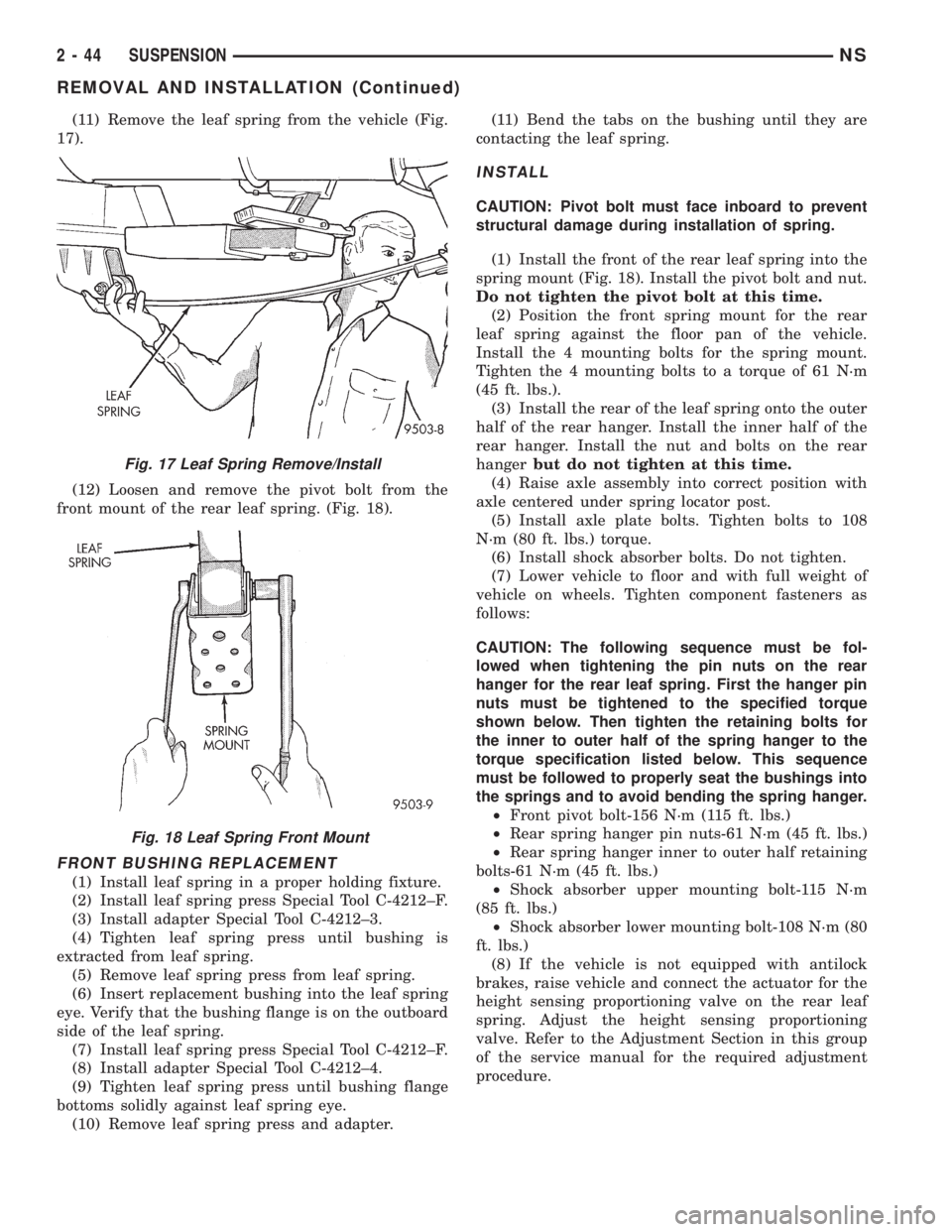
(11) Remove the leaf spring from the vehicle (Fig.
17).
(12) Loosen and remove the pivot bolt from the
front mount of the rear leaf spring. (Fig. 18).
FRONT BUSHING REPLACEMENT
(1) Install leaf spring in a proper holding fixture.
(2) Install leaf spring press Special Tool C-4212±F.
(3) Install adapter Special Tool C-4212±3.
(4) Tighten leaf spring press until bushing is
extracted from leaf spring.
(5) Remove leaf spring press from leaf spring.
(6) Insert replacement bushing into the leaf spring
eye. Verify that the bushing flange is on the outboard
side of the leaf spring.
(7) Install leaf spring press Special Tool C-4212±F.
(8) Install adapter Special Tool C-4212±4.
(9) Tighten leaf spring press until bushing flange
bottoms solidly against leaf spring eye.
(10) Remove leaf spring press and adapter.(11) Bend the tabs on the bushing until they are
contacting the leaf spring.
INSTALL
CAUTION: Pivot bolt must face inboard to prevent
structural damage during installation of spring.
(1) Install the front of the rear leaf spring into the
spring mount (Fig. 18). Install the pivot bolt and nut.
Do not tighten the pivot bolt at this time.
(2) Position the front spring mount for the rear
leaf spring against the floor pan of the vehicle.
Install the 4 mounting bolts for the spring mount.
Tighten the 4 mounting bolts to a torque of 61 N´m
(45 ft. lbs.).
(3) Install the rear of the leaf spring onto the outer
half of the rear hanger. Install the inner half of the
rear hanger. Install the nut and bolts on the rear
hangerbut do not tighten at this time.
(4) Raise axle assembly into correct position with
axle centered under spring locator post.
(5) Install axle plate bolts. Tighten bolts to 108
N´m (80 ft. lbs.) torque.
(6) Install shock absorber bolts. Do not tighten.
(7) Lower vehicle to floor and with full weight of
vehicle on wheels. Tighten component fasteners as
follows:
CAUTION: The following sequence must be fol-
lowed when tightening the pin nuts on the rear
hanger for the rear leaf spring. First the hanger pin
nuts must be tightened to the specified torque
shown below. Then tighten the retaining bolts for
the inner to outer half of the spring hanger to the
torque specification listed below. This sequence
must be followed to properly seat the bushings into
the springs and to avoid bending the spring hanger.
²Front pivot bolt-156 N´m (115 ft. lbs.)
²Rear spring hanger pin nuts-61 N´m (45 ft. lbs.)
²Rear spring hanger inner to outer half retaining
bolts-61 N´m (45 ft. lbs.)
²Shock absorber upper mounting bolt-115 N´m
(85 ft. lbs.)
²Shock absorber lower mounting bolt-108 N´m (80
ft. lbs.)
(8) If the vehicle is not equipped with antilock
brakes, raise vehicle and connect the actuator for the
height sensing proportioning valve on the rear leaf
spring. Adjust the height sensing proportioning
valve. Refer to the Adjustment Section in this group
of the service manual for the required adjustment
procedure.
Fig. 17 Leaf Spring Remove/Install
Fig. 18 Leaf Spring Front Mount
2 - 44 SUSPENSIONNS
REMOVAL AND INSTALLATION (Continued)
Page 77 of 1938

SHOCK ABSORBER
REMOVE/INSTALL
(1) Raise vehicle. Vehicle is to be raised and sup-
ported on jackstands or on a frame contact type
hoist. See Hoisting in the Lubrication And Mainte-
nance section of this service manual.
(2) Support the rear axle of the vehicle using 2
jackstands positioned at the outer ends of the axle.
NOTE: If the shock absorber lower mounting bolt
deflects upward during removal, raise axle by
adjusting the support jack. If the lower shock
absorber bolt deflects downward during removal,
lower the axle by adjusting the support jack.
(3) Remove the shock absorber lower mounting
bolt.
(4) While holding shock absorber, remove the
shock absorber upper mounting bolt.
(5) To install the shock absorber use the reverse
sequence of its removal.
(6) Lower the vehicle to the ground so the full
weight of the vehicle is supported by the suspension.
(7) Tighten the upper and lower shock absorber
mounting bolt to their specified torques.
REAR TRACK BAR
REMOVE
(1) Remove the nut and bolt mounting the track
bar to the rear axle (Fig. 19).
(2) Remove the nut and bolt attaching the track
bar to the track bar mount on the body of the vehicle.
Remove the track bar from the track bar mount.
INSTALL
(1) Install the track bar first into the body mount
for the track bar (Fig. 20). Install the track bar boltwith the head of the bolt facing toward the rear of
the vehicle (Fig. 21). Do not tighten.
(2) Install the track bar into its mounting bracket
on the rear axle (Fig. 19). Install the track bar bolt
with the head of the bolt facing toward the rear of
the vehicle. Do not tighten.
(3) Lower the vehicle to the ground until the full
weight of the vehicle is supported by the wheels.
Tighten both track bar attaching bolts to a torque of
95 N´m (70 ft. lbs.).
TRACK BAR MOUNT
REMOVE
(1) Remove the track bar from the track bar
mount.
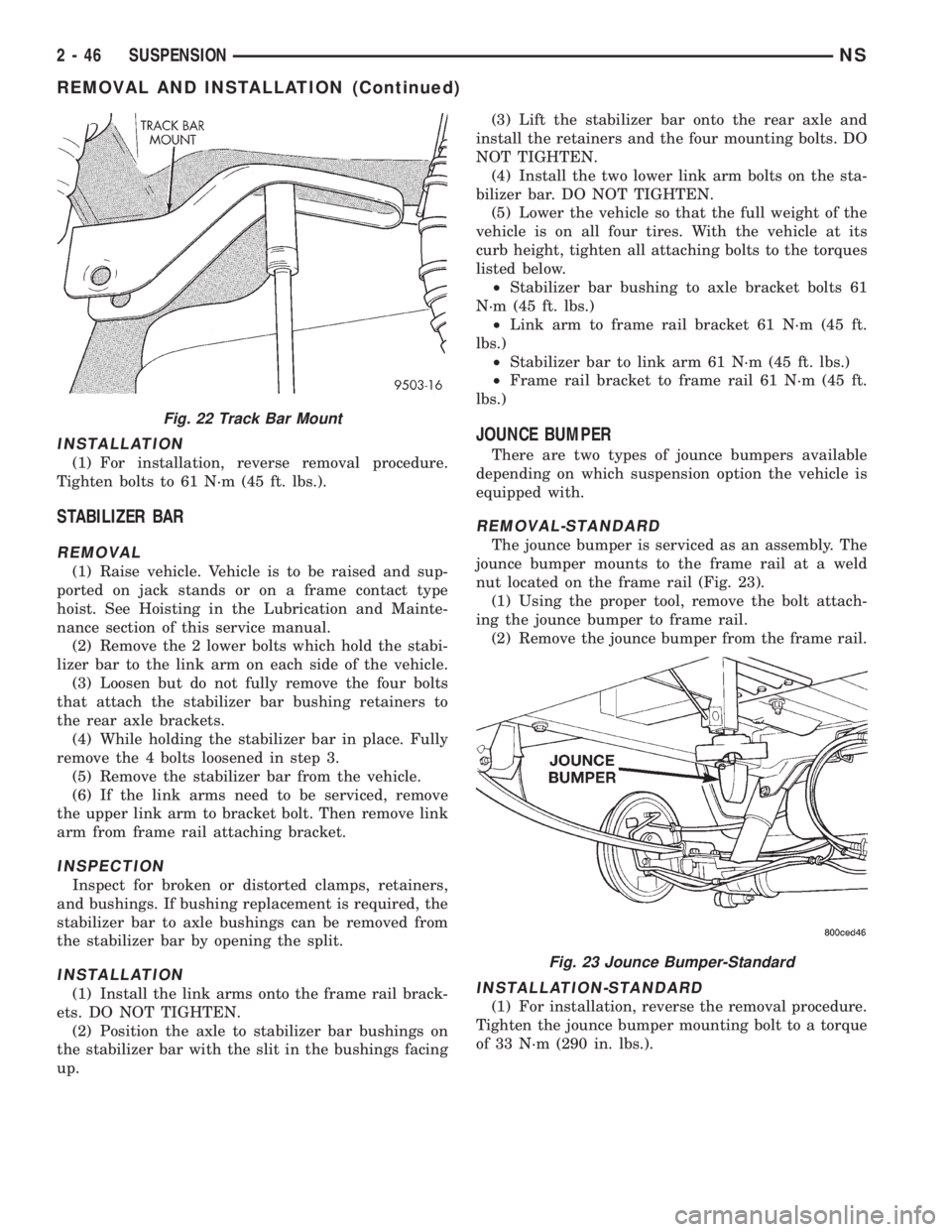
(2) Remove the three bolts attaching the track bar
mount to the body (Fig. 22).
Fig. 19 Track Bar Mounting To Axle
Fig. 20 Track Bar Installation
Fig. 21 Track Bar Bolt Installation
NSSUSPENSION 2 - 45
REMOVAL AND INSTALLATION (Continued)
Page 78 of 1938
INSTALLATION
(1) For installation, reverse removal procedure.
Tighten bolts to 61 N´m (45 ft. lbs.).
STABILIZER BAR
REMOVAL
(1) Raise vehicle. Vehicle is to be raised and sup-
ported on jack stands or on a frame contact type
hoist. See Hoisting in the Lubrication and Mainte-
nance section of this service manual.
(2) Remove the 2 lower bolts which hold the stabi-
lizer bar to the link arm on each side of the vehicle.
(3) Loosen but do not fully remove the four bolts
that attach the stabilizer bar bushing retainers to
the rear axle brackets.
(4) While holding the stabilizer bar in place. Fully
remove the 4 bolts loosened in step 3.
(5) Remove the stabilizer bar from the vehicle.
(6) If the link arms need to be serviced, remove
the upper link arm to bracket bolt. Then remove link
arm from frame rail attaching bracket.
INSPECTION
Inspect for broken or distorted clamps, retainers,
and bushings. If bushing replacement is required, the
stabilizer bar to axle bushings can be removed from
the stabilizer bar by opening the split.
INSTALLATION
(1) Install the link arms onto the frame rail brack-
ets. DO NOT TIGHTEN.
(2) Position the axle to stabilizer bar bushings on
the stabilizer bar with the slit in the bushings facing
up.(3) Lift the stabilizer bar onto the rear axle and
install the retainers and the four mounting bolts. DO
NOT TIGHTEN.
(4) Install the two lower link arm bolts on the sta-
bilizer bar. DO NOT TIGHTEN.
(5) Lower the vehicle so that the full weight of the
vehicle is on all four tires. With the vehicle at its
curb height, tighten all attaching bolts to the torques
listed below.
²Stabilizer bar bushing to axle bracket bolts 61
N´m (45 ft. lbs.)
²Link arm to frame rail bracket 61 N´m (45 ft.
lbs.)
²Stabilizer bar to link arm 61 N´m (45 ft. lbs.)
²Frame rail bracket to frame rail 61 N´m (45 ft.
lbs.)
JOUNCE BUMPER
There are two types of jounce bumpers available
depending on which suspension option the vehicle is
equipped with.
REMOVAL-STANDARD
The jounce bumper is serviced as an assembly. The
jounce bumper mounts to the frame rail at a weld
nut located on the frame rail (Fig. 23).
(1) Using the proper tool, remove the bolt attach-
ing the jounce bumper to frame rail.
(2) Remove the jounce bumper from the frame rail.
INSTALLATION-STANDARD
(1) For installation, reverse the removal procedure.
Tighten the jounce bumper mounting bolt to a torque
of 33 N´m (290 in. lbs.).
Fig. 22 Track Bar Mount
Fig. 23 Jounce Bumper-Standard
2 - 46 SUSPENSIONNS
REMOVAL AND INSTALLATION (Continued)
Page 79 of 1938
REMOVAL-HEAVY DUTY
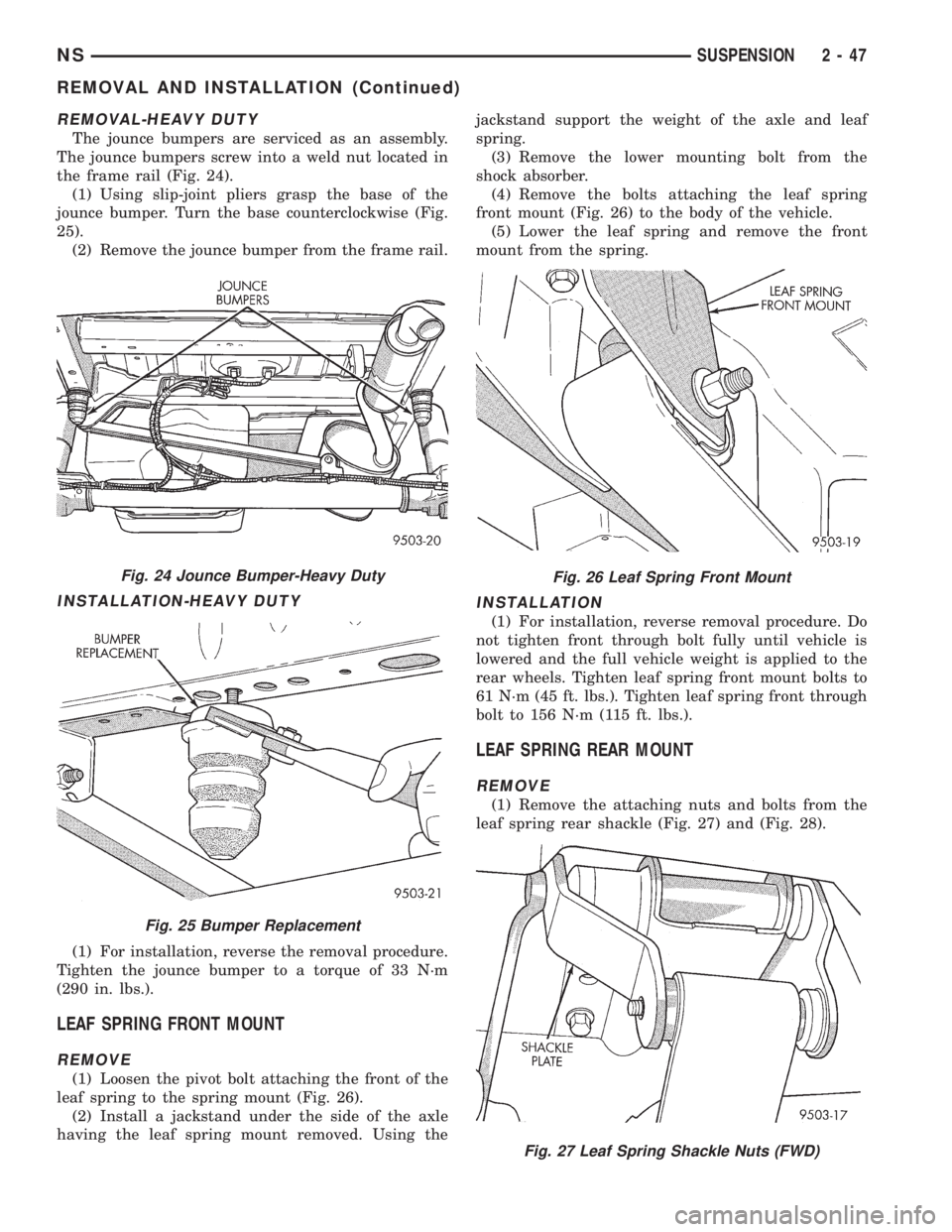
The jounce bumpers are serviced as an assembly.
The jounce bumpers screw into a weld nut located in
the frame rail (Fig. 24).
(1) Using slip-joint pliers grasp the base of the
jounce bumper. Turn the base counterclockwise (Fig.
25).
(2) Remove the jounce bumper from the frame rail.
INSTALLATION-HEAVY DUTY
(1) For installation, reverse the removal procedure.
Tighten the jounce bumper to a torque of 33 N´m
(290 in. lbs.).
LEAF SPRING FRONT MOUNT
REMOVE
(1) Loosen the pivot bolt attaching the front of the
leaf spring to the spring mount (Fig. 26).
(2) Install a jackstand under the side of the axle
having the leaf spring mount removed. Using thejackstand support the weight of the axle and leaf
spring.
(3) Remove the lower mounting bolt from the
shock absorber.
(4) Remove the bolts attaching the leaf spring
front mount (Fig. 26) to the body of the vehicle.
(5) Lower the leaf spring and remove the front
mount from the spring.
INSTALLATION
(1) For installation, reverse removal procedure. Do
not tighten front through bolt fully until vehicle is
lowered and the full vehicle weight is applied to the
rear wheels. Tighten leaf spring front mount bolts to
61 N´m (45 ft. lbs.). Tighten leaf spring front through
bolt to 156 N´m (115 ft. lbs.).
LEAF SPRING REAR MOUNT
REMOVE
(1) Remove the attaching nuts and bolts from the
leaf spring rear shackle (Fig. 27) and (Fig. 28).
Fig. 24 Jounce Bumper-Heavy Duty
Fig. 25 Bumper Replacement
Fig. 26 Leaf Spring Front Mount
Fig. 27 Leaf Spring Shackle Nuts (FWD)
NSSUSPENSION 2 - 47
REMOVAL AND INSTALLATION (Continued)
Page 81 of 1938
SUSPENSION
CONTENTS
page
SPECIFICATIONS
ALIGNMENT SPECIFICATIONS............. 1
SPECIFICATIONS
ALIGNMENT SPECIFICATIONS
All alignment specifications are to be checked and
adjusted with the vehicle at its correct ride height.
Refer to the ride height specifications listed in the
following alignment specifications chart.
* Camber is adjustable using the Mopar Cam-
ber Adjustment Service Kit. Refer to the Mopar
Parts Catalog for the required service kit part
number.
** Caster is not adjustable. If found to be out
of specification check for proper ride heights
and damaged/worn out suspension components
and replace as necessary.
*** Toe-In is positive.**** Toe, Camber and thrust angle are not
adjustable. If found to be out of specification
check for proper ride heights and damaged/
worn out suspension components and replace
as necessary.
***** When Measuring ride heights: 1) Ensure
that the tire pressures are correct. 2) Jounce
the vehicle at the bumper several times and
release at the bottom of the stroke. 3) Measure
from the ground to the outboard, lower, center
section of the fender wheel well opening. Ride
heights are not adjustable. If found to be out of
specification check for damaged and/or worn
out suspension components and replace as nec-
essary.
NS/GSSUSPENSION 2 - 1
Page 83 of 1938
BRAKES
CONTENTS
page page
ANTILOCK BRAKE SYSTEM ±
TEVES MARK-20....................... 85BASE BRAKE SYSTEM..................... 3
GENERAL INFORMATION................... 1
GENERAL INFORMATION
INDEX
page page
GENERAL INFORMATION
BASE BRAKE SYSTEM COMPONENT
DESCRIPTION......................... 1GENERAL VEHICLE SERVICE CAUTIONS...... 1
GENERAL INFORMATION
GENERAL VEHICLE SERVICE CAUTIONS
CAUTION: At no time when servicing a vehicle, can a
sheet metal screw, bolt or other metal fastener be
installed in the shock tower to take the place of an
original plastic clip. Also, NO holes can be drilled into
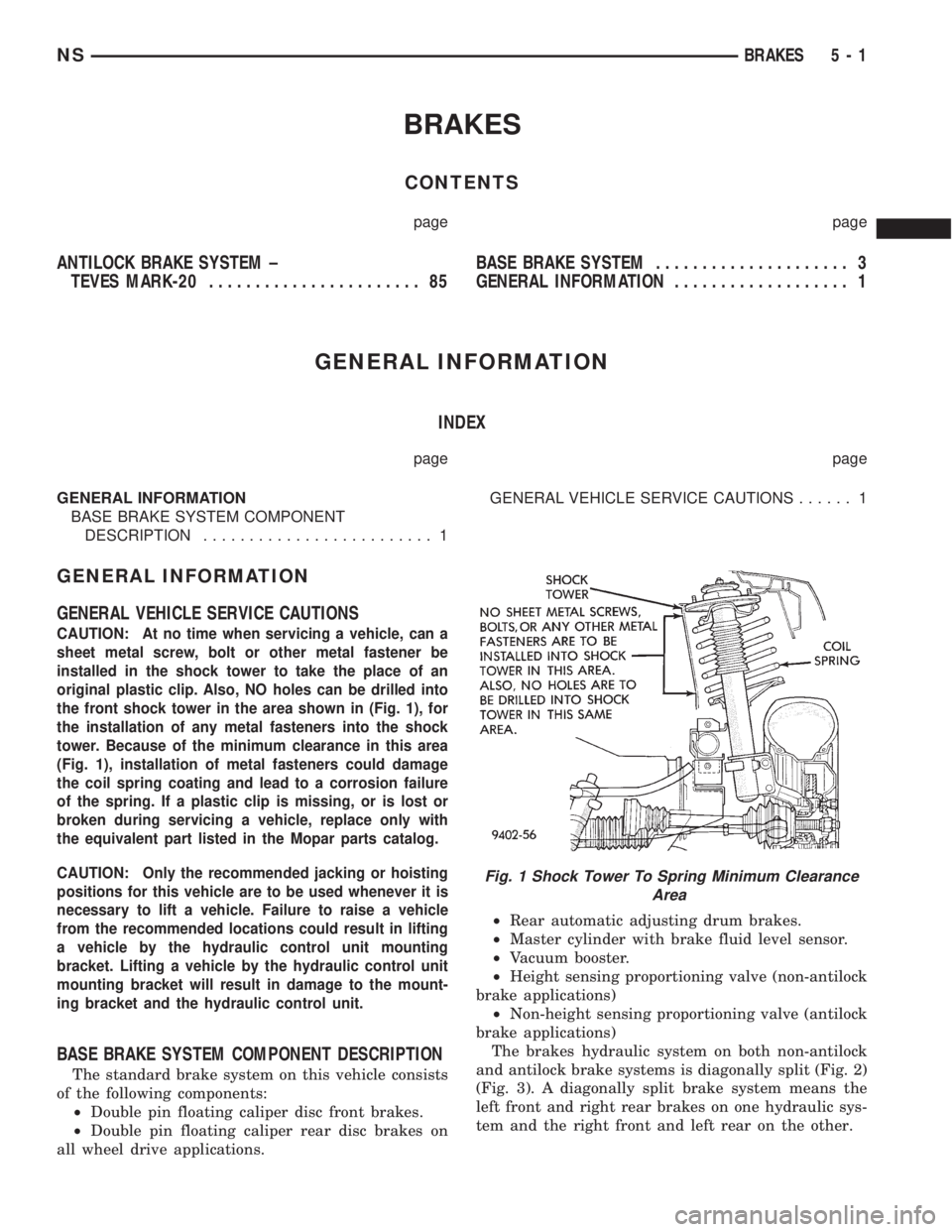
the front shock tower in the area shown in (Fig. 1), for
the installation of any metal fasteners into the shock
tower. Because of the minimum clearance in this area
(Fig. 1), installation of metal fasteners could damage
the coil spring coating and lead to a corrosion failure
of the spring. If a plastic clip is missing, or is lost or
broken during servicing a vehicle, replace only with
the equivalent part listed in the Mopar parts catalog.
CAUTION: Only the recommended jacking or hoisting
positions for this vehicle are to be used whenever it is
necessary to lift a vehicle. Failure to raise a vehicle
from the recommended locations could result in lifting
a vehicle by the hydraulic control unit mounting
bracket. Lifting a vehicle by the hydraulic control unit
mounting bracket will result in damage to the mount-
ing bracket and the hydraulic control unit.
BASE BRAKE SYSTEM COMPONENT DESCRIPTION
The standard brake system on this vehicle consists
of the following components:
²Double pin floating caliper disc front brakes.
²Double pin floating caliper rear disc brakes on
all wheel drive applications.²Rear automatic adjusting drum brakes.
²Master cylinder with brake fluid level sensor.
²Vacuum booster.
²Height sensing proportioning valve (non-antilock
brake applications)
²Non-height sensing proportioning valve (antilock
brake applications)
The brakes hydraulic system on both non-antilock
and antilock brake systems is diagonally split (Fig. 2)
(Fig. 3). A diagonally split brake system means the
left front and right rear brakes on one hydraulic sys-
tem and the right front and left rear on the other.
Fig. 1 Shock Tower To Spring Minimum Clearance
Area
NSBRAKES 5 - 1
Page 85 of 1938
BASE BRAKE SYSTEM
INDEX
page page
DESCRIPTION AND OPERATION
CHASSIS TUBES AND HOSES.............. 7
FRONT DISC BRAKE SYSTEM.............. 4
HUB/BEARING REAR WHEEL............... 9
MASTER CYLINDER...................... 7
PARKING BRAKE SYSTEM OPERATION....... 5
POWER BRAKE VACUUM BOOSTER
OPERATION........................... 8
PROPORTIONING VALVES................. 5
REAR DISC BRAKES...................... 5
REAR DRUM BRAKES..................... 5
RED BRAKE WARNING LAMP OPERATION..... 8
STOP LAMP SWITCH...................... 9
DIAGNOSIS AND TESTING
ADJUSTER REAR DRUM BRAKE
(AUTOMATIC)......................... 14
BRAKE FLUID CONTAMINATION............ 19
BRAKE ROTOR......................... 14
BRAKE SYSTEM BASIC DIAGNOSIS GUIDE.... 9
BRAKE SYSTEM DIAGNOSIS CHARTS....... 10
PROPORTIONING VALVES................ 16
RED BRAKE WARNING LAMP TEST......... 19
STOP LAMP SWITCH TEST PROCEDURE..... 19
TRACTION CONTROL LAMP TEST.......... 19
SERVICE PROCEDURES
BLEEDING BASE BRAKE
HYDRAULIC SYSTEM................... 20
BRAKE DRUM MACHINING................ 24
BRAKE TUBE REPAIR PROCEDURE......... 24
MASTER CYLINDER BLEEDING
PROCEDURE......................... 22
MASTER CYLINDER FLUID LEVEL CHECK.... 20
PARK BRAKE AUTO ADJUSTER
MECHANISM RELEASE................. 26
ROTOR MACHINING (FRONT/REAR)......... 22
REMOVAL AND INSTALLATION
BRAKE SUPPORT PLATE (REAR DRUM
BRAKES)............................ 37
FRONT DISC BRAKE CALIPER............. 27
FRONT DISC BRAKE PADS................ 30
FRONT PARK BRAKE CABLE.............. 65
HUB/BEARING.......................... 40
HYDRAULIC BRAKE TUBES AND HOSES..... 58
INTERMEDIATE PARK BRAKE CABLE....... 66
JUNCTION BLOCK....................... 55
LEFT REAR PARK BRAKE CABLE........... 67
MASTER CYLINDER..................... 44
PARK BRAKE PEDAL MECHANISM.......... 58PARK BRAKE SHOES (WITH REAR DISC
BRAKES)............................ 60
PROPORTIONING VALVE (W/ABS BRAKES) . . . 56
PROPORTIONING VALVE
(W/O ABS BRAKES).................... 57
REAR BRAKE DRUM..................... 33
REAR BRAKE WHEEL CYLINDER........... 39
REAR DISC BRAKE CALIPER.............. 28
REAR DISC BRAKE SHOES................ 31
REAR DRUM BRAKE SHOES............... 34
RIGHT REAR PARK BRAKE CABLE......... 66
STOP LAMP SWITCH..................... 69
VACUUM BOOSTER 2.4 LITER ENGINE...... 47
VACUUM BOOSTER 3.0 LITER ENGINE...... 49
VACUUM BOOSTER 3.3/3.8 LITER ENGINE.... 52
WHEEL AND TIRE INSTALLATION........... 27
DISASSEMBLY AND ASSEMBLY
FRONT DISC BRAKE CALIPER............. 71
MASTER CYLINDER BRAKE FLUID LEVEL
SWITCH............................. 71
MASTER CYLINDER FLUID RESERVOIR
FILL TUBE............................ 71
MASTER CYLINDER FLUID RESERVOIR...... 70
MASTER CYLINDER TO POWER BRAKE
BOOSTER VACUUM SEAL............... 69
WHEEL CYLINDER REAR DRUM BRAKE...... 76
CLEANING AND INSPECTION
BRAKE HOSE AND BRAKE LINES
INSPECTION.......................... 78
FRONT DISC BRAKE PAD LINING
INSPECTION.......................... 76
REAR DISC BRAKES..................... 76
REAR DRUM BRAKE SHOE LINING
INSPECTION.......................... 77
REAR DRUM BRAKE WHEEL CYLINDER...... 78
REAR WHEEL HUB AND BEARING
ASSEMBLY........................... 78
ADJUSTMENTS
PARK BRAKE CABLE ADJUSTMENT......... 81
PARK BRAKE SHOES (WITH REAR DISC
BRAKES)............................ 79
PROPORTIONING VALVE
(HEIGHT SENSING).................... 81
REAR DRUM BRAKE SHOE ADJUSTMENT.... 79
STOP LAMP SWITCH..................... 78
SPECIFICATIONS
BRAKE ACTUATION SYSTEM.............. 83
BRAKE FASTENER TORQUE
SPECIFICATIONS...................... 83
NSBRAKES 5 - 3
Page 87 of 1938
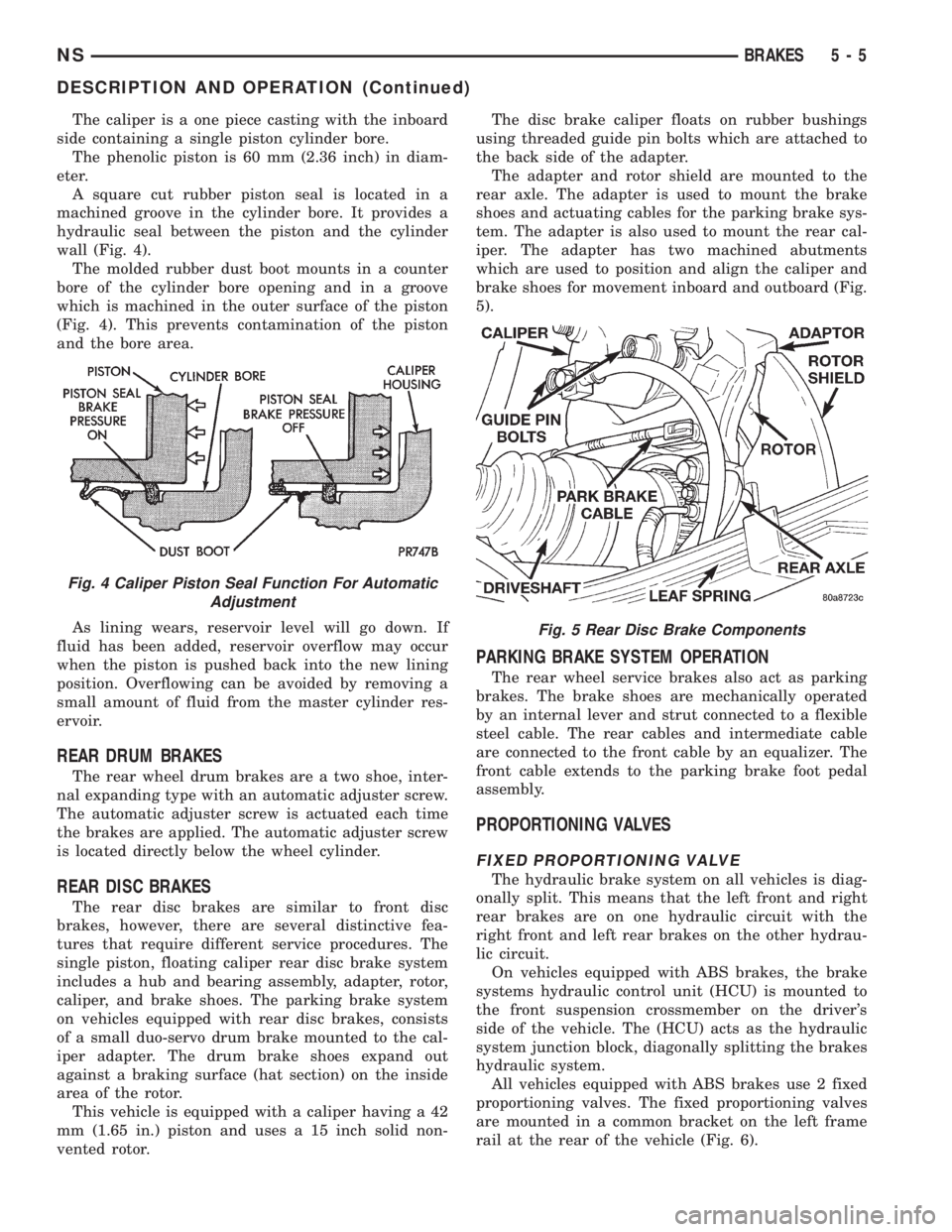
The caliper is a one piece casting with the inboard
side containing a single piston cylinder bore.
The phenolic piston is 60 mm (2.36 inch) in diam-
eter.
A square cut rubber piston seal is located in a
machined groove in the cylinder bore. It provides a
hydraulic seal between the piston and the cylinder
wall (Fig. 4).
The molded rubber dust boot mounts in a counter
bore of the cylinder bore opening and in a groove
which is machined in the outer surface of the piston
(Fig. 4). This prevents contamination of the piston
and the bore area.
As lining wears, reservoir level will go down. If
fluid has been added, reservoir overflow may occur
when the piston is pushed back into the new lining
position. Overflowing can be avoided by removing a
small amount of fluid from the master cylinder res-
ervoir.
REAR DRUM BRAKES
The rear wheel drum brakes are a two shoe, inter-
nal expanding type with an automatic adjuster screw.
The automatic adjuster screw is actuated each time
the brakes are applied. The automatic adjuster screw
is located directly below the wheel cylinder.
REAR DISC BRAKES
The rear disc brakes are similar to front disc
brakes, however, there are several distinctive fea-
tures that require different service procedures. The
single piston, floating caliper rear disc brake system
includes a hub and bearing assembly, adapter, rotor,
caliper, and brake shoes. The parking brake system
on vehicles equipped with rear disc brakes, consists
of a small duo-servo drum brake mounted to the cal-
iper adapter. The drum brake shoes expand out
against a braking surface (hat section) on the inside
area of the rotor.
This vehicle is equipped with a caliper having a 42
mm (1.65 in.) piston and uses a 15 inch solid non-
vented rotor.The disc brake caliper floats on rubber bushings
using threaded guide pin bolts which are attached to
the back side of the adapter.
The adapter and rotor shield are mounted to the
rear axle. The adapter is used to mount the brake
shoes and actuating cables for the parking brake sys-
tem. The adapter is also used to mount the rear cal-
iper. The adapter has two machined abutments
which are used to position and align the caliper and
brake shoes for movement inboard and outboard (Fig.
5).
PARKING BRAKE SYSTEM OPERATION
The rear wheel service brakes also act as parking
brakes. The brake shoes are mechanically operated
by an internal lever and strut connected to a flexible
steel cable. The rear cables and intermediate cable
are connected to the front cable by an equalizer. The
front cable extends to the parking brake foot pedal
assembly.
PROPORTIONING VALVES
FIXED PROPORTIONING VALVE
The hydraulic brake system on all vehicles is diag-
onally split. This means that the left front and right
rear brakes are on one hydraulic circuit with the
right front and left rear brakes on the other hydrau-
lic circuit.
On vehicles equipped with ABS brakes, the brake
systems hydraulic control unit (HCU) is mounted to
the front suspension crossmember on the driver's
side of the vehicle. The (HCU) acts as the hydraulic
system junction block, diagonally splitting the brakes
hydraulic system.
All vehicles equipped with ABS brakes use 2 fixed
proportioning valves. The fixed proportioning valves
are mounted in a common bracket on the left frame
rail at the rear of the vehicle (Fig. 6).
Fig. 4 Caliper Piston Seal Function For Automatic
Adjustment
Fig. 5 Rear Disc Brake Components
NSBRAKES 5 - 5
DESCRIPTION AND OPERATION (Continued)