service CHRYSLER VOYAGER 1996 Manual Online
[x] Cancel search | Manufacturer: CHRYSLER, Model Year: 1996, Model line: VOYAGER, Model: CHRYSLER VOYAGER 1996Pages: 1938, PDF Size: 55.84 MB
Page 147 of 1938
(30) Road test the vehicle and make several stops
to wear off any foreign material on the brakes and to
seat the brake shoe linings.
FRONT PARK BRAKE CABLE
REMOVE
(1) Raise vehicle on jackstands or centered on a
hoist. See Hoisting in the Lubrication and Mainte-
nance group of this service manual.
(2) Manually lockout the automatic self adjusting
mechanism of the park brake pedal assembly. Refer
to Manual Lockout Of Auto Adjuster Mechanism in
this section of the service manual for the required
procedure.
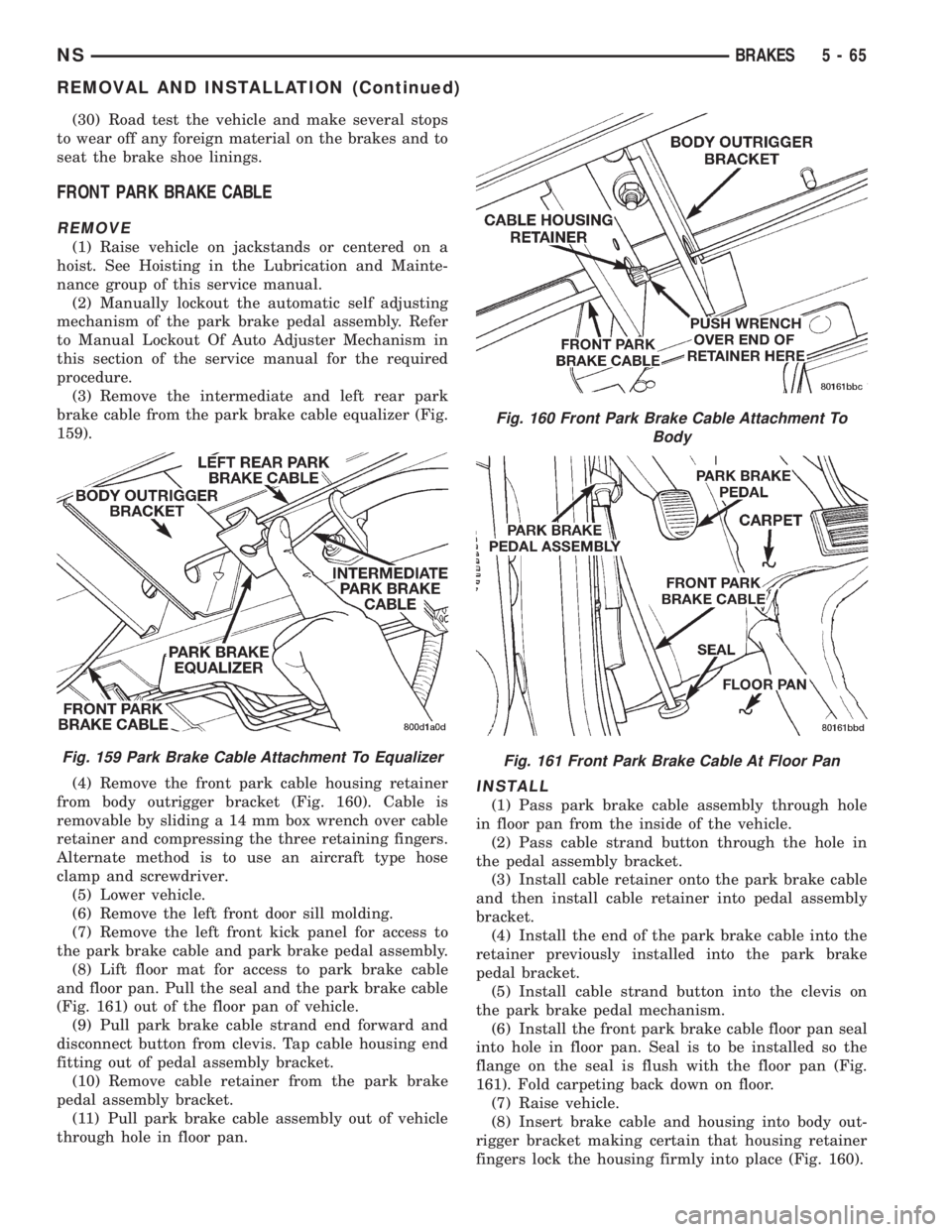
(3) Remove the intermediate and left rear park
brake cable from the park brake cable equalizer (Fig.
159).
(4) Remove the front park cable housing retainer
from body outrigger bracket (Fig. 160). Cable is
removable by sliding a 14 mm box wrench over cable
retainer and compressing the three retaining fingers.
Alternate method is to use an aircraft type hose
clamp and screwdriver.
(5) Lower vehicle.
(6) Remove the left front door sill molding.
(7) Remove the left front kick panel for access to
the park brake cable and park brake pedal assembly.
(8) Lift floor mat for access to park brake cable
and floor pan. Pull the seal and the park brake cable
(Fig. 161) out of the floor pan of vehicle.
(9) Pull park brake cable strand end forward and
disconnect button from clevis. Tap cable housing end
fitting out of pedal assembly bracket.
(10) Remove cable retainer from the park brake
pedal assembly bracket.
(11) Pull park brake cable assembly out of vehicle
through hole in floor pan.
INSTALL
(1) Pass park brake cable assembly through hole
in floor pan from the inside of the vehicle.
(2) Pass cable strand button through the hole in
the pedal assembly bracket.
(3) Install cable retainer onto the park brake cable
and then install cable retainer into pedal assembly
bracket.
(4) Install the end of the park brake cable into the
retainer previously installed into the park brake
pedal bracket.
(5) Install cable strand button into the clevis on
the park brake pedal mechanism.
(6) Install the front park brake cable floor pan seal
into hole in floor pan. Seal is to be installed so the
flange on the seal is flush with the floor pan (Fig.
161). Fold carpeting back down on floor.
(7) Raise vehicle.
(8) Insert brake cable and housing into body out-
rigger bracket making certain that housing retainer
fingers lock the housing firmly into place (Fig. 160).
Fig. 159 Park Brake Cable Attachment To Equalizer
Fig. 160 Front Park Brake Cable Attachment To
Body
Fig. 161 Front Park Brake Cable At Floor Pan
NSBRAKES 5 - 65
REMOVAL AND INSTALLATION (Continued)
Page 148 of 1938
(9) Assemble the park brake cables onto the park
brake cable equalizer (Fig. 159).
(10) Release the automatic adjuster mechanism on
the park brake pedal assembly. Refer to Parking
Brake Automatic Adjuster in the Service Procedures
Section in this group of the service manual for the
required procedure.
(11) Lower vehicle and apply the park brake pedal
1 time, this will seat the park brake cables.
INTERMEDIATE PARK BRAKE CABLE
REMOVE
(1) Raise vehicle on jackstands or centered on a
hoist. See Hoisting in the Lubrication and Mainte-
nance group of this service manual.
(2) Manually lockout the automatic self adjusting
mechanism of the park brake pedal assembly. Refer
to Manual Lockout Of Auto Adjuster Mechanism in
this section of the service manual for the required
procedure.
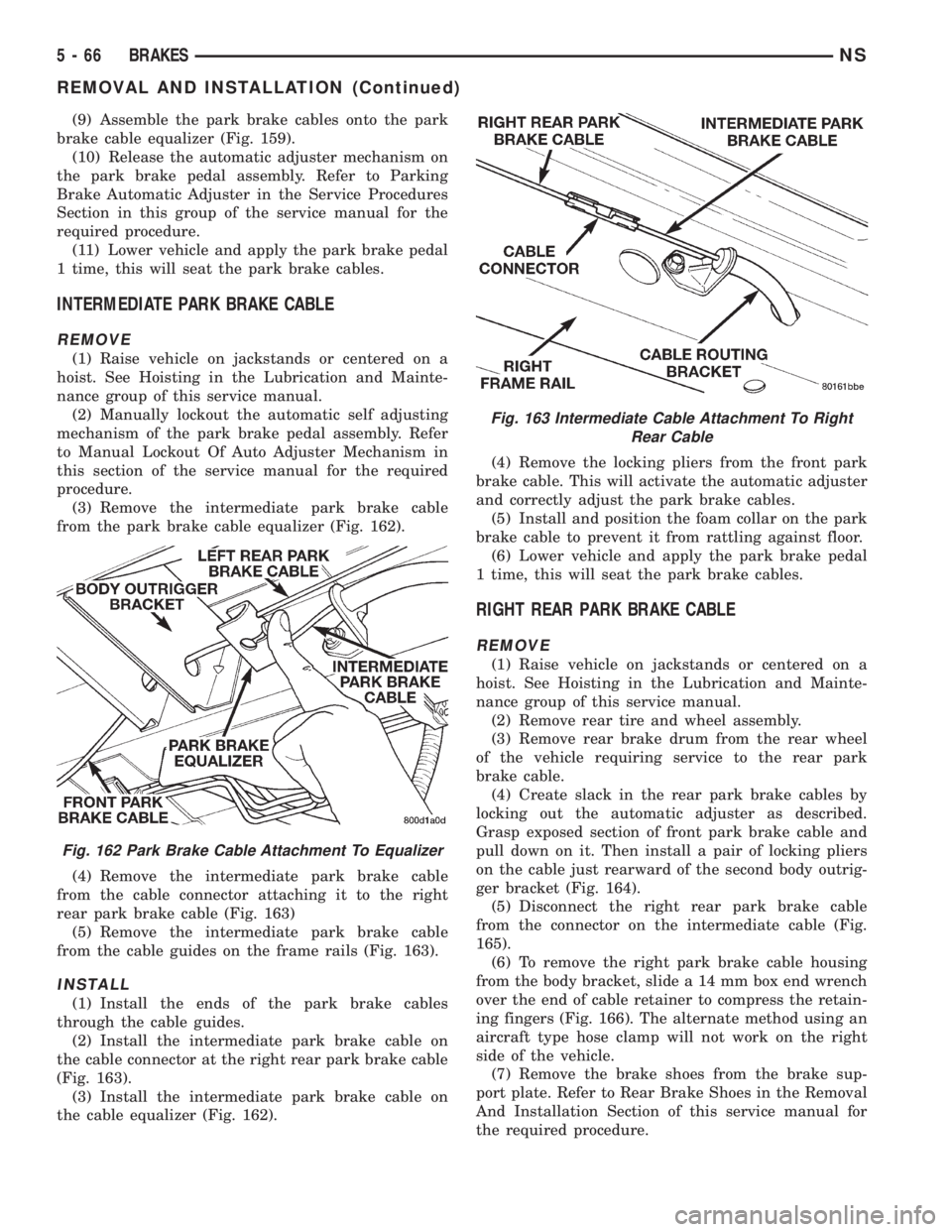
(3) Remove the intermediate park brake cable
from the park brake cable equalizer (Fig. 162).
(4) Remove the intermediate park brake cable
from the cable connector attaching it to the right
rear park brake cable (Fig. 163)
(5) Remove the intermediate park brake cable
from the cable guides on the frame rails (Fig. 163).
INSTALL
(1) Install the ends of the park brake cables
through the cable guides.
(2) Install the intermediate park brake cable on
the cable connector at the right rear park brake cable
(Fig. 163).
(3) Install the intermediate park brake cable on
the cable equalizer (Fig. 162).(4) Remove the locking pliers from the front park
brake cable. This will activate the automatic adjuster
and correctly adjust the park brake cables.
(5) Install and position the foam collar on the park
brake cable to prevent it from rattling against floor.
(6) Lower vehicle and apply the park brake pedal
1 time, this will seat the park brake cables.
RIGHT REAR PARK BRAKE CABLE
REMOVE
(1) Raise vehicle on jackstands or centered on a
hoist. See Hoisting in the Lubrication and Mainte-
nance group of this service manual.
(2) Remove rear tire and wheel assembly.
(3) Remove rear brake drum from the rear wheel
of the vehicle requiring service to the rear park
brake cable.
(4) Create slack in the rear park brake cables by
locking out the automatic adjuster as described.
Grasp exposed section of front park brake cable and
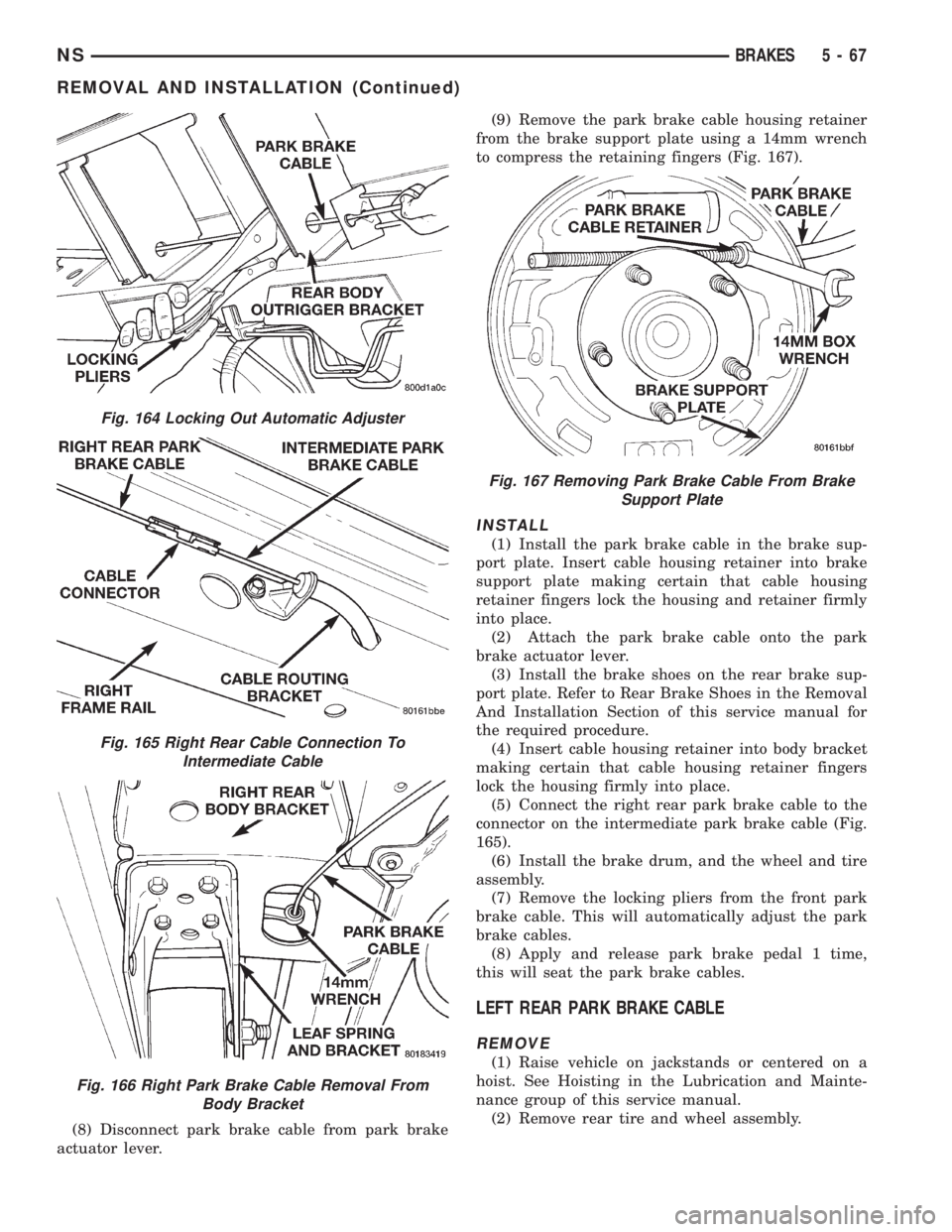
pull down on it. Then install a pair of locking pliers
on the cable just rearward of the second body outrig-
ger bracket (Fig. 164).
(5) Disconnect the right rear park brake cable
from the connector on the intermediate cable (Fig.
165).
(6) To remove the right park brake cable housing
from the body bracket, slide a 14 mm box end wrench
over the end of cable retainer to compress the retain-
ing fingers (Fig. 166). The alternate method using an
aircraft type hose clamp will not work on the right
side of the vehicle.
(7) Remove the brake shoes from the brake sup-
port plate. Refer to Rear Brake Shoes in the Removal
And Installation Section of this service manual for
the required procedure.
Fig. 162 Park Brake Cable Attachment To Equalizer
Fig. 163 Intermediate Cable Attachment To Right
Rear Cable
5 - 66 BRAKESNS
REMOVAL AND INSTALLATION (Continued)
Page 149 of 1938
(8) Disconnect park brake cable from park brake
actuator lever.(9) Remove the park brake cable housing retainer
from the brake support plate using a 14mm wrench
to compress the retaining fingers (Fig. 167).
INSTALL
(1) Install the park brake cable in the brake sup-
port plate. Insert cable housing retainer into brake
support plate making certain that cable housing
retainer fingers lock the housing and retainer firmly
into place.
(2) Attach the park brake cable onto the park
brake actuator lever.
(3) Install the brake shoes on the rear brake sup-
port plate. Refer to Rear Brake Shoes in the Removal
And Installation Section of this service manual for
the required procedure.
(4) Insert cable housing retainer into body bracket
making certain that cable housing retainer fingers
lock the housing firmly into place.
(5) Connect the right rear park brake cable to the
connector on the intermediate park brake cable (Fig.
165).
(6) Install the brake drum, and the wheel and tire
assembly.
(7) Remove the locking pliers from the front park
brake cable. This will automatically adjust the park
brake cables.
(8) Apply and release park brake pedal 1 time,
this will seat the park brake cables.
LEFT REAR PARK BRAKE CABLE
REMOVE
(1) Raise vehicle on jackstands or centered on a
hoist. See Hoisting in the Lubrication and Mainte-
nance group of this service manual.
(2) Remove rear tire and wheel assembly.
Fig. 164 Locking Out Automatic Adjuster
Fig. 165 Right Rear Cable Connection To
Intermediate Cable
Fig. 166 Right Park Brake Cable Removal From
Body Bracket
Fig. 167 Removing Park Brake Cable From Brake
Support Plate
NSBRAKES 5 - 67
REMOVAL AND INSTALLATION (Continued)
Page 150 of 1938
(3) Remove rear brake drum from the rear wheel
of the vehicle requiring service to the rear park
brake cable.
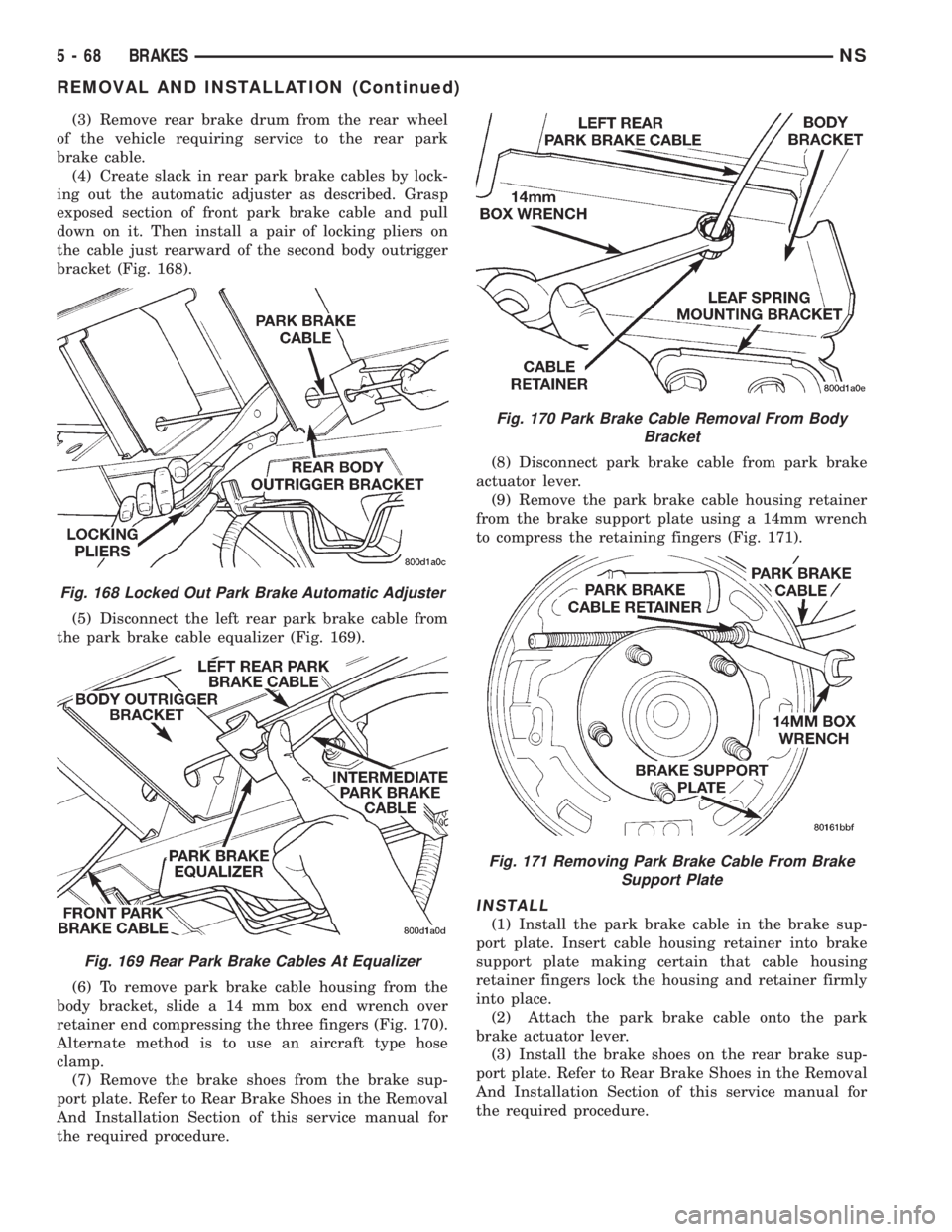
(4) Create slack in rear park brake cables by lock-
ing out the automatic adjuster as described. Grasp
exposed section of front park brake cable and pull
down on it. Then install a pair of locking pliers on
the cable just rearward of the second body outrigger
bracket (Fig. 168).
(5) Disconnect the left rear park brake cable from
the park brake cable equalizer (Fig. 169).
(6) To remove park brake cable housing from the
body bracket, slide a 14 mm box end wrench over
retainer end compressing the three fingers (Fig. 170).
Alternate method is to use an aircraft type hose
clamp.
(7) Remove the brake shoes from the brake sup-
port plate. Refer to Rear Brake Shoes in the Removal
And Installation Section of this service manual for
the required procedure.(8) Disconnect park brake cable from park brake
actuator lever.
(9) Remove the park brake cable housing retainer
from the brake support plate using a 14mm wrench
to compress the retaining fingers (Fig. 171).
INSTALL
(1) Install the park brake cable in the brake sup-
port plate. Insert cable housing retainer into brake
support plate making certain that cable housing
retainer fingers lock the housing and retainer firmly
into place.
(2) Attach the park brake cable onto the park
brake actuator lever.
(3) Install the brake shoes on the rear brake sup-
port plate. Refer to Rear Brake Shoes in the Removal
And Installation Section of this service manual for
the required procedure.
Fig. 168 Locked Out Park Brake Automatic Adjuster
Fig. 169 Rear Park Brake Cables At Equalizer
Fig. 170 Park Brake Cable Removal From Body
Bracket
Fig. 171 Removing Park Brake Cable From Brake
Support Plate
5 - 68 BRAKESNS
REMOVAL AND INSTALLATION (Continued)
Page 152 of 1938
(7) Road test vehicle to ensure proper operation of
the vehicle's power brake system.
MASTER CYLINDER FLUID RESERVOIR
(1) Clean master cylinder housing and brake fluid
reservoir. Use only a solvent such as Mopar Brake
Parts Cleaner or an equivalent.
(2) Remove the filler tube and brake fluid reser-
voir cap. Using a syringe or equivalent type tool
empty as much brake fluid as possible from the res-
ervoir.
CAUTION: When removing fluid reservoir from the
master cylinder, do not pry off using any type of
tool. This can damage the fluid reservoir or master
cylinder housing.
(3) Remove the master cylinder assembly from the
power brake vacuum booster. Refer to master cylin-
der, in the removal and installation section in this
group of the service manual for the required proce-
dure
(4) Mount the master cylinder in a vise using the
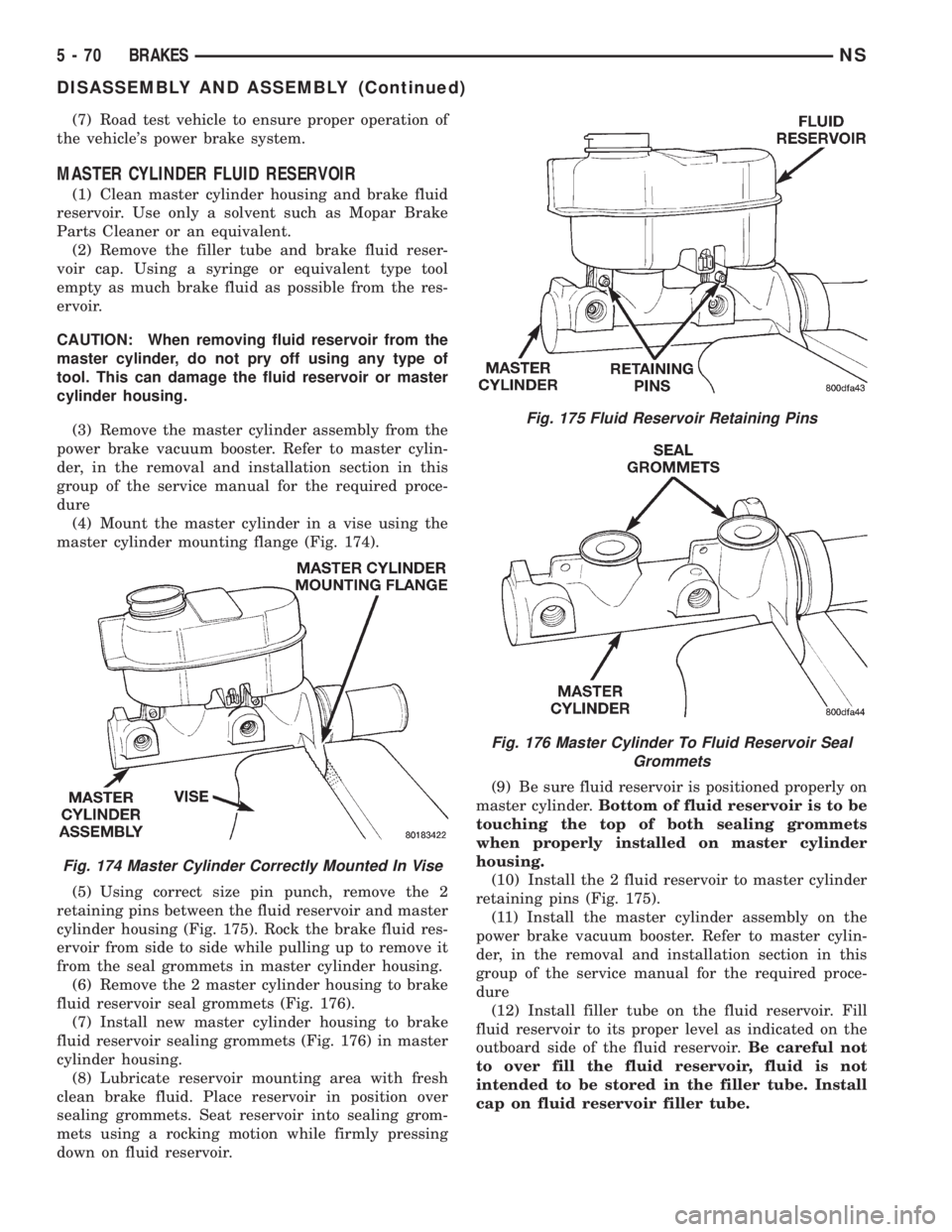
master cylinder mounting flange (Fig. 174).
(5) Using correct size pin punch, remove the 2
retaining pins between the fluid reservoir and master
cylinder housing (Fig. 175). Rock the brake fluid res-
ervoir from side to side while pulling up to remove it
from the seal grommets in master cylinder housing.
(6) Remove the 2 master cylinder housing to brake
fluid reservoir seal grommets (Fig. 176).
(7) Install new master cylinder housing to brake
fluid reservoir sealing grommets (Fig. 176) in master
cylinder housing.
(8) Lubricate reservoir mounting area with fresh
clean brake fluid. Place reservoir in position over
sealing grommets. Seat reservoir into sealing grom-
mets using a rocking motion while firmly pressing
down on fluid reservoir.(9) Be sure fluid reservoir is positioned properly on
master cylinder.Bottom of fluid reservoir is to be
touching the top of both sealing grommets
when properly installed on master cylinder
housing.
(10) Install the 2 fluid reservoir to master cylinder
retaining pins (Fig. 175).
(11) Install the master cylinder assembly on the
power brake vacuum booster. Refer to master cylin-
der, in the removal and installation section in this
group of the service manual for the required proce-
dure
(12) Install filler tube on the fluid reservoir. Fill
fluid reservoir to its proper level as indicated on the
outboard side of the fluid reservoir.Be careful not
to over fill the fluid reservoir, fluid is not
intended to be stored in the filler tube. Install
cap on fluid reservoir filler tube.
Fig. 174 Master Cylinder Correctly Mounted In Vise
Fig. 175 Fluid Reservoir Retaining Pins
Fig. 176 Master Cylinder To Fluid Reservoir Seal
Grommets
5 - 70 BRAKESNS
DISASSEMBLY AND ASSEMBLY (Continued)
Page 153 of 1938
MASTER CYLINDER FLUID RESERVOIR FILL TUBE
The master cylinder fluid reservoir filler neck is
removable from the master cylinder fluid reservoir.
The filler neck if required, can be replaced as a sep-
arate component of the fluid reservoir.
The filler neck is removed and installed using the
following procedure.
REMOVE
(1) Check brake fluid level in master cylinder fluid
reservoir to be sure brake fluid is not in the filler
neck. If brake fluid is in filler neck, lower fluid level
before removing filler neck from fluid reservoir
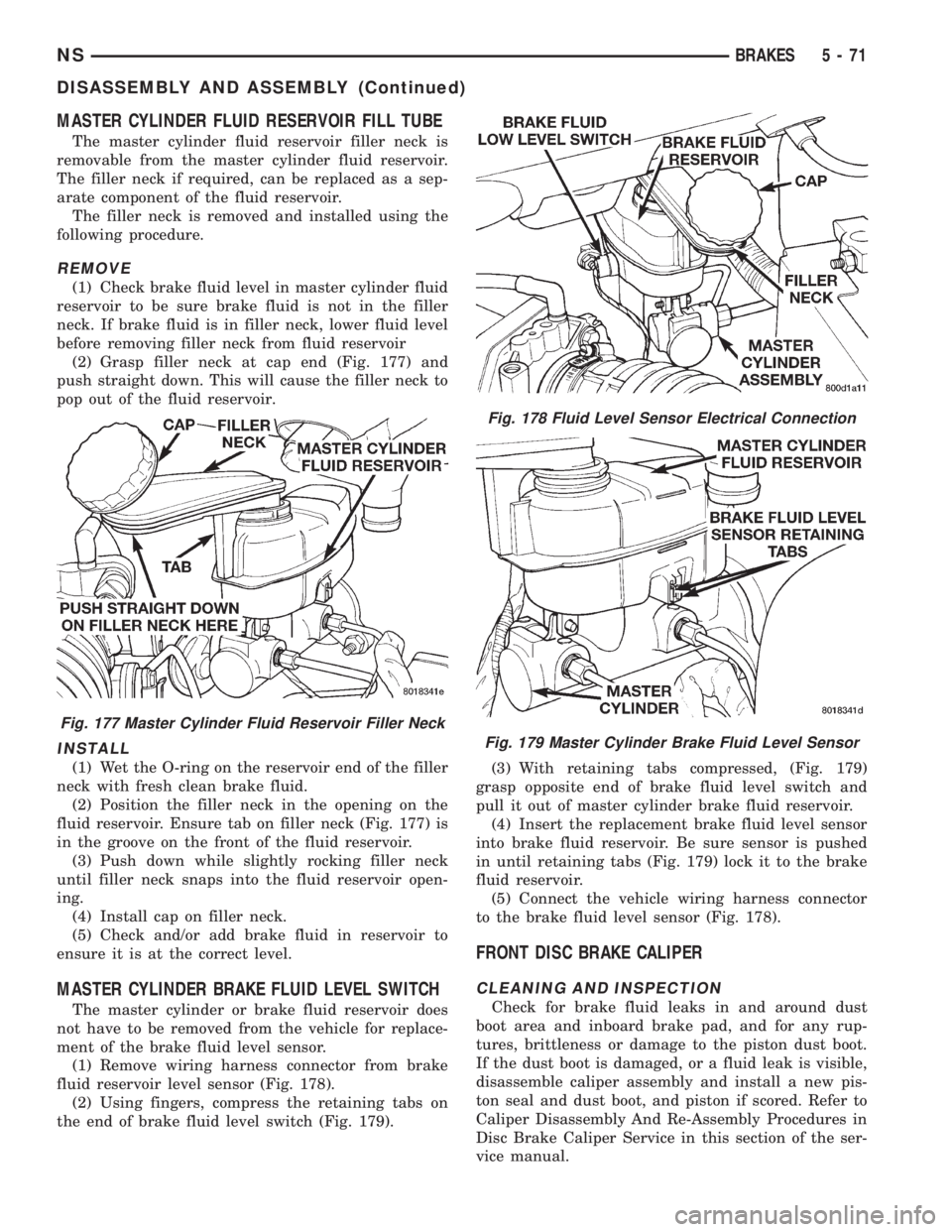
(2) Grasp filler neck at cap end (Fig. 177) and
push straight down. This will cause the filler neck to
pop out of the fluid reservoir.
INSTALL
(1) Wet the O-ring on the reservoir end of the filler
neck with fresh clean brake fluid.
(2) Position the filler neck in the opening on the
fluid reservoir. Ensure tab on filler neck (Fig. 177) is
in the groove on the front of the fluid reservoir.
(3) Push down while slightly rocking filler neck
until filler neck snaps into the fluid reservoir open-
ing.
(4) Install cap on filler neck.
(5) Check and/or add brake fluid in reservoir to
ensure it is at the correct level.
MASTER CYLINDER BRAKE FLUID LEVEL SWITCH
The master cylinder or brake fluid reservoir does
not have to be removed from the vehicle for replace-
ment of the brake fluid level sensor.
(1) Remove wiring harness connector from brake
fluid reservoir level sensor (Fig. 178).
(2) Using fingers, compress the retaining tabs on
the end of brake fluid level switch (Fig. 179).(3) With retaining tabs compressed, (Fig. 179)
grasp opposite end of brake fluid level switch and
pull it out of master cylinder brake fluid reservoir.
(4) Insert the replacement brake fluid level sensor
into brake fluid reservoir. Be sure sensor is pushed
in until retaining tabs (Fig. 179) lock it to the brake
fluid reservoir.
(5) Connect the vehicle wiring harness connector
to the brake fluid level sensor (Fig. 178).
FRONT DISC BRAKE CALIPER
CLEANING AND INSPECTION
Check for brake fluid leaks in and around dust
boot area and inboard brake pad, and for any rup-
tures, brittleness or damage to the piston dust boot.
If the dust boot is damaged, or a fluid leak is visible,
disassemble caliper assembly and install a new pis-
ton seal and dust boot, and piston if scored. Refer to
Caliper Disassembly And Re-Assembly Procedures in
Disc Brake Caliper Service in this section of the ser-
vice manual.
Fig. 177 Master Cylinder Fluid Reservoir Filler Neck
Fig. 178 Fluid Level Sensor Electrical Connection
Fig. 179 Master Cylinder Brake Fluid Level Sensor
NSBRAKES 5 - 71
DISASSEMBLY AND ASSEMBLY (Continued)
Page 154 of 1938
Check the guide pin dust boots to determine if they
are in good condition. Replace if they are damaged,
dry, or found to be brittle. Refer to Guide Pin Bush-
ing Service in Disc Brake Caliper Service in this sec-
tion of the service manual.
CALIPER GUIDE PIN BUSHING SERVICE
The double pin caliper uses a sealed for life bush-
ing and sleeve assembly. If required this assembly
can be serviced using the following procedure.
REMOVING CALIPER GUIDE PIN BUSHINGS
(1) Remove caliper from brake rotor (See Brake
Shoe Removal). Hang caliper assembly on a wire
hook away from the brake rotor.
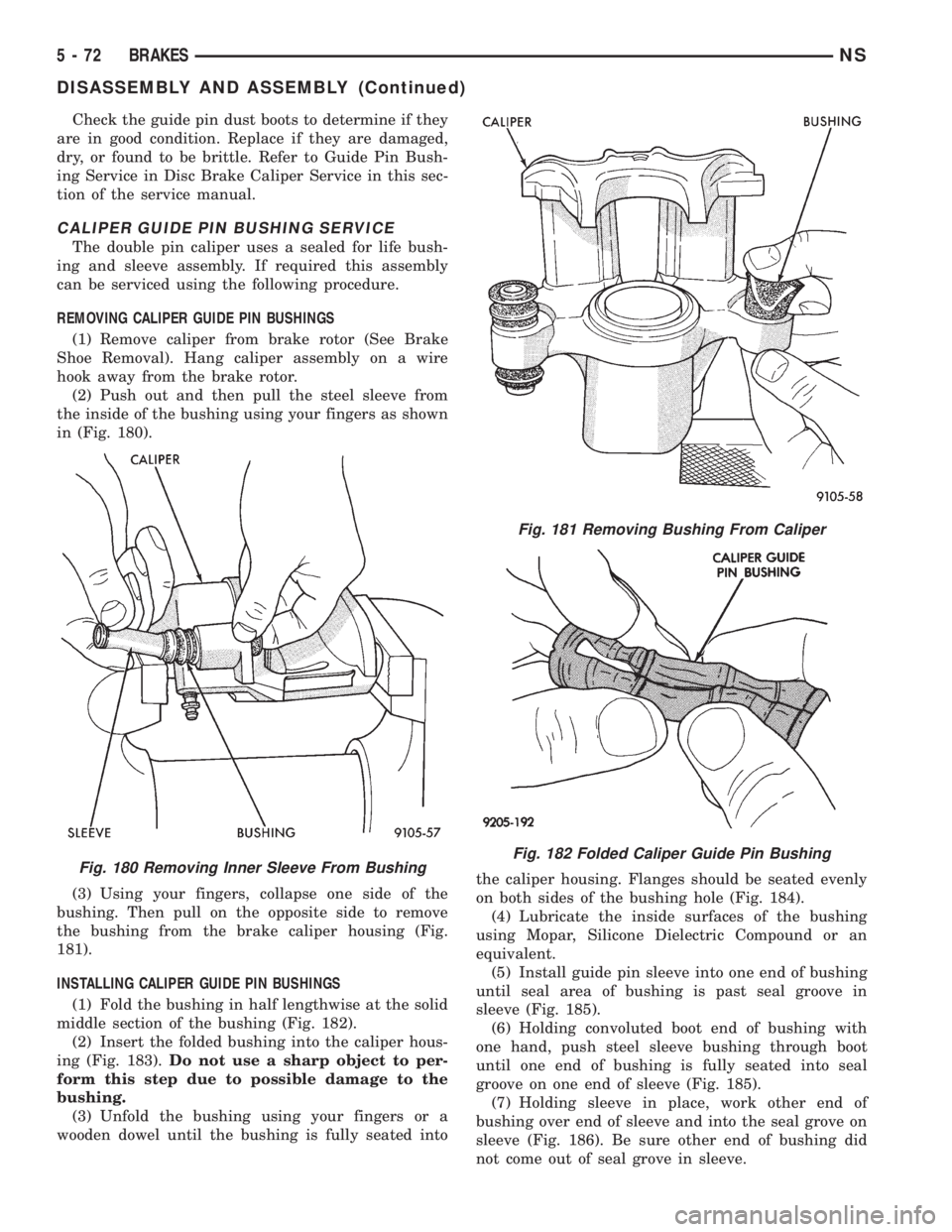
(2) Push out and then pull the steel sleeve from
the inside of the bushing using your fingers as shown
in (Fig. 180).
(3) Using your fingers, collapse one side of the
bushing. Then pull on the opposite side to remove
the bushing from the brake caliper housing (Fig.
181).
INSTALLING CALIPER GUIDE PIN BUSHINGS
(1) Fold the bushing in half lengthwise at the solid
middle section of the bushing (Fig. 182).
(2) Insert the folded bushing into the caliper hous-
ing (Fig. 183).Do not use a sharp object to per-
form this step due to possible damage to the
bushing.
(3) Unfold the bushing using your fingers or a
wooden dowel until the bushing is fully seated intothe caliper housing. Flanges should be seated evenly
on both sides of the bushing hole (Fig. 184).
(4) Lubricate the inside surfaces of the bushing
using Mopar, Silicone Dielectric Compound or an
equivalent.
(5) Install guide pin sleeve into one end of bushing
until seal area of bushing is past seal groove in
sleeve (Fig. 185).
(6) Holding convoluted boot end of bushing with
one hand, push steel sleeve bushing through boot
until one end of bushing is fully seated into seal
groove on one end of sleeve (Fig. 185).
(7) Holding sleeve in place, work other end of
bushing over end of sleeve and into the seal grove on
sleeve (Fig. 186). Be sure other end of bushing did
not come out of seal grove in sleeve.
Fig. 180 Removing Inner Sleeve From Bushing
Fig. 181 Removing Bushing From Caliper
Fig. 182 Folded Caliper Guide Pin Bushing
5 - 72 BRAKESNS
DISASSEMBLY AND ASSEMBLY (Continued)
Page 157 of 1938
(12) Inspect caliper piston for pitting, scratches, or
any physical damage. Replace piston if there is evi-
dence of scratches, pitting or physical damage.
CALIPER ASSEMBLY
CAUTION: Excessive vise pressure will cause bore
distortion and binding of piston.
(1) Clamp caliper in a vise (with protective caps
installed on jaws of vise).
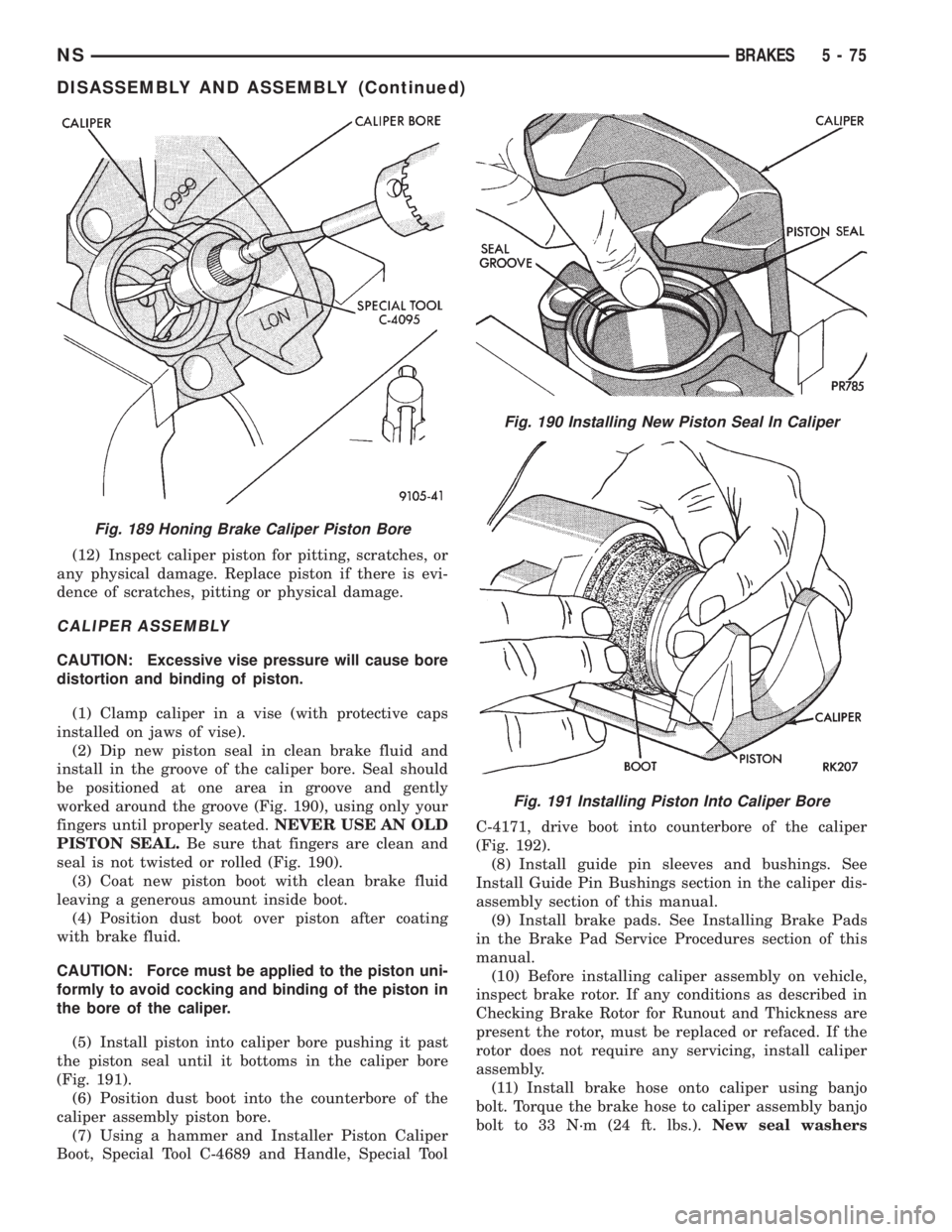
(2) Dip new piston seal in clean brake fluid and
install in the groove of the caliper bore. Seal should
be positioned at one area in groove and gently
worked around the groove (Fig. 190), using only your
fingers until properly seated.NEVER USE AN OLD
PISTON SEAL.Be sure that fingers are clean and
seal is not twisted or rolled (Fig. 190).
(3) Coat new piston boot with clean brake fluid
leaving a generous amount inside boot.
(4) Position dust boot over piston after coating
with brake fluid.
CAUTION: Force must be applied to the piston uni-
formly to avoid cocking and binding of the piston in
the bore of the caliper.
(5) Install piston into caliper bore pushing it past
the piston seal until it bottoms in the caliper bore
(Fig. 191).
(6) Position dust boot into the counterbore of the
caliper assembly piston bore.
(7) Using a hammer and Installer Piston Caliper
Boot, Special Tool C-4689 and Handle, Special ToolC-4171, drive boot into counterbore of the caliper
(Fig. 192).
(8) Install guide pin sleeves and bushings. See
Install Guide Pin Bushings section in the caliper dis-
assembly section of this manual.
(9) Install brake pads. See Installing Brake Pads
in the Brake Pad Service Procedures section of this
manual.
(10) Before installing caliper assembly on vehicle,
inspect brake rotor. If any conditions as described in
Checking Brake Rotor for Runout and Thickness are
present the rotor, must be replaced or refaced. If the
rotor does not require any servicing, install caliper
assembly.
(11) Install brake hose onto caliper using banjo
bolt. Torque the brake hose to caliper assembly banjo
bolt to 33 N´m (24 ft. lbs.).New seal washers
Fig. 189 Honing Brake Caliper Piston Bore
Fig. 190 Installing New Piston Seal In Caliper
Fig. 191 Installing Piston Into Caliper Bore
NSBRAKES 5 - 75
DISASSEMBLY AND ASSEMBLY (Continued)
Page 159 of 1938
lation section in this group of the service manual for
the required procedure.
The combined brake shoe and lining material
thickness should be measured at the thinnest part of
the assembly.
When a set of brake shoes are worn to a total
thickness of approximately 7.0 mm (9/32 inch) they
should be replaced.
Replacebothbrake shoe assemblies (inboard and
outboard). It is necessary thatbothrear wheel sets
be replaced whenever brake shoe assemblies on
either side are replaced.
If the brake shoe assemblies do not require
replacement, reinstall, the assemblies making sure
each brake shoe is returned to the original position.
Refer to Rear Disc Brake Shoe Installation in the
Removal And Installation section in this group of the
service manual for the required procedure.
CALIPER INSPECTION
Check for brake fluid leaks in and around boot
area and inboard lining, and for any ruptures, brit-
tleness or damage to the piston dust boot. If the boot
is damaged, or a fluid leak is visible, disassemble cal-
iper assembly and install a new seal and boot, and
piston if scored. Refer to Rear Disc Brake Caliper in
the Disassembly And Assembly Section in this group
of the service manual.
Check the guide pin dust boots to determine if they
are in good condition. Replace if they are damaged,
dry, or found to be brittle. Refer to Rear Disc Brake
Caliper in the Disassembly And Assembly Section in
this group of the service manual.
REAR DRUM BRAKE SHOE LINING INSPECTION
(1) Remove the tire and wheel assembly from the
vehicle
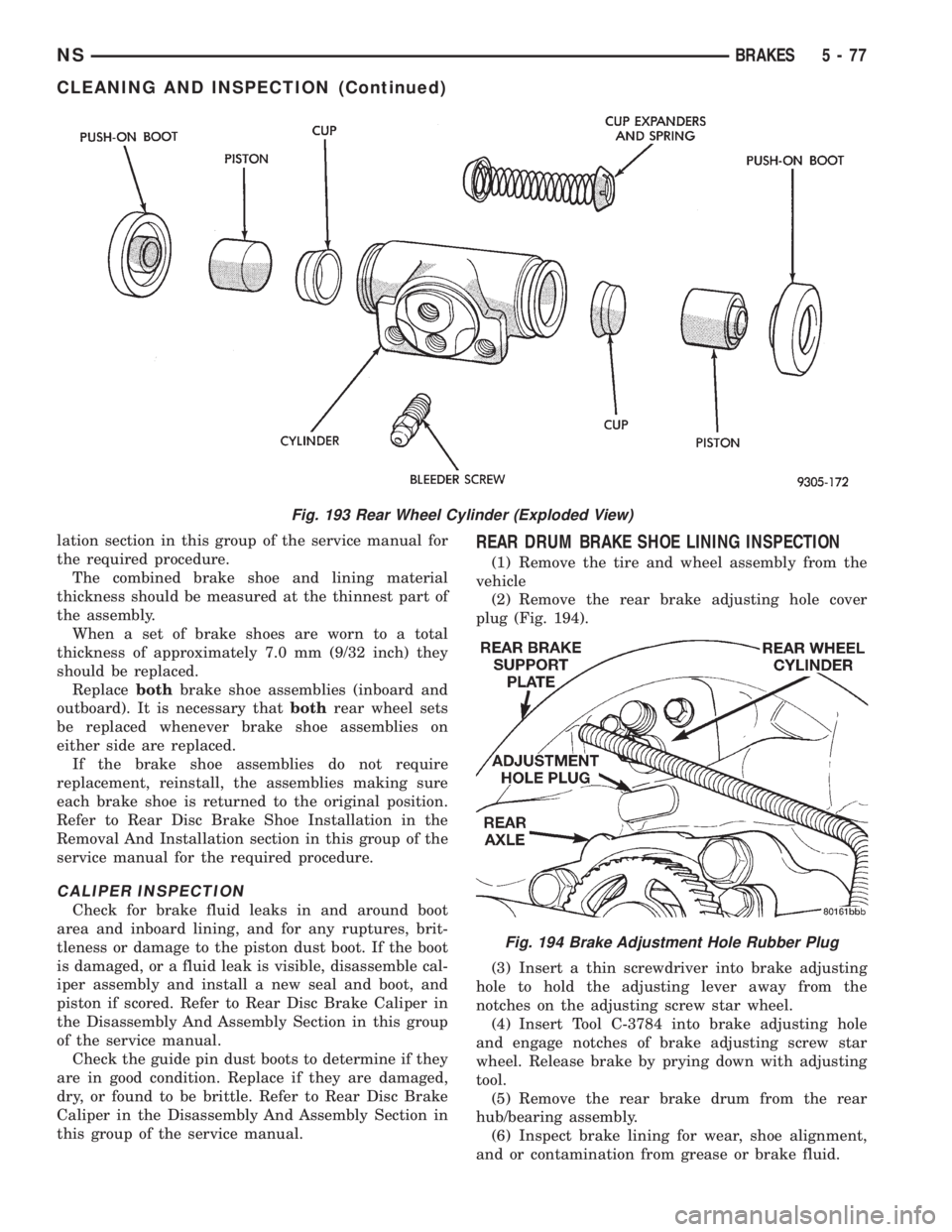
(2) Remove the rear brake adjusting hole cover
plug (Fig. 194).
(3) Insert a thin screwdriver into brake adjusting
hole to hold the adjusting lever away from the
notches on the adjusting screw star wheel.
(4) Insert Tool C-3784 into brake adjusting hole
and engage notches of brake adjusting screw star
wheel. Release brake by prying down with adjusting
tool.
(5) Remove the rear brake drum from the rear
hub/bearing assembly.
(6) Inspect brake lining for wear, shoe alignment,
and or contamination from grease or brake fluid.
Fig. 193 Rear Wheel Cylinder (Exploded View)
Fig. 194 Brake Adjustment Hole Rubber Plug
NSBRAKES 5 - 77
CLEANING AND INSPECTION (Continued)
Page 160 of 1938
REAR DRUM BRAKE WHEEL CYLINDER
With brake drums removed, inspect the wheel cyl-
inder boots for evidence of a brake fluid leak. Visu-
ally check the boots for cuts, tears, or heat cracks. If
any of these conditions exist, the wheel cylinders
should be completely cleaned, inspected and new
parts installed.
If a wheel cylinder is leaking and the brake lining
material is saturated with brake fluid, the brake
shoes must be replaced.
BRAKE HOSE AND BRAKE LINES INSPECTION
Flexible rubber hose is used at both front brakes
and at the rear axle. Inspection of brake hoses
should be performed whenever the brake system is
serviced and every 7,500 miles or 12 months, which-
ever comes first (every engine oil change). Inspect
hydraulic brake hoses for surface cracking, scuffing,
or worn spots. If the fabric casing of the rubber hose
becomes exposed due to cracks or abrasions in the
rubber hose cover, the hose should be replaced imme-
diately. Eventual deterioration of the hose can take
place with possible burst failure. Faulty installation
can cause twisting, resulting in wheel, tire, or chassis
interference.
The steel brake tubing should be inspected period-
ically for evidence of physical damage or contact with
moving or hot components.
The flexible brake tube sections used on this vehi-
cle in the primary and secondary tubes from the
master cylinder to the ABS hydraulic control unit
connections and the chassis brake tubes between the
hydraulic control unit and the proportioning valve
must also be inspected. This flexible tubing must be
inspected for kinks, fraying and its contact with
other components of the vehicle or contact with the
body of the vehicle.
REAR WHEEL HUB AND BEARING ASSEMBLY
The rear hub and bearing assembly is designed for
the life of the vehicle and should require no mainte-
nance. The following procedure may be used for eval-
uation of bearing condition.
With wheel and brake drum removed, rotate
flanged outer ring of hub. Excessive roughness, lat-
eral play or resistance to rotation may indicate dirt
intrusion or bearing failure. If the rear wheel bear-
ings exhibit these conditions during inspection, the
hub and bearing assembly should be replaced.
Damaged bearing seals and resulting excessive
grease loss may also require bearing replacement.
Moderate grease loss from bearing is considered nor-
mal and should not require replacement of the hub
and bearing assembly.
ADJUSTMENTS
STOP LAMP SWITCH
(1) Remove stop lamp switch from its bracket by
rotating it approximately 30É in a counter-clockwise
direction.
(2) Disconnect wiring harness connector from stop
lamp switch.
(3) Hold stop lamp switch firmly in one hand.
Then using other hand, pull outward on the plunger
of the stop lamp switch until it has ratcheted out to
its fully extended position.
(4) Install the stop lamp switch into the bracket
using the following procedure. Depress the brake
pedal as far down as possible. Then while keeping
the brake pedal depressed, install the stop lamp
switch into the bracket by aligning index key on
switch with slot at top of square hole in mounting
bracket. When switch is fully installed in the square
hole of the bracket, rotate switch clockwise approxi-
mately 30É to lock the switch into the bracket.
CAUTION: Do not use excessive force when pulling
back on brake pedal to adjust the stop lamp switch.
If too much force is used, damage to the vacuum
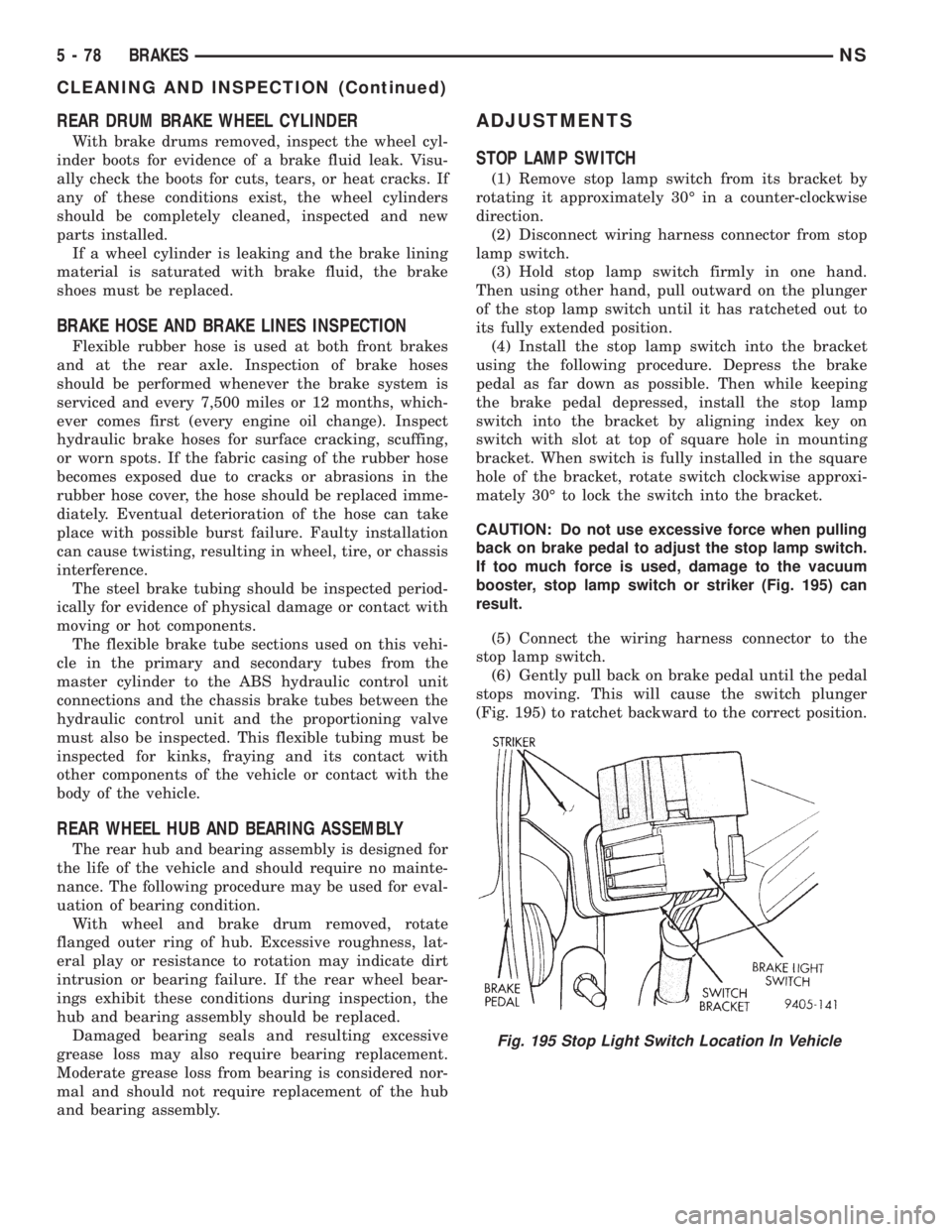
booster, stop lamp switch or striker (Fig. 195) can
result.
(5) Connect the wiring harness connector to the
stop lamp switch.
(6) Gently pull back on brake pedal until the pedal
stops moving. This will cause the switch plunger
(Fig. 195) to ratchet backward to the correct position.
Fig. 195 Stop Light Switch Location In Vehicle
5 - 78 BRAKESNS
CLEANING AND INSPECTION (Continued)