service CHRYSLER VOYAGER 1996 Workshop Manual
[x] Cancel search | Manufacturer: CHRYSLER, Model Year: 1996, Model line: VOYAGER, Model: CHRYSLER VOYAGER 1996Pages: 1938, PDF Size: 55.84 MB
Page 88 of 1938
FIXED PROPORTIONING VALVE OPERATION
The fixed proportioning valve is made out of alumi-
num and has an integral mounting bracket. The
fixed proportioning valve is non-serviceable compo-
nent and must be replaced as an assembly if found to
be functioning improperly.
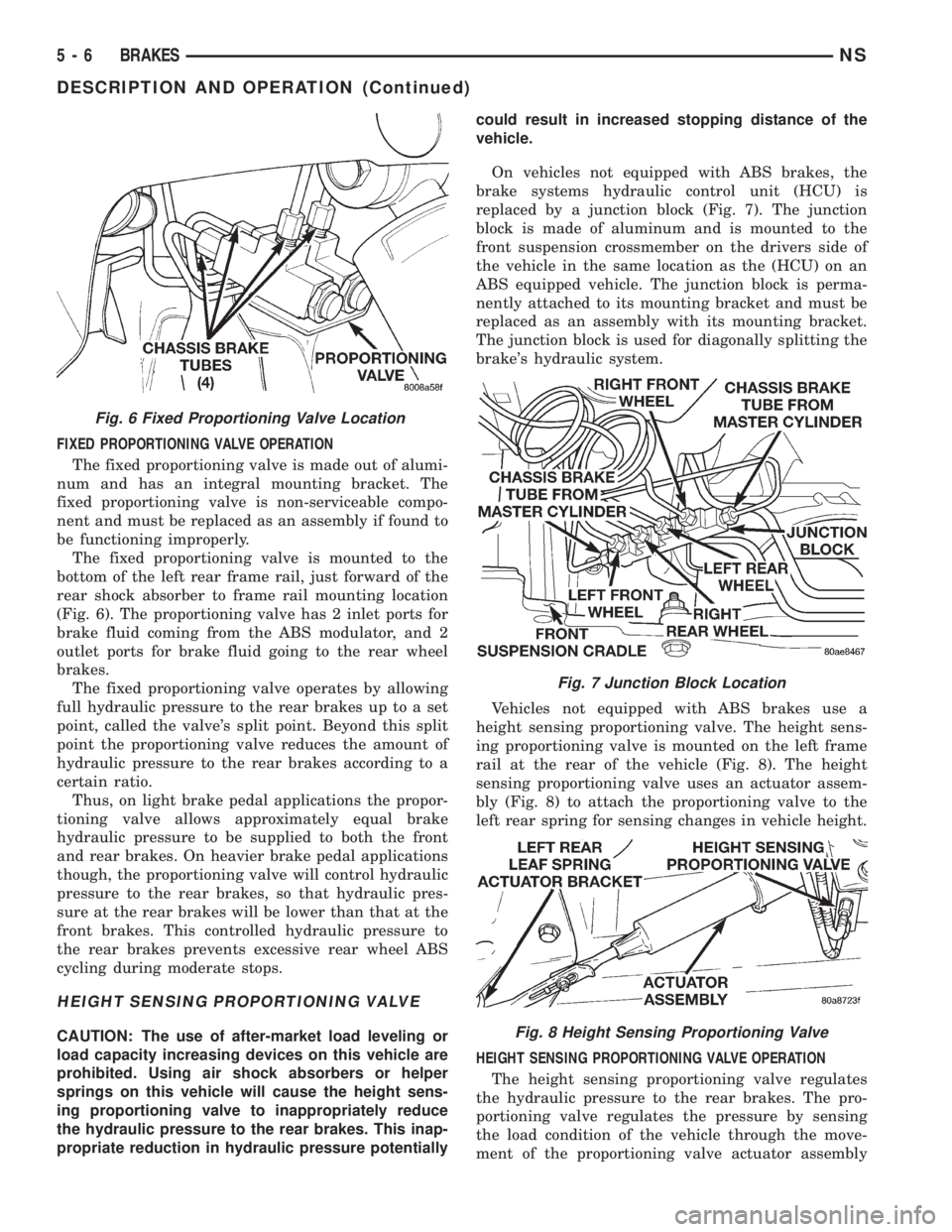
The fixed proportioning valve is mounted to the
bottom of the left rear frame rail, just forward of the
rear shock absorber to frame rail mounting location
(Fig. 6). The proportioning valve has 2 inlet ports for
brake fluid coming from the ABS modulator, and 2
outlet ports for brake fluid going to the rear wheel
brakes.
The fixed proportioning valve operates by allowing
full hydraulic pressure to the rear brakes up to a set
point, called the valve's split point. Beyond this split
point the proportioning valve reduces the amount of
hydraulic pressure to the rear brakes according to a
certain ratio.
Thus, on light brake pedal applications the propor-
tioning valve allows approximately equal brake
hydraulic pressure to be supplied to both the front
and rear brakes. On heavier brake pedal applications
though, the proportioning valve will control hydraulic
pressure to the rear brakes, so that hydraulic pres-
sure at the rear brakes will be lower than that at the
front brakes. This controlled hydraulic pressure to
the rear brakes prevents excessive rear wheel ABS
cycling during moderate stops.
HEIGHT SENSING PROPORTIONING VALVE
CAUTION: The use of after-market load leveling or
load capacity increasing devices on this vehicle are
prohibited. Using air shock absorbers or helper
springs on this vehicle will cause the height sens-
ing proportioning valve to inappropriately reduce
the hydraulic pressure to the rear brakes. This inap-
propriate reduction in hydraulic pressure potentiallycould result in increased stopping distance of the
vehicle.
On vehicles not equipped with ABS brakes, the
brake systems hydraulic control unit (HCU) is
replaced by a junction block (Fig. 7). The junction
block is made of aluminum and is mounted to the
front suspension crossmember on the drivers side of
the vehicle in the same location as the (HCU) on an
ABS equipped vehicle. The junction block is perma-
nently attached to its mounting bracket and must be
replaced as an assembly with its mounting bracket.
The junction block is used for diagonally splitting the
brake's hydraulic system.
Vehicles not equipped with ABS brakes use a
height sensing proportioning valve. The height sens-
ing proportioning valve is mounted on the left frame
rail at the rear of the vehicle (Fig. 8). The height
sensing proportioning valve uses an actuator assem-
bly (Fig. 8) to attach the proportioning valve to the
left rear spring for sensing changes in vehicle height.
HEIGHT SENSING PROPORTIONING VALVE OPERATION
The height sensing proportioning valve regulates
the hydraulic pressure to the rear brakes. The pro-
portioning valve regulates the pressure by sensing
the load condition of the vehicle through the move-
ment of the proportioning valve actuator assembly
Fig. 6 Fixed Proportioning Valve Location
Fig. 7 Junction Block Location
Fig. 8 Height Sensing Proportioning Valve
5 - 6 BRAKESNS
DESCRIPTION AND OPERATION (Continued)
Page 91 of 1938

normal. This may indicate:(1)Abnormal loss of
brake fluid in the master cylinder fluid reservoir
resulting from a leak in the hydraulic system.(2)
Brake shoe linings which have worn to a point
requiring replacement.
As the brake fluid drops below the minimum level,
the brake fluid level sensor closes to ground the
brake warning light circuit. This will turn on the red
brake warning light. At this time, master cylinder
fluid reservoir should be checked and filled to the full
mark with DOT 3 brake fluid.If brake fluid level
has dropped below the add line in the master
cylinder fluid reservoir, the entire brake
hydraulic system should be checked for evi-
dence of a leak.
STOP LAMP SWITCH
The stop lamp switch controls operation of the
vehicles stop lamps. Also, if the vehicle is equippedwith speed control, the stop lamp switch will deacti-
vate speed control when the brake pedal is
depressed.
The stop lamp switch controls operation of the
right and left tail, stop and turn signal lamp and
CHMSL lamp, by supplying battery current to these
lamps.
The stop lamp switch controls the lamp operation
by opening and closing the electrical circuit to the
stop lamps.
HUB/BEARING REAR WHEEL
The rear hub and bearing assembly used on this
vehicle is serviceable only as a complete assembly. No
attempt should be made to disassemble a rear hub
and bearing assembly in an effort to repair it.
The rear hub and bearing assembly is attached to
the rear axle using 4 mounting bolts that are remov-
able from the back of the rear hub/bearing.
DIAGNOSIS AND TESTING
BRAKE SYSTEM BASIC DIAGNOSIS GUIDE
SYMPTOMCHART 1
MISC.
COND.CHART 2
WARNING
LIGHTCHART 3
POWER
BRAKESCHART 4
BRAKE
NOISECHART 5
WHEEL
BRAKES
Brake Warning Light On X NO NO
Excessive Pedal Travel 6 X NO O
Pedal Goes To The Floor 6 X
Stop Light On Without Brakes 3
All Brakes Drag 5
Rear Brakes Drag 2 NO NO
Grabby Brakes O X
Spongy Brake Pedal X NO
Premature Rear Brake Lockup 4 NO NO O
Excessive Pedal Effort 1 O
Rough Engine Idle NO O
Brake Chatter (Rough) NO NO X
Surge During Braking NO NO X
Noise During Braking NO NO X
Rattle Or Clunking Noise NO NO X
Pedal Pulsates During Braking NO NO X
Pull To Right Or Left NO NO X
No: Not A Possible Cause X: Most Likely Cause O: Possible Cause
NSBRAKES 5 - 9
DESCRIPTION AND OPERATION (Continued)
Page 96 of 1938
ADJUSTER REAR DRUM BRAKE (AUTOMATIC)
The rear drum brakes on this vehicle automatically
adjust, when required, during the normal operation
of the vehicle every time the brakes are applied. Use
the following procedure to test the operation of the
automatic adjuster.
Place the vehicle on a hoist with a helper in the
driver's seat to apply the brakes. Remove the access
plug from the adjustment hole in each brake support
plate to provide visual access of the brake adjuster
star wheel.
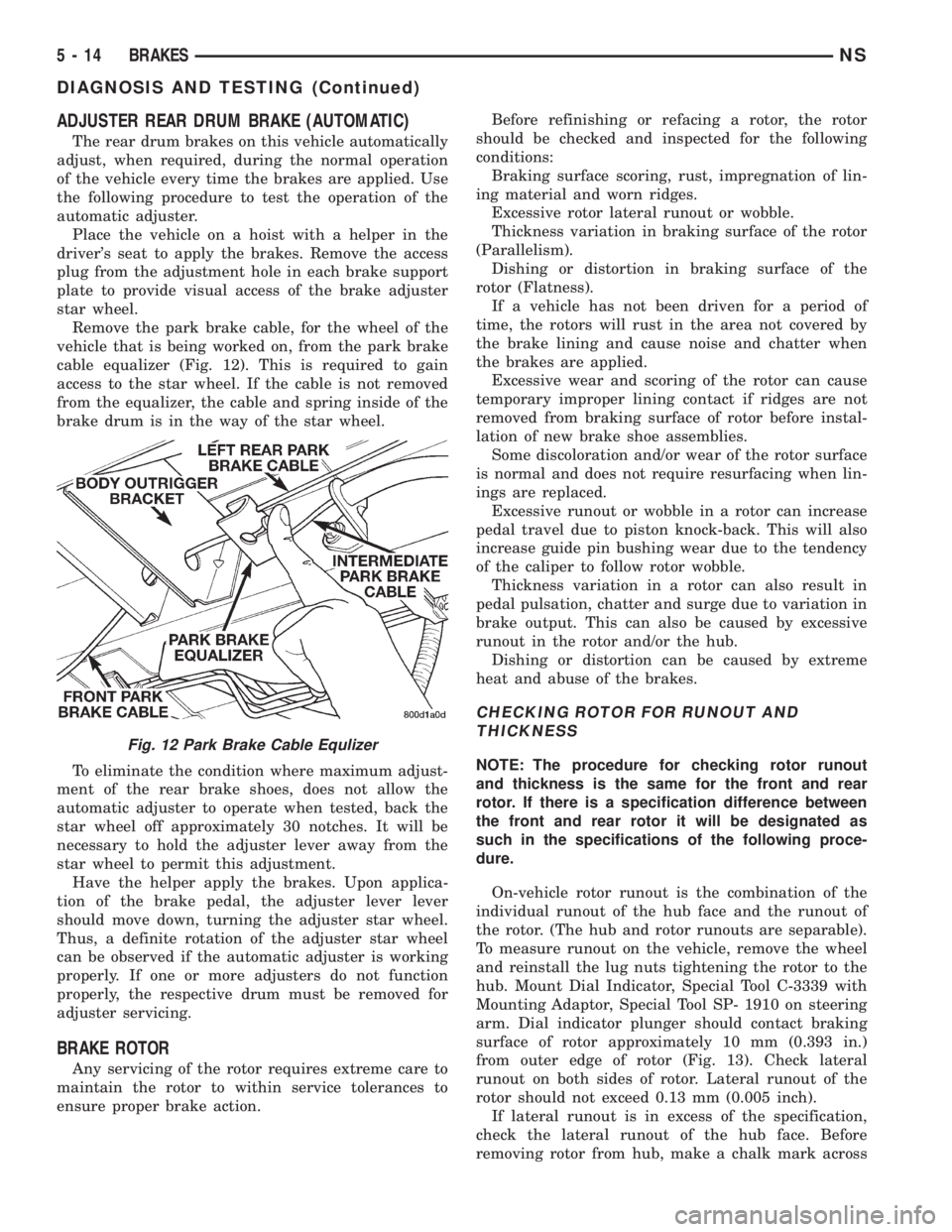
Remove the park brake cable, for the wheel of the
vehicle that is being worked on, from the park brake
cable equalizer (Fig. 12). This is required to gain
access to the star wheel. If the cable is not removed
from the equalizer, the cable and spring inside of the
brake drum is in the way of the star wheel.
To eliminate the condition where maximum adjust-
ment of the rear brake shoes, does not allow the
automatic adjuster to operate when tested, back the
star wheel off approximately 30 notches. It will be
necessary to hold the adjuster lever away from the
star wheel to permit this adjustment.
Have the helper apply the brakes. Upon applica-
tion of the brake pedal, the adjuster lever lever
should move down, turning the adjuster star wheel.
Thus, a definite rotation of the adjuster star wheel
can be observed if the automatic adjuster is working
properly. If one or more adjusters do not function
properly, the respective drum must be removed for
adjuster servicing.
BRAKE ROTOR
Any servicing of the rotor requires extreme care to
maintain the rotor to within service tolerances to
ensure proper brake action.Before refinishing or refacing a rotor, the rotor
should be checked and inspected for the following
conditions:
Braking surface scoring, rust, impregnation of lin-
ing material and worn ridges.
Excessive rotor lateral runout or wobble.
Thickness variation in braking surface of the rotor
(Parallelism).
Dishing or distortion in braking surface of the
rotor (Flatness).
If a vehicle has not been driven for a period of
time, the rotors will rust in the area not covered by
the brake lining and cause noise and chatter when
the brakes are applied.
Excessive wear and scoring of the rotor can cause
temporary improper lining contact if ridges are not
removed from braking surface of rotor before instal-
lation of new brake shoe assemblies.
Some discoloration and/or wear of the rotor surface
is normal and does not require resurfacing when lin-
ings are replaced.
Excessive runout or wobble in a rotor can increase
pedal travel due to piston knock-back. This will also
increase guide pin bushing wear due to the tendency
of the caliper to follow rotor wobble.
Thickness variation in a rotor can also result in
pedal pulsation, chatter and surge due to variation in
brake output. This can also be caused by excessive
runout in the rotor and/or the hub.
Dishing or distortion can be caused by extreme
heat and abuse of the brakes.
CHECKING ROTOR FOR RUNOUT AND
THICKNESS
NOTE: The procedure for checking rotor runout
and thickness is the same for the front and rear
rotor. If there is a specification difference between
the front and rear rotor it will be designated as
such in the specifications of the following proce-
dure.
On-vehicle rotor runout is the combination of the
individual runout of the hub face and the runout of
the rotor. (The hub and rotor runouts are separable).
To measure runout on the vehicle, remove the wheel
and reinstall the lug nuts tightening the rotor to the
hub. Mount Dial Indicator, Special Tool C-3339 with
Mounting Adaptor, Special Tool SP- 1910 on steering
arm. Dial indicator plunger should contact braking
surface of rotor approximately 10 mm (0.393 in.)
from outer edge of rotor (Fig. 13). Check lateral
runout on both sides of rotor. Lateral runout of the
rotor should not exceed 0.13 mm (0.005 inch).
If lateral runout is in excess of the specification,
check the lateral runout of the hub face. Before
removing rotor from hub, make a chalk mark across
Fig. 12 Park Brake Cable Equlizer
5 - 14 BRAKESNS
DIAGNOSIS AND TESTING (Continued)
Page 100 of 1938
shoe assemblies meeting the OEM lining mate-
rial specification. The vehicles brake system is
not balanced for after market brake shoe
assembly lining material.
If both front and rear brakes check OK, proceed to
verify that the actuator assembly for the height sens-
ing proportioning valve is adjusted correctly. See
Height Sensing Proportioning Valve in the Adjust-
ment Section in this group of the service manual for
the adjustment procedure. If the proportioning valve
is adjusted correctly, proceed with the test procedure
for the height sensing proportioning valve as follows:
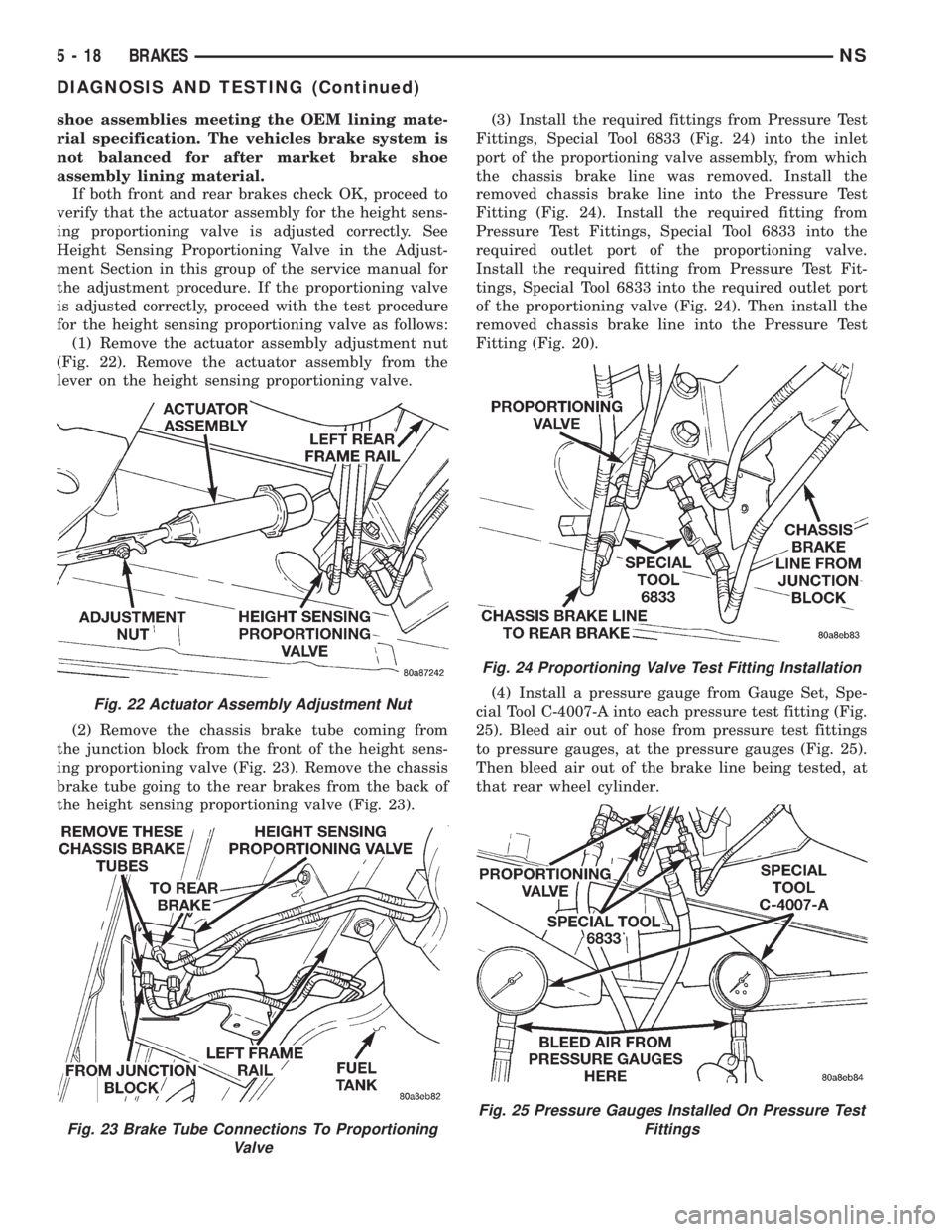
(1) Remove the actuator assembly adjustment nut
(Fig. 22). Remove the actuator assembly from the
lever on the height sensing proportioning valve.
(2) Remove the chassis brake tube coming from
the junction block from the front of the height sens-
ing proportioning valve (Fig. 23). Remove the chassis
brake tube going to the rear brakes from the back of
the height sensing proportioning valve (Fig. 23).(3) Install the required fittings from Pressure Test
Fittings, Special Tool 6833 (Fig. 24) into the inlet
port of the proportioning valve assembly, from which
the chassis brake line was removed. Install the
removed chassis brake line into the Pressure Test
Fitting (Fig. 24). Install the required fitting from
Pressure Test Fittings, Special Tool 6833 into the
required outlet port of the proportioning valve.
Install the required fitting from Pressure Test Fit-
tings, Special Tool 6833 into the required outlet port
of the proportioning valve (Fig. 24). Then install the
removed chassis brake line into the Pressure Test
Fitting (Fig. 20).
(4) Install a pressure gauge from Gauge Set, Spe-
cial Tool C-4007-A into each pressure test fitting (Fig.
25). Bleed air out of hose from pressure test fittings
to pressure gauges, at the pressure gauges (Fig. 25).
Then bleed air out of the brake line being tested, at
that rear wheel cylinder.
Fig. 22 Actuator Assembly Adjustment Nut
Fig. 23 Brake Tube Connections To Proportioning
Valve
Fig. 24 Proportioning Valve Test Fitting Installation
Fig. 25 Pressure Gauges Installed On Pressure Test
Fittings
5 - 18 BRAKESNS
DIAGNOSIS AND TESTING (Continued)
Page 101 of 1938
(5) With the aid of a helper, apply pressure to the
brake pedal until a pressure of 6895 kPa (1000 psi) is
obtained on the proportioning valve inlet gauge.
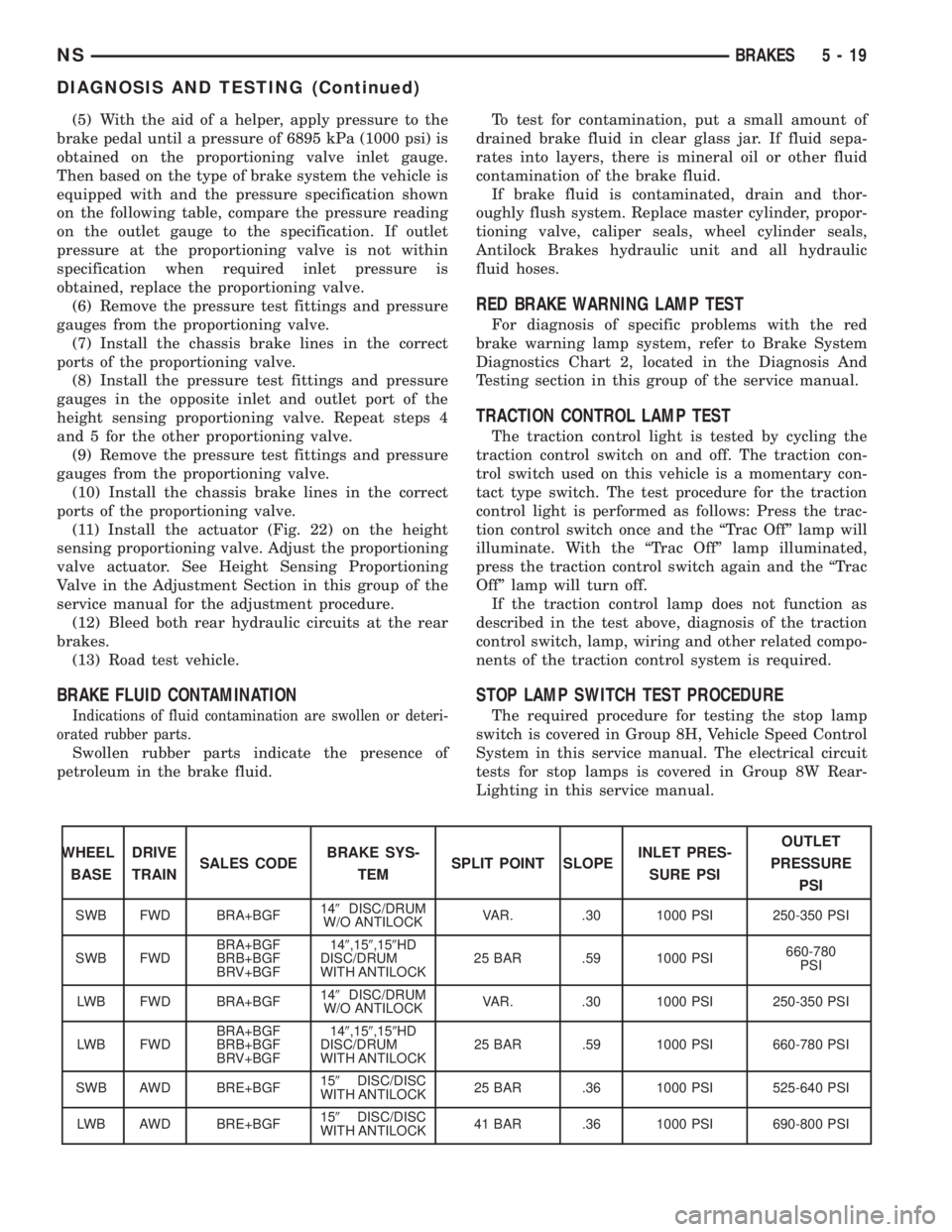
Then based on the type of brake system the vehicle is
equipped with and the pressure specification shown
on the following table, compare the pressure reading
on the outlet gauge to the specification. If outlet
pressure at the proportioning valve is not within
specification when required inlet pressure is
obtained, replace the proportioning valve.
(6) Remove the pressure test fittings and pressure
gauges from the proportioning valve.
(7) Install the chassis brake lines in the correct
ports of the proportioning valve.
(8) Install the pressure test fittings and pressure
gauges in the opposite inlet and outlet port of the
height sensing proportioning valve. Repeat steps 4
and 5 for the other proportioning valve.
(9) Remove the pressure test fittings and pressure
gauges from the proportioning valve.
(10) Install the chassis brake lines in the correct
ports of the proportioning valve.
(11) Install the actuator (Fig. 22) on the height
sensing proportioning valve. Adjust the proportioning
valve actuator. See Height Sensing Proportioning
Valve in the Adjustment Section in this group of the
service manual for the adjustment procedure.
(12) Bleed both rear hydraulic circuits at the rear
brakes.
(13) Road test vehicle.
BRAKE FLUID CONTAMINATION
Indications of fluid contamination are swollen or deteri-
orated rubber parts.
Swollen rubber parts indicate the presence of
petroleum in the brake fluid.To test for contamination, put a small amount of
drained brake fluid in clear glass jar. If fluid sepa-
rates into layers, there is mineral oil or other fluid
contamination of the brake fluid.
If brake fluid is contaminated, drain and thor-
oughly flush system. Replace master cylinder, propor-
tioning valve, caliper seals, wheel cylinder seals,
Antilock Brakes hydraulic unit and all hydraulic
fluid hoses.
RED BRAKE WARNING LAMP TEST
For diagnosis of specific problems with the red
brake warning lamp system, refer to Brake System
Diagnostics Chart 2, located in the Diagnosis And
Testing section in this group of the service manual.
TRACTION CONTROL LAMP TEST
The traction control light is tested by cycling the
traction control switch on and off. The traction con-
trol switch used on this vehicle is a momentary con-
tact type switch. The test procedure for the traction
control light is performed as follows: Press the trac-
tion control switch once and the ªTrac Offº lamp will
illuminate. With the ªTrac Offº lamp illuminated,
press the traction control switch again and the ªTrac
Offº lamp will turn off.
If the traction control lamp does not function as
described in the test above, diagnosis of the traction
control switch, lamp, wiring and other related compo-
nents of the traction control system is required.
STOP LAMP SWITCH TEST PROCEDURE
The required procedure for testing the stop lamp
switch is covered in Group 8H, Vehicle Speed Control
System in this service manual. The electrical circuit
tests for stop lamps is covered in Group 8W Rear-
Lighting in this service manual.
WHEEL
BASEDRIVE
TRAINSALES CODEBRAKE SYS-
TEMSPLIT POINT SLOPEINLET PRES-
SURE PSIOUTLET
PRESSURE
PSI
SWB FWD BRA+BGF149DISC/DRUM
W/O ANTILOCKVAR. .30 1000 PSI 250-350 PSI
SWB FWDBRA+BGF
BRB+BGF
BRV+BGF149,159,159HD
DISC/DRUM
WITH ANTILOCK25 BAR .59 1000 PSI660-780
PSI
LWB FWD BRA+BGF149DISC/DRUM
W/O ANTILOCKVAR. .30 1000 PSI 250-350 PSI
LWB FWDBRA+BGF
BRB+BGF
BRV+BGF149,159,159HD
DISC/DRUM
WITH ANTILOCK25 BAR .59 1000 PSI 660-780 PSI
SWB AWD BRE+BGF159DISC/DISC
WITH ANTILOCK25 BAR .36 1000 PSI 525-640 PSI
LWB AWD BRE+BGF159DISC/DISC
WITH ANTILOCK41 BAR .36 1000 PSI 690-800 PSI
NSBRAKES 5 - 19
DIAGNOSIS AND TESTING (Continued)
Page 102 of 1938
SERVICE PROCEDURES
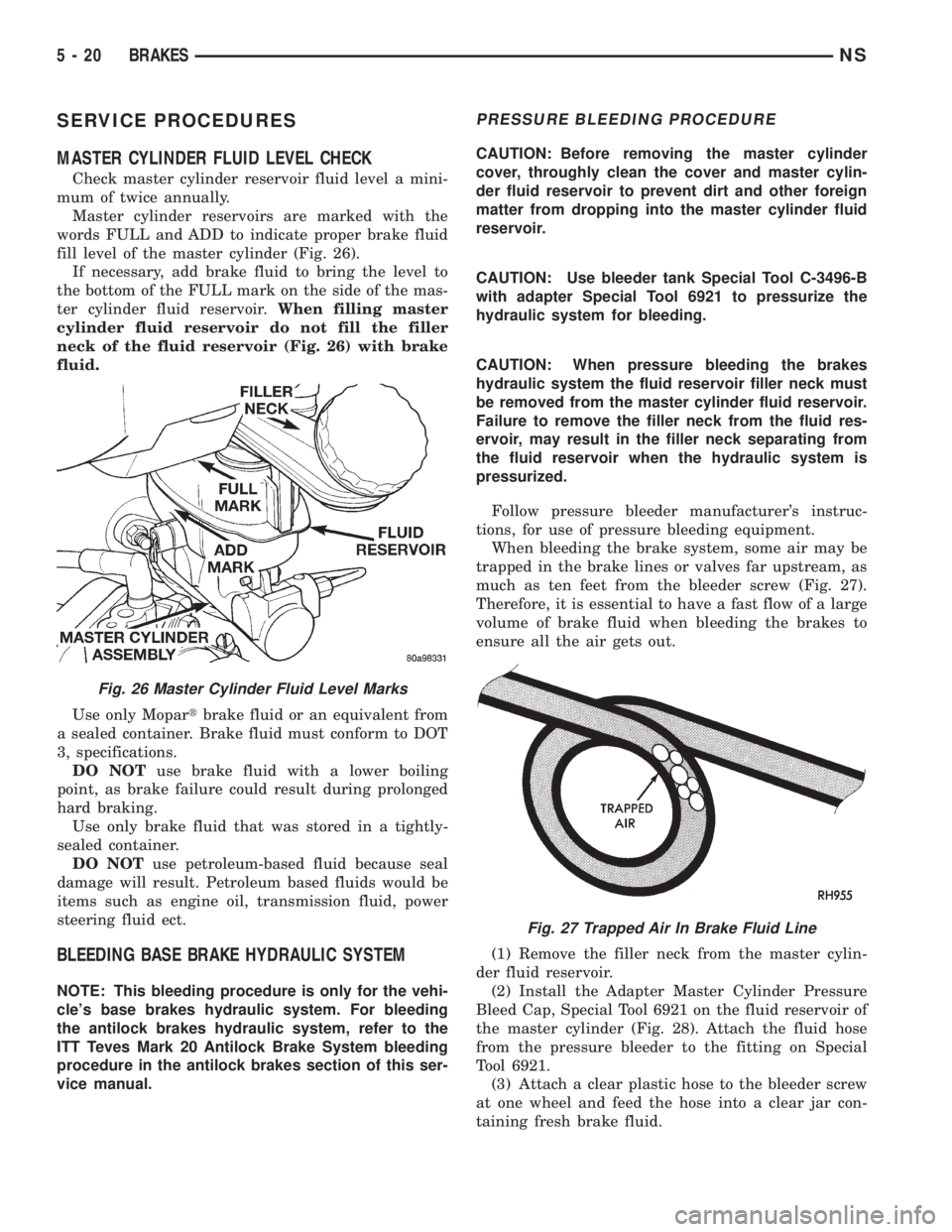
MASTER CYLINDER FLUID LEVEL CHECK
Check master cylinder reservoir fluid level a mini-
mum of twice annually.
Master cylinder reservoirs are marked with the
words FULL and ADD to indicate proper brake fluid
fill level of the master cylinder (Fig. 26).
If necessary, add brake fluid to bring the level to
the bottom of the FULL mark on the side of the mas-
ter cylinder fluid reservoir.When filling master
cylinder fluid reservoir do not fill the filler
neck of the fluid reservoir (Fig. 26) with brake
fluid.
Use only Mopartbrake fluid or an equivalent from
a sealed container. Brake fluid must conform to DOT
3, specifications.
DO NOTuse brake fluid with a lower boiling
point, as brake failure could result during prolonged
hard braking.
Use only brake fluid that was stored in a tightly-
sealed container.
DO NOTuse petroleum-based fluid because seal
damage will result. Petroleum based fluids would be
items such as engine oil, transmission fluid, power
steering fluid ect.
BLEEDING BASE BRAKE HYDRAULIC SYSTEM
NOTE: This bleeding procedure is only for the vehi-
cle's base brakes hydraulic system. For bleeding
the antilock brakes hydraulic system, refer to the
ITT Teves Mark 20 Antilock Brake System bleeding
procedure in the antilock brakes section of this ser-
vice manual.
PRESSURE BLEEDING PROCEDURE
CAUTION: Before removing the master cylinder
cover, throughly clean the cover and master cylin-
der fluid reservoir to prevent dirt and other foreign
matter from dropping into the master cylinder fluid
reservoir.
CAUTION: Use bleeder tank Special Tool C-3496-B
with adapter Special Tool 6921 to pressurize the
hydraulic system for bleeding.
CAUTION: When pressure bleeding the brakes
hydraulic system the fluid reservoir filler neck must
be removed from the master cylinder fluid reservoir.
Failure to remove the filler neck from the fluid res-
ervoir, may result in the filler neck separating from
the fluid reservoir when the hydraulic system is
pressurized.
Follow pressure bleeder manufacturer's instruc-
tions, for use of pressure bleeding equipment.
When bleeding the brake system, some air may be
trapped in the brake lines or valves far upstream, as
much as ten feet from the bleeder screw (Fig. 27).
Therefore, it is essential to have a fast flow of a large
volume of brake fluid when bleeding the brakes to
ensure all the air gets out.
(1) Remove the filler neck from the master cylin-
der fluid reservoir.
(2) Install the Adapter Master Cylinder Pressure
Bleed Cap, Special Tool 6921 on the fluid reservoir of
the master cylinder (Fig. 28). Attach the fluid hose
from the pressure bleeder to the fitting on Special
Tool 6921.
(3) Attach a clear plastic hose to the bleeder screw
at one wheel and feed the hose into a clear jar con-
taining fresh brake fluid.
Fig. 26 Master Cylinder Fluid Level Marks
Fig. 27 Trapped Air In Brake Fluid Line
5 - 20 BRAKESNS
Page 103 of 1938
NOTE: The following wheel sequence should be
used when bleeding the brake hydraulic system.
The use of this wheel sequence will ensure ade-
quate removal of all trapped air from the brake
hydraulic system.
²Left Rear Wheel
²Right Front Wheel
²Right Rear Wheel
²Left Front Wheel
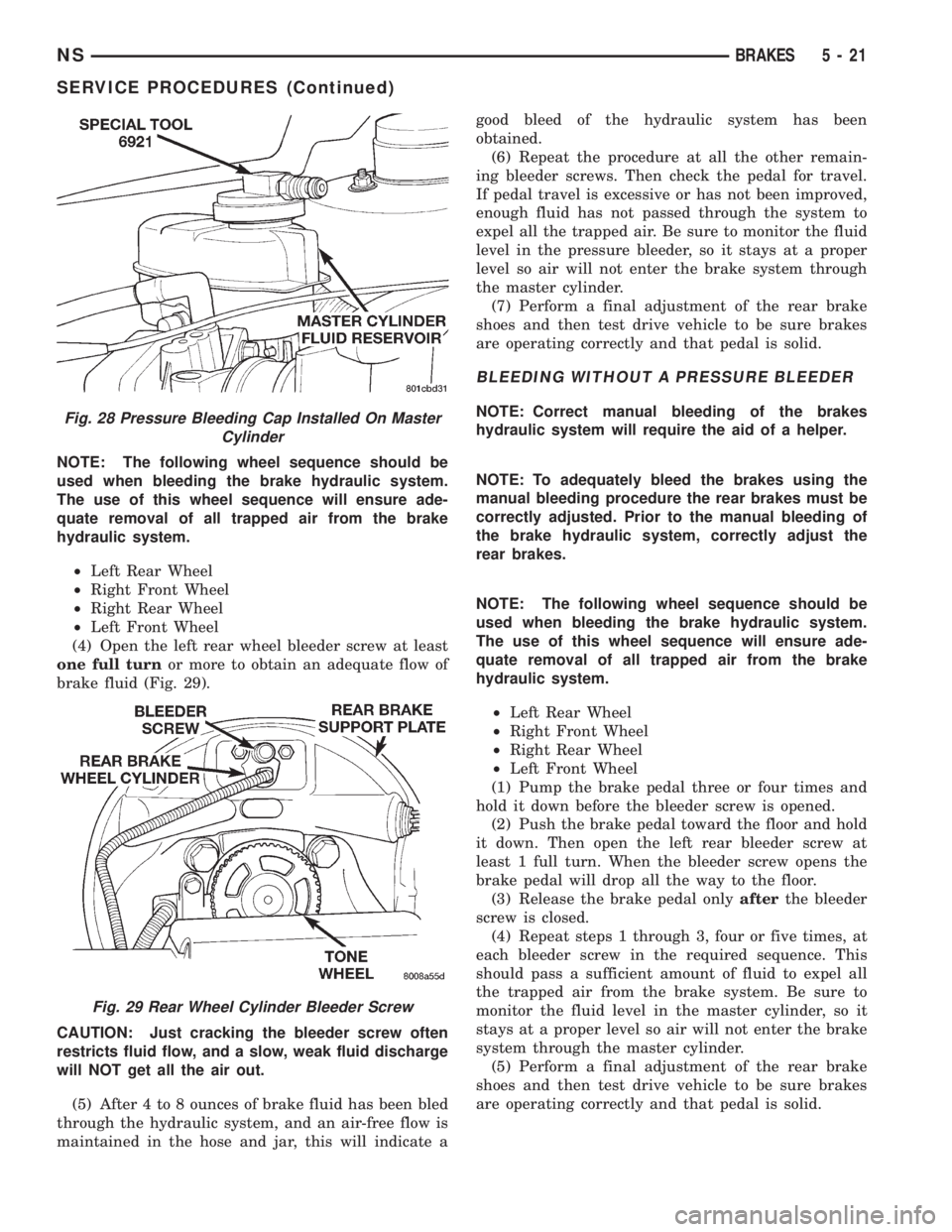
(4) Open the left rear wheel bleeder screw at least
one full turnor more to obtain an adequate flow of
brake fluid (Fig. 29).
CAUTION: Just cracking the bleeder screw often
restricts fluid flow, and a slow, weak fluid discharge
will NOT get all the air out.
(5) After 4 to 8 ounces of brake fluid has been bled
through the hydraulic system, and an air-free flow is
maintained in the hose and jar, this will indicate agood bleed of the hydraulic system has been
obtained.
(6) Repeat the procedure at all the other remain-
ing bleeder screws. Then check the pedal for travel.
If pedal travel is excessive or has not been improved,
enough fluid has not passed through the system to
expel all the trapped air. Be sure to monitor the fluid
level in the pressure bleeder, so it stays at a proper
level so air will not enter the brake system through
the master cylinder.
(7) Perform a final adjustment of the rear brake
shoes and then test drive vehicle to be sure brakes
are operating correctly and that pedal is solid.
BLEEDING WITHOUT A PRESSURE BLEEDER
NOTE: Correct manual bleeding of the brakes
hydraulic system will require the aid of a helper.
NOTE: To adequately bleed the brakes using the
manual bleeding procedure the rear brakes must be
correctly adjusted. Prior to the manual bleeding of
the brake hydraulic system, correctly adjust the
rear brakes.
NOTE: The following wheel sequence should be
used when bleeding the brake hydraulic system.
The use of this wheel sequence will ensure ade-
quate removal of all trapped air from the brake
hydraulic system.
²Left Rear Wheel
²Right Front Wheel
²Right Rear Wheel
²Left Front Wheel
(1) Pump the brake pedal three or four times and
hold it down before the bleeder screw is opened.
(2) Push the brake pedal toward the floor and hold
it down. Then open the left rear bleeder screw at
least 1 full turn. When the bleeder screw opens the
brake pedal will drop all the way to the floor.
(3) Release the brake pedal onlyafterthe bleeder
screw is closed.
(4) Repeat steps 1 through 3, four or five times, at
each bleeder screw in the required sequence. This
should pass a sufficient amount of fluid to expel all
the trapped air from the brake system. Be sure to
monitor the fluid level in the master cylinder, so it
stays at a proper level so air will not enter the brake
system through the master cylinder.
(5) Perform a final adjustment of the rear brake
shoes and then test drive vehicle to be sure brakes
are operating correctly and that pedal is solid.Fig. 28 Pressure Bleeding Cap Installed On Master
Cylinder
Fig. 29 Rear Wheel Cylinder Bleeder Screw
NSBRAKES 5 - 21
SERVICE PROCEDURES (Continued)
Page 104 of 1938
MASTER CYLINDER BLEEDING PROCEDURE
CAUTION: When clamping master cylinder in vise,
only clamp master cylinder by its mounting flange,
do not clamp on primary piston, seal\boot or body
of master cylinder.
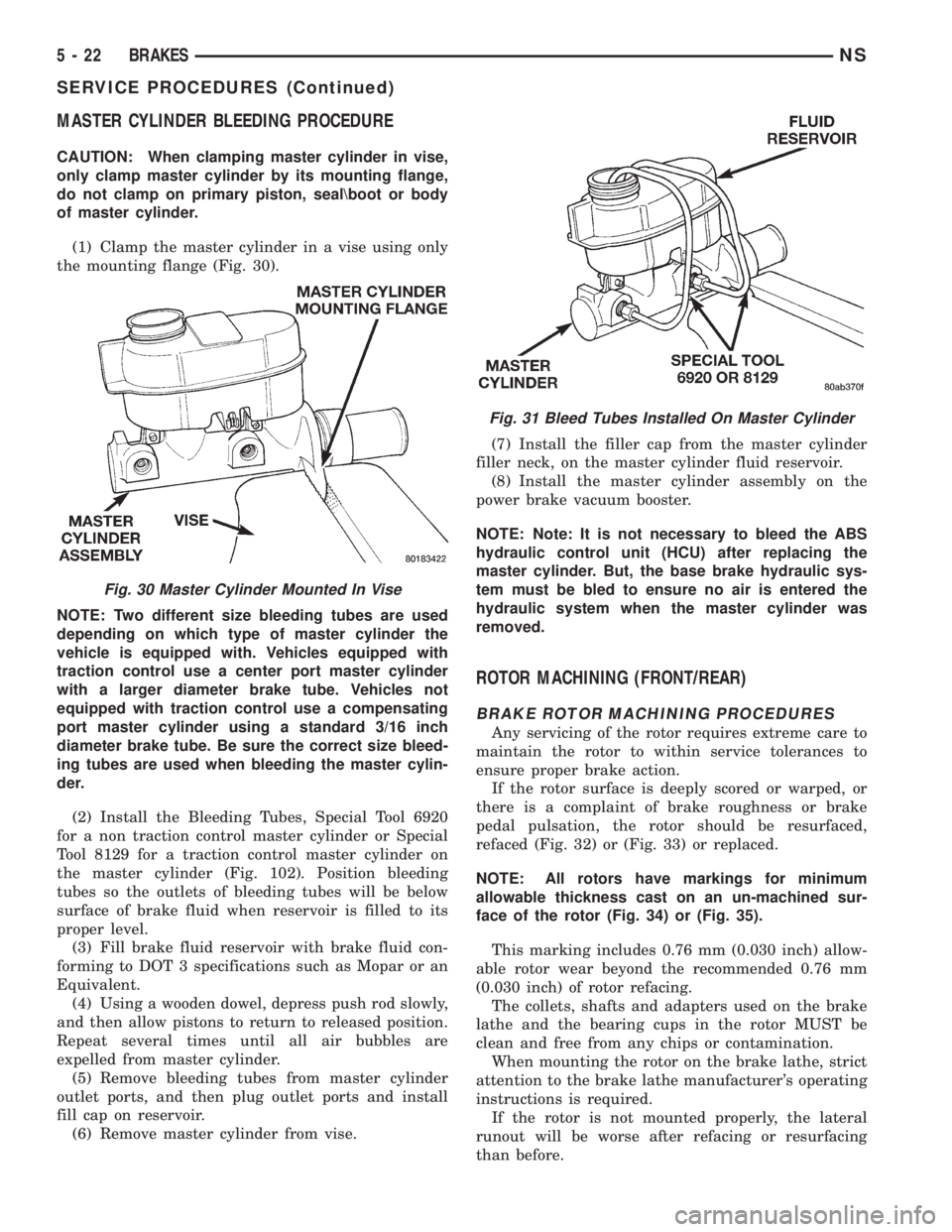
(1) Clamp the master cylinder in a vise using only
the mounting flange (Fig. 30).
NOTE: Two different size bleeding tubes are used
depending on which type of master cylinder the
vehicle is equipped with. Vehicles equipped with
traction control use a center port master cylinder
with a larger diameter brake tube. Vehicles not
equipped with traction control use a compensating
port master cylinder using a standard 3/16 inch
diameter brake tube. Be sure the correct size bleed-
ing tubes are used when bleeding the master cylin-
der.
(2) Install the Bleeding Tubes, Special Tool 6920
for a non traction control master cylinder or Special
Tool 8129 for a traction control master cylinder on
the master cylinder (Fig. 102). Position bleeding
tubes so the outlets of bleeding tubes will be below
surface of brake fluid when reservoir is filled to its
proper level.
(3) Fill brake fluid reservoir with brake fluid con-
forming to DOT 3 specifications such as Mopar or an
Equivalent.
(4) Using a wooden dowel, depress push rod slowly,
and then allow pistons to return to released position.
Repeat several times until all air bubbles are
expelled from master cylinder.
(5) Remove bleeding tubes from master cylinder
outlet ports, and then plug outlet ports and install
fill cap on reservoir.
(6) Remove master cylinder from vise.(7) Install the filler cap from the master cylinder
filler neck, on the master cylinder fluid reservoir.
(8) Install the master cylinder assembly on the
power brake vacuum booster.
NOTE: Note: It is not necessary to bleed the ABS
hydraulic control unit (HCU) after replacing the
master cylinder. But, the base brake hydraulic sys-
tem must be bled to ensure no air is entered the
hydraulic system when the master cylinder was
removed.
ROTOR MACHINING (FRONT/REAR)
BRAKE ROTOR MACHINING PROCEDURES
Any servicing of the rotor requires extreme care to
maintain the rotor to within service tolerances to
ensure proper brake action.
If the rotor surface is deeply scored or warped, or
there is a complaint of brake roughness or brake
pedal pulsation, the rotor should be resurfaced,
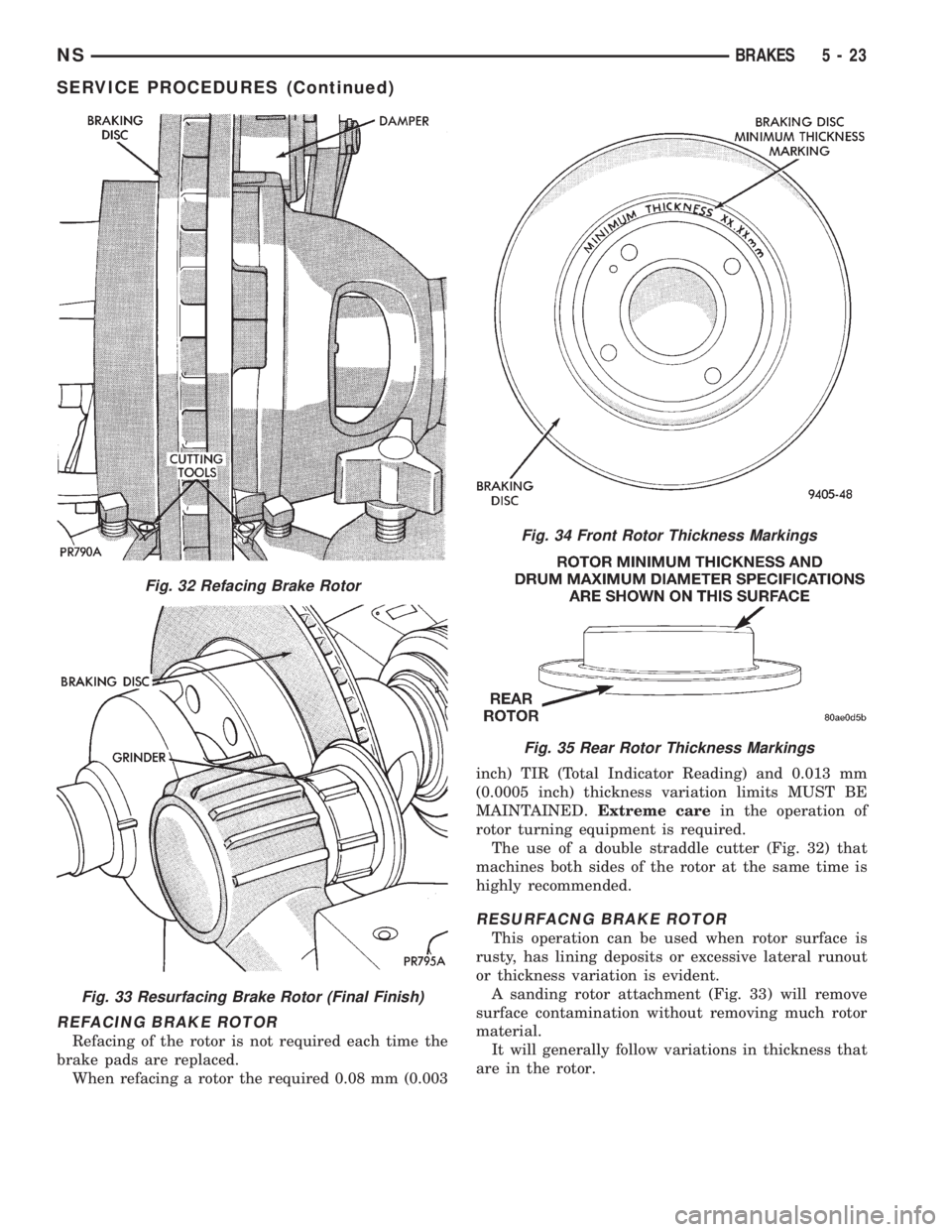
refaced (Fig. 32) or (Fig. 33) or replaced.
NOTE: All rotors have markings for minimum
allowable thickness cast on an un-machined sur-
face of the rotor (Fig. 34) or (Fig. 35).
This marking includes 0.76 mm (0.030 inch) allow-
able rotor wear beyond the recommended 0.76 mm
(0.030 inch) of rotor refacing.
The collets, shafts and adapters used on the brake
lathe and the bearing cups in the rotor MUST be
clean and free from any chips or contamination.
When mounting the rotor on the brake lathe, strict
attention to the brake lathe manufacturer's operating
instructions is required.
If the rotor is not mounted properly, the lateral
runout will be worse after refacing or resurfacing
than before.
Fig. 30 Master Cylinder Mounted In Vise
Fig. 31 Bleed Tubes Installed On Master Cylinder
5 - 22 BRAKESNS
SERVICE PROCEDURES (Continued)
Page 105 of 1938
REFACING BRAKE ROTOR
Refacing of the rotor is not required each time the
brake pads are replaced.
When refacing a rotor the required 0.08 mm (0.003inch) TIR (Total Indicator Reading) and 0.013 mm
(0.0005 inch) thickness variation limits MUST BE
MAINTAINED.Extreme carein the operation of
rotor turning equipment is required.
The use of a double straddle cutter (Fig. 32) that
machines both sides of the rotor at the same time is
highly recommended.
RESURFACNG BRAKE ROTOR
This operation can be used when rotor surface is
rusty, has lining deposits or excessive lateral runout
or thickness variation is evident.
A sanding rotor attachment (Fig. 33) will remove
surface contamination without removing much rotor
material.
It will generally follow variations in thickness that
are in the rotor.
Fig. 32 Refacing Brake Rotor
Fig. 33 Resurfacing Brake Rotor (Final Finish)
Fig. 34 Front Rotor Thickness Markings
Fig. 35 Rear Rotor Thickness Markings
NSBRAKES 5 - 23
SERVICE PROCEDURES (Continued)
Page 106 of 1938
BRAKE DRUM MACHINING
Measure the runout and diameter of the rear brake
using only accurate measuring equipment. There
should be no variation in the drum diameter greater
than 0.090 mm (0.004 inch). Drum runout should not
exceed 0.15 mm (0.006 inch) out of round. If the
drum runout or diameter variation exceed these val-
ues the drum should be refaced. For best results in
eliminating the irregularities that cause brake rough-
ness and surge, the amount of material removed dur-
ing a single cut should be limited to 0.13 mm (0.005
inch). When the entire braking surface has been
cleaned. A final cut of 0.0254 mm (0.001 inch) will
assure a good drum surface providing the equipment
used is capable of the precision required for resurfac-
ing brake drums. Deeper cuts are permissible for the
sole purpose of removing deep score marks.Do not
reface more than 1.52 mm (0.060 inch) over the
standard drum diameter.
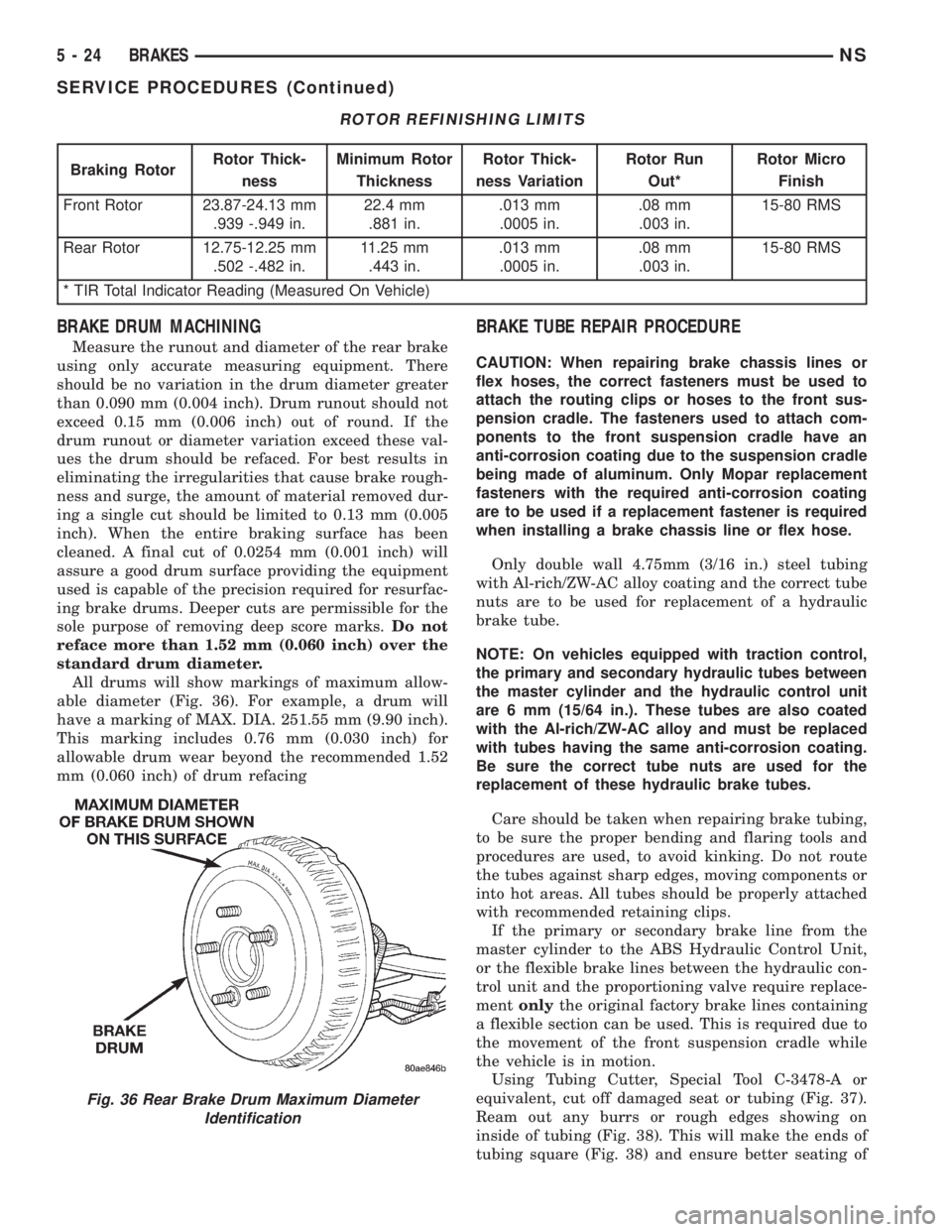
All drums will show markings of maximum allow-
able diameter (Fig. 36). For example, a drum will
have a marking of MAX. DIA. 251.55 mm (9.90 inch).
This marking includes 0.76 mm (0.030 inch) for
allowable drum wear beyond the recommended 1.52
mm (0.060 inch) of drum refacing
BRAKE TUBE REPAIR PROCEDURE
CAUTION: When repairing brake chassis lines or
flex hoses, the correct fasteners must be used to
attach the routing clips or hoses to the front sus-
pension cradle. The fasteners used to attach com-
ponents to the front suspension cradle have an
anti-corrosion coating due to the suspension cradle
being made of aluminum. Only Mopar replacement
fasteners with the required anti-corrosion coating
are to be used if a replacement fastener is required
when installing a brake chassis line or flex hose.
Only double wall 4.75mm (3/16 in.) steel tubing
with Al-rich/ZW-AC alloy coating and the correct tube
nuts are to be used for replacement of a hydraulic
brake tube.
NOTE: On vehicles equipped with traction control,
the primary and secondary hydraulic tubes between
the master cylinder and the hydraulic control unit
are 6 mm (15/64 in.). These tubes are also coated
with the Al-rich/ZW-AC alloy and must be replaced
with tubes having the same anti-corrosion coating.
Be sure the correct tube nuts are used for the
replacement of these hydraulic brake tubes.
Care should be taken when repairing brake tubing,
to be sure the proper bending and flaring tools and
procedures are used, to avoid kinking. Do not route
the tubes against sharp edges, moving components or
into hot areas. All tubes should be properly attached
with recommended retaining clips.
If the primary or secondary brake line from the
master cylinder to the ABS Hydraulic Control Unit,
or the flexible brake lines between the hydraulic con-
trol unit and the proportioning valve require replace-
mentonlythe original factory brake lines containing
a flexible section can be used. This is required due to
the movement of the front suspension cradle while
the vehicle is in motion.
Using Tubing Cutter, Special Tool C-3478-A or
equivalent, cut off damaged seat or tubing (Fig. 37).
Ream out any burrs or rough edges showing on
inside of tubing (Fig. 38). This will make the ends of
tubing square (Fig. 38) and ensure better seating of
ROTOR REFINISHING LIMITS
Braking RotorRotor Thick-
nessMinimum Rotor
ThicknessRotor Thick-
ness VariationRotor Run
Out*Rotor Micro
Finish
Front Rotor 23.87-24.13 mm
.939 -.949 in.22.4 mm
.881 in..013 mm
.0005 in..08 mm
.003 in.15-80 RMS
Rear Rotor 12.75-12.25 mm
.502 -.482 in.11.25 mm
.443 in..013 mm
.0005 in..08 mm
.003 in.15-80 RMS
* TIR Total Indicator Reading (Measured On Vehicle)
Fig. 36 Rear Brake Drum Maximum Diameter
Identification
5 - 24 BRAKESNS
SERVICE PROCEDURES (Continued)