CD changer CHRYSLER VOYAGER 2001 User Guide
[x] Cancel search | Manufacturer: CHRYSLER, Model Year: 2001, Model line: VOYAGER, Model: CHRYSLER VOYAGER 2001Pages: 4284, PDF Size: 83.53 MB
Page 225 of 4284
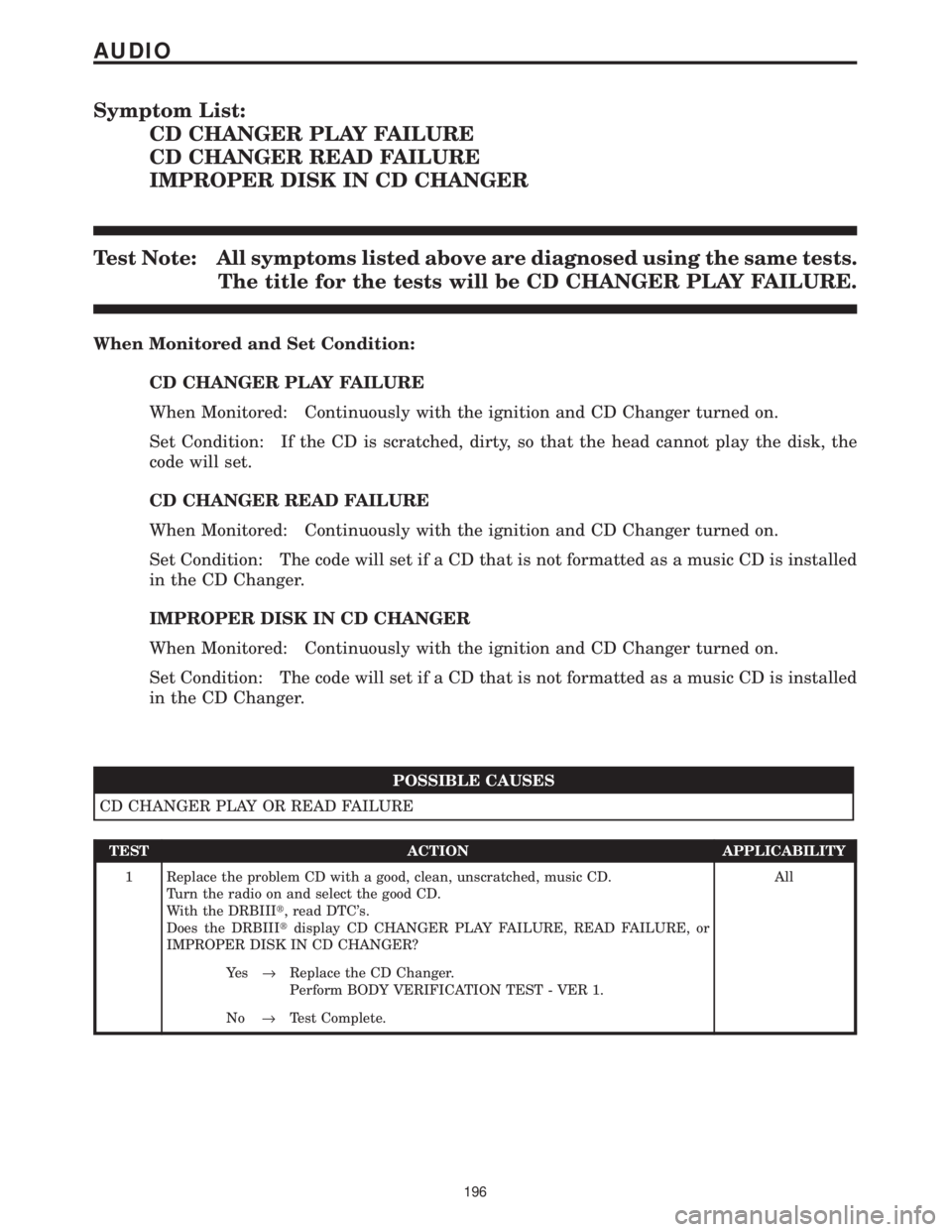
Symptom List:
CD CHANGER PLAY FAILURE
CD CHANGER READ FAILURE
IMPROPER DISK IN CD CHANGER
Test Note: All symptoms listed above are diagnosed using the same tests.
The title for the tests will be CD CHANGER PLAY FAILURE.
When Monitored and Set Condition:
CD CHANGER PLAY FAILURE
When Monitored: Continuously with the ignition and CD Changer turned on.
Set Condition: If the CD is scratched, dirty, so that the head cannot play the disk, the
code will set.
CD CHANGER READ FAILURE
When Monitored: Continuously with the ignition and CD Changer turned on.
Set Condition: The code will set if a CD that is not formatted as a music CD is installed
in the CD Changer.
IMPROPER DISK IN CD CHANGER
When Monitored: Continuously with the ignition and CD Changer turned on.
Set Condition: The code will set if a CD that is not formatted as a music CD is installed
in the CD Changer.
POSSIBLE CAUSES
CD CHANGER PLAY OR READ FAILURE
TEST ACTION APPLICABILITY
1 Replace the problem CD with a good, clean, unscratched, music CD.
Turn the radio on and select the good CD.
With the DRBIIIt, read DTC's.
Does the DRBIIItdisplay CD CHANGER PLAY FAILURE, READ FAILURE, or
IMPROPER DISK IN CD CHANGER?All
Ye s®Replace the CD Changer.
Perform BODY VERIFICATION TEST - VER 1.
No®Test Complete.
196
AUDIO
Page 226 of 4284

Symptom:
CD CHANGER POWER SUPPLY TOO HIGH
When Monitored and Set Condition:
CD CHANGER POWER SUPPLY TOO HIGH
When Monitored: Continuously with the ignition and CD Changer turned on.
Set Condition: The code will set if the radio detects voltage above 16.0 volts for 5 seconds.
POSSIBLE CAUSES
CD CHANGER POWER SUPPLY TOO HIGH
POWER SUPPLY OF CD CHANGER
TEST ACTION APPLICABILITY
1 Turn the ignition off.
Disconnect the CD Changer harness connector.
Start the engine.
Measure the voltage of the Ignition Switch Output circuit.
Is the voltage above 16.0 volts?All
Ye s®Repair the charging system as necessary.
Perform BODY VERIFICATION TEST - VER 1.
No®Replace the CD Changer.
Perform BODY VERIFICATION TEST - VER 1.
197
AUDIO
Page 227 of 4284

Symptom List:
CD CHANGER TEMPERATURE HIGH
CD CHANGER TEMPERATURE LOW
Test Note: All symptoms listed above are diagnosed using the same tests.
The title for the tests will be CD CHANGER TEMPERATURE
HIGH.
When Monitored and Set Condition:
CD CHANGER TEMPERATURE HIGH
When Monitored: Continuously with the ignition and CD Changer turned on.
Set Condition: The code will set if the temperature inside the CD Changer is above +65É
C (+145É F).
CD CHANGER TEMPERATURE LOW
When Monitored: Continuously with the ignition and CD Changer turned on.
Set Condition: The code will set if the temperature inside the CD Changer is below -23É
C (-10É F).
POSSIBLE CAUSES
LOW OR HIGH TEMPERATURE FAILURE
TEST ACTION APPLICABILITY
1 With the DRBIIIt, erase the audio DTC's.
Start the engine and allow the engine to reach normal operating temperature.
If the vehicle has been in the hot sunlight or extreme cold move the vehicle indoors
and open the doors to allow the inside temperature to stabilize.
The CD Changer will operate between -23É C and 65É C (-10É F and +145É F).
With the DRBIIIt, read DTC's.
Does the DRBIIItdisplay CD CHANGER TEMPERATURE LOW or CD CHANGER
TEMPERATURE HIGH?All
Ye s®Replace the CD Changer.
Perform BODY VERIFICATION TEST - VER 1.
No®Test Complete.
198
AUDIO
Page 391 of 4284
Symptom:
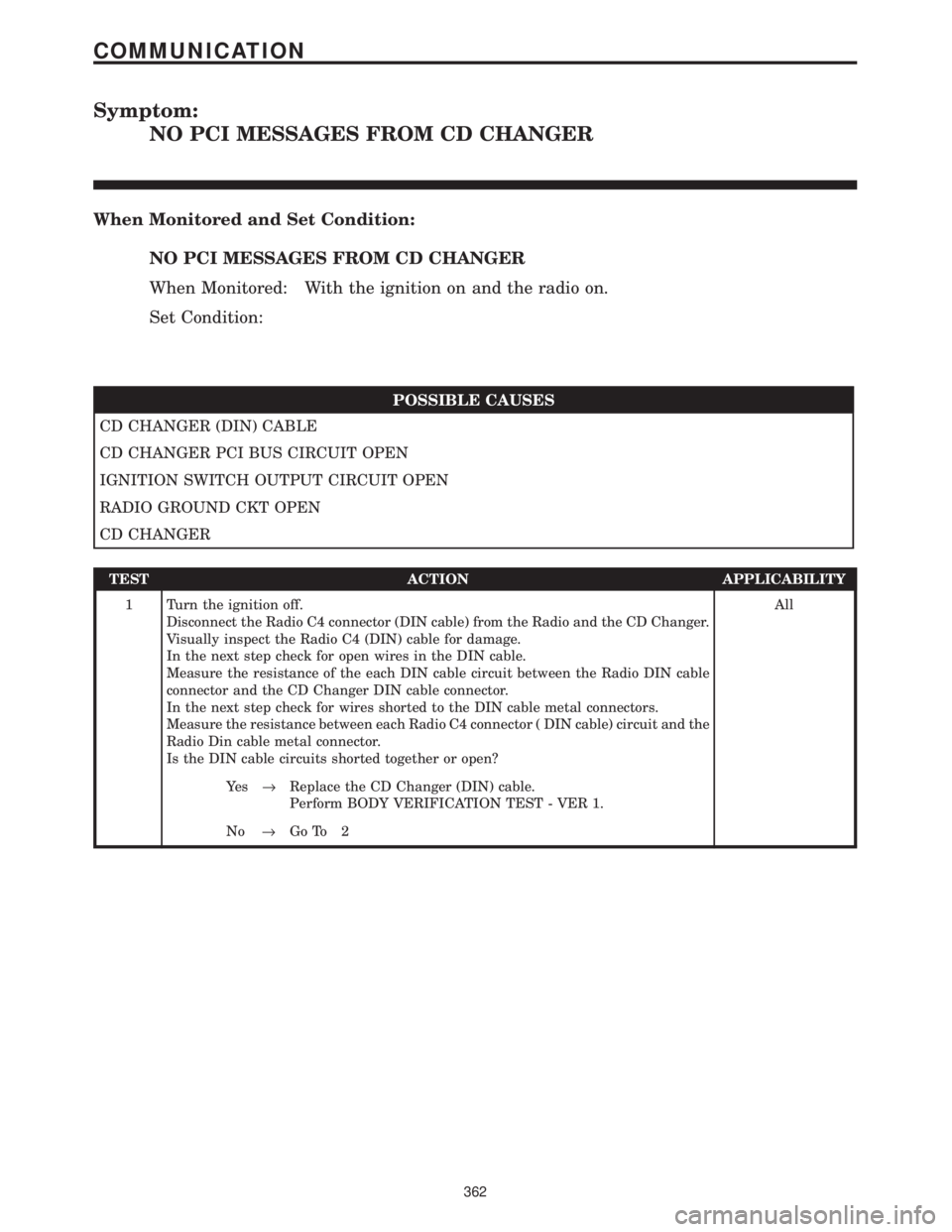
NO PCI MESSAGES FROM CD CHANGER
When Monitored and Set Condition:
NO PCI MESSAGES FROM CD CHANGER
When Monitored: With the ignition on and the radio on.
Set Condition:
POSSIBLE CAUSES
CD CHANGER (DIN) CABLE
CD CHANGER PCI BUS CIRCUIT OPEN
IGNITION SWITCH OUTPUT CIRCUIT OPEN
RADIO GROUND CKT OPEN
CD CHANGER
TEST ACTION APPLICABILITY
1 Turn the ignition off.
Disconnect the Radio C4 connector (DIN cable) from the Radio and the CD Changer.
Visually inspect the Radio C4 (DIN) cable for damage.
In the next step check for open wires in the DIN cable.
Measure the resistance of the each DIN cable circuit between the Radio DIN cable
connector and the CD Changer DIN cable connector.
In the next step check for wires shorted to the DIN cable metal connectors.
Measure the resistance between each Radio C4 connector ( DIN cable) circuit and the
Radio Din cable metal connector.
Is the DIN cable circuits shorted together or open?All
Ye s®Replace the CD Changer (DIN) cable.
Perform BODY VERIFICATION TEST - VER 1.
No®Go To 2
362
COMMUNICATION
Page 392 of 4284
TEST ACTION APPLICABILITY
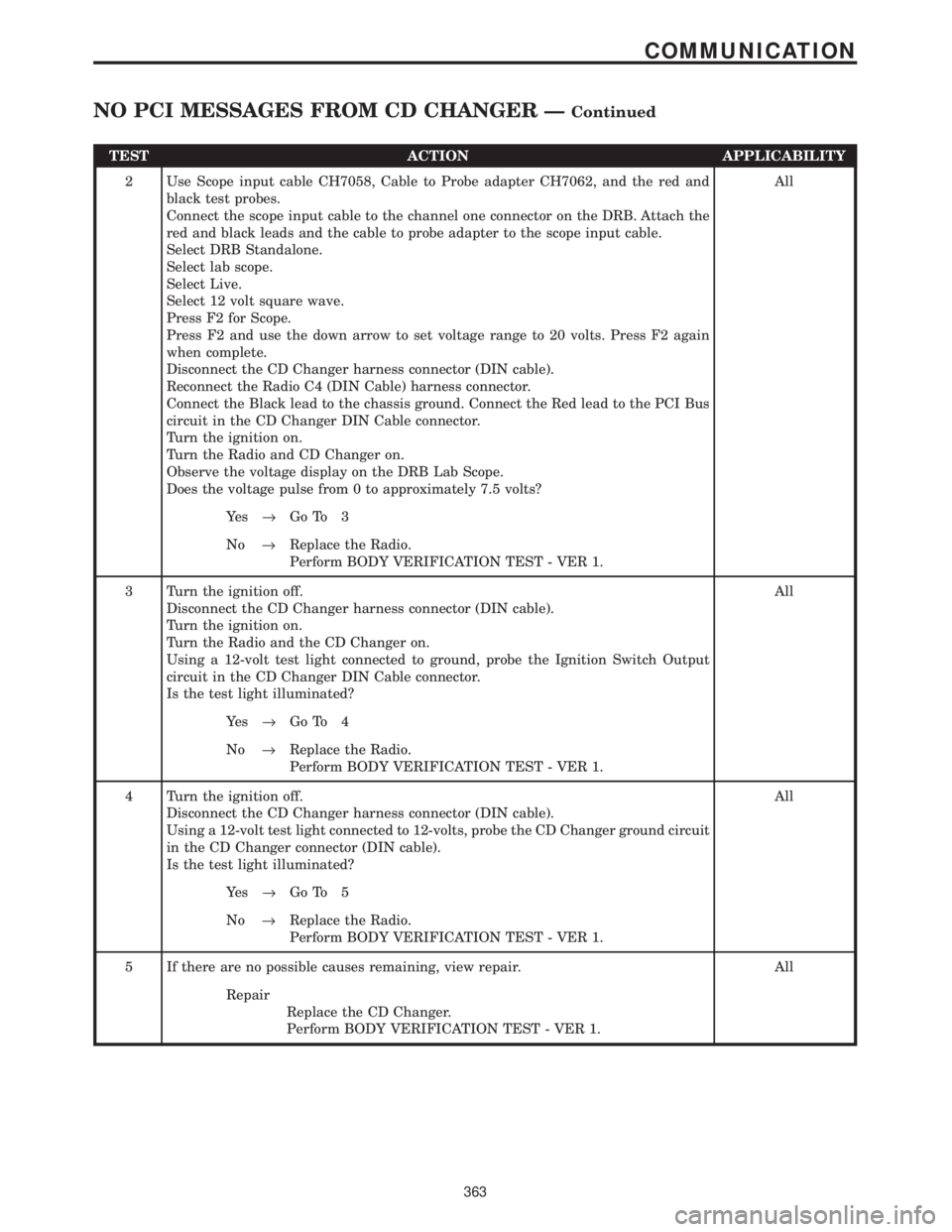
2 Use Scope input cable CH7058, Cable to Probe adapter CH7062, and the red and
black test probes.
Connect the scope input cable to the channel one connector on the DRB. Attach the
red and black leads and the cable to probe adapter to the scope input cable.
Select DRB Standalone.
Select lab scope.
Select Live.
Select 12 volt square wave.
Press F2 for Scope.
Press F2 and use the down arrow to set voltage range to 20 volts. Press F2 again
when complete.
Disconnect the CD Changer harness connector (DIN cable).
Reconnect the Radio C4 (DIN Cable) harness connector.
Connect the Black lead to the chassis ground. Connect the Red lead to the PCI Bus
circuit in the CD Changer DIN Cable connector.
Turn the ignition on.
Turn the Radio and CD Changer on.
Observe the voltage display on the DRB Lab Scope.
Does the voltage pulse from 0 to approximately 7.5 volts?All
Ye s®Go To 3
No®Replace the Radio.
Perform BODY VERIFICATION TEST - VER 1.
3 Turn the ignition off.
Disconnect the CD Changer harness connector (DIN cable).
Turn the ignition on.
Turn the Radio and the CD Changer on.
Using a 12-volt test light connected to ground, probe the Ignition Switch Output
circuit in the CD Changer DIN Cable connector.
Is the test light illuminated?All
Ye s®Go To 4
No®Replace the Radio.
Perform BODY VERIFICATION TEST - VER 1.
4 Turn the ignition off.
Disconnect the CD Changer harness connector (DIN cable).
Using a 12-volt test light connected to 12-volts, probe the CD Changer ground circuit
in the CD Changer connector (DIN cable).
Is the test light illuminated?All
Ye s®Go To 5
No®Replace the Radio.
Perform BODY VERIFICATION TEST - VER 1.
5 If there are no possible causes remaining, view repair. All
Repair
Replace the CD Changer.
Perform BODY VERIFICATION TEST - VER 1.
363
COMMUNICATION
NO PCI MESSAGES FROM CD CHANGER ÐContinued
Page 1062 of 4284
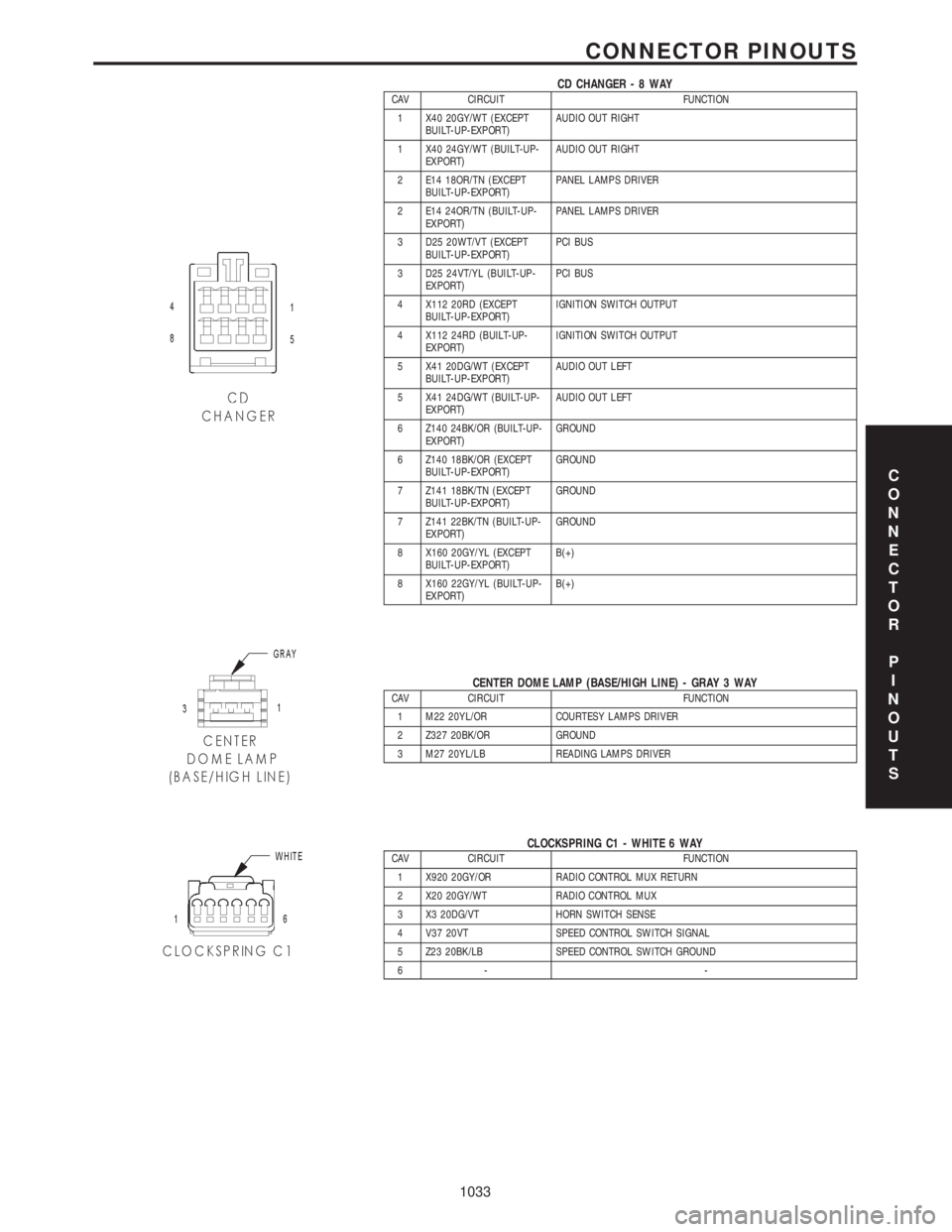
CD CHANGER-8WAYCAV CIRCUIT FUNCTION
1 X40 20GY/WT (EXCEPT
BUILT-UP-EXPORT)AUDIO OUT RIGHT
1 X40 24GY/WT (BUILT-UP-
EXPORT)AUDIO OUT RIGHT
2 E14 18OR/TN (EXCEPT
BUILT-UP-EXPORT)PANEL LAMPS DRIVER
2 E14 24OR/TN (BUILT-UP-
EXPORT)PANEL LAMPS DRIVER
3 D25 20WT/VT (EXCEPT
BUILT-UP-EXPORT)PCI BUS
3 D25 24VT/YL (BUILT-UP-
EXPORT)PCI BUS
4 X112 20RD (EXCEPT
BUILT-UP-EXPORT)IGNITION SWITCH OUTPUT
4 X112 24RD (BUILT-UP-
EXPORT)IGNITION SWITCH OUTPUT
5 X41 20DG/WT (EXCEPT
BUILT-UP-EXPORT)AUDIO OUT LEFT
5 X41 24DG/WT (BUILT-UP-
EXPORT)AUDIO OUT LEFT
6 Z140 24BK/OR (BUILT-UP-
EXPORT)GROUND
6 Z140 18BK/OR (EXCEPT
BUILT-UP-EXPORT)GROUND
7 Z141 18BK/TN (EXCEPT
BUILT-UP-EXPORT)GROUND
7 Z141 22BK/TN (BUILT-UP-
EXPORT)GROUND
8 X160 20GY/YL (EXCEPT
BUILT-UP-EXPORT)B(+)
8 X160 22GY/YL (BUILT-UP-
EXPORT)B(+)
CENTER DOME LAMP (BASE/HIGH LINE) - GRAY 3 WAYCAV CIRCUIT FUNCTION
1 M22 20YL/OR COURTESY LAMPS DRIVER
2 Z327 20BK/OR GROUND
3 M27 20YL/LB READING LAMPS DRIVER
CLOCKSPRING C1 - WHITE 6 WAYCAV CIRCUIT FUNCTION
1 X920 20GY/OR RADIO CONTROL MUX RETURN
2 X20 20GY/WT RADIO CONTROL MUX
3 X3 20DG/VT HORN SWITCH SENSE
4 V37 20VT SPEED CONTROL SWITCH SIGNAL
5 Z23 20BK/LB SPEED CONTROL SWITCH GROUND
6- -
C
O
N
N
E
C
T
O
R
P
I
N
O
U
T
S
1033
CONNECTOR PINOUTS
Page 1119 of 4284
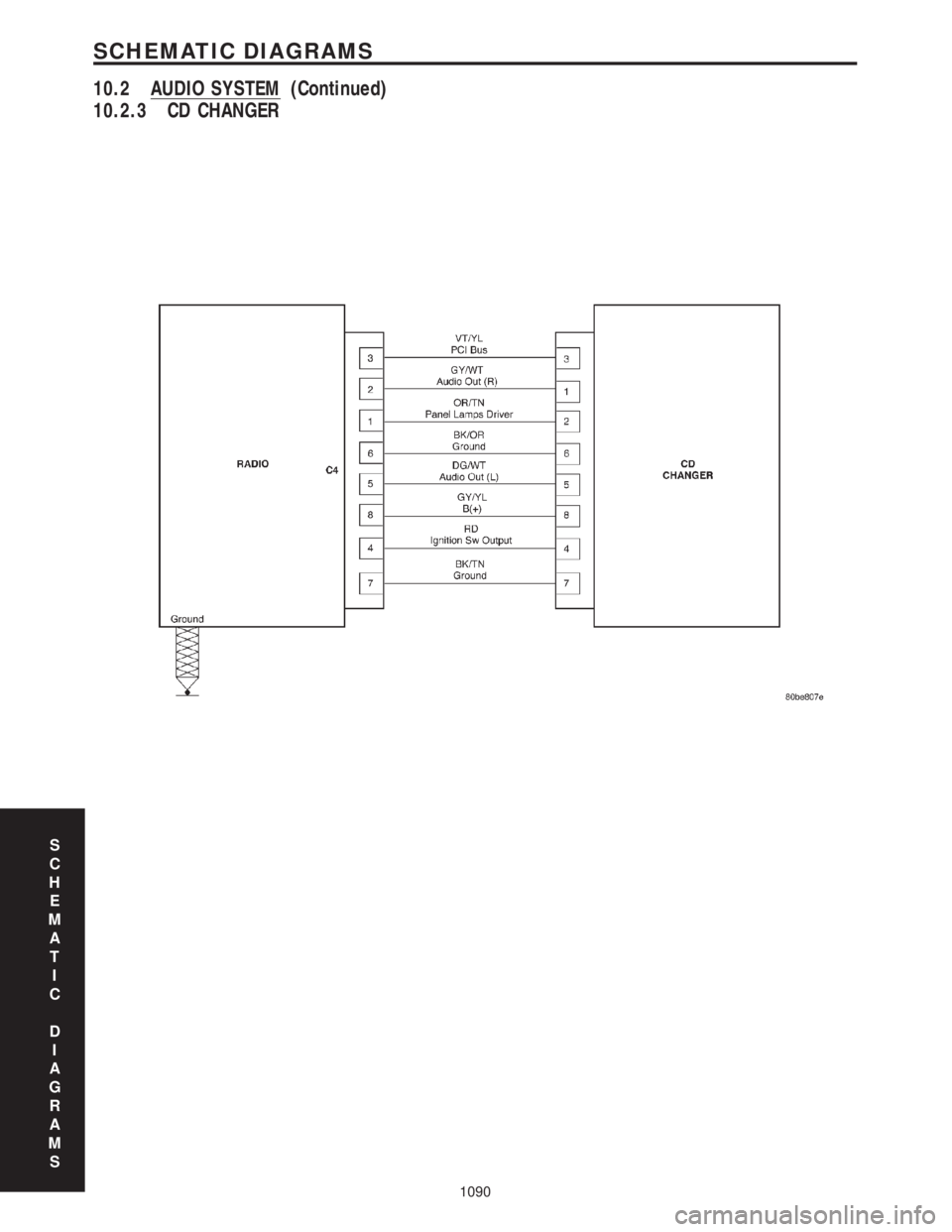
10.2.3 CD CHANGER
S
C
H
E
M
A
T
I
C
D
I
A
G
R
A
M
S
1090
SCHEMATIC DIAGRAMS
10.2 AUDIO SYSTEM (Continued)
Page 1758 of 4284

RADIATOR
DESCRIPTION
The radiator is a cross-flow type (horizontal tubes)
with design features that provide greater strength
along with sufficient heat transfer capabilities to
keep the engine satisfactorily cooled. The radiator
has plastic side tanks and aluminum cooling tubes.
OPERATION
The radiator functions as a heat exchanger, using
air flow across the exterior of the radiator tubes. This
heat is then transferred from the coolant and into
the passing air.
REMOVAL
(1) Disconnect negative cable from battery.
(2) Remove radiator upper crossmember support.
(Refer to 23 - BODY/EXTERIOR/GRILLE OPENING
REINFORCEMENT - REMOVAL)
WARNING: DO NOT REMOVE THE CYLINDER
BLOCK PLUG OR THE RADIATOR DRAINCOCK
WITH THE SYSTEM HOT AND UNDER PRESSURE
BECAUSE SERIOUS BURNS FROM COOLANT CAN
OCCUR.
(3) Drain the cooling system. (Refer to 7 - COOL-
ING - STANDARD PROCEDURE)
(4) Remove the radiator fans. (Refer to 7 - COOL-
ING/ENGINE/RADIATOR FAN - REMOVAL)(5) Disconnect coolant reserve/recovery hose.
(6) Remove vapor purge solenoid from mounting
bracket.
(7) Disconnect upper and lower hoses from the
radiator (Fig. 13) or (Fig. 14).
(8) Remove the A/C condenser side brackets to
radiator attaching screws (Fig. 15). Separate the con-
denser from the radiator by lifting upward to disen-
gage from lower mounts (Fig. 15). Allow the
condenser to rest in front of radiator.
(9) Radiator can now be lifted free from engine
compartment.Care should be taken not to dam-
age radiator cooling fins or water tubes during
removal.
Fig. 12 Thermostat Position In Outlet Connector
1 - LOCATING NOTCH
2 - THERMOSTAT
3 - COOLANT OUTLET CONNECTOR
Fig. 13 Radiator Hoses to Radiator - 2.4L
1 - UPPER HOSE
2 - LOWER HOSE
3 - HOSE SUPPORT CLIP
Fig. 14 Radiator Hoses to Radiator - 3.3/3.8L
1 - UPPER HOSE
2 - LOWER HOSE
7 - 24 ENGINERS
ENGINE COOLANT THERMOSTAT - 3.3/3.8L (Continued)
Page 1794 of 4284

(4) Disconnect upper radiator hose adapter tube,
water pump hose, and EGR hose at thermostat hous-
ing.
(5) Remove both thermostat housing attaching
bolts and housing (Fig. 10).
INSTALLATION
(1) Install thermostat housing, gasket, and retain-
ing bolts (Fig. 10). Torque bolts to 27.5N´m.
(2) Connect upper radiator hose adapter tube,
water pump hose, and EGR cooler hose to thermostat
housing.
(3) Install front wiper unit (Refer to 8 - ELECTRI-
CAL/WIPERS/WASHERS/WIPER MODULE -
INSTALLATION).
(4) Refill cooling system (Refer to 7 - COOLING/
ENGINE/COOLANT - STANDARD PROCEDURE).
(5) Connect negative battery cable.
RADIATOR
DESCRIPTION
The radiator is a cross-flow type (horizontal tubes)
with design features that provide greater strength
along with sufficient heat transfer capabilities tokeep the engine satisfactorily cooled. The radiator
has plastic side tanks and aluminum cooling tubes.
OPERATION
The radiator functions as a heat exchanger, using
air flow across the exterior of the radiator tubes. This
heat is then transferred from the coolant and into
the passing air.
REMOVAL
(1) Disconnect negative cable from battery.
(2) Remove radiator upper crossmember support.
(Refer to 23 - BODY/EXTERIOR/GRILLE OPENING
REINFORCEMENT - REMOVAL).
WARNING: DO NOT REMOVE THE CYLINDER
BLOCK PLUG OR THE RADIATOR DRAINCOCK
WITH THE SYSTEM HOT AND UNDER PRESSURE
BECAUSE SERIOUS BURNS FROM COOLANT CAN
OCCUR.
(3) Drain the cooling system (Refer to 7 - COOL-
ING/ENGINE/COOLANT - STANDARD PROCE-
DURE).
Fig. 9 THERMOSTAT HOUSING LOCATION
1 - CYLINDER HEAD COVER
2 - THERMOSTAT HOUSING
3 - AIR BLEED
4 - WATER PUMP
5 - WATER PUMP HOUSING TO THERMOSTAT HOUSING
BYPASS HOSE
6 - E G R VA LV E
Fig. 10 THERMOSTAT HOUSING ASSEMBLY
1 - THERMOSTAT HOUSING GASKET
2 - THERMOSTAT HOUSING
3 - RETAINING BOLTS
4 - CYLINDER HEAD
5 - CYLINDER HEAD COVER/INTAKE MANIFOLD
7a - 20 ENGINERG
ENGINE COOLANT THERMOSTAT (Continued)
Page 1805 of 4284
AUDIO
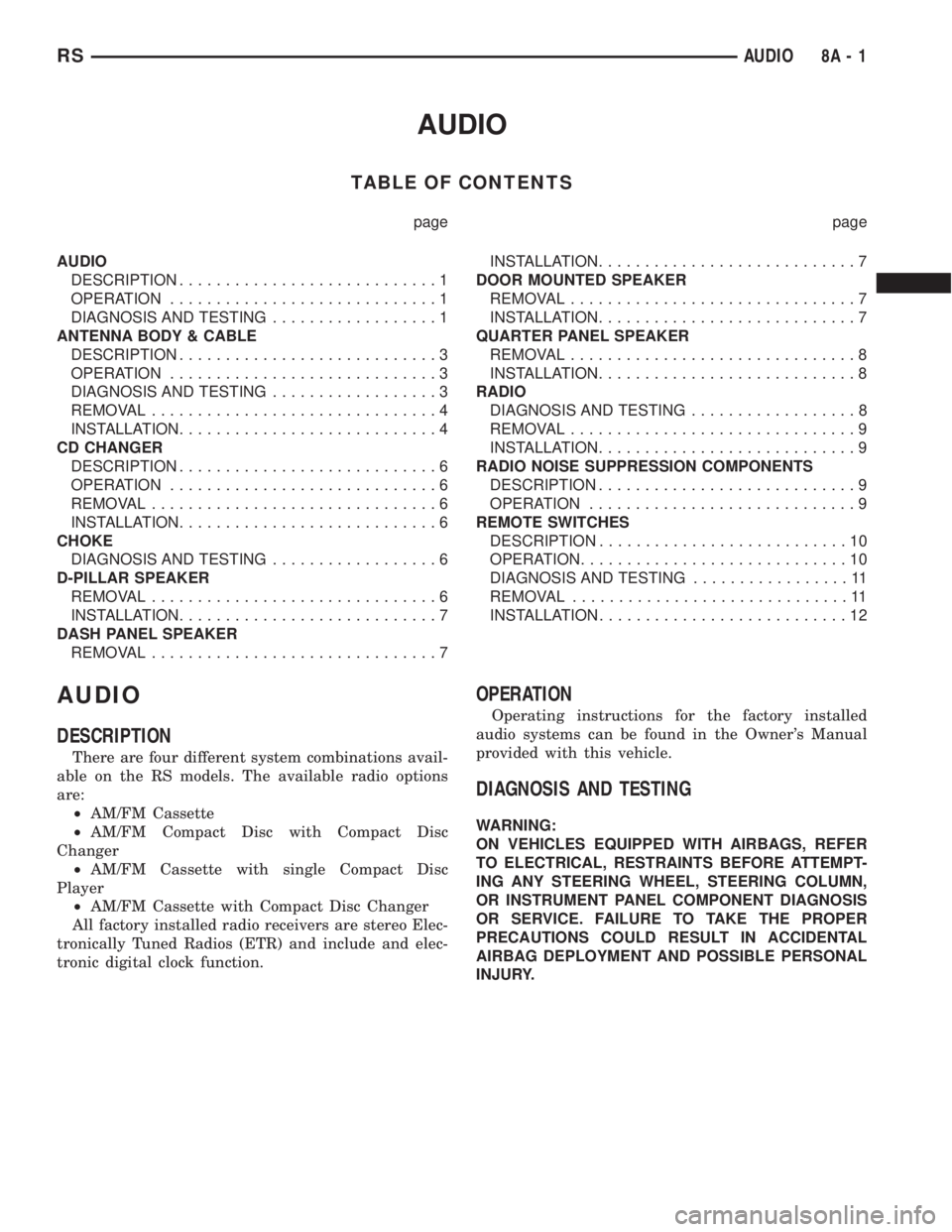
TABLE OF CONTENTS
page page
AUDIO
DESCRIPTION............................1
OPERATION.............................1
DIAGNOSIS AND TESTING..................1
ANTENNA BODY & CABLE
DESCRIPTION............................3
OPERATION.............................3
DIAGNOSIS AND TESTING..................3
REMOVAL...............................4
INSTALLATION............................4
CD CHANGER
DESCRIPTION............................6
OPERATION.............................6
REMOVAL...............................6
INSTALLATION............................6
CHOKE
DIAGNOSIS AND TESTING..................6
D-PILLAR SPEAKER
REMOVAL...............................6
INSTALLATION............................7
DASH PANEL SPEAKER
REMOVAL...............................7INSTALLATION............................7
DOOR MOUNTED SPEAKER
REMOVAL...............................7
INSTALLATION............................7
QUARTER PANEL SPEAKER
REMOVAL...............................8
INSTALLATION............................8
RADIO
DIAGNOSIS AND TESTING..................8
REMOVAL...............................9
INSTALLATION............................9
RADIO NOISE SUPPRESSION COMPONENTS
DESCRIPTION............................9
OPERATION.............................9
REMOTE SWITCHES
DESCRIPTION...........................10
OPERATION.............................10
DIAGNOSIS AND TESTING.................11
REMOVAL..............................11
INSTALLATION...........................12
AUDIO
DESCRIPTION
There are four different system combinations avail-
able on the RS models. The available radio options
are:
²AM/FM Cassette
²AM/FM Compact Disc with Compact Disc
Changer
²AM/FM Cassette with single Compact Disc
Player
²AM/FM Cassette with Compact Disc Changer
All factory installed radio receivers are stereo Elec-
tronically Tuned Radios (ETR) and include and elec-
tronic digital clock function.
OPERATION
Operating instructions for the factory installed
audio systems can be found in the Owner's Manual
provided with this vehicle.
DIAGNOSIS AND TESTING
WARNING:
ON VEHICLES EQUIPPED WITH AIRBAGS, REFER
TO ELECTRICAL, RESTRAINTS BEFORE ATTEMPT-
ING ANY STEERING WHEEL, STEERING COLUMN,
OR INSTRUMENT PANEL COMPONENT DIAGNOSIS
OR SERVICE. FAILURE TO TAKE THE PROPER
PRECAUTIONS COULD RESULT IN ACCIDENTAL
AIRBAG DEPLOYMENT AND POSSIBLE PERSONAL
INJURY.
RSAUDIO8A-1