wiring CHRYSLER VOYAGER 2001 Service Manual
[x] Cancel search | Manufacturer: CHRYSLER, Model Year: 2001, Model line: VOYAGER, Model: CHRYSLER VOYAGER 2001Pages: 4284, PDF Size: 83.53 MB
Page 965 of 4284
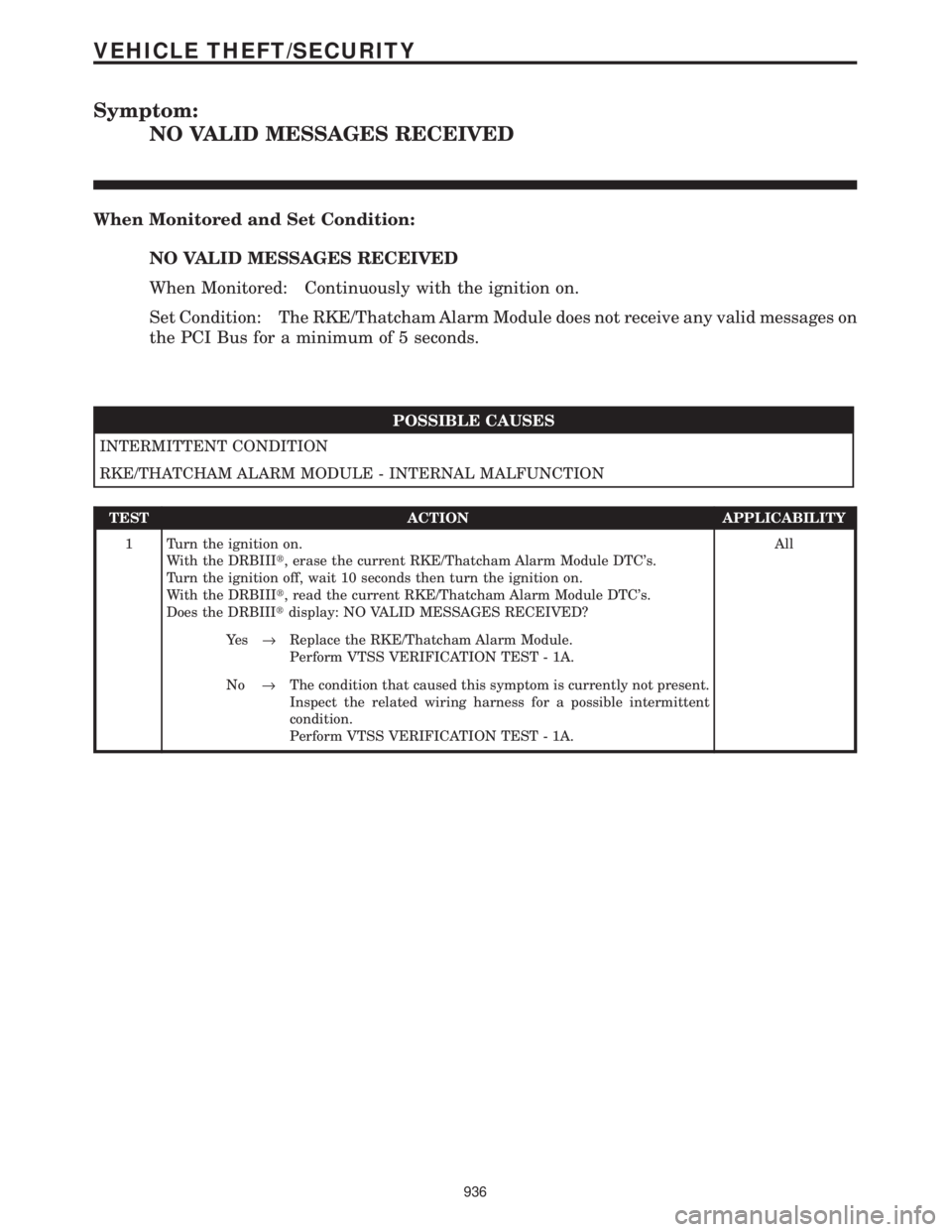
Symptom:
NO VALID MESSAGES RECEIVED
When Monitored and Set Condition:
NO VALID MESSAGES RECEIVED
When Monitored: Continuously with the ignition on.
Set Condition: The RKE/Thatcham Alarm Module does not receive any valid messages on
the PCI Bus for a minimum of 5 seconds.
POSSIBLE CAUSES
INTERMITTENT CONDITION
RKE/THATCHAM ALARM MODULE - INTERNAL MALFUNCTION
TEST ACTION APPLICABILITY
1 Turn the ignition on.
With the DRBIIIt, erase the current RKE/Thatcham Alarm Module DTC's.
Turn the ignition off, wait 10 seconds then turn the ignition on.
With the DRBIIIt, read the current RKE/Thatcham Alarm Module DTC's.
Does the DRBIIItdisplay: NO VALID MESSAGES RECEIVED?All
Ye s®Replace the RKE/Thatcham Alarm Module.
Perform VTSS VERIFICATION TEST - 1A.
No®The condition that caused this symptom is currently not present.
Inspect the related wiring harness for a possible intermittent
condition.
Perform VTSS VERIFICATION TEST - 1A.
936
VEHICLE THEFT/SECURITY
Page 966 of 4284
Symptom:
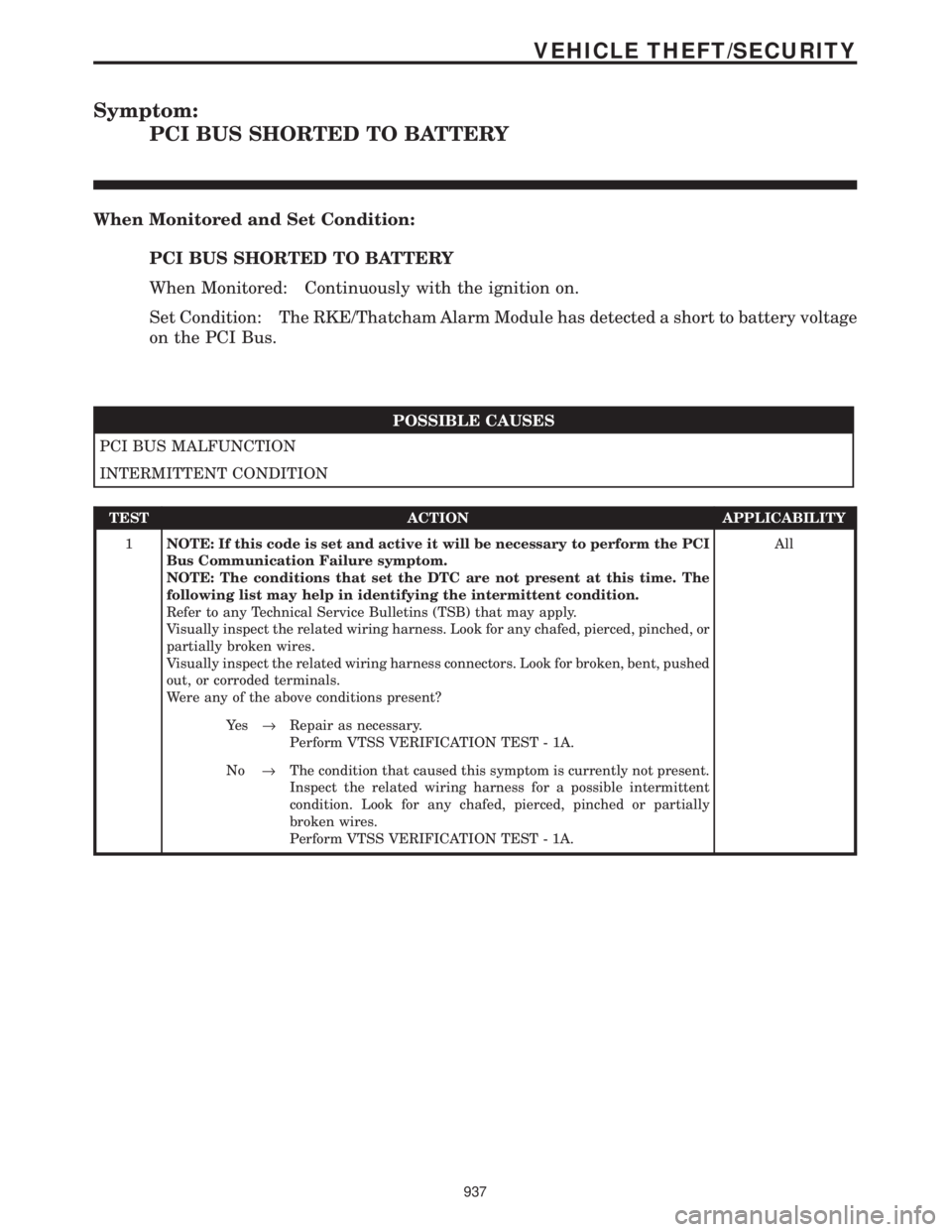
PCI BUS SHORTED TO BATTERY
When Monitored and Set Condition:
PCI BUS SHORTED TO BATTERY
When Monitored: Continuously with the ignition on.
Set Condition: The RKE/Thatcham Alarm Module has detected a short to battery voltage
on the PCI Bus.
POSSIBLE CAUSES
PCI BUS MALFUNCTION
INTERMITTENT CONDITION
TEST ACTION APPLICABILITY
1NOTE: If this code is set and active it will be necessary to perform the PCI
Bus Communication Failure symptom.
NOTE: The conditions that set the DTC are not present at this time. The
following list may help in identifying the intermittent condition.
Refer to any Technical Service Bulletins (TSB) that may apply.
Visually inspect the related wiring harness. Look for any chafed, pierced, pinched, or
partially broken wires.
Visually inspect the related wiring harness connectors. Look for broken, bent, pushed
out, or corroded terminals.
Were any of the above conditions present?All
Ye s®Repair as necessary.
Perform VTSS VERIFICATION TEST - 1A.
No®The condition that caused this symptom is currently not present.
Inspect the related wiring harness for a possible intermittent
condition. Look for any chafed, pierced, pinched or partially
broken wires.
Perform VTSS VERIFICATION TEST - 1A.
937
VEHICLE THEFT/SECURITY
Page 967 of 4284
Symptom:
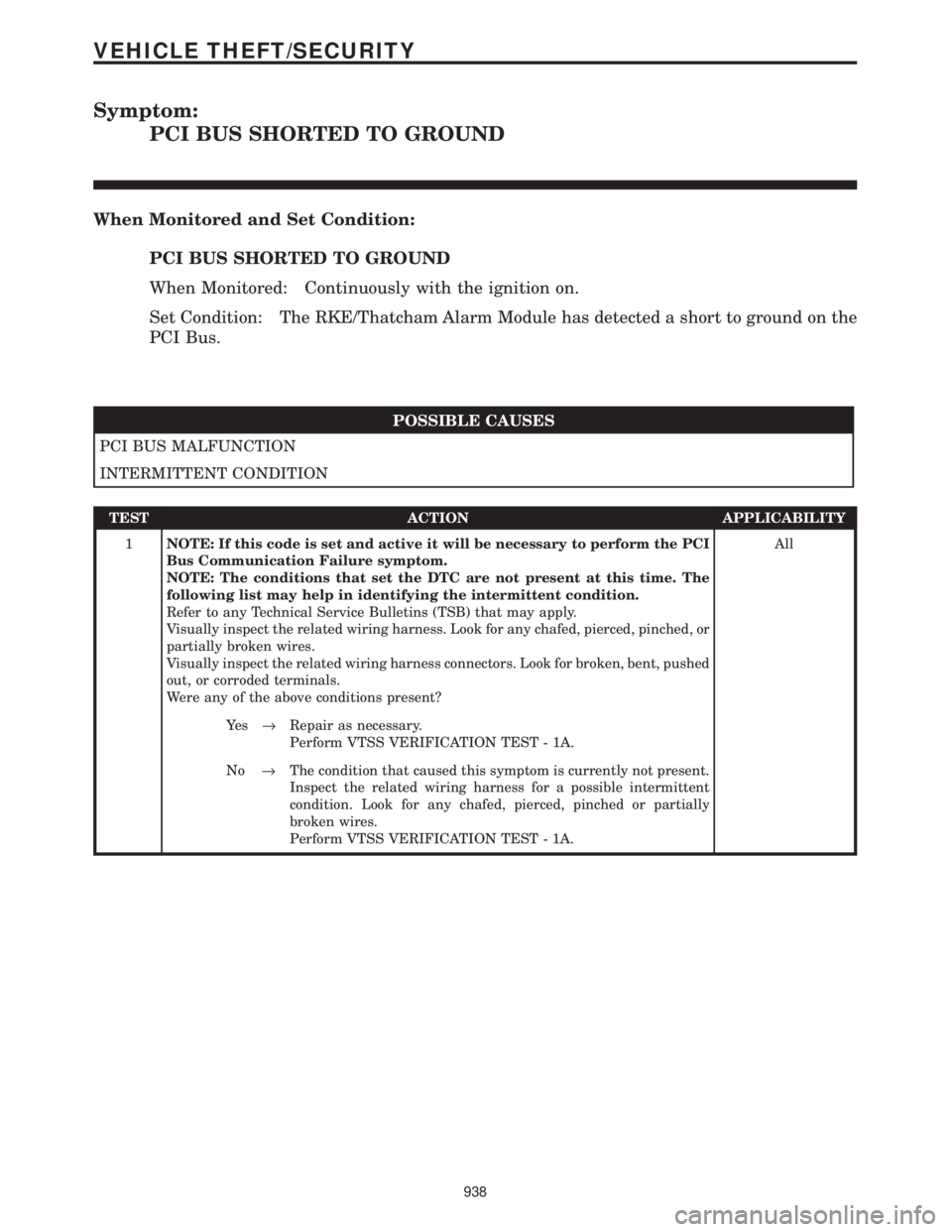
PCI BUS SHORTED TO GROUND
When Monitored and Set Condition:
PCI BUS SHORTED TO GROUND
When Monitored: Continuously with the ignition on.
Set Condition: The RKE/Thatcham Alarm Module has detected a short to ground on the
PCI Bus.
POSSIBLE CAUSES
PCI BUS MALFUNCTION
INTERMITTENT CONDITION
TEST ACTION APPLICABILITY
1NOTE: If this code is set and active it will be necessary to perform the PCI
Bus Communication Failure symptom.
NOTE: The conditions that set the DTC are not present at this time. The
following list may help in identifying the intermittent condition.
Refer to any Technical Service Bulletins (TSB) that may apply.
Visually inspect the related wiring harness. Look for any chafed, pierced, pinched, or
partially broken wires.
Visually inspect the related wiring harness connectors. Look for broken, bent, pushed
out, or corroded terminals.
Were any of the above conditions present?All
Ye s®Repair as necessary.
Perform VTSS VERIFICATION TEST - 1A.
No®The condition that caused this symptom is currently not present.
Inspect the related wiring harness for a possible intermittent
condition. Look for any chafed, pierced, pinched or partially
broken wires.
Perform VTSS VERIFICATION TEST - 1A.
938
VEHICLE THEFT/SECURITY
Page 968 of 4284
Symptom:
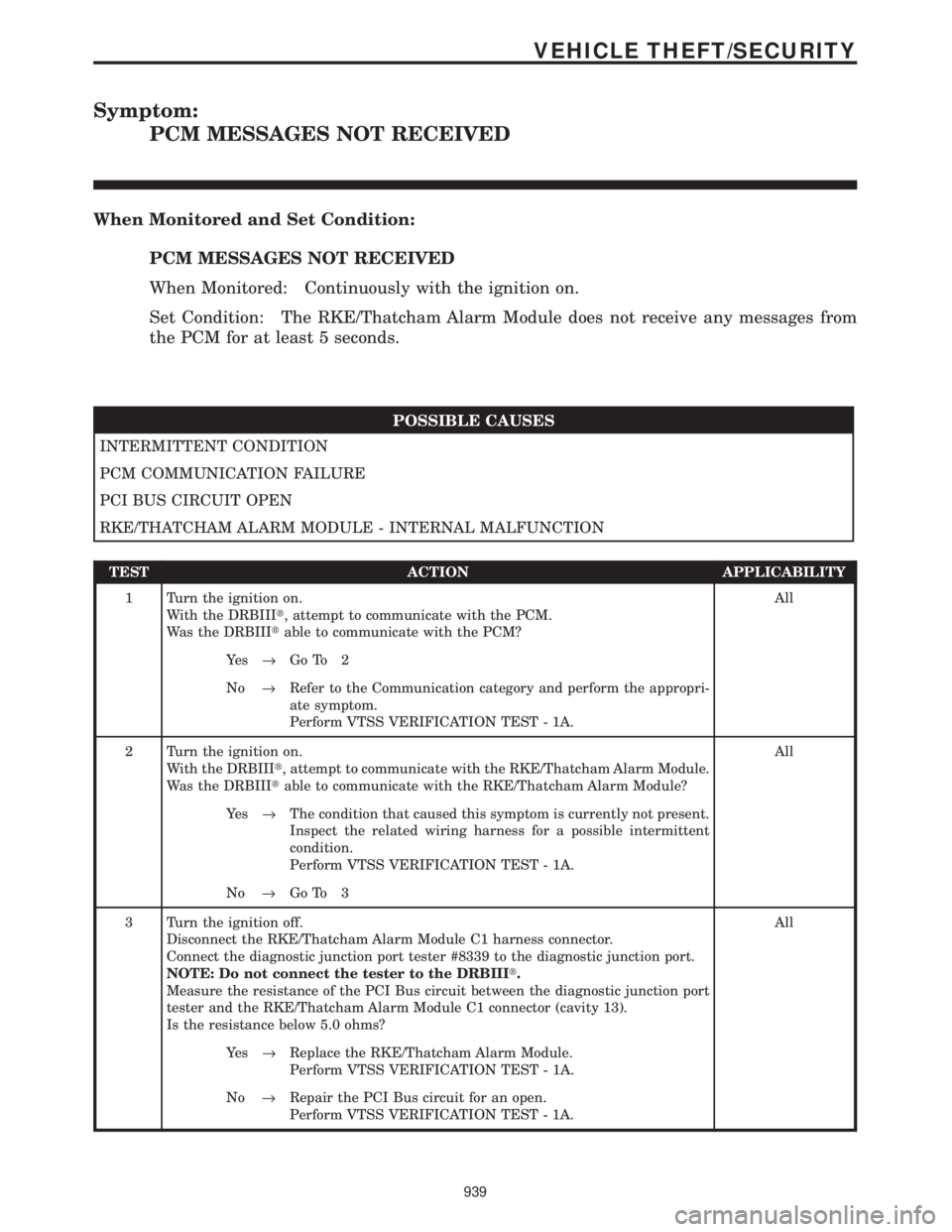
PCM MESSAGES NOT RECEIVED
When Monitored and Set Condition:
PCM MESSAGES NOT RECEIVED
When Monitored: Continuously with the ignition on.
Set Condition: The RKE/Thatcham Alarm Module does not receive any messages from
the PCM for at least 5 seconds.
POSSIBLE CAUSES
INTERMITTENT CONDITION
PCM COMMUNICATION FAILURE
PCI BUS CIRCUIT OPEN
RKE/THATCHAM ALARM MODULE - INTERNAL MALFUNCTION
TEST ACTION APPLICABILITY
1 Turn the ignition on.
With the DRBIIIt, attempt to communicate with the PCM.
Was the DRBIIItable to communicate with the PCM?All
Ye s®Go To 2
No®Refer to the Communication category and perform the appropri-
ate symptom.
Perform VTSS VERIFICATION TEST - 1A.
2 Turn the ignition on.
With the DRBIIIt, attempt to communicate with the RKE/Thatcham Alarm Module.
Was the DRBIIItable to communicate with the RKE/Thatcham Alarm Module?All
Ye s®The condition that caused this symptom is currently not present.
Inspect the related wiring harness for a possible intermittent
condition.
Perform VTSS VERIFICATION TEST - 1A.
No®Go To 3
3 Turn the ignition off.
Disconnect the RKE/Thatcham Alarm Module C1 harness connector.
Connect the diagnostic junction port tester #8339 to the diagnostic junction port.
NOTE: Do not connect the tester to the DRBIIIt.
Measure the resistance of the PCI Bus circuit between the diagnostic junction port
tester and the RKE/Thatcham Alarm Module C1 connector (cavity 13).
Is the resistance below 5.0 ohms?All
Ye s®Replace the RKE/Thatcham Alarm Module.
Perform VTSS VERIFICATION TEST - 1A.
No®Repair the PCI Bus circuit for an open.
Perform VTSS VERIFICATION TEST - 1A.
939
VEHICLE THEFT/SECURITY
Page 969 of 4284
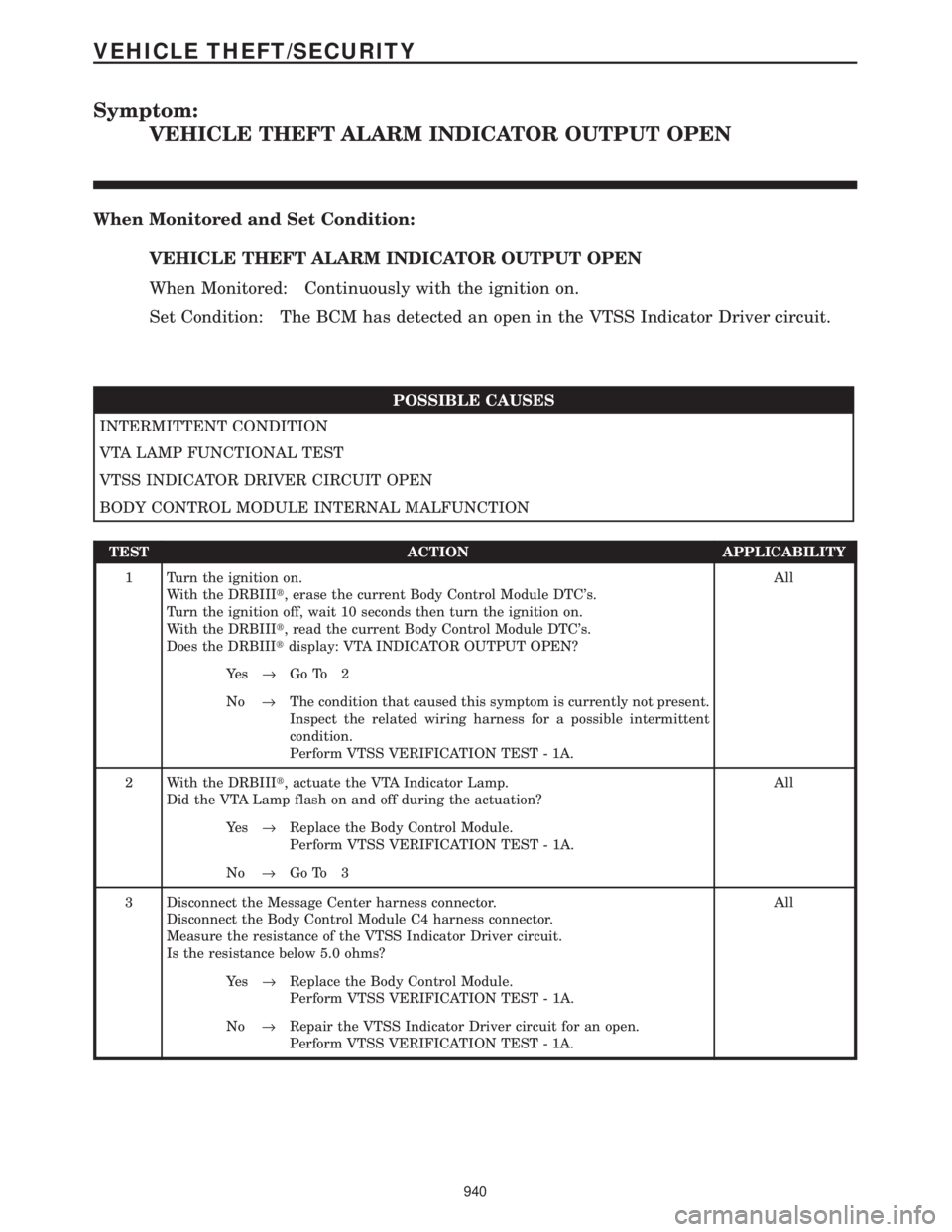
Symptom:
VEHICLE THEFT ALARM INDICATOR OUTPUT OPEN
When Monitored and Set Condition:
VEHICLE THEFT ALARM INDICATOR OUTPUT OPEN
When Monitored: Continuously with the ignition on.
Set Condition: The BCM has detected an open in the VTSS Indicator Driver circuit.
POSSIBLE CAUSES
INTERMITTENT CONDITION
VTA LAMP FUNCTIONAL TEST
VTSS INDICATOR DRIVER CIRCUIT OPEN
BODY CONTROL MODULE INTERNAL MALFUNCTION
TEST ACTION APPLICABILITY
1 Turn the ignition on.
With the DRBIIIt, erase the current Body Control Module DTC's.
Turn the ignition off, wait 10 seconds then turn the ignition on.
With the DRBIIIt, read the current Body Control Module DTC's.
Does the DRBIIItdisplay: VTA INDICATOR OUTPUT OPEN?All
Ye s®Go To 2
No®The condition that caused this symptom is currently not present.
Inspect the related wiring harness for a possible intermittent
condition.
Perform VTSS VERIFICATION TEST - 1A.
2 With the DRBIIIt, actuate the VTA Indicator Lamp.
Did the VTA Lamp flash on and off during the actuation?All
Ye s®Replace the Body Control Module.
Perform VTSS VERIFICATION TEST - 1A.
No®Go To 3
3 Disconnect the Message Center harness connector.
Disconnect the Body Control Module C4 harness connector.
Measure the resistance of the VTSS Indicator Driver circuit.
Is the resistance below 5.0 ohms?All
Ye s®Replace the Body Control Module.
Perform VTSS VERIFICATION TEST - 1A.
No®Repair the VTSS Indicator Driver circuit for an open.
Perform VTSS VERIFICATION TEST - 1A.
940
VEHICLE THEFT/SECURITY
Page 970 of 4284
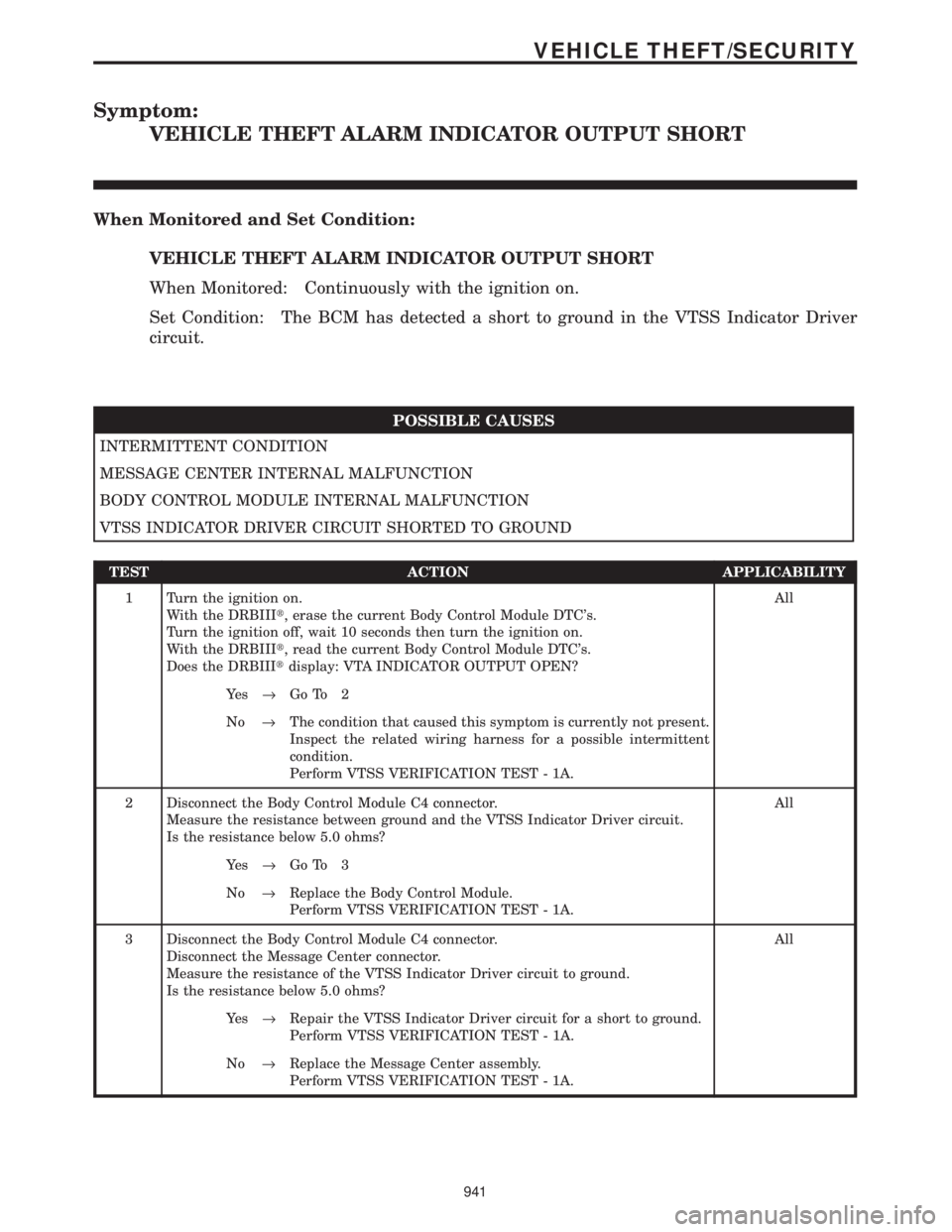
Symptom:
VEHICLE THEFT ALARM INDICATOR OUTPUT SHORT
When Monitored and Set Condition:
VEHICLE THEFT ALARM INDICATOR OUTPUT SHORT
When Monitored: Continuously with the ignition on.
Set Condition: The BCM has detected a short to ground in the VTSS Indicator Driver
circuit.
POSSIBLE CAUSES
INTERMITTENT CONDITION
MESSAGE CENTER INTERNAL MALFUNCTION
BODY CONTROL MODULE INTERNAL MALFUNCTION
VTSS INDICATOR DRIVER CIRCUIT SHORTED TO GROUND
TEST ACTION APPLICABILITY
1 Turn the ignition on.
With the DRBIIIt, erase the current Body Control Module DTC's.
Turn the ignition off, wait 10 seconds then turn the ignition on.
With the DRBIIIt, read the current Body Control Module DTC's.
Does the DRBIIItdisplay: VTA INDICATOR OUTPUT OPEN?All
Ye s®Go To 2
No®The condition that caused this symptom is currently not present.
Inspect the related wiring harness for a possible intermittent
condition.
Perform VTSS VERIFICATION TEST - 1A.
2 Disconnect the Body Control Module C4 connector.
Measure the resistance between ground and the VTSS Indicator Driver circuit.
Is the resistance below 5.0 ohms?All
Ye s®Go To 3
No®Replace the Body Control Module.
Perform VTSS VERIFICATION TEST - 1A.
3 Disconnect the Body Control Module C4 connector.
Disconnect the Message Center connector.
Measure the resistance of the VTSS Indicator Driver circuit to ground.
Is the resistance below 5.0 ohms?All
Ye s®Repair the VTSS Indicator Driver circuit for a short to ground.
Perform VTSS VERIFICATION TEST - 1A.
No®Replace the Message Center assembly.
Perform VTSS VERIFICATION TEST - 1A.
941
VEHICLE THEFT/SECURITY
Page 971 of 4284
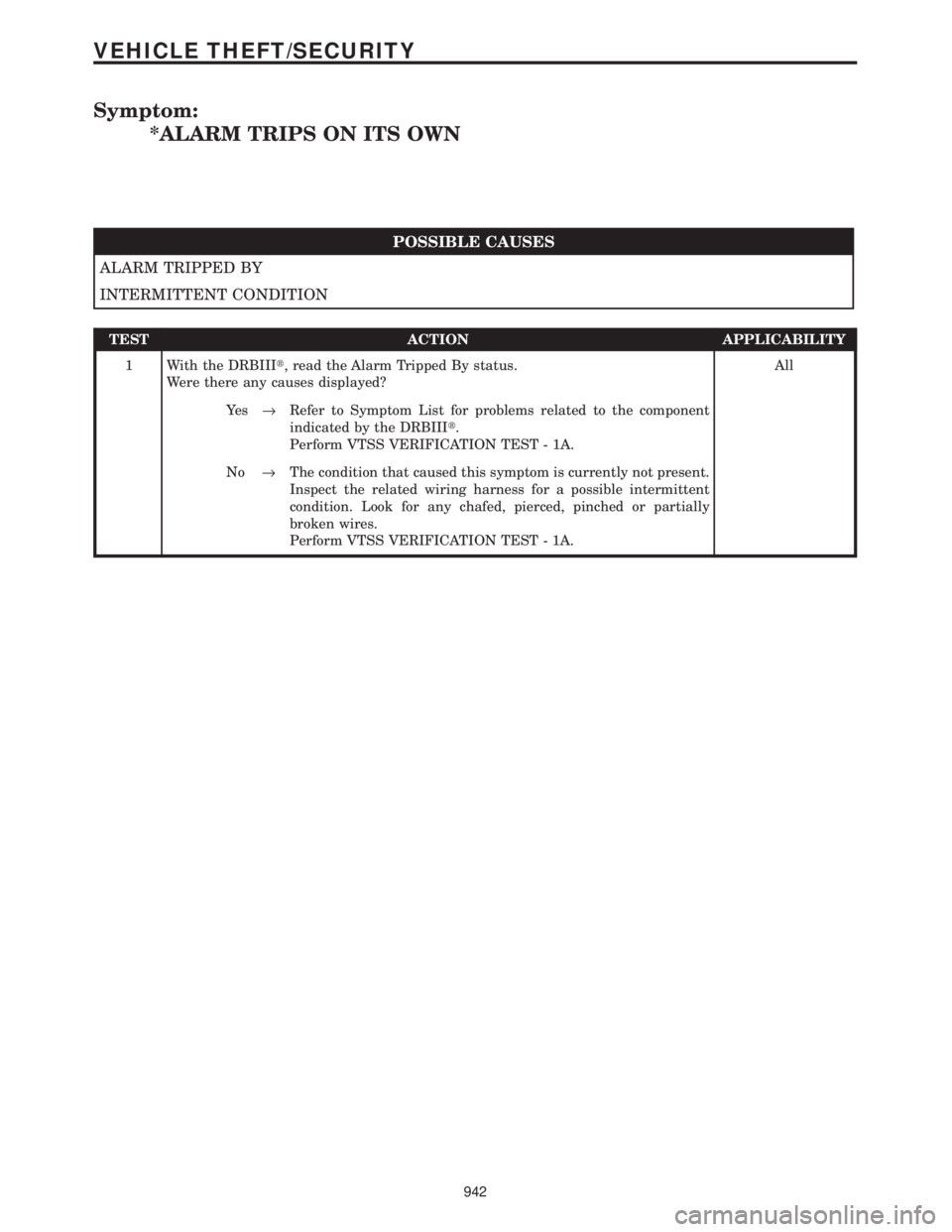
Symptom:
*ALARM TRIPS ON ITS OWN
POSSIBLE CAUSES
ALARM TRIPPED BY
INTERMITTENT CONDITION
TEST ACTION APPLICABILITY
1 With the DRBIIIt, read the Alarm Tripped By status.
Were there any causes displayed?All
Ye s®Refer to Symptom List for problems related to the component
indicated by the DRBIIIt.
Perform VTSS VERIFICATION TEST - 1A.
No®The condition that caused this symptom is currently not present.
Inspect the related wiring harness for a possible intermittent
condition. Look for any chafed, pierced, pinched or partially
broken wires.
Perform VTSS VERIFICATION TEST - 1A.
942
VEHICLE THEFT/SECURITY
Page 981 of 4284
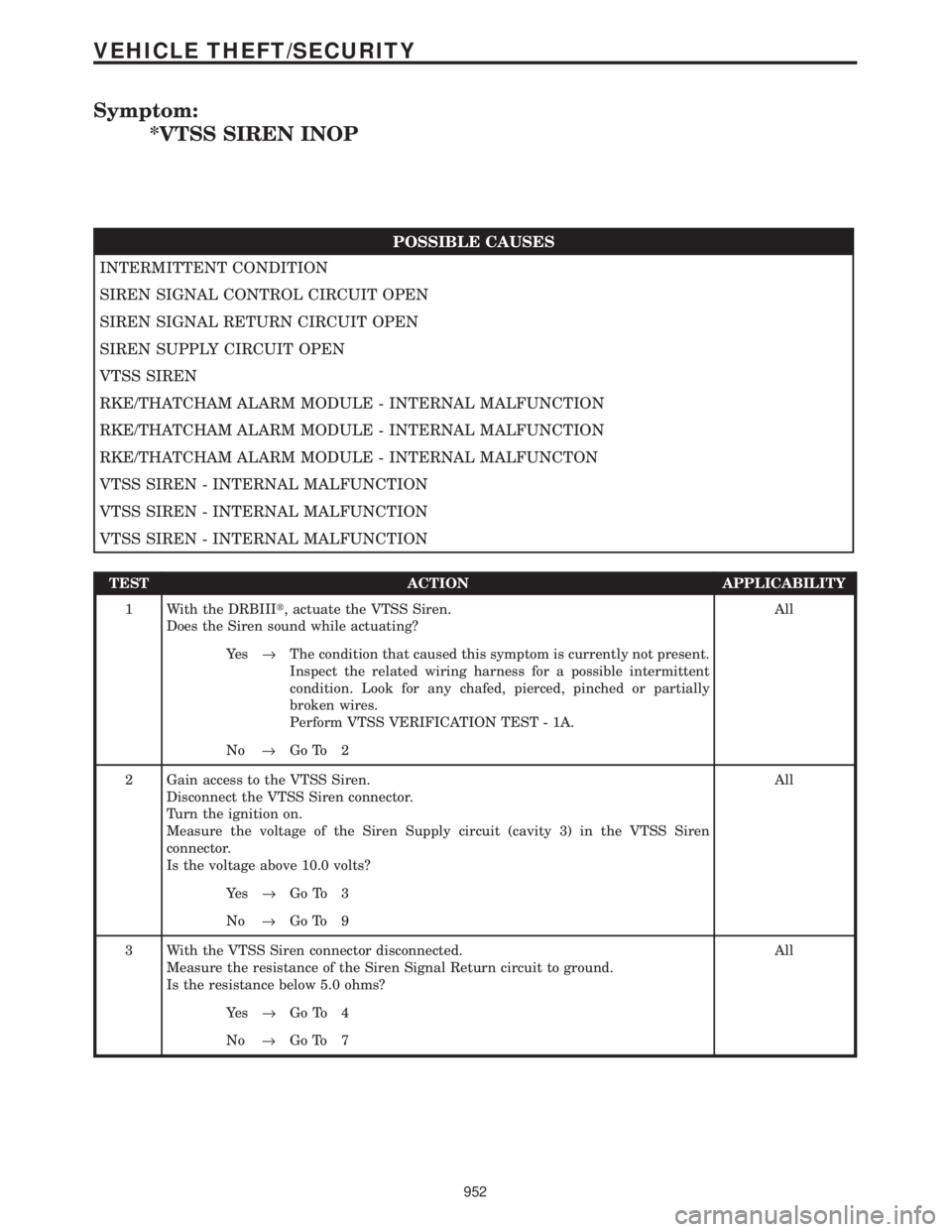
Symptom:
*VTSS SIREN INOP
POSSIBLE CAUSES
INTERMITTENT CONDITION
SIREN SIGNAL CONTROL CIRCUIT OPEN
SIREN SIGNAL RETURN CIRCUIT OPEN
SIREN SUPPLY CIRCUIT OPEN
VTSS SIREN
RKE/THATCHAM ALARM MODULE - INTERNAL MALFUNCTION
RKE/THATCHAM ALARM MODULE - INTERNAL MALFUNCTION
RKE/THATCHAM ALARM MODULE - INTERNAL MALFUNCTON
VTSS SIREN - INTERNAL MALFUNCTION
VTSS SIREN - INTERNAL MALFUNCTION
VTSS SIREN - INTERNAL MALFUNCTION
TEST ACTION APPLICABILITY
1 With the DRBIIIt, actuate the VTSS Siren.
Does the Siren sound while actuating?All
Ye s®The condition that caused this symptom is currently not present.
Inspect the related wiring harness for a possible intermittent
condition. Look for any chafed, pierced, pinched or partially
broken wires.
Perform VTSS VERIFICATION TEST - 1A.
No®Go To 2
2 Gain access to the VTSS Siren.
Disconnect the VTSS Siren connector.
Turn the ignition on.
Measure the voltage of the Siren Supply circuit (cavity 3) in the VTSS Siren
connector.
Is the voltage above 10.0 volts?All
Ye s®Go To 3
No®Go To 9
3 With the VTSS Siren connector disconnected.
Measure the resistance of the Siren Signal Return circuit to ground.
Is the resistance below 5.0 ohms?All
Ye s®Go To 4
No®Go To 7
952
VEHICLE THEFT/SECURITY
Page 988 of 4284
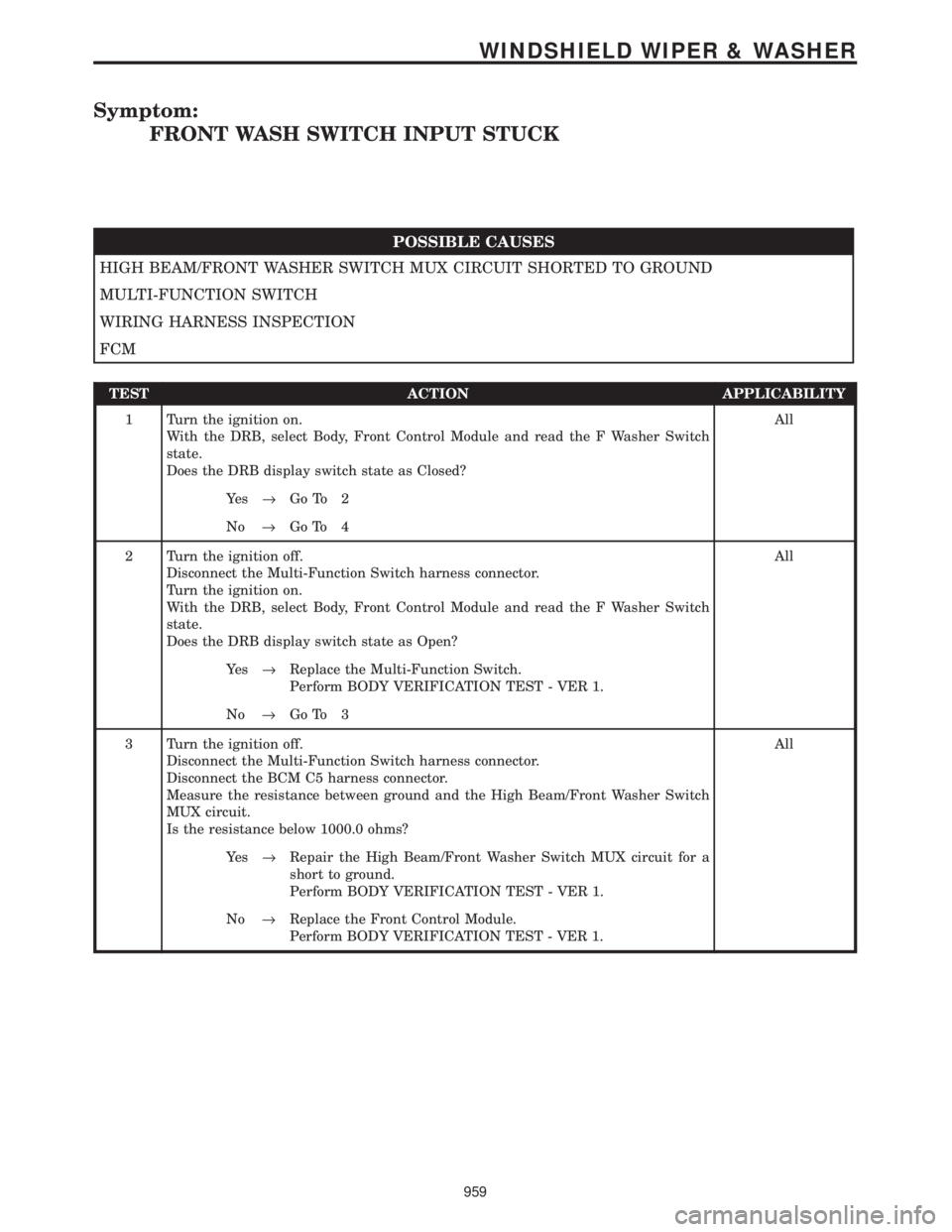
Symptom:
FRONT WASH SWITCH INPUT STUCK
POSSIBLE CAUSES
HIGH BEAM/FRONT WASHER SWITCH MUX CIRCUIT SHORTED TO GROUND
MULTI-FUNCTION SWITCH
WIRING HARNESS INSPECTION
FCM
TEST ACTION APPLICABILITY
1 Turn the ignition on.
With the DRB, select Body, Front Control Module and read the F Washer Switch
state.
Does the DRB display switch state as Closed?All
Ye s®Go To 2
No®Go To 4
2 Turn the ignition off.
Disconnect the Multi-Function Switch harness connector.
Turn the ignition on.
With the DRB, select Body, Front Control Module and read the F Washer Switch
state.
Does the DRB display switch state as Open?All
Ye s®Replace the Multi-Function Switch.
Perform BODY VERIFICATION TEST - VER 1.
No®Go To 3
3 Turn the ignition off.
Disconnect the Multi-Function Switch harness connector.
Disconnect the BCM C5 harness connector.
Measure the resistance between ground and the High Beam/Front Washer Switch
MUX circuit.
Is the resistance below 1000.0 ohms?All
Ye s®Repair the High Beam/Front Washer Switch MUX circuit for a
short to ground.
Perform BODY VERIFICATION TEST - VER 1.
No®Replace the Front Control Module.
Perform BODY VERIFICATION TEST - VER 1.
959
WINDSHIELD WIPER & WASHER
Page 989 of 4284
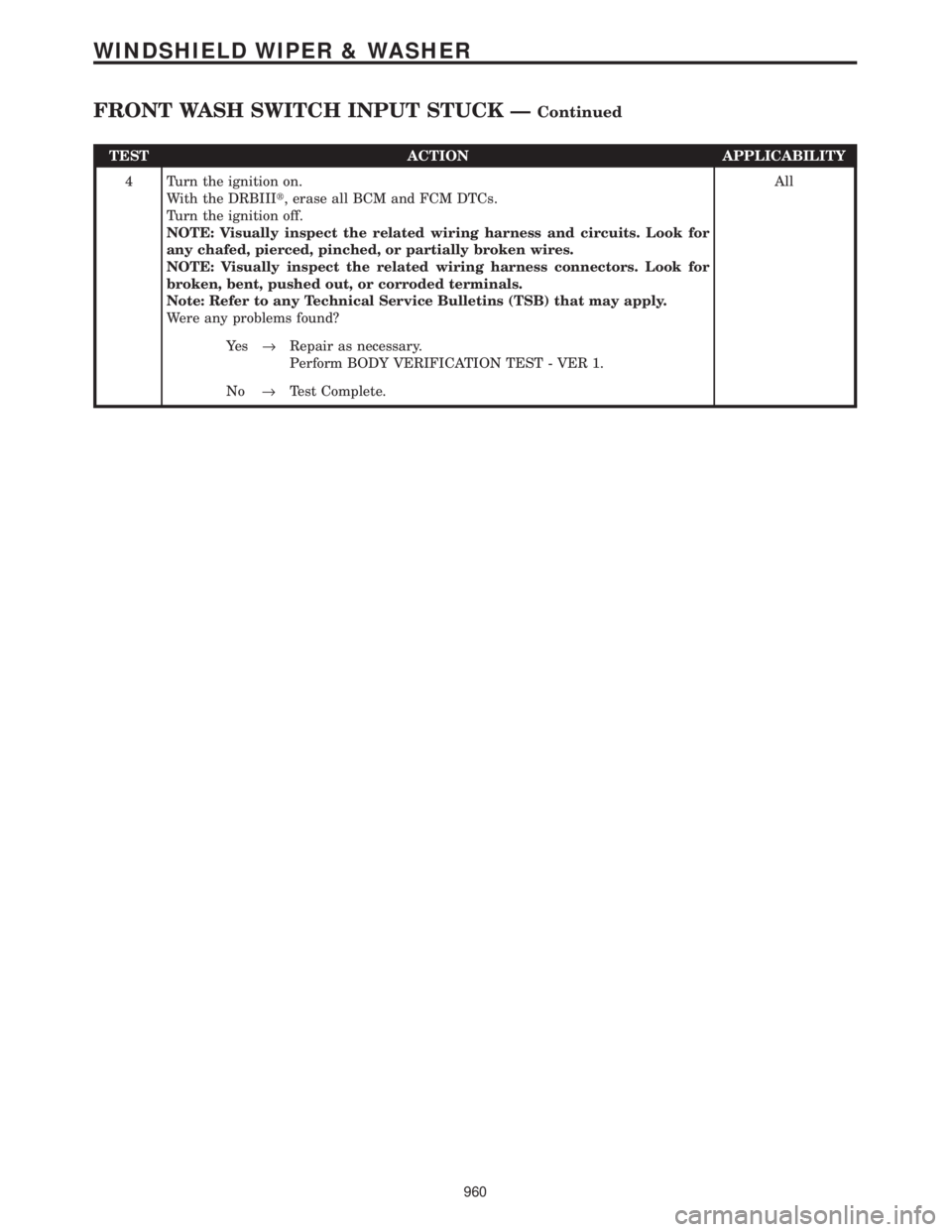
TEST ACTION APPLICABILITY
4 Turn the ignition on.
With the DRBIIIt, erase all BCM and FCM DTCs.
Turn the ignition off.
NOTE: Visually inspect the related wiring harness and circuits. Look for
any chafed, pierced, pinched, or partially broken wires.
NOTE: Visually inspect the related wiring harness connectors. Look for
broken, bent, pushed out, or corroded terminals.
Note: Refer to any Technical Service Bulletins (TSB) that may apply.
Were any problems found?All
Ye s®Repair as necessary.
Perform BODY VERIFICATION TEST - VER 1.
No®Test Complete.
960
WINDSHIELD WIPER & WASHER
FRONT WASH SWITCH INPUT STUCK ÐContinued