fold seats CITROEN BERLINGO VAN 2021 Handbook (in English)
[x] Cancel search | Manufacturer: CITROEN, Model Year: 2021, Model line: BERLINGO VAN, Model: CITROEN BERLINGO VAN 2021Pages: 260, PDF Size: 7.57 MB
Page 39 of 260
37
Ease of use and comfort
3General
recommendations for the
seats
For safety reasons, seat adjustments
must only be made when the vehicle is
stationary.
Folding or unfolding the seat backrests
must only be done with the vehicle
stationary.
Before moving the seat backwards,
ensure that there is no person or object
that might prevent the full travel of the seat.
There is a risk of trapping or pinching
passengers if present in the rear seats or of
jamming the seat if large objects are placed
on the floor behind the seat.
Do not place hard or heavy objects on
the backrests forming a table. They could
become dangerous projectiles in the event of
sudden braking or a collision.
–
Do not remove a head restraint without
stowing it; secure it to a support inside the
vehicle.
–
Check that the seat belts remain accessible
to the passenger and easy to fasten.
–
Passengers must never take their seat
without adjusting and fastening their seat belt.
– In row 3, be careful not to leave your feet
under the row 2 seat while it is being tilted.
–
When a row 3 seat is in the fully folded
position, ensure that the strap is correctly
hooked to the
Top Tether fixing of the row 2
backrest: risk of unexpected tipping of the
seat.
Before carrying out the manoeuvres,
check that nothing and no one is
obstructing the moving elements and their
locking.
To avoid sudden folding, take care to hold the
backrest and support it until it is horizontal.
Never put your hand underneath the seat
cushion to guide the seat downwards or
upwards, you could get your fingers trapped.
Place your hand on the grip/strap (depending
on equipment) at the top of the seat cushion.
Please note: an incorrectly latched
backrest compromises the safety of
passengers in the event of sudden braking or
an impact.
The contents of the boot may be thrown
forward - risk of severe injury!
Front seats
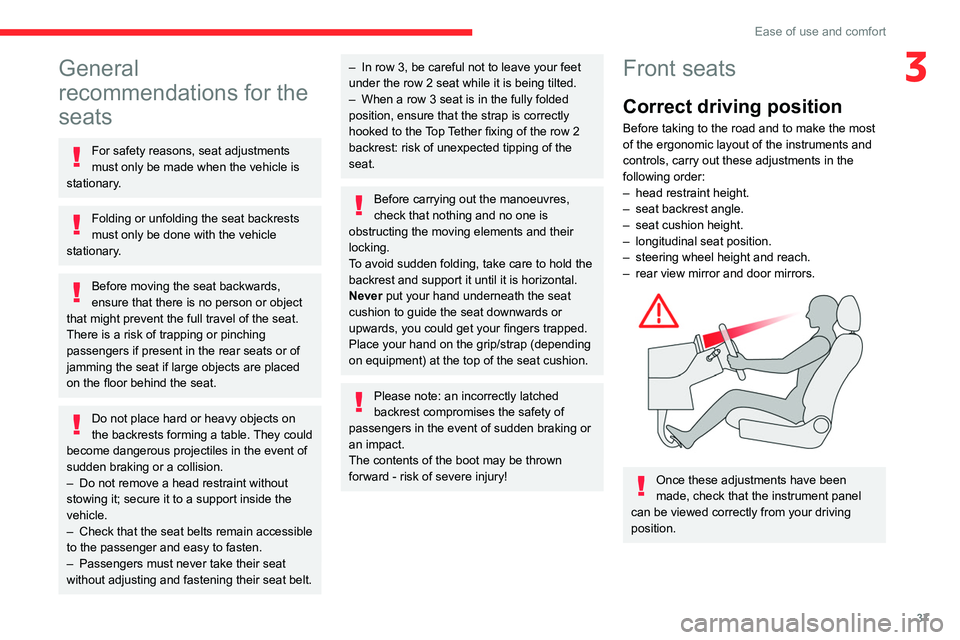
Correct driving position
Before taking to the road and to make the most
of the ergonomic layout of the instruments and
controls, carry out these adjustments in the
following order:
–
head restraint height.
–
seat backrest angle.
–
seat cushion height.
–
longitudinal seat position.
–
steering wheel height and reach.
–
rear view mirror and door mirrors.
Once these adjustments have been
made, check that the instrument panel
can be viewed correctly from your driving
position.
Page 43 of 260

41
Ease of use and comfort
3Heated mirrors
► Press this button.
For more information on Rear screen
demisting/defrosting , refer to the
corresponding section.
Interior rear view mirror
Equipped with an anti-dazzle system, which
darkens the mirror glass and reduces the
nuisance to the driver caused by the sun,
headlamps of other vehicles, etc.
Manual model
Day/night position
► Pull the lever to change to the anti-dazzle
"night” position.
►
Push the lever to change to the normal "day"
position.
Adjustment
►
Set the mirror to the normal “day” position.
Automatic "electrochrome" model
This system automatically and gradually
transitions between day and night use, with the
aid of a sensor that measures the light arriving
from the rear of the vehicle.
To ensure optimum visibility while manoeuvring, the mirror lightens
automatically when reverse gear is engaged.
Child-monitoring mirror
A child-monitoring mirror is installed above
the interior rear view mirror. It allows the
vehicle's rear passengers to be observed and
facilitates discussion between the front and rear
passengers without changing the mirror setting
and without turning around. It can be folded
easily to avoid dazzle.
Rear bench seat (row 2)
Folding the backrests
First steps:
► lower the head restraints,
►
if necessary
, move the front seats forward,
►
check that nothing or no person might
interfere with the folding of the backrests
(clothing, luggage, etc.),
►
check that the outer seat belts are lying flat
on the backrests.
The folding of the backrest is accompanied by a slight lowering of the
corresponding seat cushion.
When the backrest is released, the red
indicator is visible in the release grips on the
outer seats.
► Turn the backrest release handle 1.
Page 44 of 260
42
Ease of use and comfort
Central seat
► Pull the backrest release paddle 2 or 3
towards you.
The backrest folds fully onto the cushion.
Repositioning the backrests
Outer seat (left-hand or right-hand)
First check that the outer seat belts are
lying vertically flat alongside the backrest
latching rings.
► Put the backrest in the upright position and
push it firmly to latch it home.
► Check that the red indicator on the release
grips 1 of the outer seats is no longer visible.
► Ensure that the outer seat belts are not
trapped during the manoeuvre.
Check that the backrest of the upright
central seat is correctly aligned with the
backrests of the outer seats.
► Guide the backrest down to the horizontal
position.
Repositioning the backrests
First check that the outer seat belts are
lying vertically flat alongside the backrest
latching rings.
►
Put the backrest in the upright position and
push it firmly to latch it home.
►
Check that the red indicator in the release
grip
1 is no longer visible.
►
Ensure that the outer seat belts are not
trapped during the manoeuvre.
Rear seats (row 2)
Folding the backrests
First steps:
► lower the head restraints,
►
if necessary
, move the front seats forward,
►
check that nothing or no person might
interfere with the folding of the backrests
(clothing, luggage, etc.),
►
check that the outer seat belts are lying flat
on the backrests.
The folding of the backrest is accompanied by a slight lowering of the
corresponding seat cushion.
When the backrest is released, the red
indicator is visible in the release grips on the
outer seats.
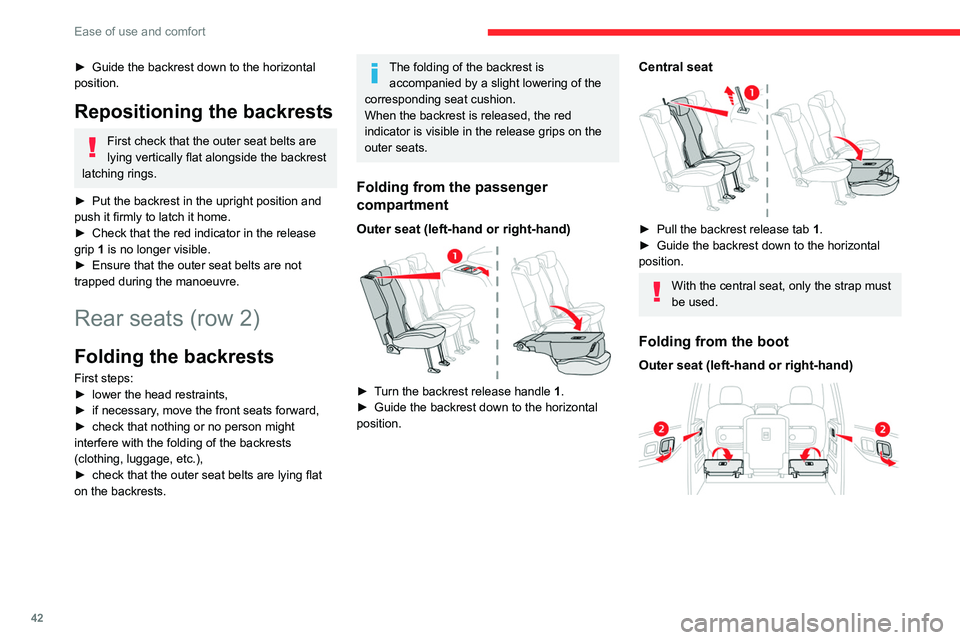
Folding from the passenger
compartment
Outer seat (left-hand or right-hand)
► Turn the backrest release handle 1.
► Guide the backrest down to the horizontal
position.
Central seat
► Pull the backrest release tab 1 .
► Guide the backrest down to the horizontal
position.
With the central seat, only the strap must
be used.
Folding from the boot
Outer seat (left-hand or right-hand)
Page 45 of 260
43
Ease of use and comfort
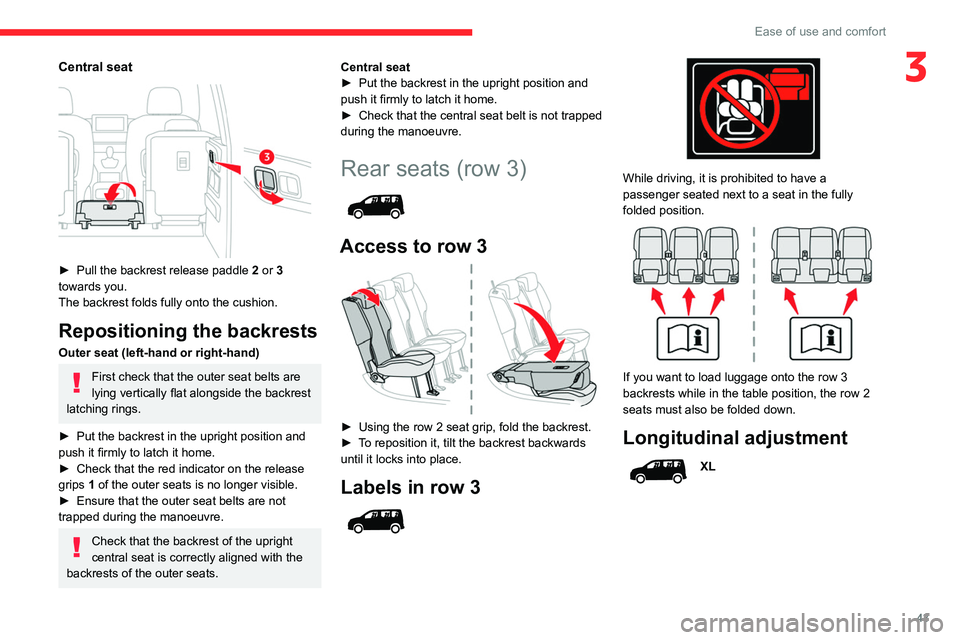
3Central seat
► Pull the backrest release paddle 2 or 3
towards you.
The backrest folds fully onto the cushion.
Repositioning the backrests
Outer seat (left-hand or right-hand)
First check that the outer seat belts are
lying vertically flat alongside the backrest
latching rings.
►
Put the backrest in the upright position and
push it firmly to latch it home.
►
Check that the red indicator on the release
grips
1 of the outer seats is no longer visible.
►
Ensure that the outer seat belts are not
trapped during the manoeuvre.
Check that the backrest of the upright
central seat is correctly aligned with the
backrests of the outer seats. Central seat
►
Put the backrest in the upright position and
push it firmly to latch it home.
►
Check that the central seat belt is not trapped
during the manoeuvre.
Rear seats (row 3)
Access to row 3
► Using the row 2 seat grip, fold the backrest.
► T o reposition it, tilt the backrest backwards
until it locks into place.
Labels in row 3
While driving, it is prohibited to have a
passenger seated next to a seat in the fully
folded position.
If you want to load luggage onto the row 3
backrests while in the table position, the row 2
seats must also be folded down.
Longitudinal adjustment
XL
Page 51 of 260

49
Ease of use and comfort
3If the problem persists, have the system checked
by a CITROËN dealer or a qualified workshop.
Floor boxes
There are two boxes located under the rear
passenger footwells.
►
T
o open them, slide your fingers into the
notch and lift the cover.
Aircraft style tables
► To put the table back in place, pull it upwards.
As a safety precaution, the aircraft style table
unhooks itself if excessive pressure is applied.
► To store the table, pull it downwards.
Do not place hard or heavy objects on
the table. Such objects could become
projectiles in the event of sudden
deceleration.
Side blinds
They are fitted to the windows of the sliding side
doors (depending on version).
► To raise or lower the blind, pull it by the tab.
To avoid damaging the blind: – Guide it slowly , using the tab, while
raising or lowering it.
–
Make sure the tab is securely fastened
before opening the door
.
High load retaining net
This net, hooked onto the upper mountings and
the lower rings or lugs, enables the use of the full
loading volume, up to the roof:
–
Behind the front seats (row 1) when the rear
seats are folded.
–
Behind the rear seats (row 2).
When positioning the net, check that the
strap loops are visible from the boot; this
will make slackening or tightening them
easier.
Remove the luggage cover shelf or roller
(depending on version).
Page 52 of 260

50
Ease of use and comfort
low position, you can store it folded by sliding it
towards the backrests of the rear seats.
► To deploy it from the boot, grasp it and unfold
it to the boot pillars.
The maximum authorised weight on the luggage cover shelf is 25 kg.
Luggage cover
XL
XL
In the 5-seat configuration, it is installed behind
the second row seats, with the third row seats
stored folded away.
In the 7-seat configuration, it is stored behind the
third row seats.
In the event of sudden deceleration,
objects placed on the load space cover
can turn into projectiles.
Installation behind row 1
► Open the covers on the upper mountings 1 .
► Unroll the high load retaining net.
►
Position one end of the net's metal bar in the
corresponding upper mounting 1
, then do the
same with the other end.
►
Fully extend the straps.
► Wind each strap around bar 3 located under
the front seat cushion (row 1), then secure each spring hook to the ring on the corresponding
strap.
►
Fold down the rear seats.
►
T
ighten the straps without raising the bench
seat.
►
Check that the net is hooked and tightened
correctly
.
Installation behind row 2
► Fold or remove the luggage cover
.
► Open the covers on the upper mountings 2
.
►
Unroll the high load retaining net.
►
Position one end of the net's metal bar in the
corresponding upper mounting 2
, then do the
same with the other end.
►
Attach the hook on each of the net's straps
to the corresponding stowing ring 4
(located on
the floor).
►
T
ighten the straps.
►
Check that the net is hooked and tightened
correctly
.
Never use the ISOFIX ring, which is for
fixing the strap of a child seat with Top
Tether.
Two-position luggage cover
shelf (removable)
M
M
It can be installed in two different positions: high
and low.
It consists of two sections which can be folded
back on each other.
►
T
o fold it from the boot, grasp it and fold it
back on itself up to the rear seats. From the
Page 53 of 260

51
Ease of use and comfort
3low position, you can store it folded by sliding it
towards the backrests of the rear seats.
►
T
o deploy it from the boot, grasp it and unfold
it to the boot pillars.
The maximum authorised weight on the luggage cover shelf is 25 kg.
Luggage cover
XL
XL
In the 5-seat configuration, it is installed behind
the second row seats, with the third row seats
stored folded away.
In the 7-seat configuration, it is stored behind the
third row seats.
In the event of sudden deceleration,
objects placed on the load space cover
can turn into projectiles.
Installation
► Position the left and right ends of the roller in
the cut-outs A.
►
Pull out the roller until it reaches the boot
pillars.
►
Insert the roller guides into the rails in the
pillars B
.
► Depending on version, you can access the
boot by opening the rear screen in the tailgate
and attaching the roller guides into the rails in
the pillars C
.
► The roller can be stored behind row 2 or 3.
Removal
► Remove the roller guides from the rails in
pillars B
.
►
Guide the roller as it reels in.
►
Unlock the roller by pressing one of the
handles located at the ends of the roller bracket.
Stowing rings
Use the stowing rings on the rear floor to secure
loads.
Page 80 of 260

78
Safety
Rear seat belt(s) warning lamp(s)
The corresponding warning lamp (3 to 5) lights
up red in the seat belt and front passenger
airbag warning lamps display screen if one or
more rear passengers (row 2) unfasten their seat
belt.
These seat belt warning lamps only apply to row 2.
Advice
The driver must ensure that passengers use the seat belts correctly and that they
are all fastened before setting off.
Wherever you are seated in the vehicle,
always fasten your seat belt, even for short
journeys.
Do not interchange the seat belt buckles, as
they will not fulfil their role fully.
Before and after use, ensure that the seat belt
is reeled in correctly.
After folding or moving a seat or rear bench
seat, ensure that the seat belt is positioned
and reeled in correctly.
Installation
The lower part of the strap must be
positioned as low as possible on the pelvis.
Outer seats
Depending on equipment, they may be fitted with
a single pretensioning system and force limiters.
Be sure to put the correct seat belt in the correct
buckle.
Do not interchange the belts or buckles for the
outer seats with the belt or buckle for the centre
seat.
Centre seat
The seat belt does not have a pyrotechnic
pretensioning system and force limiters.
Installation
► Pull the strap and insert the tongue A into the
right buckle (located on the passenger’s left side
when seated in the vehicle).
►
Insert the tongue
B into the left buckle
(located on the passenger’s right side when
seated in the vehicle).
►
Check that each buckle is fastened correctly
by pulling the strap.
Removal and storage
► Press the red button on buckle B , then the
button on buckle A.
►
Guide the strap as it reels in and take tongue
B
, then A to the magnet at the anchoring point
on the roof.
Before performing any operations on the
rear seats, to avoid damage to the seat
belts check that the lateral belts are properly
tensioned. The central seat belt must be
completely reeled in.
Rear seat belts (row 3)
These seat belts are not fitted with a pyrotechnic
pretensioning system or force limiter.
Seat belt(s) warning lamps
1. Front left seat belt warning lamp (or
depending on country, driver’s warning lamp).
2. Front right seat belt warning lamp (or
depending on country, driver’s warning lamp).
3. Rear right seat belt warning lamp (row 2).
4. Rear centre seat belt warning lamp (row 2).
5. Rear left seat belt warning lamp (row 2).
At speeds above approximately 12 mph
(20
km/h), the warning lamp(s) flashes for 2
minutes, accompanied by an audible signal.
Once these 2 minutes have elapsed, the warning
lamp(s) remains on until the driver or the front
passenger and/or the rear passenger(s) fasten
their seat belt.
Front seat belt warning lamp(s)
On switching on the ignition, warning lamp
1 comes on in the instrument panel, and the
corresponding warning lamp ( 1 or 2) comes on
in red in the seat belt and front passenger airbag
warning lamp display if the driver's seat belt and/
or the passenger(s) seat belt is/are not fastened
or is/are unfastened.
Page 81 of 260

79
Safety
5Rear seat belt(s) warning lamp(s)
The corresponding warning lamp (3 to 5) lights
up red in the seat belt and front passenger
airbag warning lamps display screen if one or
more rear passengers (row 2) unfasten their seat
belt.
These seat belt warning lamps only apply to row 2.
Advice
The driver must ensure that passengers use the seat belts correctly and that they
are all fastened before setting off.
Wherever you are seated in the vehicle,
always fasten your seat belt, even for short
journeys.
Do not interchange the seat belt buckles, as
they will not fulfil their role fully.
Before and after use, ensure that the seat belt
is reeled in correctly.
After folding or moving a seat or rear bench
seat, ensure that the seat belt is positioned
and reeled in correctly.
Installation
The lower part of the strap must be
positioned as low as possible on the pelvis.
The upper part must be positioned in the
hollow of the shoulder.
In order to be effective, a seat belt must:
–
be tightened as close to the body as
possible,
–
be pulled in front of you with a smooth
movement, checking that it does not twist,
–
be used to restrain only one person,
–
not show any signs of cuts or fraying,
–
not be converted or modified in order not to
affect its performance.
Recommendations for children
Use a suitable child seat if the passenger
is less than 12 years old or shorter than one
and a half metres.
Never use the same seat belt to secure more
than one child.
Never carry a child on your lap.
For more information on Child seats, refer to
the corresponding section.
Maintenance
In accordance with current safety
regulations, for all repairs on your vehicle's
seat belts, go to a qualified workshop with
the skills and equipment needed, which a
CITROËN dealer is able to provide.
Have the seat belts checked regularly by a
CITROËN dealer or a qualified workshop,
particularly if the straps show signs of
damage.
Clean the seat belt straps with soapy water or
a textile cleaning product, sold by CITROËN
dealers.
In the event of an impact
Depending on the nature and
seriousness of impacts, the pyrotechnic
pretensioner device may trigger before
and independently of airbag deployment.
Deployment of the pretensioners is
accompanied by a slight discharge of
harmless smoke and a noise, due to the
activation of the pyrotechnic cartridge
incorporated in the system.
In all cases, the airbag warning lamp comes
on.
Following an impact, have the seat belt
system checked, and if necessary replaced,
by a CITROËN dealer or a qualified
workshop.
Airbags
System designed to contribute towards
improving the safety of the occupants (with the
exception of the centre seat in row 2) in the
event of violent collisions.
The airbags supplement the action of the force-
limiting seat belts.
If a collision occurs, the electronic detectors
record and analyse the front and side impacts
sustained in the impact detection zones:
Page 88 of 260

86
Safety
"ISOFIX" mountings
Row 2
* On some versions, the central seat is not
equipped with ISOFIX mountings.
The vehicle has been approved in accordance
with the latest ISOFIX regulation.
If fitted on the vehicle, the regulation ISOFIX
mountings are identified by labels.
Child weight and age guide
Seat Under 13
kg
(groups
0 (d)
and
0+)
Up to about 1 year old From 9 to 18
kg
(group 1)
From about 1 to 3 years old 15-25 kg
(group
2)
From about 3 to 6
years old 22-36 kg
(group
3)
From about 6 to 10 years old
Row 1 (a) Fixed passenger seat X
Passenger seat
with forwards
and backwards
adjustment With passenger
airbag deactivated
"OFF"
U (f)
With passenger
airbag activated
"ON" X
UF (f)
Row
2 (b) (e) U
Row
3 (b) (e) U (g) (h)
Key
(a) Refer to the current legislation in the country in which you are drivin\
g before placing a child in this seat position.
(b) To install a rearward-facing or forward-facing child seat on a rear seat,\
adjust the rear seat to the fully back position with the backrest strai\
ghtened.
(c) Universal child seat: child seat suitable for installation in all vehic\
les using the seat belt.
(d) Group 0: from birth to 10
kg. Carrycots and "car" infant carriers must not be installed on the fro\
nt passenger seat(s) or the seats in row 3.
(e) To install a rearward-facing or forward-facing child seat on a rear seat,\
move the seats in front of it forward, then straighten their backrests \
to allow
sufficient room for the child seat and the child's legs.
(f) With the fixed passenger seat (which cannot be placed in the folded position), adjust the backrest angle to 0°.
For more information on the Front seats and, in particular, the folded position for the backrest, refer to the corresponding secti\
on.
(g) On the M version, fold down the backrests in row
2.
(h) Installing child seats with a support leg is prohibited in the third ro\
w.
U Seat position suitable for installing a child seat secured using the se\
at belt and universally approved for rearward-facing and/or forward-faci\
ng use.
UF Seat position suitable for installing a child seat secured using a seat\
belt and universally approved for forward-facing use.
X Seat position not suitable for installing a child seat for the stated w\
eight class.