change CITROEN C1 2021 User Guide
[x] Cancel search | Manufacturer: CITROEN, Model Year: 2021, Model line: C1, Model: CITROEN C1 2021Pages: 269, PDF Size: 7.63 MB
Page 76 of 269
74
C1_en_Chap04_conduite_ed01-2016
There is an audible signal when the driver's door is opened and the vehicle is in "ACC "
mode.
If
the vehicle is not immobilised, the
e
ngine will not stop.
Switching off using the
electronic key
F Immobilise
the vehicle.
F W ith a manual gearbox: put the gear lever
i
nto neutral.
F
W
ith an ETG gearbox: place the gear
s
elector at N .
F
W
ith the electronic key inside
t
he vehicle, press the " S TA R T/
STOP "
button.
The
engine stops.
The
steering locks when a door is opened or on
l
ocking the vehicle.
F
P
ress the "START/STOP " button
again
to change to "OFF "
mode.
Emergency starting
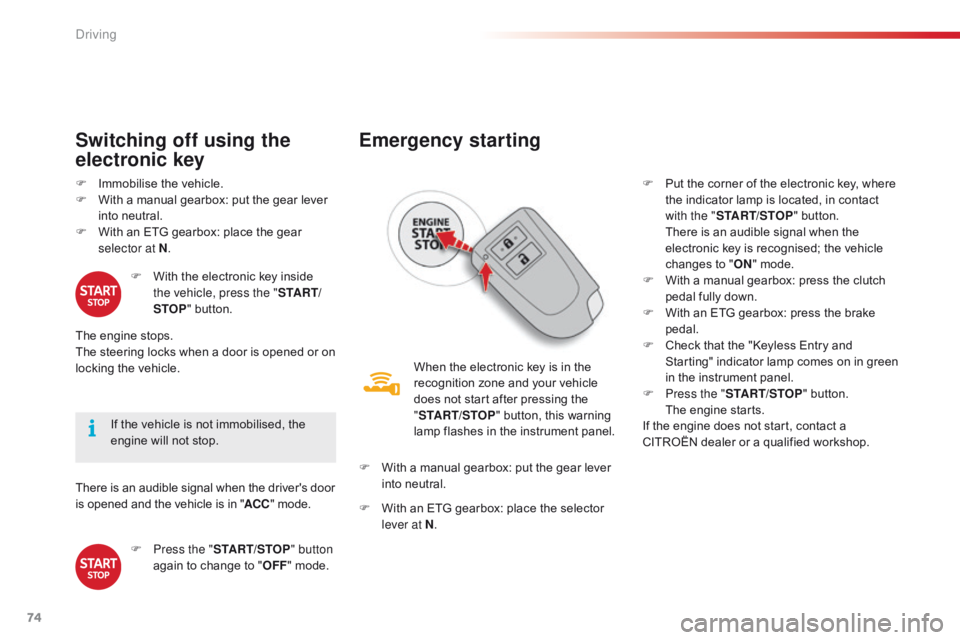
When the electronic key is in the recognition zone and your vehicle
d
oes not start after pressing the
"ST
ART/STOP "
button, this warning
l
amp flashes in the instrument panel.
F
W
ith
a manual gearbox: put the gear lever
i
nto
neutral.
F
W
ith
an ETG gearbox: place the selector
l
ever at N . F
P
ut the corner of the electronic key, where
t
he indicator lamp is located, in contact
w
ith the "
START/STOP " button.
T
here is an audible signal when the
e
lectronic key is recognised; the vehicle
c
hanges to "
ON " mode.
F
W
ith a manual gearbox: press the clutch
p
edal fully down.
F
W
ith an ETG gearbox: press the brake
ped
al.
F
C
heck that the "Keyless Entry and S
tarting" indicator lamp comes on in green i
n the instrument panel.
F
P
ress the "START/STOP "
button.
T
he engine starts.
If
the engine does not start, contact a
C
ITROËN dealer or a qualified workshop.
Driving
Page 79 of 269

77
C1_en_Chap04_conduite_ed01-2016
Gear selector
ETG electronic gearbox
The five-speed ETG electronic gearbox offers a choice between the ease of automated operation o r the pleasure of manual gear changing.
R.
R
everse: with your foot on the brake pedal,
m
ove the gear selector to the right then
f
or ward to select this position.
N.
N
eutral: with your foot on the brake pedal,
s
elect this position to start the engine.
E.
A
utomatic (Easy) mode: move the gear
s
elector back to select this mode.
M.
M
anual mode with sequential gear
c
hanging: move the gear selector back
t
hen to the left to select this mode.Press
behind the "+"
s
teering
m
ounted control paddle to change up.
Steering mounted control paddles
The position of the gear selector (R , N, E or M ) i
s displayed in the instrument panel.
In
automatic (Easy) mode, when you
t
emporarily take control of gear changing,
t
he gear engaged is also displayed in the
in
strument
pan
el.
Display in the instrument panel
Press behind the "-" steering m
ounted control paddle to change
d
own.
The
steering mounted control paddles
c
annot be used to select neutral or to
e
ngage or come out of reverse gear.
4
Driving
Page 80 of 269

78
C1_en_Chap04_conduite_ed01-2016
F With the parking brake applied, press the b
rake pedal then select position N.
F
S
tart the engine.
Moving off
if you do not press the brake pedal or if the gear selector is not in position N,
engine
starting is not possible. Never
leave a child unsupervised inside
t
he vehicle with the engine running.F
Sel
ect position E using the gear selector.
The gearbox then operates in auto-active
m
ode, without any intervention required by
t
he driver.
It continuously selects the most suitable g
ear for:
- o ptimised fuel consumption,
-
t
he driving style,
-
t
he profile of the road,
-
t
he load in the vehicle.
To
obtain optimum acceleration, when
ov
ertaking another vehicle for example, press
f
irmly on the accelerator pedal going beyond
t
he point of resistance.
Automatic (EASY) mode
It is possible to change mode at any time, by moving the gear selector from position E to
position M
and the other way round.
F
W
ith
your
foot
on
the
brake
pedal,
select
p
osition R
, E or M.
F
R
elease
the
parking
brake.
F
P
rogressively
release
the
brake
pedal.
A
ccelerate
away.
The
creep
function
may
be
temporarily
u
navailable
if
the
clutch
temperature
is
t
oo
high
or
the
gradient
too
steep.
An
a
udible
signal
gives
a
warning
if
the
c
lutch
temperature
is
too
high.
Never select neutral N when the vehicle
is
moving.
This
function
makes
manoeuvring
the
vehicle
a
t
low
speed
easier
(parking,
traffic
jams…).
After
first
placing
the
gear
selector
in
p
osition
E
, M or R , the vehicle moves off as
soon as you take your foot off the brake
pedal ,
at
low
speed,
with
the
engine
at
idle.
Creep function
Driving
Page 81 of 269
79
C1_en_Chap04_conduite_ed01-2016
Temporarily taking control of
gear changes
You can temporarily take control of gear changes using the "+" and "-" steering
m
ounted control paddles.
Gear
change commands are only acted on if
t
he engine speed allows. There is an audible
s
ignal if a command is not accepted.
The
gear engaged is displayed in the
in
strument
pan
el.
This function allows you to anticipate certain
situations
such as overtaking a vehicle or
a
pproaching a corner.
After
a few moments with no action on the
c
ontrols, the gearbox returns to automatic
c
ontrol of the gears. It
is possible to change mode at any time, by
m
oving the gear selector from position E to
position M
and the other way round.
Never select neutral N when the vehicle
is
moving.
F
P
lace the gear selector in position M
.
F
C
hange up or down using:
- t he gear selector, pushing:
- b ack, "+" to change up,
-
f
or ward, "-"
to change down.
-
o
r the "+" or "-"
steering mounted
c
ontrol paddle.
The
gear engaged is displayed.
Gear
change commands are only acted on if
t
he engine speed allows.
It is not necessary to release the accelerator
peal
during gear changes. There is an audible
s
ignal if a command is not accepted.
When
braking or slowing down, the gearbox
a
utomatically changes down so that pick-up is
i
n the right gear.
Manual mode
Under sharp acceleration, the gearbox will not change up without action by the driver on
t
he gear selector or steering mounted control
p
addles (unless the engine speed is close to
m
aximum).
To
engage reverse, the vehicle must be
s
tationary with your foot on the brake pedal.
F
Sel
ect position R .
Reverse
There is an audible signal on engaging reverse.
4
Driving
Page 83 of 269
81
C1_en_Chap04_conduite_ed01-2016
System which reduces fuel consumption by recommending the most appropriate gear.
Gear shift indicator
Operation
Example:
- Y ou are in third gear.
-
Y
ou press the accelerator pedal.
-
T
he system may suggest that you engage
a
higher gear.
Depending
on the driving situation and your
v
ehicle's equipment, the system may advise
y
ou to change gear.
The gear engagement recommendations must
n
ot be considered compulsory. In fact, the
c
onfiguration of the road, the amount of traffic
a
nd safety remain determining factors when
c
hoosing the best gear. Therefore, the driver
r
emains responsible for deciding whether or not
t
o follow the advice given by the system.
This function cannot be deactivated.
The information appears in the
i
nstrument panel in the form of an
a
r row. The
system adapts its gear change
r
ecommendation according to the d
riving conditions (slope, load, ...) and t
he demands of the driver (power,
a
cceleration, braking, ...).
The
system never suggests:
-
e
ngaging first gear,
-
enga
ging
r
everse
g
ear.
With
an ETG electronic gearbox, the
s
ystem is only active in manual mode.
With the PureTech 82 engine, the
s
ystem only suggests when to
c
hange up.
4
Driving
Page 97 of 269
95
C1_en_Chap04_conduite_ed01-2016
Under-inflation detection
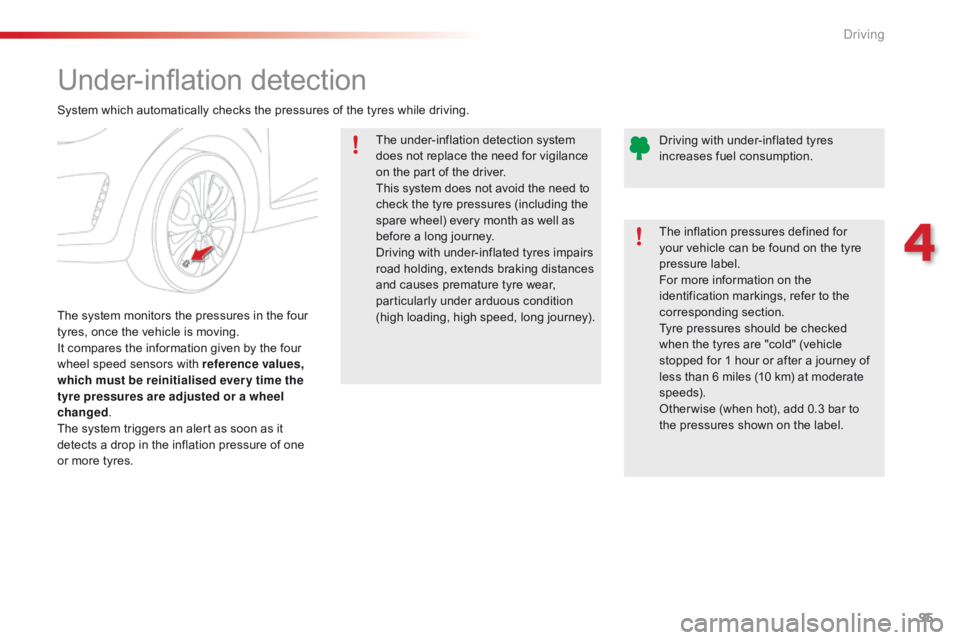
The system monitors the pressures in the four t
yres, once the vehicle is moving.
It
compares the information given by the four
w
heel speed sensors with reference values,
which must be reinitialised ever y time the
tyre pressures are adjusted or a wheel
changed .
The
system triggers an alert as soon as it
d
etects a drop in the inflation pressure of one
o
r more tyres. The
under-inflation detection system
d
oes not replace the need for vigilance
o
n the part of the driver.
This system does not avoid the need to
c
heck the tyre pressures (including the
s
pare wheel) every month as well as
b
efore a long journey.
Driving with under-inflated tyres impairs
r
oad holding, extends braking distances
a
nd causes premature tyre wear, p
articularly under arduous condition (
high loading, high speed, long journey).
System
which automatically checks the pressures of the tyres while driving.
The inflation pressures defined for
y
our vehicle can be found on the tyre
p
ressure label.
For more information on the
i
dentification markings, refer to the c
orresponding s ection.
Tyre pressures should be checked
w
hen the tyres are "cold" (vehicle
s
topped for 1 hour or after a journey of
l
ess than 6 miles (10 km) at moderate
s
peeds).
Other wise
(when hot), add 0.3 bar to
t
he pressures shown on the label.
Driving
with under-inflated tyres
i
ncreases fuel consumption.
4
Driving
Page 101 of 269

99
C1_en_Chap05_eclairage-visibilite_ed01-2016
Model without AUTO lighting
Model with AUTO lightingSelection ring for main lighting
mode
Turn the ring to position the symbol required f
acing the mark.
Lighting
off / Daytime running lamps.
Sidelamps
o
nly.
Dipped
or main beam headlamps.
Automatic
illumination of
h
eadlamps.
Dipping the headlamps
With dipped beam on, push the control stalk away from you to change to main beam. Pull
t
he stalk toward you change back to dipped
b
eam.
In
the lighting off and sidelamps modes, the
d
river can switch on the main beam headlamps
t
emporarily ("headlamp flash") by maintaining a
p
ull on the stalk.
Displays
Illumination of the corresponding indicator lamp in the instrument panel confirms the lighting
s
witched on.
5
Lighting and visibility
Page 115 of 269

113
C1_en_Chap06_securite_ed01-2016
Never leave accumulations of snow or any object projecting above the bonnet
o
r in front of the roof: this might fall into
t
he field of vision of the sensor and
g
enerate a detection.
Operating limits
The system o nly d etects v ehicles (cars, lorries) t
hat are stationary or moving in the same
d
irection as your vehicle. In
difficult weather conditions (very
h
eavy rain, snow, fog, hail...), braking
d
istances increase, which can reduce
t
he ability of the system to avoid a
c
ollision.
The
driver must therefore remain
par
ticularly
v
igilant.
The
system is not triggered or is interrupted if
t
he
d
river:
-
a
ccelerates strongly (even if the speed
l
imiter is on),
-
o
r turns the steering wheel suddenly
(
avoiding
m
anoeuvre).
Detection
capability is less effective if:
-
y
ou are driving on roads with pronounced
b
ends and/or on roads in poor condition,
-
y
our vehicle is excessively loaded, as
t
his changes the horizontal attitude of the
v
ehicle.
-
y
our vehicle skids.
It
does not detect small vehicles
(
bicycles, motorcycles), pedestrians or
a
nimals, nor non-reflective stationary
ob
jects.Unwanted triggering of the system
It is possible for the system to detect a risk of imminent collision and start working, in the
fo
llowing
c
onditions
in par
ticular:
-
d
etection of an object located close to the
e
dge of the road entering a corner (safety
b
arrier, lamp post or road sign),
-
d
etection of a structure located at the top
o
r bottom of a steep slope (advertising
h
oarding, steet lighting),
-
d
etection of reflective objects (central
r
eservation...) in the road,
-
d
etection of the upper bar of a bridge or a
t
raffic light gantry,
-
p
assing a vehicle travelling in the other
d
irection in a corner,
-
p
assing a vehicle traveling in the other
d
irection, at a crossroads, when your
v
ehicle is turning left or right,
-
i
f the vehicle ahead of you sends up water
o
r snow,
-
i
f your vehicle stops very close to an
ov
erhanging wall or other vehicles,
-
w
hen your vehicle closes rapidly on the
v
ehicle
a
head,
-
i
f the vehicle is raised or lowered,
-
i
f the vehicle passes through a plastic
c
urtain,
-
i
f driving through mist or smoke,
-
i
f the sensor is misaligned (following
r
eplacement after a collision).
6
Safety
Page 119 of 269

117
C1_en_Chap06_securite_ed01-2016
The driver must ensure that passengers use the seat belts correctly and that they are all
f
astened before setting off.
Wherever
you are seated in the vehicle,
a
lways fasten your seat belt, even for short
journeys.
Do
not interchange the seat belt buckles as
t
hey will not fulfil their role fully.
The
seat belts are fitted with an inertia reel
p
ermitting automatic adjustment of the
l
ength of the strap to your size. The seat belt
i
s stowed automatically when not in use.
Before
and after use, ensure that the seat
b
elt is reeled in correctly.
The
lower part of the strap must be
p
ositioned as low as possible on the pelvis.
The
upper part must be positioned in the
h
ollow of the shoulder.
The
inertia reels are fitted with an automatic
l
ocking device which comes into operation in
t
he event of a collision, emergency braking
o
r if the vehicle rolls over. You can release
t
he device by pulling the strap firmly and
t
hen releasing it so that it reels in slightly.Recommendations for children
Use a suitable child seat if the passenger is less than 12 years old or shorter than one
a
nd a half metres.
Never
use the same seat belt to secure more
t
han one person.
Never
allow a child to travel on your lap.
For
more information on child seats, refer to
t
he corresponding section.
In
order
to
be
effective,
a
seat
belt
must:
-
b
e
tightened
as
close
to
the
body
as
p
ossible,
-
b
e
pulled
in
front
of
you
with
a
smooth
m
ovement,
checking
that
it
does
not
t
wist,
-
b
e
used
to
restrain
only
one
person,
-
n
ot
bear
any
trace
of
cuts
or
fraying,
-
n
ot
be
converted
or
modified
to
avoid
a
ffecting
it
s
p
erformance.
In the event of an impact
Depending on the nature and
seriousness of the impact , the
pretensioning
device may be deployed
b
efore and independently of the airbags.
D
eployment of the pretensioners is
a
ccompanied by a slight discharge of
h
armless smoke and a noise, due to the
a
ctivation of the pyrotechnic cartridge
i
ncorporated in the system.
In
all cases, the airbag warning lamp
c
omes on.
Following
an impact, have the seat belts
s
ystem checked, and if necessary replaced,
b
y a CITROËN dealer or a qualified
w
orkshop.
In
accordance
with
current
safety
r
egulations,
for
all
repairs
on
your
vehicle's
s
eat
belts,
go
to
a
qualified
workshop
with
t
he
skills
and
equipment
needed,
which
a
C
ITROËN
dealer
is
able
to
provide.
Have
your
seat
belts
checked
regularly
by
a
CITROËN
dealer
or
a
qualified
workshop,
p
articularly
if
the
straps
show
signs
of
d
amage.
Clean the seat belt straps with soapy
water
or
a
textile
cleaning
product,
sold
by
C
ITROËN
dealers.
After
folding
or
moving
a
seat
or
rear
bench
s
eat,
ensure
that
the
seat
belt
is
positioned
a
nd
reeled
in
correctly.
Advice
6
Safety
Page 150 of 269
148
C1_en_Chap07_info-pratiques_ed01-2016
Checking levels
Take care when working under the bonnet, as certain areas of the engine
m
ay be extremely hot (risk of burns) and
t
he cooling fan could start at any time
(
even with the ignition off).
Engine oil level
The check of the oil level is carried out with the dipstick, located under
t
he bonnet. For the position of the
d
ipstick, refer to the under-bonnet
v
iew on a previous page.
Checking with dipstick
Check all of these levels regularly, in line with the manufacturer's service schedule. Top them up if necessary, unless other wise indicated.
I f a level drops significantly, have the corresponding system checked by a CITROËN dealer or a qualified workshop.
To
ensure the accuracy of the reading,
y
our vehicle must be on a level
s
ur face, with the engine off for at least
3
0 minutes.
It
is normal to top up the oil level between
t
wo services (or oil changes). CITROËN
r
ecommends that you check the level, and top
u
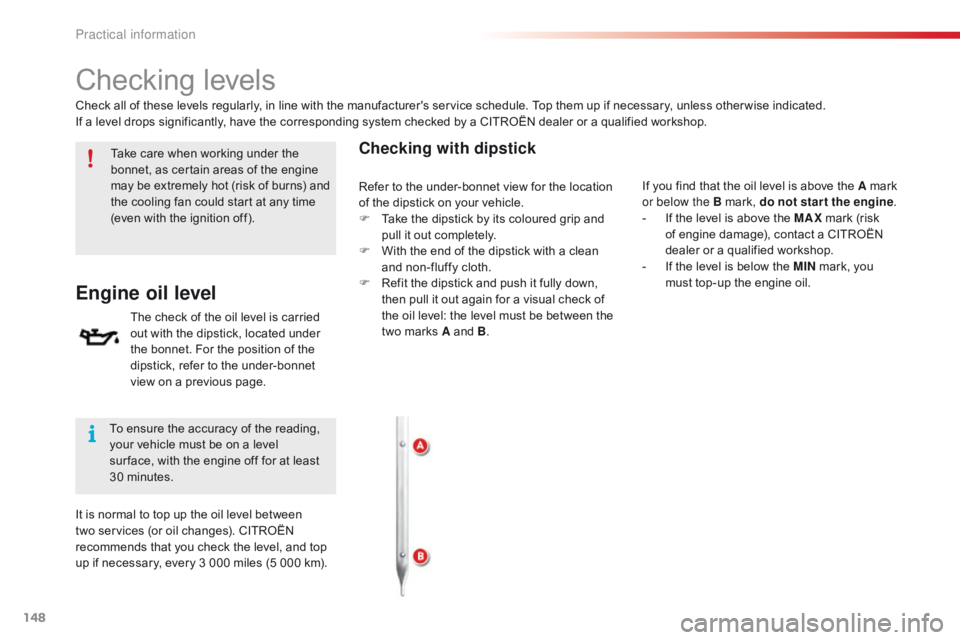
p if necessary, every 3 000 miles (5 000 km). If
you find that the oil level is above the A mark
o
r below the B mark, do not star t the engine.
-
I
f the level is above the MAX
mark (risk
o
f engine damage), contact a CITROËN
d
ealer or a qualified workshop.
-
I
f the level is below the MIN
mark, you
m
ust top-up the engine oil.
Refer
to the under-bonnet view for the location
o
f the dipstick on your vehicle.
F
T
ake the dipstick by its coloured grip and
p
ull it out completely.
F
W
ith the end of the dipstick with a clean
a
nd non-fluffy cloth.
F
R
efit the dipstick and push it fully down,
t
hen pull it out again for a visual check of
t
he oil level: the level must be between the
t
wo marks A and B.
Practical information