tow Citroen C4 2016 2.G Owner's Manual
[x] Cancel search | Manufacturer: CITROEN, Model Year: 2016, Model line: C4, Model: Citroen C4 2016 2.GPages: 396, PDF Size: 10.22 MB
Page 5 of 396
C4-2_en_Chap00a_sommaire_ed02-2015
Driving recommendations 166
Starting / Switching off the engine
with
the key
1
68
Starting
/ Switching off the engine
with
Keyless Entry and Starting
1
71
Manual
par
king
b
rake
1
74
Electric
parking brake
1
75
Manual
g
earbox
1
81
Automatic
gearbox
1
82
Gear
ef ficiency indicator
1
87
Stop
& Start
1
88
Hill start assist
1
91
Tyre
under-inflation detection
1
92
Lane
departure warning system
1
94
Blind spot sensors
1
95
Speed
limiter
1
98
Cruise control
2
01
Memorising
speeds
2
04
Parking
sensors
2
06
Driving
Fuel 20 9
Misfuel prevention (Diesel) 2 11
Snow chains
2
12
Very
cold climate screen
2
13
Towing
a trailer
2
13
Towbar
with quickly detachable towball
2
14
Energy
economy mode
2
19
Audio
pre-equipment
2
20
Changing
a wiper blade
2
21
Fitting
roof bars
2
22
Bonnet
2
23
Petrol
engines
2
24
Diesel
engines
2
25
Checking
levels
2
26
Checks
23
0
AdBlue
® additive and SCR system
(
BlueHDi Diesel) 2 32
Accessories
2
36
Practical information
Running out of fuel (Diesel) 2 38
Temporary pu ncture
r
epair kit
2
39
Spare wheel
2
44
Changing
a bulb
2
51
Changing
a fuse
2
60
12
V battery
2
65
Towing
the vehicle
2
69
In the event o f a b reakdown
Petrol engines 2 71
Petrol weights 2 72
Diesel
engines
2
73
Diesel
weights
2
75
Dimensions
2
78
Identification
ma
rkings
2
79
Technical data
Emergency or assistance 280
7-inch touch screen tablet 2 83
Audio
system
3
53
Audio and telematics
Alphabetical
in
dex
Contents
Page 6 of 396
4
C4-2_en_Chap00b_vue-ensemble_ed02-2015
Exterior
Keyless Entry and Starting 6 2- 68
Remote
control
5
6 - 61, 68
-
o
pening / closing
-
b
ack-up control
-
battery
Alarm
7
1-74
Wiper
controls
1
35 -138
Changing
a wiper blade
2
21 Door
mirrors
87
- 88
Blind
spot sensors
1
95 -197
Boot
5
7, 62, 79 - 80
Temporary
puncture repair kit
2
39 -243
Changing
a wheel
2
44-250
-
tools
-
r
emoving / refitting
Topping
up the AdBlue
a
dditive
3
3 -36, 232-235
Changing
bu
lbs
2
57-259
-
r
ear lamps
-
3
rd brake lamp
-
n
umber plate lamp
Parking
sensors
2
06 -207
Towbar
1
67, 213
Quickly
detachable
towballl
2
14-218
To w i n g
2
6 9 - 2 7 0Accessories
23
6-237
Roof bars
2
22
Panoramic
sunroof
1
07
Braking
assistance
1
40
Trajectory
control
1
41-142
Tyre
under-inflation detection
1
92-193
Tyre
pressures
2
43, 279
Snow chains
2
12Lighting
controls
1
24-131
Headlamp
adj
ustment
1
32
Welcome
lighting
1
30
Directional
lighting systems
1
33 -134
Changing
bu
lbs
2
51-256
-
f
ront lamps
-
f
ront foglamps
-
si
de repeaters
Doors
6
9 -70, 78
Keyless Entry and
Starting
6
2- 68
-
o
pening / closing
-
em
ergency
c
ontrol
Child
lock
1
65
Electric
windows
7
5 -77
Fuel
tank
2
09 -210
Misfuel prevention
2
11
Over view
Page 12 of 396
10
C4-2_en_Chap00c_eco-conduite_ed02-2015
Eco-driving is a range of everyday practices that allow the motorist to optimise their fuel consumption and CO2 emissions.
Optimise the use of your gearbox
With a manual gearbox, move off gently and change up without waiting. During acceleration change up early.
With
an automatic gearbox, give preference to automatic mode and
a
void pressing the accelerator pedal heavily or suddenly.
Drive smoothly
Maintain a safe distance between vehicles, use engine braking rather than the brake pedal, and press the accelerator progressively. These
p
ractices contribute towards a reduction in fuel consumption and CO
2
emissions
and
also
helps
reduce
the
background
traffic
noise.
If
your
vehicle
has
cruise
control,
make
use
of
the
system
at
speeds
a
bove
25
mph
(40
km/h)
when
the
traffic
is
flowing
well.
Control the use of your electrical
equipment
Before moving off, if the passenger compartment is too warm, ventilate it b y opening the windows and air vents before using the air conditioning.
Above
30 mph (50 km/h), close the windows and leave the air vents
ope
n.
Remember
to make use of equipment that can help keep the
t
emperature in the passenger compartment down (sunroof and window
b
linds...).
Switch
off the air conditioning, unless it has automatic regulation, as
s
oon as the desired temperature is attained.
Switch
off the demisting and defrosting controls, if not automatic.
Switch
off the heated seat as soon as possible.
Switch
off the headlamps and front foglamps when the level of light
d
oes not require their use.
Avoid
running the engine before moving off, particularly in winter; your
v
ehicle will warm up much faster while driving.
As
a passenger, if you avoid connecting your multimedia devices
(
film, music, video game...), you will contribute towards limiting the
c
onsumption of electrical energy, and so of fuel.
Disconnect
your portable devices before leaving the vehicle.
Eco-driving
The gear shift indicator invites you engage the most suitable gear: as soon as the indication is displayed in the instrument panel, follow it
s
traight away.
For
vehicles fitted with an automatic gearbox, this indicator appears
o
nly in manual mode.
Eco-driving
Page 22 of 396
20
C4-2_en_Chap01_instruments-de-bord_ed02-2015
Warning/indicator lampis on Cause Action/Observations
Anti-lock
Braking System
(ABS) fixed.
The
anti-lock braking system has a
f
ault.The
vehicle retains conventional braking.
Drive carefully at reduced speed and contact a
CITROËN
dealer or a qualified workshop without
d
e l ay.
Engine
autodiagnosis
system
flashing.
The
engine management system has
a
fault.Risk
of destruction of the catalytic converter.
Have
it checked by a CITROËN dealer or a qualified
w
orkshop.
fixed. The
emission control system has a
f
ault.
The warning lamp should go off when the engine is started.
I f it does not go off, contact a CITROËN dealer or qualified w
orkshop without delay.
Low fuel level fixed, accompanied by a
nd audible signal and
a
message. When
it first comes on there remains a
pproximately 6 litres of fuel in the
tank.
At
this point, you begin to use the fuel
r
eserve.Refuel
as soon as possible to avoid running out of f
uel.
Until
sufficient fuel is added, this warning lamp will
c
ome on every time the ignition is switched on,
a
ccompanied by an audible signal and a message.
T
his audible signal and message are repeated
with
increasing frequency as the fuel level drops
tow
ards "0".
Fuel
tank capacity: approximately 60 litres.
Never continue to drive until you run out of fuel, as
this
could damage the emission control and injection
s
ystems.
Instruments
Page 27 of 396
25
C4-2_en_Chap01_instruments-de-bord_ed02-2015
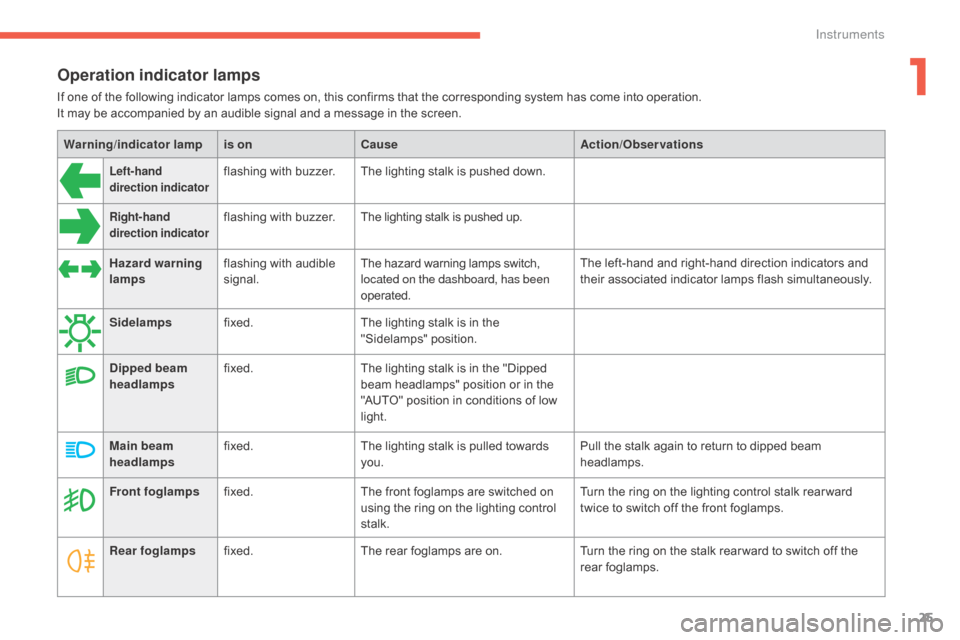
Operation indicator lamps
If one of the following indicator lamps comes on, this confirms that the corresponding system has come into operation.
I t may be accompanied by an audible signal and a message in the screen.
Warning /indicator lampis on Cause Action/Observations
Left-hand
direction indicatorflashing with buzzer.The lighting stalk is pushed down.
Right-hand
direction indicatorflashing with buzzer.The lighting stalk is pushed up.
Hazard warning
lamps flashing
with audible
s
ignal. The
hazard warning lamps switch,
l
ocated on the dashboard, has been
operated. The
left-hand and right-hand direction indicators and
t
heir associated indicator lamps flash simultaneously.
Sidelamps fixed. The
lighting stalk is in the
"
Sidelamps"
p
osition.
Dipped beam
headlamps fixed.
The
lighting stalk is in the "Dipped
b
eam headlamps" position or in the
"
AUTO" position in conditions of low
l
ight.
Main beam
headlamps fixed.
The
lighting stalk is pulled towards
yo
u. Pull
the stalk again to return to dipped beam
h
eadlamps.
Front foglamps fixed. The
front foglamps are switched on
u
sing the ring on the lighting control
st
alk. Turn
the ring on the lighting control stalk rear ward
t
wice to switch off the front foglamps.
Rear foglamps fixed. The
rear foglamps are on.Turn
the ring on the stalk rear ward to switch off the
r
ear
fo
glamps.
1
Instruments
Page 60 of 396
58
C4-2_en_Chap02_ouvertures_ed02-2015
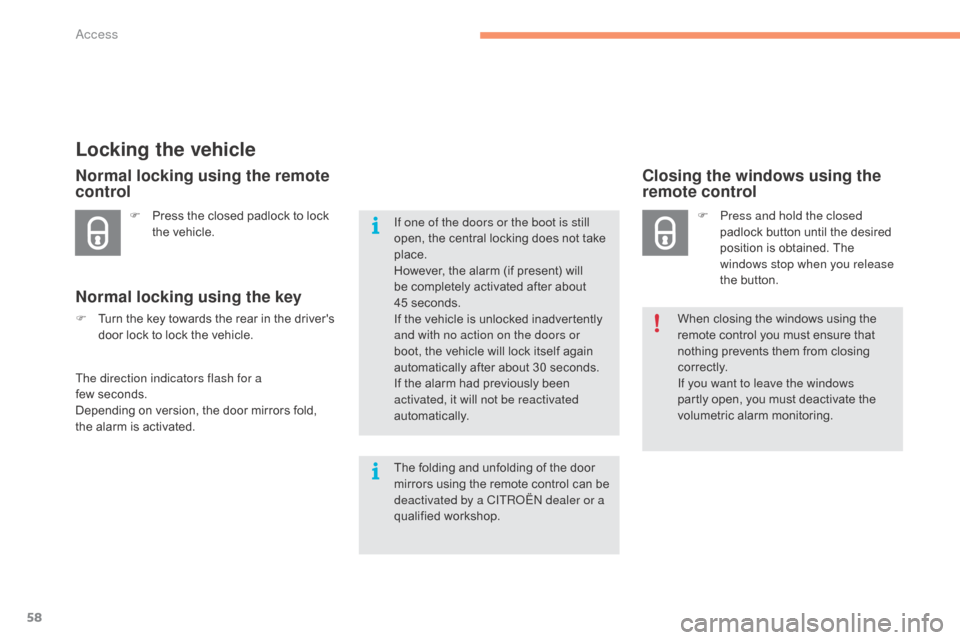
Locking the vehicle
F Press the closed padlock to lock t
he vehicle.
Normal locking using the remote
control
Normal locking using the key
F Turn the key towards the rear in the driver's d
oor lock to lock the vehicle.
The direction indicators flash for a
few seconds.
Depending
on version, the door mirrors fold,
t
he alarm is activated.
Closing the windows using the
remote control
F Press and hold the closed padlock button until the desired
p
osition is obtained. The
w
indows stop when you release
the
button.
When
closing the windows using the
r
emote control you must ensure that
n
othing prevents them from closing
c
o r r e c t l y.
If you want to leave the windows
partly
open, you must deactivate the
v
olumetric
alar
m
m
onitoring.
If one of the doors or the boot is still
open,
the
central
locking
does
not
take
p
lace.
However,
the
alarm
(if
present)
will
b
e
completely
activated
after
about
4
5 seconds.
If
the
vehicle
is
unlocked
inadvertently
a
nd with no action on the doors or
boot,
the
vehicle
will
lock
itself
again
a
utomatically
after
about
30
seconds.
If
the
alarm
had
previously
been
a
ctivated, it will not be reactivated
automatically.
The
folding
and
unfolding
of
the
door
m
irrors
using
the
remote
control
can
be
d
eactivated by a CITROËN dealer or a
qualified
w
orkshop.
Access
Page 62 of 396
60
C4-2_en_Chap02_ouvertures_ed02-2015
Back-up control
Locking the driver's door
F Insert the key in the door lock, then turn it t
o the rear.
You can also apply the procedure described for
the
p
assenger
do
ors.
Unlocking the driver's door
F Insert the key in the door lock, then turn it t
o the front.
Unlocking the passenger doors
F Pull the interior door opening control.
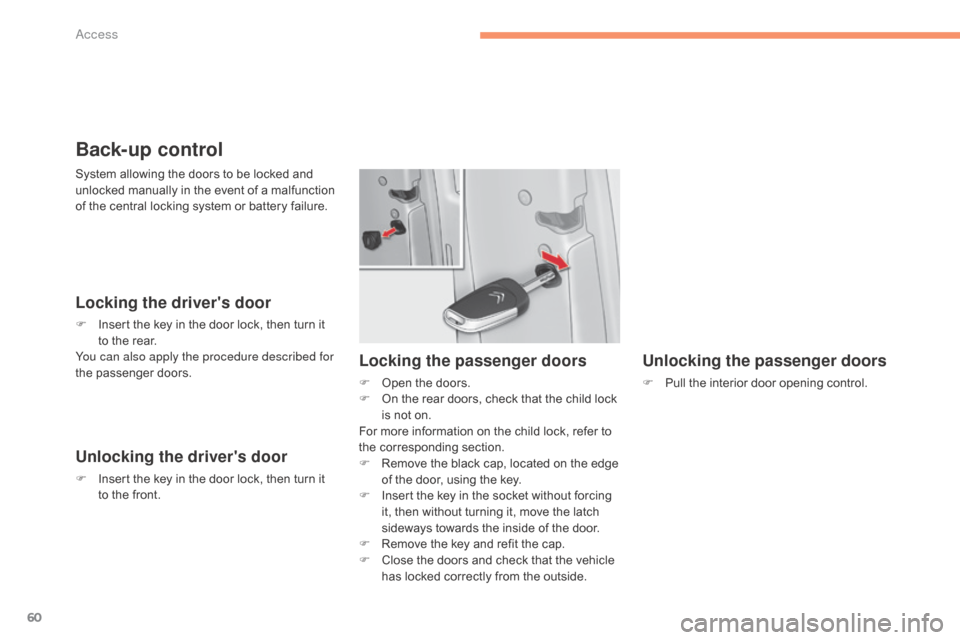
Locking the passenger doors
F Open the doors.
F O n the rear doors, check that the child lock
i
s not on.
For
more information on the child lock, refer to
t
he corresponding section.
F
R
emove the black cap, located on the edge
o
f the door, using the key.
F
I
nsert the key in the socket without forcing
i
t, then without turning it, move the latch
s
ideways towards the inside of the door.
F
R
emove the key and refit the cap.
F
C
lose the doors and check that the vehicle
h
as locked correctly from the outside.
System
allowing
the
doors
to
be
locked
and
u
nlocked
manually
in
the
event
of
a
malfunction
o
f
the
central
locking
system
or
battery
failure.
Access
Page 68 of 396
66
C4-2_en_Chap02_ouvertures_ed02-2015
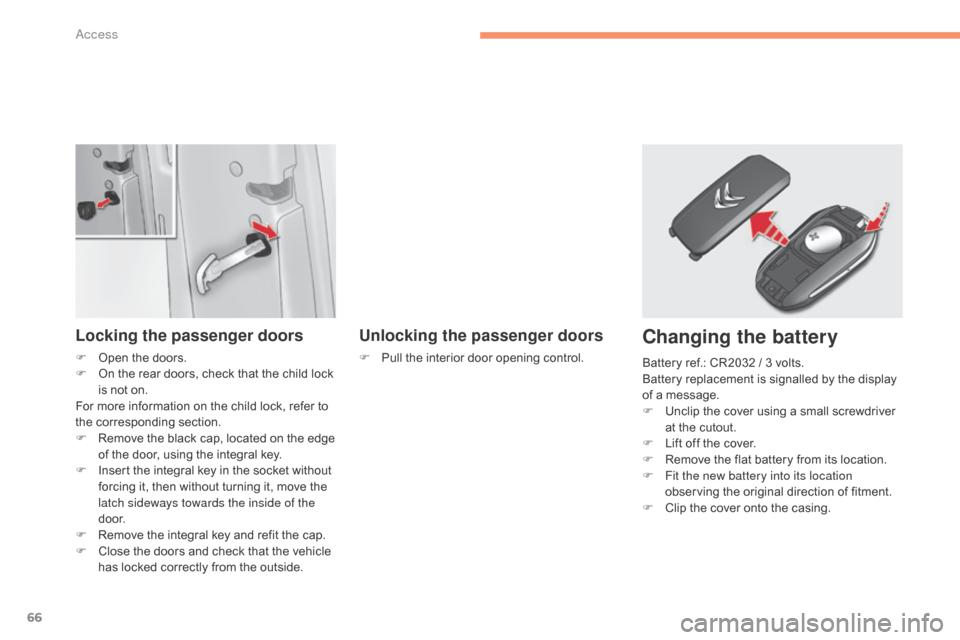
Locking the passenger doors
F Open the doors.
F O n the rear doors, check that the child lock
i
s not on.
For
more information on the child lock, refer to
t
he corresponding section.
F
R
emove the black cap, located on the edge
o
f the door, using the integral key.
F
I
nsert the integral key in the socket without
f
orcing it, then without turning it, move the
l
atch sideways towards the inside of the
d o o r.
F
R
emove the integral key and refit the cap.
F
C
lose the doors and check that the vehicle
h
as locked correctly from the outside.
Unlocking the passenger doors
F Pull the interior door opening control.
Changing the battery
Battery ref.: CR2032 / 3 volts.
B attery replacement is signalled by the display
o
f a message.
F
U
nclip the cover using a small screwdriver
a
t the cutout.
F
L
ift off the cover.
F
R
emove the flat battery from its location.
F
F
it the new battery into its location
observing
the original direction of fitment.
F
C
lip the cover onto the casing.
Access
Page 75 of 396
73
C4-2_en_Chap02_ouvertures_ed02-2015
Locking the vehicle
with exterior perimeter
monitoring only
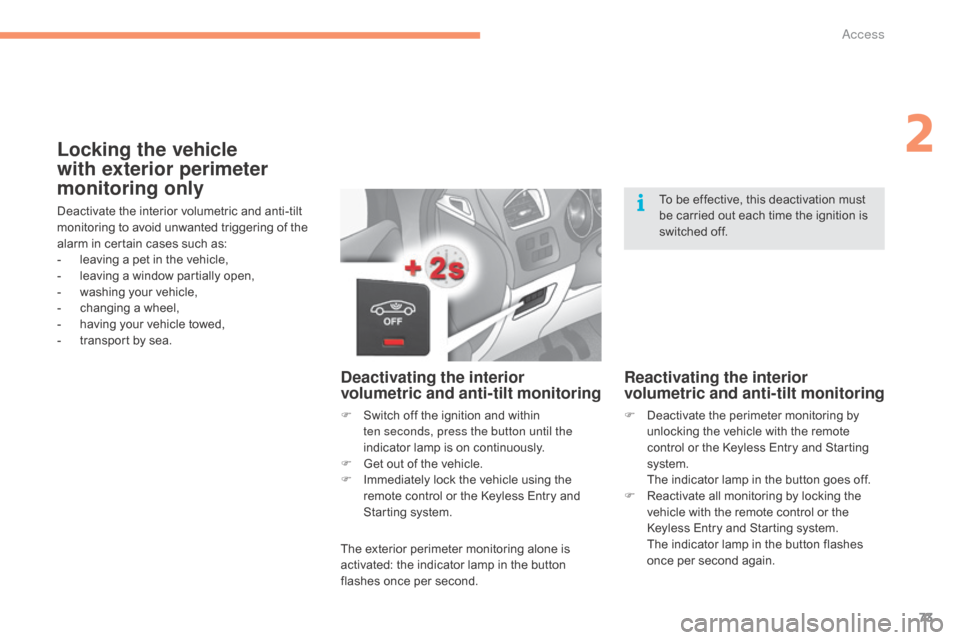
Deactivate the interior volumetric and anti-tilt monitoring to avoid unwanted triggering of the
a
larm in certain cases such as:
-
l
eaving a pet in the vehicle,
-
l
eaving a window partially open,
-
w
ashing your vehicle,
-
c
hanging a wheel,
-
h
aving your vehicle towed,
-
t
ransport by sea.
Deactivating the interior
volumetric and anti-tilt monitoring
F Switch off the ignition and within t
en seconds, press the button until the
indicator
lamp is on continuously.
F
G
et out of the vehicle.
F
I
mmediately lock the vehicle using the
r
emote control or the Keyless Entry and
S
tarting system.
The
exterior perimeter monitoring alone is
a
ctivated: the indicator lamp in the button
f
lashes once per second.
Reactivating the interior
volumetric and anti-tilt monitoring
F Deactivate the perimeter monitoring by u
nlocking the vehicle with the remote
c
ontrol or the Keyless Entry and Starting
s
ystem.
T
he indicator lamp in the button goes off.
F
R
eactivate all monitoring by locking the
v
ehicle with the remote control or the
K
eyless Entry and Starting system.
T
he indicator lamp in the button flashes
o
nce per second again.
To
be effective, this deactivation must
b
e carried out each time the ignition is
s
witched off.
2
Access
Page 93 of 396
91
C4-2_en_Chap03_ergonomie-et-confort_ed02-2015
Stop & Start
The heating and air conditioning systems only work when the engine is
r
unning.
To
maintain a comfortable temperature
i
n the passenger compartment, you can
t
emporarily deactivate the Stop & Start
s
ystem.
For
more information on Stop & Start,
r
efer to the corresponding section.
In
order
for
these
systems
to
be
fully
effective,
follow
the
operation
and
maintenance
g
uidelines
belo
w:
F
T
o
obtain
an
even
air
distribution,
take
care
not
to
obstruct
the
exterior
air
intake
grilles
l
ocated at the base of the windscreen, the nozzles, the vents and the air outlets, as well
as
the
air
extractor
located
in
the
boot.
F
D
o
not
cover
the
sunshine
sensor,
located
on
the
dashboard;
this
is
used
for
regulation
o
f
the
air
conditioning
system.
F
O
perate
the
air
conditioning
system
for
at
least
5
to
10
minutes,
once
or
twice
a
month
t
o
keep
it
in
per fect
working
order.
F
E
nsure
that
the
passenger
compartment
filter
is
in
good
condition
and
have
the
filter
e
lements
replaced
regularly.
W
e
recommend
the
use
of
a
combined
passenger
compartment
filter.
Thanks
to
its
s
pecial active additive, it contributes to the purification of the air breathed by the
occupants
and
the
cleanliness
of
the
passenger
compartment
(reduction
of
allergic
s
ymptoms,
bad
odours
and
greasy
deposits).
F
T
o
ensure
correct
operation
of
the
air
conditioning
system,
you
are
also
advised
to
have
i
t
checked
regularly
as
recommended
in
the
maintenance
and
warranty
guide.
F
I
f
the
system
does
not
produce
cold
air,
switch
it
off
and
contact
a
CITROËN
dealer
or
a
q
ualified
w
orkshop.
When
towing
the
maximum
load
on
a
steep
gradient
in
high
temperatures,
switching
off
the
a
ir
conditioning
increases
the
available
engine
power
and
so
improves
the
towing
ability. The condensation created by the air
conditioning
results in a discharge
o
f water under the vehicle which is
per fectly normal.
If after an extended stop in sunshine,
t
he interior temperature is very
h
igh, first ventilate the passenger
c
ompartment for a few moments.
Put the air flow control at a setting high
e
nough to quickly change the air in the
p
assenger
c
ompartment.
The air conditioning system does not
c
ontain chlorine and does not present
any danger to the ozone layer.
Recommendations for ventilation and air conditioning
3
Ease of use and comfort