warning CITROEN C4 2019 Owner's Guide
[x] Cancel search | Manufacturer: CITROEN, Model Year: 2019, Model line: C4, Model: CITROEN C4 2019Pages: 317, PDF Size: 9.31 MB
Page 103 of 317
101
C4-cactus_en_Chap05_securite_ed01-2016
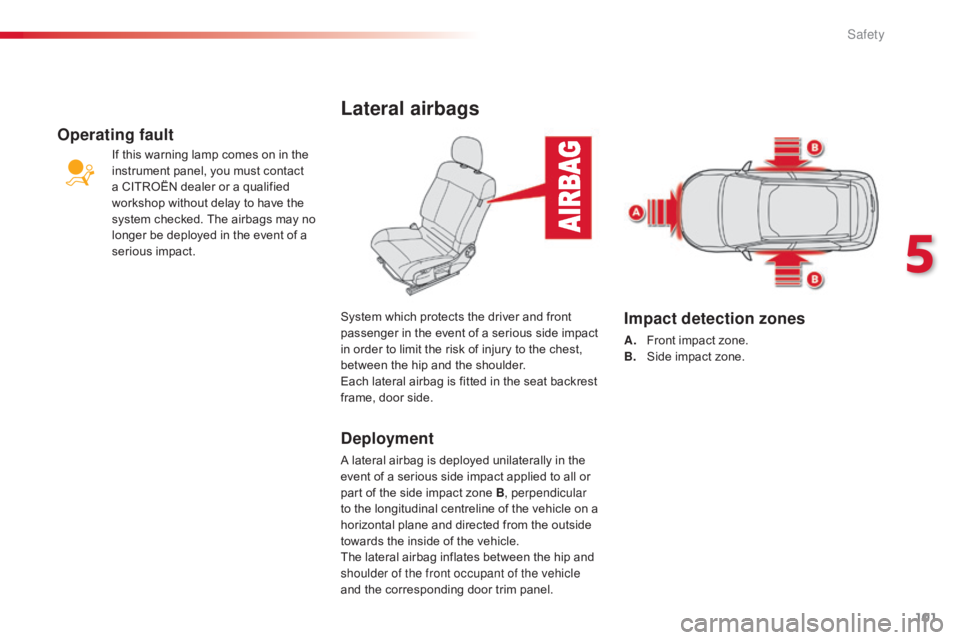
Lateral airbags
Deployment
A lateral airbag is deployed unilaterally in the event of a serious side impact applied to all or
p
art of the side impact zone B, perpendicular
to
the longitudinal centreline of the vehicle on a
h
orizontal plane and directed from the outside
t
owards the inside of the vehicle.
The
lateral airbag inflates between the hip and
s
houlder of the front occupant of the vehicle
and
the corresponding door trim panel.
System
which protects the driver and front
p
assenger in the event of a serious side impact
i
n order to limit the risk of injury to the chest,
b
etween the hip and the shoulder.
Each lateral airbag is fitted in the seat backrest
f
rame, door side.
Impact detection zones
A. Front
impact zone.
B. S ide impact zone.
Operating fault
If this warning lamp comes on in the instrument panel, you must contact
a
CITROËN dealer or a qualified
w
orkshop without delay to have the
s
ystem checked. The airbags may no
l
onger be deployed in the event of a
s
erious
im
pact.
5
Safety
Page 104 of 317
102
C4-cactus_en_Chap05_securite_ed01-2016
In the event of a minor impact or bump on the side of the vehicle or if the
vehicle
rolls over, the airbags may not
b
e deployed.
In the event of a rear or front collision,
none
of the lateral airbags is deployed.
System
contributing
towards
greater
protection
f
or
the
the
driver
and
passengers
(with
the
e
xception
of
the
rear
centre
passenger)
in
the
e
vent
of
a
serious
side
impact
in
order
to
limit
t
he
risk
of
injury
to
the
side
of
the
head.
Each
curtain
airbag
is
built
into
the
pillars
and
t
he
upper
passenger
compartment
area.
Curtain airbags
Deployment
The curtain airbag is deployed at the same t
ime as the corresponding lateral airbag in the
e
vent of a serious side impact applied to all or
p
art of the side impact zone B, perpendicular
to
the longitudinal centreline of the vehicle on a
h
orizontal plane and directed from the outside
t
owards the inside of the vehicle.
The
curtain airbag inflates between the front or
r
ear occupant of the vehicle and the windows.If
this warning lamp comes on in the
i
nstrument panel, you must contact
a
CITROËN dealer or a qualified
w
orkshop to have the system checked.
Operating fault
The airbags may no longer be deployed in the e
vent of a serious impact.
Safety
Page 109 of 317
107
C4-cactus_en_Chap05_securite_ed01-2016
Passenger airbag OFF
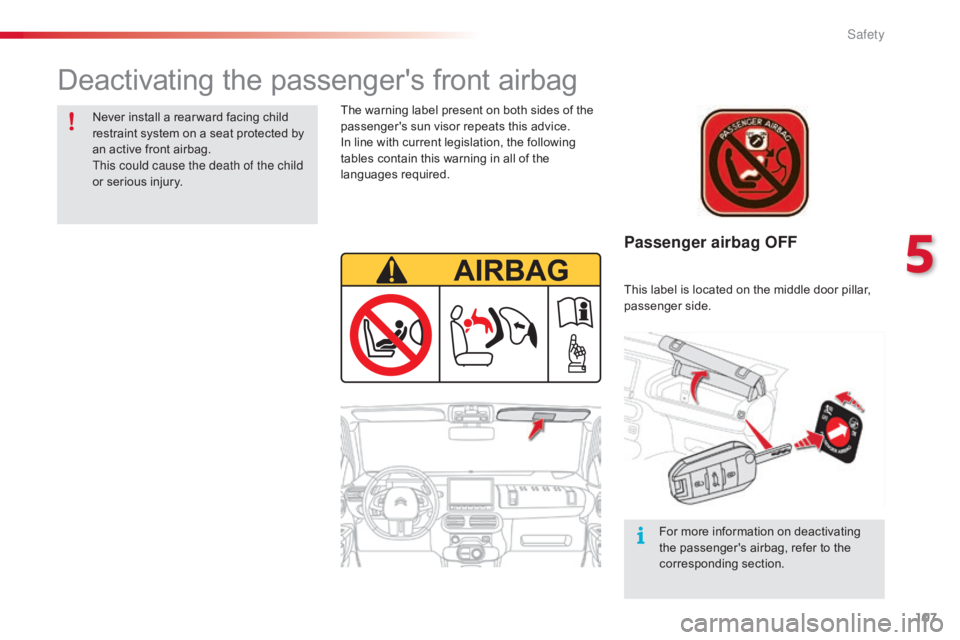
The warning label present on both sides of the passenger's sun visor repeats this advice.
In
line with current legislation, the following
t
ables contain this warning in all of the
lan
guages
r
equired.
Never
install
a
rear ward
facing
child
r
estraint
system
on
a
seat
protected
by
a
n
active
front
airbag.
This could cause the death of the child
or
serious
injury.
For
more information on deactivating
t
he passenger's airbag, refer to the
c
orresponding
s
ection.
Deactivating the passenger's front airbag
This label is located on the middle door pillar, passenger s ide.
5
Safety
Page 122 of 317
120
C4-cactus_en_Chap06_conduite_ed01-2016
When towing
Distribution of loads
F Distribute the load in the trailer so that the heaviest items are as close as possible to
t
he axle and the nose weight approaches
t
he maximum permitted without
e
xceeding it.
Air density decreases with altitude, thus
reducing
engine per formance. Above
1 0
00 metres, the maximum towed load must
b
e reduced by 10 % for every 1 000 metres of
al
titude.
For
more information on weights (and the
t
owed loads which apply to your vehicle) refer
to
the corresponding section.
Side wind
F Take into account the increased sensitivity t
o side wind.
Cooling
Towing a trailer on a slope increases the temperature of the coolant.
As
the fan is electrically controlled, its cooling
c
apacity is not dependent on the engine speed.
F
T
o lower the engine speed, reduce your
s
peed.
The
maximum towed load on a long incline
d
epends on the gradient and the ambient
t
emperature.
In
all cases, keep a check on the coolant
t
emperature. F
I
f the warning lamp and the
S
TOP
warning lamp come on,
s
top the vehicle and switch off
the
engine as soon as possible.
Braking
Towing a trailer increases the braking distance.
T o avoid overheating of the brakes, the use of
e
ngine braking is recommended.
Ty r e s
F Check the tyre pressures of the towing v
ehicle and of the trailer, observing the
re
commended
p
ressures.
Lighting
F Check the electrical lighting and signalling o
n the trailer and the hadlamp beam height
o
f your vehicle.
For
more information on adjusting the
h
eadlamp beam height, refer to the
c
orresponding
s
ection.
The
rear parking sensors will be
d
eactivated automatically if a genuine
C
ITROËN towbar is used.
Driving
Page 124 of 317
122
C4-cactus_en_Chap06_conduite_ed01-2016
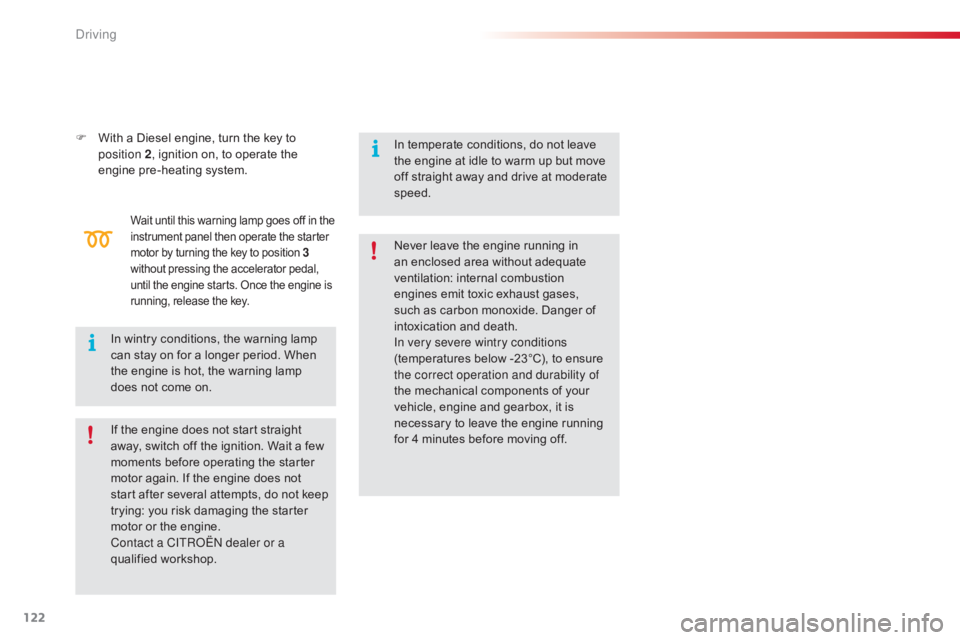
F With a Diesel engine, turn the key to p
osition 2 ,
ignition on, to operate the
eng
ine
p
re-heating
s
ystem.
Wait until this warning lamp goes off in the instrument panel then operate the starter m
otor by turning the key to position 3
without
pressing the accelerator pedal,
u
ntil the engine starts. Once the engine is
r
unning, release the key.
In wintry conditions, the warning lamp can stay on for a longer period. When
t
he engine is hot, the warning lamp
d
oes not come on. In
temperate conditions, do not leave
t
he engine at idle to warm up but move
o
ff straight away and drive at moderate
s
peed.
Never leave the engine running in
a
n enclosed area without adequate
v
entilation:
in
ternal
c
ombustion
e
ngines emit toxic exhaust gases,
s
uch as carbon monoxide. Danger of i
ntoxication and death.
In very severe wintry conditions
(temperatures
below -23°C), to ensure
t
he correct operation and durability of
the
mechanical components of your
v
ehicle, engine and gearbox, it is
n
ecessary to leave the engine running
f
or 4 minutes before moving off.
If
the engine does not start straight
a
way, switch off the ignition. Wait a few
m
oments before operating the starter
m
otor again. If the engine does not
s
tart after several attempts, do not keep
t
rying: you risk damaging the starter
m
otor or the engine.
Contact a CITROËN dealer or a
qualified
w
orkshop.
Driving
Page 126 of 317
124
C4-cactus_en_Chap06_conduite_ed01-2016
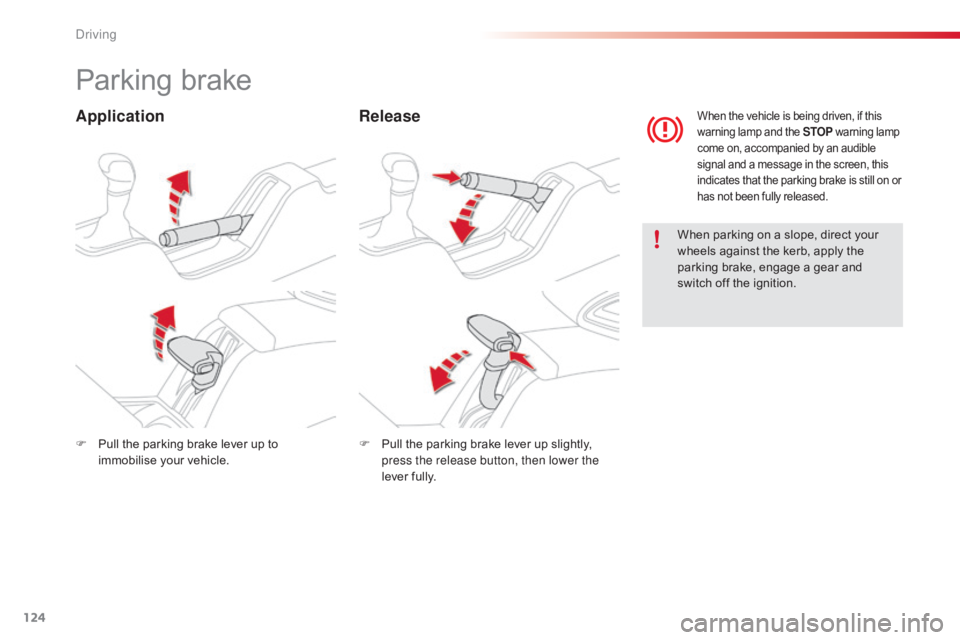
Parking brake
ApplicationRelease
When parking on a slope, direct your w
heels against the kerb, apply the
p
arking brake, engage a gear and
s
witch off the ignition.
When the vehicle is being driven, if this warning lamp and the STOP w arning lam p c
ome on, accompanied by an audible
s
ignal and a message in the screen, this
i
ndicates that the parking brake is still on or
h
as not been fully released.
F Pull the parking brake lever up to i
mmobilise your vehicle. F
P ull the parking brake lever up slightly, p
ress the release button, then lower the
lever
f
ully.
Driving
Page 129 of 317
127
C4-cactus_en_Chap06_conduite_ed01-2016
ETG electronic gearbox
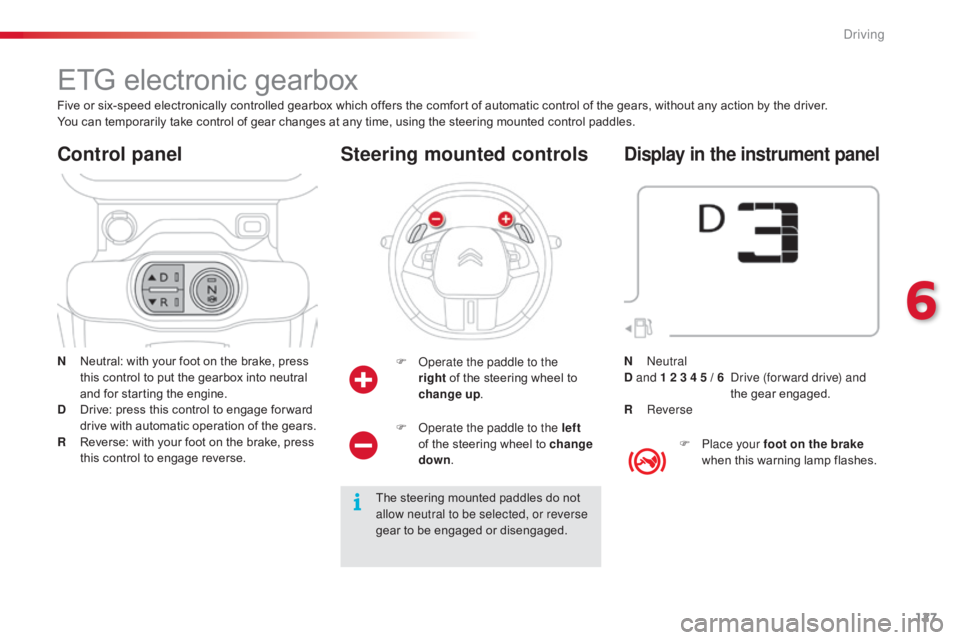
N Neutral: with your foot on the brake, press t
his control to put the gearbox into neutral
a
nd for starting the engine.
D
D
rive: press this control to engage for ward
d
rive with automatic operation of the gears.
R
R
everse: with your foot on the brake, press
t
his control to engage reverse.
Control panel
F Operate the paddle to the right of the steering wheel to
ch
ange
up.
Steering mounted controls
The steering mounted paddles do not a
llow neutral to be selected, or reverse
gear
to be engaged or disengaged.
Five
or
six-speed
electronically
controlled
gearbox
which
offers the comfort of automatic control of the gears, without any action by the driver.
You
can
temporarily
take
control
of
gear
changes
at
any
time, using the steering mounted control paddles.
F
O
perate the paddle to the left
of the steering wheel to change
down .
Display in the instrument panel
F Place your foot on the brake
when this warning lamp flashes.
N
Neutral
D and 1 2 3 4 5 / 6
D
rive (for ward drive) and
the
g
ear
enga
ged.
R
Reverse
6
Driving
Page 130 of 317
128
C4-cactus_en_Chap06_conduite_ed01-2016
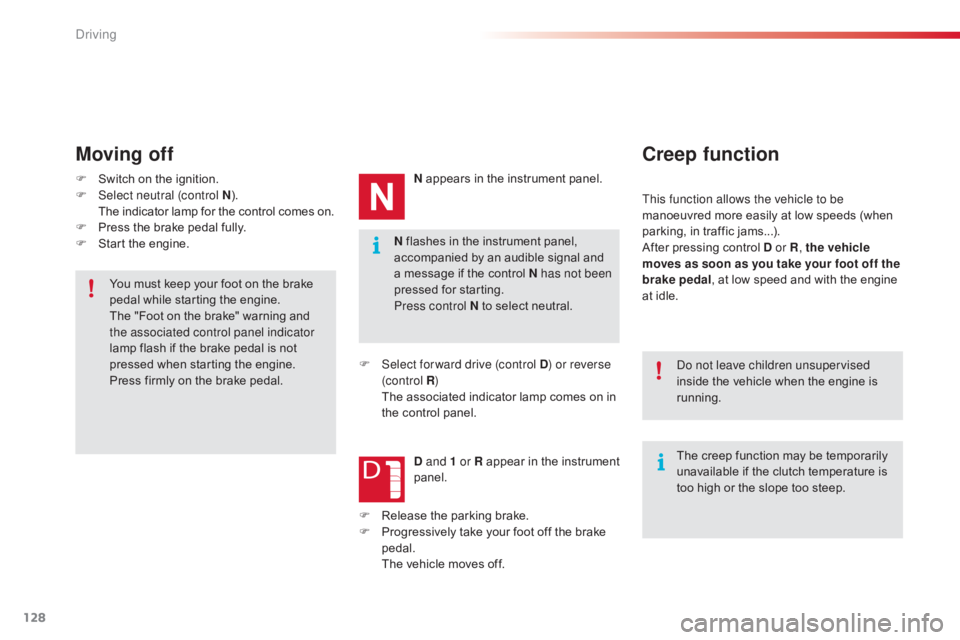
N flashes in the instrument panel, accompanied by an audible signal and
a
message if the control N has not been
pressed
for starting.
Press control N
to select neutral.
Moving off
F Switch on the ignition.
F Sel ect neutral (control N ).
T
he indicator lamp for the control comes on.
F
P
ress the brake pedal fully.
F
S
tart the engine. N
appears in the instrument panel.
F
S
elect for ward drive (control D) or reverse
(c ontrol R )
T
he associated indicator lamp comes on in
t
he control panel.
D and 1 or R
appear in the instrument
pan
el.
Creep function
This function allows the vehicle to be
manoeuvred more easily at low speeds (when
p
arking, in traffic jams...).
After
pressing control D or R, the vehicle
moves as soon as you take your foot off the
brake pedal ,
at low speed and with the engine
a
t idle.
The
creep function may be temporarily
u
navailable if the clutch temperature is
t
oo high or the slope too steep.
Do not leave children unsupervised
inside
the vehicle when the engine is
r
unning.
You
must
keep
your
foot
on
the
brake
p
edal
while
starting
the
engine.
The
"Foot
on
the
brake"
warning
and
t
he associated control panel indicator
lamp
flash
if
the
brake
pedal
is
not
p
ressed
when
starting
the
engine.
Press
firmly
on
the
brake
pedal. F
R
elease
the
parking
brake.
F
P
rogressively
take
your
foot
off
the
brake
ped
al.
T
he
vehicle
moves
off.
Driving
Page 131 of 317
129
C4-cactus_en_Chap06_conduite_ed01-2016
Never select neutral (position N) when
moving.
Forward drive
F Press control D . T
he indicator lamp in the control comes on.
D
and the gear engaged appear in
t
he instrument panel.
The
gearbox then operates in auto-adaptive
m
ode, without any action on the part of the
d
river. It continuously selects the most suitable
g
ear taking account of:
-
o
ptimisation of fuel consumption,
-
d
riving style,
-
r
oad conditions,
-
v
ehicle load.
For
optimum acceleration, when
ov
ertaking another vehicle for example,
p
ress the accelerator pedal fully down,
beyond
the point of resistance.
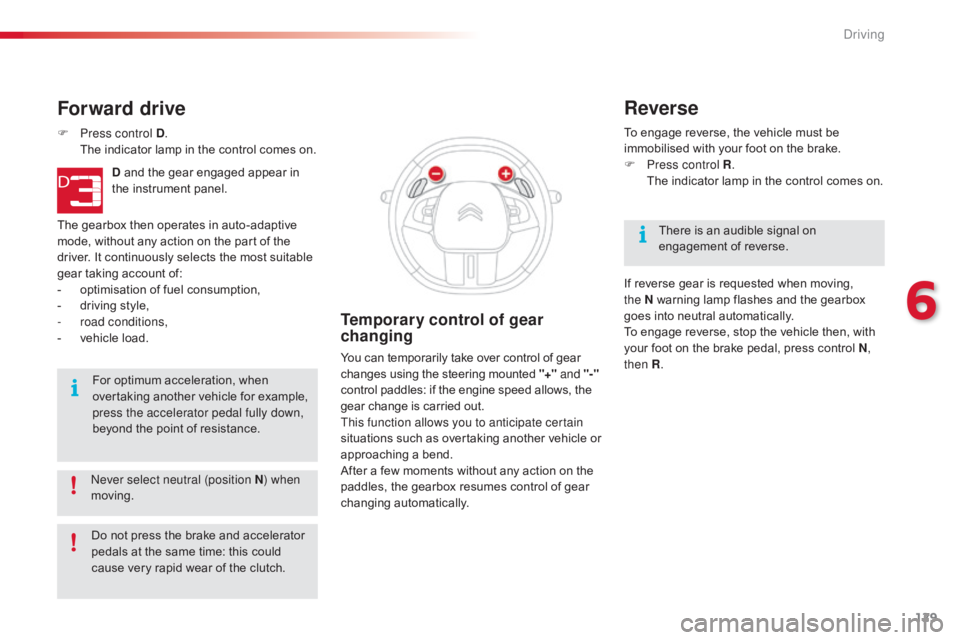
Temporary control of gear
changing
You can temporarily take over control of gear changes using the steering mounted "+" and
"-"
control
paddles: if the engine speed allows, the
g
ear change is carried out.
This function allows you to anticipate certain
situations
s
uch
a
s
ov
ertaking
a
nother
v
ehicle
o
r
a
pproaching a bend.
After
a few moments without any action on the
p
addles, the gearbox resumes control of gear
c
hanging
a
utomatically. To
engage reverse, the vehicle must be
i
mmobilised with your foot on the brake.
F
P
ress control R
.
T
he indicator lamp in the control comes on.
Reverse
There is an audible signal on enga
gement o f r everse.
If
reverse gear is requested when moving,
t
he
N
warning lamp flashes and the gearbox
g
oes
into neutral automatically.
To
engage reverse, stop the vehicle then, with
y
our
foot on the brake pedal, press control N,
then R .
Do
not
press
the
brake
and
accelerator
p
edals
at
the
same
time:
this
could
c
ause
very
rapid
wear
of
the
clutch.
6
Driving
Page 132 of 317
130
C4-cactus_en_Chap06_conduite_ed01-2016
Before switching off the engine:
- p ress control N to be in neutral,
or
-
l
eave the vehicle in gear; in this case the
v
ehicle cannot be moved.
Stopping the vehicle
For all parking situations, you must
ap ply the parking brake to immobilise
t
he vehicle.
When
immobilising the vehicle with
t
he engine running, you must select
neu
tral
N.
Operating fault
- - - appears in the instrument panel.
F
P
ress control N .
F
P
ress
the brake pedal.
F
W
ait
for around 30 seconds until N or a
gear
appears in the instrument panel.
F
P
ress control D , then N.
F
W
ith
your foot still on the brake pedal, start
t
he
eng
ine.
The
gearbox is operational again.
Reinitialisation
(5-speed electronic
gearbox)
Following disconnection of the battery, it is necessary to reinitialise the gearbox.
F
S
witch on the ignition.
In
exceptional circumstances, the
g
earbox may need an automatic
r
einitialisation: starting and gear
c
hanging are no longer possible.
- - -
appears in the instrument
pan
el.
Follow
the procedure described above.
Before
d
oing
a
nything
u
nder
t
he
b
onnet,
e
nsure that control N has been pressed
and
that
the
parking
brake
is
applied. With
the ignition on, illumination of t
his warning lamp, accompanied by
a
n audible signal and a message,
i
ndicates a gearbox fault.
Have
it checked by a CITROËN dealer or a
q
ualified
w
orkshop.
Driving