ignition CITROEN C4 CACTUS 2017 Repair Manual
[x] Cancel search | Manufacturer: CITROEN, Model Year: 2017, Model line: C4 CACTUS, Model: CITROEN C4 CACTUS 2017Pages: 256, PDF Size: 7.62 MB
Page 143 of 256
141
A flat battery prevents the engine from
starting.
For more information on the 12 V batter y,
refer to the corresponding section.
-
f
or more than ten minutes, to use the
equipment for up to approximately thirty
minutes.
Let the engine run for the duration specified to
ensure that the battery charge is sufficient.
Do not repeatedly and continuously restart the
engine in order to charge the battery.
Changing a wiper blade
Before removing a front
wiper blade
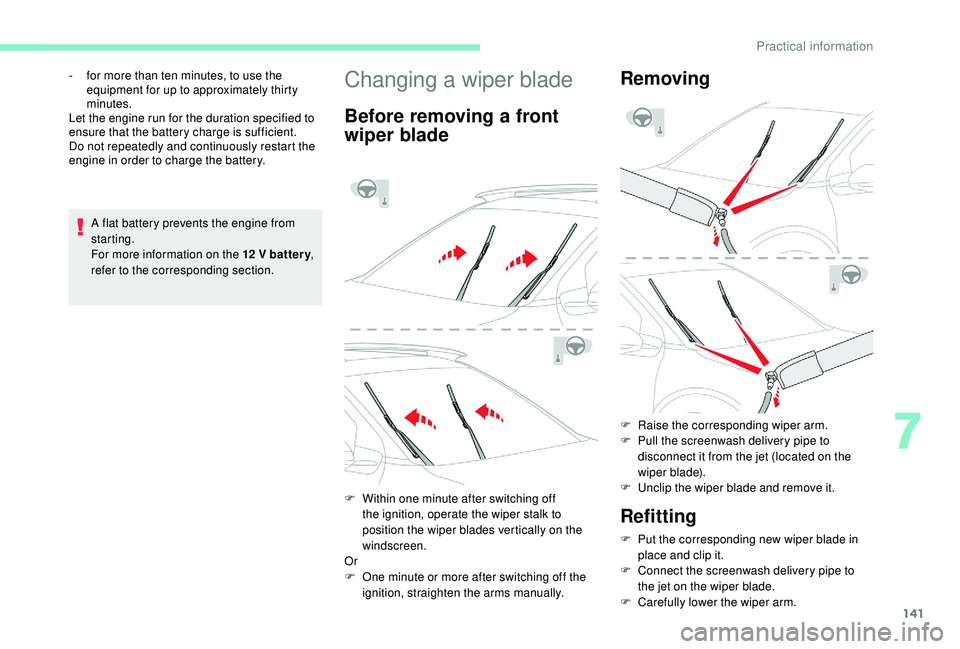
F Within one minute after switching off
the ignition, operate the wiper stalk to
position the wiper blades vertically on the
windscreen.
Or
F
O
ne minute or more after switching off the
ignition, straighten the arms manually.
Removing
F Raise the corresponding wiper arm.
F P ull the screenwash delivery pipe to
disconnect it from the jet (located on the
wiper blade).
F
U
nclip the wiper blade and remove it.
Refitting
F Put the corresponding new wiper blade in place and clip it.
F
C
onnect the screenwash delivery pipe to
the jet on the wiper blade.
F
C
arefully lower the wiper arm.
7
Practical information
Page 144 of 256
142
After refitting a front wiper blade
F Switch on the ignition.
F O perate the wiper stalk again to park the
wiper blades.
Replacement of wiper arms should be
carried out only by a CITROËN dealer or
in a qualified workshop.
Roof bars
For safety reasons and to avoid damaging
the roof, it is essential to use the
transverse bars approved for your vehicle.
Obser ve the fitting instructions and the
conditions of use in the guide supplied
with the roof bars.
Version without longitudinal
bars
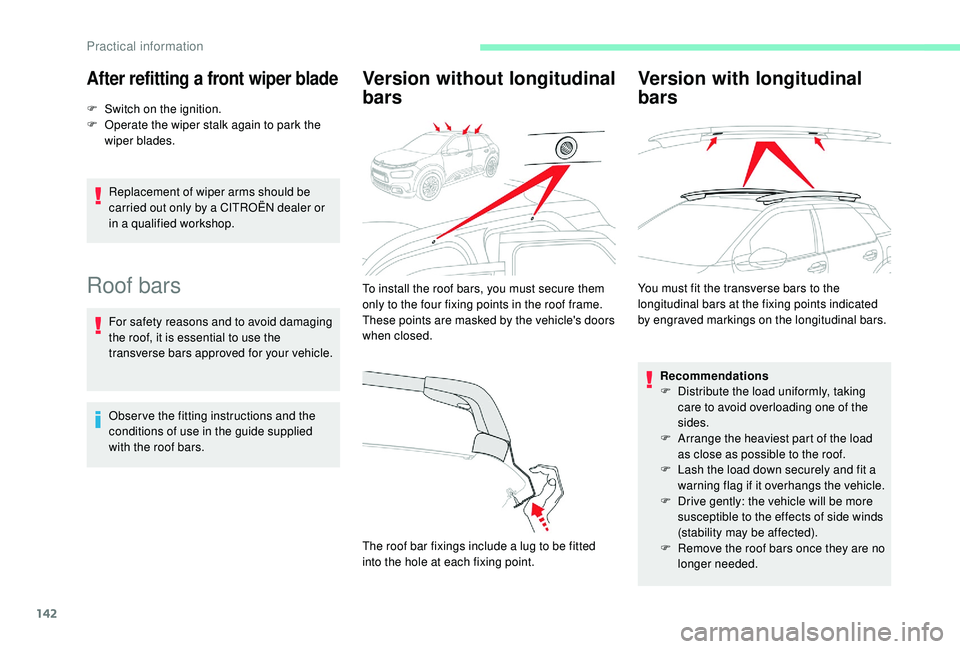
To install the roof bars, you must secure them
only to the four fixing points in the roof frame.
These points are masked by the vehicle's doors
when closed.
The roof bar fixings include a lug to be fitted
into the hole at each fixing point.
Version with longitudinal
bars
You must fit the transverse bars to the
longitudinal bars at the fixing points indicated
by engraved markings on the longitudinal bars.
Recommendations
F
D
istribute the load uniformly, taking
care to avoid overloading one of the
sides.
F
A
rrange the heaviest part of the load
as close as possible to the roof.
F
L
ash the load down securely and fit a
warning flag if it overhangs the vehicle.
F
D
rive gently: the vehicle will be more
susceptible to the effects of side winds
(stability may be affected).
F
R
emove the roof bars once they are no
longer needed.
Practical information
Page 146 of 256

144
Because of the presence of electrical
equipment under the bonnet, it is
recommended that exposure to water
(rain, washing, etc.) be limited.
Engines
Petrol
Diesel
These engines are examples provided as a
guide.
The locations of the following elements may
vary:
-
A
ir filter.
-
E
ngine oil dipstick.
-
E
ngine oil filler cap. 1.
Screenwash fluid reservoir.
2. Engine coolant reservoir.
3. Brake fluid reser voir.
4. Battery.
5. Fusebox.
6. A i r f i l t e r.
7. Engine oil dipstick.
8. Engine oil filler cap.
9. Remote earth point.
The Diesel fuel system operates under
very high pressure.
All work on this circuit must be carried out
only by a CITROËN dealer or a qualified
workshop.
Checking levels
Check all of these levels regularly, in line with
the manufacturer's service schedule. Top them
up if necessary, unless other wise indicated.
If a level drops significantly, have the
corresponding system checked by a CITROËN
dealer or a qualified workshop.
The fluid must comply with the
manufacturer's recommendations and with
the vehicle's engine. Take care when working under the bonnet,
as certain areas of the engine may be
extremely hot (risk of burns) and the
cooling fan could start at any time (even
with the ignition off).
Used products
Avoid prolonged contact of used oil or
fluids with the skin.
Most of these fluids are harmful to health
or indeed very corrosive.
Do not discard used oil or fluids into
sewers or onto the ground.
Take used oil to a CITROËN dealer or
a qualified workshop and dispose of
it in the containers reser ved for this
purpose.
Engine oil level
The check is carried out either when
the ignition is switched on using the
oil level indicator in the instrument
panel for vehicles equipped with an
electric gauge, or using the dipstick.
Practical information
Page 147 of 256

145
To ensure that the reading is correct, your
vehicle must be parked on a level sur face
with the engine stopped for more than
30 minutes.
It is normal to top up the oil level between
two ser vices (or oil changes). CITROËN
recommends that you check the level, and top
up, if necessary, every 3,000 miles (5,000 km).
Checking using the dipstick
The location of the dipstick is shown in the
corresponding underbonnet layout view.
F
T
ake the dipstick by its coloured grip and
pull it out completely.
F
W
ipe the end of the dipstick using a clean
non-fluffy cloth.
F
R
efit the dipstick and push fully down, then
pull it out again to make the visual check:
the correct level is between marks A and B .A = MA X
B = MIN
If you find that the level is above the A mark or
below the B mark, do not star t the engine.
- I f the level is above the MAX mark (risk of
damage to the engine), contact a CITROËN
dealer or a qualified workshop.
-
I
f the level is below the MIN mark, you must
top up the engine oil.
Oil grade
Before topping up the oil or changing the oil,
check that the oil is the correct grade for your
engine and conforms to the manufacturer's
recommendations.
Topping up the engine oil level
The location of the oil filler cap is shown in the
corresponding underbonnet layout view.
F
U
nscrew the oil filler cap to access the filler
opening.
F
A
dd oil in small quantities, avoiding any
spills on engine components (risk of fire).
F
W
ait a few minutes before checking the
level again using the dipstick.
F
A
dd more oil if necessary.
F
A
fter checking the level, carefully refit the oil
filler cap and the dipstick in its tube.
After topping up the oil, the check when
switching on the ignition with the oil level
indicator in the instrument panel is not
valid during the 30 minutes after topping
up.
Engine oil change
In order to maintain the reliability of the engine
and emissions control system, never use
additives in the engine oil.
7
Practical information
Page 153 of 256

151
Important: in the event of a top-up after
a breakdown because of a lack of
AdBlue, you must wait around 5 minutes
before switching on the ignition, without
opening the driver's door, locking
the vehicle, introducing the key into
the ignition switch, or introducing
the key of the
K
eyless Entr y and
Star ting system into the passenger
compartment .
Switch on the ignition, then wait for 10
seconds before starting the engine.
Access to the AdBlue® tank
via the boot
Filling the AdBlue® tank is an operation
included in every routine ser vice on your
vehicle by a CITROËN dealer or a qualified
workshop.
Nevertheless, given the capacity of the tank, it
may be necessary to top up the fluid between
ser vices, as soon as an alert (warning lamps
and a message) indicates it.
You are recommended to go to a CITROËN
dealer or a qualified workshop.
If you intend to do the topping-up yourself,
read the following procedure carefully.
The supply in a non-drip bottle simplifies the
topping-up. F
S
witch off the ignition and remove the key.
Or
F
W
ith
K
eyless Entry and Starting, press the
" START/STOP " button to switch off the
engine.
F
F
rom the boot, lift the carpet and then,
depending on the equipment, lift out the
spare wheel and/or the storage box.
F
W
ithout pressing, turn the black cap a
quarter turn anti-clockwise and lift it off.
F
T
urn the blue cap anti-clockwise.
Access to the AdBlue® tank
via the fuel filler flap
A blue cap under the fuel filler flap indicates
access to the AdBlue® tank.
Read the following procedure carefully to
be able to top up properly.
F
S
witch off the ignition and remove the key.
Or
F
W
ith
K
eyless Entry and Starting, press the
" START/STOP " button to switch off the
engine.
F
T
ake non-drip bottles of AdBlue
®. After first
checking the use-by date, read carefully
the instructions on use on the label before
pouring the contents of the bottle into your
vehicle's AdBlue
® tank.
F
A
fter filling, per form the same operations in
reverse order.
7
Practical information
Page 155 of 256
153
Running out of fuel
(Diesel)
On vehicles fitted with HDi engines, the fuel
system must be primed if you run out of fuel.If the engine does not start first time, do
not keep trying, but start the procedure
again from the beginning.
BlueHDi engines
F Fill the fuel tank with at least five litres of Diesel fuel.
F
S
witch on the ignition (without starting the
engine).
F
W
ait around 6 seconds and switch off the
ignition.
F
R
epeat the operation 10 times.
F
O
perate the starter to run the engine.
Warning triangle (storage)
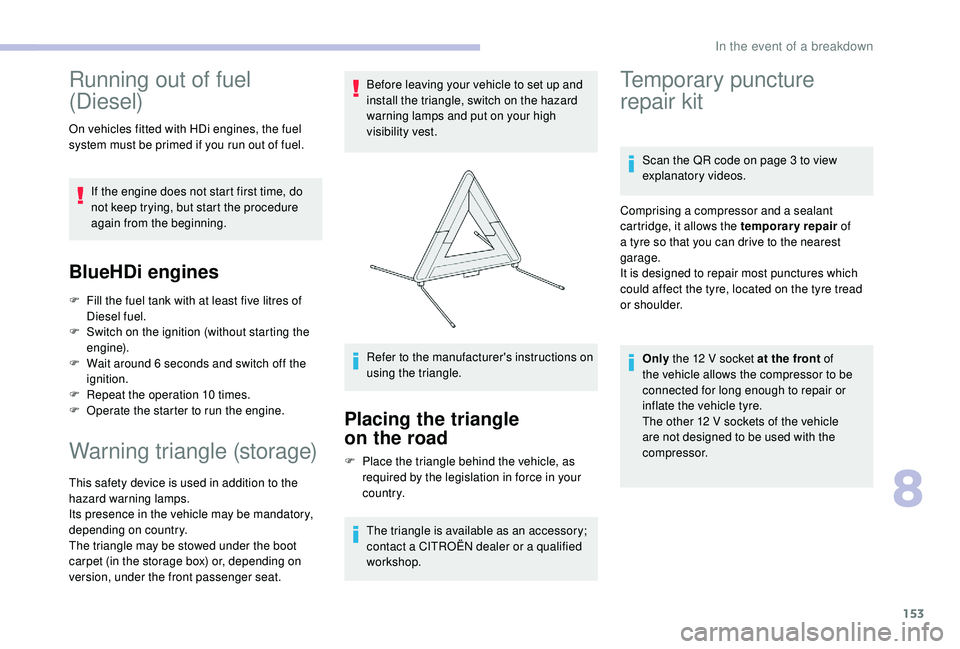
This safety device is used in addition to the
hazard warning lamps.
Its presence in the vehicle may be mandatory,
depending on country.
The triangle may be stowed under the boot
carpet (in the storage box) or, depending on
version, under the front passenger seat. Before leaving your vehicle to set up and
install the triangle, switch on the hazard
warning lamps and put on your high
visibility vest.
Refer to the manufacturer's instructions on
using the triangle.
Placing the triangle
on the road
F Place the triangle behind the vehicle, as
required by the legislation in force in your
c o u nt r y.
The triangle is available as an accessory;
contact a CITROËN dealer or a qualified
workshop.
Temporary puncture
repair kit
Scan the QR code on page 3 to view
explanatory videos.
Comprising a compressor and a sealant
cartridge, it allows the temporary repair of
a tyre so that you can drive to the nearest
garage.
It is designed to repair most punctures which
could affect the tyre, located on the tyre tread
or shoulder.
Only the 12 V socket at the front of
the vehicle allows the compressor to be
connected for long enough to repair or
inflate the vehicle tyre.
The other 12 V sockets of the vehicle
are not designed to be used with the
compressor.
8
In the event of a breakdown
Page 157 of 256
155
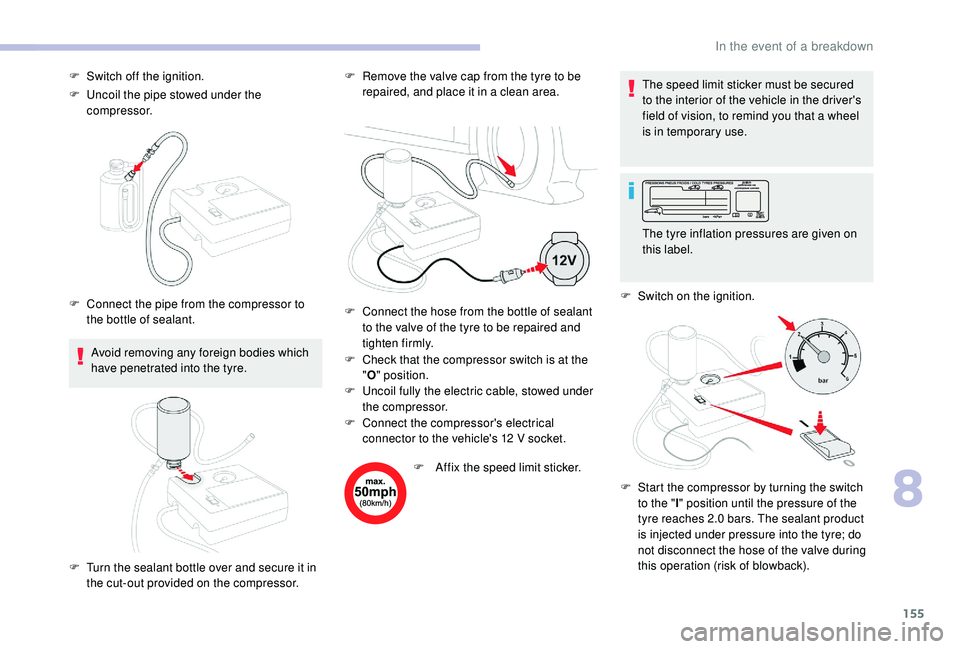
F Uncoil the pipe stowed under the compressor.
Avoid removing any foreign bodies which
have penetrated into the tyre. F
R
emove the valve cap from the tyre to be
repaired, and place it in a clean area.
F
C
heck that the compressor switch is at the
" O " position.
F
U
ncoil fully the electric cable, stowed under
the compressor.
F
A
ffix the speed limit sticker.The speed limit sticker must be secured
to the interior of the vehicle in the driver's
field of vision, to remind you that a wheel
is in temporary use.
F
S
witch on the ignition.
F
S
witch off the ignition.
F
C
onnect the pipe from the compressor to
the bottle of sealant.
F
T
urn the sealant bottle over and secure it in
the cut-out provided on the compressor. F
C
onnect the hose from the bottle of sealant
to the valve of the tyre to be repaired and
tighten firmly.
F
C
onnect the compressor's electrical
connector to the vehicle's 12 V socket. The tyre inflation pressures are given on
this label.
F
S
tart the compressor by turning the switch
to the " l" position until the pressure of the
tyre reaches 2.0 bars. The sealant product
is injected under pressure into the tyre; do
not disconnect the hose of the valve during
this operation (risk of blowback).
8
In the event of a breakdown
Page 158 of 256
156
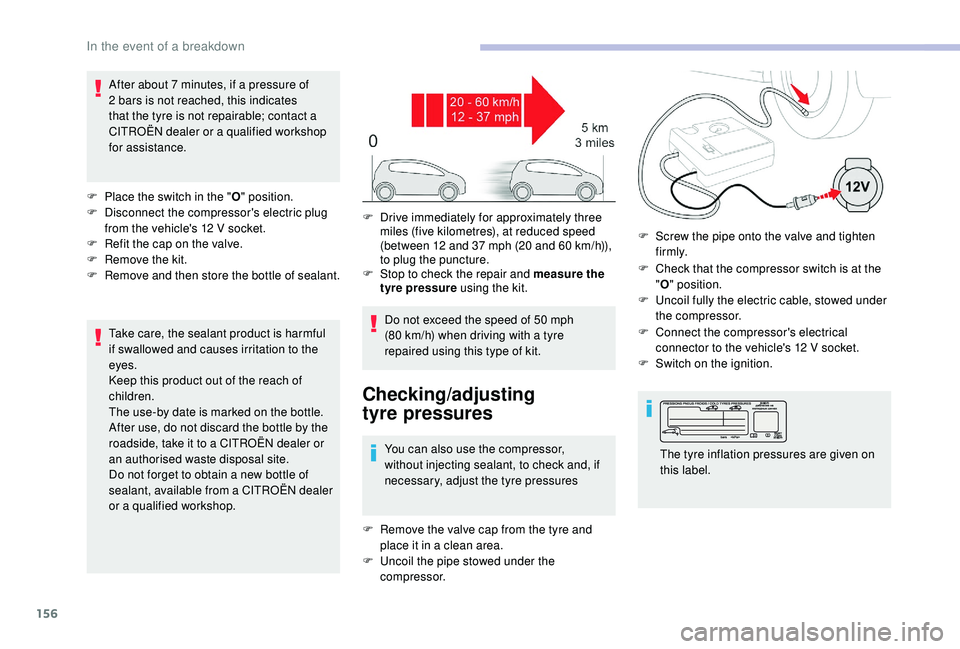
After about 7 minutes, if a pressure of
2 bars is not reached, this indicates
that the tyre is not repairable; contact a
CITROËN dealer or a qualified workshop
for assistance.
F
P
lace the switch in the " O" position.
F
D
isconnect the compressor's electric plug
from the vehicle's 12 V socket.
F
R
efit the cap on the valve.
F
R
emove the kit.
F
R
emove and then store the bottle of sealant.
Take care, the sealant product is harmful
if swallowed and causes irritation to the
eyes.
Keep this product out of the reach of
children.
The use-by date is marked on the bottle.
After use, do not discard the bottle by the
roadside, take it to a CITROËN dealer or
an authorised waste disposal site.
Do not forget to obtain a new bottle of
sealant, available from a CITROËN dealer
or a qualified workshop. Do not exceed the speed of 50 mph
(80
km/h) when driving with a tyre
repaired using this type of kit.
Checking/adjusting
tyre pressures
You can also use the compressor,
without injecting sealant, to check and, if
necessary, adjust the tyre pressures F
C
heck that the compressor switch is at the
" O " position.
F
U
ncoil fully the electric cable, stowed under
the compressor.
The tyre inflation pressures are given on
this label.
F
D
rive immediately for approximately three
miles (five kilometres), at reduced speed
(between 12 and 37 mph (20 and 60 km/h)),
to plug the puncture.
F
S
top to check the repair and measure the
tyre pressure using the kit.
F
R
emove the valve cap from the tyre and
place it in a clean area.
F
U
ncoil the pipe stowed under the
compressor. F
S
crew the pipe onto the valve and tighten
f i r m l y.
F
C
onnect the compressor's electrical
connector to the vehicle's 12 V socket.
F
S
witch on the ignition.
In the event of a breakdown
Page 161 of 256
159
Removing a wheel
Parking the vehicle
Park the vehicle where it does not block
traffic: the ground must be level, stable
and non-slippery.
With a manual gearbox, engage first
gear then switch off the ignition to block
the wheels.
With an automatic gearbox , place the
gear selector at position P then switch off
the ignition to block the wheels.
With an electronic gearbox , place the
gear selector at position D then switch off
the ignition to block the wheels.
Apply the parking brake and check that
the warning lamp is on in the instrument
panel.
The passengers must get out of the
vehicle and wait in safety.
Make sure that the jack is correctly
positioned at one of the vehicle's jacking
points.
Incorrect use of the jack could cause the
vehicle to drop.
Never go underneath a vehicle raised
using a jack; use an axle stand. Wheel with hub cap
When refitting the wheel
, after tightening
the wheel bolts, refit the hub cap, starting
by placing its aperture in line with the
valve and then pushing it into place all
round its edge with the palm of your hand.
List of operations
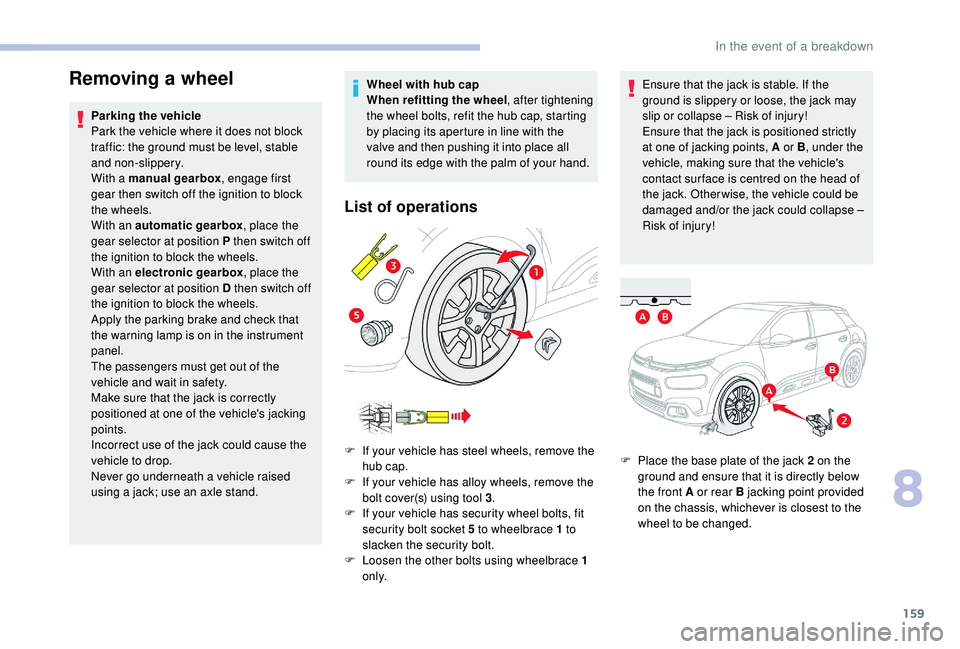
F If your vehicle has steel wheels, remove the hub cap.
F
I
f your vehicle has alloy wheels, remove the
bolt cover(s) using tool 3 .
F
I
f your vehicle has security wheel bolts, fit
security bolt socket 5 to wheelbrace 1 to
slacken the security bolt.
F
L
oosen the other bolts using wheelbrace 1
o n l y. Ensure that the jack is stable. If the
ground is slippery or loose, the jack may
slip or collapse – Risk of injury!
Ensure that the jack is positioned strictly
at one of jacking points, A or B
, under the
vehicle, making sure that the vehicle's
contact sur face is centred on the head of
the jack. Otherwise, the vehicle could be
damaged and/or the jack could collapse –
Risk of injury!
F P lace the base plate of the jack 2 on the
ground and ensure that it is directly below
the front A or rear B jacking point provided
on the chassis, whichever is closest to the
wheel to be changed.
8
In the event of a breakdown
Page 163 of 256
161
After changing a wheel
Do not exceed 50 mph (80 km/h) when
driving with the "space-saver" type spare
wheel fitted.
Visit a CITROËN dealer or a qualified
workshop as soon as possible to have the
tightness of the bolts and the pressure of
the spare wheel checked.
Have the punctured wheel checked. After
inspection, the technician will let you know
if the tyre can be repaired or if it must be
replaced.
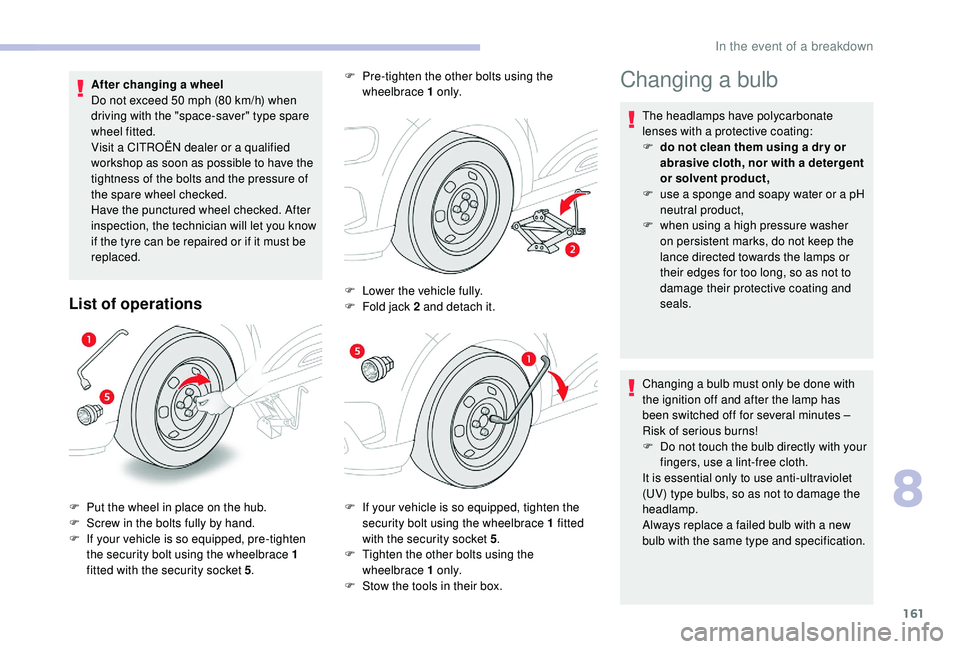
List of operations
F If your vehicle is so equipped, tighten the security bolt using the wheelbrace 1 fitted
with the security socket 5.
F
T
ighten the other bolts using the
wheelbrace 1 o n l y.
F
S
tow the tools in their box.
F
P
ut the wheel in place on the hub.
F
S
crew in the bolts fully by hand.
F
I
f your vehicle is so equipped, pre-tighten
the security bolt using the wheelbrace 1
fitted with the security socket 5. F
P
re-tighten the other bolts using the
wheelbrace 1 o n l y.
F
L
ower the vehicle fully.
F
F
old jack 2 and detach it.
Changing a bulb
The headlamps have polycarbonate
lenses with a protective coating:
F
d
o not clean them using a dr y or
abrasive cloth, nor with a detergent
or solvent product,
F
u
se a sponge and soapy water or a pH
neutral product,
F
w
hen using a high pressure washer
on persistent marks, do not keep the
lance directed towards the lamps or
their edges for too long, so as not to
damage their protective coating and
seals.
Changing a bulb must only be done with
the ignition off and after the lamp has
been switched off for several minutes –
Risk of serious burns!
F
D
o not touch the bulb directly with your
fingers, use a lint-free cloth.
It is essential only to use anti-ultraviolet
(UV) type bulbs, so as not to damage the
headlamp.
Always replace a failed bulb with a new
bulb with the same type and specification.
8
In the event of a breakdown