Screen CITROEN C4 PICASSO 2019 Owner's Manual
[x] Cancel search | Manufacturer: CITROEN, Model Year: 2019, Model line: C4 PICASSO, Model: CITROEN C4 PICASSO 2019Pages: 316, PDF Size: 10.36 MB
Page 72 of 316
70
A child sur veillance mirror is installed above the
interior mirror. This allows you to keep watch
over the passengers in the back of the vehicle
and facilitates discussion between passengers
in the front and the back without needing to
adjust the mirror and without turning around. It
can be easily folded to avoid dazzle.
Ventilation
Air intake
The air circulating in the passenger
compartment is filtered and originates either
from the outside via the grille located at the
base of the windscreen, or from the inside in air
recirculation mode.
Air treatment
The incoming air follows various routes
depending on the controls selected by the
driver:
-
d
irect arrival in the passenger compartment
(air intake),
-
p
assage through a
heating circuit (heating),
-
p
assage through a cooling circuit (air
conditioning).
Control panel
The controls of this system are accessible in the
Air conditioning menu of the touch screen A .
The demisting/defrosting controls for the
windscreen and rear screen are located to the
left of the touch screen.
Air distribution
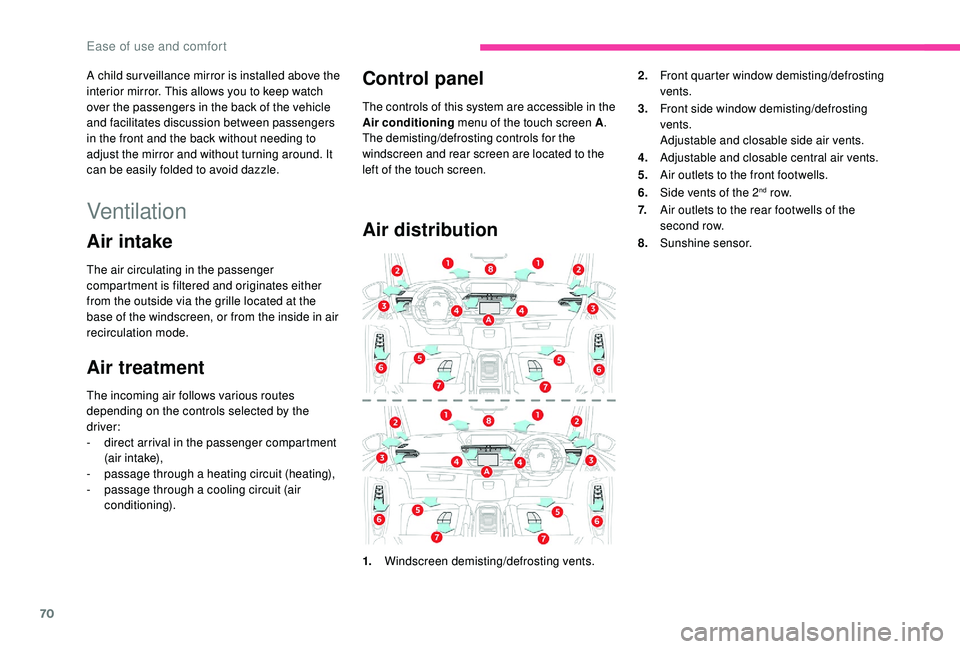
1. Windscreen demisting/defrosting vents. 2.
Front quarter window demisting/defrosting
vents.
3. Front side window demisting/defrosting
vents.
Adjustable and closable side air vents.
4. Adjustable and closable central air vents.
5. Air outlets to the front footwells.
6. Side vents of the 2
nd row.
7. Air outlets to the rear footwells of the
second row.
8. Sunshine sensor.
Ease of use and comfort
Page 73 of 316
71
Recommendations for ventilation and air conditioning
In order for these systems to be fully
effective, follow the operation and
maintenance guidelines below:
F
T
o ensure that the air is distributed
evenly, keep the external air intake
grilles at the base of the windscreen, the
nozzles, the vents, the air outlets and
the air extractor in the boot free from
obstructions.
F
D
o not cover the sunshine sensor,
located on the dashboard; this is used
for regulation of the automatic air
conditioning system.
F
O
perate the air conditioning system for
at least 5
to 10 minutes once or twice
a
month to keep it in per fect working
o r d e r.
F
E
nsure that the passenger compartment
filter is in good condition and have the
filter elements replaced regularly. We
recommend the use of a
combined
passenger compartment filter. Thanks to
its special active additive, it contributes
to the purification of the air breathed by
the occupants and the cleanliness of
the passenger compartment (reduction
of allergic symptoms, bad odours and
greasy deposits). If after an extended stop in sunshine,
the interior temperature is very high,
first air the passenger compartment for
a
few moments.
Put the air flow control at a
setting high
enough to quickly change the air in the
passenger compartment.
The condensation created by the air
conditioning results in a discharge of water
under the vehicle which is per fectly normal.
Stop & Star t
The heating and air conditioning systems
only work when the engine is running.
To maintain a
comfortable temperature
in the passenger compartment, you may
temporarily deactivate the Stop & Start
system.
For more information on Stop & Star t ,
refer to the corresponding section.
F
T
o ensure correct operation of the
air conditioning system, you are also
advised to have it checked regularly as
recommended in the Maintenance and
Warranty Guide.
F
I
f the system does not produce cold air,
switch it off and contact a
CITROËN
dealer or a
qualified workshop.
When towing the maximum load on a
steep
gradient in high temperatures, switching off
the air conditioning increases the available
engine power and so improves the towing
ability.
To avoid the windows misting up and
deterioration in the quality of the air:
-
d
o not drive for too long with the
ventilation switched off.
-
d
o not keep air recirculation set for an
extended period.
3
Ease of use and comfort
Page 74 of 316
72
Heating
The heating only operates when the engine is
running.
Press the Air conditioning menu button to
display the system controls page.
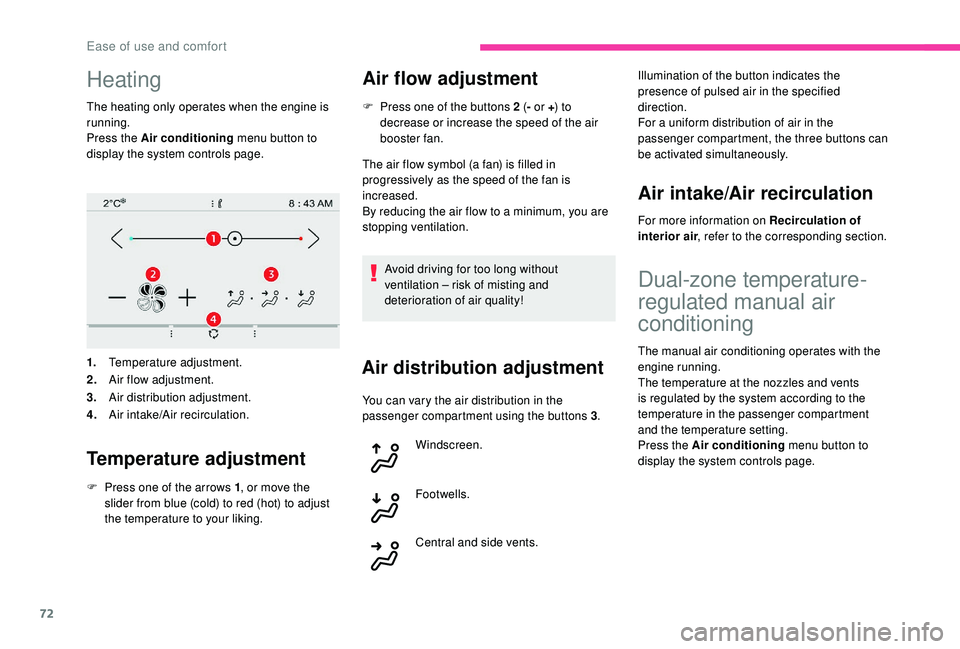
1. Temperature adjustment.
2. Air flow adjustment.
3. Air distribution adjustment.
4. Air intake/Air recirculation.
Temperature adjustment
F Press one of the arrows 1 , or move the
slider from blue (cold) to red (hot) to adjust
the temperature to your liking.
Air flow adjustment
F Press one of the buttons 2 ( - or +) to
decrease or increase the speed of the air
booster fan.
The air flow symbol (a fan) is filled in
progressively as the speed of the fan is
increased.
By reducing the air flow to a
minimum, you are
stopping ventilation.
Avoid driving for too long without
ventilation – risk of misting and
deterioration of air quality!
Air distribution adjustment
You can vary the air distribution in the
passenger compartment using the buttons 3 .
Windscreen.
Footwells.
Central and side vents. Illumination of the button indicates the
presence of pulsed air in the specified
direction.
For a
uniform distribution of air in the
passenger compartment, the three buttons can
be activated simultaneously.
Air intake/Air recirculation
For more information on Recirculation of
interior air , refer to the corresponding section.
Dual-zone temperature-
regulated manual air
conditioning
The manual air conditioning operates with the
engine running.
The temperature at the nozzles and vents
is regulated by the system according to the
temperature in the passenger compartment
and the temperature setting.
Press the Air conditioning menu button to
display the system controls page.
Ease of use and comfort
Page 75 of 316
73
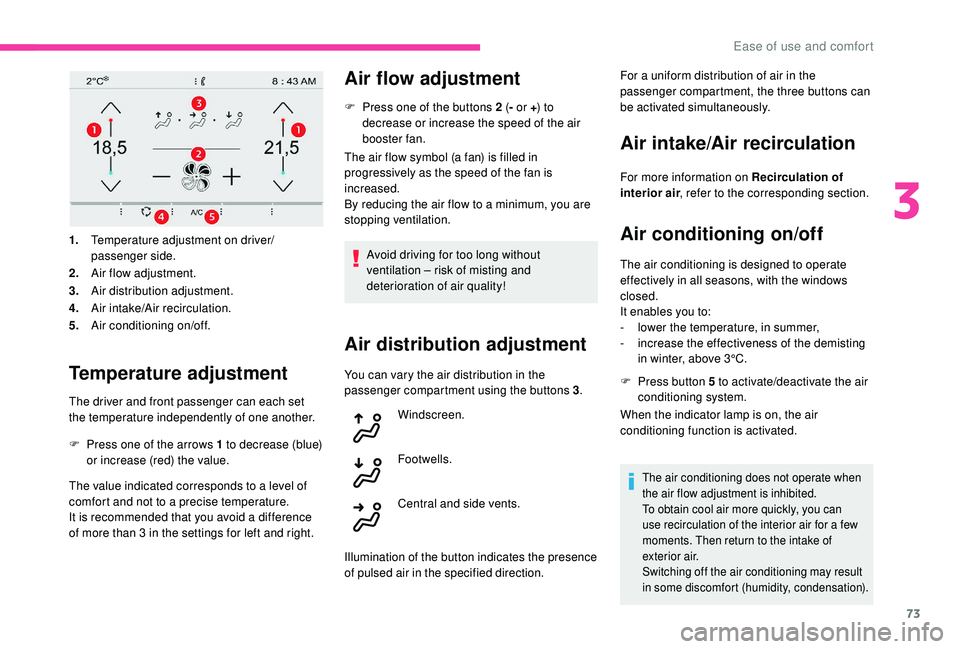
1.Temperature adjustment on driver/
passenger side.
2. Air flow adjustment.
3. Air distribution adjustment.
4. Air intake/Air recirculation.
5. Air conditioning on/off.
Temperature adjustment
The driver and front passenger can each set
the temperature independently of one another.
F
P
ress one of the arrows 1
t
o decrease (blue)
or increase (red) the value.
The value indicated corresponds to a
level of
comfort and not to a
precise temperature.
It is recommended that you avoid a
difference
of more than 3
in the settings for left and right.
Air flow adjustment
F Press one of the buttons 2 ( - or +) to
decrease or increase the speed of the air
booster fan.
The air flow symbol (a fan) is filled in
progressively as the speed of the fan is
increased.
By reducing the air flow to a
minimum, you are
stopping ventilation.
Avoid driving for too long without
ventilation – risk of misting and
deterioration of air quality!
Air distribution adjustment
You can vary the air distribution in the
passenger compartment using the buttons 3 .
Windscreen.
Footwells.
Central and side vents.
Illumination of the button indicates the presence
of pulsed air in the specified direction.
Air intake/Air recirculation
For more information on Recirculation of
interior air , refer to the corresponding section.
Air conditioning on/off
The air conditioning is designed to operate
effectively in all seasons, with the windows
closed.
It enables you to:
-
l
ower the temperature, in summer,
-
i
ncrease the effectiveness of the demisting
in winter, above 3°C.
F
P
ress button 5 to activate/deactivate the air
conditioning system.
When the indicator lamp is on, the air
conditioning function is activated.
The air conditioning does not operate when
the air flow adjustment is inhibited.
To obtain cool air more quickly, you can
use recirculation of the interior air for a
few
moments. Then return to the intake of
exterior air.
Switching off the air conditioning may result
in some discomfort (humidity, condensation).
For a uniform distribution of air in the
p assenger compartment, the three buttons can
be activated simultaneously.
3
Ease of use and comfort
Page 76 of 316
74
Dual-zone automatic air
conditioning
The air conditioning operates with the engine
running, but the ventilation and its controls are
available with the ignition on.
Operation of the air conditioning and regulation
of temperature, air flow and air distribution in
the passenger compartment are automatic.
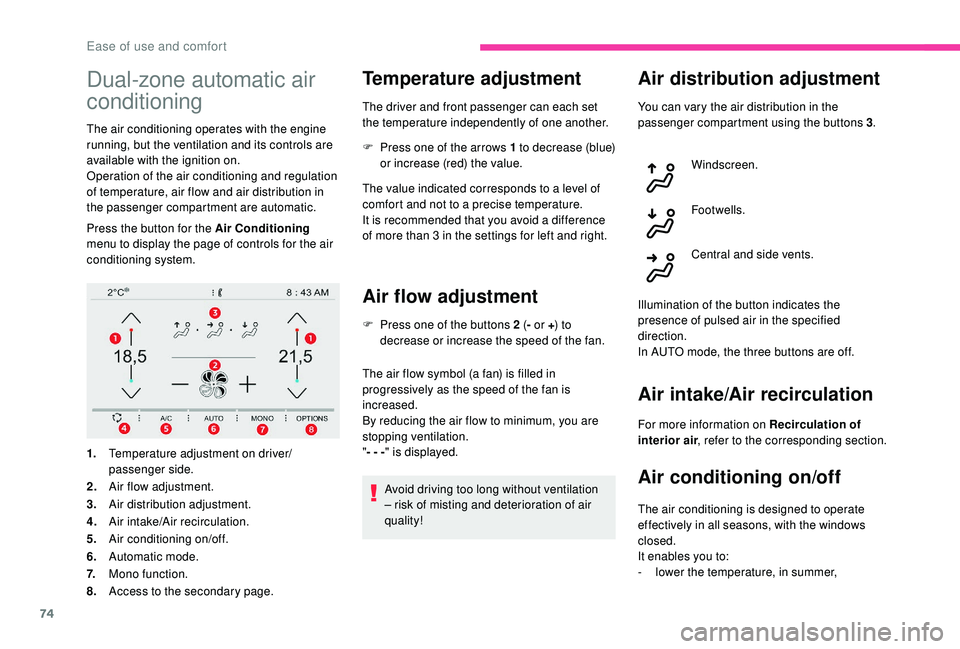
Press the button for the Air Conditioning
menu to display the page of controls for the air
conditioning system.
Temperature adjustment
The driver and front passenger can each set
the temperature independently of one another.
F
P
ress one of the arrows 1
t
o decrease (blue)
or increase (red) the value.
The value indicated corresponds to a
level of
comfort and not to a
precise temperature.
It is recommended that you avoid a
difference
of more than 3
in the settings for left and right.
Air flow adjustment
F Press one of the buttons 2 ( - or +) to
decrease or increase the speed of the fan.
The air flow symbol (a fan) is filled in
progressively as the speed of the fan is
increased.
By reducing the air flow to minimum, you are
stopping ventilation.
" - - - " is displayed.
Avoid driving too long without ventilation
– risk of misting and deterioration of air
quality!
Air distribution adjustment
You can vary the air distribution in the
passenger compartment using the buttons 3 .
Windscreen.
Footwells.
Central and side vents.
Illumination of the button indicates the
presence of pulsed air in the specified
direction.
In AUTO mode, the three buttons are off.
Air intake/Air recirculation
For more information on Recirculation of
interior air , refer to the corresponding section.
Air conditioning on/off
The air conditioning is designed to operate
effectively in all seasons, with the windows
closed.
It enables you to:
-
l
ower the temperature, in summer,
1.
Temperature adjustment on driver/
passenger side.
2. Air flow adjustment.
3. Air distribution adjustment.
4. Air intake/Air recirculation.
5. Air conditioning on/off.
6. Automatic mode.
7. Mono function.
8. Access to the secondary page.
Ease of use and comfort
Page 78 of 316
76
Settings for passengers in the
2nd rowSettings for passengers in the
third row
Ventilation with ignition on
function
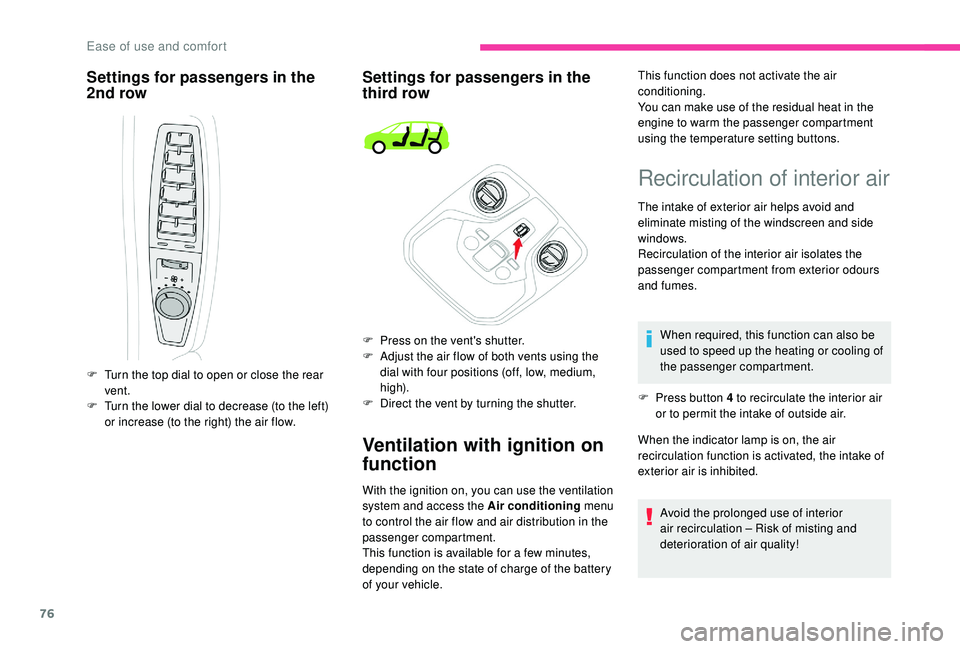
F Turn the top dial to open or close the rear
vent.
F
T
urn the lower dial to decrease (to the left)
or increase (to the right) the air flow. F
P
ress on the vent's shutter.
F
A
djust the air flow of both vents using the
dial with four positions (off, low, medium,
h i g h).
F
D
irect the vent by turning the shutter.
With the ignition on, you can use the ventilation
system and access the Air conditioning menu
to control the air flow and air distribution in the
passenger compartment.
This function is available for a
few minutes,
depending on the state of charge of the battery
of your vehicle. This function does not activate the air
conditioning.
You can make use of the residual heat in the
engine to warm the passenger compartment
using the temperature setting buttons.
Recirculation of interior air
The intake of exterior air helps avoid and
eliminate misting of the windscreen and side
windows.
Recirculation of the interior air isolates the
passenger compartment from exterior odours
and fumes.
When required, this function can also be
used to speed up the heating or cooling of
the passenger compartment.
F
P
ress button 4 to recirculate the interior air
or to permit the intake of outside air.
When the indicator lamp is on, the air
recirculation function is activated, the intake of
exterior air is inhibited.
Avoid the prolonged use of interior
air recirculation – Risk of misting and
deterioration of air quality!
Ease of use and comfort
Page 79 of 316

77
Front demist – defrost
On/Off
F Press this button to demist or defrost the windscreen and side windows as quickly as
possible. The indicator lamp in the button
comes on.
The system automatically manages the air
conditioning (depending on version), air
flow and air intake, and provides optimum
distribution towards the windscreen and side
windows.
F
T
o switch off demisting/defrosting, press
this button again. The indicator lamp in the
button goes off.
With Stop & Start, when demisting/
defrosting has been activated, STOP
mode is not available.
Rear screen demist –
defrost
On/Off
F Press this button to demist /defrost the rear screen and, depending on version, the door
mirrors. The indicator lamp in the button
comes on.
Demisting/defrosting switches off automatically
to prevent excessive electrical consumption.
F
I
t is possible to stop the demisting/
defrosting operation before it is switched off
automatically by pressing this button again.
The indicator lamp in the button goes off.
Switch off the demisting/defrosting of
the rear screen and door mirrors as
soon as appropriate, as lower current
consumption results in reduced fuel
consumption. Rear screen demisting/defrosting can only
be operated when the engine is running.
Fragrance diffuser
Diffuses a fragrance in the passenger
c ompartment from the central air vents.
Your diffuser is fitted with an empty
cartridge when your vehicle is delivered.
You therefore need to install a
cartridge
before use.
Flow adjustment
F Turn button A to adjust (left to decrease, right to increase) or stop (completely to the
left) the fragranced air flow.
The central vents must be open.
3
Ease of use and comfort
Page 84 of 316

82
The connection of an electrical device
not approved by CITROËN, such as
a USB charger, may adversely affect the
operation of vehicle electrical systems,
causing faults such as poor radio
reception or inter ference with displays in
the screens.
JACK socket
To connect a portable device so that you
c an listen to your music files via the vehicle's
speakers.
The management of the files is done using your
portable device.
For more information on Audio and
telematics and in particular the use of
this equipment, refer to the corresponding
section.
USB port
When the USB port is used, the portable
device charges automatically.
A message is displayed if the power drawn
by the portable device exceeds the current
supplied by the vehicle.
Mats
Fitting
The USB port is located in the central storage.
It allows the connection of a portable device or
a
USB memory stick.
It reads the audio files which are sent to your
audio system and played via the vehicle's
speakers.
You can manage these files using the steering
mounted or touch screen controls.
When fitting the mat for the first time, on the
driver's side use only the fixings provided in the
wallet attached.
The other mats are simply placed on the
carpet.
Ease of use and comfort
Page 87 of 316
85
12 V accessory socket
Do not exceed the maximum power rating
of the socket (risk of damage to your
device).
The connection of an electrical device
not approved by CITROËN, such as
a
USB charger, may adversely affect the
operation of vehicle electrical systems,
causing faults such as poor radio
reception or inter ference with displays in
the screens.
Boot fittings
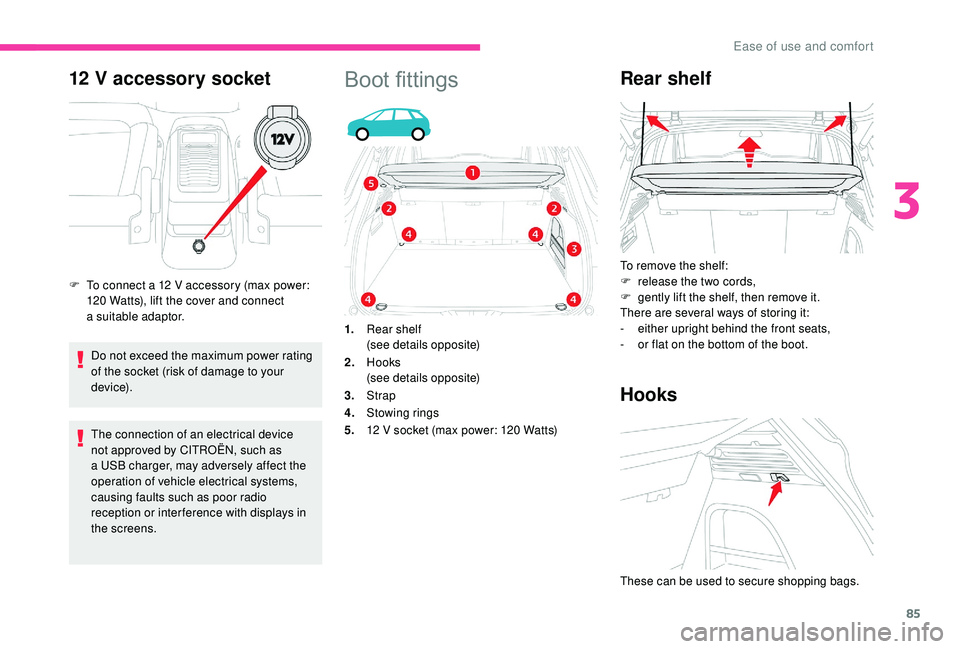
1. Rear shelf
(see details opposite)
2. Hooks
(see details opposite)
3. Strap
4. Stowing rings
5. 12
V socket (max power: 120 Watts)
Rear shelf
To remove the shelf:
F r elease the two cords,
F
g
ently lift the shelf, then remove it.
There are several ways of storing it:
-
ei
ther upright behind the front seats,
-
o
r flat on the bottom of the boot.
Hooks
F To connect a 12 V accessory (max power:
120 Watts), lift the cover and connect
a
suitable adaptor.
These can be used to secure shopping bags.
3
Ease of use and comfort
Page 95 of 316

93
Guide-me-home headlamps
Manual
Activation
F W ith the ignition off, "flash" the headlamps
using the lighting control stalk.
F
A
nother "headlamp flash" switches the
function off.
Deactivation
Manual guide-me-home lighting goes off
automatically at the end of a given period of time.
Automatic
With the "Automatic headlamp illumination"
function activated (lighting control stalk
in the AUTO position), under low ambient
light, the dipped beam headlamps come on
automatically when the ignition is switched off.
Activation, deactivation and the duration of the
guide-me-home lighting are set in the touch
screen's Driving menu.
Select " Guide-me-home lighting " to activate
or deactivate the function.
To set the duration, select the icon of the
" Guide-me-home lighting " function.
Automatic illumination of
headlamps
To switch off the parking lamps, return the
lighting control stalk to the central position.
When the ring is at the "AUTO" position and
a
low level of ambient light is detected by the
sunshine sensor, the number plate lamps,
sidelamps and dipped beam headlamps are
switched on automatically, without any action
on the part of the driver. They can also come
on if rain is detected, at the same time as
automatic operation of the windscreen wipers.
As soon as the brightness returns to
a
sufficient level or after the windscreen wipers
are switched off, the lamps are switched off
automatically.Operating fault
In the event of a malfunction of the
s unshine sensor, the lighting comes
on, this warning lamp is displayed in
the instrument panel accompanied
by an audible signal and/or
a
message.
Contact a
CITROËN dealer or a qualified
workshop.
In fog or snow, the sunshine sensor may
detect sufficient light. In this case, the
lighting will not come on automatically.
Do not cover the sunshine sensor,
integrated with the rain sensor and located
at the top of the windscreen behind the
rear view mirror; the associated functions
would no longer be controlled.
Front daytime running
lamps (LEDs)
The temporary illumination of the dipped beam
headlamps after the vehicle's ignition has been
switched off makes the driver's exit easier
when the light is poor.
4
Lighting and visibility