Off DACIA DUSTER 2010 1.G Service Manual
[x] Cancel search | Manufacturer: DACIA, Model Year: 2010, Model line: DUSTER, Model: DACIA DUSTER 2010 1.GPages: 200, PDF Size: 7.12 MB
Page 130 of 200

maintenance:interior trim ...................................... (up to the end of the DU)
interior trim maintenance ................................... (up to the end of the DU)
4.16
ENG_UD22288_6
Entretien des garnitures intérieures (B90 - U90 - L90 Ph2 - F90 Ph2 \
- R90 Ph2 - H79 - Dacia)
ENG_NU_898-5_H79_Dacia_4
Jaune NoirNoir texte
Glass instrument panel(e.g.: instrument panel, clock, exterior
temperature display, radio display).
Use a soft or cotton cloth. If this does
not clean them properly, use a soft cloth
(or cotton wool) slightly moistened with
soapy water and then wipe clean with
another damp soft or cotton cloth.
Finally, dry off carefully with a soft dry
cloth.
Cleaning products containing alco -
hol must not be used under any cir-
cumstances.
Seat belts
These must be kept clean. Use products
selected by our Technical Department
or warm, soapy water and a sponge
and wipe with a dry cloth.
Detergents or dyes must not be used
under any circumstances.
Interior trim maintenance
INTERIOR TRIM MAINTENANCE (1/2)
A well-maintained vehicle will have a
longer service life. It is therefore ad -
visable to maintain the vehicle interior
regularly.
Stains should always be dealt with
quickly. Whatever type of stain is on
the trim, use soapy water (if possible,
warm water) containing:
Do not use detergents (washing up
liquid, powdered products, alcohol -
based products, etc.).
Use a soft cloth.
Rinse and soak up the excess.Fabrics (seats, door trim,
etc.)
Dust fabrics regularly.
Liquid stains
Use soapy water.
Dab lightly (never rub) with a soft cloth,
rinse and remove the excess.
Solid or thick stains
Remove any excess solid or thick ma-
terial immediately and carefully using
a spatula (from the edge inwards to
avoid spreading the stain).
Clean using the procedure for a liquid
stain.
Special instructions for sweets or
chewing gum
Put an ice cube on the stain to solidify
it, then proceed as for a solid stain.
For advice on interior maintenance
and/or on unsatisfactory results,
contact an approved dealer.
Page 137 of 200
tyre inflation kit...................................... (up to the end of the DU)
5.5
ENG_UD22629_3
Kit de gonflage des pneumatiques (H79 - Dacia)
ENG_NU_898-5_H79_Dacia_5
Tyre inflation kit
TYRE INFLATION KIT (1/3)
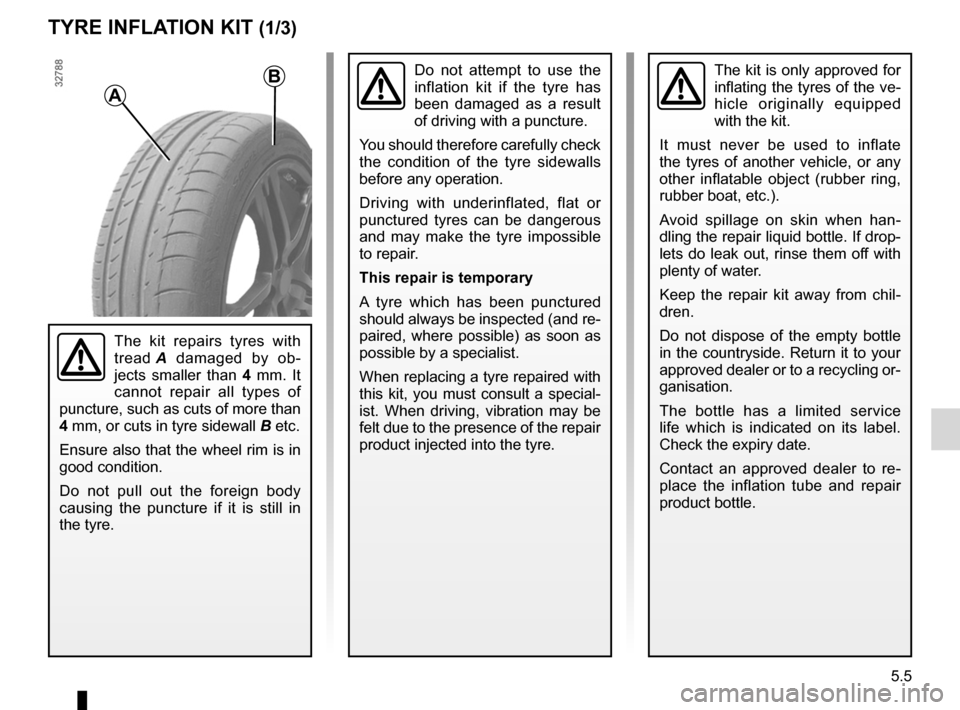
The kit repairs tyres with
tread A damaged by ob -
jects smaller than 4 mm. It
cannot repair all types of
puncture, such as cuts of more than
4 mm, or cuts in tyre sidewall B etc.
Ensure also that the wheel rim is in
good condition.
Do not pull out the foreign body
causing the puncture if it is still in
the tyre.
Do not attempt to use the
inflation kit if the tyre has
been damaged as a result
of driving with a puncture.
You should therefore carefully check
the condition of the tyre sidewalls
before any operation.
Driving with underinflated, flat or
punctured tyres can be dangerous
and may make the tyre impossible
to repair.
This repair is temporary
A tyre which has been punctured
should always be inspected (and re-
paired, where possible) as soon as
possible by a specialist.
When replacing a tyre repaired with
this kit, you must consult a special-
ist. When driving, vibration may be
felt due to the presence of the repair
product injected into the tyre.The kit is only approved for
inflating the tyres of the ve-
hicle originally equipped
with the kit.
It must never be used to inflate
the tyres of another vehicle, or any
other inflatable object (rubber ring,
rubber boat, etc.).
Avoid spillage on skin when han -
dling the repair liquid bottle. If drop-
lets do leak out, rinse them off with
plenty of water.
Keep the repair kit away from chil -
dren.
Do not dispose of the empty bottle
in the countryside. Return it to your
approved dealer or to a recycling or-
ganisation.
The bottle has a limited service
life which is indicated on its label.
Check the expiry date.
Contact an approved dealer to re -
place the inflation tube and repair
product bottle.
A
B
Page 141 of 200
changing a wheel.................................. (up to the end of the DU)
practical advice ..................................... (up to the end of the DU)
jack ....................................................... (up to the end of the DU)
puncture ................................................ (up to the end of the DU)
lifting the vehicle changing a wheel ............................ (up to the end of the DU)
5.9
ENG_UD20699_3
Changement de roue (H79 - Dacia)
ENG_NU_898-5_H79_Dacia_5
Changing a wheel
CHANGING A WHEEL (1/2)
Switch on the hazard warn-
ing lights.
Park the vehicle away from
traffic on firm, flat, non-slip -
pery ground (if necessary, place a
solid support under the jack base).
Apply the handbrake and engage a
gear (first or reverse gear).
Ask the passengers to leave the ve-
hicle and to keep away from traffic.
If you have a puncture, re -
place the wheel as soon as
possible.
A tyre which has been punc-
tured should always be inspected
(and repaired, where possible) by a
specialist.
Vehicles equipped with a jack
and wheelbrace
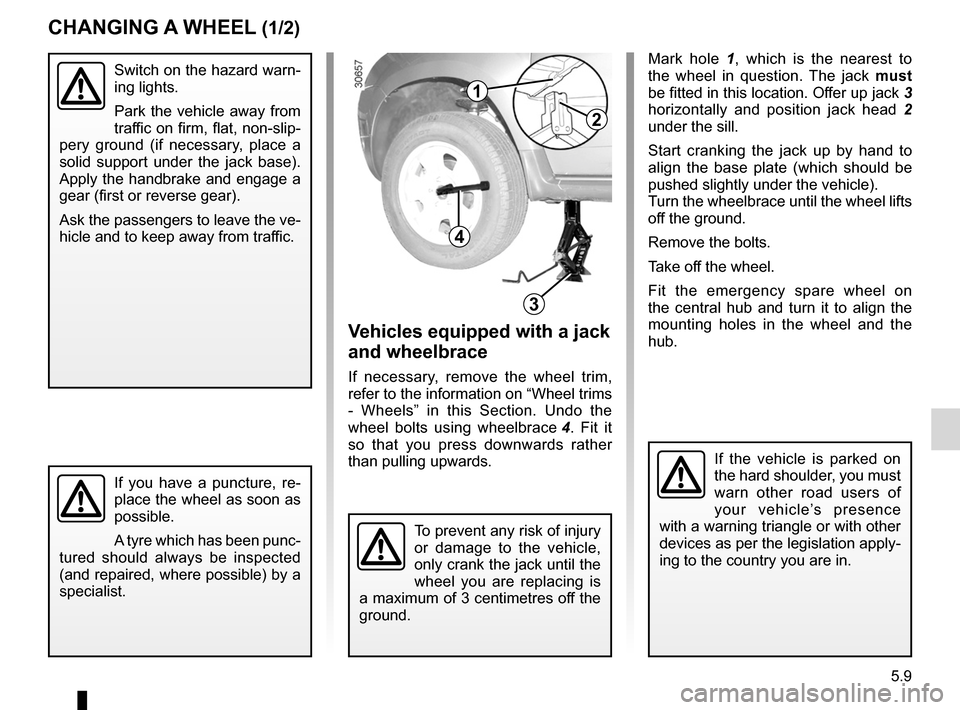
If necessary, remove the wheel trim,
refer to the information on “Wheel trims
- Wheels” in this Section. Undo the
wheel bolts using wheelbrace 4 . Fit it
so that you press downwards rather
than pulling upwards. Mark hole
1 , which is the nearest to
the wheel in question. The jack must
be fitted in this location. Offer up jack 3
horizontally and position jack head 2
under the sill.
Start cranking the jack up by hand to
align the base plate (which should be
pushed slightly under the vehicle).
Turn the wheelbrace until the wheel lifts
off the ground.
Remove the bolts.
Take off the wheel.
Fit the emergency spare wheel on
the central hub and turn it to align the
mounting holes in the wheel and the
hub.
To prevent any risk of injury
or damage to the vehicle,
only crank the jack until the
wheel you are replacing is
a maximum of 3 centimetres off the
ground.
If the vehicle is parked on
the hard shoulder, you must
warn other road users of
your vehicle’s presence
with a warning triangle or with other
devices as per the legislation apply-
ing to the country you are in.
1
2
3
4
Page 160 of 200
batterytroubleshooting ............................... (up to the end of the DU)
practical advice ..................................... (up to the end of the DU)
5.28
ENG_UD24505_3
Batterie : dépannage (H79 - Dacia)
ENG_NU_898-5_H79_Dacia_5
Jaune NoirNoir texte
Battery: troubleshooting
BATTERY: troubleshooting (1/2)
To avoid all risk of sparks:
– Ensure that any consumers (cour -
tesy lights, etc.) are switched off
before disconnecting or reconnect -
ing the battery;
– when charging, stop the charger
before connecting or disconnecting
the battery;
– to avoid creating a short circuit be -
tween the terminals, do not place
metal objects on the battery;
– always wait at least one minute after
the engine has been switched off
before disconnecting a battery;
– make sure that you reconnect the
battery terminals after refitting.
Handle the battery with care
as it contains sulphuric acid,
which must not come into
contact with eyes or skin. If
it does, wash the affected area with
plenty of cold water and consult a
doctor, if necessary.
Ensure that naked flames, red hot
objects and sparks do not come into
contact with the battery as there is a
risk of explosion.
The engine may be hot when car -
rying out operations in close prox -
imity. In addition, the engine cooling
fan can come on at any moment.
Risk of serious injury.
Special procedures may be
required to charge some
batteries. Contact your ap -
proved dealer.
Avoid all risk of sparks which may
cause an immediate explosion, and
charge the battery in a well-venti -
lated area.
Risk of serious injury.
Connecting a battery charger
The battery charger must be com -
patible with a battery with nominal
voltage of 12 volts.
Do not disconnect the battery when the
engine is running. Follow the instruc-
tions given by the manufacturer of
the battery charger you are using.
When many accessories are fitted to
the vehicle, have them connected to
the + after ignition feed.
Page 161 of 200
JauneNoirNoir texte
5.29
ENG_UD24505_3
Batterie : dépannage (H79 - Dacia)
ENG_NU_898-5_H79_Dacia_5
BATTERY: troubleshooting (2/2)
Starting the vehicle using the
battery from another vehicle
If you have to use the battery from an-
other vehicle to start, obtain suitable
jump leads (with a large cross section)
from an approved dealer or, if you al -
ready have jump leads, ensure that
they are in perfect condition.
The two batteries must have an iden-
tical nominal voltage of 12 volts. The
battery supplying the current should
have a capacity (amp-hours, Ah) which
is at least the same as that of the dis-
charged battery.
Ensure that there is no risk of contact
between the two vehicles (risk of short
circuiting when the positive terminals
are connected) and that the discharged
battery is properly connected. Switch
off your vehicle ignition.
Start the engine of the vehicle supply -
ing the current and run it at an interme-
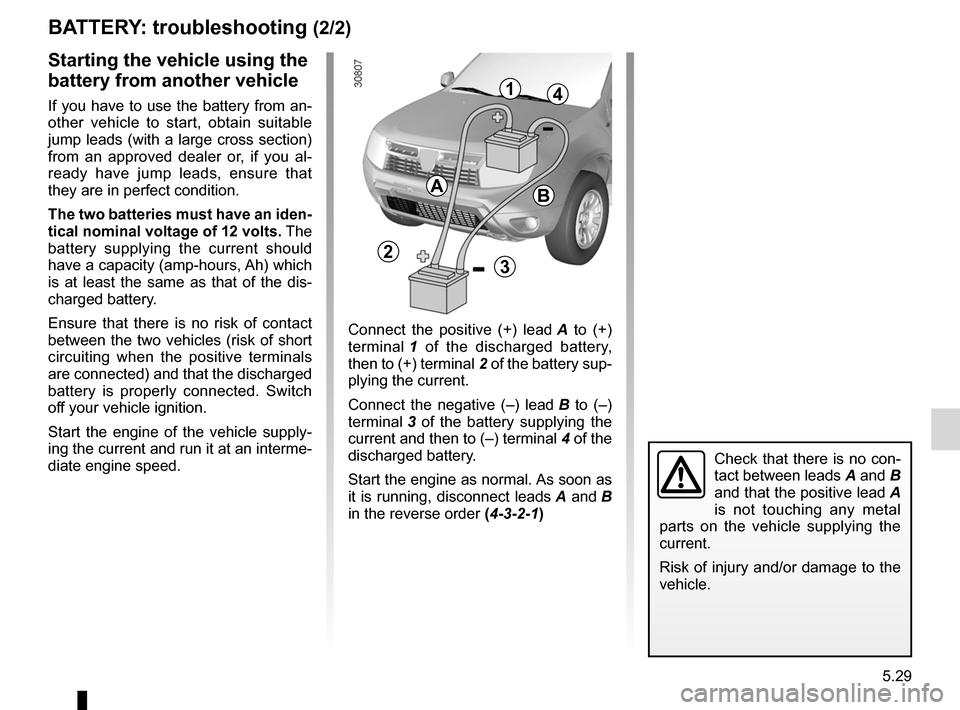
diate engine speed. Connect the positive (+) lead
A to (+)
terminal 1 of the discharged battery,
then to (+) terminal 2 of the battery sup-
plying the current.
Connect the negative (–) lead B to (–)
terminal 3 of the battery supplying the
current and then to (–) terminal 4 of the
discharged battery.
Start the engine as normal. As soon as
it is running, disconnect leads A and B
in the reverse order (4-3-2-1)
Check that there is no con-
tact between leads A and B
and that the positive lead A
is not touching any metal
parts on the vehicle supplying the
current.
Risk of injury and/or damage to the
vehicle.
AB
14
23
Page 163 of 200
wiper blades ......................................... (up to the end of the DU)
practical advice ..................................... (up to the end of the DU)
wipers blades ............................................. (up to the end of the DU)
5.31
ENG_UD20625_2
Balais d’essuie-vitre (H79 - Dacia)
ENG_NU_898-5_H79_Dacia_5
Wiper blades
WIPER BLADES
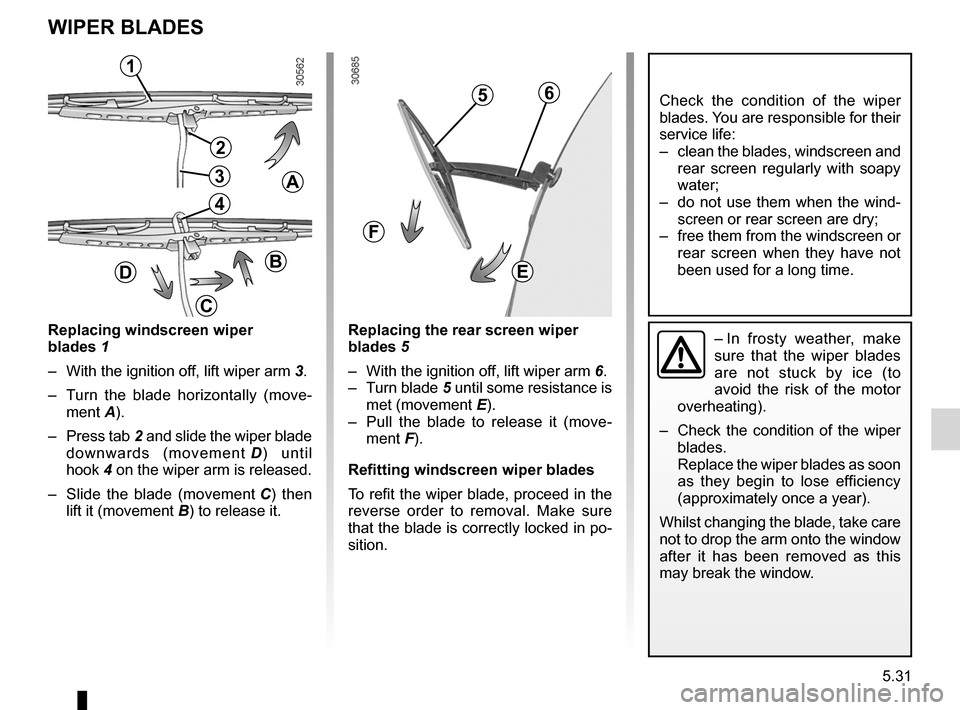
Replacing windscreen wiper
blades 1
– With the ignition off, lift wiper arm 3.
– Turn the blade horizontally (move -
ment A).
– Press tab 2 and slide the wiper blade
downwards (movement D ) until
hook 4 on the wiper arm is released.
– Slide the blade (movement C ) then
lift it (movement B) to release it.Replacing the rear screen wiper
blades 5
– With the ignition off, lift wiper arm 6.
– Turn blade 5 until some resistance is
met (movement E).
– Pull the blade to release it (move -
ment F).
Refitting windscreen wiper blades
To refit the wiper blade, proceed in the
reverse order to removal. Make sure
that the blade is correctly locked in po-
sition.
Check the condition of the wiper
blades. You are responsible for their
service life:
– clean the blades, windscreen and
rear screen regularly with soapy
water;
– do not use them when the wind-
screen or rear screen are dry;
– free them from the windscreen or
rear screen when they have not
been used for a long time.
– In frosty weather, make
sure that the wiper blades
are not stuck by ice (to
avoid the risk of the motor
overheating).
– Check the condition of the wiper
blades.
Replace the wiper blades as soon
as they begin to lose efficiency
(approximately once a year).
Whilst changing the blade, take care
not to drop the arm onto the window
after it has been removed as this
may break the window.
2
3
4
A
C
1
BD
56
F
E
Page 164 of 200
towing hitch........................................... (up to the end of the DU)
practical advice ..................................... (up to the end of the DU)
towing breakdown ...................................... (up to the end of the DU)
5.32
ENG_UD22437_4
Remorquage : dépannage (H79 - Dacia)
ENG_NU_898-5_H79_Dacia_5
Jaune NoirNoir texte
Towing: troubleshooting
TOWING: breakdown (1/3)
Towing procedure
The steering wheel must be un -
locked and the ignition key must be
in position M (ignition on) to pro -
vide stop lights and hazard warning
lights on the towed vehicle. At night
the vehicle must have its lights on.
Unhitch the trailer, etc., if one is being
towed.
You must observe the towing regu -
lations which apply in the country in
which you are driving: do not exceed
the towing weight for your vehicle.
Contact an approved Dealer.
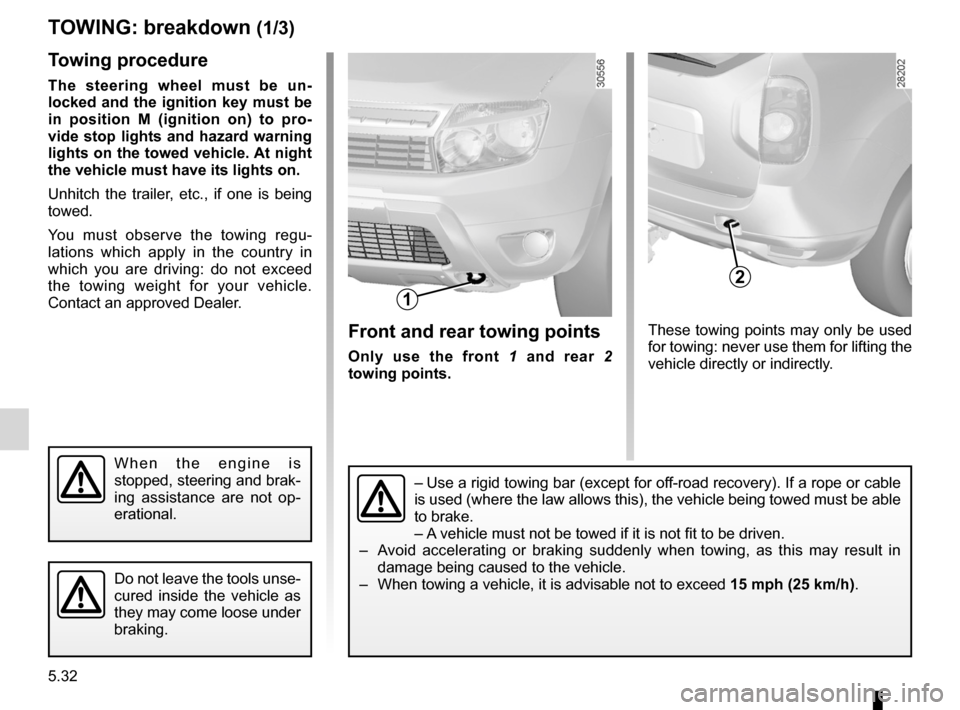
Front and rear towing points
Only use the front 1 and rear 2
towing points.
W h e n t h e e n g i n e i s
stopped, steering and brak-
ing assistance are not op -
erational.
Do not leave the tools unse-
cured inside the vehicle as
they may come loose under
braking.
– Use a rigid towing bar (except for off-road recovery). If a rope or cable
is used (where the law allows this), the vehicle being towed must be able
to brake.
– A vehicle must not be towed if it is not fit to be driven.
– Avoid accelerating or braking suddenly when towing, as this may result in
damage being caused to the vehicle.
– When towing a vehicle, it is advisable not to exceed 15 mph (25 km/h).
These towing points may only be used
for towing: never use them for lifting the
vehicle directly or indirectly.
1
2
Page 165 of 200
JauneNoirNoir texte
5.33
ENG_UD22437_4
Remorquage : dépannage (H79 - Dacia)
ENG_NU_898-5_H79_Dacia_5
TOWING: breakdown (2/3)
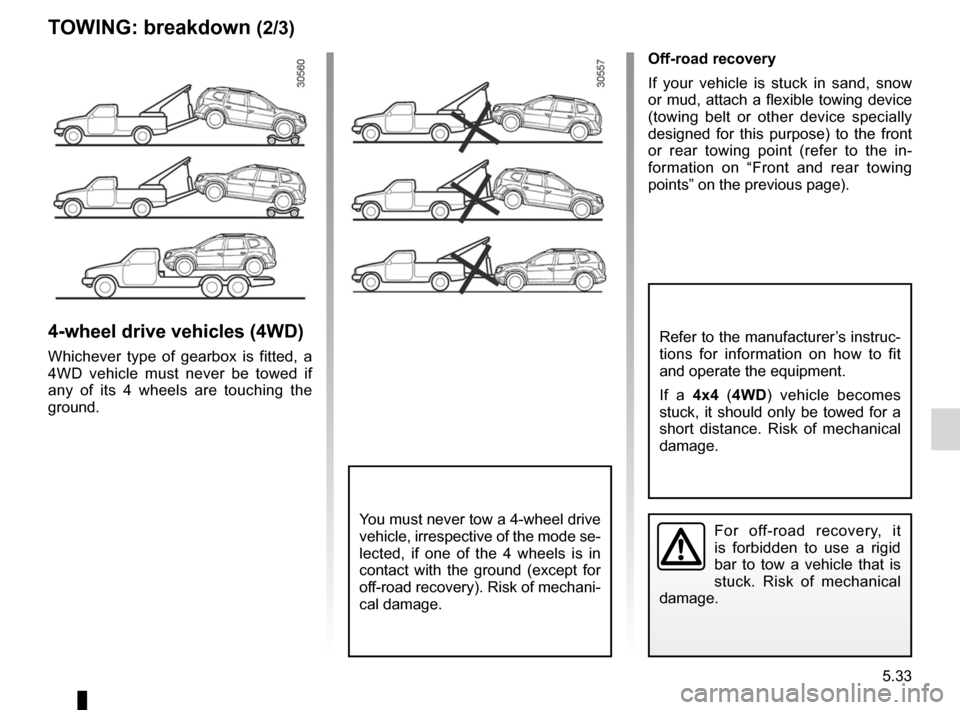
4-wheel drive vehicles (4WD)
Whichever type of gearbox is fitted, a
4WD vehicle must never be towed if
any of its 4 wheels are touching the
ground.
Off-road recovery
If your vehicle is stuck in sand, snow
or mud, attach a flexible towing device
(towing belt or other device specially
designed for this purpose) to the front
or rear towing point (refer to the in -
formation on “Front and rear towing
points” on the previous page).
For off-road recovery, it
is forbidden to use a rigid
bar to tow a vehicle that is
stuck. Risk of mechanical
damage.You must never tow a 4-wheel drive
vehicle, irrespective of the mode se-
lected, if one of the 4 wheels is in
contact with the ground (except for
off-road recovery). Risk of mechani-
cal damage.
Refer to the manufacturer’s instruc-
tions for information on how to fit
and operate the equipment.
If a 4x4 (4WD ) vehicle becomes
stuck, it should only be towed for a
short distance. Risk of mechanical
damage.
Page 173 of 200
JauneNoirNoir texte
5.41
ENG_UD20968_2
Anomalies de fonctionnement (H79 - Dacia)
ENG_NU_898-5_H79_Dacia_5
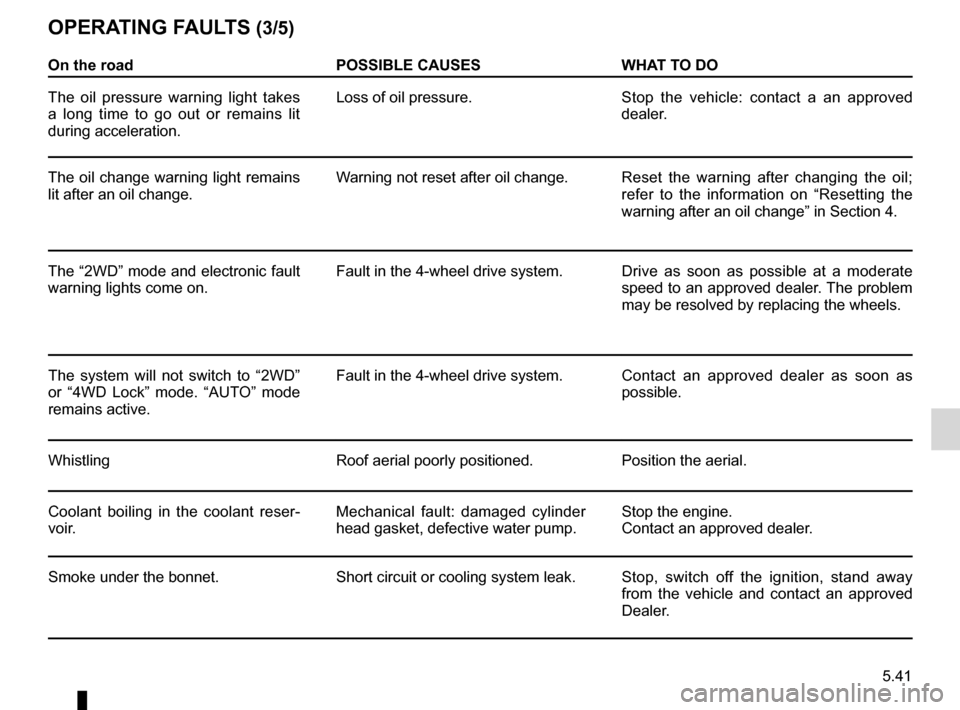
OPERATING FAULTS (3/5)
On the road POSSIBLE CAUSESWHAT TO DO
The oil pressure warning light takes
a long time to go out or remains lit
during acceleration. Loss of oil pressure.
Stop the vehicle: contact a an approved
dealer.
The oil change warning light remains
lit after an oil change. Warning not reset after oil change.
Reset the warning after changing the oil;
refer to the information on “Resetting the
warning after an oil change” in Section 4.
The “2WD” mode and electronic fault
warning lights come on. Fault in the 4-wheel drive system.
Drive as soon as possible at a moderate
speed to an approved dealer. The problem
may be resolved by replacing the wheels.
The system will not switch to “2WD”
or “4WD Lock” mode. “AUTO” mode
remains active. Fault in the 4-wheel drive system.
Contact an approved dealer as soon as
possible.
Whistling Roof aerial poorly positioned.Position the aerial.
Coolant boiling in the coolant reser -
voir. Mechanical fault: damaged cylinder
head gasket, defective water pump.Stop the engine.
Contact an approved dealer.
Smoke under the bonnet. Short circuit or cooling system leak.Stop, switch off the ignition, stand away
from the vehicle and contact an approved
Dealer.
Page 174 of 200
5.42
ENG_UD20968_2
Anomalies de fonctionnement (H79 - Dacia)
ENG_NU_898-5_H79_Dacia_5
Jaune NoirNoir texte
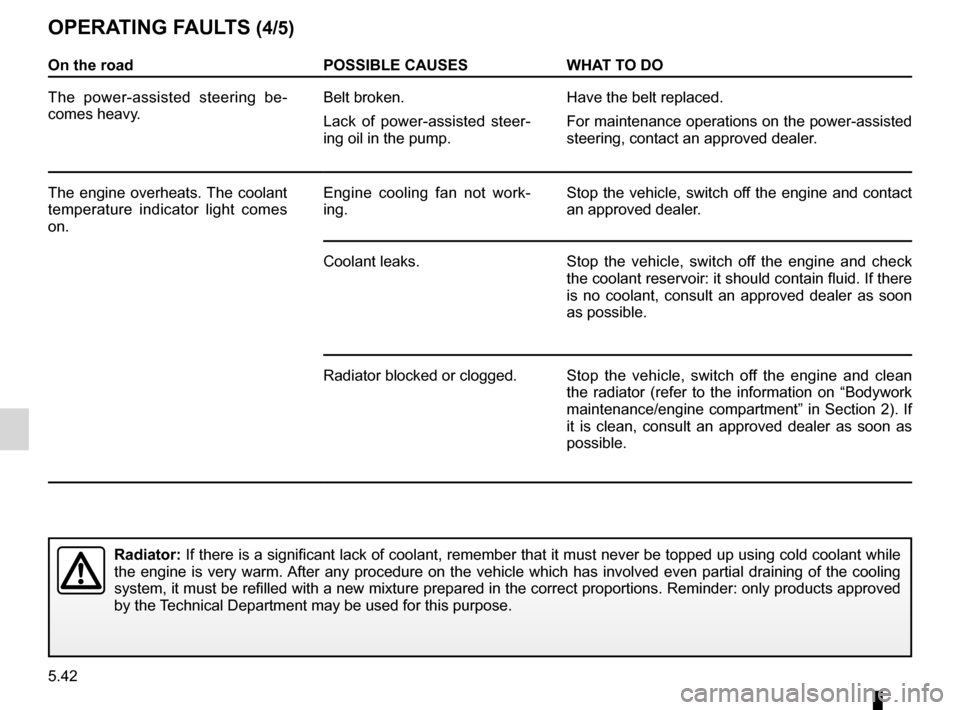
On the road POSSIBLE CAUSESWHAT TO DO
The power-assisted steering be -
comes heavy. Belt broken.
Lack of power-assisted steer
-
ing oil in the pump. Have the belt replaced.
For maintenance operations on the power-assisted
steering, contact an approved dealer.
The engine overheats. The coolant
temperature indicator light comes
on. Engine cooling fan not work
-
ing. Stop the vehicle, switch off the engine and contact
an approved dealer.
Coolant leaks. Stop the vehicle, switch off the engine and check
the coolant reservoir: it should contain fluid. If there
is no coolant, consult an approved dealer as soon
as possible.
Radiator blocked or clogged. Stop the vehicle, switch off the engine and clean
the radiator (refer to the information on “Bodywork
maintenance/engine compartment” in Section 2). If
it is clean, consult an approved dealer as soon as
possible.
OPERATING FAULTS (4/5)
Radiator: If there is a significant lack of coolant, remember that it must never be topped up using cold coolant while
the engine is very warm. After any procedure on the vehicle which has involved even partial draining of the cooling
system, it must be refilled with a new mixture prepared in the correct proportions. Reminder: only products approved
by the Technical Department may be used for this purpose.