Off DACIA DUSTER 2010 1.G User Guide
[x] Cancel search | Manufacturer: DACIA, Model Year: 2010, Model line: DUSTER, Model: DACIA DUSTER 2010 1.GPages: 200, PDF Size: 7.12 MB
Page 56 of 200
variable power-assisted steering ........................... (current page)
power-assisted steering ......................................... (current page)
power-assisted steering ......................................... (current page)
steering wheel adjustment ...................................... (up to the end of the DU)
1.50
ENG_UD20567_3
Volant de direction/Direction assistée (H79 - Dacia)
ENG_NU_898-5_H79_Dacia_1
Steering wheel, Power-assisted steering
STEERING WHEEL, POWER-ASSISTED STEERING
Power Assisted Steering
With the engine running, do not leave
the steering wheel at full lock while sta-
tionary as this may damage the power -
assisted steering pump.
With the engine switched off, or if there
is a system fault, it is still possible to
turn the steering wheel. The force re -
quired will be greater.
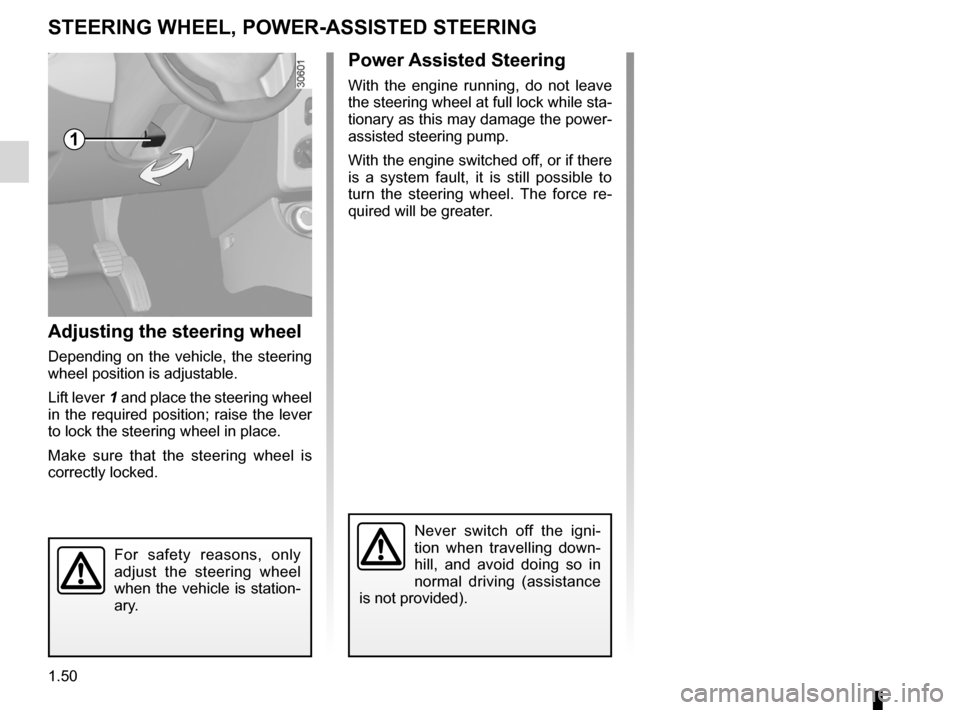
Adjusting the steering wheel
Depending on the vehicle, the steering
wheel position is adjustable.
Lift lever 1 and place the steering wheel
in the required position; raise the lever
to lock the steering wheel in place.
Make sure that the steering wheel is
correctly locked.
For safety reasons, only
adjust the steering wheel
when the vehicle is station-
ary.
Never switch off the igni -
tion when travelling down -
hill, and avoid doing so in
normal driving (assistance
is not provided).
1
Page 60 of 200
lighting:exterior ............................................ (up to the end of the DU)
lights: dipped beam headlights ................................... (current page)
lights: side lights ......................................................... (current page)
lights: main beam headlights ...................................... (current page)
lights ..................................................... (up to the end of the DU)
signals and lights .................................. (up to the end of the DU)
control instruments ............................... (up to the end of the DU)
1.54
ENG_UD14459_1
Éclairages et signalisations extérieures (H79 - Dacia)
ENG_NU_898-5_H79_Dacia_1
Jaune NoirNoir texte
Exterior lighting and signals
EXTERIOR LIGHTING AND SIGNALS (1/2)
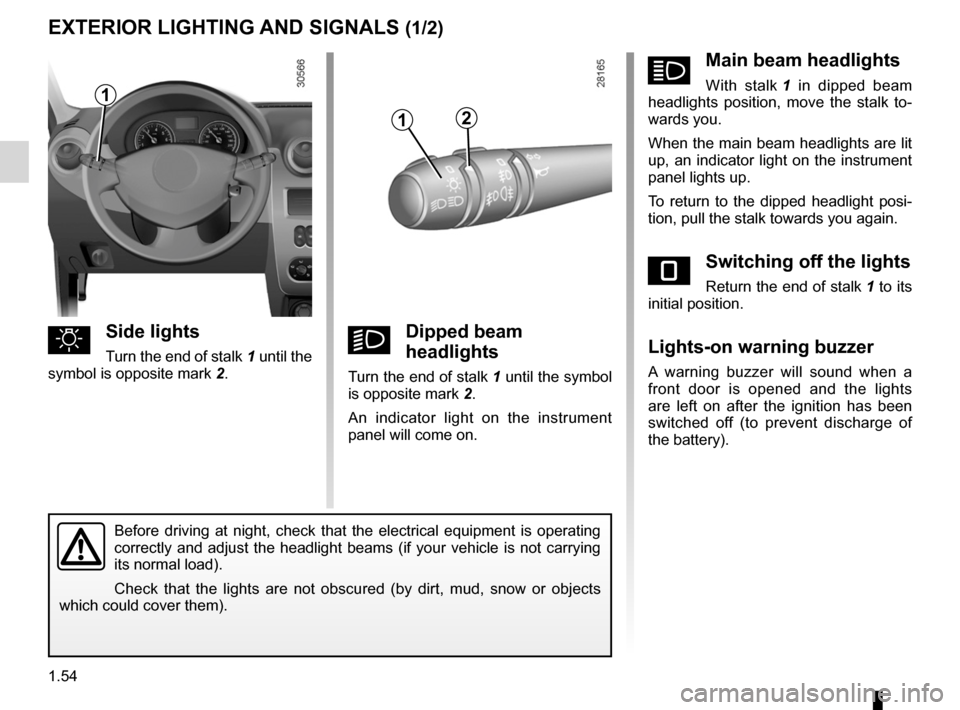
uSide lights
Turn the end of stalk 1 until the
symbol is opposite mark 2.kDipped beam
headlights
Turn the end of stalk 1 until the symbol
is opposite mark 2.
An indicator light on the instrument
panel will come on.
áMain beam headlights
With stalk 1 in dipped beam
headlights position, move the stalk to -
wards you.
When the main beam headlights are lit
up, an indicator light on the instrument
panel lights up.
To return to the dipped headlight posi-
tion, pull the stalk towards you again.
eSwitching off the lights
Return the end of stalk 1 to its
initial position.
Lights-on warning buzzer
A warning buzzer will sound when a
front door is opened and the lights
are left on after the ignition has been
switched off (to prevent discharge of
the battery).
Before driving at night, check that the electrical equipment is operating
correctly and adjust the headlight beams (if your vehicle is not carrying
its normal load).
Check that the lights are not obscured (by dirt, mud, snow or objects
which could cover them).
12
1
Page 61 of 200
warning buzzer ...................................................... (current page)
fog lights ................................................................ (current page)
lights: fog lights .......................................................... (current page)
JauneNoirNoir texte
1.55
ENG_UD14459_1
Éclairages et signalisations extérieures (H79 - Dacia)
ENG_NU_898-5_H79_Dacia_1
EXTERIOR LIGHTING AND SIGNALS (2/2)
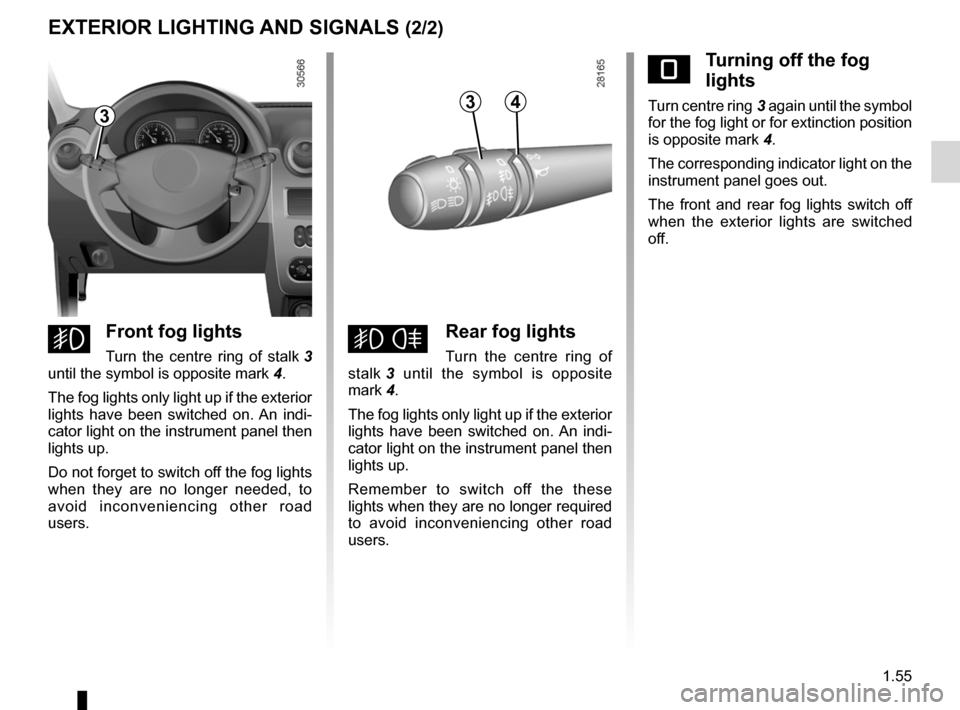
eTurning off the fog
lights
Turn centre ring 3 again until the symbol
for the fog light or for extinction position
is opposite mark 4.
The corresponding indicator light on the
instrument panel goes out.
The front and rear fog lights switch off
when the exterior lights are switched
off.
gFront fog lights
Turn the centre ring of stalk 3
until the symbol is opposite mark 4.
The fog lights only light up if the exterior
lights have been switched on. An indi -
cator light on the instrument panel then
lights up.
Do not forget to switch off the fog lights
when they are no longer needed, to
avoid inconveniencing other road
users.hRear fog lights
Turn the centre ring of
stalk 3 until the symbol is opposite
mark 4.
The fog lights only light up if the exterior
lights have been switched on. An indi -
cator light on the instrument panel then
lights up.
Remember to switch off the these
lights when they are no longer required
to avoid inconveniencing other road
users.
343
Page 63 of 200
wipers ................................................... (up to the end of the DU)
windscreen washer ............................... (up to the end of the DU)
1.57
ENG_UD24504_4
Essuie-vitre /Lave-vitre/Dégivrage (H79 - Dacia)
ENG_NU_898-5_H79_Dacia_1
Windscreen washer/wiper, De-icing
WINDSCREEN WASHER/WIPER, DE-ICING (1/3)
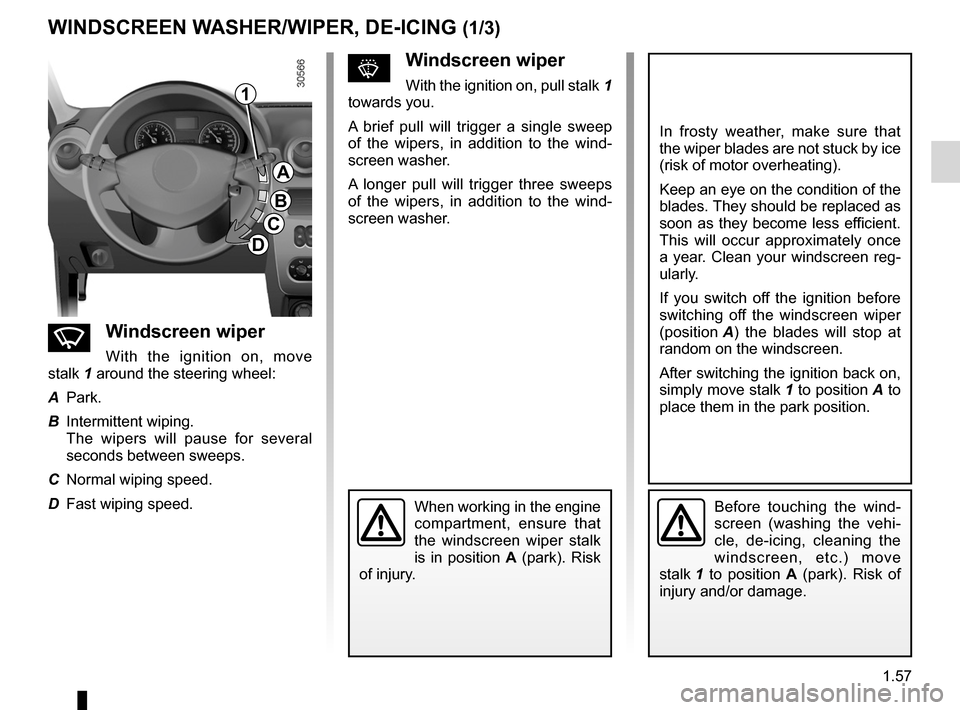
nWindscreen wiper
With the ignition on, move
stalk 1 around the steering wheel:
A Park.
B Intermittent wiping.
The wipers will pause for several
seconds between sweeps.
C Normal wiping speed.
D Fast wiping speed.
sWindscreen wiper
With the ignition on, pull stalk 1
towards you.
A brief pull will trigger a single sweep
of the wipers, in addition to the wind -
screen washer.
A longer pull will trigger three sweeps
of the wipers, in addition to the wind -
screen washer.
In frosty weather, make sure that
the wiper blades are not stuck by ice
(risk of motor overheating).
Keep an eye on the condition of the
blades. They should be replaced as
soon as they become less efficient.
This will occur approximately once
a year. Clean your windscreen reg-
ularly.
If you switch off the ignition before
switching off the windscreen wiper
(position A ) the blades will stop at
random on the windscreen.
After switching the ignition back on,
simply move stalk 1 to position A to
place them in the park position.
Before touching the wind -
screen (washing the vehi -
cle, de-icing, cleaning the
windscreen, etc.) move
stalk 1 to position A (park). Risk of
injury and/or damage.When working in the engine
compartment, ensure that
the windscreen wiper stalk
is in position A (park). Risk
of injury.
1
A
B
C
D
Page 68 of 200
1.62
ENG_UD22445_3
Réservoir carburant (H79 - Dacia)
ENG_NU_898-5_H79_Dacia_1
Persistent smell of fuel
If you notice a persistent
smell of fuel you should:
– stop the vehicle as soon
as traffic conditions allow and
switch off the ignition;
– switch on the hazard warning
lights and ask your passengers to
leave the vehicle and stay clear
of the traffic;
– contact an approved Dealer.
No modifications what -
soever are permitted on
any part of the fuel supply
system (computers, wiring,
fuel circuit, injector, protection
covers, etc.) as this may be danger-
ous (such work must be undertaken
by qualified Network personnel).
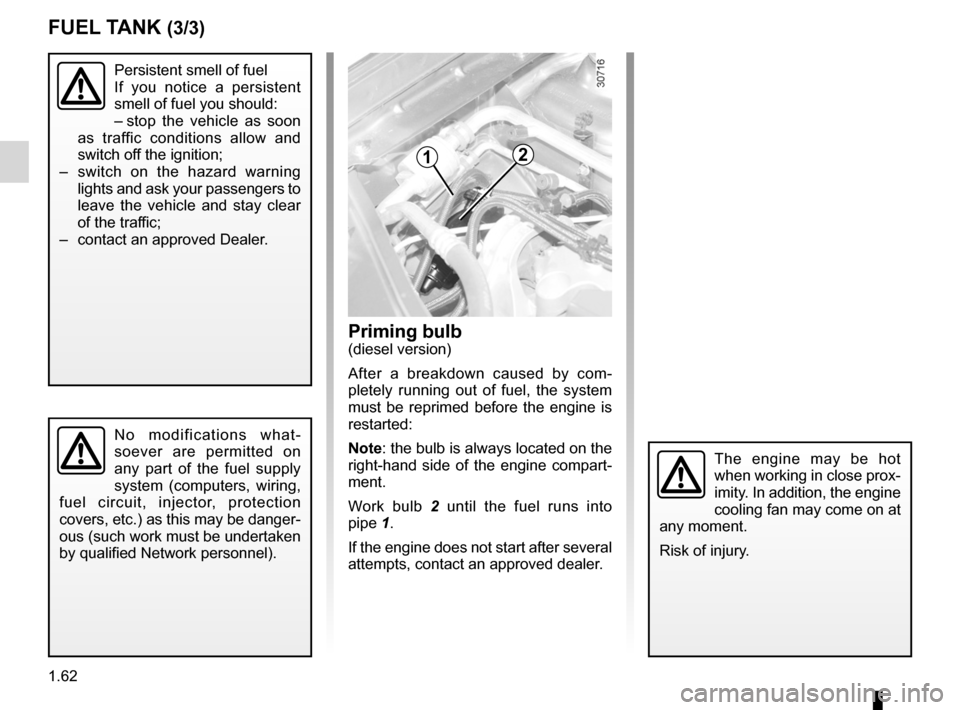
Priming bulb (diesel version)
After a breakdown caused by com -
pletely running out of fuel, the system
must be reprimed before the engine is
restarted:
Note: the bulb is always located on the
right-hand side of the engine compart-
ment.
Work bulb 2 until the fuel runs into
pipe 1.
If the engine does not start after several
attempts, contact an approved dealer.
The engine may be hot
when working in close prox-
imity. In addition, the engine
cooling fan may come on at
any moment.
Risk of injury.
FUEL TANK (3/3)
12
Page 70 of 200
engine immobiliser (switch) .................. (up to the end of the DU)
ignition switch ....................................... (up to the end of the DU)
starting the engine ................................ (up to the end of the DU)
running in .............................................. (up to the end of the DU)
driving ................................................... (up to the end of the DU)
2.2
ENG_UD20629_3
Rodage / Contacteur de démarrage (H79 - Dacia)
ENG_NU_898-5_H79_Dacia_2
Running in, Ignition switch
Petrol version
For the first 600 miles (1,000 km), do
not exceed 78 mph (130 km/h) in the
highest gear, or 3,000 to 3,500 rpm.
You may only expect top performance
from your vehicle after approximately
1,800 miles (3,000 km).
S e r v i c e i n t e r v a l s : r e f e r t o t h e
Maintenance Service Booklet for the
vehicle.
Diesel version
For the first 900 miles (1,500 km), do
not exceed 2,500 rpm. After complet -
ing this mileage you may drive faster,
although you may only expect top per-
formance after approximately 3,600
miles (6,000 km).
Do not accelerate hard while the engine
is still cold and do not let the engine
over-rev.
S e r v i c e i n t e r v a l s : r e f e r t o t h e
Maintenance Service Booklet for the
vehicle.
RUNNING IN, IGNITION SWITCH
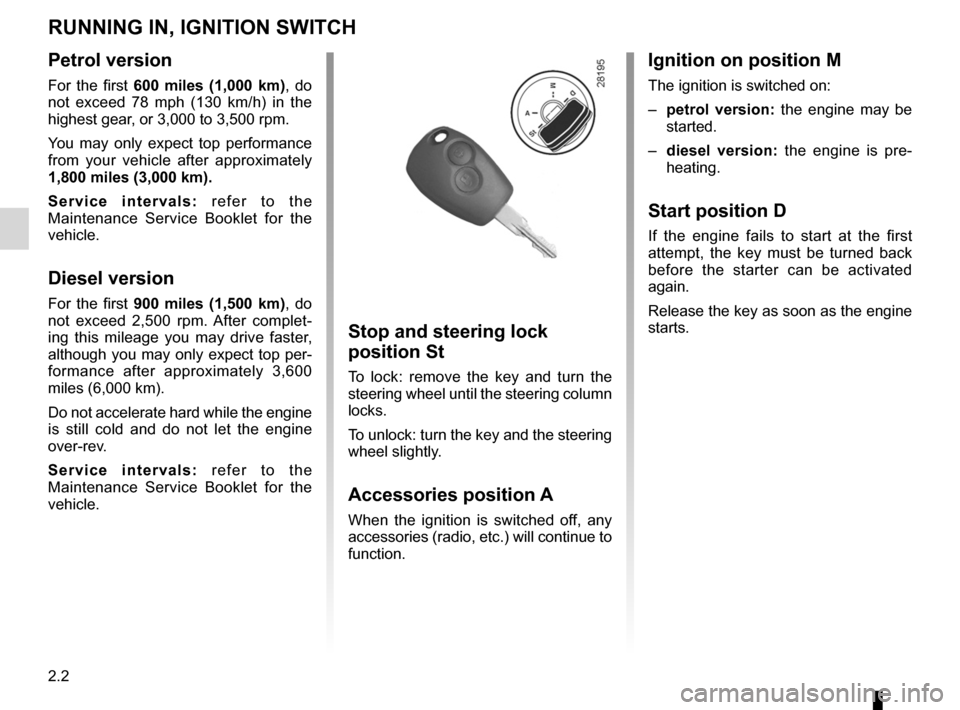
Stop and steering lock
position St
To lock: remove the key and turn the
steering wheel until the steering column
locks.
To unlock: turn the key and the steering
wheel slightly.
Accessories position A
When the ignition is switched off, any
accessories (radio, etc.) will continue to
function.
Ignition on position M
The ignition is switched on:
– petrol version: the engine may be
started.
– diesel version: the engine is pre -
heating.
Start position D
If the engine fails to start at the first
attempt, the key must be turned back
before the starter can be activated
again.
Release the key as soon as the engine
starts.
Page 71 of 200
driving ................................................... (up to the end of the DU)
starting .................................................. (up to the end of the DU)
starting the engine ................................ (up to the end of the DU)
2.3
ENG_UD17439_2
Mise en route / Arrêt du moteur (H79 - Dacia)
ENG_NU_898-5_H79_Dacia_2
Petrol injection
Engine warm or cold
– Turn the key to the start position
without depressing the accelera -
tor.
– Release the key as soon as the
engine starts.ÉDiesel injection
Turn the ignition key to ignition “On” po-
sition M, and hold this position until the
preheating warning light goes out.
Turn the key to starter position D with-
out depressing the accelerator
pedal.
Release the key as soon as the engine
starts.
Stopping the engine
With the engine idling, turn the key
back to “Stop” position St.
Starting the engine
In very cold conditions (temperatures
below –20°C): so that it is easier to
start the engine, switch on the ignition
for several seconds before starting the
engine.
Make sure the engine immobiliser is not
activated. Refer to the information on
the “Engine immobiliser” in Section 1.
Starting/stopping the engine
STARTING/STOPPING THE ENGINE
Never leave your vehicle with the key or remote control inside and never leave a child (or a pet) unsupervised, even
for a short while.
The reason for this is that the child may endanger himself or others by starting the engine, activating equipment such
as the window winders for example, or locking the doors.
Risk of serious injury.
Never switch off the ignition before the vehicle has stopped completely. Once the engine has stopped, the brake servo,
power assisted steering and passive safety equipment such as air bags wi\
ll no longer operate.
The steering is locked when the key is removed.
Page 75 of 200

ENG_NU_898-5_H79_Dacia_2
Driving
– Drive carefully for the first few miles
u")
JauneNoirNoir texte
2.7
ENG_UD22435_3
Conseils : antipollution, économies de carburant, conduite (H79 - Da\
cia)
ENG_NU_898-5_H79_Dacia_2
Driving
– Drive carefully for the first few miles
until the engine reaches its normal
operating temperature, rather than
let it warm up while the vehicle is sta-
tionary.
– Speed is expensive.
– Sporty driving uses a lot of fuel: drive
with a light right foot.
– Brake as little as possible. If you an-
ticipate an obstacle or bend in ad -
vance, you may then simply release
the accelerator pedal.
– Avoid sudden acceleration.
ADVICE: antipollution, fuel economy and driving (2/3)
– Double declutching and accelerating
before switching off are unnecessary
in modern vehicles.
– Do not try to maintain the same
speed up a hill, accelerate no more
than you would on the level. Keep
your foot in the same position on the
accelerator pedal.
– Do not overrev the engine in the in-
termediate gears. Always use the
highest gear possible without labour-
ing the engine.
On versions with an automatic gear-
box, it is preferable to keep the gear
lever in position D.
Your vehicle has a greater
ground clearance than an
ordinary passenger vehicle.
This gives it a higher centre
of gravity, making it more suscepti-
ble to rolling during sudden or ag -
gressive manoeuvres, or when cor-
nering at high speeds.
Take extra care when the vehicle is
loaded (in particular when the load
is on the roof).
Ensure that all passengers are
wearing their seat belts.
A label affixed to the sun visor re -
minds you of this.
Vehicles with 4x4 (4WD) trans -
mission
On flat, level ground, with the vehi-
cle unladen, you are recommended
to start in second gear.
Driving problems
On the driver ’s side, only
use mats specially adapted
for the vehicle and attached
to prefitted devices. Check regularly
to make sure they are secure. Do
not overlay several mats.
Risk of pedals jamming .
Page 76 of 200

ENG_NU_898-5_H79_Dacia_2
ADVICE: antipollution, fuel economy and driving (3/3)
– In vehicles fitted")
2.8
ENG_UD22435_3
Conseils : antipollution, économies de carburant, conduite (H79 - Da\
cia)
ENG_NU_898-5_H79_Dacia_2
ADVICE: antipollution, fuel economy and driving (3/3)
– In vehicles fitted with air condi -
tioning, it is normal to observe an
increase in fuel consumption (es -
pecially in urban conditions) when
it is used. For vehicles fitted with
manual air conditioning, switch off
the system when it is not required.
Advice for reducing consumption
and therefore helping to preserve
the environment:
If the vehicle has been parked in the
sun, open the doors for a few mo -
ments to let the hot air escape before
starting the engine.
– Never fill the fuel tank right to the
brim to avoid overflow.
– Do not leave an empty roof rack
fitted to the vehicle.
– It is better to fit a trailer for bulky ob-
jects.
– When towing a caravan, fit a wind
deflector and adjust it carefully.
Advice on use
– Electricity is fuel; switch off all the
electrical components which are
not really needed. However (safety
first), keep your lights on when the
visibility is bad (“see and be seen”).
– Use the air vents. Driving with the
windows open at 60 mph (100 km/h)
will increase fuel consumption by
4%. –
Avoid using the vehicle for door-to -
door journeys (short journeys, with
long stops in-between) because in
these conditions, the engine never
reaches its ideal temperature.
Tyres
Increased fuel consumption could be
the result of:
– insufficient pressure,
– using non-recommended tyres.
Page 79 of 200
4 wheel drive (4WD) ............................. (up to the end of the DU)
driving ................................................... (up to the end of the DU)
2.11
ENG_UD20643_3
Transmission : 4 roues motrices (4WD) (H79 - Dacia)
ENG_NU_898-5_H79_Dacia_2
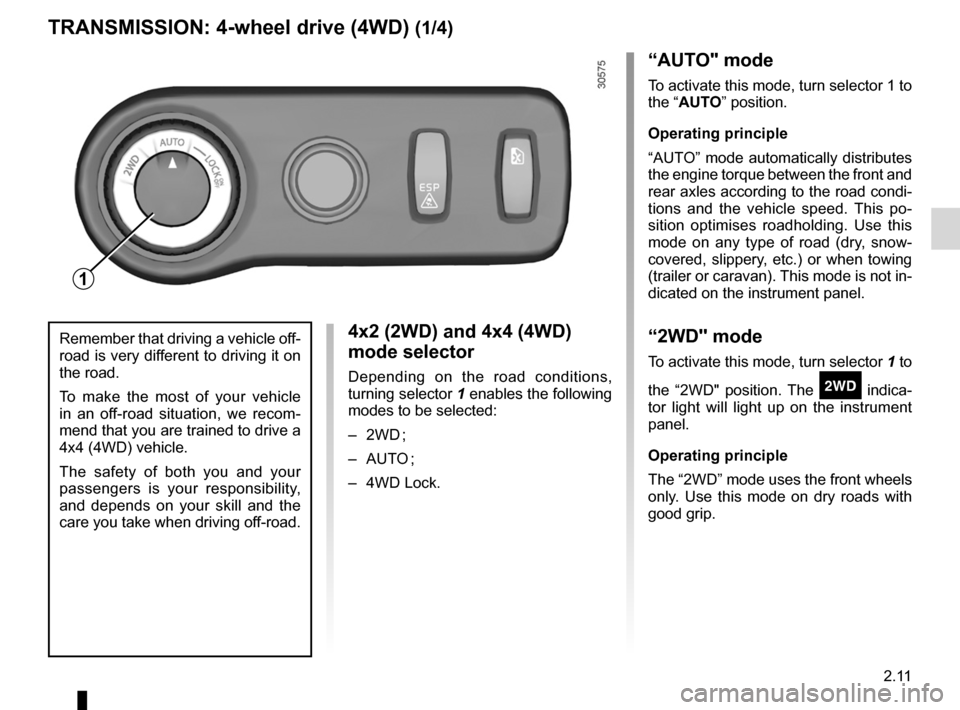
4x2 (2WD) and 4x4 (4WD)
mode selector
Depending on the road conditions,
turning selector 1 enables the following
modes to be selected:
– 2WD ;
– AUTO ;
– 4WD Lock.
Transmission: 4-wheel drive (4WD)
TRANSMISSION: 4-wheel drive (4WD) (1/4)
“AUTO" mode
To activate this mode, turn selector 1 to
the “AUTO” position.
Operating principle
“AUTO” mode automatically distributes
the engine torque between the front and
rear axles according to the road condi -
tions and the vehicle speed. This po -
sition optimises roadholding. Use this
mode on any type of road (dry, snow -
covered, slippery, etc.) or when towing
(trailer or caravan). This mode is not in-
dicated on the instrument panel.
“2WD" mode
To activate this mode, turn selector 1 to
the “2WD" position. The
‘ indica -
tor light will light up on the instrument
panel.
Operating principle
The “2WD” mode uses the front wheels
only. Use this mode on dry roads with
good grip.
Remember that driving a vehicle off-
road is very different to driving it on
the road.
To make the most of your vehicle
in an off-road situation, we recom -
mend that you are trained to drive a
4x4 (4WD) vehicle.
The safety of both you and your
passengers is your responsibility,
and depends on your skill and the
care you take when driving off-road.
1