Off DACIA DUSTER 2010 1.G Owner's Guide
[x] Cancel search | Manufacturer: DACIA, Model Year: 2010, Model line: DUSTER, Model: DACIA DUSTER 2010 1.GPages: 200, PDF Size: 7.12 MB
Page 98 of 200
air conditioning ..................................... (up to the end of the DU)
heating system ..................................... (up to the end of the DU)
heating and air conditioning system ..... (up to the end of the DU)
ventilation heating and air conditioning system (up to the end of the DU)
air conditioning ...................................................... (current page)
3.8
ENG_UD18246_14
Air conditionné : informations et conseils utilisation (B90 - U90 - \
L90 Ph2 - F90 Ph2 - R90 Ph2 - H79 - Dacia)
ENG_NU_898-5_H79_Dacia_3
Air conditioning: information and advice on use
AIR CONDITIONING: information and advice on use
Fuel consumption
You will normally notice an increase
in fuel consumption (especially
when driving in town) when the air
conditioning is operating.
For vehicles fitted with air condition -
ing with no automatic mode, switch
off the system when it is not re -
quired.
Advice for reducing consumption
and helping to preserve the envi-
ronment
Drive with the air vents open and
the windows closed.
If the vehicle has been parked in
the sun, open the doors for a few
moments to let the hot air escape
before starting the engine. Operating faults
As a general rule, contact your ap-
proved dealer in the event of an op-
erating fault.
– Reduction in de-icing, demist -
ing or air conditioning per -
formance.
This may be caused by the pas-
senger compartment filter car -
tridge becoming clogged.
– No cold air is being produced .
Check that the controls are set
correctly and that the fuses are
sound. Otherwise, switch off the
system.
Do not open the refriger -
ant fluid circuit. The fluid
may damage eyes or skin.Presence of water under the ve -
hicle. After prolonged use of the air
conditioning system, it is normal for
water to be present under the vehi-
cle. This is caused by condensation.Maintenance
Refer to the Maintenance Service
Booklet for your vehicle for the in -
spection frequency.
Page 103 of 200
mirrors .................................................. (up to the end of the DU)
sun visor ............................................... (up to the end of the DU)
grab handle ........................................... (up to the end of the DU)
3.13
ENG_UD20689_3
Pare-soleil - Poignée de maintien (H79 - Dacia)
ENG_NU_898-5_H79_Dacia_3
Sun visor/grab handle
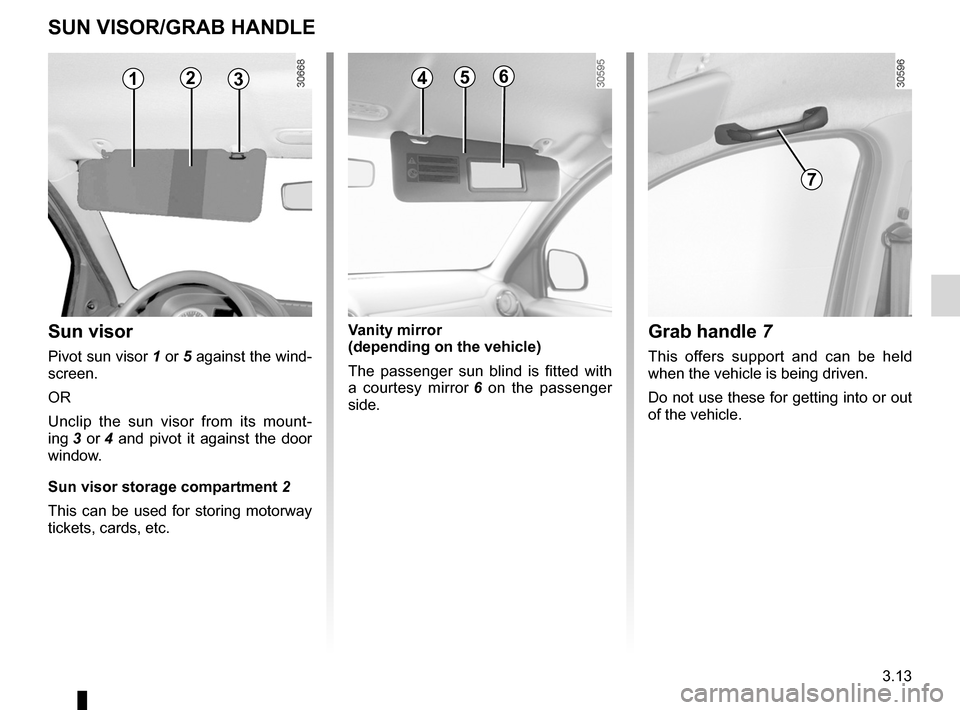
Vanity mirror
(depending on the vehicle)
The passenger sun blind is fitted with
a courtesy mirror 6 on the passenger
side.Grab handle 7
This offers support and can be held
when the vehicle is being driven.
Do not use these for getting into or out
of the vehicle.
SuN VISOR/GRAB HANDLE
7
Sun visor
Pivot sun visor 1 or 5 against the wind -
screen.
OR
Unclip the sun visor from its mount -
ing 3 or 4 and pivot it against the door
window.
Sun visor storage compartment 2
This can be used for storing motorway
tickets, cards, etc.
456132
Page 110 of 200
tailgate ................................................................... (current page)
3.20
ENG_UD20574_2
Coffre à bagages (H79 - Dacia)
ENG_NU_898-5_H79_Dacia_3
Luggage compartment
T AILGATE
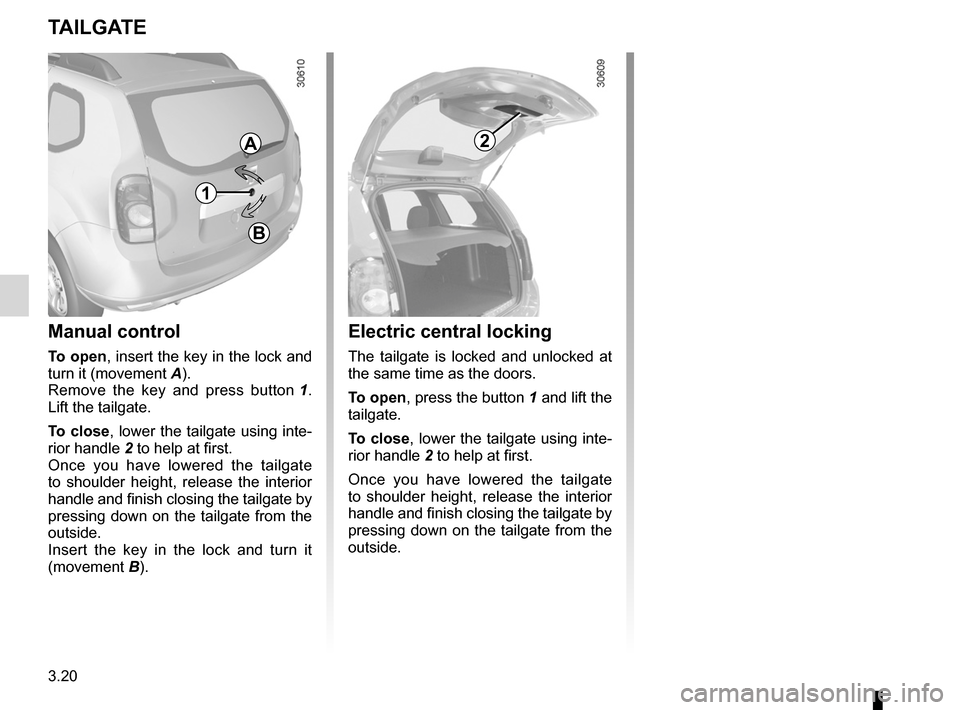
Manual control
To open, insert the key in the lock and
turn it (movement A).
Remove the key and press button 1 .
Lift the tailgate.
To close, lower the tailgate using inte-
rior handle 2 to help at first.
Once you have lowered the tailgate
to shoulder height, release the interior
handle and finish closing the tailgate by
pressing down on the tailgate from the
outside.
Insert the key in the lock and turn it
(movement B).
Electric central locking
The tailgate is locked and unlocked at
the same time as the doors.
To open, press the button 1 and lift the
tailgate.
To close, lower the tailgate using inte-
rior handle 2 to help at first.
Once you have lowered the tailgate
to shoulder height, release the interior
handle and finish closing the tailgate by
pressing down on the tailgate from the
outside.
1
2A
B
Page 111 of 200
transporting objectsin the luggage compartment ........... (up to the end of the DU)
towing rings .......................................... (up to the end of the DU)
towing towing equipment ............................ (up to the end of the DU)
towing equipment fitting ............................................... (up to the end of the DU)
towing a caravan .................................. (up to the end of the DU)
3.21
ENG_UD24628_3
Transport d’objets dans le coffre (H79 - Dacia)
ENG_NU_898-5_H79_Dacia_3
Transporting objects in the boot
TRANSPORTING OBjECTS IN THE LuGGAGE COMPARTMENT
Always position the heavi -
est items directly on the
floor. Use the lashing points
on the luggage compart -
ment floor, if these are fitted to the
vehicle. The luggage should be
loaded in such a way that no items
will be thrown forward and strike the
occupants if the driver has to brake
suddenly.
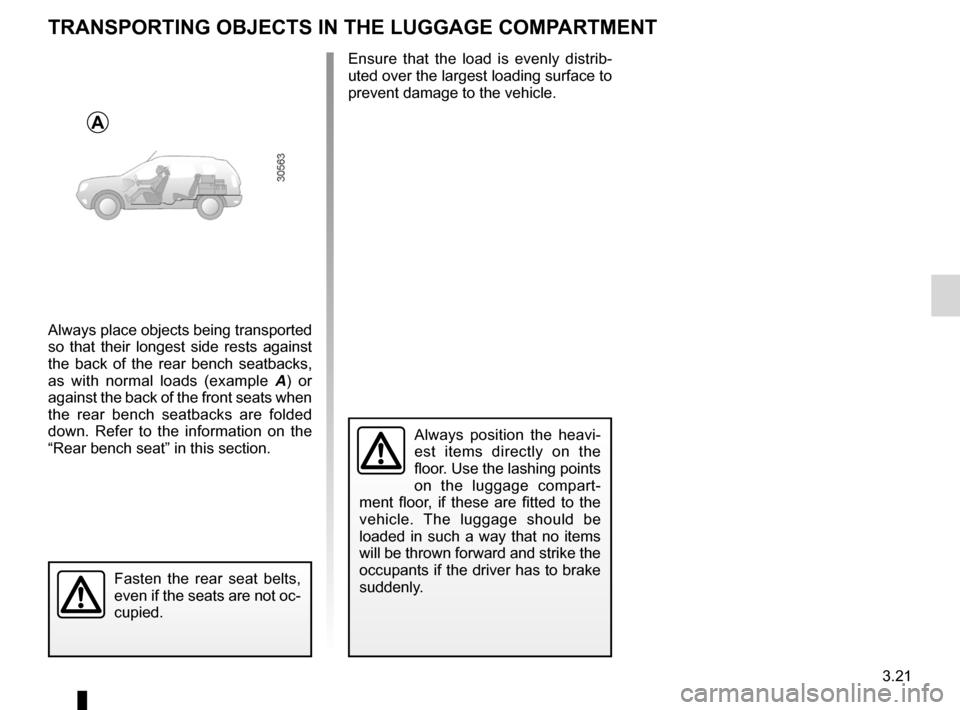
Always place objects being transported
so that their longest side rests against
the back of the rear bench seatbacks,
as with normal loads (example A ) or
against the back of the front seats when
the rear bench seatbacks are folded
down. Refer to the information on the
“Rear bench seat” in this section.
A
Fasten the rear seat belts,
even if the seats are not oc-
cupied.
Ensure that the load is evenly distrib -
uted over the largest loading surface to
prevent damage to the vehicle.
Page 118 of 200
capacity of mechanical components......................(current page)
engine oil .............................................. (up to the end of the DU)
dipstick.................................................. (up to the end of the DU)
levels .................................................... (up to the end of the DU)
maintenance: mechanical ...................................... (up to the end of the DU)
4.4
ENG_UD20645_2
Niveau huile moteur : généralités (H79 - Dacia)
ENG_NU_898-5_H79_Dacia_4
It is normal for an engine to use oil for
lubrication and cooling of moving parts
and it is sometimes necessary to top up
the level between oil changes.
However, contact an approved dealer if
more than 0.5 litres is being consumed
every 600 miles (1,000 km) after the
running in period.
Oil change frequency: check the oil
level from time to time and certainly
before any long journey to avoid the
risk of damaging your engine.
The vehicle must be parked on level
ground and the engine should have
been switched off for some time before-
hand to obtain an accurate reading.
Engine oil level: general information
ENGINE OIL LEVEL: general information
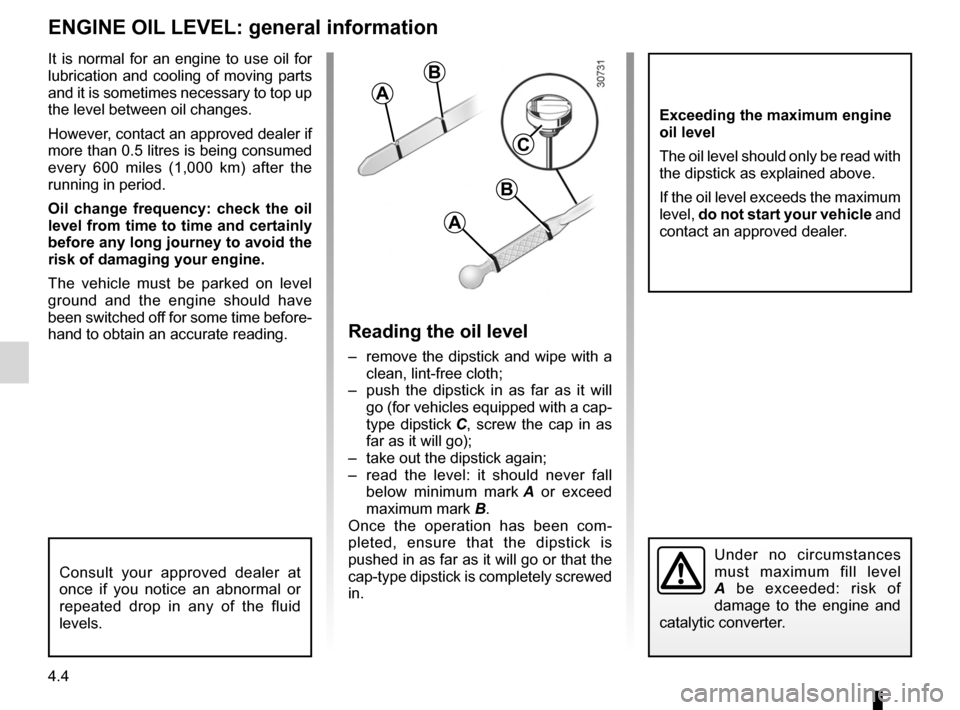
Reading the oil level
– remove the dipstick and wipe with a
clean, lint-free cloth;
– push the dipstick in as far as it will
go (for vehicles equipped with a cap-
type dipstick C, screw the cap in as
far as it will go);
– take out the dipstick again;
– read the level: it should never fall
below minimum mark A or exceed
maximum mark B.
Once the operation has been com -
pleted, ensure that the dipstick is
pushed in as far as it will go or that the
cap-type dipstick is completely screwed
in.
Under no circumstances
must maximum fill level
A be exceeded: risk of
damage to the engine and
catalytic converter.
Consult your approved dealer at
once if you notice an abnormal or
repeated drop in any of the fluid
levels.
Exceeding the maximum engine
oil level
The oil level should only be read with
the dipstick as explained above.
If the oil level exceeds the maximum
level, do not start your vehicle and
contact an approved dealer.
A
B
A
B
C
Page 121 of 200
levels .................................................... (up to the end of the DU)
brake fluid .............................................................. (current page)
maintenance: mechanical ....................................................... (current page)
tanks and reservoirs brake fluid ........................................................ (current page)
4.7
ENG_UD20646_2
Niveaux (H79 - Dacia)
ENG_NU_898-5_H79_Dacia_4
Levels:
Brake fluid
LEVELS (1/3)
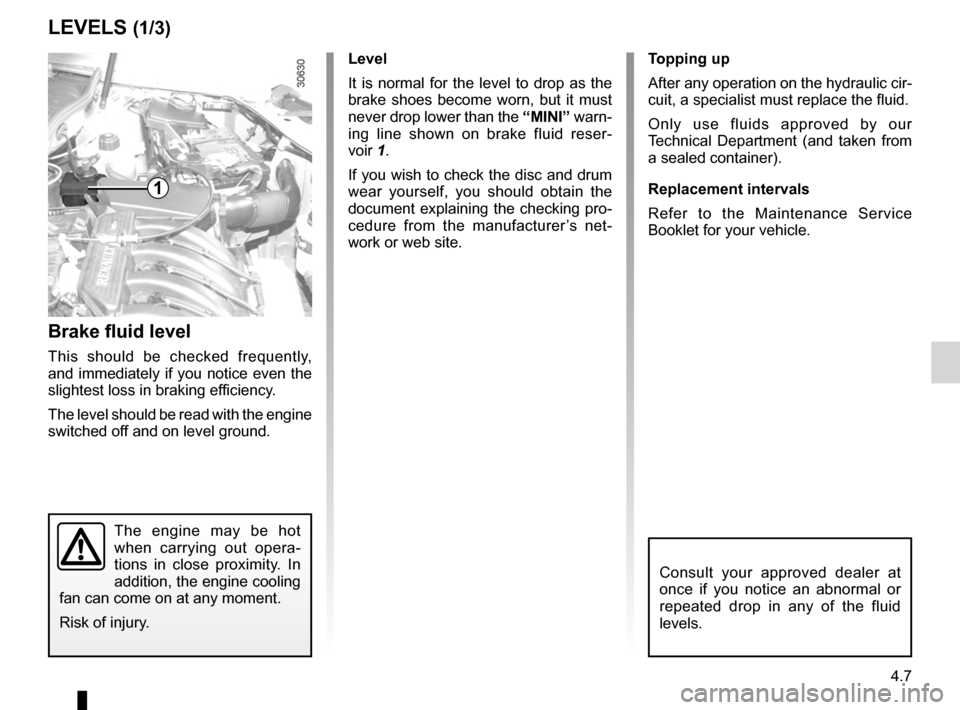
Brake fluid level
This should be checked frequently,
and immediately if you notice even the
slightest loss in braking efficiency.
The level should be read with the engine
switched off and on level ground. Level
It is normal for the level to drop as the
brake shoes become worn, but it must
never drop lower than the
“MINI” warn-
ing line shown on brake fluid reser -
voir 1.
If you wish to check the disc and drum
wear yourself, you should obtain the
document explaining the checking pro-
cedure from the manufacturer ’s net -
work or web site. Topping up
After any operation on the hydraulic cir-
cuit, a specialist must replace the fluid.
Only use fluids approved by our
Technical Department (and taken from
a sealed container).
Replacement intervals
Refer to the Maintenance Service
Booklet for your vehicle.
The engine may be hot
when carrying out opera
-
tions in close proximity. In
addition, the engine cooling
fan can come on at any moment.
Risk of injury.
Consult your approved dealer at
once if you notice an abnormal or
repeated drop in any of the fluid
levels.
1
Page 122 of 200
levels:coolant ............................................................. (current page)
engine coolant ....................................................... (current page)
tanks and reservoirs coolant ............................................................. (current page)
4.8
ENG_UD20646_2
Niveaux (H79 - Dacia)
ENG_NU_898-5_H79_Dacia_4
Jaune NoirNoir texte
Engine coolant
LEVELS (2/3)
Coolant level checking frequency
Check the coolant level regularly
(very severe damage is likely to be
caused to the engine if it runs out of
coolant).
If the level needs to be topped up, only
use products approved by our Technical
Department which ensure:
– protection against freezing;
– anticorrosion protection of the cool -
ing system.
Replacement intervals
Refer to the Maintenance Service
Booklet for your vehicle.
No operations should be
carried out on the cooling
circuit when the engine is
hot.
Risk of burns.
Consult your approved dealer at
once if you notice an abnormal or
repeated drop in any of the fluid
levels.
The engine may be hot
when carrying out opera -
tions in close proximity. In
addition, the engine cooling
fan can come on at any moment.
Risk of injury.
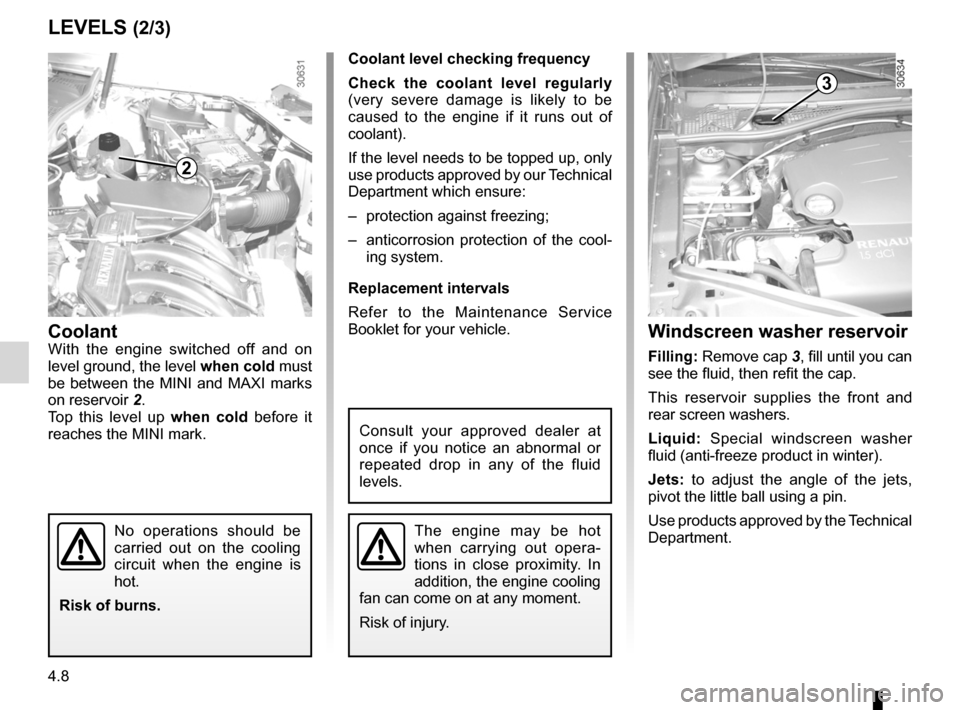
Windscreen washer reservoir
Filling: Remove cap 3, fill until you can
see the fluid, then refit the cap.
This reservoir supplies the front and
rear screen washers.
Liquid: Special windscreen washer
fluid (anti-freeze product in winter).
Jets: to adjust the angle of the jets,
pivot the little ball using a pin.
Use products approved by the Technical
Department.
CoolantWith the engine switched off and on
level ground, the level when cold must
be between the MINI and MAXI marks
on reservoir 2.
Top this level up when cold before it
reaches the MINI mark.
2
3
Page 123 of 200
levels:windscreen washer reservoir ........................... (current page)
power-assisted steering ......................................... (current page)
power-assisted steering ......................................... (current page)
windscreen washer ................................................ (current page)
power-assisted steering pump ...............................(current page)
tanks and reservoirs: windscreen washer .......................................... (current page)
JauneNoirNoir texte
4.9
ENG_UD20646_2
Niveaux (H79 - Dacia)
ENG_NU_898-5_H79_Dacia_4
LEVELS (3/3)
Power-assisted steering pump
Windscreen washer reservoir
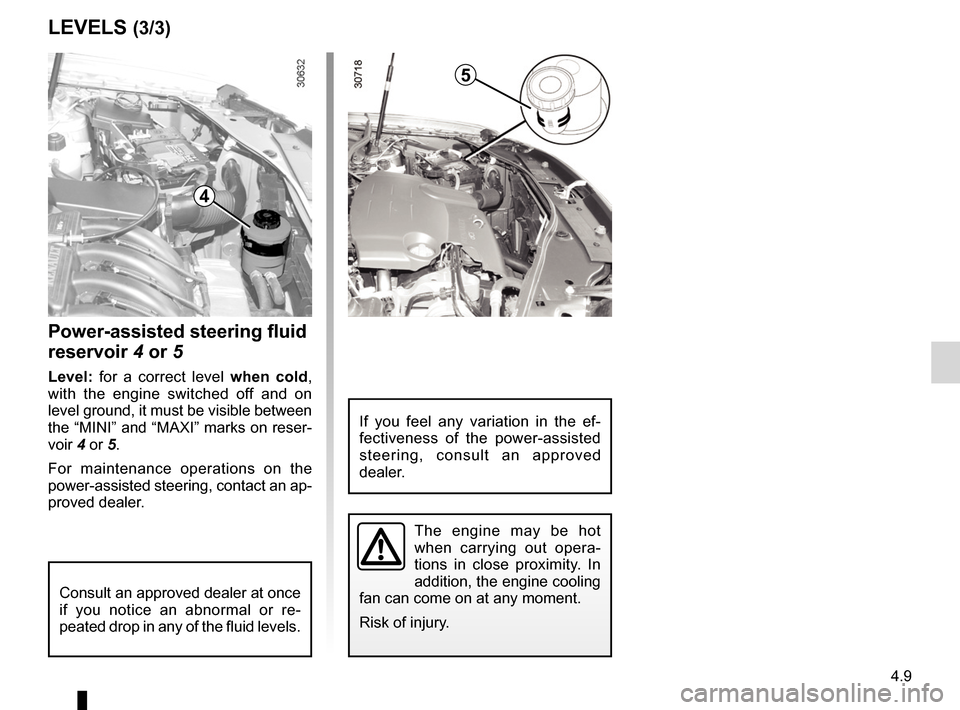
Power-assisted steering fluid
reservoir 4 or 5
Level: for a correct level when cold,
with the engine switched off and on
level ground, it must be visible between
the “MINI” and “MAXI” marks on reser-
voir 4 or 5.
For maintenance operations on the
power-assisted steering, contact an ap-
proved dealer.
The engine may be hot
when carrying out opera -
tions in close proximity. In
addition, the engine cooling
fan can come on at any moment.
Risk of injury.
Consult an approved dealer at once
if you notice an abnormal or re -
peated drop in any of the fluid levels.
If you feel any variation in the ef -
fectiveness of the power-assisted
steering, consult an approved
dealer.
5
4
Page 127 of 200
bodywork (maintenance) ...................... (up to the end of the DU)
maintenance: bodywork ........................................ (up to the end of the DU)
washing ................................................ (up to the end of the DU)
paintwork maintenance .................................................... (current page)
4.13
ENG_UD20966_2
Entretien de la carrosserie / compartiment moteur (H79 - Dacia)
ENG_NU_898-5_H79_Dacia_4
Bodywork maintenance, engine compartment
BODyWORK MAINTENANCE, ENGINE COMPARTMENT (1/3)
A well-maintained vehicle has a longer
service life. It is therefore recom -
mended that attention is paid to the out-
side of the vehicle on a regular basis.
Protection against the effects
of corrosive agents
Although your vehicle has been treated
with very effective anti-corrosion prod -
ucts, it nevertheless remains subject to
the effects of:
– corrosives in the atmosphere
– atmospheric pollution (urban and in-
dustrial areas);
– saline atmosphere (near the sea,
particularly in hot weather);
– seasonal and damp climatic condi -
tions, (e.g.: road salt in winter, water
from road cleaners, etc.).
– abrasives
Wind-borne dust and sand, mud, road grit thrown up by other vehicles, etc.
– minor impacts
You should take a minimum number of
precautions in order to safeguard your
vehicle against such risks and not to
lose the benefit of your vehicle’s anti -
corrosion protection.
y ou should not:
– Degrease or clean mechanical com-
ponents, underneath the body, parts
with hinges (eg. fuel filler cap, inside
the fuel flap) and painted plastic ex-
ternal fittings (eg. bumpers) using
high-pressure cleaning equipment
or by spraying on products not ap -
proved by our Technical Department.
If adequate precautions are not
taken, this could cause corrosion or
lead to operational faults.
– Aim a high pressure water jet directly
onto damaged parts of the vehicle
(eg. painted bumpers, lights, etc.).
Wash these parts carefully by hand.
– Wash the vehicle in bright sunlight or
freezing temperatures. –
Use hard brushes to clean alloy
wheels. These can scratch or
damage the wheel’s protective coat-
ing.
– Scrape off mud or dirt without
prewetting.
– Allow dirt to accumulate.
– Allow rust to form following minor im-
pacts.
– Use solvents not approved by the
Technical Department to remove
stains as this could damage the
paintwork.
– Drive when the vehicle is muddy or
covered in snow (the wheel arches,
underneath the body, radiator, etc.
must always be free from mud or
snow).
It is forbidden to wash the engine compartment using a high-pressure
water jet: this risks damaging the electrical/electronic components in the
engine compartment.
A label affixed in the engine compartment reminds you of this.
Page 128 of 200
4.14
ENG_UD20966_2
Entretien de la carrosserie / compartiment moteur (H79 - Dacia)
ENG_NU_898-5_H79_Dacia_4
Jaune NoirNoir texte
BODyWORK MAINTENANCE, ENGINE COMPARTMENT (2/3)
y ou should
–
Respect local regulations about
washing vehicles (e.g. do not wash
your vehicle on a public highway).
– Always follow the recommenda -
tions supplied with the high-pressure
cleaning equipment (jet distance and
pressure).
– Before going through a roller type
car wash, return the windscreen
wiper stalk to park position (refer
to the information on “Windscreen
wash/wipe” in Section 1), check the
mounting of external accessories,
additional lights and door mirrors
and be sure to hold the wiper blades
and radio aerial in place with adhe -
sive tape. Remove the radio aerial
mast if your vehicle is fitted with this
equipment.
Remember to remove the tape and
refit the antenna after washing. –
After driving off-road (eg. on muddy,
dusty or sandy terrain) quickly clean
the radiator from the outside of the
vehicle through the openings in the
bumper, to prevent it from becoming
blocked or clogged (risk of engine
overheating).
– Wash your vehicle frequently with
the engine off , using shampoo ap -
proved by our Technical Department
(never use abrasive products) and
rinse thoroughly using a warm or
cold water jet (never hot):
– spots of tree resin and industrial
grime;
– the layer of dust or mud and any
insects;
– bird droppings , which contain
chemicals that rapidly discolour
paintwork and may even cause
the paint to peel off ;
Wash the vehicle immediately to
remove these marks since it is im-
possible to remove them by pol -
ishing; –
salt deposited in the wheel arches
and underneath the body after
driving in areas where the roads
are chemically treated;
– mud in the wheel arches and un-
derneath the body which form
damp patches.
– Clean mud and sand from the
wheels, in particular the inside of the
wheels and the brakes, as this can:
– reduce the braking efficiency and
damage the components of the
braking system;
– cause vibrations in the bodywork
and steering column.
We have selected special products
to care for your vehicle and you can
obtain these from the manufactur -
er’s accessory outlets.