Rod DAEWOO LACETTI 2004 Service Repair Manual
[x] Cancel search | Manufacturer: DAEWOO, Model Year: 2004, Model line: LACETTI, Model: DAEWOO LACETTI 2004Pages: 2643, PDF Size: 80.54 MB
Page 1155 of 2643
PARKING BRAKE 4G – 3
DAEWOO V–121 BL4
7. Inspect and replace any parts of doubtful strength
or quality. This can be shown by discoloration from
heat or stress.
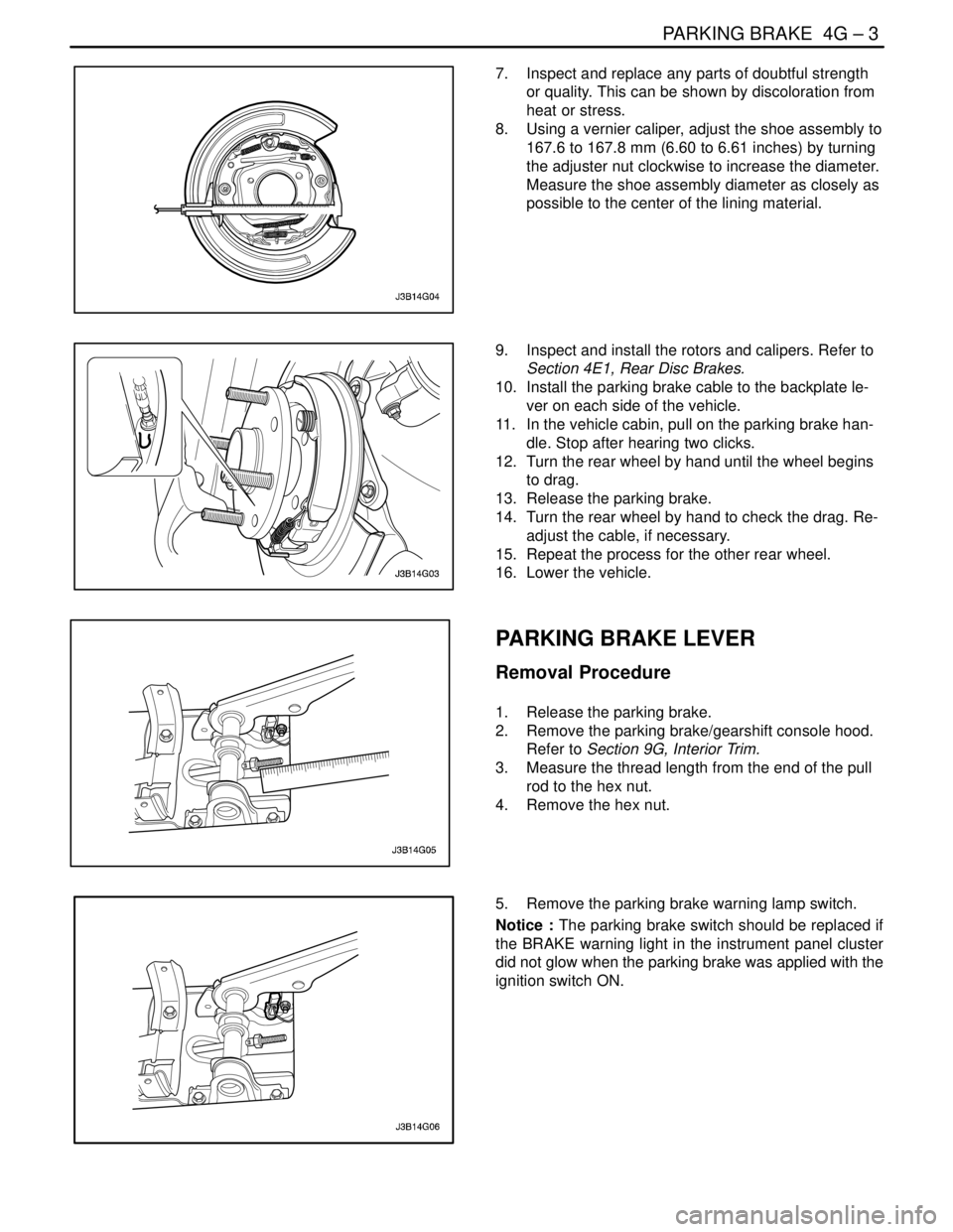
8. Using a vernier caliper, adjust the shoe assembly to
167.6 to 167.8 mm (6.60 to 6.61 inches) by turning
the adjuster nut clockwise to increase the diameter.
Measure the shoe assembly diameter as closely as
possible to the center of the lining material.
9. Inspect and install the rotors and calipers. Refer to
Section 4E1, Rear Disc Brakes.
10. Install the parking brake cable to the backplate le-
ver on each side of the vehicle.
11. In the vehicle cabin, pull on the parking brake han-
dle. Stop after hearing two clicks.
12. Turn the rear wheel by hand until the wheel begins
to drag.
13. Release the parking brake.
14. Turn the rear wheel by hand to check the drag. Re-
adjust the cable, if necessary.
15. Repeat the process for the other rear wheel.
16. Lower the vehicle.
PARKING BRAKE LEVER
Removal Procedure
1. Release the parking brake.
2. Remove the parking brake/gearshift console hood.
Refer to Section 9G, Interior Trim.
3. Measure the thread length from the end of the pull
rod to the hex nut.
4. Remove the hex nut.
5. Remove the parking brake warning lamp switch.
Notice : The parking brake switch should be replaced if
the BRAKE warning light in the instrument panel cluster
did not glow when the parking brake was applied with the
ignition switch ON.
Page 1156 of 2643
4G – 4IPARKING BRAKE
DAEWOO V–121 BL4
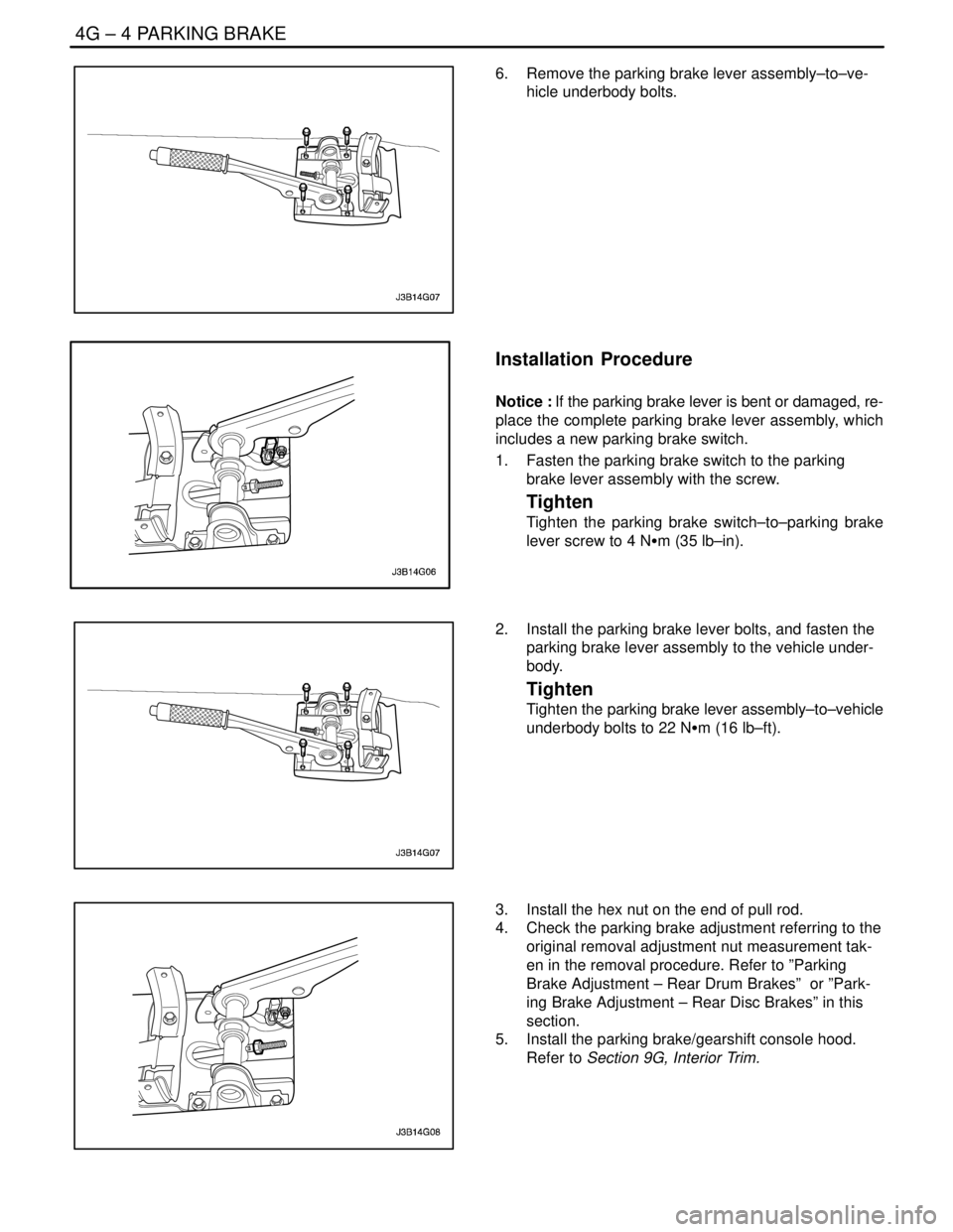
6. Remove the parking brake lever assembly–to–ve-
hicle underbody bolts.
Installation Procedure
Notice : If the parking brake lever is bent or damaged, re-
place the complete parking brake lever assembly, which
includes a new parking brake switch.
1. Fasten the parking brake switch to the parking
brake lever assembly with the screw.
Tighten
Tighten the parking brake switch–to–parking brake
lever screw to 4 NSm (35 lb–in).
2. Install the parking brake lever bolts, and fasten the
parking brake lever assembly to the vehicle under-
body.
Tighten
Tighten the parking brake lever assembly–to–vehicle
underbody bolts to 22 NSm (16 lb–ft).
3. Install the hex nut on the end of pull rod.
4. Check the parking brake adjustment referring to the
original removal adjustment nut measurement tak-
en in the removal procedure. Refer to ”Parking
Brake Adjustment – Rear Drum Brakes” or ”Park-
ing Brake Adjustment – Rear Disc Brakes” in this
section.
5. Install the parking brake/gearshift console hood.
Refer to Section 9G, Interior Trim.
Page 1157 of 2643
PARKING BRAKE 4G – 5
DAEWOO V–121 BL4
PARKING BRAKE CABLE
Removal Procedure
1. Remove the parking brake/gearshift console hood.
Refer to Section 9G, Interior Trim.
2. Release the parking brake lever and the hex nut on
the end of pull rod.
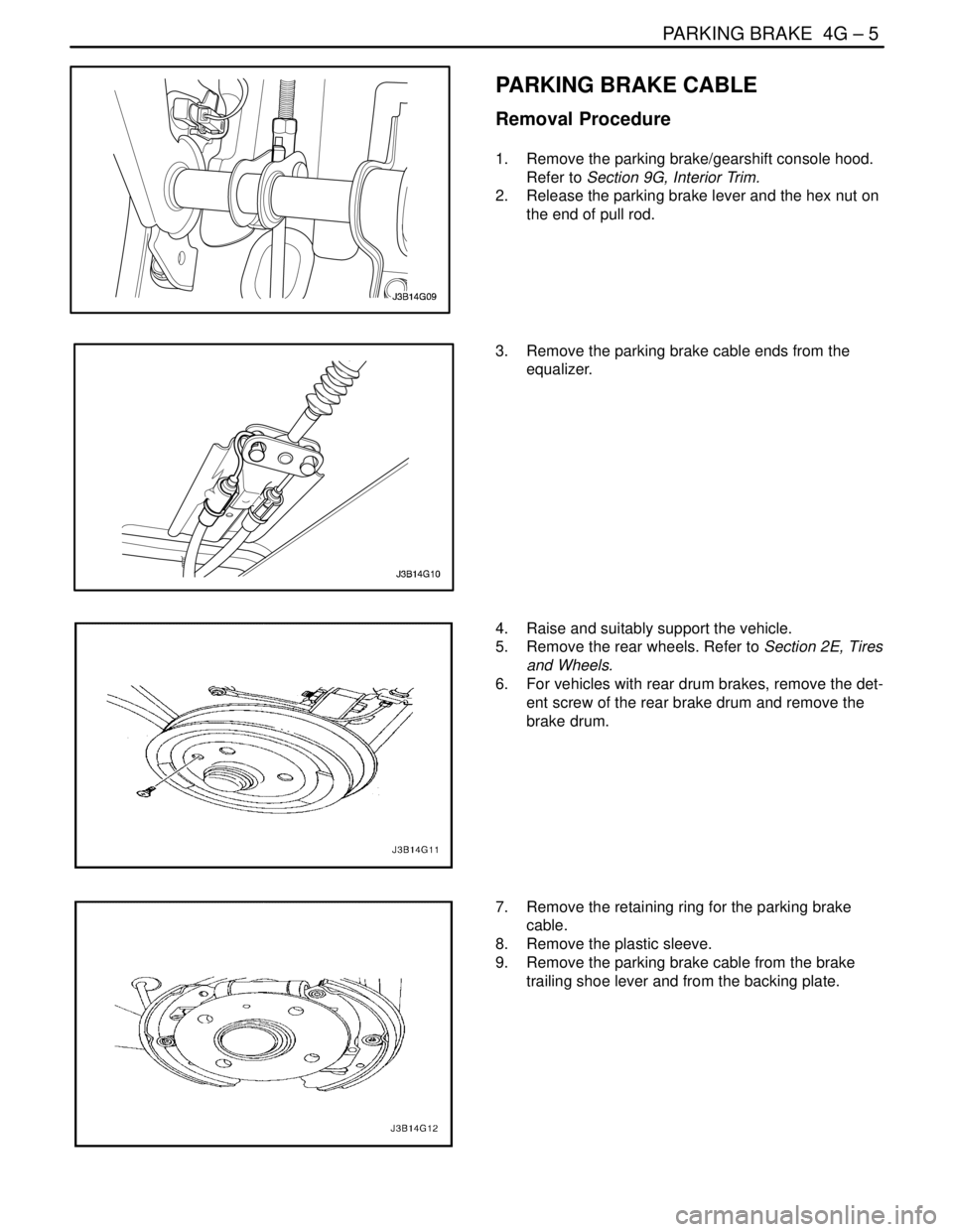
3. Remove the parking brake cable ends from the
equalizer.
4. Raise and suitably support the vehicle.
5. Remove the rear wheels. Refer to Section 2E, Tires
and Wheels.
6. For vehicles with rear drum brakes, remove the det-
ent screw of the rear brake drum and remove the
brake drum.
7. Remove the retaining ring for the parking brake
cable.
8. Remove the plastic sleeve.
9. Remove the parking brake cable from the brake
trailing shoe lever and from the backing plate.
Page 1160 of 2643
4G – 8IPARKING BRAKE
DAEWOO V–121 BL4
9. Attach the parking brake cable ends to the equaliz-
er.
10. Adjust the hex nut on the end of pull rod. Refer to
”Parking Brake Adjustment” in this section.
11. Install the parking brake/gearshift console hood.
Refer to Section 9G, Interior Trim.
PARKING BRAKE HANDLE
Removal Procedure
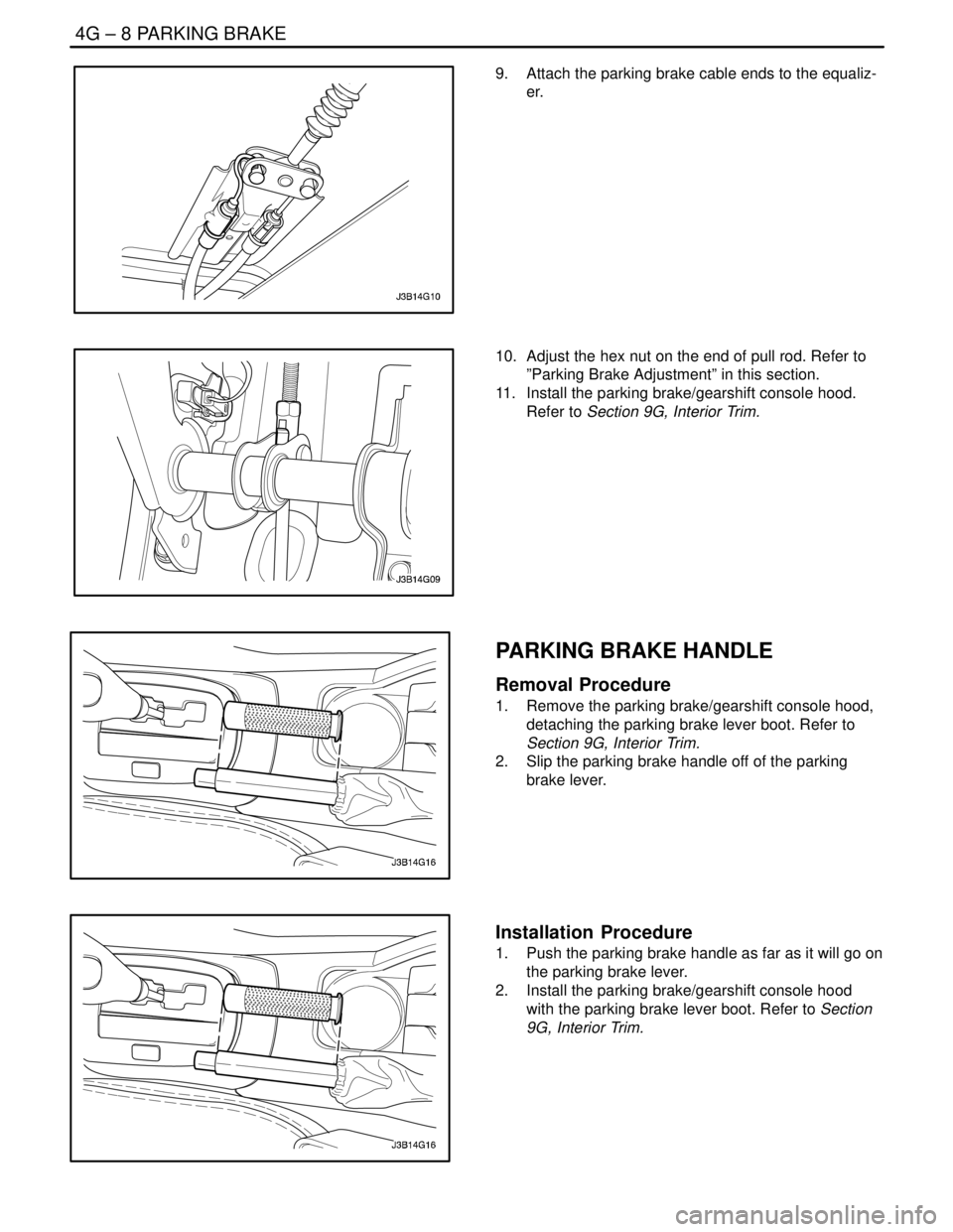
1. Remove the parking brake/gearshift console hood,
detaching the parking brake lever boot. Refer to
Section 9G, Interior Trim.
2. Slip the parking brake handle off of the parking
brake lever.
Installation Procedure
1. Push the parking brake handle as far as it will go on
the parking brake lever.
2. Install the parking brake/gearshift console hood
with the parking brake lever boot. Refer to Section
9G, Interior Trim.
Page 1350 of 2643

SECTION : 5A1
ZF 4 HP 16 AUTOMATIC TRANSAXLE
CAUTION : Disconnect the negative battery cable before removing or installing any electrical unit or when a tool
or equipment could easily come in contact with exposed electrical terminals. Disconnecting this cable will help
prevent personal injury and damage to the vehicle. The ignition must also be in LOCK unless otherwise noted.
TABLE OF CONTENTS
INTRODUCTION5A1–3 . . . . . . . . . . . . . . . . . . . . . . . . . . .
ZF 4HP 16 Automatic Transaxle 5A1–3. . . . . . . . . . . .
Transaxle Components 5A1–4. . . . . . . . . . . . . . . . . . . .
SPECIFICATIONS5A1–5 . . . . . . . . . . . . . . . . . . . . . . . . .
General Specifications 5A1–5. . . . . . . . . . . . . . . . . . . .
Transaxle Gear Ratio 5A1–5. . . . . . . . . . . . . . . . . . . . . .
Fluid Capacity 5A1–5. . . . . . . . . . . . . . . . . . . . . . . . . . . .
Fastener Tightening Specifications 5A1–5. . . . . . . . . .
Shift Speed Chart 5A1–7. . . . . . . . . . . . . . . . . . . . . . . . .
Line Pressure 5A1–8. . . . . . . . . . . . . . . . . . . . . . . . . . . .
SPECIAL TOOLS5A1–9 . . . . . . . . . . . . . . . . . . . . . . . . . .
Special Tools Table 5A1–9. . . . . . . . . . . . . . . . . . . . . . .
SCHEMATIC AND ROUTING DIAGRAMS5A1–11 . . .
Transaxle Control Module (1 of 2) 5A1–11. . . . . . . . . .
Transaxle Control Module (2 of 2) 5A1–12. . . . . . . . . .
Shift Mode Diagram 5A1–13. . . . . . . . . . . . . . . . . . . . . .
Power Flow Diagram 5A1–17. . . . . . . . . . . . . . . . . . . . .
COMPONENT LOCATOR5A1–33 . . . . . . . . . . . . . . . . . .
Transaxle Identification Information 5A1–33. . . . . . . .
Torque Converter 5A1–34. . . . . . . . . . . . . . . . . . . . . . . .
Transaxle Housing 5A1–35. . . . . . . . . . . . . . . . . . . . . . .
Oil Pump 5A1–36. . . . . . . . . . . . . . . . . . . . . . . . . . . . . . .
Rear Cover & Oil Pan Cover 5A1–37. . . . . . . . . . . . . .
Parking Lever 5A1–38. . . . . . . . . . . . . . . . . . . . . . . . . . .
Input Shaft & Shift Gear 5A1–39. . . . . . . . . . . . . . . . . .
Valve Body 5A1–41. . . . . . . . . . . . . . . . . . . . . . . . . . . . .
Gear Shift Control 5A1–42. . . . . . . . . . . . . . . . . . . . . . .
DIAGNOSTIC INFORMATION AND PROCEDURES
DIAGNOSIS5A1–43 . . . . . . . . . . . . . . . . . . . . . . . . . . . .
Basic Knowledge Required 5A1–43. . . . . . . . . . . . . . . .
Functional Check Procedure 5A1–43. . . . . . . . . . . . . .
Line Pressure Check Procedure 5A1–43. . . . . . . . . . .
Clutch Plate Diagnosis 5A1–45. . . . . . . . . . . . . . . . . . .
Cooler Flushing and Flow Test 5A1–45. . . . . . . . . . . . . Transaxle Fluid Level Service Procedure 5A1–45. . . .
Electrical/Garage Shift Test 5A1–47. . . . . . . . . . . . . . .
Road Test Procedure 5A1–47. . . . . . . . . . . . . . . . . . . . .
Torque Converter Lock–Up Clutch(TCC)
Diagnosis 5A1–48. . . . . . . . . . . . . . . . . . . . . . . . . . . . .
TCM Initialization Procedure 5A1–50. . . . . . . . . . . . . .
Shift Speed Chart 5A1–51. . . . . . . . . . . . . . . . . . . . . . . .
Internal Wiring Harness Check 5A1–51. . . . . . . . . . . .
Transaxle Wiring Harness Connector 5A1–54. . . . . . .
Symptom Diagnosis 5A1–56. . . . . . . . . . . . . . . . . . . . . .
DIAGNOSTIC TROUBLE CODE DIAGNOSIS5A1–60
Diagnostic Trouble Code (DTC) Identification 5A1–60
DTC P0562 – System Voltage Low 5A1–68. . . . . . . . .
DTC P0563 – System Voltage High 5A1–71. . . . . . . .
DTC P0601 – Internal Control Module Memory
Checksum Error 5A1–74. . . . . . . . . . . . . . . . . . . . . . .
DTC P0603 – Internal Control Module Keep
Alive Memory(KAM) Error 5A1–76. . . . . . . . . . . . . . .
DTC P0604 – Internal Control Module Random
Access Memory(RAM) Error 5A1–78. . . . . . . . . . . . .
DTC P0606 – Transaxle Control Module
Processor Fault 5A1–80. . . . . . . . . . . . . . . . . . . . . . . .
DTC P0703 – Brake Switch Circuit
Malfunction 5A1–83. . . . . . . . . . . . . . . . . . . . . . . . . . .
DTC P0705 – Transmission Range Sensor
Circuit Malfunction(PRNDL Input) 5A1–86. . . . . . . .
DTC P0710 – Transmission Fluid Temperature
Sensor Circuit Malfunction 5A1–89. . . . . . . . . . . . . .
DTC P0715 – Input Speed Sensor(ISS) Circuit
Malfunction 5A1–92. . . . . . . . . . . . . . . . . . . . . . . . . . .
DTC P0716 – Input Speed Sensor(ISS) Circuit
Range/Performance 5A1–95. . . . . . . . . . . . . . . . . . . .
DTC P0717 – Input Speed Sensor(ISS) Circuit
No Signal 5A1–98. . . . . . . . . . . . . . . . . . . . . . . . . . . . .
DTC P0720 – Output Speed Sensor(OSS)
Circuit Malfunction 5A1–101. . . . . . . . . . . . . . . . . . . .
DTC P0721 – Output Speed Sensor(OSS)
Circuit Range/Performance 5A1–104. . . . . . . . . . . . .
Page 1352 of 2643

ZF 4 HP 16 AUTOMATIC TRANSAXLE 5A1 – 3
DAEWOO V–121 BL4
Important Measurement/Adjustment 5A1–230. . . . . . .
GENERAL DESCRIPTION AND SYSTEM
OPERATION5A1–232 . . . . . . . . . . . . . . . . . . . . . . . . . . . Mechanical Components 5A1–232. . . . . . . . . . . . . . . . .
Electronical Components 5A1–236. . . . . . . . . . . . . . . .
TCM Inputs That Affect the 4HP 16
Transaxle 5A1–241. . . . . . . . . . . . . . . . . . . . . . . . . . .
INTRODUCTION
ZF 4HP 16 AUTOMATIC TRANSAXLE
The ZF 4 HP 16 is a four–speed automatic transaxle de-
signed for cars with front–wheel drive and a transversely
mounted engine.
The transaxle has a hydrodynamic torque converter with
a controlled slip lock–up clutch.
A planetary gear train establishes the mechanical gear ra-
tios. The integral constant ratio can be adapted to the en-
gine’s power output and the vehicle’s weight. The elec-
tronic–hydraulic control makes controlled power shifts and
various shift programs possible. In selector lever position
”P”, the output is locked mechanically.The special feature of this transaxle is that it operates with-
out freewheels. Shifting between individual gears takes
place by means of overlapping clutch engagement and re-
lease.
The advantage of overlap shifting is as follows:
– The transaxle can be of more compact design
and is lighter on account of the absence of free-
wheels and the lower number of shift elements
– Lower drag losses, i.e. higher efficiency
– Lower peak torques acting on the components
and driveline.
However, overlap shifting necessitates high–performance
hardware and software, and precision engine signals.
Page 1392 of 2643

ZF 4 HP 16 AUTOMATIC TRANSAXLE 5A1 – 43
DAEWOO V–121 BL4
DIAGNOSTIC INFORMATION AND
PROCEDURES DIAGNOSIS
BASIC KNOWLEDGE REQUIRED
You must be familiar with some basic electronics to use
this section of the Service Manual. They will help you to
follow diagnostic procedures.
Notice : Lack of the basic knowledge of this transaxle
when performing diagnostic procedures could result in in-
correct diagnostic performance or damage to transaxle
components.
Do not, under any circumstances, attempt to diagnose a
transaxle problem without this basic knowledge.
Notice : If a wire is probed with a sharp instrument and not
properly sealed afterward, the wire will corrode and an
open circuit will result.
Diagnostic test probes are now available that allow you to
probe individual wires without leaving the wire open to the
environment. These probe devices are inexpensive and
easy to install, and they permanently seal the wire from
corrosion.
Special Tools
You should be able to use a Digital Volt Meter (DVM), a cir-
cuit tester, jumper wires or leads and a line pressure gauge
set.
The functional check procedure is designed to verify the
correct operation of electronic components in the trans-
axle.
This will eliminate the unnecessary removal of transaxle
components.
FUNCTIONAL CHECK PROCEDURE
Begin with the Functional Check Procedure which pro-
vides a general outline of how to diagnose automatic
transaxle. The following functional check procedure will in-
dicate the proper path of diagnosing the transaxle by de-
scribing the basic checks and then referencing the loca-
tions of the specific checks.
S Check the fluid level according to the Fluid Level
Service Procedure.
S Check the transaxle for fluid leaks.
S Check if the transaxle fluid is not burnt by color and
smell.
S Ensure that the transaxle is not in Limp Home
Mode(LHM).
S Check the battery terminals and the ground con-
nections for corrosion or looseness.
S Check that the cooler flow is not restricted.S Check all electrical connections for tightness.
S Use on–board diagnostic tool or a scan tool to see
if any transaxle trouble codes have been set. Refer
to the appropriate ”Diagnostic Trouble Code (DTC)”
information and repair the vehicle as directed. After
repairing the vehicle, perform the road test and
verify that the code has not set again.
S Perform the Electrical/Garage Shift Tests.
S Perform the Road Test Procedure in this section.
S Inspect the oil and check for metal or other contam-
inants in the oil pan.
LINE PRESSURE CHECK
PROCEDURE
The 4HP 16 A/T uses a trochoid type oil pump to produce
hydraulic pressure, and a pressure control solenoid (sole-
noid 1) to control that pressure at the pressure regulator
valve, after it leaves the pump. The transaxle pressure
control solenoid is controlled by an electrical signal that
ranges from 0 to 12 volts corresponds to minimum line
pressure (approx. 89.9 to 124.7 psi (6.2 to 8.6 bar)) and
0 volt corresponds to a maximum line pressure (approx.
221.9 to 252.4 psi (15.3 to 17.4 bar)) in all range.
Line pressures are calculated for two sets of gear ranges
– Drive–Park–Neutral and Reverse. This allow the trans-
axle line pressure to be appropriate for different pressure
needs in different gear ranges:
Gear
Range
Solenoid
1RPMPressure
Drive,
ReverseOff2,500221.9~252.4psi
(15.3~17.4 bar)
On2,50017.4~269.8psi
(1.2~18.6 bar)
Neutral,
ParkOff2,500221.9~252.4psi
(15.3~17.4 bar)
On2,50089.9~269.8 psi
(6.2~18.6 bar)
Before performing a line pressure check, verify that the
pressure control solenoid is receiving the correct electrical
signal from the TCM:
1. Install a scan tool.
2. Start the engine and set parking brake.
3. Check for a stored pressure control solenoid diag-
nostic trouble code, and other diagnostic trouble
codes.
Page 1396 of 2643

ZF 4 HP 16 AUTOMATIC TRANSAXLE 5A1 – 47
DAEWOO V–121 BL4
Repairing the Fluid Leak
Once the leak point is found the source of the leak must
be determined. The following list describes the potential
causes for the leak:
S Fasteners are not torqued to specification.
S Fastener threads and fastener holes are dirty or
corroded.
S Gaskets, seals or sleeves are misarranged, dam-
aged or worn.
S Damaged, warped or scratched seal bore or gasket
surface.
S Loose or worn bearing causing excess seal or
sleeve wears.
S Case or component porosity.
S Fluid level is too high.
S Plugged vent or damaged vent tube.
S Water or coolant in fluid.
S Fluid drain back holes plugged.
ELECTRICAL/GARAGE SHIFT TEST
This preliminary test should be performed before a hoist
or road test to make sure electronic control inputs is con-
nected and operating. If the inputs are not checked before
operating the transaxle, a simple electrical condition could
be misdiagnosed as a major transaxle condition.
A scan tool provides valuable information and must be
used on the automatic transaxle for accurate diagnosis.
1. Move gear selector to P (Park) and set the parking
brake.
2. Connect scan tool to Data Link Connector (DLC)
terminal.
3. Start engine.
4. Turn the scan tool ON.
5. Verify that the appropriate signals are present.
These signals may include:
S ENGINE SPEED
S VEHICLE SPEED
S THROTTLE POSITION
S TRANSAXLE GEAR STATE
S GEAR SHIFT LEVER POSITION
S TRANSAXLE FLUID TEMPERATURE
S CLOSED THROTTLE POSITION LEARN
S OPEN THROTTLE POSITION LEARNT
S CLOSED ACCEL. PEDAL POSITION LEARNT
S OPEN ACCEL. PEDAL POSITION LEARNT
S A/C COMPRESSOR STATUS
S MODE SWITCH
S THROTTLE POSITION VOLTAGE
S GEAR SHIFT LEVER POSITION VOLTAGE
S TRANS. FLUID TEMPERATURE VOLTAGE
S A/C SWITCH
S MODE SWITCH VOLTAGE
S BATTERY VOLTAGE
6. Monitor the A/C COMPRESSOR STATUS signal
while pushing the A/C switch.S The A/C COMPRESSOR STATUS should come
ON when the A/C switch is pressed, and turns
OFF when the A/C switch is repushed.
7. Monitor the GEAR SHIFT LEVER POSITION signal
and move the gear shift control lever through all the
ranges.
S Verify that the GEAR SHIFT LEVER POSITION
value matches the gear range indicated on the
instrument panel or console.
S Gear selections should be immediate and not
harsh.
8. Move gear shift control lever to neutral and monitor
the THROTTLE POSITION signal while increasing
and decreasing engine speed with the accelerator
pedal.
S THROTTLE POSITION should increase with
engine speed.
ROAD TEST PROCEDURE
S Perform the road test using a scan tool.
S This test should be performed when traffic and road
conditions permit.
S Observe all traffic regulations.
The TCM calculates upshift points based primarily on two
inputs : throttle angle and vehicle speed. When the TCM
wants a shift to occur, an electrical signal is sent to the shift
solenoids which in turn moves the valves to perform the
upshift.
The shift speed charts reference throttle angle instead of
”min throttle” or ”wot” to make shift speed measurement
more uniform and accurate. A scan tool should be used to
monitor throttle angle. Some scan tools have been pro-
grammed to record shift point information. Check the
introduction manual to see if this test is available.
Upshift Procedure
With gear selector in drive(D)
1. Look at the shift speed chart contained in this sec-
tion and choose a percent throttle angle of 10 or
25%.
2. Set up the scan tool to monitor throttle angle and
vehicle speed.
3. Accelerate to the chosen throttle angle and hold the
throttle steady.
4. As the transaxle upshifts, note the shift speed and
commanded gear changes for :
S Second gear.
S Third gear.
S Fourth gear.
Important : Shift speeds may vary due to slight hydraulic
delays responding to electronic controls. A change from
the original equipment tire size affects shift speeds.
Note when TCC applies. This should occur in fourth gear.
If the apply is not noticed by an rpm drop, refer to the
”Lock–up Clutch Diagnosis” information contained in this
section.
Page 1405 of 2643

5A1 – 56IZF 4 HP 16 AUTOMATIC TRANSAXLE
DAEWOO V–121 BL4
SYMPTOM DIAGNOSIS
Oil Leakage
Notice :
– Careful localization of leakage points may make it
possible to prevent incorrect or cost–intensive re-
pairs.
Test Steps :– Thoroughly clean the transaxle, engine, and sur-
rounding area(using a steam jet, for example).
– To locate leakage, use a suitable identifying spray
or similar product.
– Depending on the amount of leakage, take the
car for a short or a longer test drive – It may prove
sufficient to place the car on a hoist and run the
engine at idle speed to trace the leak.
– If possible, determine exactly which type of oil is
escaping.
Symptom
Possible CauseAction
Transaxle Oil Leak-
ageOil Pump(Torque Converter Sealing)S Visually check torque converter sealing.
S Replace the converter sealing as described in
the transaxle repair on the vehicle service.
Crankshaft Sealing RingS Check whether engine oil or TFT is leaking out.
S If leak is engine oil, replace the sealing ring as
described in the engine repair instruction.
Torque ConverterS Visual check.
S Fit an exchange converter as described in the
repair instruction.
Oil Content Too HighS Check oil level(TFT and axle oil) as described
in this chapter.
S Correct oil level, and recheck after a test drive.
Notice : Comply with the measuring procedure (fill-
ing procedure) in the repair instruction. Check the oil
level at the overflow plug adjust to proper level if nec-
essary.
O–ring at Bolt Head Damaged or Miss-
ingS Check O–ring.
S Replace O–ring as described in the repair in-
struction.
Shaft SealS Visually check the shaft seal.
S Replace the sealing ring as described in the
repair instruction.
Hose Clamp LooseS Check to ensure that the hose clamp fits tightly.
S If necessary, retighten clamp.
Oil Pan Gasket Not Installed ProperlyS Check to see if the gasket was positioned
properly.
S Install gasket properly as described in the re-
pair instruction.
Oil Pan Gasket DamagedS Check the gasket visually.
S Replace gasket as described in the repair in-
struction.
Bolt at Bracket LooseCheck the Tightening Torque
Retighten bolt
Sealing Ring at Oil DipstickS Check O–ring.
S If necessary, replace O–ring.
Sealing Ring Near End–Cover Connec-
tion DefectiveS Check sealing rings.
S Put in new sealing ring Check O–ring as de-
scribed in the repair instruction.
Page 1406 of 2643

ZF 4 HP 16 AUTOMATIC TRANSAXLE 5A1 – 57
DAEWOO V–121 BL4
Symptom ActionPossible Cause
Sealing Ring Selector ShaftS Check sealing ring.
S Replace sealing ring as described in the repair
instruction.
O–ring at Socket OutletS Check O–ring.
S Replace O–ring as described in the repair in-
struction.
O–ring and Speed Sensor ConnectionS Check O–ring.
S Replace O–ring as described in the repair in-
struction.
Oil Leak Incorrectly IdentifiedS No oil leak is possible at this point.
Speed Sensor Itself Is LeakingS Check speed sensor.
S Replace speed sensor as described in the re-
pair instruction.
Hair Line Crack at the Piping in the Con-
nection Area, Sealing Ring Fit in Trans-
axle HousingS Pressurize the line with compressed air and
check it.
S Replace lines as described in the repair in-
struction.
O–ring Defective, IncorrectCheck O–ring.
Replace O–rings as described in the repair instruc-
tion.
Plug LooseCheck the Tightening Torque for the screw plug.
Tighten to torque specified in the repair instruction.
Noise
SymptomPossible CauseAction
NoiseTFT Level Too LowS When the TFT level is too low, the gear wheels
from the transaxle oil pump might generate
noise.
S Check the TFT level as described in the repair
instruction and fill to the proper level.
Monolith in Catalytic Converter Has
BrokenS Check according to the exhaust gas diagnostic
procedure or by shaking the catalytic converter
casing.
S Replace catalytic converter if necessary.
Noise from Auxiliaries (e.g. exhaust
system, alternator, drive shafts.)S Check these components; if necessary, elimi-
nate the faults as described in the repair in-
struction
Noise from Tires or Wheel BearingsS Eliminate fault if necessary
Noise from Planetary GearsS Whistling noise on traction and overrun(in first
gear only)caused by high rotating speeds(func-
tionally unavoidable)
Cumulative Tooth Backlash in the Com-
plete Drive LineS Production status. Customer must be con-
vinced.
Jerky Noise of the Parking Lock (e.g.
when the car is standing on a gradient)S Load–reversal reaction
S Apply the handbrake before selection the park-
ing Lock (position P)