key DAEWOO LACETTI 2004 Service User Guide
[x] Cancel search | Manufacturer: DAEWOO, Model Year: 2004, Model line: LACETTI, Model: DAEWOO LACETTI 2004Pages: 2643, PDF Size: 80.54 MB
Page 149 of 2643
1.8L DOHC ENGINE MECHANICAL 1C2 – 29
DAEWOO V–121 BL4
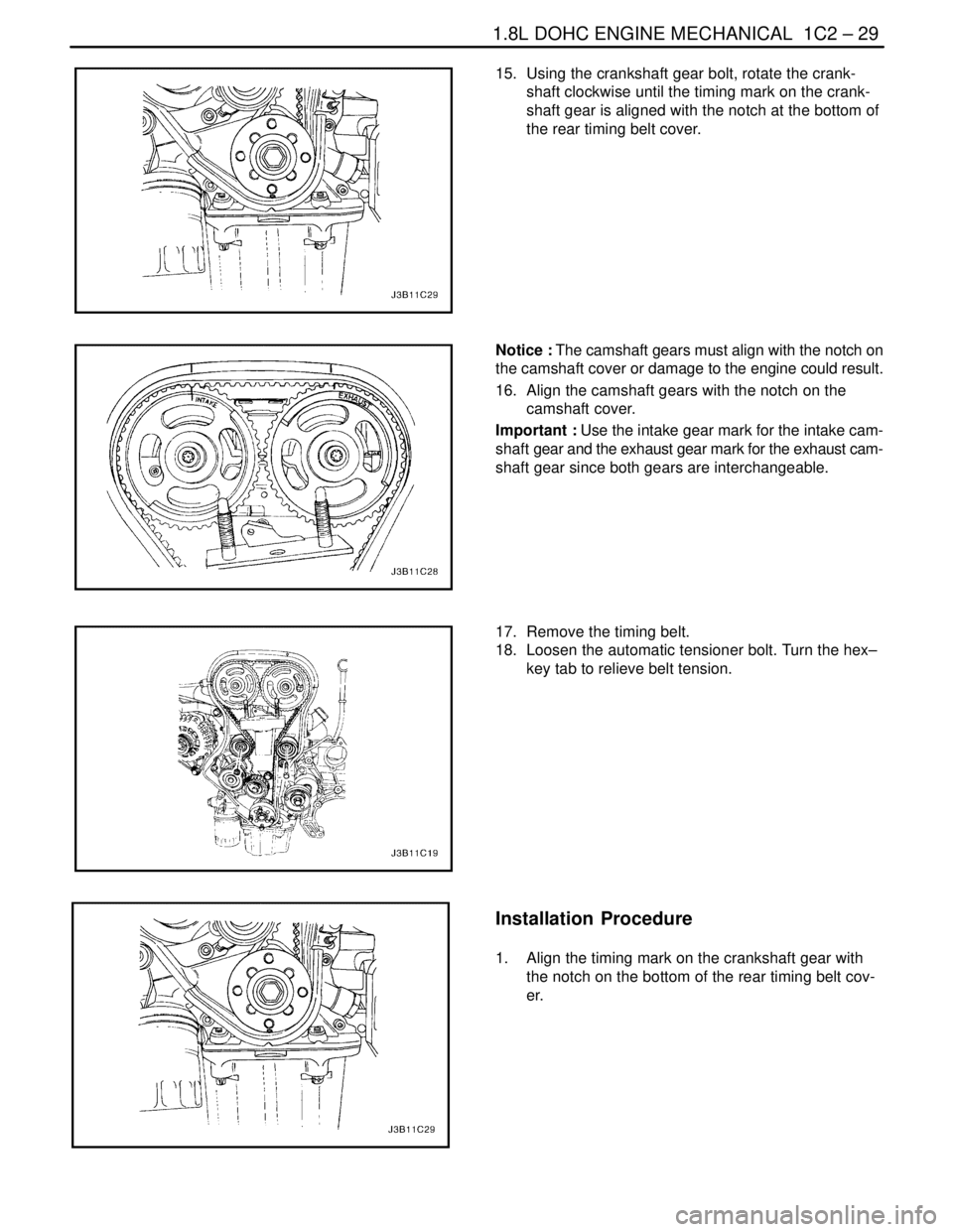
15. Using the crankshaft gear bolt, rotate the crank-
shaft clockwise until the timing mark on the crank-
shaft gear is aligned with the notch at the bottom of
the rear timing belt cover.
Notice : The camshaft gears must align with the notch on
the camshaft cover or damage to the engine could result.
16. Align the camshaft gears with the notch on the
camshaft cover.
Important : Use the intake gear mark for the intake cam-
shaft gear and the exhaust gear mark for the exhaust cam-
shaft gear since both gears are interchangeable.
17. Remove the timing belt.
18. Loosen the automatic tensioner bolt. Turn the hex–
key tab to relieve belt tension.
Installation Procedure
1. Align the timing mark on the crankshaft gear with
the notch on the bottom of the rear timing belt cov-
er.
Page 150 of 2643
1C2 – 30I1.8L DOHC ENGINE MECHANICAL
DAEWOO V–121 BL4
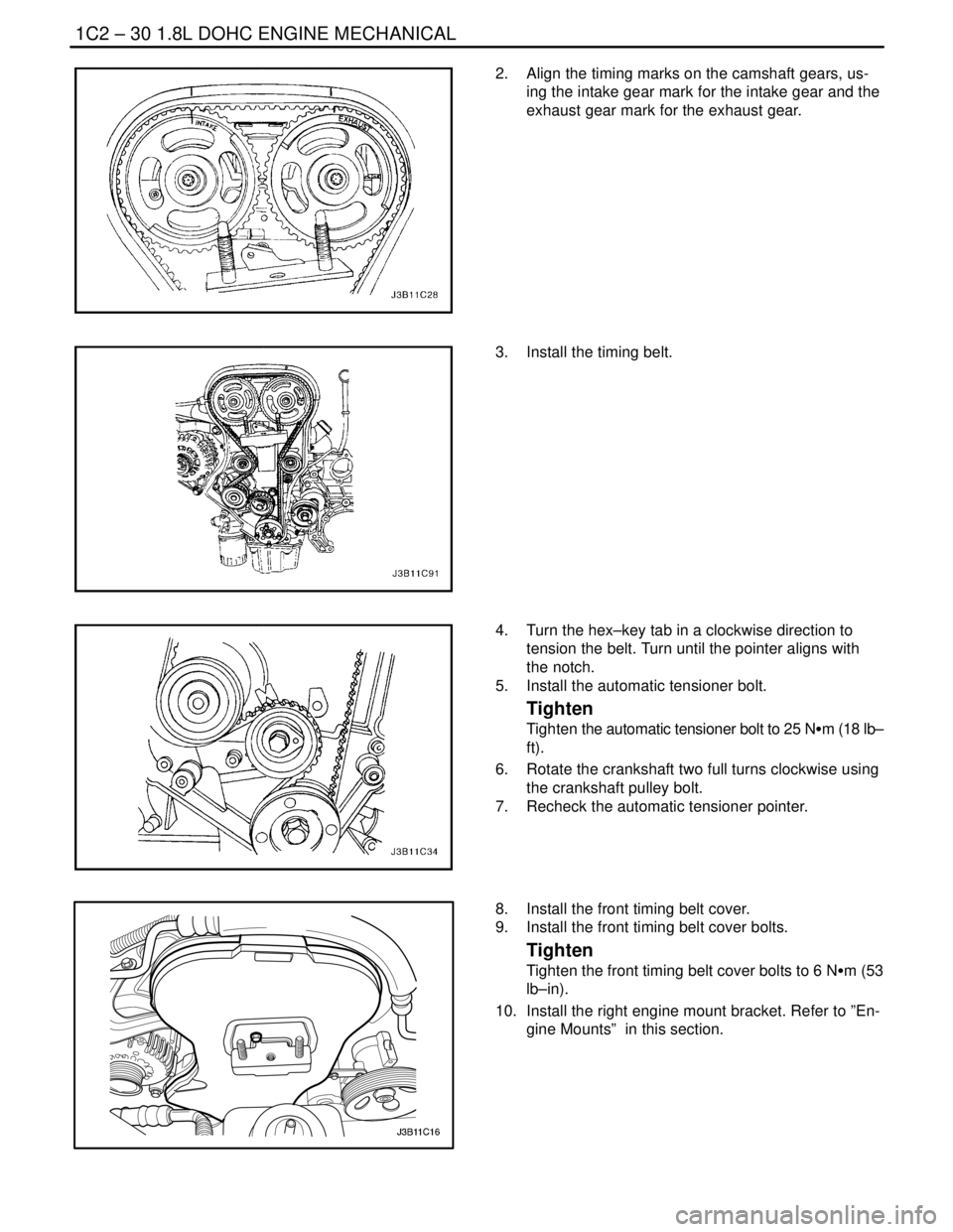
2. Align the timing marks on the camshaft gears, us-
ing the intake gear mark for the intake gear and the
exhaust gear mark for the exhaust gear.
3. Install the timing belt.
4. Turn the hex–key tab in a clockwise direction to
tension the belt. Turn until the pointer aligns with
the notch.
5. Install the automatic tensioner bolt.
Tighten
Tighten the automatic tensioner bolt to 25 NSm (18 lb–
ft).
6. Rotate the crankshaft two full turns clockwise using
the crankshaft pulley bolt.
7. Recheck the automatic tensioner pointer.
8. Install the front timing belt cover.
9. Install the front timing belt cover bolts.
Tighten
Tighten the front timing belt cover bolts to 6 NSm (53
lb–in).
10. Install the right engine mount bracket. Refer to ”En-
gine Mounts” in this section.
Page 157 of 2643
1.8L DOHC ENGINE MECHANICAL 1C2 – 37
DAEWOO V–121 BL4
ENGINE MOUNT
Tools Required
J–28467–B Engine Assembly Support Fixture
X–28467–560 Engine Assembly Support Channel
Removal Procedure
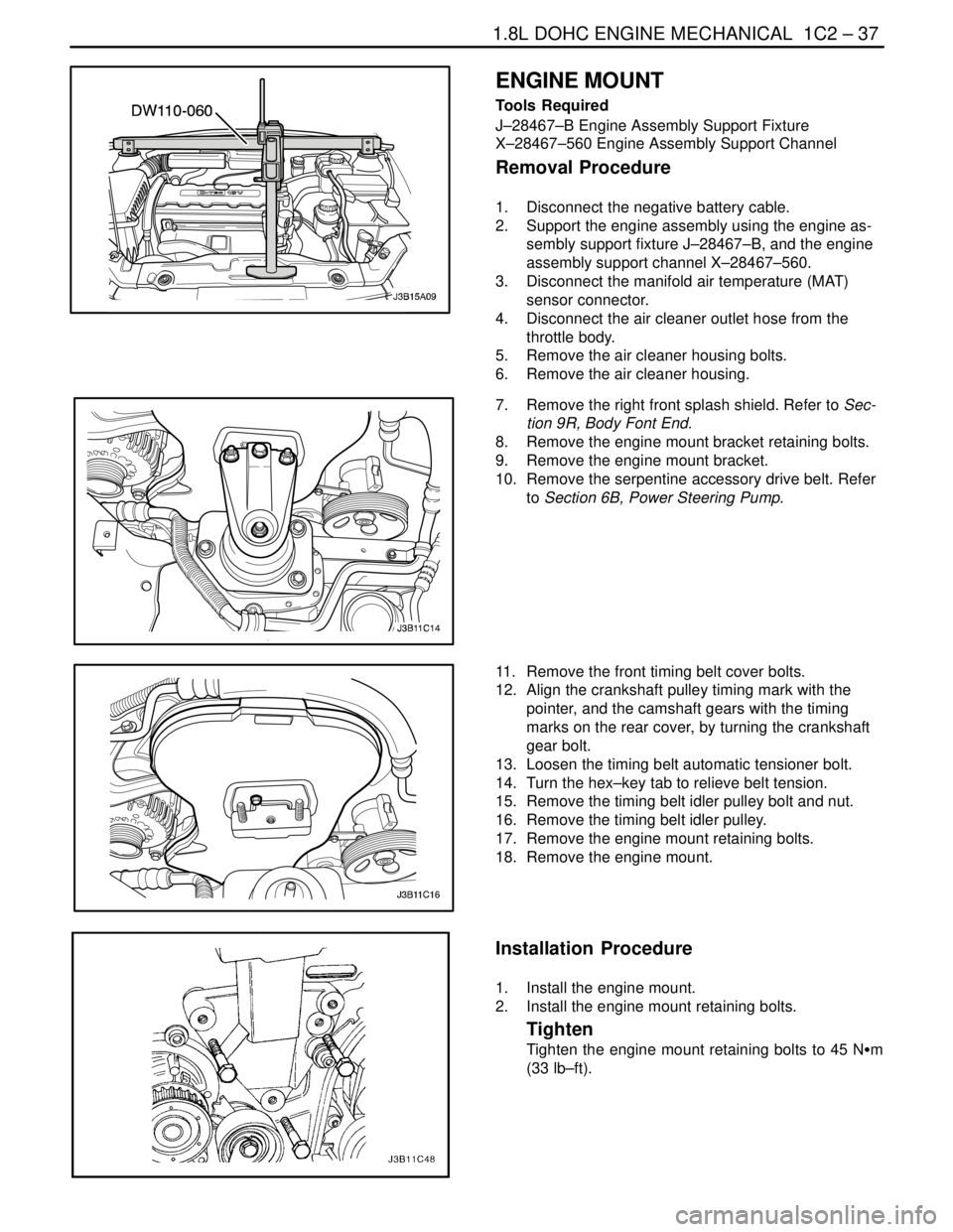
1. Disconnect the negative battery cable.
2. Support the engine assembly using the engine as-
sembly support fixture J–28467–B, and the engine
assembly support channel X–28467–560.
3. Disconnect the manifold air temperature (MAT)
sensor connector.
4. Disconnect the air cleaner outlet hose from the
throttle body.
5. Remove the air cleaner housing bolts.
6. Remove the air cleaner housing.
7. Remove the right front splash shield. Refer to Sec-
tion 9R, Body Font End.
8. Remove the engine mount bracket retaining bolts.
9. Remove the engine mount bracket.
10. Remove the serpentine accessory drive belt. Refer
to Section 6B, Power Steering Pump.
11. Remove the front timing belt cover bolts.
12. Align the crankshaft pulley timing mark with the
pointer, and the camshaft gears with the timing
marks on the rear cover, by turning the crankshaft
gear bolt.
13. Loosen the timing belt automatic tensioner bolt.
14. Turn the hex–key tab to relieve belt tension.
15. Remove the timing belt idler pulley bolt and nut.
16. Remove the timing belt idler pulley.
17. Remove the engine mount retaining bolts.
18. Remove the engine mount.
Installation Procedure
1. Install the engine mount.
2. Install the engine mount retaining bolts.
Tighten
Tighten the engine mount retaining bolts to 45 NSm
(33 lb–ft).
Page 158 of 2643
1C2 – 38I1.8L DOHC ENGINE MECHANICAL
DAEWOO V–121 BL4
3. Install the timing belt idler pulleys.
4. Install the timing belt idler pulley bolt and nut.
Tighten
Tighten the timing belt idler pulley bolt and nut to 25
NSm (18 lb–ft).
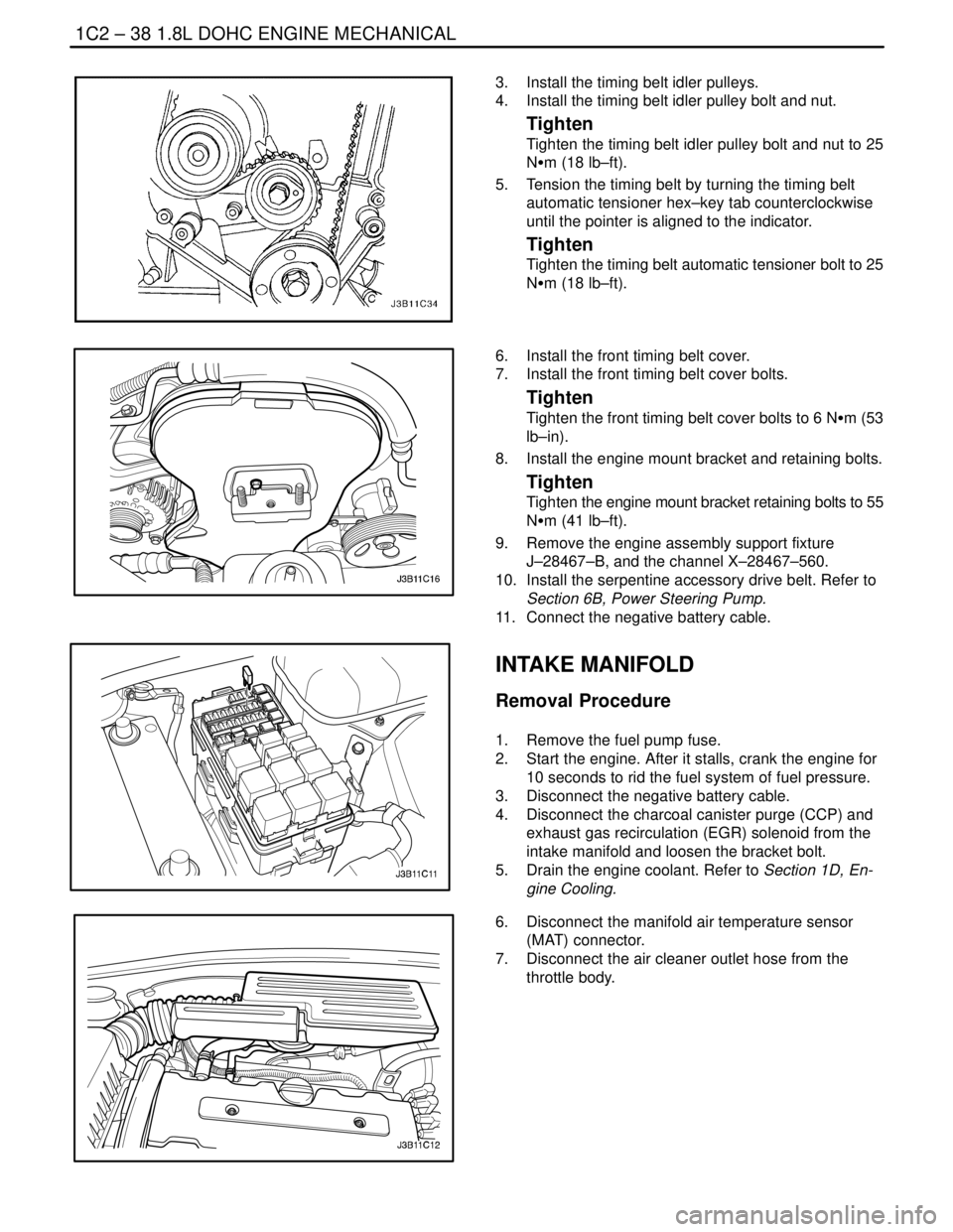
5. Tension the timing belt by turning the timing belt
automatic tensioner hex–key tab counterclockwise
until the pointer is aligned to the indicator.
Tighten
Tighten the timing belt automatic tensioner bolt to 25
NSm (18 lb–ft).
6. Install the front timing belt cover.
7. Install the front timing belt cover bolts.
Tighten
Tighten the front timing belt cover bolts to 6 NSm (53
lb–in).
8. Install the engine mount bracket and retaining bolts.
Tighten
Tighten the engine mount bracket retaining bolts to 55
NSm (41 lb–ft).
9. Remove the engine assembly support fixture
J–28467–B, and the channel X–28467–560.
10. Install the serpentine accessory drive belt. Refer to
Section 6B, Power Steering Pump.
11. Connect the negative battery cable.
INTAKE MANIFOLD
Removal Procedure
1. Remove the fuel pump fuse.
2. Start the engine. After it stalls, crank the engine for
10 seconds to rid the fuel system of fuel pressure.
3. Disconnect the negative battery cable.
4. Disconnect the charcoal canister purge (CCP) and
exhaust gas recirculation (EGR) solenoid from the
intake manifold and loosen the bracket bolt.
5. Drain the engine coolant. Refer to Section 1D, En-
gine Cooling.
6. Disconnect the manifold air temperature sensor
(MAT) connector.
7. Disconnect the air cleaner outlet hose from the
throttle body.
Page 178 of 2643
1C2 – 58I1.8L DOHC ENGINE MECHANICAL
DAEWOO V–121 BL4
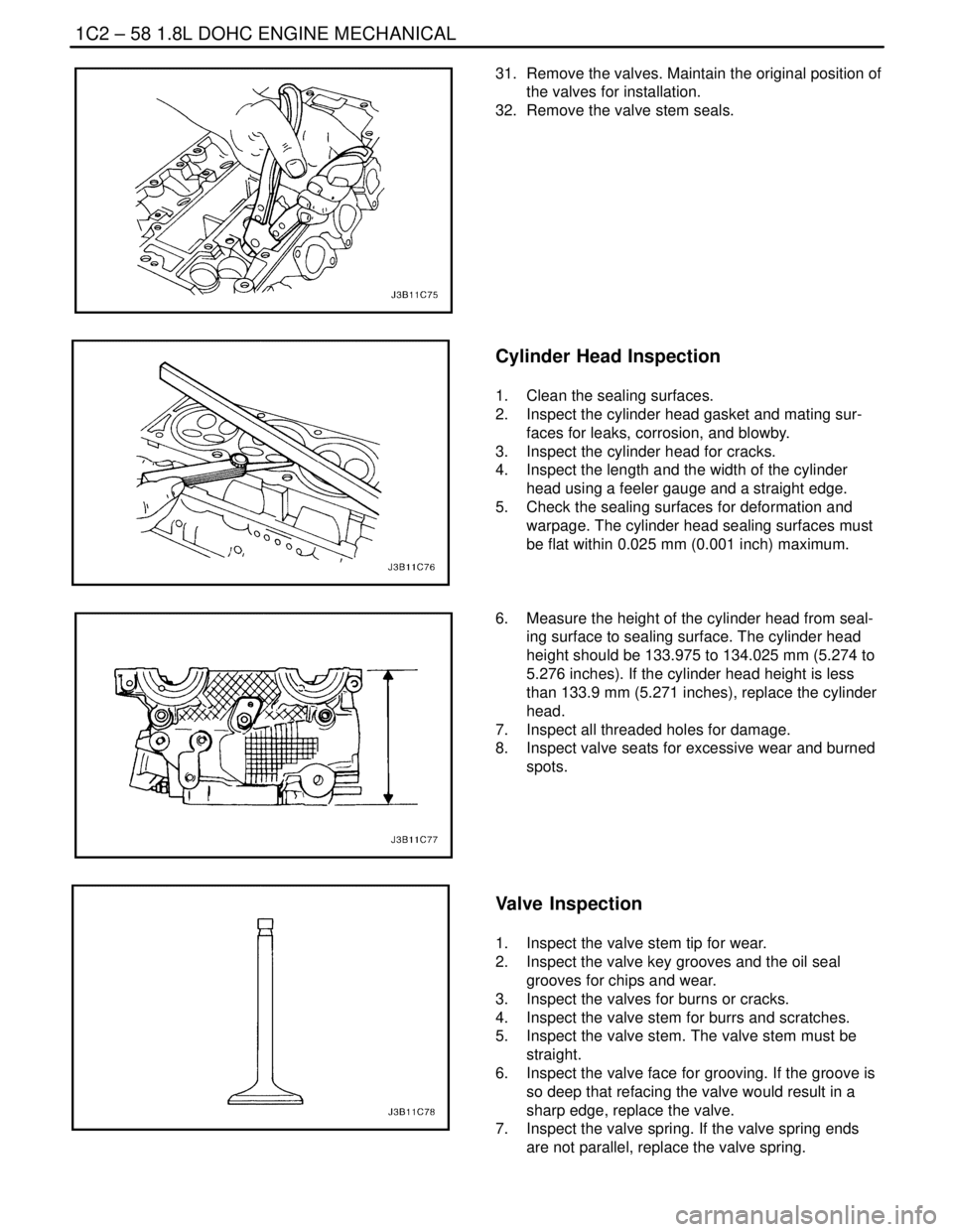
31. Remove the valves. Maintain the original position of
the valves for installation.
32. Remove the valve stem seals.
Cylinder Head Inspection
1. Clean the sealing surfaces.
2. Inspect the cylinder head gasket and mating sur-
faces for leaks, corrosion, and blowby.
3. Inspect the cylinder head for cracks.
4. Inspect the length and the width of the cylinder
head using a feeler gauge and a straight edge.
5. Check the sealing surfaces for deformation and
warpage. The cylinder head sealing surfaces must
be flat within 0.025 mm (0.001 inch) maximum.
6. Measure the height of the cylinder head from seal-
ing surface to sealing surface. The cylinder head
height should be 133.975 to 134.025 mm (5.274 to
5.276 inches). If the cylinder head height is less
than 133.9 mm (5.271 inches), replace the cylinder
head.
7. Inspect all threaded holes for damage.
8. Inspect valve seats for excessive wear and burned
spots.
Valve Inspection
1. Inspect the valve stem tip for wear.
2. Inspect the valve key grooves and the oil seal
grooves for chips and wear.
3. Inspect the valves for burns or cracks.
4. Inspect the valve stem for burrs and scratches.
5. Inspect the valve stem. The valve stem must be
straight.
6. Inspect the valve face for grooving. If the groove is
so deep that refacing the valve would result in a
sharp edge, replace the valve.
7. Inspect the valve spring. If the valve spring ends
are not parallel, replace the valve spring.
Page 181 of 2643
1.8L DOHC ENGINE MECHANICAL 1C2 – 61
DAEWOO V–121 BL4
4. Inspect the dimension for the valve seat width.
S Intake: 1.2 to 1.4 mm (0.047 to 0.055 inch).
S Exhaust: 1.4 to 1.8 mm (0.055 to 0.070 inch).
5. Inspect the assembly height of the intake valves
and the exhaust valves. If the dimension is exceed-
ed, install new valves. Inspect the assembly height
of the intake valves and the exhaust valves again. If
the valve assembly height is still too large despite
replacing the valves, replace the cylinder head.
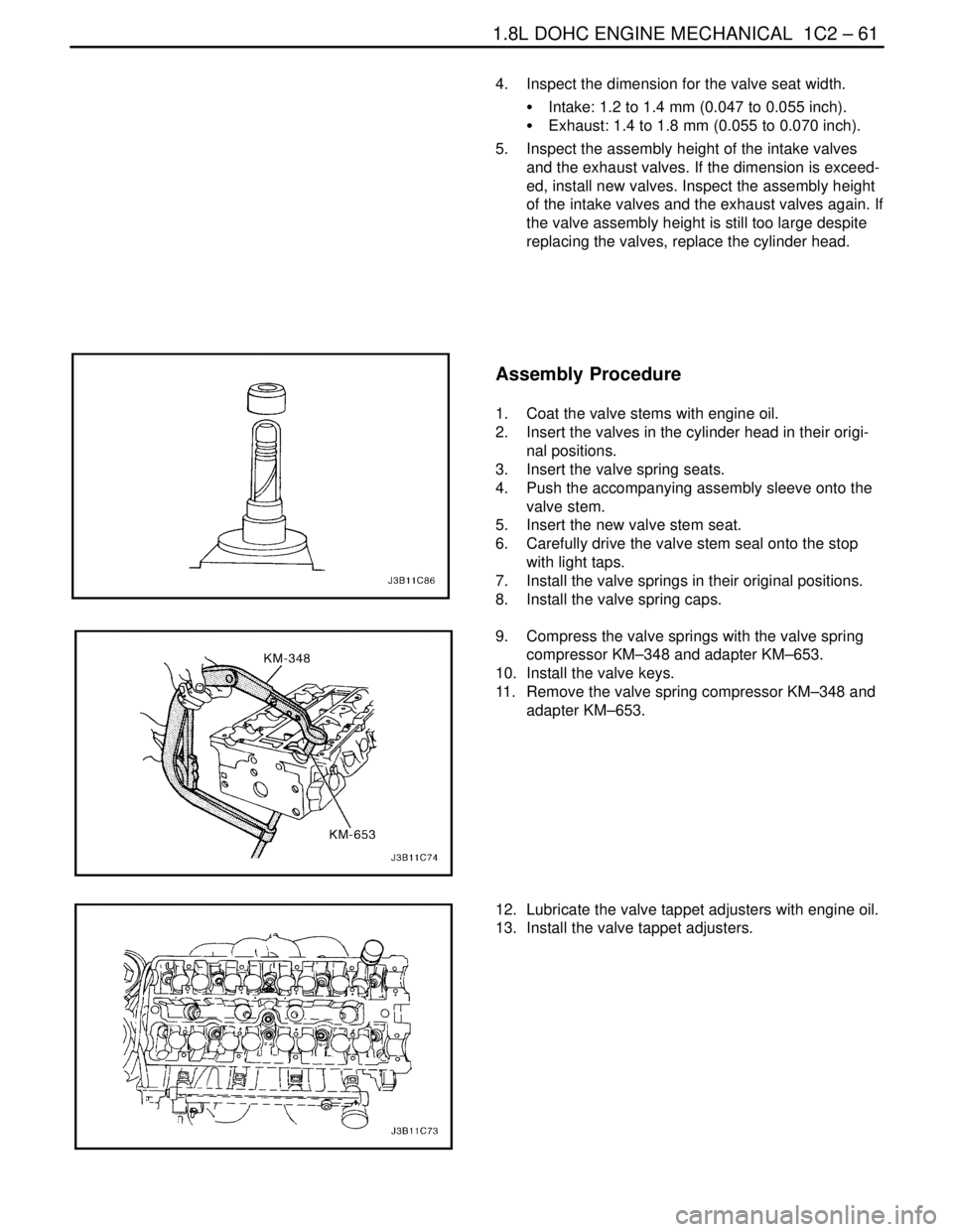
Assembly Procedure
1. Coat the valve stems with engine oil.
2. Insert the valves in the cylinder head in their origi-
nal positions.
3. Insert the valve spring seats.
4. Push the accompanying assembly sleeve onto the
valve stem.
5. Insert the new valve stem seat.
6. Carefully drive the valve stem seal onto the stop
with light taps.
7. Install the valve springs in their original positions.
8. Install the valve spring caps.
9. Compress the valve springs with the valve spring
compressor KM–348 and adapter KM–653.
10. Install the valve keys.
11. Remove the valve spring compressor KM–348 and
adapter KM–653.
12. Lubricate the valve tappet adjusters with engine oil.
13. Install the valve tappet adjusters.
Page 184 of 2643
1C2 – 64I1.8L DOHC ENGINE MECHANICAL
DAEWOO V–121 BL4
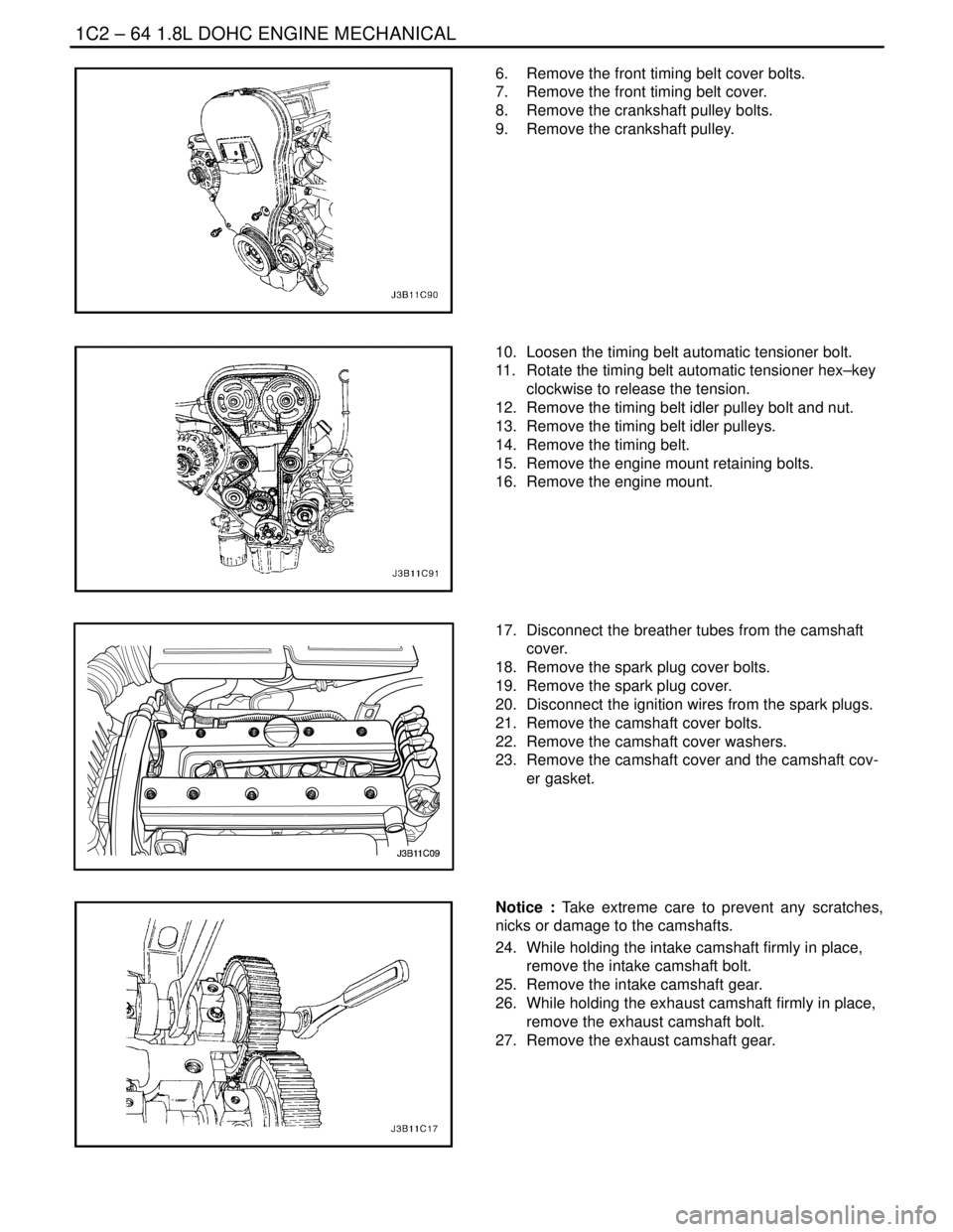
6. Remove the front timing belt cover bolts.
7. Remove the front timing belt cover.
8. Remove the crankshaft pulley bolts.
9. Remove the crankshaft pulley.
10. Loosen the timing belt automatic tensioner bolt.
11. Rotate the timing belt automatic tensioner hex–key
clockwise to release the tension.
12. Remove the timing belt idler pulley bolt and nut.
13. Remove the timing belt idler pulleys.
14. Remove the timing belt.
15. Remove the engine mount retaining bolts.
16. Remove the engine mount.
17. Disconnect the breather tubes from the camshaft
cover.
18. Remove the spark plug cover bolts.
19. Remove the spark plug cover.
20. Disconnect the ignition wires from the spark plugs.
21. Remove the camshaft cover bolts.
22. Remove the camshaft cover washers.
23. Remove the camshaft cover and the camshaft cov-
er gasket.
Notice : Take extreme care to prevent any scratches,
nicks or damage to the camshafts.
24. While holding the intake camshaft firmly in place,
remove the intake camshaft bolt.
25. Remove the intake camshaft gear.
26. While holding the exhaust camshaft firmly in place,
remove the exhaust camshaft bolt.
27. Remove the exhaust camshaft gear.
Page 223 of 2643

ENGINE ELECTRICAL 1E – 9
DAEWOO V–121 BL4
STARTER MOTOR NOISE
To correct starter motor noise during starting, use the following procedure:
Checks
Action
Check for a high–pitched whine during cranking, before
the engine fires. The engine cranks and fires properly.The distance is too great between the starter pinion and
the flywheel. Shimming the starter toward the flywheel is
required.
Check for a high–pitched whine after the engine fires, as
the key is being released. The engine cranks and fires
properly. This intermittent complaint is often diagnosed as
”starter hang–in” or ”solenoid weak.”The distance is too small between the starter pinion and
the flywheel. Shimming the starter away from the flywheel
is required.
Check for a loud ”whoop” after the engine fires but while
the starter is still held engaged. The sound is like a siren
if the engine is revved while the starter is engaged.The most probable cause is a defective clutch. A new
clutch will often correct this problem.
Check for a ”rumble,” a ”growl,” or, in severe cases, a
”knock” as the starter is coasting down to a stop after start-
ing the engine.The most probable cause is a bent or unbalanced starter
armature. A new armature will often correct this problem.
If the complaint is noise, correction can be achieved by
proper shimming as follows:
1. Check for a bent or a worn flywheel.
2. Start the engine and carefully touch the outside di-
ameter of the rotating flywheel ring gear with chalk
or a crayon to show the high point of the tooth run-
out. Turn the engine OFF and rotate the flywheel so
that the marked teeth are in the area of the starter
pinion gear.
3. Disconnect the negative battery cable to prevent
cranking the engine.
4. Check the pinion–to–flywheel clearance by using a
wire gauge of 0.5 mm (0.02 inch) minimum thick-
ness (or diameter). Center a pinion tooth between
two flywheel teeth and the gauge. Do not gauge in
the corners, where a misleading larger dimension
may be observed. If the clearance is under this
minimum, shimming the starter away from the fly-
wheel is required.
5. If the clearance approaches 1.5 mm (0.06 inch) or
more, shimming the starter toward the flywheel is
required. This condition is generally the cause of
broken flywheel teeth or the starter housing. Shim
the starter toward the flywheel by shimming only
the outboard starter mounting pad. A shim of 0.40
mm (0.016 inch) thickness at this location will de-
crease the clearance by approximately 0.30 mm
(0.012 inch). If normal starter shims are not avail-
able, plain washers or other suitable material may
be used as shims.BATTERY LOAD TEST
1. Check the battery for obvious damage, such as a
cracked or broken case or cover, which could per-
mit the loss of electrolyte. If obvious damage is
noted, replace the battery.
CAUTION : Do not charge the battery if the hydrome-
ter is clear or light yellow. Instead, replace the battery.
If the battery feels hot, or if violent gassing or spew-
ing of electrolyte through the vent hole occurs, dis-
continue charging or reduce the charging rate to
avoid personal injury.
2. Check the hydrometer. If the green dot is visible, go
to the load test procedure. If the indicator is dark
but green is not visible, charge the battery. For
charging a battery removed from the vehicle, refer
to ”Charging a Completely Discharged Battery” in
this section.
3. Connect a voltmeter and a battery load tester
across the battery terminals.
4. Apply a 300–ampere load for 15 seconds to remove
any surface charge from the battery.
5. Remove the load.
6. Wait 15 seconds to let the battery recover, and ap-
ply a 270–ampere load.
Important : The battery temperature must be estimated
by touch and by the temperature condition the battery has
been exposed for the preceding few hours.
7. If the voltage does not drop below the minimum
listed, the battery is good and should be reinstalled.
If the voltage is less than the minimum listed, re-
place the battery. Refer to ”Battery Specifications”
in this section.
Page 352 of 2643

1F – 106IENGINE CONTROLS
DAEWOO V–121 BL4
DATA LINK CONNECTOR DIAGNOSIS (1.4L/1.6L DOHC)
Circuit Description
The provision for communicating with the Engine Control
Module (ECM) is the Data Link Connector (DLC). It is lo-
cated under the instrument panel. The DLC is used to con-
nect the scan tool. Battery power and ground is supplied
for the scan tool through the DLC. The Keyword 2000 seri-
al data circuit to the DLC allows the ECM to communicate
with the scan tool. A Universal Asynchronous Receiver
Transmitter (UART) serial data line is used to communi-
cate with the other modules such as the Electronic Brake
Control Module (EBCM), the Supplemental Inflatable Re-
straint (SIR) system. and the Instrument Panel Cluster.
Diagnostic Aids
Ensure that the correct application (model line, car year,
etc.) has been selected on the scan tool. If communication
still cannot be established, try the scan tool on another ve-
hicle to ensure that the scan tool or cables are not the
cause of the condition.
An intermittent may be caused by a poor connection,
rubbed through wire insulation, or a broken wire inside the
insulation.
Any circuitry that is suspected of causing an intermittent
complaint should be thoroughly checked for the following
conditions:
S Backed–out terminals.S Improper mating of terminals.
S Broken locks.
S Improperly formed or damaged terminals.
S Poor terminal–to–wiring connection.
S Physical damage to the wiring harness.
S Corrosion.
Test Description
Number(s) below refer to the step number(s) on the Diag-
nostic Table.
1. The On–Board Diagnostic (EOBD) System Check
prompts the technician to complete some basic
checks and store the freeze frame and failure re-
cords data on the scan tool if applicable. This
creates an electronic copy of the data taken when
the malfunction occurred. The information is then
stored on the scan tool for later reference.
2. Unlike the UART serial data circuit, the only time a
Class II serial data circuit has any voltage on it is
when a scan tool asks the ECM for information and
sends the information out.
5. Locate and repair any shorts that may have caused
the fuse to open before replacement, if the no volt-
age condition was due to an open fuse.
10. The scan tool or associated cables could be mal-
functioning. Refer to the scan tool’s manual for re-
pair information.
Page 354 of 2643

1F – 108IENGINE CONTROLS
DAEWOO V–121 BL4
DATA LINK CONNECTOR DIAGNOSIS (1.8L DOHC)
Circuit Description
The provision for communicating with the Engine Control
Module (ECM) is the Data Link Connector (DLC). It is lo-
cated under the instrument panel. The DLC is used to con-
nect the scan tool. Battery power and ground is supplied
for the scan tool through the DLC. The Keyword 2000 seri-
al data circuit to the DLC allows the ECM to communicate
with the scan tool. A Universal Asynchronous Receiver
Transmitter (UART) serial data line is used to communi-
cate with the other modules such as the Electronic Brake
Control Module (EBCM), the Supplemental Inflatable Re-
straint (SIR) system. and the Instrument Panel Cluster.
Diagnostic Aids
Ensure that the correct application (model line, car year,
etc.) has been selected on the scan tool. If communication
still cannot be established, try the scan tool on another ve-
hicle to ensure that the scan tool or cables are not the
cause of the condition.
An intermittent may be caused by a poor connection,
rubbed through wire insulation, or a broken wire inside the
insulation.
Any circuitry that is suspected of causing an intermittent
complaint should be thoroughly checked for the following
conditions:
S Backed–out terminals.S Improper mating of terminals.
S Broken locks.
S Improperly formed or damaged terminals.
S Poor terminal–to–wiring connection.
S Physical damage to the wiring harness.
S Corrosion.
Test Description
Number(s) below refer to the step number(s) on the Diag-
nostic Table.
1. The On–Board Diagnostic (EOBD) System Check
prompts the technician to complete some basic
checks and store the freeze frame and failure re-
cords data on the scan tool if applicable. This
creates an electronic copy of the data taken when
the malfunction occurred. The information is then
stored on the scan tool for later reference.
2. Unlike the UART serial data circuit, the only time a
Class II serial data circuit has any voltage on it is
when a scan tool asks the ECM for information and
sends the information out.
5. Locate and repair any shorts that may have caused
the fuse to open before replacement, if the no volt-
age condition was due to an open fuse.
10. The scan tool or associated cables could be mal-
functioning. Refer to the scan tool’s manual for re-
pair information.