maintenance DAEWOO LACETTI 2004 Service User Guide
[x] Cancel search | Manufacturer: DAEWOO, Model Year: 2004, Model line: LACETTI, Model: DAEWOO LACETTI 2004Pages: 2643, PDF Size: 80.54 MB
Page 203 of 2643
1D – 8IENGINE COOLING
DAEWOO V–121 BL4
MAINTENANCE AND REPAIR
ON–VEHICLE SERVICE
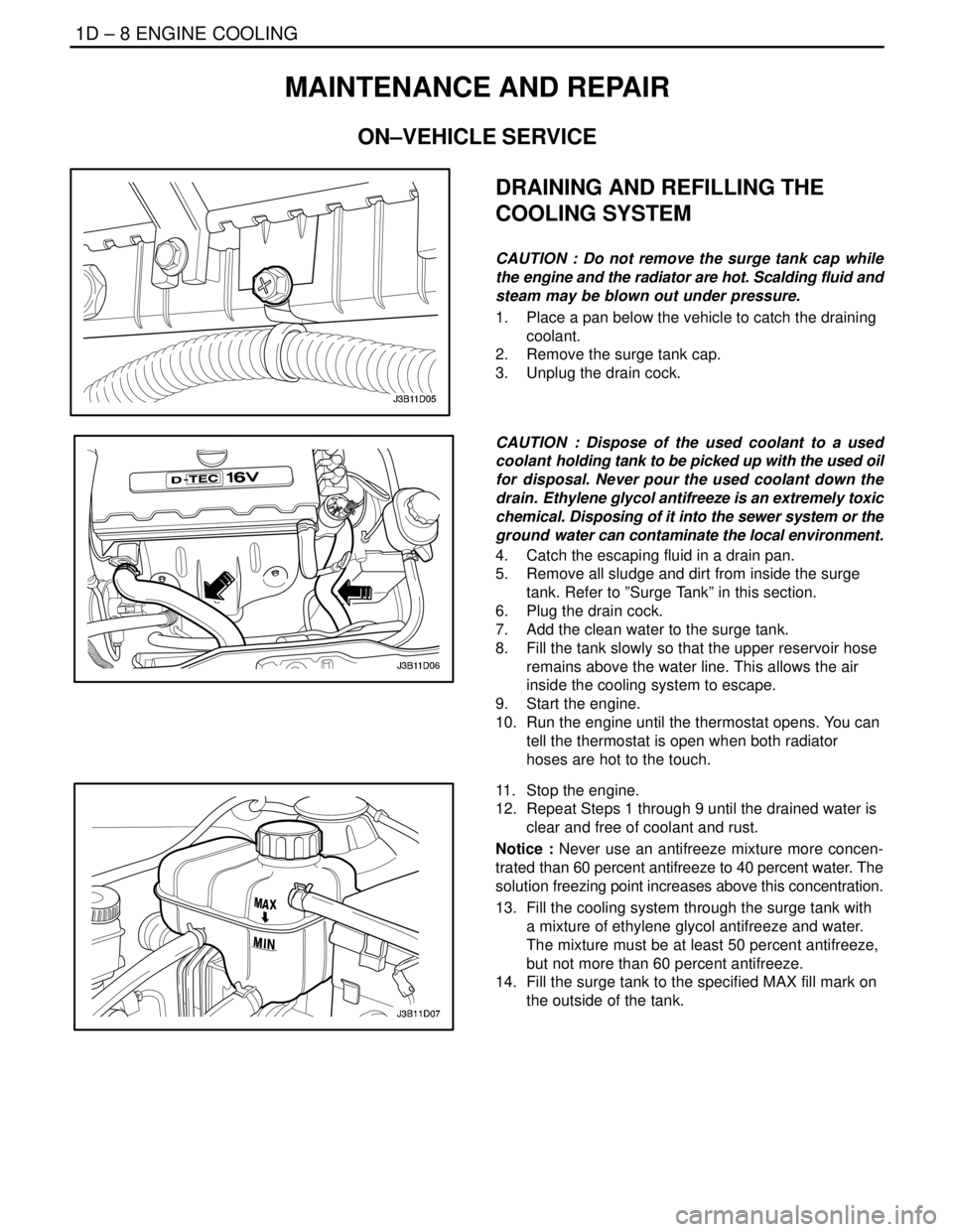
DRAINING AND REFILLING THE
COOLING SYSTEM
CAUTION : Do not remove the surge tank cap while
the engine and the radiator are hot. Scalding fluid and
steam may be blown out under pressure.
1. Place a pan below the vehicle to catch the draining
coolant.
2. Remove the surge tank cap.
3. Unplug the drain cock.
CAUTION : Dispose of the used coolant to a used
coolant holding tank to be picked up with the used oil
for disposal. Never pour the used coolant down the
drain. Ethylene glycol antifreeze is an extremely toxic
chemical. Disposing of it into the sewer system or the
ground water can contaminate the local environment.
4. Catch the escaping fluid in a drain pan.
5. Remove all sludge and dirt from inside the surge
tank. Refer to ”Surge Tank” in this section.
6. Plug the drain cock.
7. Add the clean water to the surge tank.
8. Fill the tank slowly so that the upper reservoir hose
remains above the water line. This allows the air
inside the cooling system to escape.
9. Start the engine.
10. Run the engine until the thermostat opens. You can
tell the thermostat is open when both radiator
hoses are hot to the touch.
11. Stop the engine.
12. Repeat Steps 1 through 9 until the drained water is
clear and free of coolant and rust.
Notice : Never use an antifreeze mixture more concen-
trated than 60 percent antifreeze to 40 percent water. The
solution freezing point increases above this concentration.
13. Fill the cooling system through the surge tank with
a mixture of ethylene glycol antifreeze and water.
The mixture must be at least 50 percent antifreeze,
but not more than 60 percent antifreeze.
14. Fill the surge tank to the specified MAX fill mark on
the outside of the tank.
Page 215 of 2643

SECTION : 1E
ENGINE ELECTRICAL
CAUTION : Disconnect the negative battery cable before removing or installing any electrical unit or when a tool
or equipment could easily come in contact with exposed electrical terminals. Disconnecting this cable will help
prevent personal injury and damage to the vehicle. The ignition must also be in LOCK unless otherwise noted.
TABLE OF CONTENTS
SPECIFICATIONS1E–2 . . . . . . . . . . . . . . . . . . . . . . . . . .
Starter Specifications 1E–2. . . . . . . . . . . . . . . . . . . . . .
Battery Specifications 1E–2. . . . . . . . . . . . . . . . . . . . . .
Fastener Tightening Specifications 1E–3. . . . . . . . . .
SCHEMATIC AND ROUTING DIAGRAMS1E–4 . . . . .
Startimg System 1E–4. . . . . . . . . . . . . . . . . . . . . . . . . .
Charging System 1E–5. . . . . . . . . . . . . . . . . . . . . . . . . .
DIAGNOSIS1E–6 . . . . . . . . . . . . . . . . . . . . . . . . . . . . . . . .
No Crank 1E–6. . . . . . . . . . . . . . . . . . . . . . . . . . . . . . . .
Starter Motor Noise 1E–9. . . . . . . . . . . . . . . . . . . . . . .
Battery Load Test 1E–9. . . . . . . . . . . . . . . . . . . . . . . . .
Genrator Output Test 1E–10. . . . . . . . . . . . . . . . . . . . .
Generator System Check 1E–10. . . . . . . . . . . . . . . . .
MAINTENANCE AND REPAIR1E–11 . . . . . . . . . . . . . .
ON–VEHICLE SERVICE 1E–11. . . . . . . . . . . . . . . . . . . .
Generator 1E–11. . . . . . . . . . . . . . . . . . . . . . . . . . . . . . .
Starter 1E–14. . . . . . . . . . . . . . . . . . . . . . . . . . . . . . . . . .
Battery and Battery Tray 1E–15. . . . . . . . . . . . . . . . . . . UNIT REPAIR 1E–17. . . . . . . . . . . . . . . . . . . . . . . . . . . . .
Starter Motor 1E–17. . . . . . . . . . . . . . . . . . . . . . . . . . . . .
Generator 1E–25. . . . . . . . . . . . . . . . . . . . . . . . . . . . . . .
GENERAL DESCRIPTION AND SYSTEM
OPERATION1E–30 . . . . . . . . . . . . . . . . . . . . . . . . . . . . .
Battery 1E–30. . . . . . . . . . . . . . . . . . . . . . . . . . . . . . . . . .
Ratings 1E–30. . . . . . . . . . . . . . . . . . . . . . . . . . . . . . . . . .
Reserve Capacity 1E–30. . . . . . . . . . . . . . . . . . . . . . . . .
Cold Cranking Amperage 1E–30. . . . . . . . . . . . . . . . . .
Built–In Hydrometer 1E–30. . . . . . . . . . . . . . . . . . . . . . .
Charging Procedure 1E–30. . . . . . . . . . . . . . . . . . . . . . .
Charging Time Required 1E–31. . . . . . . . . . . . . . . . . . .
Charging a Completely Discharged Battery
(OFF the Vehicle) 1E–31. . . . . . . . . . . . . . . . . . . . . . .
Jump Starting Procedure 1E–31. . . . . . . . . . . . . . . . . .
Generator 1E–32. . . . . . . . . . . . . . . . . . . . . . . . . . . . . . .
Charging System 1E–32. . . . . . . . . . . . . . . . . . . . . . . . .
Starter 1E–32. . . . . . . . . . . . . . . . . . . . . . . . . . . . . . . . . .
Starting System 1E–32. . . . . . . . . . . . . . . . . . . . . . . . . .
Page 225 of 2643
ENGINE ELECTRICAL 1E – 11
DAEWOO V–121 BL4
MAINTENANCE AND REPAIR
ON–VEHICLE SERVICE
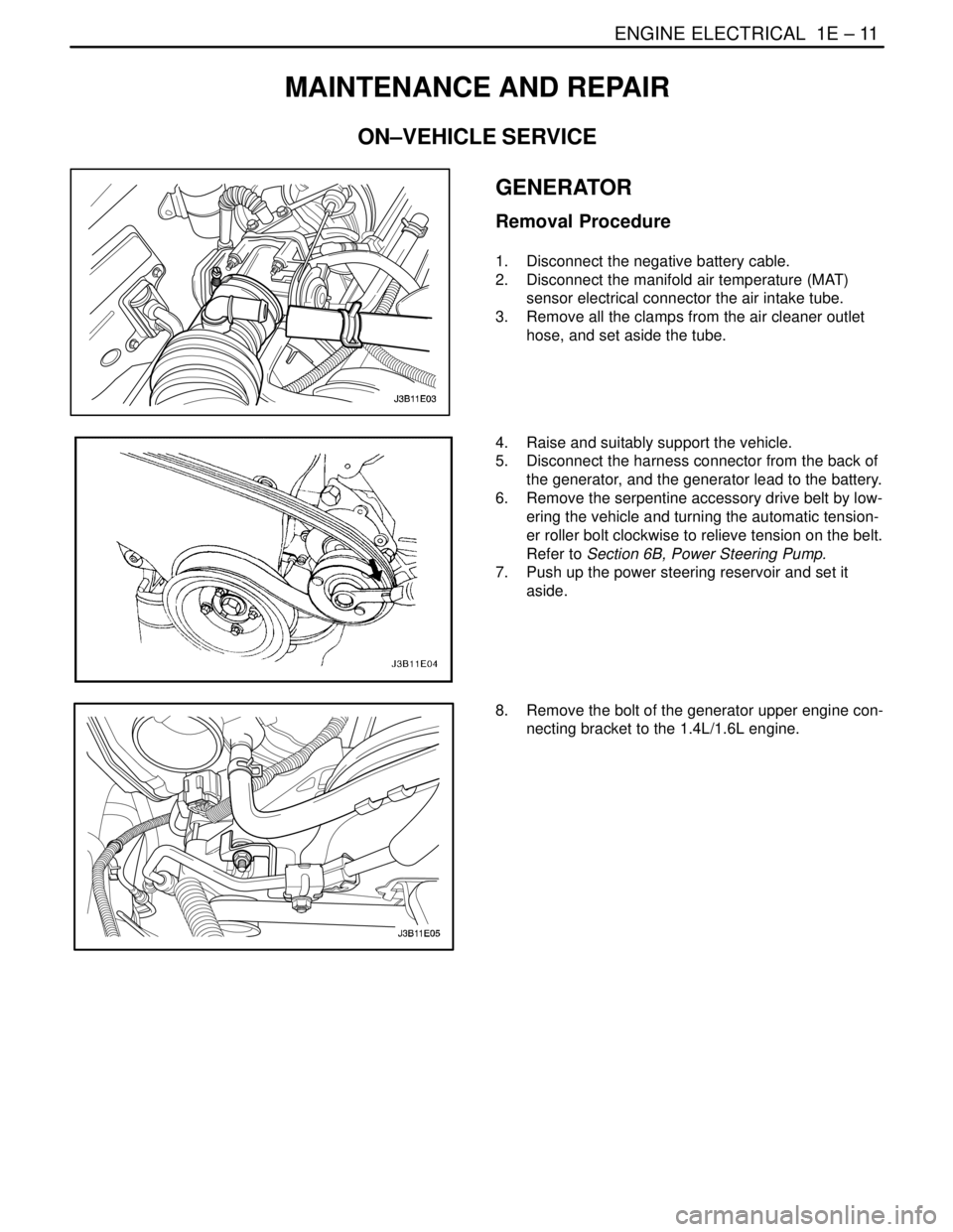
GENERATOR
Removal Procedure
1. Disconnect the negative battery cable.
2. Disconnect the manifold air temperature (MAT)
sensor electrical connector the air intake tube.
3. Remove all the clamps from the air cleaner outlet
hose, and set aside the tube.
4. Raise and suitably support the vehicle.
5. Disconnect the harness connector from the back of
the generator, and the generator lead to the battery.
6. Remove the serpentine accessory drive belt by low-
ering the vehicle and turning the automatic tension-
er roller bolt clockwise to relieve tension on the belt.
Refer to Section 6B, Power Steering Pump.
7. Push up the power steering reservoir and set it
aside.
8. Remove the bolt of the generator upper engine con-
necting bracket to the 1.4L/1.6L engine.
Page 251 of 2643

ENGINE CONTROLS 1F – 5
DAEWOO V–121 BL4
SYMPTOM DIAGNOSIS1F–574 . . . . . . . . . . . . . . . . . . .
Important Preliminary Checks 1F–574. . . . . . . . . . . . .
Intermittents 1F–574. . . . . . . . . . . . . . . . . . . . . . . . . . . .
Hard Start 1F–576. . . . . . . . . . . . . . . . . . . . . . . . . . . . . .
Surges or Chuggles 1F–579. . . . . . . . . . . . . . . . . . . . . .
Lack of Power, Sluggishness, or Sponginess 1F–581
Hesitation, Sag, Stumble 1F–583. . . . . . . . . . . . . . . . .
Cuts Out, Misses 1F–584. . . . . . . . . . . . . . . . . . . . . . . .
Poor Fuel Economy 1F–587. . . . . . . . . . . . . . . . . . . . . .
Rough, Unstable, or Incorrect Idle, Stalling 1F–588. .
Excessive Exhaust Emissions or Odors 1F–591. . . . .
Dieseling, Run–On 1F–592. . . . . . . . . . . . . . . . . . . . . . .
Backfire 1F–593. . . . . . . . . . . . . . . . . . . . . . . . . . . . . . . .
MAINTENANCE AND REPAIR1F–594 . . . . . . . . . . . . .
ON–VEHICLE SERVICE 1F–594. . . . . . . . . . . . . . . . . . .
Fuel System Pressure Relief 1F–594. . . . . . . . . . . . . .
Fuel Tank 1F–594. . . . . . . . . . . . . . . . . . . . . . . . . . . . . . .
Fuel Pump 1F–596. . . . . . . . . . . . . . . . . . . . . . . . . . . . . .
Fuel Filter 1F–597. . . . . . . . . . . . . . . . . . . . . . . . . . . . . .
Fuel Rail and Injectors (1.4L/1.6L DOHC) 1F–598. . .
Fuel Rail and Injectors (1.8L DOHC) 1F–600. . . . . . .
Engine Coolant Temperature Sensor
(1.4L/1.6L DOHC) 1F–602. . . . . . . . . . . . . . . . . . . . . .
Engine Coolant Temperature Sensor
(1.8L DOHC) 1F–602. . . . . . . . . . . . . . . . . . . . . . . . . .
Throttle Position Sensor (1.8L DOHC) 1F–603. . . . . .
Throttle Body (1.4L/1.6L DOHC) 1F–603. . . . . . . . . . .
Throttle Body (1.8L DOHC) 1F–604. . . . . . . . . . . . . . .
Front Heated Oxygen Sensor (HO2S 1)
(1.4L/1.6L DOHC) 1F–606. . . . . . . . . . . . . . . . . . . . . .
Front Heated Oxygen Sensor (HO2S 1)
(1.8L DOHC) 1F–607. . . . . . . . . . . . . . . . . . . . . . . . . .
Rear Heated Oxygen Sensor (HO2S 2) 1F–607. . . . .
Intake Air Temperature Sensor
(1.4L/1.6L DOHC) 1F–608. . . . . . . . . . . . . . . . . . . . . .
Intake Air Temperature Sensor (1.8L DOHC) 1F–609
Idle Air Control Valve (1.8L DOHC) 1F–609. . . . . . . . .
Manifold Absolute Pressure Sensor
(1.4L/1.6L DOHC) 1F–610. . . . . . . . . . . . . . . . . . . . . .
Manifold Absolute Pressure Sensor
(1.8L DOHC) 1F–611. . . . . . . . . . . . . . . . . . . . . . . . . .
Exhaust Gas Recirculation Valve
(1.4L/1.6L DOHC) 1F–611. . . . . . . . . . . . . . . . . . . . . .
Exhaust Gas Recirculation Valve (1.8L DOHC) 1F–612
Knock Sensor (1.4L/1.6L DOHC) 1F–612. . . . . . . . . .
Knock Sensor (1.8L DOHC) 1F–613. . . . . . . . . . . . . . .
Evaporative Emission Canister 1F–614. . . . . . . . . . . . Evaporative Emission Canister Purge Solenoid Valve 1
F–615
Crankshaft Position (CKP) Sensor
(1.4L/1.6L DOHC) 1F–615. . . . . . . . . . . . . . . . . . . . . .
Crankshaft Position (CKP) Sensor
(1.8L DOHC) 1F–616. . . . . . . . . . . . . . . . . . . . . . . . . .
Camshaft Position Sensor (1.4L/1.6L DOHC) 1F–618
Camshaft Position Sensor (1.8L DOHC) 1F–619. . . .
Engine Control Module (1.4L/1.6L DOHC) 1F–620. . .
Engine Control Module (1.8L DOHC) 1F–621. . . . . . .
Electronic Ignition System Ignition Coil
(1.4L/1.6L DOHC) 1F–621. . . . . . . . . . . . . . . . . . . . . .
Electronic Ignition System Ignition Coil
(1.8L DOHC) 1F–622. . . . . . . . . . . . . . . . . . . . . . . . . .
GENERAL DESCRIPTION AND SYSTEM
OPERATION1F–623 . . . . . . . . . . . . . . . . . . . . . . . . . . . .
Ignition System Operation 1F–623. . . . . . . . . . . . . . . .
Electronic Ignition System Ignition Coil 1F–623. . . . . .
Crankshaft Position Sensor 1F–623. . . . . . . . . . . . . . .
Camshaft Position Sensor 1F–623. . . . . . . . . . . . . . . .
Idle Air System Operation 1F–623. . . . . . . . . . . . . . . . .
Fuel Control System Operation 1F–623. . . . . . . . . . . .
Evaporative Emission Control System
Operation 1F–624. . . . . . . . . . . . . . . . . . . . . . . . . . . . .
Evaporative Emission Canister 1F–625. . . . . . . . . . . .
Positive Crankcase Ventilation System
Operation 1F–625. . . . . . . . . . . . . . . . . . . . . . . . . . . . .
Engine Coolant Temperature Sensor 1F–625. . . . . . .
Throttle Position Sensor 1F–625. . . . . . . . . . . . . . . . . .
Catalyst Monitor Oxygen Sensors 1F–625. . . . . . . . . .
Exhaust Gas Recirculation Valve 1F–626. . . . . . . . . . .
Intake Air Temperature Sensor 1F–626. . . . . . . . . . . .
Idle Air Control Valve 1F–626. . . . . . . . . . . . . . . . . . . . .
Manifold Absolute Pressure Sensor 1F–626. . . . . . . .
Engine Control Module 1F–627. . . . . . . . . . . . . . . . . . .
Fuel Injector 1F–627. . . . . . . . . . . . . . . . . . . . . . . . . . . .
Knock Sensor 1F–627. . . . . . . . . . . . . . . . . . . . . . . . . . .
Rough Road Sensor 1F–627. . . . . . . . . . . . . . . . . . . . .
Strategy–Based Diagnostics 1F–628. . . . . . . . . . . . . .
EOBD Serviceability Issues 1F–628. . . . . . . . . . . . . . .
Serial Data Communications 1F–629. . . . . . . . . . . . . .
On–Board Diagnostic (EOBD) 1F–629. . . . . . . . . . . . .
Comprehensive Component Monitor Diagnostic
Operation 1F–630. . . . . . . . . . . . . . . . . . . . . . . . . . . . .
Common EOBD Terms 1F–630. . . . . . . . . . . . . . . . . . .
Reading Diagnostic Trouble Codes 1F–632. . . . . . . . .
Primary System–Based Diagnostics 1F–633. . . . . . . .
Page 840 of 2643

1F – 594IENGINE CONTROLS
DAEWOO V–121 BL4
MAINTENANCE AND REPAIR
ON–VEHICLE SERVICE
FUEL SYSTEM PRESSURE RELIEF
Procedure
CAUTION : The fuel system is under pressure. To
avoid fuel spillage and the risk of personal injury or
fire, it is necessary to relieve the fuel system pressure
before disconnecting the fuel lines.
1. Remove the fuel cap.
2. Remove the fuel pump fuse Ef18 from the engine
fuse block.
3. Start the engine and allow the engine to stall.
4. Crank the engine for an additional 10 seconds.
FUEL TANK
Removal Procedure
CAUTION : The fuel system is under pressure. To
avoid fuel spillage and the risk of personal injury or
fire, it is necessary to relieve the fuel system pressure
before disconnecting the fuel lines.
1. Relieve the fuel pressure. Refer to ” Fuel System
Pressure Relief ” in this section.
2. Disconnect the negative battery cable.
3. Drain the fuel tank.
4. Remove the front muffler. Refer to Section 1G, Ex-
haust System
5. Remove the fuel tank filler tube clamp at the fuel
tank.
6. Disconnect the fuel tank filler tube.
7. Disconnect the fuel vapor line near the fuel tank
filler tube.
8. Disconnect the fuel pump harness connector.
Page 875 of 2643

ENGINE CONTROLS 1F – 629
DAEWOO V–121 BL4
tentially interfere with the operation of the Exhaust Gas
Recirculation (EGR) valve and thereby turn on the MIL.
Small leaks in the exhaust system near the post catalyst
oxygen sensor can also cause the MIL to turn on.
Aftermarket electronics, such as cellular phones, stereos,
and anti–theft devices, may radiate electromagnetic inter-
ference (EMI) into the control system if they are improperly
installed. This may cause a false sensor reading and turn
on the MIL.
Environment
Temporary environmental conditions, such as localized
flooding, will have an effect on the vehicle ignition system.
If the ignition system is rain–soaked, it can temporarily
cause engine misfire and turn on the MIL.
Refueling
A new EOBD diagnostic checks the integrity of the entire
Evaporative (EVAP) Emission system. If the vehicle is re-
started after refueling and the fuel cap is not secured cor-
rectly, the on–board diagnostic system will sense this as
a system fault, turn on the MIL, and set DTC P0440.
Vehicle Marshaling
The transportation of new vehicles from the assembly
plant to the dealership can involve as many as 60 key
cycles within 2 to 3 miles of driving. This type of operation
contributes to the fuel fouling of the spark plugs and will
turn on the MIL with a set DTC P0300.
Poor Vehicle Maintenance
The sensitivity of EOBD diagnostics will cause the MIL to
turn on if the vehicle is not maintained properly. Restricted
air filters, fuel filters, and crankcase deposits due to lack
of oil changes or improper oil viscosity can trigger actual
vehicle faults that were not previously monitored prior to
EOBD. Poor vehicle maintenance can not be classified as
a ”non–vehicle fault,” but with the sensitivity of EOBD
diagnostics, vehicle maintenance schedules must be
more closely followed.
Severe Vibration
The Misfire diagnostic measures small changes in the
rotational speed of the crankshaft. Severe driveline vibra-
tions in the vehicle, such as caused by an excessive
amount of mud on the wheels, can have the same effect
on crankshaft speed as misfire and, therefore, may set
DTC P0300.
Related System Faults
Many of the EOBD system diagnostics will not run if the
engine controlmodule (ECM) detects a fault on a related
system or component. One example would be that if the
ECM detected a Misfire fault, the diagnostics on the cata-
lytic converter would be suspended until the Misfire fault
was repaired. If the Misfire fault is severe enough, the cat-
alytic converter can be damaged due to overheating andwill never set a Catalyst DTC until the Misfire fault is re-
paired and the Catalyst diagnostic is allowed to run to
completion. If this happens, the customer may have to
make two trips to the dealership in order to repair the ve-
hicle.
SERIAL DATA COMMUNICATIONS
Class II Serial Data Communications
Government regulations require that all vehicle manufac-
turers establish a common communication system. This
vehicle utilizes the ”Class II” communication system. Each
bit of information can have one of two lengths: long or
short. This allows vehicle wiring to be reduced by transmit-
ting and receiving multiple signals over a single wire. The
messages carried on Class II data streams are also priori-
tized. If two messages attempt to establish communica-
tions on the data line at the same time, only the message
with higher priority will continue. The device with the lower
priority message must wait. Themost significant result of
this regulation is that it provides scan tool manufacturers
with the capability to access data from any make or model
vehicle that is sold.
The data displayed on the other scan tool will appear the
same, with some exceptions. Some scan tools will only be
able to display certain vehicle parameters as values that
are a coded representation of the true or actual value. On
this vehicle the scan tool displays the actual values for ve-
hicle parameters. It will not be necessary to perform any
conversions from coded values to actual values.
ON–BOARD DIAGNOSTIC (EOBD)
On–Board Diagnostic Tests
A diagnostic test is a series of steps, the result of which is
a pass or fail reported to the diagnostic executive. When
a diagnostic test reports a pass result, the diagnostic
executive records the following data:
S The diagnostic test has been completed since the
last ignition cycle.
S The diagnostic test has passed during the current
ignition cycle.
S The fault identified by the diagnostic test is not cur-
rently active.
When a diagnostic test reports a fail result, the diagnostic
executive records the following data:
S The diagnostic test has been completed since the
last ignition cycle.
S The fault identified by the diagnostic test is current-
ly active.
S The fault has been active during this ignition cycle.
S The operating conditions at the time of the failure.
Remember, a fuel trim Diagnostic Trouble Code (DTC)
may be triggered by a list of vehicle faults. Make use of all
information available (other DTCs stored, rich or lean con-
dition, etc.) when diagnosing a fuel trim fault.
Page 881 of 2643

SECTION : 1G
ENGINE EXHAUST
TABLE OF CONTENTS
SPECIFICATIONS1G–1 . . . . . . . . . . . . . . . . . . . . . . . . . .
Fastener Tightening Specifications 1G–1. . . . . . . . . .
COMPONENT LOCATOR1G–2 . . . . . . . . . . . . . . . . . . . .
Exhaust System 1G–2. . . . . . . . . . . . . . . . . . . . . . . . . .
MAINTENANCE AND REPAIR1G–3 . . . . . . . . . . . . . . .
ON–VEHICLE SERVICE 1G–3. . . . . . . . . . . . . . . . . . . . .
Catalytic Converter 1G–3. . . . . . . . . . . . . . . . . . . . . . . . Exhaust Front Pipe 1G–4. . . . . . . . . . . . . . . . . . . . . . . .
Muffler – Front 1G–6. . . . . . . . . . . . . . . . . . . . . . . . . . . .
Muffler – Rear 1G–7. . . . . . . . . . . . . . . . . . . . . . . . . . . .
GENERAL DESCRIPTION AND SYSTEM
OPERATION1G–9 . . . . . . . . . . . . . . . . . . . . . . . . . . . . . .
Exhaust System 1G–9. . . . . . . . . . . . . . . . . . . . . . . . . .
Muffler 1G–9. . . . . . . . . . . . . . . . . . . . . . . . . . . . . . . . . . .
Catalytic Converters 1G–9. . . . . . . . . . . . . . . . . . . . . . .
SPECIFICATIONS
FASTENER TIGHTENING SPECIFICATIONS
ApplicationNSmLb–FtLb–In
Catalytic Converter–to–Exhaust Manifold Nuts4037–
Exhaust Front Pipe–to–Catalytic Converter Nuts4030–
Exhaust Manifold Cover Bolts1511–
Exhaust Front Pip–to–Front Muffler3022–
Front Muffler–to–Rear Muffler Nuts3022–
Front Bracket–to–Cylinder Block Bolt5037–
Catalytic Converter–to–Underbody Shield2.5–22
Front Muffler–to–Underbody Shield2.5–22
Rear Muffler–to–Underbody Shield2.5–22
Page 883 of 2643
ENGINE EXHAUST 1G – 3
DAEWOO V–121 BL4
MAINTENANCE AND REPAIR
ON–VEHICLE SERVICE
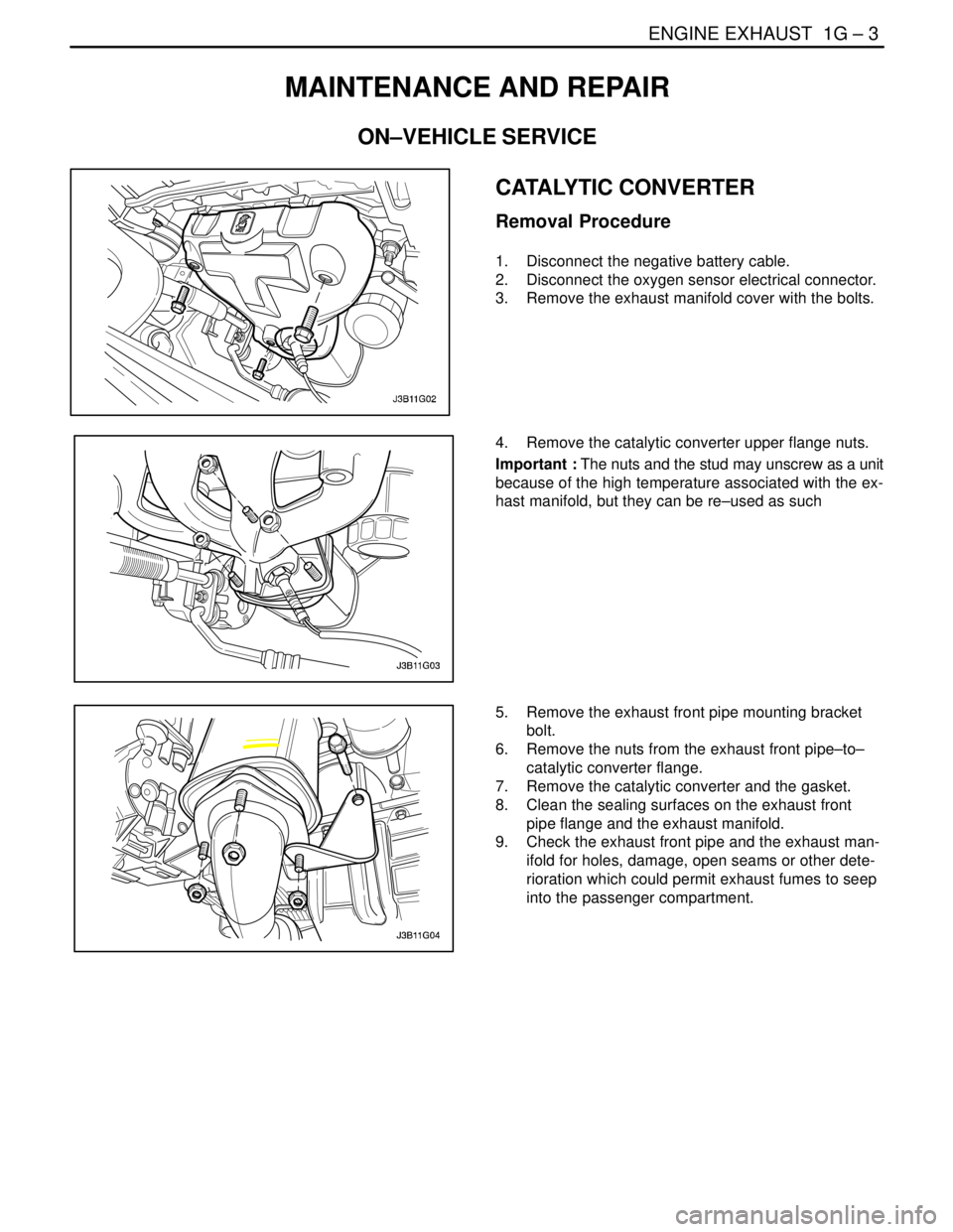
CATALYTIC CONVERTER
Removal Procedure
1. Disconnect the negative battery cable.
2. Disconnect the oxygen sensor electrical connector.
3. Remove the exhaust manifold cover with the bolts.
4. Remove the catalytic converter upper flange nuts.
Important : The nuts and the stud may unscrew as a unit
because of the high temperature associated with the ex-
hast manifold, but they can be re–used as such
5. Remove the exhaust front pipe mounting bracket
bolt.
6. Remove the nuts from the exhaust front pipe–to–
catalytic converter flange.
7. Remove the catalytic converter and the gasket.
8. Clean the sealing surfaces on the exhaust front
pipe flange and the exhaust manifold.
9. Check the exhaust front pipe and the exhaust man-
ifold for holes, damage, open seams or other dete-
rioration which could permit exhaust fumes to seep
into the passenger compartment.
Page 918 of 2643

SECTION : 2C
FRONT SUSPENSION
CAUTION : Disconnect the negative battery cable before removing or installing any electrical unit or when a tool
or equipment could easily come in contact with exposed electrical terminals. Disconnecting this cable will help
prevent personal injury and damage to the vehicle. The ignition must also be in LOCK unless otherwise noted.
TABLE OF CONTENTS
SPECIFICATIONS2C–2 . . . . . . . . . . . . . . . . . . . . . . . . . .
General Specifications 2C–2. . . . . . . . . . . . . . . . . . . . .
Fastener Tightening Specifications 2C–2. . . . . . . . . . .
SPECIAL TOOLS2C–3 . . . . . . . . . . . . . . . . . . . . . . . . . . .
Special Tools Table 2C–3. . . . . . . . . . . . . . . . . . . . . . . .
DIAGNOSIS2C–5 . . . . . . . . . . . . . . . . . . . . . . . . . . . . . . . .
Strut Dampener 2C–5. . . . . . . . . . . . . . . . . . . . . . . . . . .
Ball Joint and Knuckle 2C–6. . . . . . . . . . . . . . . . . . . . . .
Excessive Friction Check 2C–6. . . . . . . . . . . . . . . . . . .
COMPONENT LOCATOR2C–7 . . . . . . . . . . . . . . . . . . . .
Front Suspension 2C–7. . . . . . . . . . . . . . . . . . . . . . . . . .
MAINTENANCE AND REPAIR2C–9 . . . . . . . . . . . . . . .
ON–VEHICLE SERVICE 2C–9. . . . . . . . . . . . . . . . . . . . .
Stabilizer Shaft and Insulators 2C–9. . . . . . . . . . . . . . . Stabilizer Link 2C–10. . . . . . . . . . . . . . . . . . . . . . . . . . . .
Knuckle Assembly 2C–10. . . . . . . . . . . . . . . . . . . . . . . .
Hub and Bearing 2C–13. . . . . . . . . . . . . . . . . . . . . . . . .
Control Arm 2C–14. . . . . . . . . . . . . . . . . . . . . . . . . . . . . .
Strut Assembly 2C–16. . . . . . . . . . . . . . . . . . . . . . . . . . .
Crossmember Assembly 2C–18. . . . . . . . . . . . . . . . . . .
UNIT REPAIR 2C–21. . . . . . . . . . . . . . . . . . . . . . . . . . . . .
Ball Joint 2C–21. . . . . . . . . . . . . . . . . . . . . . . . . . . . . . . .
Control Arm Bushings 2C–21. . . . . . . . . . . . . . . . . . . . .
Front Strut Assembly 2C–22. . . . . . . . . . . . . . . . . . . . . .
Knuckle 2C–23. . . . . . . . . . . . . . . . . . . . . . . . . . . . . . . . .
GENERAL DESCRIPTION AND SYSTEM
OPERATION 2C–25 . . . . . . . . . . . . . . . . . . . . . . . . . . . .
Front Suspension 2C–25. . . . . . . . . . . . . . . . . . . . . . . . .
Page 926 of 2643
FRONT SUSPENSION 2C – 9
DAEWOO V–121 BL4
MAINTENANCE AND REPAIR
ON–VEHICLE SERVICE
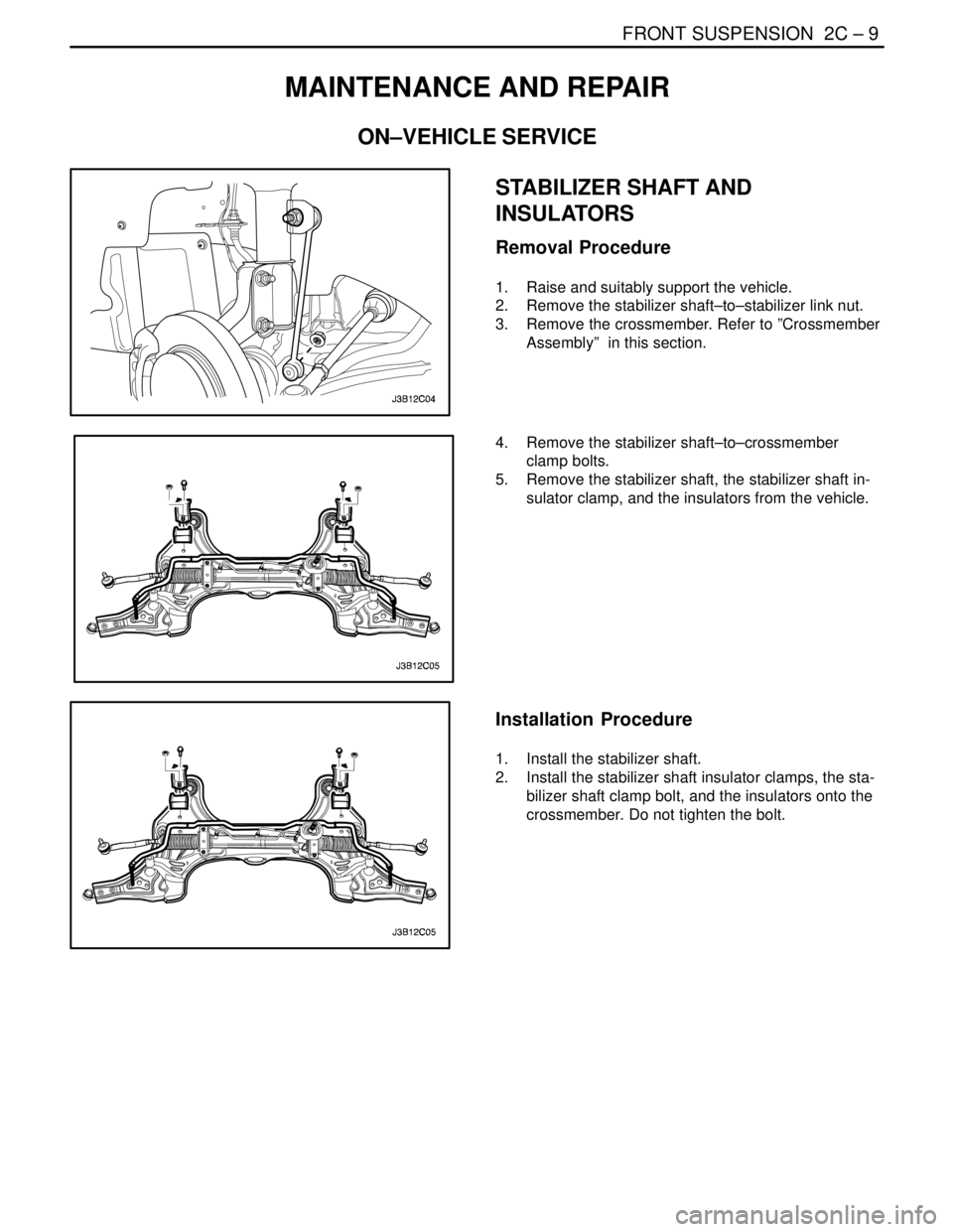
STABILIZER SHAFT AND
INSULATORS
Removal Procedure
1. Raise and suitably support the vehicle.
2. Remove the stabilizer shaft–to–stabilizer link nut.
3. Remove the crossmember. Refer to ”Crossmember
Assembly” in this section.
4. Remove the stabilizer shaft–to–crossmember
clamp bolts.
5. Remove the stabilizer shaft, the stabilizer shaft in-
sulator clamp, and the insulators from the vehicle.
Installation Procedure
1. Install the stabilizer shaft.
2. Install the stabilizer shaft insulator clamps, the sta-
bilizer shaft clamp bolt, and the insulators onto the
crossmember. Do not tighten the bolt.