Iat DAEWOO LACETTI 2004 Service Repair Manual
[x] Cancel search | Manufacturer: DAEWOO, Model Year: 2004, Model line: LACETTI, Model: DAEWOO LACETTI 2004Pages: 2643, PDF Size: 80.54 MB
Page 1700 of 2643
5A2 – 110IAISIN AUTOMATIC TRANSAXLE
DAEWOO V–121 BL4
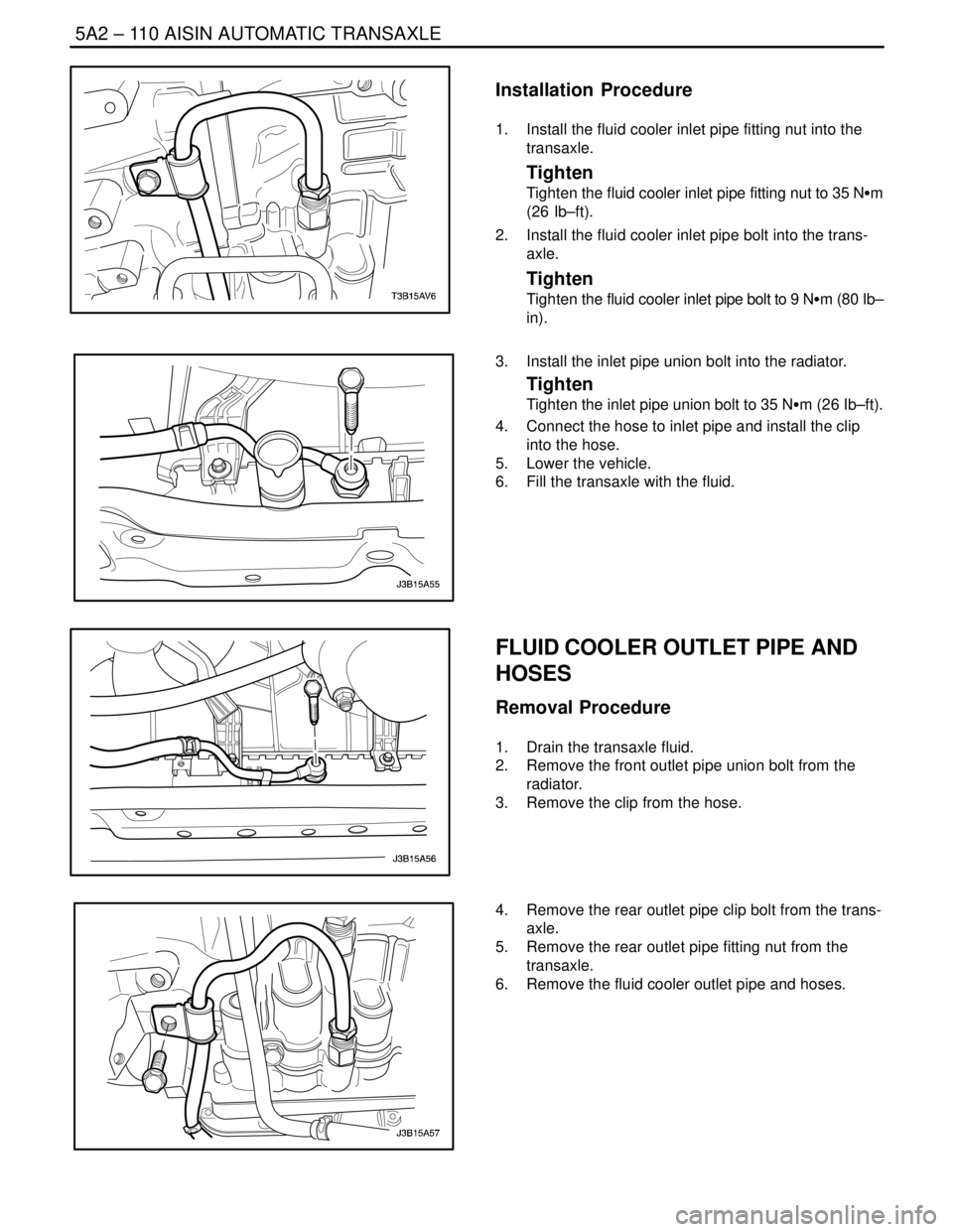
Installation Procedure
1. Install the fluid cooler inlet pipe fitting nut into the
transaxle.
Tighten
Tighten the fluid cooler inlet pipe fitting nut to 35 NSm
(26 Ib–ft).
2. Install the fluid cooler inlet pipe bolt into the trans-
axle.
Tighten
Tighten the fluid cooler inlet pipe bolt to 9 NSm (80 Ib–
in).
3. Install the inlet pipe union bolt into the radiator.
Tighten
Tighten the inlet pipe union bolt to 35 NSm (26 Ib–ft).
4. Connect the hose to inlet pipe and install the clip
into the hose.
5. Lower the vehicle.
6. Fill the transaxle with the fluid.
FLUID COOLER OUTLET PIPE AND
HOSES
Removal Procedure
1. Drain the transaxle fluid.
2. Remove the front outlet pipe union bolt from the
radiator.
3. Remove the clip from the hose.
4. Remove the rear outlet pipe clip bolt from the trans-
axle.
5. Remove the rear outlet pipe fitting nut from the
transaxle.
6. Remove the fluid cooler outlet pipe and hoses.
Page 1773 of 2643
AISIN AUTOMATIC TRANSAXLE 5A2 – 183
DAEWOO V–121 BL4
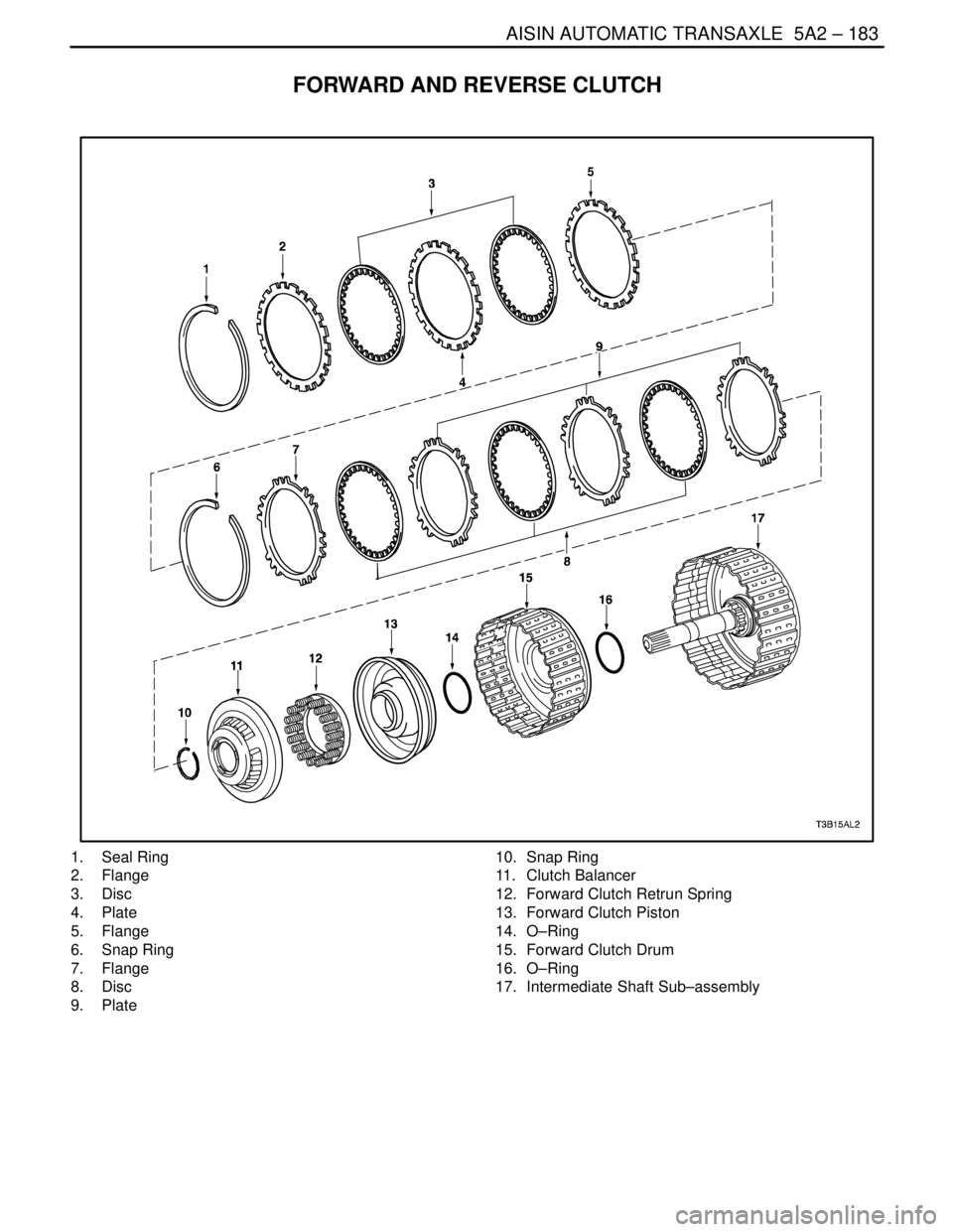
FORWARD AND REVERSE CLUTCH
1. Seal Ring
2. Flange
3. Disc
4. Plate
5. Flange
6. Snap Ring
7. Flange
8. Disc
9. Plate10. Snap Ring
11. Clutch Balancer
12. Forward Clutch Retrun Spring
13. Forward Clutch Piston
14. O–Ring
15. Forward Clutch Drum
16. O–Ring
17. Intermediate Shaft Sub–assembly
Page 1777 of 2643

AISIN AUTOMATIC TRANSAXLE 5A2 – 187
DAEWOO V–121 BL4
15. Using a small screwdriver, remove the O–ring from
the forward clutch drum.
16. Using a small screwdriver, remove the O–ring from
the intermediate shaft sub–assembly.
Inspection Procedure
1. Check to see if the sliding surface of the disc, plate
flange are worn or burnt. If necessary, replace
them.
S If the lining of the disc is peeling off or discol-
ored, or even if a part of the printed number is
defaced, replace all discs.
S Before assembling new discs, soak them in ATF
for at least 15 minutes.
2. Using vernier calipers, measure the free length of
the spring together with the spring seat.
S Standard free length: 24.04 mm (0.9465 in.)
Page 1778 of 2643
5A2 – 188IAISIN AUTOMATIC TRANSAXLE
DAEWOO V–121 BL4
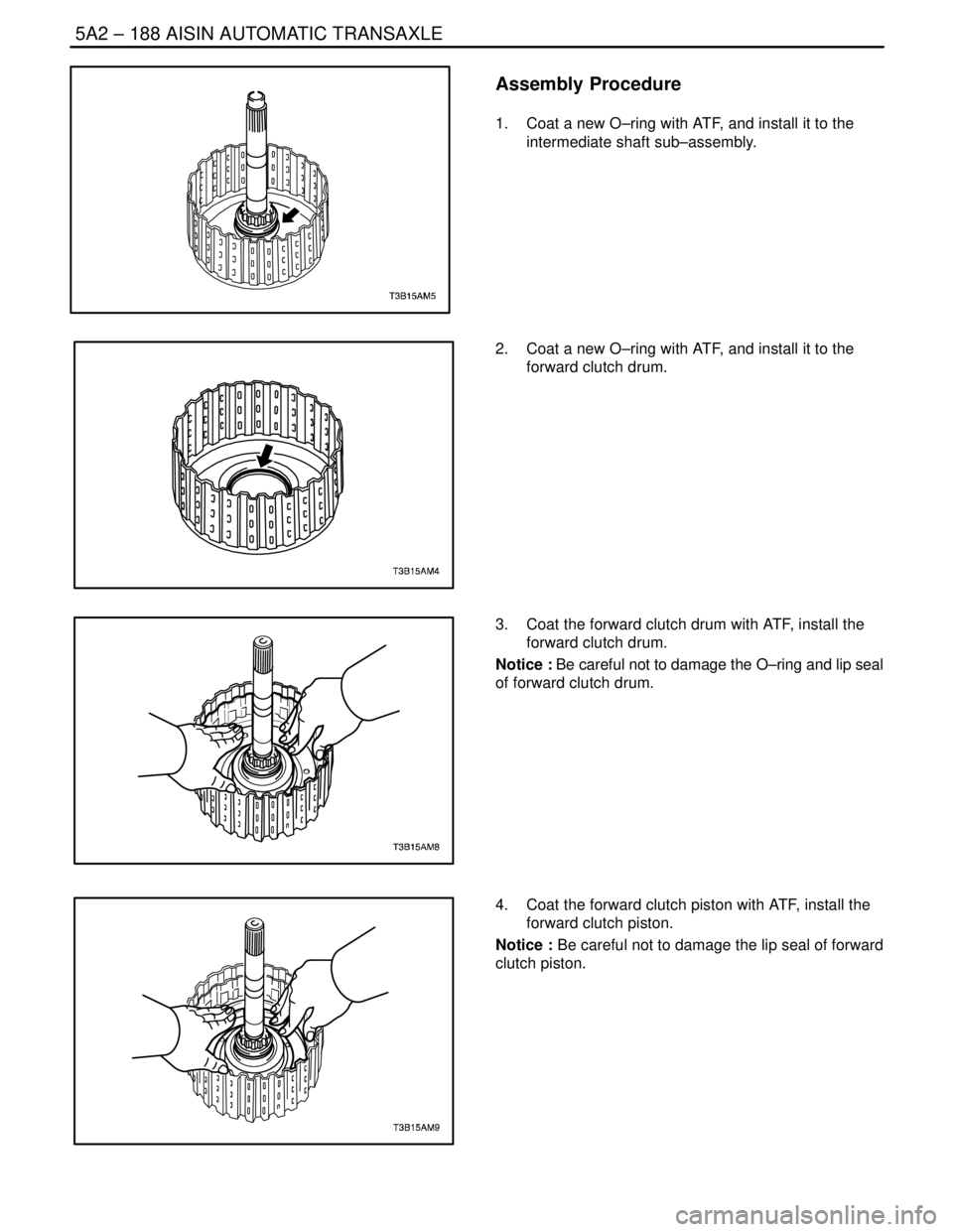
Assembly Procedure
1. Coat a new O–ring with ATF, and install it to the
intermediate shaft sub–assembly.
2. Coat a new O–ring with ATF, and install it to the
forward clutch drum.
3. Coat the forward clutch drum with ATF, install the
forward clutch drum.
Notice : Be careful not to damage the O–ring and lip seal
of forward clutch drum.
4. Coat the forward clutch piston with ATF, install the
forward clutch piston.
Notice : Be careful not to damage the lip seal of forward
clutch piston.
Page 1813 of 2643
AISIN AUTOMATIC TRANSAXLE 5A2 – 223
DAEWOO V–121 BL4
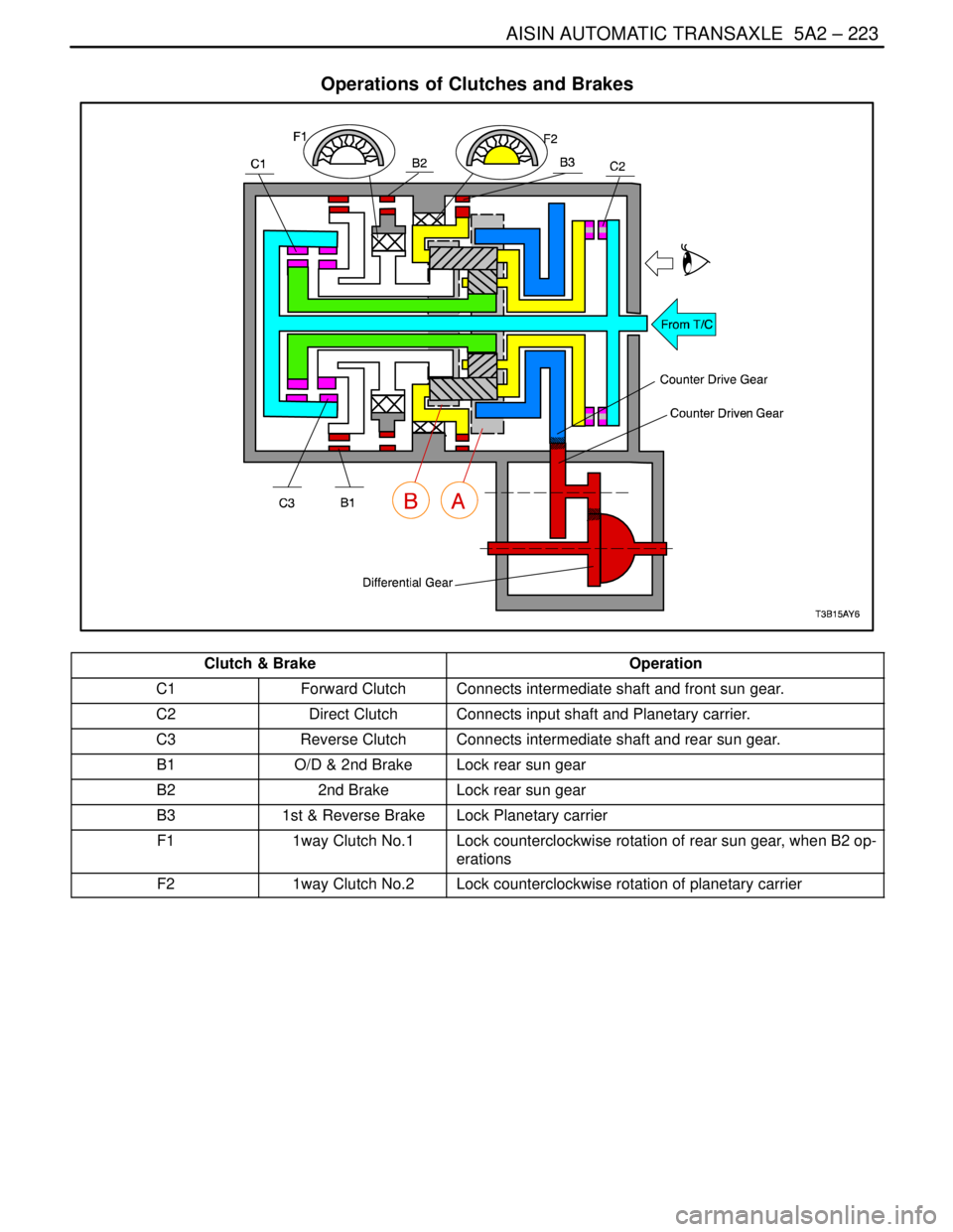
Operations of Clutches and Brakes
Clutch & BrakeOperation
C1Forward ClutchConnects intermediate shaft and front sun gear.
C2Direct ClutchConnects input shaft and Planetary carrier.
C3Reverse ClutchConnects intermediate shaft and rear sun gear.
B1O/D & 2nd BrakeLock rear sun gear
B22nd BrakeLock rear sun gear
B31st & Reverse BrakeLock Planetary carrier
F11way Clutch No.1Lock counterclockwise rotation of rear sun gear, when B2 op-
erations
F21way Clutch No.2Lock counterclockwise rotation of planetary carrier
Page 1834 of 2643

5B – 10IFIVE–SPEED MANUAL TRANSAXLE
DAEWOO V–121 BL4
1. Roller Bearing
2. Transaxle Main Shaft
3. Washer
4. Washer Retaining Ring
5. 4th Speed Gear
6. Needle Cage
7. Synchronizer Ring
8. Shift Sleeve
9. Synchronizer Key
10. 3rd & 4th Synchronizer Spring
11. Washer
12. Circlip
13. 3rd Speed Gear
14. Washer
15. Washer Retaining Ring
16. 2nd Speed Gear
17. Needle Cage
18. Inside Synchronizer Ring
19. Intermediate Ring
20. Outside Synchronizer Ring
21. Sliding Gear
22. 1st & 2nd Synchronizer Key
23. 1st & 2nd Synchronizer Spring
24. Washer
25. Circlip
26. 1st Speed Gear
27. Needle Cage28. Needle Cage
29. Main Shaft Disc
30. Retaining Ring
31. Groove Ball Bearing
32. Washer
33. Retaining Ring
34. 5th Speed Gear
35. Needle Cage
36. Synchronizer Ring
37. 5th Shift Sleeve
38. 5th Synchronizer Spring
39. 5th Synchronizer Key
40. Retaining Ring
41. Needle Sleeve
42. Input Drive Shift
43. Input Shaft Cluster Gear
44. Bolt
45. Retaining Ring
46. Cluster Bearing Ring
47. Groove Ball Bearing
48. Cluster 5th Speed Gear
49. Retaining Ring
50. Washer
51. Reverse Idler Gear
52. Reverse Idler Gear Shaft
53. Ball
Page 1851 of 2643
FIVE–SPEED MANUAL TRANSAXLE 5B – 27
DAEWOO V–121 BL4
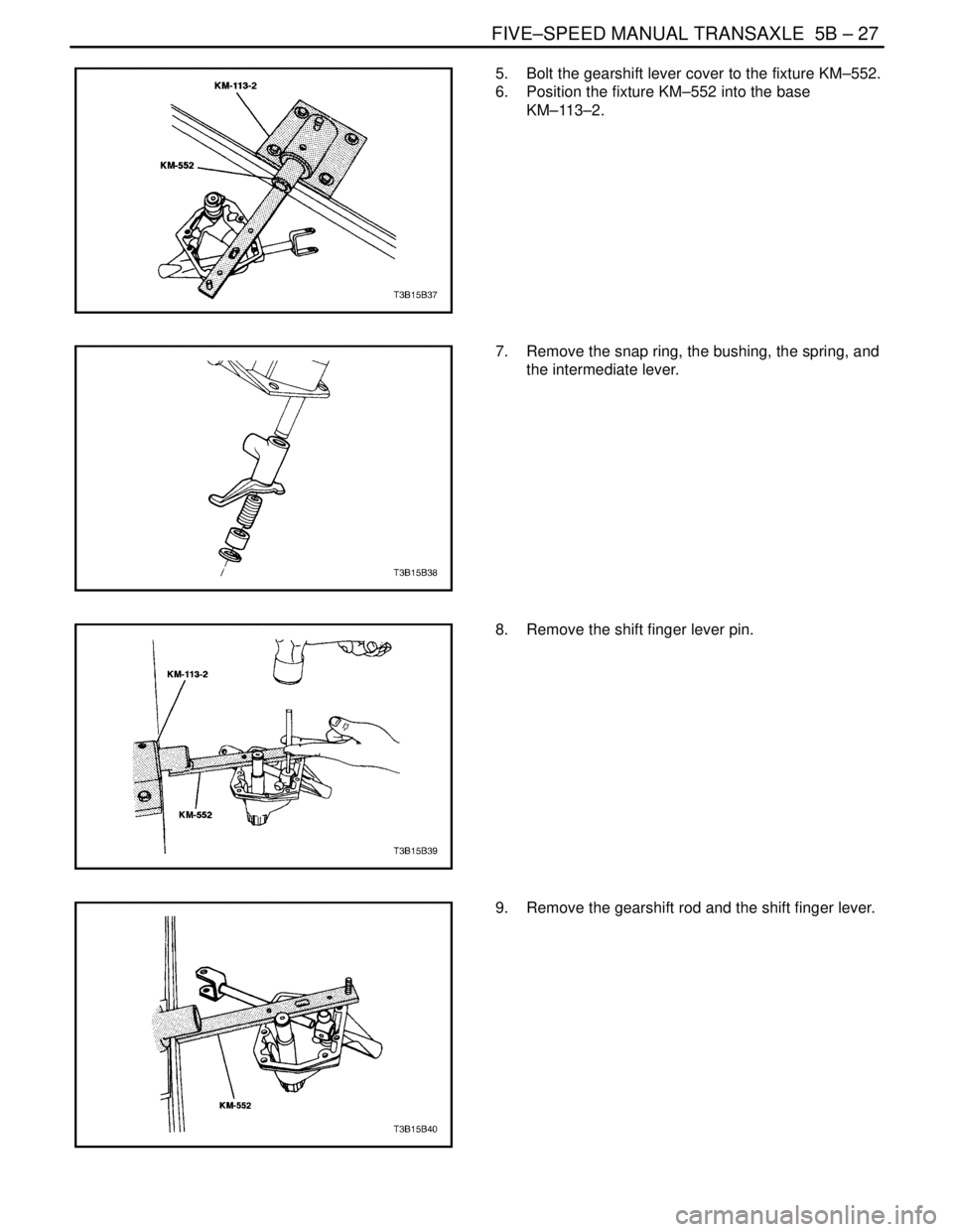
5. Bolt the gearshift lever cover to the fixture KM–552.
6. Position the fixture KM–552 into the base
KM–113–2.
7. Remove the snap ring, the bushing, the spring, and
the intermediate lever.
8. Remove the shift finger lever pin.
9. Remove the gearshift rod and the shift finger lever.
Page 1886 of 2643
5B – 62IFIVE–SPEED MANUAL TRANSAXLE
DAEWOO V–121 BL4
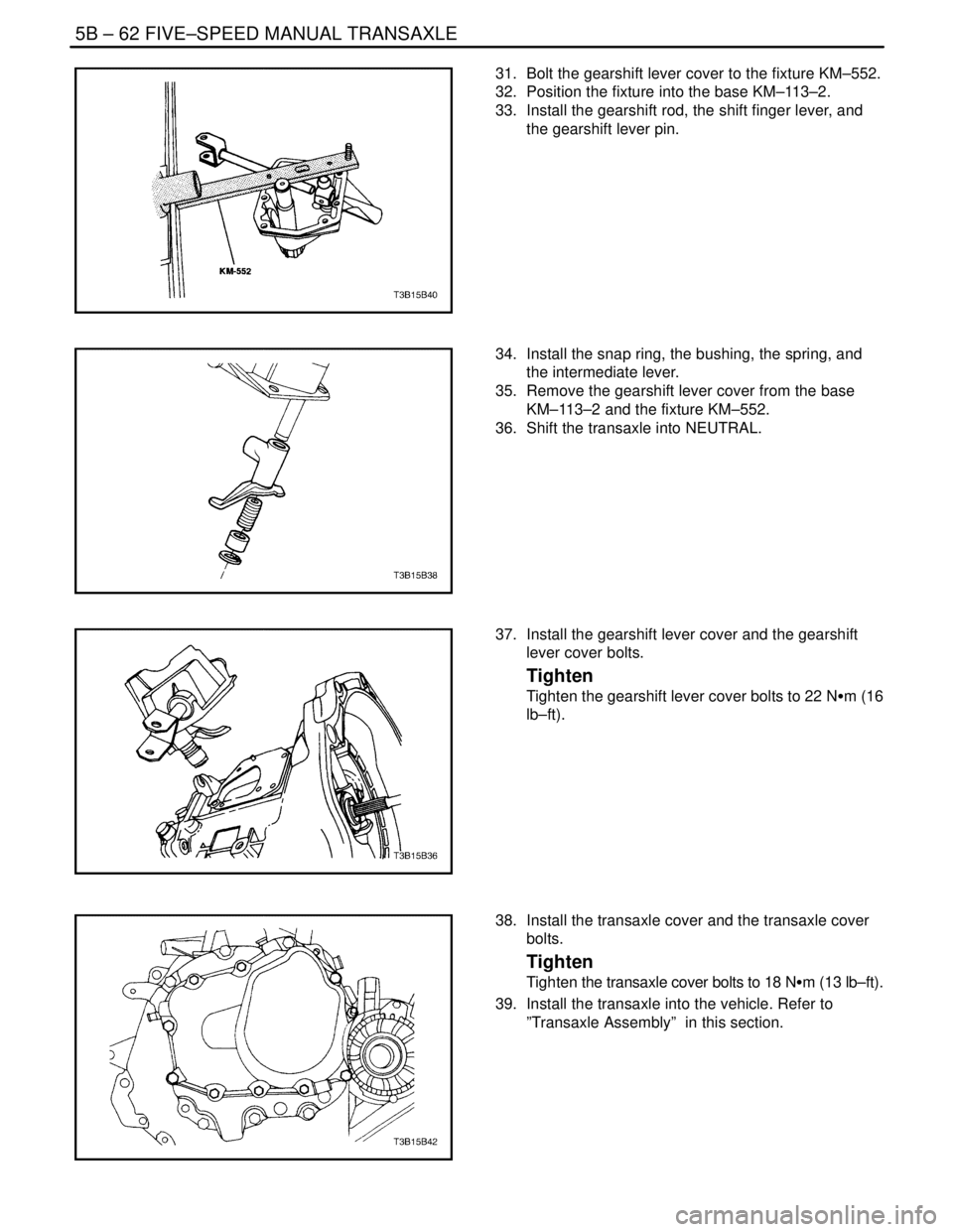
31. Bolt the gearshift lever cover to the fixture KM–552.
32. Position the fixture into the base KM–113–2.
33. Install the gearshift rod, the shift finger lever, and
the gearshift lever pin.
34. Install the snap ring, the bushing, the spring, and
the intermediate lever.
35. Remove the gearshift lever cover from the base
KM–113–2 and the fixture KM–552.
36. Shift the transaxle into NEUTRAL.
37. Install the gearshift lever cover and the gearshift
lever cover bolts.
Tighten
Tighten the gearshift lever cover bolts to 22 NSm (16
lb–ft).
38. Install the transaxle cover and the transaxle cover
bolts.
Tighten
Tighten the transaxle cover bolts to 18 NSm (13 lb–ft).
39. Install the transaxle into the vehicle. Refer to
”Transaxle Assembly” in this section.
Page 1903 of 2643

6A – 2IPOWER STEERING SYSTEM
DAEWOO V–121 BL4
DIAGNOSIS
POWER STEERING SYSTEM
PRESSURE TEST
Tools Required
KM–354–B Pressure Test Gauge Kit
Check the fluid pressure as follows to determine whether
the trouble is in the pump or the gear unit.
Test Procedure
1. Check the power steering fluid level and the power
steering pump belt tension. Refer to ”Checking and
Adding Fluid” in this section and Section 6B, Power
Steering Pump.
2. Disconnect the high pressure line at the pump. Use
a small container to catch any fluid.
3. Connect the hose of the pressure test gauge kit
KM–354–B to the power steering pressure hose
from the power steering pump.
4. Place the gear selector lever in PARK (automatic
transaxle–equipped vehicles) or NEUTRAL (manual
transaxle–equipped vehicles). Set the parking
brake.
5. Open the gauge valve fully.
6. Start the engine and let it idle.
7. Turn the steering wheel from lock to lock several
times to warm the fluid to operating temperature.
8. Increase the engine speed to 1,500 rpm.
Notice : The power steering pump could be damaged if
the valve is fully closed for more than 5 seconds.
9. Close the gauge valve fully, and read the pressure.
The pump pressure with the valve closed should be
between 8,330 kPa to 8,820 kPa (1,208 psi to
1,279 psi). With electronic variable orifice, the pres-
sure should be between 8,500 kPa to 8,960 kPa
(1,233 psi to 1,299 psi).
10. Immediately open the gauge valve fully.
11. Turn the steering wheel all the way to the left and
the right. If the pressure is within the specified lim-
its, the problem is not in the pump. Check the pow-
er steering gear for leaks.
POWER STEERING SYSTEM LEAK
TEST
General Procedure
Inspect the following:
S The fluid reservoir for overfill.
S Fluid for aeration and overflow.
S The hoses for loose connections.
S The torsion bar, stub shaft and adjuster seals for
leaks.
S The component sealing surfaces for damage.
Important : Verify the exact point of the leak. The point
from which the fluid is dripping is not necessarily the point
at which the system is leaking. When service is required,
clean the leak area upon disassembly, replace the leaking
seal, check the component sealing surfaces for damage
and reset the torque bolt to specifications, where required.
External Leak Check
The purpose of this procedure is to pinpoint the location of
the leak. In some cases, the leak can be easily located, but
seepage–type leaks may be harder to find. To locate seep-
age leaks, use the following method:
1. With the engine off, wipe dry the complete power
steering system.
2. Check the power steering fluid level in the pump’s
reservoir. Adjust the fluid level as necessary. Refer
to ”Checking and Adding Fluid” in this section.
Notice : Do not hold the steering wheel at a stop for any
length of time as this can damage the power steering
pump.
3. Start the engine. Turn the steering wheel counter-
clockwise and clockwise from stop to stop several
times.
4. Find the exact area of the leak and repair it.
Page 1907 of 2643
6A – 6IPOWER STEERING SYSTEM
DAEWOO V–121 BL4
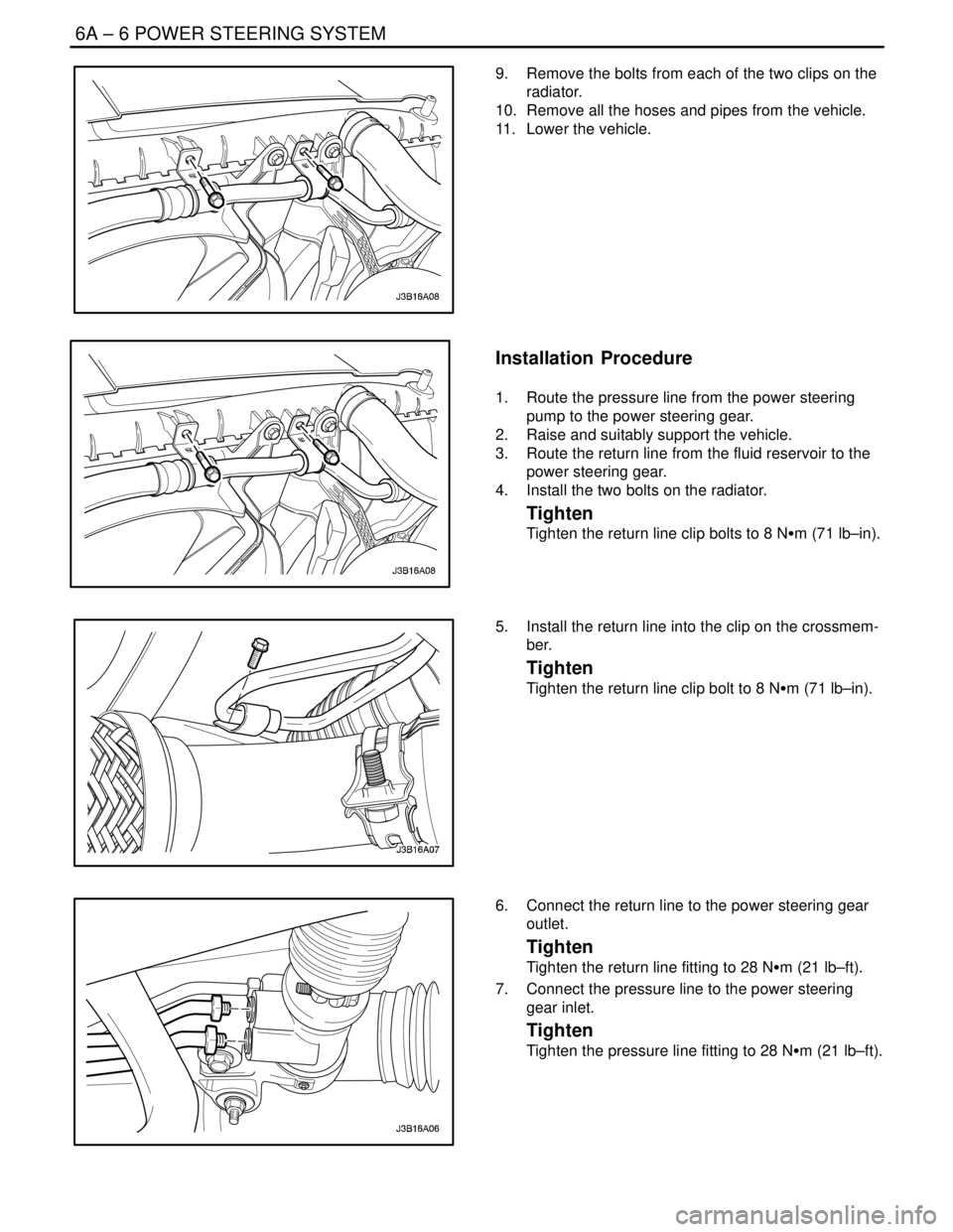
9. Remove the bolts from each of the two clips on the
radiator.
10. Remove all the hoses and pipes from the vehicle.
11. Lower the vehicle.
Installation Procedure
1. Route the pressure line from the power steering
pump to the power steering gear.
2. Raise and suitably support the vehicle.
3. Route the return line from the fluid reservoir to the
power steering gear.
4. Install the two bolts on the radiator.
Tighten
Tighten the return line clip bolts to 8 NSm (71 lb–in).
5. Install the return line into the clip on the crossmem-
ber.
Tighten
Tighten the return line clip bolt to 8 NSm (71 lb–in).
6. Connect the return line to the power steering gear
outlet.
Tighten
Tighten the return line fitting to 28 NSm (21 lb–ft).
7. Connect the pressure line to the power steering
gear inlet.
Tighten
Tighten the pressure line fitting to 28 NSm (21 lb–ft).