Iat DAEWOO LACETTI 2004 Service Repair Manual
[x] Cancel search | Manufacturer: DAEWOO, Model Year: 2004, Model line: LACETTI, Model: DAEWOO LACETTI 2004Pages: 2643, PDF Size: 80.54 MB
Page 1950 of 2643

POWER STEERING GEAR 6C – 33
DAEWOO V–121 BL4
GENERAL DESCRIPTION
AND SYSTEM OPERATION
POWER RACK AND PINION
The power rack and pinion steering system has a rotary
control valve that directs hydraulic fluid coming from the
hydraulic pump to one side or the other side of the rack pis-
ton. The integral rack piston is attached to the rack. The
rack piston converts hydraulic pressure to a linear force
that moves the rack left or right. That force is then trans-
mitted through the tie rods to the steering knuckles, which
turn the wheels.
If power rack and pinion steering is not available, manual
rack and pinion control is used; however, with this system,
more steering effort is required. The movement of the
steering wheel is transferred to the pinion. The rotary
movement of the pinion is then transferred through the pin-
ion threads, which mesh with teeth on the rack, thereby
causing the rack to move in a linear direction.
A vane–type of hydraulic pump provides hydraulic pres-
sure for both steering systems.
SPEED SENSITIVE POWER
STEERING SYSTEM
The speed sensitive power steering (SSPS) system varies
the driver effort required to steer as the vehicle speed
changes. At low speeds, the system provides maximum
power assist for easy turning and parking maneuvers. At
higher speeds, the steering power is reduced to provide
the driver with firmer steering and directional stability. The
SSPS system accomplishes this by reducing the amount
of power steering fluid flow from the power steering pump
to the power steering gear as the vehicle speed increases.
When the vehicle is stationary, the SSPS system provides
maximum fluid flow to the steering gear. As the vehicle
speed increases, the fluid flow to the steering gear is de-
creased.
Control Module
The SSPS control module processes the vehicle speed in-
formation from the engine control module (ECM) and uses
the steering wheel rotation sensor to provide a control sig-
nal to the electronic variable orifice (EVO) actuator located
on the power steering pump.
Electronic Variable Orifice (EVO) Actuator
The electronic variable orifice (EVO) actuator is located on
the power steering pump and contains a solenoid– oper-
ated pintle valve. Fluid leaving the pump passes through
an orifice in the actuator tip. When the EVO actuator is
powered by the SSPS control module, the pintle moves
into the orifice and reduces the power steering fluid flow.As the vehicle speed increases, current from the SSPS
control module increases, and the pintle blocks more and
more of the orifice.
Steering Wheel Rotation Sensor
The steering wheel rotation sensor is located at the end of
the steering column housing and is used to send a signal
to the controller when abrupt or evasive steering maneu-
vers are needed.
Power Steering Pressure Hose
SSPS vehicles have a specific pressure hose assembly
which includes an in–line check valve in the rack and pin-
ion assembly. This reduces the amount of steering wheel
”kick” when driving over irregular road surfaces while oper-
ating at speeds with reduced flow rate and pressure.
Power Rack and Pinion
Except for differences in valve machining, the design of
the SSPS power rack and pinion assembly is the same as
for the a non–SSPS system. The steering wheel move-
ment is transferred to the pinion via the intermediate shaft.
The pinion moves the rack left or right through meshing the
pinion and the rack teeth. The force is then transmitted
through the tie rods and steering knuckle to steer the
wheels.
The power rack and pinion steering system has a rotary
control valve which directs the hydraulic fluid from the
power steering pump to one side or the other side of the
rack piston. The piston is attached to the rack and uses hy-
draulic pressure to move the rack left or right. The rotary
control valve regulates the degree of assist by responding
to the driver’s torque input.
If hydraulic assist is not available, manual control is main-
tained. However, under this condition, more steering effort
is required.
Power Steering Pump
The standard vane–type pump, which provides hydraulic
pressure for the system, incorporates a special discharge
fitting to hold the EVO actuator.
System Operation
System operation originates with input from the vehicle
speed sensor via the engine control module to the SSPS
control module. The SSPS control module sends a signal
to the SSPS actuator to vary the rate of fluid flow output
by the power steering pump.
Circuit Operation
The SSPS system uses inputs from the speed sensor and
steering wheel rotation sensor to the SSPS controller to
determine the desired amount of power steering assist.
The SSPS control module constantly compares the
amount of current flowing through the EVO actuator to the
desired current it has calculated. The EVO actuator has a
pintle that moves in and out of an orifice, regulating power
Page 1964 of 2643
6E – 10ISTEERING WHEEL AND COLUMN
DAEWOO V–121 BL4
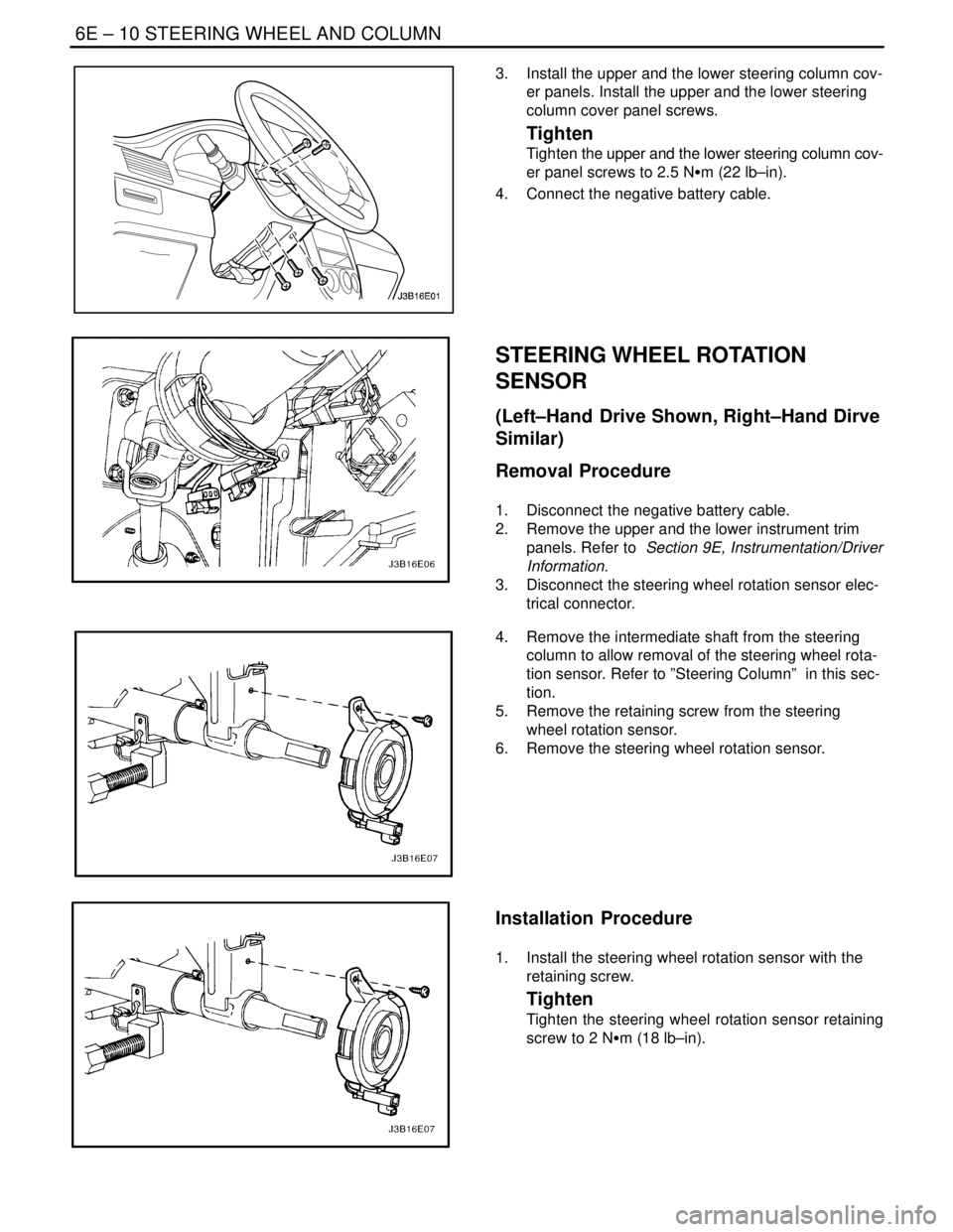
3. Install the upper and the lower steering column cov-
er panels. Install the upper and the lower steering
column cover panel screws.
Tighten
Tighten the upper and the lower steering column cov-
er panel screws to 2.5 NSm (22 lb–in).
4. Connect the negative battery cable.
STEERING WHEEL ROTATION
SENSOR
(Left–Hand Drive Shown, Right–Hand Dirve
Similar)
Removal Procedure
1. Disconnect the negative battery cable.
2. Remove the upper and the lower instrument trim
panels. Refer to Section 9E, Instrumentation/Driver
Information.
3. Disconnect the steering wheel rotation sensor elec-
trical connector.
4. Remove the intermediate shaft from the steering
column to allow removal of the steering wheel rota-
tion sensor. Refer to ”Steering Column” in this sec-
tion.
5. Remove the retaining screw from the steering
wheel rotation sensor.
6. Remove the steering wheel rotation sensor.
Installation Procedure
1. Install the steering wheel rotation sensor with the
retaining screw.
Tighten
Tighten the steering wheel rotation sensor retaining
screw to 2 NSm (18 lb–in).
Page 1965 of 2643
STEERING WHEEL AND COLUMN 6E – 11
DAEWOO V–121 BL4
2. Install the intermediate shaft onto the steering col-
umn. Refer to ”Steering Column” in this section.
3. Connect the steering wheel rotation sensor electri-
cal connector.
4. Install the upper and the lower instrument trim pan-
els. Refer to Section 9E, Instrumentation/Driver
Information.
5. Connect the negative battery cable.
STEERING WHEEL WITHOUT SIR
Tools Required
KM–210–A Steering Wheel Puller
Removal Procedure
1. Disconnect the negative battery cable.
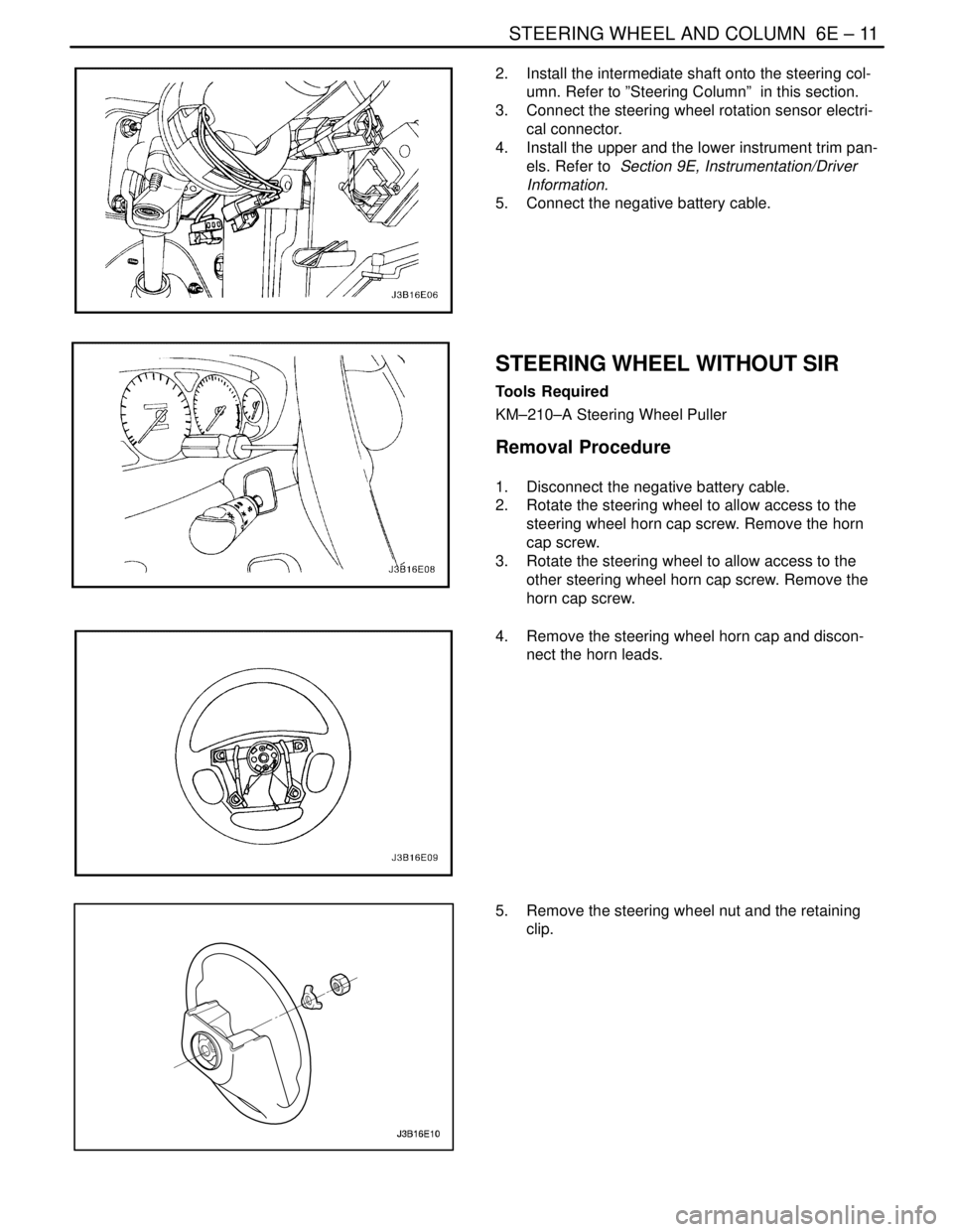
2. Rotate the steering wheel to allow access to the
steering wheel horn cap screw. Remove the horn
cap screw.
3. Rotate the steering wheel to allow access to the
other steering wheel horn cap screw. Remove the
horn cap screw.
4. Remove the steering wheel horn cap and discon-
nect the horn leads.
5. Remove the steering wheel nut and the retaining
clip.
Page 1970 of 2643
6E – 16ISTEERING WHEEL AND COLUMN
DAEWOO V–121 BL4
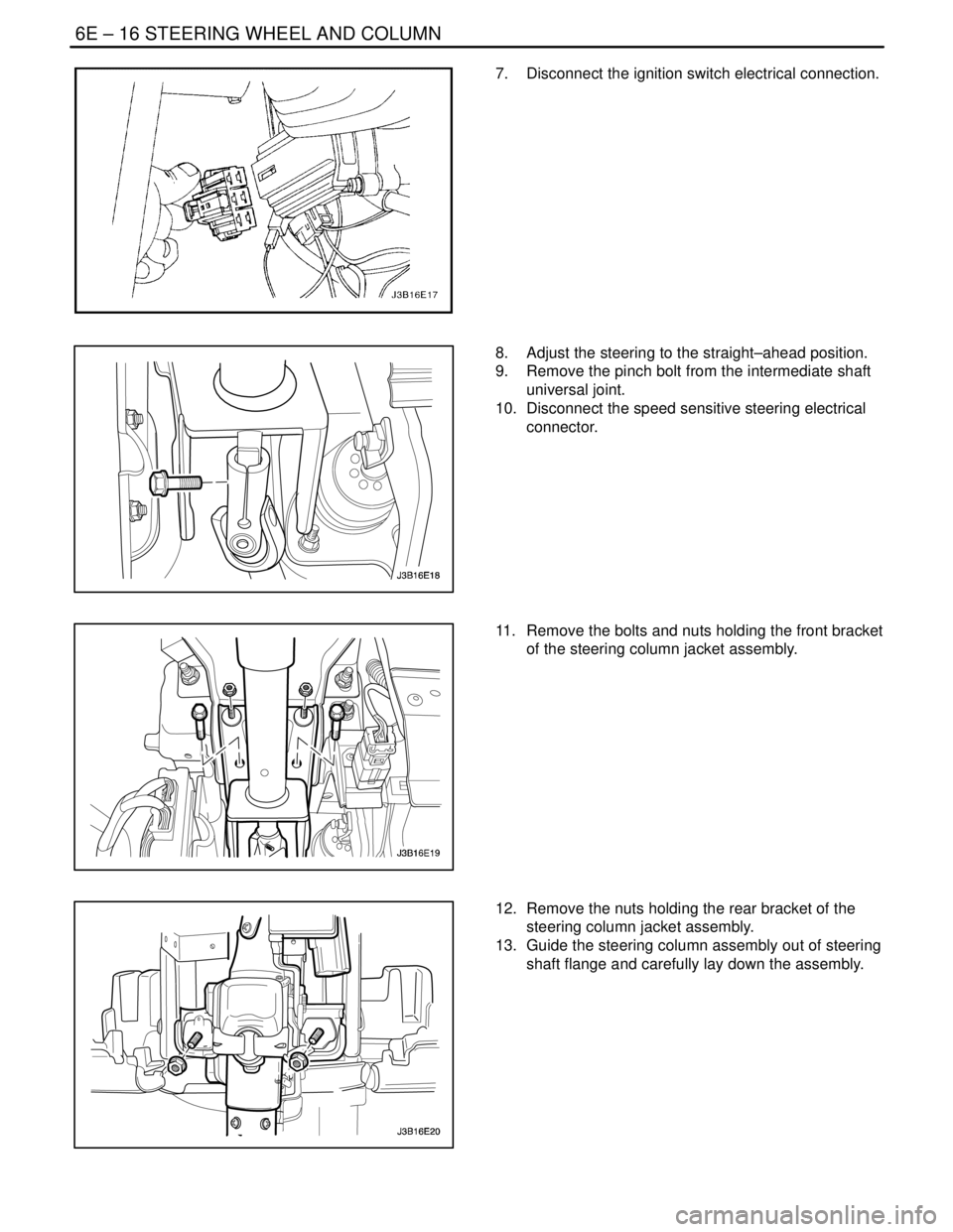
7. Disconnect the ignition switch electrical connection.
8. Adjust the steering to the straight–ahead position.
9. Remove the pinch bolt from the intermediate shaft
universal joint.
10. Disconnect the speed sensitive steering electrical
connector.
11. Remove the bolts and nuts holding the front bracket
of the steering column jacket assembly.
12. Remove the nuts holding the rear bracket of the
steering column jacket assembly.
13. Guide the steering column assembly out of steering
shaft flange and carefully lay down the assembly.
Page 2010 of 2643

7B – 8IMANUAL CONTROL HEATING, VENTILATION AND AIR CONDITIONING SYSTEM
DAEWOO V–121 BL4
DIAGNOSIS
GENERAL DIAGNOSIS
TESTING THE REFRIGERANT
SYSTEM
If you suspect a problem in the refrigerant system, check
for the following conditions:
1. Check the outer surfaces of the radiator and the
condenser cores to be sure that the airflow is not
blocked by dirt, leaves, or other foreign material.
Check between the condenser and the radiator, as
well as all outer surfaces.
2. Check for restrictions or kinks in the condenser
core, the hoses, and the tubes.
3. Check the operation of the blower fan.
4. Check all the air ducts for leaks or restrictions. Low
airflow rate may indicate a restricted evaporator
core.
5. Check for slippage of the compressor clutch.
6. Check the drive belt tension.
INSUFFICIENT COOLING ”QUICK
CHECK” PROCEDURE
Perform the following ”hand–feel” procedure to get a quick
idea of whether the A/C system has the proper charge of
Refrigerant–134a. The air temperature must be above
21°C (70°F) for most models.
1. Warm up engine. Run the engine at idle.
2. Open the hood and all the doors.
3. Turn the A/C switch ON.
4. Set the temperature control to the full cold position.
5. Set the blower speed switch on the maximum
speed setting.
6. ”Hand–feel” the temperature of the evaporator out-
let pipe. The pipe should be cold.
7. Check for other problems. Refer to ”Testing the Re-
frigerant System” in this section.
8. Leak check the system. Refer to ”Leak Testing the
Refrigerant System” in this section. If you find a
leak, discharge the system and repair the leak as
required. After completing the repair, evacuate the
system and charge it.
9. If there is no leak, refer to ”Insufficient Cooling
Diagnosis” in this section.
Page 2018 of 2643

7B – 16IMANUAL CONTROL HEATING, VENTILATION AND AIR CONDITIONING SYSTEM
DAEWOO V–121 BL4
SYMPTOM DIAGNOSIS
PRESSURE TEST CHART (R–134A SYSTEM)
Test ResultsRelated SymptiomsProbable CauseRemedy
Discharge (high)
pressure abnormally
highAfter stopping the compres-
sor, the pressure drops
about 299 kPa (28 psig)
quickly, then falls gradually.Air in the system.Recover, evacuate and re-
charge the system with the
specified amount of refrig-
erant.
The condenser is exces-
sively hot.Excessive refrigerant in the sys-
tem.Recover, evacuate and re-
charge the system with the
specified amount of refrig-
erant.
Reduced or no airflow
through the condenser.Condenser or the radiator fins are
clogged.Clean the condenser or the
radiator fins.
Condenser or the radiator fan is
not working properly.Check the voltage and the
fan rpm.
Check the fan direction.
Line to the condenser is ex-
cessively hot.Restricted flow of refrigerant in
the system.Locate and repair the re-
striction.
Discharge pressure
abnormally lowThe condenser is not hot.Insufficient refrigerant in the sys-
tem.Check the system for a
leak.
Charge the system.
High and low pressures are
balanced soon after stop-
ping the compressor.Faulty compressor pressure relief
valve.Repair or replace the com-
pressor.
Low–side pressure is high-
er than normal.Faulty compressor seal.
The outlet of the expansion
valve is not frosted.Faulty expansion valve.Replace the expansion
valve.
Low pressure gauge indi-
cates vacuum.Moisture in the system.Recover, evacuate, and re-
charge the system.
Suction (low) pres-
sure abnormally lowCondenser is not hot.Insufficient refrigerant in the sys-
tem.Repair the leaks.
Recover, evacuate, and re-
charge the system.
The expansion valve is not
frosted and the lowpressure
line is not cold.Faulty expansion valve.Replace the expansion
valve.
Low–Pressure gauge indi-
cates a vacuum.Frozen expansion valve.
Discharge temperature is
low and the airflow from the
vents is restricted.Evaporator is frozen.Clear the restricted evapo-
rator case drain.
The expansion valve is
frosted.Expansion valve is clogged.Clean or replace the expan-
sion valve.
The receiver–dryer outlet is
cool and the inlet is warm.Receiver–dryer is clogged.Replace the receiver–dryer.
Suction pressure ab-
normally highLow–pressure hose and
check joint are cooler than
the temperature around the
evaporator.Expansion valve is opened for too
long.Replace the expansion
valve.
Capillary tube is loose.
Page 2019 of 2643

MANUAL CONTROL HEATING, VENTILATION AND AIR CONDITIONING SYSTEM 7B – 17
DAEWOO V–121 BL4
Test ResultsRemedy Probable Cause Related Symptioms
Suction pressure ab-
normally highSuction pressure is lowered
when the condenser is
cooled by water.Excessive refrigerant in the sys-
tem.Recover, evacuate, and re-
charge the system.
High and low pressure are
equalized as soon as the
compressor is stopped and
both gauges fluctuate while
the compressor is running.Faulty gasket.Repair or replace the com-
pressor.
Faulty high–pressure valve. (V5
compressor only)
Foreign particles stuck in the
high–pressure valve. (V5 com-
pressor only)
Suction and dis-
charge pressure ab-
ll hi h
Reduced airflow through
the condenser.Clogged condenser or radiator
fins.Clean the condenser and
the radiator.
g
normally highRadiator cooling fans working im-
properly.Check the voltage and the
radiator cooling fan rpm.
Check the fan direction.
Condenser is excessively
hot.Excessive refrigerant in the sys-
tem.Recover, evacuate, and re-
charge the system.
Suction and dis-
charge pressure ab-
normally lowLow–pressure hose and
metal end areas are cooler
than the evaporator.Clogged or kinked low–pressure
hose.Repair or replace the low–
pressure hose.
Temperature around the ex-
pansion valve is low
compared to that around
the receiver–dryer.Clogged high–pressure line.Repair or replace the high–
pressure line.
Refrigerant leaksThe compressor clutch is
dirty.Leaking compressor shaft seal.Repair or replace the com-
pressor.
The compressor bolts are
dirty.Leaking around a compressor
housing bolt.Tighten the bolt(s) or re-
place the compressor.
The compressor gasket is
wet with oil.Leaking compressor gasket.Repair or replace the com-
pressor.
Page 2021 of 2643

MANUAL CONTROL HEATING, VENTILATION AND AIR CONDITIONING SYSTEM 7B – 19
DAEWOO V–121 BL4
MAINTENANCE AND REPAIR
ON–VEHICLE SERVICE
GENERAL A/C SYSTEM SERVICE PROCEDURES
O–RING REPLACEMENT
Important : Even though O–rings may look identical, it is
extremely important that only recommended service re-
placement air conditioning O–rings be used or excessive
leakage of refrigerant may occur.
Important : Always slip the O–ring onto the flange tube to
ensure proper locating and sealing.
Install new Daewoo–approved service replacement air
conditioning (A/C) O–rings whenever a joint or a fitting is
disassembled, except when the O–rings are provided on
new components.
When replacing O–rings on an A/C component or a joint
connection, the fitting design should be identified to en-
sure installation of the correct air conditioning service re-
placement O–ring. Some joint connections and compo-
nents will implement a ”captured” O–ring design fitting that
uses a groove to retain the O–ring. Others do not have a
groove and use a ”non–captured” or ”standard” O–ring.
Assembly and tightening procedures are the same for
both designs, but the O–rings are different.
Notice : Before installation, verify that both O–rings and
fittings have not been nicked or deformed. Deformed or
nicked parts must be replaced. Failure to use the proper
service replacement parts and procedures may result in
excessive refrigerant leakage.
HANDLING REFRIGERANT
CAUTION : Always work in a well–ventilated area and
avoid breathing any refrigerant fumes. If you have dif-
ficulty with breathing, seek medical attention immedi-
ately. If refrigerant comes in contact with any part of
your body, flush the exposed area with water. If a rash
or pain develops, seek medical attention.
Air conditioning systems contain refrigerant. This is a
chemical mixture which requires special handling proce-
dures to avoid personal injury.
Always wear goggles and wrap a clean cloth around the
fittings, the valves and the connections when performing
work that involves opening the refrigerant system. Do not
weld or steam clean on or near any vehicle–installed air
conditioning lines or components.
All refrigerant drums are shipped with a heavy metal screw
cap. The purpose of the cap is to protect the valve and the
safety plug from damage. It is good practice to replace the
cap after each use of the drum.If it is necessary to transport or carry any container of re-
frigerant in a vehicle, do not carry it in the passenger
compartment.
HANDLING OF REFRIGERANT LINES
AND FITTINGS
Notice : Using too low or too high torque when tightening
a fitting can result in loose joints or deformed joint parts.
Both conditions can result in refrigerant leakage.
S Keep all metal tubing lines free of dents or kinks.
Any line restrictions will cause the loss of system
capacity.
S Never bend a flexible hose line to a radius of less
than four times the diameter of the hose.
S Never allow a flexible hose line to come within 65
mm (2–1/2 inches) of the exhaust manifold.
S Inspect flexible hose lines regularly for leaks or
brittleness.
S Replace flexible hose lines with new lines if you find
signs of deterioration or leaking.
S Discharge all refrigerant of the refrigeration system
before disconnecting any fitting in the refrigeration
system.
S Proceed very cautiously regardless of the gauge
readings.
CAUTION : Keep your face and your hands away from
the fitting so that you will not be injured if there hap-
pens to be liquid refrigerant in the line.
S Open the fittings very slowly.
S If you notice pressure when you loosen a fitting,
allow the pressure to bleed off as described under
”Discharging, Adding Oil, Evacuating, and Charging
Procedures for A/C System” in this section.
S Cap or tape any refrigerant line immediately after it
is opened. This will prevent the entrance of mois-
ture and dirt, which can cause internal compressor
wear or plugged lines in the condenser, the evapo-
rator core, the expansion valve, or the compressor
inlet screens.
Important : Use two proper wrenches to connect the O–
ring fittings.
S Back up the opposing fitting to prevent distortion of
the connecting lines or the components.
S Back up both the swagged fitting on the flexible
hose connections and the coupling to which it is
attached with two wrenches to prevent turning the
fitting and damaging the ground seat.
S Keep the O–rings and the seats in perfect condi-
tion. A burr or a piece of dirt may cause a refriger-
ant leak.
Page 2053 of 2643

MANUAL CONTROL HEATING, VENTILATION AND AIR CONDITIONING SYSTEM 7B – 51
DAEWOO V–121 BL4
GENERAL DESCRIPTION
AND SYSTEM OPERATION
GENERAL INFORMATION
THE V5 A/C SYSTEM
The V5 variable displacement compressor along with the
thermal expansion valve on the evaporator, constitutes a
largely self–regulating system. There is no pressure cycl-
ing switch, no high–pressure cut–off switch and no low–
pressure cut–off switch. The compressor clutch is con-
trolled by the electronic control module (ECM), which
receives data from various engine systems and from a
pressure transducer located in the high–pressure refriger-
ant pipe. In normal operation, the clutch is engaged contin-
uously. Should one of the monitored conditions become
abnormal, the ECM will disengage the compressor clutch
until normal operation is restored. These conditions in-
clude the following:
S Wide–open throttle.
S High engine coolant temperature.
S High engine RPM.
S Refrigerant low pressure.
S Refrigerant high pressure.
The compressor clutch will remain disengaged until nor-
mal operation is established.
SYSTEM
COMPONENTS–FUNCTIONAL
Compressor
All compressors are belt–driven from the engine crank-
shaft through the compressor clutch pulley. The compres-
sor pulley rotates without driving the compressor shaft un-
til an electromagnetic clutch coil is energized. When
voltage is applied to energize the clutch coil, the clutch
plate and hub assembly is drawn rearward toward the
pulley. The magnetic force locks the clutch plate and
pulley together as one unit to drive the compressor shaft.
As the compressor shaft is driven, it compresses the low–
pressure refrigerant vapor from the evaporator into a
high–pressure, high–temperature vapor. The refrigerant
oil which is used to lubricate the compressor is carried with
the refrigerant. Refer to ”V5 Air Conditioning Compressor
Overhaul” in this section.
Condenser Core
The condenser assembly in front of the radiator consists
of coils which carry the refrigerant, and cooling fins that
provide the rapid transfer of heat. The air passing through
the condenser cools the high–pressure refrigerant vapor
and causes it to condense into a liquid.
Expansion Valve
The expansion valve is located with the evaporator core,
on the front passenger side fire wall.
The expansion valve can fail in three different positions:
open, closed, or restricted.
An expansion valve that fails in the open position will result
in a noisy A/C compressor or no cooling. The cause can
be a broken spring, a broken ball, or excessive moisture
in the A/C system. If the spring or the ball are found to be
defective, replace the expansion valve. If excessive mois-
ture is found in the A/C system, recycle the refrigerant.
An expansion valve that fails in the closed position will re-
sult in low suction pressure and no cooling. This may be
caused by a failed power dome or excessive moisture in
the A/C system. If the power dome on the expansion valve
is found to be defective, replace the expansion valve. If ex-
cessive moisture is found in the A/C system, recycle the
refrigerant.
A restricted expansion valve will result in low suction pres-
sure and no cooling. This may be caused by debris in the
refrigerant system. If debris is believed to be the cause, re-
cycle the refrigerant, replace the expansion valve, and re-
place the receiver–dryer.
Evaporator Core
The evaporator is a device which cools and dehumidifies
the air before it enters the vehicle. High–pressure liquid re-
frigerant flows through the expansion tube orifice and be-
comes a low–pressure gas in the evaporator. The heat in
the air passing through the evaporator core is transferred
to the cooler surface of the core, which cools the air. As the
process of heat transfer from the air to the evaporator core
surface is taking place, any moisture or humidity in the air
condenses on the outside surface of the evaporator core
and is drained off as water.
Receiver–Dryer
The sealed receiver–dryer assembly is connected to the
condenser outlet pipe. It acts as a refrigerant storing con-
tainer, receiving liquid, vapor, and refrigerant oil from the
evaporator.
At the bottom of the receiver–dryer is the desiccant, which
acts as a drying agent for the moisture that may have en-
tered the system. An oil bleed hole is located near the bot-
tom of the receiver–dryer outlet pipe to provide an oil re-
turn path to the compressor. The receiver–dryer is
serviceable only as an assembly.
Heater Core
The heater core heats the air before it enters the vehicle.
Engine coolant is circulated through the core to heat the
outside air passing over the fins of the core. The core is
functional at all times and may be used to temper condi-
tioned air in the A/C mode as well as in the heat or the vent
modes.
Page 2073 of 2643

7D – 18IAUTOMATIC TEMPERATURE CONTROL HEATING, VENTILATION, AND AIR CONDITIONING SYSTEM
DAEWOO V–121 BL4
DIAGNOSTIC TROUBLE CODES
CODE 1 – IN–CAR SENSOR ERROR
This code will set if the output of the in–car sensor indicates a probable short circuit or an open in the sensor or the associat-
ed wiring harness, or a malfunction of the ATC controller.
Code 1 – In–Car Sensor Error
StepActionValue(s)YesNo
11. Disconnect the in–car sensor connector from
the ATC controller.
2. Examine the wiring from the sensor to the con-
nector and the connector for any signs of dam-
age.
3. Measure the resistance between the in–car
sensor connector terminals.
Is there any sign of damage in the wiring or connec-
tor, or is the resistance outside the specified value
at 20 to 25°C (68 to 77°F)?2600–2100 ΩGo to Step 2Go to Step 3
2Repair the damaged wiring or the connector, or re-
place the in–car sensor as required.
Is the repair complete?–System OK–
31. Turn the ignition to ON.
2. Measure the voltage between the two connec-
tor terminals on the controller housing.
Is the voltage equal to the value specified?> 4 vGo to Step 7Go to Step 4
4Check the terminals on the in–car sensor connector.
Is any problem found with the connector?–Go to Step 5Go to Step 6
5Repair the connector terminals or replace the in–car
sensor or ATC controller as required.
Is the repair complete?–System OK–