Temperature DAEWOO NUBIRA 2004 Service Repair Manual
[x] Cancel search | Manufacturer: DAEWOO, Model Year: 2004, Model line: NUBIRA, Model: DAEWOO NUBIRA 2004Pages: 2643, PDF Size: 80.54 MB
Page 1531 of 2643

5A1 – 182IZF 4 HP 16 AUTOMATIC TRANSAXLE
DAEWOO V–121 BL4
RangePark/
Neutr
alRever
seD321
GearNR1st2nd3rd4th1st2nd3rd1st2nd1st
Solenoid Valve
1ONON/
OFFON/
OFFON/
OFFON/
OFFON/
OFFON/
OFFON/
OFFON/
OFFON/
OFFON/
OFFON/
OFF
Solenoid Valve
2ONONONOFFOFFOFFONOFFOFFONOFFON
Line Pressure
Control Sole-
noid Valve 3
(EDS 3)OFFOFFOFFONON/
OFFON/
OFFOFFONON/
OFFOFFONOFF
Line Pressure
Control Sole-
noid Valve 4
(EDS 4)ONOFFONONONOFFONONONONONON
Line Pressure
Control Sole-
noid Valve 5
(EDS 5)OFFOFFONONOFFOFFONONOFFONONON
Line Pressure
Control Sole-
noid Valve 6
(EDS 6)ONOFFONONONOFFONONONONONON
Brake BAAAAAAAA
Brake CH
Brake DH
Clutch EAAAAAA
Brake FHHHHHHH
Lock–up
ClutchA
A = Applied
H = Holding
ON = The solenoid is energized.
OFF = The solenoid is de–energized.
** = Manual Second–Third gear is only available above approximately 100 km/h (62 mph).
*** = Manual First–Second gear is only available above approximately 60 km/h (37 mph).
Note : Manual First–Third gear is also possible at high vehicle speed as a safety feature.
DIAGNOSTIC TROUBLE CODE(DTC) P1883
3–2 SHIFT MALFUNCTION
Circuit Description
The special feature of 4HP 16 Auto Transaxle is that it op-
erates without freewheels. Shifting between individual
gears takes place by means of overlapping clutch engage-
ment and release.
The advantage of overlap shifting are as follows:
– The transaxle can be of more compact design
and is lighter on account of the absence of free-
wheels and the lower number of shift elements.– Lower drag losses, i.e. higher efficiency.
– Lower peak torque acting on the components and
driveline.
However, overlap shifting necessitates high–performance
hardware and software, and precision engine signals.
Conditions for Setting the DTC
S Transmission oil temperature is greater than –10°C
(14°F).
S Selector lever is not in N(Neutral), P(Park) position.
S System voltage is greater than 9 volts.
Page 1533 of 2643

5A1 – 184IZF 4 HP 16 AUTOMATIC TRANSAXLE
DAEWOO V–121 BL4
RangePark/
Neutr
alRever
seD321
GearNR1st2nd3rd4th1st2nd3rd1st2nd1st
Solenoid Valve
1ONON/
OFFON/
OFFON/
OFFON/
OFFON/
OFFON/
OFFON/
OFFON/
OFFON/
OFFON/
OFFON/
OFF
Solenoid Valve
2ONONONOFFOFFOFFONOFFOFFONOFFON
Line Pressure
Control Sole-
noid Valve 3
(EDS 3)OFFOFFOFFONON/
OFFON/
OFFOFFONON/
OFFOFFONOFF
Line Pressure
Control Sole-
noid Valve 4
(EDS 4)ONOFFONONONOFFONONONONONON
Line Pressure
Control Sole-
noid Valve 5
(EDS 5)OFFOFFONONOFFOFFONONOFFONONON
Line Pressure
Control Sole-
noid Valve 6
(EDS 6)ONOFFONONONOFFONONONONONON
Brake BAAAAAAAA
Brake CH
Brake DH
Clutch EAAAAAA
Brake FHHHHHHH
Lock–up
ClutchA
A = Applied
H = Holding
ON = The solenoid is energized.
OFF = The solenoid is de–energized.
** = Manual Second–Third gear is only available above approximately 100 km/h (62 mph).
*** = Manual First–Second gear is only available above approximately 60 km/h (37 mph).
Note : Manual First–Third gear is also possible at high vehicle speed as a safety feature.
DIAGNOSTIC TROUBLE CODE(DTC) P1884
4–3 SHIFT MALFUNCTION
Circuit Description
The special feature of 4HP 16 Auto Transaxle is that it op-
erates without freewheels. Shifting between individual
gears takes place by means of overlapping clutch engage-
ment and release.
The advantage of overlap shifting are as follows:
– The transaxle can be of more compact design
and is lighter on account of the absence of free-
wheels and the lower number of shift elements.– Lower drag losses, i.e. higher efficiency.
– Lower peak torque acting on the components and
driveline.
However, overlap shifting necessitates high–performance
hardware and software, and precision engine signals.
Conditions for Setting the DTC
S Transmission oil temperature is greater than –10°C
(14°F).
S Selector lever is not in N(Neutral), P(Park) position.
S System voltage is greater than 9 volts.
Page 1535 of 2643

5A1 – 186IZF 4 HP 16 AUTOMATIC TRANSAXLE
DAEWOO V–121 BL4
RangePark/
Neutr
alRever
seD321
GearNR1st2nd3rd4th1st2nd3rd1st2nd1st
Solenoid Valve
1ONON/
OFFON/
OFFON/
OFFON/
OFFON/
OFFON/
OFFON/
OFFON/
OFFON/
OFFON/
OFFON/
OFF
Solenoid Valve
2ONONONOFFOFFOFFONOFFOFFONOFFON
Line Pressure
Control Sole-
noid Valve 3
(EDS 3)OFFOFFOFFONON/
OFFON/
OFFOFFONON/
OFFOFFONOFF
Line Pressure
Control Sole-
noid Valve 4
(EDS 4)ONOFFONONONOFFONONONONONON
Line Pressure
Control Sole-
noid Valve 5
(EDS 5)OFFOFFONONOFFOFFONONOFFONONON
Line Pressure
Control Sole-
noid Valve 6
(EDS 6)ONOFFONONONOFFONONONONONON
Brake BAAAAAAAA
Brake CH
Brake DH
Clutch EAAAAAA
Brake FHHHHHHH
Lock–up
ClutchA
A = Applied
H = Holding
ON = The solenoid is energized.
OFF = The solenoid is de–energized.
** = Manual Second–Third gear is only available above approximately 100 km/h (62 mph).
*** = Manual First–Second gear is only available above approximately 60 km/h (37 mph).
Note : Manual First–Third gear is also possible at high vehicle speed as a safety feature.
DIAGNOSTIC TROUBLE CODE(DTC) P1885
3–1 SHIFT MALFUNCTION
Circuit Description
The special feature of 4HP 16 Auto Transaxle is that it op-
erates without freewheels. Shifting between individual
gears takes place by means of overlapping clutch engage-
ment and release.
The advantage of overlap shifting are as follows:
– The transaxle can be of more compact design
and is lighter on account of the absence of free-
wheels and the lower number of shift elements.– Lower drag losses, i.e. higher efficiency.
– Lower peak torque acting on the components and
driveline.
However, overlap shifting necessitates high–performance
hardware and software, and precision engine signals.
Conditions for Setting the DTC
S Transmission oil temperature is greater than –10°C
(14°F).
S Selector lever is not in N(Neutral), P(Park) position.
S System voltage is greater than 9 volts.
Page 1537 of 2643

5A1 – 188IZF 4 HP 16 AUTOMATIC TRANSAXLE
DAEWOO V–121 BL4
RangePark/
Neutr
alRever
seD321
GearNR1st2nd3rd4th1st2nd3rd1st2nd1st
Solenoid Valve
1ONON/
OFFON/
OFFON/
OFFON/
OFFON/
OFFON/
OFFON/
OFFON/
OFFON/
OFFON/
OFFON/
OFF
Solenoid Valve
2ONONONOFFOFFOFFONOFFOFFONOFFON
Line Pressure
Control Sole-
noid Valve 3
(EDS 3)OFFOFFOFFONON/
OFFON/
OFFOFFONON/
OFFOFFONOFF
Line Pressure
Control Sole-
noid Valve 4
(EDS 4)ONOFFONONONOFFONONONONONON
Line Pressure
Control Sole-
noid Valve 5
(EDS 5)OFFOFFONONOFFOFFONONOFFONONON
Line Pressure
Control Sole-
noid Valve 6
(EDS 6)ONOFFONONONOFFONONONONONON
Brake BAAAAAAAA
Brake CH
Brake DH
Clutch EAAAAAA
Brake FHHHHHHH
Lock–up
ClutchA
A = Applied
H = Holding
ON = The solenoid is energized.
OFF = The solenoid is de–energized.
** = Manual Second–Third gear is only available above approximately 100 km/h (62 mph).
*** = Manual First–Second gear is only available above approximately 60 km/h (37 mph).
Note : Manual First–Third gear is also possible at high vehicle speed as a safety feature.
DIAGNOSTIC TROUBLE CODE(DTC) P1886
4–2 SHIFT MALFUNCTION
Circuit Description
The special feature of 4HP 16 Auto Transaxle is that it op-
erates without freewheels. Shifting between individual
gears takes place by means of overlapping clutch engage-
ment and release.
The advantage of overlap shifting are as follows:
– The transaxle can be of more compact design
and is lighter on account of the absence of free-
wheels and the lower number of shift elements.– Lower drag losses, i.e. higher efficiency.
– Lower peak torque acting on the components and
driveline.
However, overlap shifting necessitates high–performance
hardware and software, and precision engine signals.
Conditions for Setting the DTC
S Transmission oil temperature is greater than –10°C
(14°F).
S Selector lever is not in N(Neutral), P(Park) position.
S System voltage is greater than 9 volts.
Page 1541 of 2643

5A1 – 192IZF 4 HP 16 AUTOMATIC TRANSAXLE
DAEWOO V–121 BL4
FLUID LEVEL SET AFTER SERVICE
1. Add transaxle fluid through the fill cap hole prior to
adjusting the fluid level. The amount of fluid to add
should be based on the type of service done.
Adjustment Notice
S Use ESSO LT 71141 transaxle fluid only.
S Oil pan removed : 4L (4.2 qt)
S Torque converter removed : 2L (2.1 qt)
S Complete overhaul : 6.7L (7.1qt)
S Drain plug removed : 4L (4.2 qt)
2. Check the transaxle fluid level. Refer to ”Transaxle
Fluid Level Checking Procedure” in this section.
3. Add additional fluid through the fill cap hole in 0.5
liter (0.5 quart) increments until the fluid comes out
through the plug hole.
4. Allow the fluid to finish draining out through the plug
hole, then install the fluid level plug.
5. When the fluid level setting procedure is completed,
wipe any fluid from the transaxle case with a rag or
shop towel. Also, check that the fluid fill cap and the
vent tube are properly installed.
REPAIRING FLUID LEAKS
Locating Leaks
General Method
1. Verify that the leak is transaxle fluid.
2. Thoroughly clean the suspected leak area.
3. Operate the vehicle for about 25 kilometers (15
miles) or until the transaxle reaches normal operat-
ing temperature, 88°C (190°F).
4. Park the vehicle over clean paper or cardboard.
5. Turn the engine off and look for fluid spots on the
paper.
6. Make the necessary repairs to correct the leak.
Powder Method
1. Thoroughly clean the suspected leak area.
2. Apply an aerosol–type powder (foot powder) to the
suspected leak area.
3. Operate the vehicle for about 25 kilometers (15
miles) or until the transaxle reaches normal operat-
ing temperature, 88°C (190°F).
4. Turn the engine off.
5. Inspect the suspected leak area and trace the leak
path through the powder to find the source of the
leak.
6. Make the necessary repairs.
Page 1581 of 2643
5A1 – 232IZF 4 HP 16 AUTOMATIC TRANSAXLE
DAEWOO V–121 BL4
GENERAL DESCRIPTION
AND SYSTEM OPERATION
The ZF 4HP 16 automatic transaxle consists primarily of
the following components.
Mechanical
S Torque converter with TCC
S Drive link assembly
S Two multiple disk clutch assemblies : Clutch B,E
S Three multiple brake assemblies : Brake C,D,F
S Lock–up clutch valve
S Two planetary gear sets
S One oil pump
S Final drive and differential assembly
Electronic
S Two shift solenoid valve(sol.1,2)
S Four pressure control solenoid valve(EDS)
S Two speed sensors : A/T ISS and A/T OSS
S Fluid temperature sensor
S Automatic transaxle control module(TCM)
S Wiring harness assembly
MECHANICAL COMPONENTS
Torque Converter
The converter consists of the impeller, the turbine wheel,
the reaction member (stator) and the oil to transmit torque.
The impeller, which is driven by the engine, causes the oil
in the converter to flow in a circular pattern. This oil flow
meets the turbine wheel, where is direction of flow is de-
flected. At the hub, the oil leaves the turbine and reaches
the reaction member (stator), where it is once again de-
flected so that it reaches the impeller at the correct angle
of flow.
The reversal effect generates movement in the stator, the
reaction torque then amplifies the turbine torque.
The ratio between turbine torque and torque is referred to
as torque multiplication.
The greater the difference is speed between the pump and
turbine, the greater the torque multiplication; it is at its
highest when the turbine is at a standstill. The higher the
speed of the turbine, the lower the torque multiplication.
When the turbine speed reaches about 85%of the pump
speed, torque multiplication=1, i.e. the turbine torque
equivalent to pump torque.
The stator, which bears against the housing via the free-
wheel, is then rotating freely in the oil flow and the free-
wheel is over–come. From this point onwards, the con-
verter acts as a straightforward fluid coupling.
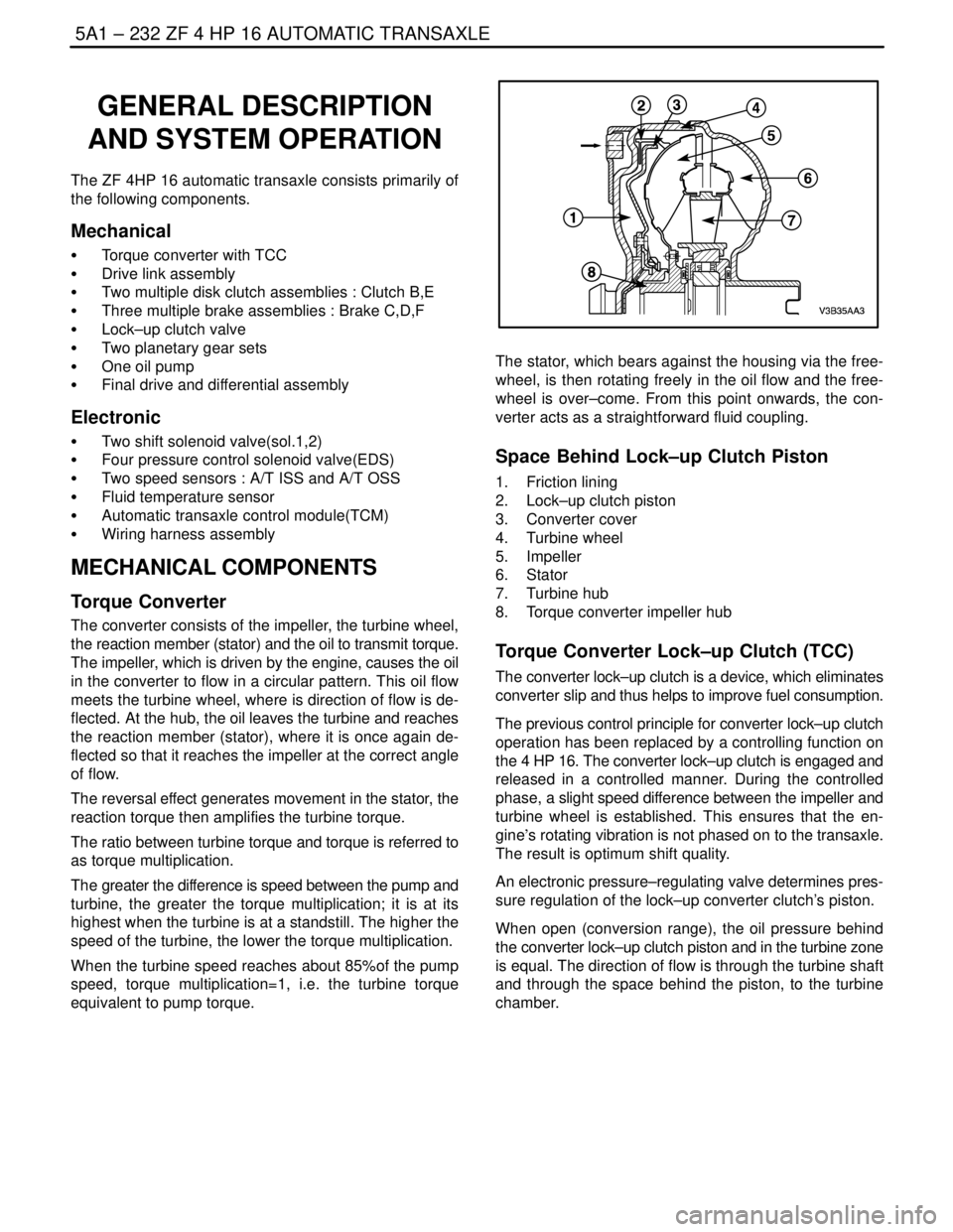
Space Behind Lock–up Clutch Piston
1. Friction lining
2. Lock–up clutch piston
3. Converter cover
4. Turbine wheel
5. Impeller
6. Stator
7. Turbine hub
8. Torque converter impeller hub
Torque Converter Lock–up Clutch (TCC)
The converter lock–up clutch is a device, which eliminates
converter slip and thus helps to improve fuel consumption.
The previous control principle for converter lock–up clutch
operation has been replaced by a controlling function on
the 4 HP 16. The converter lock–up clutch is engaged and
released in a controlled manner. During the controlled
phase, a slight speed difference between the impeller and
turbine wheel is established. This ensures that the en-
gine’s rotating vibration is not phased on to the transaxle.
The result is optimum shift quality.
An electronic pressure–regulating valve determines pres-
sure regulation of the lock–up converter clutch’s piston.
When open (conversion range), the oil pressure behind
the converter lock–up clutch piston and in the turbine zone
is equal. The direction of flow is through the turbine shaft
and through the space behind the piston, to the turbine
chamber.
Page 1587 of 2643
5A1 – 238IZF 4 HP 16 AUTOMATIC TRANSAXLE
DAEWOO V–121 BL4
Transaxle Fluid Temperature (TFT) Sensor
The TFT sensor is a positive temperature coefficient
thermistor (temperature sensitive resistor) that provides
information to the TCM regarding transaxle fluid tempera-
ture. The temperature sensor is located in valve body. Cal-
culated temperature is a factor used to determine the shift
time and shift delay time.
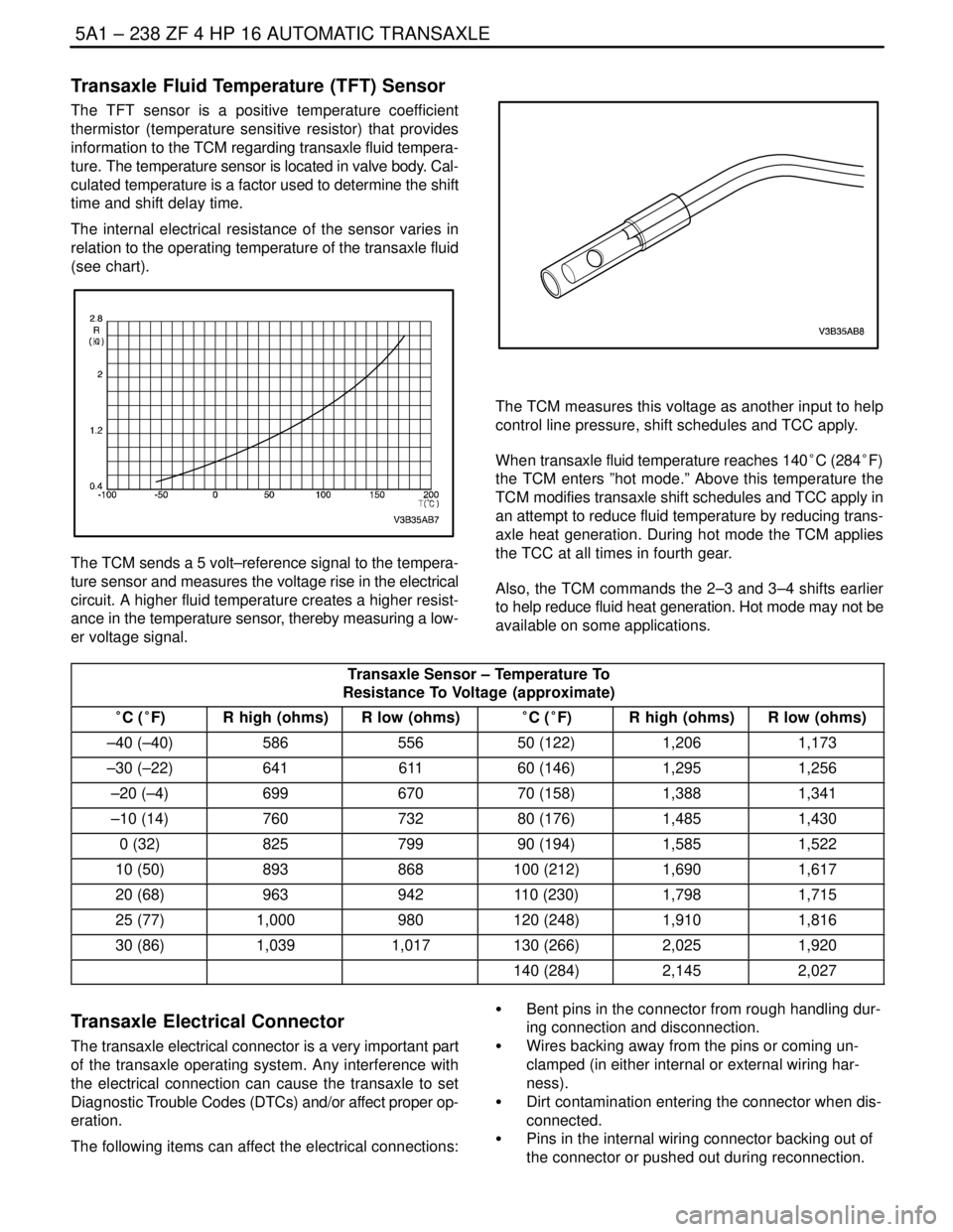
The internal electrical resistance of the sensor varies in
relation to the operating temperature of the transaxle fluid
(see chart).
The TCM sends a 5 volt–reference signal to the tempera-
ture sensor and measures the voltage rise in the electrical
circuit. A higher fluid temperature creates a higher resist-
ance in the temperature sensor, thereby measuring a low-
er voltage signal.
The TCM measures this voltage as another input to help
control line pressure, shift schedules and TCC apply.
When transaxle fluid temperature reaches 140°C (284°F)
the TCM enters ”hot mode.” Above this temperature the
TCM modifies transaxle shift schedules and TCC apply in
an attempt to reduce fluid temperature by reducing trans-
axle heat generation. During hot mode the TCM applies
the TCC at all times in fourth gear.
Also, the TCM commands the 2–3 and 3–4 shifts earlier
to help reduce fluid heat generation. Hot mode may not be
available on some applications.
Transaxle Sensor – Temperature To
Resistance To Voltage (approximate)
°C (°F)R high (ohms)R low (ohms)°C (°F)R high (ohms)R low (ohms)
–40 (–40)58655650 (122)1,2061,173
–30 (–22)64161160 (146)1,2951,256
–20 (–4)69967070 (158)1,3881,341
–10 (14)76073280 (176)1,4851,430
0 (32)82579990 (194)1,5851,522
10 (50)893868100 (212)1,6901,617
20 (68)963942110 (230)1,7981,715
25 (77)1,000980120 (248)1,9101,816
30 (86)1,0391,017130 (266)2,0251,920
140 (284)2,1452,027
Transaxle Electrical Connector
The transaxle electrical connector is a very important part
of the transaxle operating system. Any interference with
the electrical connection can cause the transaxle to set
Diagnostic Trouble Codes (DTCs) and/or affect proper op-
eration.
The following items can affect the electrical connections:S Bent pins in the connector from rough handling dur-
ing connection and disconnection.
S Wires backing away from the pins or coming un-
clamped (in either internal or external wiring har-
ness).
S Dirt contamination entering the connector when dis-
connected.
S Pins in the internal wiring connector backing out of
the connector or pushed out during reconnection.
Page 1589 of 2643

5A1 – 240IZF 4 HP 16 AUTOMATIC TRANSAXLE
DAEWOO V–121 BL4
Data Link Connector (CAN TYPE) 1.8L DOHC (Delphi 32 bit)
A Connector (Blue)B Connector (Green)C Connector (Gray)
1Solenoid 2Fluid Temperature GroundSelector Lever Line L1
2Not UsedInput Speed Sensor (+)Not Used
3Pressure Control Solenoid Valve
(EDS 4)BAT +Not Used
4TFT SensorInput Speed Sensor (–)Hold Mode Switch
5Stoplamp SwitchOutput Speed Sensor (–)Not Used
6Hold Mode IndicatorSelector Lever Line L3EDS Supply
7DLCInput Speed Sensor GroundEDS Supply
8CAN HighSpeedometerSolenoid Supply
9Solenoid 1Not UsedNot Used
10Pressure Control Solenoid Valve
(EDS 5)Output Speed Sensor (+)Not Used
11Pressure Control Solenoid Valve
(EDS 3)Selector Lever Line L4Not Used
12Pressure Control Solenoid Valve
(EDS 6)GroundNot Used
13Not UsedGroundNot Used
14Not UsedNot UsedNot Used
15Not UsedSelector Lever Line L2IG ON
16CAN LowNot UsedIG ON
Page 1590 of 2643

ZF 4 HP 16 AUTOMATIC TRANSAXLE 5A1 – 241
DAEWOO V–121 BL4
TCM INPUTS THAT AFFECT THE 4HP
16 TRANSAXLE
Throttle Position Sensor
S Provides throttle position data to the TCM for deter-
mining shift patterns and TCC apply/release.
S An incorrect throttle position sensor input could
causes erratic or shift pattern, poor shift quality or
TCC function
Automatic Transaxle Output (Shaft) Speed
Sensor
S Provides vehicle speed data to the TCM for deter-
mining shift patterns and TCC apply/release, and
gear ratio calculations.
S An incorrect throttle position sensor input could
causes erratic or shift pattern, poor shift quality or
TCC function
Automatic Transaxle Input (Shaft) Speed
Sensor
S Provides transaxle input speed data to the TCM for
determining shift patterns and TCC apply/release,
and gear ratio.
Engine Coolant Temperature Sensor
S Provides coolant temperature data to the TCM for
determining initial TCC engagement.
S An incorrect engine coolant temperature sensor
input could causes an incorrect initial TCC apply
Engine Speed
S The ignition module provides engine speed data the
TCM.
S The TCM uses engine speed information for con-
trolling wide open throttle shifts and the TCC PWM
solenoid duty cycle.
Stoplamp Switch
S Provides brake apply information to the TCM for
controlling TCC apply and release.
S An incorrect TCC stoplamp switch input could
causes an incorrect TCC apply or release.
Transaxle Fluid Temperature (TFT) Sensor
S Provides transaxle fluid temperature information to
the TCM for determining alternate shift patterns and
TCC apply during high temperature conditions (hot
mode operation).
S An incorrect transaxle temperature sensor input
could causes altered shift patterns, poor shift quali-
ty and incorrect TCC apply.
Page 1591 of 2643

SECTION : 5A2
AISIN AUTOMATIC TRANSAXLE
CAUTION : Disconnect the negative battery cable before removing or installing any electrical unit or when a tool
or equipment could easily come in contact with exposed electrical erminals. Disconnecting this cable will help
prevent personal injury and damage to the vehicle. The ignition must also be in LOCK unless otherwise noted.
TABLE OF CONTENTS
SPECIFICATIONS5A2–3 . . . . . . . . . . . . . . . . . . . . . . . . .
General Specifications 5A2–3. . . . . . . . . . . . . . . . . . . .
Transaxle Gear Ratio 5A2–3. . . . . . . . . . . . . . . . . . . . . .
Fluid Capacity 5A2–3. . . . . . . . . . . . . . . . . . . . . . . . . . . .
Line Pressure Specification 5A2–3. . . . . . . . . . . . . . . .
Fastener Tightening Specifications 5A2–4. . . . . . . . . .
SPECIAL TOOLS5A2–5 . . . . . . . . . . . . . . . . . . . . . . . . . .
Special Tools Table 5A2–5. . . . . . . . . . . . . . . . . . . . . . .
SCHEMATIC DIAGRAMS5A2–8 . . . . . . . . . . . . . . . . . . .
Transmission Control Module (1 of 4) 5A2–8. . . . . . . .
Transmission Control Module (2 of 4) 5A2–9. . . . . . . .
Transmission Control Module (3 of 4) 5A2–10. . . . . . .
Transmission Control Module (4 of 4) 5A2–11. . . . . . .
Shift Mode Diagram 5A2–12. . . . . . . . . . . . . . . . . . . . . .
COMPONENT LOCATOR5A2–17 . . . . . . . . . . . . . . . . . .
Shift Select Control 5A2–17. . . . . . . . . . . . . . . . . . . . . .
Automatic Transaxle Components 5A2–18. . . . . . . . .
Bearing and Races Installation Position
Direction 5A2–24. . . . . . . . . . . . . . . . . . . . . . . . . . . . . .
DIAGNOSIS5A2–25 . . . . . . . . . . . . . . . . . . . . . . . . . . . . . .
Electrical Connector View 5A2–25. . . . . . . . . . . . . . . . .
Wiring Harness and Connector Inspection 5A2–27. . .
Road Test 5A2–27. . . . . . . . . . . . . . . . . . . . . . . . . . . . . .
Function Check 5A2–28. . . . . . . . . . . . . . . . . . . . . . . . . .
Unit Inspection 5A2–30. . . . . . . . . . . . . . . . . . . . . . . . . .
On–Vehicle Repair (Matrix Chart) 5A2–34. . . . . . . . . .
DIAGNOSIS TROUBLE CODE DIAGNOSIS5A2–36 .
Diagnosis Trouble Code Chart 5A2–36. . . . . . . . . . . . .
DTC P0562 System Voltage Low 5A2–37. . . . . . . . . .
DTC P0563 System Voltage High 5A2–40. . . . . . . . . .
DTC P0601 Internal Control Module Memory
Checksum Error 5A2–43. . . . . . . . . . . . . . . . . . . . . . .
DTC P0604 Internal Transmission Control Module
(TCM) Random Access Memory (RAM)
Error 5A2–45. . . . . . . . . . . . . . . . . . . . . . . . . . . . . . . . . DTC P0705 Transmission Range (TR) Switch
Circuit Malfunction 5A2–47. . . . . . . . . . . . . . . . . . . . .
DTC P0712 Transmission Fluid Temperature
(TFT) Sensor Circuit Low Input 5A2–50. . . . . . . . . .
DTC P0713 Transmission Fluid Temperature
(TFT) Sensor Circuit High Input 5A2–53. . . . . . . . . .
DTC P0717 Input Shaft Speed (ISS) Sensor
Circuit No Signal 5A2–56. . . . . . . . . . . . . . . . . . . . . . .
DTC P0722 Ouput Shaft Speed (OSS) Sensor
Circuit No Signal 5A2–59. . . . . . . . . . . . . . . . . . . . . . .
DTC P0727 Engine Speed Input Circuit No
Signal 5A2–62. . . . . . . . . . . . . . . . . . . . . . . . . . . . . . . .
DTC P0741 Torque Converter Clutch (TCC)
Circuit Stuck Off 5A2–65. . . . . . . . . . . . . . . . . . . . . . .
DTC P0742 Torque Converter Clutch (TCC)
Circuit Stuck On 5A2–67. . . . . . . . . . . . . . . . . . . . . . .
DTC P0743 Torque Converter Clutch (TCC)
Electrical 5A2–69. . . . . . . . . . . . . . . . . . . . . . . . . . . . . .
DTC P0748 Pressure Control Solenoid (PCS)
Electrical 5A2–72. . . . . . . . . . . . . . . . . . . . . . . . . . . . . .
DTC P0751 Shift Solenoid 1 (SS1) Stuck Off 5A2–75
DTC P0753 Shift Solenoid 1 (SS1) Electrical 5A2–77
DTC P0756 Shift Solenoid 2 (SS2) Stuck Off 5A2–80
DTC P0758 Shift Solenoid 2 (SS2) Electrical 5A2–82
DTC P0785 Timing Solenoid (ST) Electrical 5A2–85.
DTC P1781 Engine Torque Signal Error 5A2–88. . . . .
DTC P1791 Throttle Position Signal Error 5A2–91. . .
DTC P1792 Engine Coolant Temperature (ECT)
Signal Error 5A2–93. . . . . . . . . . . . . . . . . . . . . . . . . . .
DTC U2105 Can Error 5A2–95. . . . . . . . . . . . . . . . . . . .
MAINTENANCE AND REPAIR5A2–97 . . . . . . . . . . . . .
ON–VEHICLE SERVICE 5A2–97. . . . . . . . . . . . . . . . . . .
Transaxle Fluid Level Checking Procedure 5A2–97. .
Fluid Drain Procedure 5A2–97. . . . . . . . . . . . . . . . . . . .
Locating Fluid Leaks 5A2–98. . . . . . . . . . . . . . . . . . . . .
Case Porosity Repair 5A2–98. . . . . . . . . . . . . . . . . . . . .
Fluid Cooler Flushing 5A2–99. . . . . . . . . . . . . . . . . . . . .
Control Cable Adjustment 5A2–99. . . . . . . . . . . . . . . . .