Temperature DAEWOO NUBIRA 2004 Service Repair Manual
[x] Cancel search | Manufacturer: DAEWOO, Model Year: 2004, Model line: NUBIRA, Model: DAEWOO NUBIRA 2004Pages: 2643, PDF Size: 80.54 MB
Page 1988 of 2643

7A – 14IHEATING AND VENTILATION SYSTEM
DAEWOO V–121 BL4
StepNo Yes Value(s) Action
71. Check the temperature door travel, the cable,
and the linkage.
2. Adjust to full cold.
3. Check for full hot.
Is the repair complete?–System OK–
8Adjust or repair the floor/defroster and/or the vent/
floor mode.
Is the repair complete?–System OK–
9In the vent position, is the problem objectionable
bleed?–Go to Step 10Go to Step 15
101. Check the system case for leaks.
2. Check the floor outlet attachment.
Are there problems?–Go to Step 11Go to Step 12
11Repair the system case or the floor outlet attach-
ment as required.
Is the repair complete?–System OKGo to Step 12
121. Turn the ignition switch OFF.
2. Turn the temperature control knob to full hot,
then rapidly to full cold.
Do you hear the door slam just before you reach the
end of the control travel?–Go to Step 13Go to Step 14
13Adjust the vent door to vent more.
Is the repair complete?–System OK–
141. Check the temperature door travel, the cables,
and the linkage.
2. Verify that the temperature door goes to full
cold.
3. Check the temperature door for full hot.
Is the temperature door travel correct?–System OK–
151. Set the fresh air/recirculating air control to
fresh air (indicator lamp off).
2. Set the temperature control to full cold.
3. Start the vehicle and allow the engine to warm
up.
4. Measure the air temperature at the blower in-
let, or cowl, and at the vent air outlet inside the
vehicle.
Is the outlet air more than 5°C (41°F) warmer than
the inlet air?–Go to Step 16System OK
161. Check for hot air leaks from the engine
compartment to the blower inlet.
2. Repair, as needed.
Is the repair complete?–System OK–
Page 1989 of 2643

HEATING AND VENTILATION SYSTEM 7A – 15
DAEWOO V–121 BL4
CONTROLS
StepActionValue(s)YesNo
1Verify the customer’s complaint.
Are the customer’s concerns verified?–Go to Step 2System OK
2Move controls other than the temperature adjust-
ment.
Is an excessive effort required to move the controls?–Go to Step 15Go to Step 3
3Move the temperature control.
Is an excessive effort required to move the controls?–Go to Step 6Go to Step 4
4Move the temperature control.
Does the temperature door move too easily?–Go to Step 5System OK
5Remove the cable from the controller.
Does the control knob turn freely, without the click
stops?–Go to Step 15–
6Check the cables for improper routing, kinks, wiring
interference, or other instrument panel interference.
Is there a problem?–Go to Step 7Go to Step 8
7Repair as needed.
Is the repair complete?–System OK–
81. Remove the cable from the temperature door.
2. Cycle the door manually.
3. Check for door binding.
Is there any door binding?–Go to Step 9Go to Step 12
9Check a binding door for shaft alignment, a bent
shaft, a bent door, or a warped case.
Is the door seal OK?–Go to Step 10Go to Step 11
101. Check a binding door for shaft alignment, a
bent shaft, a bent door, or a warped case.
2. Repair, as needed.
Is the repair complete?–System OK–
11Repair the door seal, as needed.
Is the repair complete?–System OK–
12Check for control binding.
Does the control bind?–Go to Step 14Go to Step 13
131. Reinstall the cable to the door.
2. Check the clearance for the cable–to–dash
components.
3. Repair any interference.
Is the repair complete?–System OK–
141. Remove the cable from the control.
2. Check the control for binding.
Does the control bind?–Go to Step 15Go to Step 16
15Replace the control.
Is the repair complete?–System OK–
16Replace the cable.
Is the repair complete?–System OK–
Page 1990 of 2643

7A – 16IHEATING AND VENTILATION SYSTEM
DAEWOO V–121 BL4
BLOWER NOISE
StepActionValue(s)YesNo
1Verify the customer’s complaint.
Are the customer’s concerns verified?–Go to Step 2System OK
21. Sit inside the vehicle.
2. Close the doors and the windows.
3. Turn the ignition ON.
4. Start the engine.
5. Set the temperature to full cold.
6. Cycle through the blower speeds, the modes,
and the temperature settings in order to find
the noise.
Is the blower noise constant at high blower speeds
or certain modes, but absent at lower speeds or in
other modes?–Go to Step 11Go to Step 3
3Check for vibrations from the blower motor and fan
assembly at each blower speed by feeling the blower
motor housing.
Did you find excessive vibration?–Go to Step 6Go to Step 4
41. Remove the blower motor and the fan assem-
bly. Refer to ”Blower Motor” in this section.
2. Check for foreign material at the opening of the
blower inlet.
Do you find any foreign material at the blower inlet?–Go to Step 5Go to Step 6
5Remove all foreign material.
Is the repair complete?–System OKGo to Step 6
61. Examine the blower fan for wear spots,
cracked blades, a cracked hub, a loose fan re-
taining nut, or bad alignment.
2. Examine the blower case for wear spots.
Did you find any problem?–Go to Step 7Go to Step 9
7Repair as required.
Is the repair complete?–System OKGo to Step 8
8Replace the motor and the fan assembly.
Is the repair complete?–System OKGo to Step 9
9If the noise is a click/tick or whine, replace the motor.
Is the repair complete?–System OKGo to Step 10
10Reinstall the original motor.
Is the problem still present?–Go to Step 11System OK
111. Set the blower speed on maximum.
2. Check full–hot to full–cold temperature posi-
tions in the defrost, floor, and vent modes.
Is the noise present in the defrost mode only?–Go to Step 12Go to Step 13
121. Check the ducts for obstructions or foreign ma-
terials.
2. Remove any obstructions or foreign materials.
3. Check the floor/defroster door seals.
4. Repair or replace the components, as needed.
Is the repair complete?–System OK–
13Is the noise present in the floor mode only?–Go to Step 12Go to Step 14
14Is the noise present in the vent mode only?–Go to Step 15Go to Step 16
Page 1991 of 2643

HEATING AND VENTILATION SYSTEM 7A – 17
DAEWOO V–121 BL4
StepNo Yes Value(s) Action
151. Check the ducts for obstructions or foreign ma-
terials.
2. Remove any obstructions or foreign materials.
3. Check the vent door seals.
4. Repair or replace as needed.
Is the repair complete?–System OK–
16Is the noise present in all modes, but not all tempera-
ture positions?–Go to Step 17Go to Step 18
171. Check the temperature door seals.
2. Repair or replace the seals, as needed.
Is the repair complete?–System OK–
181. Check the system for obstructions or foreign
materials between the fan and the temperature
door.
2. Repair or replace the components, as needed.
Is the repair complete?–System OKGo to Step 2
Page 1992 of 2643
7A – 18IHEATING AND VENTILATION SYSTEM
DAEWOO V–121 BL4
MAINTENANCE AND REPAIR
ON–VEHICLE SERVICE
TEMPERATURE CABLE
ADJUSTMENT
Because the cable and the cable housings have fixed
lengths, it is impossible to make a temperature cable ad-
justment.
In addition, the heater/air distributor case linkage cannot
be adjusted.
If a malfunction is suspected, verify the proper operation
of the controller and the mechanical doors for the heater/
air distributor case assembly.
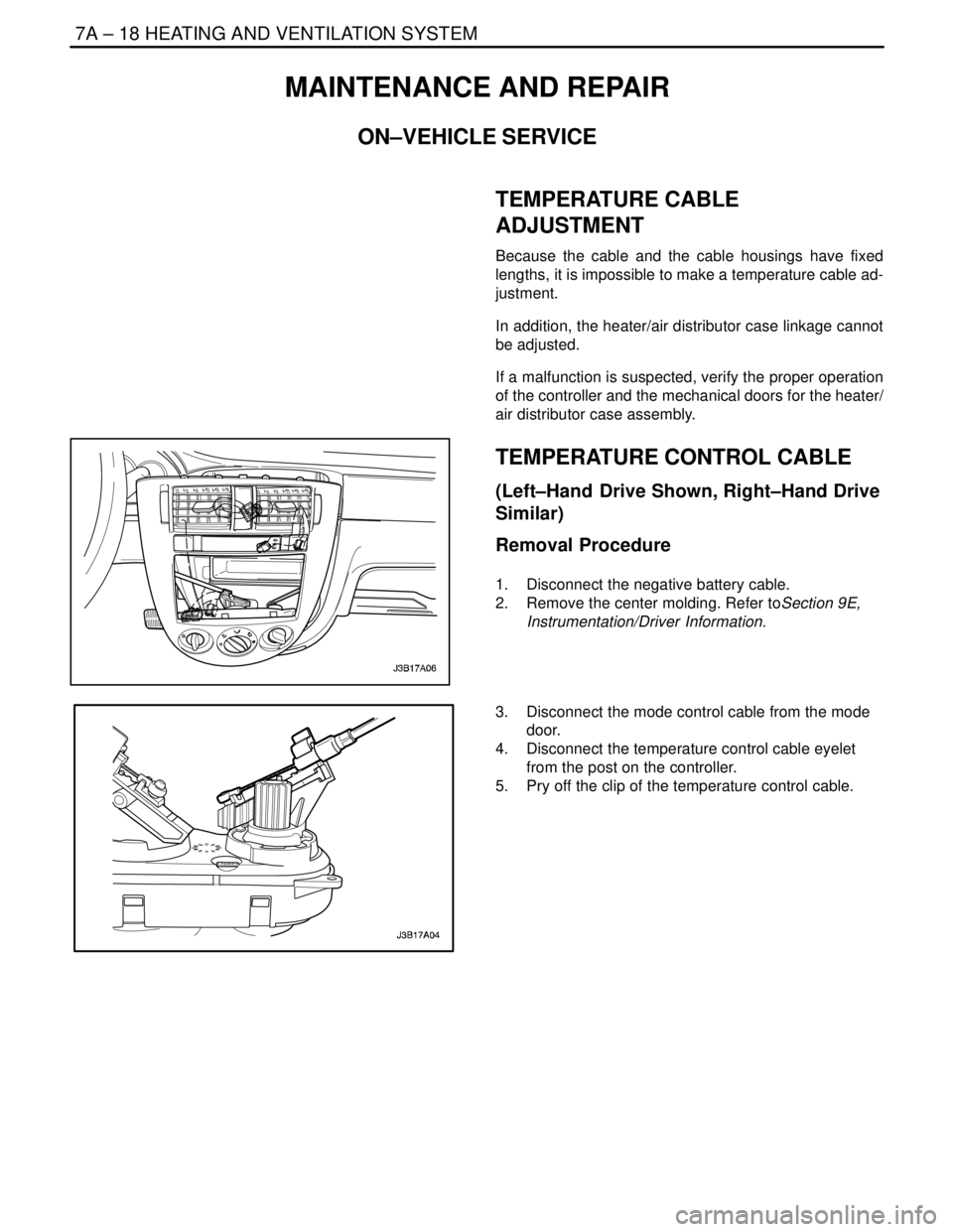
TEMPERATURE CONTROL CABLE
(Left–Hand Drive Shown, Right–Hand Drive
Similar)
Removal Procedure
1. Disconnect the negative battery cable.
2. Remove the center molding. Refer toSection 9E,
Instrumentation/Driver Information.
3. Disconnect the mode control cable from the mode
door.
4. Disconnect the temperature control cable eyelet
from the post on the controller.
5. Pry off the clip of the temperature control cable.
Page 1993 of 2643
HEATING AND VENTILATION SYSTEM 7A – 19
DAEWOO V–121 BL4
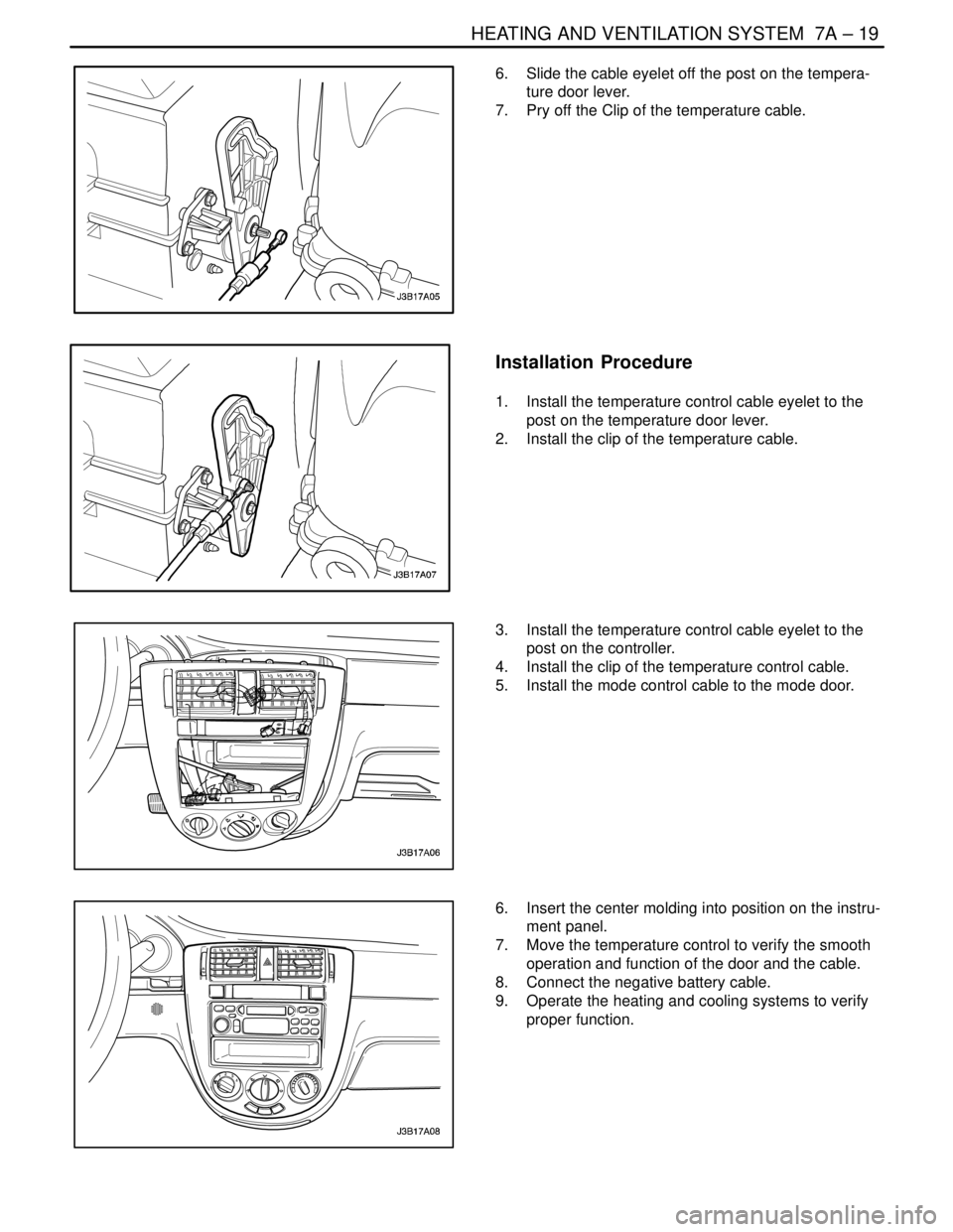
6. Slide the cable eyelet off the post on the tempera-
ture door lever.
7. Pry off the Clip of the temperature cable.
Installation Procedure
1. Install the temperature control cable eyelet to the
post on the temperature door lever.
2. Install the clip of the temperature cable.
3. Install the temperature control cable eyelet to the
post on the controller.
4. Install the clip of the temperature control cable.
5. Install the mode control cable to the mode door.
6. Insert the center molding into position on the instru-
ment panel.
7. Move the temperature control to verify the smooth
operation and function of the door and the cable.
8. Connect the negative battery cable.
9. Operate the heating and cooling systems to verify
proper function.
Page 1994 of 2643
7A – 20IHEATING AND VENTILATION SYSTEM
DAEWOO V–121 BL4
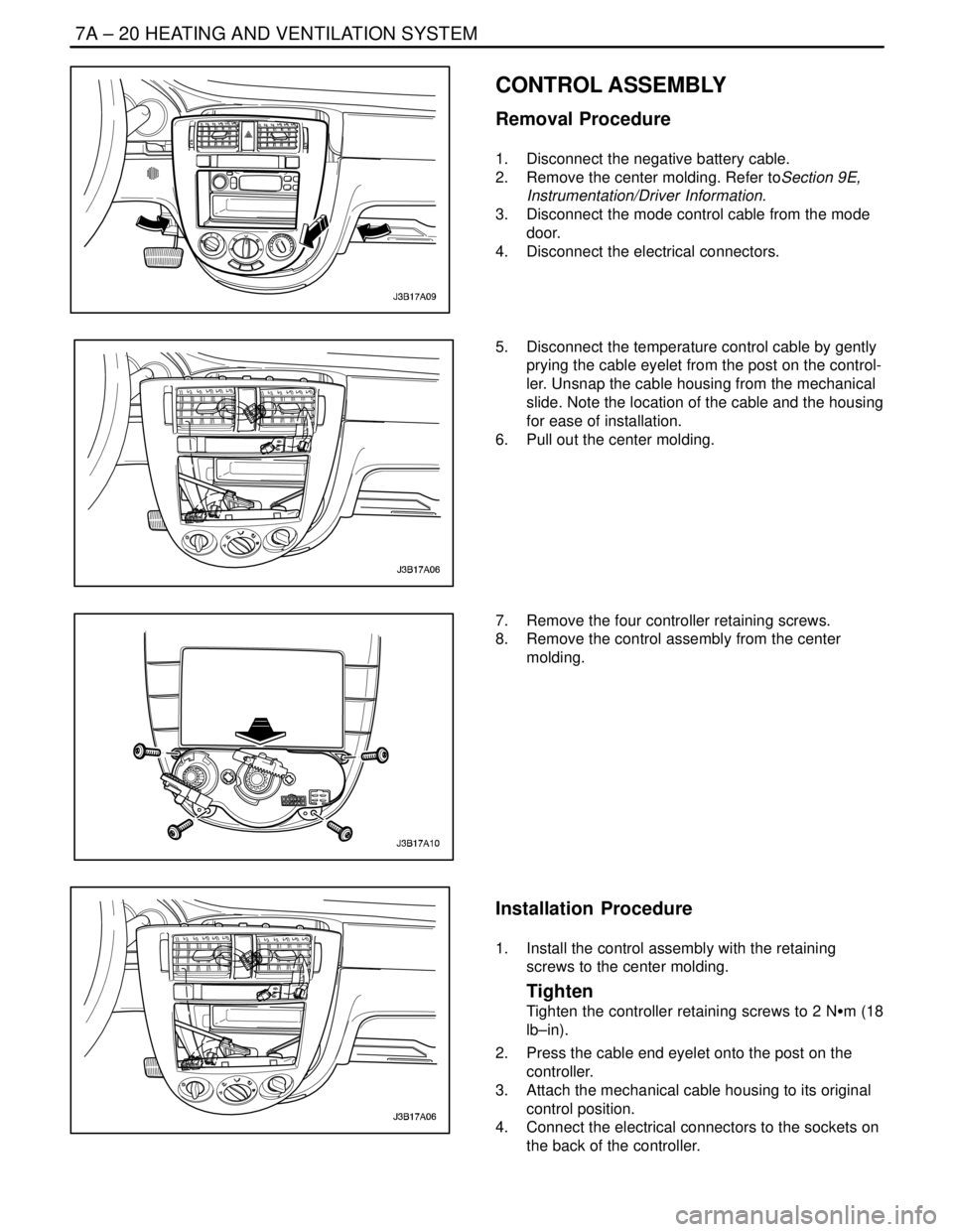
CONTROL ASSEMBLY
Removal Procedure
1. Disconnect the negative battery cable.
2. Remove the center molding. Refer toSection 9E,
Instrumentation/Driver Information.
3. Disconnect the mode control cable from the mode
door.
4. Disconnect the electrical connectors.
5. Disconnect the temperature control cable by gently
prying the cable eyelet from the post on the control-
ler. Unsnap the cable housing from the mechanical
slide. Note the location of the cable and the housing
for ease of installation.
6. Pull out the center molding.
7. Remove the four controller retaining screws.
8. Remove the control assembly from the center
molding.
Installation Procedure
1. Install the control assembly with the retaining
screws to the center molding.
Tighten
Tighten the controller retaining screws to 2 NSm (18
lb–in).
2. Press the cable end eyelet onto the post on the
controller.
3. Attach the mechanical cable housing to its original
control position.
4. Connect the electrical connectors to the sockets on
the back of the controller.
Page 2002 of 2643

7A – 28IHEATING AND VENTILATION SYSTEM
DAEWOO V–121 BL4
GENERAL DESCRIPTION
AND SYSTEM OPERATION
HEATING AND VENTILATION
SYSTEMS
The base heater system is designed to provide heating,
ventilation, windshield defrosting, side window defogging,
and on some vehicles, heating directly to the rear seat
area.
The heater and fan assembly blower regulates the airflow
from the air inlet for further processing and distribution.
The heater core transfers the heat from the engine coolant
to the inlet air.
The temperature door regulates the amount of the air that
passes through the heater core. The temperature door
also controls the temperature of the air by controlling the
mix of the heated air and the ambient air.
The mode door regulates the flow and the distribution of
the processed air to the heater ducts and to the defroster
ducts.
This console–mounted heating and ventilation panel con-
tains the following:
The Rotary Temperature Control Knob
1. The Rotary Temperature Control Knob
S Actuates by cable.
S Raises the temperature of the air entering the
vehicle by rotation toward the right, or the red
portion of the knob.
2. The Rotary Blower Control Knob
S Turns ON to operate the blower motor at four
speeds.
S Turns OFF to stop the blower.
S Operates completely independently both from
the mode control that regulates the defroster
door and from the temperature control knob.S Changes the fan speed in any mode and at any
temperature setting.
3. The Rotary Mode Control Knob
S Actuates by cable.
S Regulates the air distribution between the wind-
shield, the instrument panel, and the floor vents.
Two Push Knobs
1. The Rear Window Defogger Push Knob
S Controls the rear window defogger.
S Turns ON the rear window defogger when the
push knob is pressed and the indicator lamp is
illuminated.
2. The A/C Push Knob (if the vehicle is equipped with
air conditioning)
S Controls the A/C.
S Turns the A/C ON when the push knob is down.
However, if the blower control knob is OFF, the
A/C system is OFF, regardless of the position of
the A/C knob.
Fresh Air Control Level Or Push Knob
1. The Fresh Air Control Level
S Operates by cable.
S Switches between recirculating passenger
compartment air and bringing outside air into the
passenger compartment.
S Draws in outside air when the lever is moved to
the right.
S Recirculates inside air when the lever is moved
to the left.
2. The Fresh Air Control Push Knob
S Operates by cable.
S Switches between recirculating passenger
compartment air and bringing outside air into the
passenger compartment.
S Draws in outside air when knob is off.
S Recirculates inside air when the knob is down
with the indicator lamp illuminated.
Page 2003 of 2643

SECTION : 7B
MANUAL CONTROL HEATING, VENTILATION
AND AIR CONDITIONING SYSTEM
CAUTION : Disconnect the negative battery cable before removing or installing any electrical unit or when a tool
or equipment could easily come in contact with exposed electrical terminals. Disconnecting this cable will help
prevent personal injury and damage to the vehicle. The ignition must also be in LOCK unless otherwise noted.
TABLE OF CONTENTS
SPECIFICATIONS7B–2 . . . . . . . . . . . . . . . . . . . . . . . . . .
General Specifications 7B–2. . . . . . . . . . . . . . . . . . . . .
Fastener Tightening Specifications 7B–2. . . . . . . . . . .
SPECIAL TOOLS7B–3 . . . . . . . . . . . . . . . . . . . . . . . . . . .
Special Tools Table 7B–3. . . . . . . . . . . . . . . . . . . . . . . .
SCHEMATIC AND ROUTING DIAGRAMS7B–6 . . . . .
A/C System – Typical 7B–6. . . . . . . . . . . . . . . . . . . . . .
Manual Control A/C Diagram 7B–7. . . . . . . . . . . . . . . .
DIAGNOSIS7B–8 . . . . . . . . . . . . . . . . . . . . . . . . . . . . . . . .
GENERAL DIAGNOSIS 7B–8. . . . . . . . . . . . . . . . . . . . . .
Testing the Refrigerant System 7B–8. . . . . . . . . . . . . .
Insufficient Cooling ”Quick Check” Procedure 7B–8. .
A/C Performance Test 7B–9. . . . . . . . . . . . . . . . . . . . . .
Pressure–Temperature Relationship of
R–134A 7B–10. . . . . . . . . . . . . . . . . . . . . . . . . . . . . . .
Leak Testing Refrigerant System 7B–11. . . . . . . . . . . .
V5 SYSTEM AIR CONDITIONING DIAGNOSIS 7B–12
Insufficient Cooling Diagnosis 7B–12. . . . . . . . . . . . . .
SYMPTOM DIAGNOSIS 7B–16. . . . . . . . . . . . . . . . . . . .
Pressure Test Chart (R–134A System) 7B–16. . . . . .
Low and High Side Pressure Relationship
Chart 7B–18. . . . . . . . . . . . . . . . . . . . . . . . . . . . . . . . . .
MAINTENANCE AND REPAIR7B–19 . . . . . . . . . . . . . .
ON–VEHICLE SERVICE 7B–19. . . . . . . . . . . . . . . . . . . .
GENERAL A/C SYSTEM SERVICE
PROCEDURES 7B–19. . . . . . . . . . . . . . . . . . . . . . . . . .
O–Ring Replacement 7B–19. . . . . . . . . . . . . . . . . . . . .
Handling Refrigerant 7B–19. . . . . . . . . . . . . . . . . . . . . .
Handling of Refrigerant Lines and Fittings 7B–19. . . .
Maintaining Chemical Stability in the Refrigeration
System 7B–20. . . . . . . . . . . . . . . . . . . . . . . . . . . . . . . .
Discharging, Adding Oil, Evacuating, and Charging
Procedures for A/C System 7B–20. . . . . . . . . . . . . .
SERVICEABLE COMPONENTS 7B–23. . . . . . . . . . . . . Components Used In Non–A/C Systems 7B–23. . . . .
A/C Pressure Transducer 7B–24. . . . . . . . . . . . . . . . . .
A/C Compressor Relay 7B–24. . . . . . . . . . . . . . . . . . . .
Air Filter 7B–25. . . . . . . . . . . . . . . . . . . . . . . . . . . . . . . . .
A/C Expansion Valve 7B–25. . . . . . . . . . . . . . . . . . . . . .
A/C High–Pressure Pipe Line 7B–26. . . . . . . . . . . . . . .
Evaporator Core 7B–29. . . . . . . . . . . . . . . . . . . . . . . . . .
A/C Suction Hose Assembly 7B–30. . . . . . . . . . . . . . .
A/C Discharge Hose Compressor to
Condenser 7B–31. . . . . . . . . . . . . . . . . . . . . . . . . . . . .
Receiver–Dryer 7B–32. . . . . . . . . . . . . . . . . . . . . . . . . . .
Compressor 7B–33. . . . . . . . . . . . . . . . . . . . . . . . . . . . . .
Condenser 7B–35. . . . . . . . . . . . . . . . . . . . . . . . . . . . . . .
UNIT REPAIR 7B–37. . . . . . . . . . . . . . . . . . . . . . . . . . . . .
COMPONENT LOCATOR 7B–37. . . . . . . . . . . . . . . . . . .
V5 Compressor 7B–37. . . . . . . . . . . . . . . . . . . . . . . . . . .
V5 AIR CONDITIONING COMPRESSOR
OVERHAUL 7B–38. . . . . . . . . . . . . . . . . . . . . . . . . . . . .
Clutch Plate and Hub Assembly 7B–38. . . . . . . . . . . .
Clutch Rotor and Bearing 7B–40. . . . . . . . . . . . . . . . . .
Clutch Coil 7B–42. . . . . . . . . . . . . . . . . . . . . . . . . . . . . . .
Shaft Seal Replacement 7B–44. . . . . . . . . . . . . . . . . . .
Control Valve Assembly 7B–46. . . . . . . . . . . . . . . . . . .
Rear Head, Gasket, Valve Plate, Reed Plate,
and O–ring 7B–47. . . . . . . . . . . . . . . . . . . . . . . . . . . . .
Cylinder to Front Head O–ring 7B–48. . . . . . . . . . . . . .
Leak Testing (External) 7B–50. . . . . . . . . . . . . . . . . . . .
GENERAL DESCRIPTION AND SYSTEM
OPERATION7B–51 . . . . . . . . . . . . . . . . . . . . . . . . . . . . .
GENERAL INFORMATION 7B–51. . . . . . . . . . . . . . . . . .
The V5 A/C System 7B–51. . . . . . . . . . . . . . . . . . . . . . .
System Components – Functional 7B–51. . . . . . . . . .
System Components – Control 7B–52. . . . . . . . . . . . .
V5 Compressor – General Description 7B–52. . . . . . .
V5 Compressor – Description of Operation 7B–52. . .
Page 2010 of 2643

7B – 8IMANUAL CONTROL HEATING, VENTILATION AND AIR CONDITIONING SYSTEM
DAEWOO V–121 BL4
DIAGNOSIS
GENERAL DIAGNOSIS
TESTING THE REFRIGERANT
SYSTEM
If you suspect a problem in the refrigerant system, check
for the following conditions:
1. Check the outer surfaces of the radiator and the
condenser cores to be sure that the airflow is not
blocked by dirt, leaves, or other foreign material.
Check between the condenser and the radiator, as
well as all outer surfaces.
2. Check for restrictions or kinks in the condenser
core, the hoses, and the tubes.
3. Check the operation of the blower fan.
4. Check all the air ducts for leaks or restrictions. Low
airflow rate may indicate a restricted evaporator
core.
5. Check for slippage of the compressor clutch.
6. Check the drive belt tension.
INSUFFICIENT COOLING ”QUICK
CHECK” PROCEDURE
Perform the following ”hand–feel” procedure to get a quick
idea of whether the A/C system has the proper charge of
Refrigerant–134a. The air temperature must be above
21°C (70°F) for most models.
1. Warm up engine. Run the engine at idle.
2. Open the hood and all the doors.
3. Turn the A/C switch ON.
4. Set the temperature control to the full cold position.
5. Set the blower speed switch on the maximum
speed setting.
6. ”Hand–feel” the temperature of the evaporator out-
let pipe. The pipe should be cold.
7. Check for other problems. Refer to ”Testing the Re-
frigerant System” in this section.
8. Leak check the system. Refer to ”Leak Testing the
Refrigerant System” in this section. If you find a
leak, discharge the system and repair the leak as
required. After completing the repair, evacuate the
system and charge it.
9. If there is no leak, refer to ”Insufficient Cooling
Diagnosis” in this section.