Temperature DAEWOO NUBIRA 2004 Service Repair Manual
[x] Cancel search | Manufacturer: DAEWOO, Model Year: 2004, Model line: NUBIRA, Model: DAEWOO NUBIRA 2004Pages: 2643, PDF Size: 80.54 MB
Page 1808 of 2643
5A2 – 218IAISIN AUTOMATIC TRANSAXLE
DAEWOO V–121 BL4
GENERAL DESCRIPTION
AND SYSTEM OPERATION
TRANSAXLE DESCRIPTION
The new automatic transmission is an electronically con-
trolled 4–speed automatic transmission with Lock–up
mechanism.
The transmission is mainly composed of the torque con-
verter with lock up clutch, newly developed 4–speed plan-
etary gear unit, the hydraulic control system and the elec-
tric control system.
ELECTRONICAL COMPONENTS
Transmission Control Module (TCM)
The TCM primarily controls shift points and lockup en-
gagement. It is located on the driver side under the instru-
ment panel.
The transmission is controlled by an electronic shift sys-
tem. The Transmission Control Module (TCM) processes
input signals. From the information received, the TCM
controls the transmission hydraulic system.
The electronic shift system consists of the following :
S Transmission control module (TCM)
S Shift solenoids (SS1 and SS2)
S Pressure control solenoid (PCS)
S Lockup solenoid
S Input shaft speed (ISS) sensor
S Output shaft speed (OSS) sensor
S Transmission Fluid Temperature (TFT) sensor
S Transmission Range (TR) Switch
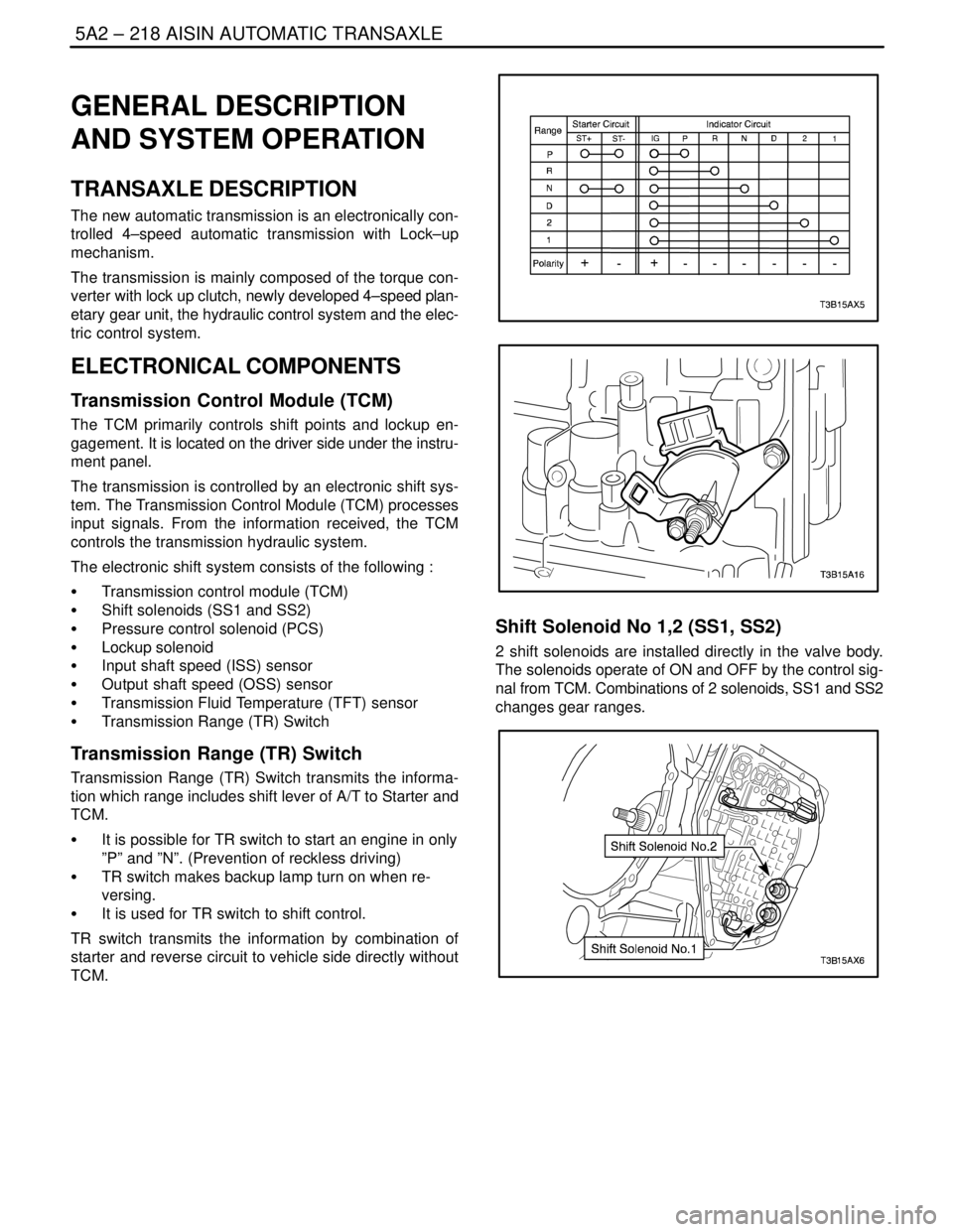
Transmission Range (TR) Switch
Transmission Range (TR) Switch transmits the informa-
tion which range includes shift lever of A/T to Starter and
TCM.
S It is possible for TR switch to start an engine in only
”P” and ”N”. (Prevention of reckless driving)
S TR switch makes backup lamp turn on when re-
versing.
S It is used for TR switch to shift control.
TR switch transmits the information by combination of
starter and reverse circuit to vehicle side directly without
TCM.
Shift Solenoid No 1,2 (SS1, SS2)
2 shift solenoids are installed directly in the valve body.
The solenoids operate of ON and OFF by the control sig-
nal from TCM. Combinations of 2 solenoids, SS1 and SS2
changes gear ranges.
Page 1809 of 2643
AISIN AUTOMATIC TRANSAXLE 5A2 – 219
DAEWOO V–121 BL4
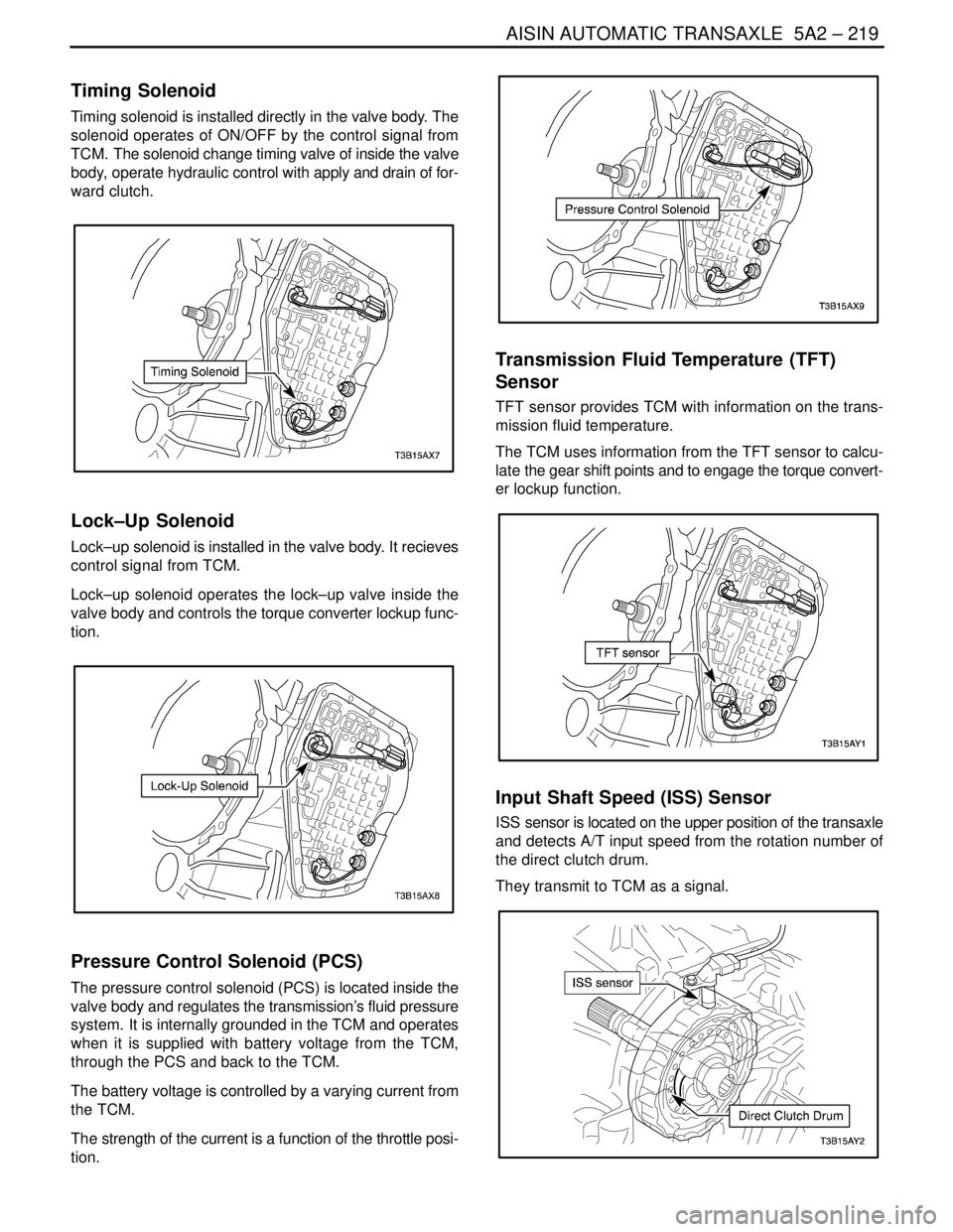
Timing Solenoid
Timing solenoid is installed directly in the valve body. The
solenoid operates of ON/OFF by the control signal from
TCM. The solenoid change timing valve of inside the valve
body, operate hydraulic control with apply and drain of for-
ward clutch.
Lock–Up Solenoid
Lock–up solenoid is installed in the valve body. It recieves
control signal from TCM.
Lock–up solenoid operates the lock–up valve inside the
valve body and controls the torque converter lockup func-
tion.
Pressure Control Solenoid (PCS)
The pressure control solenoid (PCS) is located inside the
valve body and regulates the transmission’s fluid pressure
system. It is internally grounded in the TCM and operates
when it is supplied with battery voltage from the TCM,
through the PCS and back to the TCM.
The battery voltage is controlled by a varying current from
the TCM.
The strength of the current is a function of the throttle posi-
tion.
Transmission Fluid Temperature (TFT)
Sensor
TFT sensor provides TCM with information on the trans-
mission fluid temperature.
The TCM uses information from the TFT sensor to calcu-
late the gear shift points and to engage the torque convert-
er lockup function.
Input Shaft Speed (ISS) Sensor
ISS sensor is located on the upper position of the transaxle
and detects A/T input speed from the rotation number of
the direct clutch drum.
They transmit to TCM as a signal.
Page 1903 of 2643

6A – 2IPOWER STEERING SYSTEM
DAEWOO V–121 BL4
DIAGNOSIS
POWER STEERING SYSTEM
PRESSURE TEST
Tools Required
KM–354–B Pressure Test Gauge Kit
Check the fluid pressure as follows to determine whether
the trouble is in the pump or the gear unit.
Test Procedure
1. Check the power steering fluid level and the power
steering pump belt tension. Refer to ”Checking and
Adding Fluid” in this section and Section 6B, Power
Steering Pump.
2. Disconnect the high pressure line at the pump. Use
a small container to catch any fluid.
3. Connect the hose of the pressure test gauge kit
KM–354–B to the power steering pressure hose
from the power steering pump.
4. Place the gear selector lever in PARK (automatic
transaxle–equipped vehicles) or NEUTRAL (manual
transaxle–equipped vehicles). Set the parking
brake.
5. Open the gauge valve fully.
6. Start the engine and let it idle.
7. Turn the steering wheel from lock to lock several
times to warm the fluid to operating temperature.
8. Increase the engine speed to 1,500 rpm.
Notice : The power steering pump could be damaged if
the valve is fully closed for more than 5 seconds.
9. Close the gauge valve fully, and read the pressure.
The pump pressure with the valve closed should be
between 8,330 kPa to 8,820 kPa (1,208 psi to
1,279 psi). With electronic variable orifice, the pres-
sure should be between 8,500 kPa to 8,960 kPa
(1,233 psi to 1,299 psi).
10. Immediately open the gauge valve fully.
11. Turn the steering wheel all the way to the left and
the right. If the pressure is within the specified lim-
its, the problem is not in the pump. Check the pow-
er steering gear for leaks.
POWER STEERING SYSTEM LEAK
TEST
General Procedure
Inspect the following:
S The fluid reservoir for overfill.
S Fluid for aeration and overflow.
S The hoses for loose connections.
S The torsion bar, stub shaft and adjuster seals for
leaks.
S The component sealing surfaces for damage.
Important : Verify the exact point of the leak. The point
from which the fluid is dripping is not necessarily the point
at which the system is leaking. When service is required,
clean the leak area upon disassembly, replace the leaking
seal, check the component sealing surfaces for damage
and reset the torque bolt to specifications, where required.
External Leak Check
The purpose of this procedure is to pinpoint the location of
the leak. In some cases, the leak can be easily located, but
seepage–type leaks may be harder to find. To locate seep-
age leaks, use the following method:
1. With the engine off, wipe dry the complete power
steering system.
2. Check the power steering fluid level in the pump’s
reservoir. Adjust the fluid level as necessary. Refer
to ”Checking and Adding Fluid” in this section.
Notice : Do not hold the steering wheel at a stop for any
length of time as this can damage the power steering
pump.
3. Start the engine. Turn the steering wheel counter-
clockwise and clockwise from stop to stop several
times.
4. Find the exact area of the leak and repair it.
Page 1904 of 2643

POWER STEERING SYSTEM 6A – 3
DAEWOO V–121 BL4
MAINTENANCE AND REPAIR
ON–VEHICLE SERVICE
BLEEDING THE POWER STEERING
SYSTEM
If the power steering hydraulic system has been serviced,
an accurate fluid level reading cannot be obtained until the
air is bled from the system. Follow these steps to bleed the
air from the system.
1. Turn the wheels all the way to the left and add the
power steering fluid to the MIN mark on the fluid
level indicator.
Notice : When adding fluid or making a complete fluid
change, always use DEXRON®–II or III power steering
fluid. Failure to use the proper fluid will cause hose and
seal damage and fluid leaks.
2. Start the engine. With the engine running at fast
idle, recheck the fluid level. If necessary, add fluid
to bring the level up to the MIN mark.
3. Bleed the system by turning the wheels from side to
side without reaching the stop at either end. Keep
the fluid level at the MIN mark. The air must be
eliminated from the fluid before normal steering ac-
tion can be obtained.
4. Return the wheels to the center position. Continue
running the engine for 2 to 3 minutes.
5. Road test the car to be sure the steering functions
normally and is free from noise.
6. Recheck the fluid level as described in steps 1 and
2. Make sure the fluid level is at the MAX mark af-
ter the system has stabilized at its normal operating
temperature. Add fluid as needed.
CHECKING AND ADDING FLUID
Notice : When adding fluid or making a complete fluid
change, always use DEXRON®–II or III power steering
fluid. Failure to use the proper fluid will cause hose and
seal damage and fluid leaks.
1. The power steering fluid level is indicated either by
marks on a see–through fluid reservoir or by marks
on a fluid level indicator on the fluid reservoir cap.
2. If the fluid is warmed up to 66°C (150°F), the fluid
level should be between the MAX and MIN marks.
Add fluid as needed.
3. If the fluid is cool, 21°C (70°F), the fluid level
should be at the MIN mark. Add fluid as needed.
Page 1911 of 2643

6B – 2IPOWER STEERING PUMP
DAEWOO V–121 BL4
DIAGNOSIS
POWER STEERING PUMP DIAGNOSIS
Foaming or Milky Power Steering Fluid (Air in Fluid)
ChecksAction
Check for internal leakage in the power steering pump,
causing an overflow.Repair the internal pump leakage.
Bleed the system.
Check for a low fluid level.Repair the internal pump leakage.
Bleed the system.
Cold temperatures will cause the air bubbles in the system
if the fluid level is low.
Low Pressure Due to Power Steering Pump
ChecksAction
Check for an external leakage of the power steering pump
at the seals.Replace the seals.
Repair the leak.
Bleed the system.
Check for a worn serpentine accessory drive belt.Replace the serpentine accessory drive belt.
Low Pressure Due to Power Steering Gear
ChecksAction
Check for a scored housing bore.Replace the housing bore.
Check for leakage at the valve rings or the seals.Repair the leak.
Bleed the system.
Groaning Noise in the Power Steering Pump
ChecksAction
Check for air in the power steering fluid.Perform the checks listed in ”Foaming or Milky Power
Steering Fluid (Air in Fluid)” above.
Check for a low level of power steering fluid.Repair any internal or external leaks.
Bleed the system.
Check for a loose mounting of the power steering pump.Tighten the pump mounting to specifications.
Page 1975 of 2643

SECTION : 7A
HEATING AND VENTILATION SYSTEM
CAUTION : Disconnect the negative battery cable before removing or installing any electrical unit or when a tool
or equipment could easily come in contact with exposed electrical terminals. Disconnecting this cable will help
prevent personal injury and damage to the vehicle. The ignition must also be in LOCK unless otherwise noted.
TABLE OF CONTENTS
SPECIFICATIONS7A–1 . . . . . . . . . . . . . . . . . . . . . . . . . .
Heater Temperature Specifications 7A–1. . . . . . . . . . .
Fastener Tightening Specifications 7A–1. . . . . . . . . . .
SCHEMATIC AND ROUTING DIAGRAMS7A–3 . . . . .
Non–A/C Diagrams 7A–3. . . . . . . . . . . . . . . . . . . . . . . .
Airflow – Typical 7A–4. . . . . . . . . . . . . . . . . . . . . . . . . . .
Airflow with Rear Heating Duct 7A–5. . . . . . . . . . . . . .
DIAGNOSIS7A–6 . . . . . . . . . . . . . . . . . . . . . . . . . . . . . . . .
HEATER SYSTEM 7A–6. . . . . . . . . . . . . . . . . . . . . . . . . .
Insufficient Heating or Defrosting 7A–6. . . . . . . . . . . . .
Blower Electrical 7A–9. . . . . . . . . . . . . . . . . . . . . . . . . . .
Improper Air delivery or No Mode Shift 7A–11. . . . . .
Too Much Heat 7A–13. . . . . . . . . . . . . . . . . . . . . . . . . . .
Controls 7A–15. . . . . . . . . . . . . . . . . . . . . . . . . . . . . . . . .
Blower Noise 7A–16. . . . . . . . . . . . . . . . . . . . . . . . . . . . . MAINTENANCE AND REPAIR7A–18 . . . . . . . . . . . . . .
ON–VEHICLE SERVICE 7A–18. . . . . . . . . . . . . . . . . . . .
Temperature Cable Adjustment 7A–18. . . . . . . . . . . . .
Temperature Control Cable 7A–18. . . . . . . . . . . . . . . . .
Control Assembly 7A–20. . . . . . . . . . . . . . . . . . . . . . . . .
Control Assembly Knob Lighting 7A–21. . . . . . . . . . . .
Heater/Air Distributor Case Assembly 7A–21. . . . . . .
Blower Motor 7A–23. . . . . . . . . . . . . . . . . . . . . . . . . . . . .
High–Blower Relay 7A–24. . . . . . . . . . . . . . . . . . . . . . . .
Blower Resistor 7A–25. . . . . . . . . . . . . . . . . . . . . . . . . .
Heater Hoses 7A–25. . . . . . . . . . . . . . . . . . . . . . . . . . . .
Heater Core 7A–26. . . . . . . . . . . . . . . . . . . . . . . . . . . . . .
GENERAL DESCRIPTION AND SYSTEM
OPERATION7A–28 . . . . . . . . . . . . . . . . . . . . . . . . . . . . .
Heating and Ventilation Systems 7A–28. . . . . . . . . . . .
SPECIFICATIONS
HEATER TEMPERATURE SPECIFICATIONS
Ambient Air TemperatureHeater Outlet Air Temperature
–18°C (0°F)54°C (129°F)
– 4°C (25°F)59°C (138°F)
10°C (50°F)64°C (147°F)
24°C (75°F)68°C (154°F)
FASTENER TIGHTENING SPECIFICATIONS
ApplicationNSmLb–FtLb–In
Blower Motor–to–A/C Assembly Screws1.2–11
Blower Motor Resistor Screws1.2–11
Blower Motor Retaining Screws1.2–11
Controller Retaining Screws2–18
Heater/Air Distributor Case Assembly Screw4–35
Page 1980 of 2643

7A – 6IHEATING AND VENTILATION SYSTEM
DAEWOO V–121 BL4
DIAGNOSIS
HEATER SYSTEM
INSUFFICIENT HEATING OR DEFROSTING
CAUTION : The cooling system is pressurized when hot. Injury can result from removing the surge tank cap be-
fore the engine is sufficiently cool.
Step
ActionValue(s)YesNo
1Verify the customer’s complaint.
Are the customer’s concerns verified?–Go to Step 2System OK
2Check the coolant level.
Is the coolant level correct?–Go to Step 4Go to Step 3
3Add coolant as needed.
Is the repair complete?–System OKGo to Step 4
4Check the timing belt for tension or damage.
Are the drive belts OK?–Go to Step 6Go to Step 5
5Correct any problem with the timing belt.
Is the repair complete?–System OKGo to Step 6
6Check the coolant hoses for leaks or kinks.
Are the coolant hoses OK?–Go to Step 8Go to Step 7
7Repair any problem with the coolant hoses.
Is the repair complete?–System OKGo to Step 8
8Check the surge tank cap. Refer to Section 2D, En-
gine Cooling.
Is the surge tank cap OK?–Go to Step 10Go to Step 9
9Repair or replace the surge tank cap as needed.
Is the repair complete?–System OKGo to Step 10
101. Turn the A/C switch OFF on vehicles equipped
with air conditioning (A/C).
2. Set the blower motor switch on maximum
speed.
3. Set the heater control to full hot.
4. Turn the ignition ON.
5. Check for airflow from the vent outlet.
Is there heavy airflow from the heater outlet?–Go to Step 11Go to Step 26
11Check for a change in the airflow at various blower
speeds.
Does the blower speed increase as the switch is
turned from 1 to 4.–Go to Step 12Go to ”Blower
Electrical
(Manual and
Non–A/C)”
121. Turn the A/C switch OFF.
2. Set the temperature lever to full hot.
3. Set the blower motor switch on maximum
speed.
4. With the engine sufficiently cool, remove the
surge tank cap.
5. Start the vehicle and idle the engine.
6. Watch for the flow of the coolant.
Is the coolant flow visible?–Go to Step 14Go to Step 13
Page 1981 of 2643

HEATING AND VENTILATION SYSTEM 7A – 7
DAEWOO V–121 BL4
StepNo Yes Value(s) Action
131. Check for the following problems:
S Restriction in the cooling system.
S Failed water pump impeller.
S Faulty thermostat.
2. Make repairs to the cooling system, as needed.
Are the repairs complete?–System OKGo to Step 14
141. Install the surge tank cap.
2. With the ignition ON, allow the engine to warm
up for about 20 minutes. Drive the vehicle at 48
km/h (30 mph).
3. Use a thermometer to measure the ambient air
temperature and the discharge air temperature
at the heater outlet.
Does the heater output meet the minimum values
given?Go to ”Heater
Temperature
Specifications”Go to Step 15Go to Step 16
151. Check the vehicle for cold air leaks at the fol-
lowing locations:
S Dash.
S Heater cases.
S Vents.
2. Check under the seat for obstructions.
3. Repair any leaks or obstructions.
Are the repairs complete?–System OK–
161. Turn the ignition OFF.
2. Turn the temperature control knob to full cold,
then rapidly to full hot.
3. Listen for the sound of the temperature door
slam just before it reaches the end of the travel
range of the control knob.
Does the door slam?–Go to Step 18Go to Step 17
171. Check the following aspects of the temperature
door:
S Travel.
S Cables.
S Linkage.
2. Verify the accuracy of the temperature controls
at full hot.
3. Verify the accuracy of the temperature controls
at full cold.
Is the repair complete?–System OK–
181. Set the temperature control knob to full hot.
2. Start the vehicle.
3. Check the temperature of the heater inlet hose
and the heater outlet hose by feel. The air tem-
perature around the hoses should be at least
29°C (84°F).
Is the heater inlet hose hot and the heater outlet
hose warm?–Go to Step 19Go to Step 22
19Check the thermostat. Refer to 2D, Engine Cooling.
Is the thermostat installed and seated properly?–Go to Step 20Go to Step 21
Page 1983 of 2643

HEATING AND VENTILATION SYSTEM 7A – 9
DAEWOO V–121 BL4
StepNo Yes Value(s) Action
341. Set the blower on maximum speed.
2. Rotate the temperature control from full hot to
full cold.
3. Listen for an airflow change.
Does the airflow change?–Go to Step 35Go to Step 36
351. Check the following aspects of the temperature
door:
S Travel.
S Cables.
S Linkage.
S Control.
2. Verify the accuracy of the temperature control
at full hot.
Is the repair complete?–Go to Step 1–
361. Check the system for any obstruction between
the blower and the system outlets.
2. Remove any obstruction.
Is the repair complete?–Go to Step 1–
BLOWER ELECTRICAL
StepActionValue(s)YesNo
1Verify the customer’s complaint.
Are the customer’s concerns verified?–Go to Step 2System OK
2Turn the blower ON.
Does the blower run at any speed?–Go to Step 14Go to Step 3
31. Disconnect the power connector from the blow-
er motor under the dashboard on the passen-
ger side of the vehicle.
2. Turn the ignition ON.
3. Turn the blower ON.
4. Test for voltage on the connector. The terminal
connected to the violet wire is positive and the
terminal connected to the black wire is nega-
tive.
Is this voltage present?11–14vGo to Step 4Go to Step 5
4Replace the blower motor.
Is the repair complete?–System OK–
5Check fuse F7 in the I/P fuse block in the engine fuse
block.
Is the fuse blown?–Go to Step 6Go to Step 7
61. Turn the ignition ON.
2. Use a short detector to locate a possible short
in the following locations:
S Fuse panel–to–blower speed switch.
S Blower speed switch–to–heater resistor
block.
S Heater resistor block–to–blower motor.
S Blower speed switch–to–blower HI relay.
3. Repair any short.
4. Replace any blown fuse.
Is the repair complete?–System OK–
Page 1987 of 2643

HEATING AND VENTILATION SYSTEM 7A – 13
DAEWOO V–121 BL4
StepNo Yes Value(s) Action
151. Check for obstructions in the system at the
blower inlet and check the air filter if the vehicle
is so equipped.
2. Remove any obstructions at the blower inlet
and replace the filter if it is clogged.
Is the repair complete?–System OKGo to Step 16
161. Set the blower on 4.
2. Rotate the temperature control from full hot to
full cold.
3. Listen for an airflow change.
Does the airflow change?–Go to Step 17Go to Step 18
171. Check the temperature door, the cable, the
linkage, and the control.
2. Adjust the temperature control to full hot.
Is the repair complete?–System OK–
181. Check the system for any obstruction between
the blower and the system outlets.
2. Remove any obstruction between the blower
and the system outlets.
Is the repair complete?–System OK–
TOO MUCH HEAT
StepActionValue(s)YesNo
1Verify the customer’s complaint.
Are the customer’s concerns verified?–Go to Step 2System OK
2Is there too much heat when the mode switch is in
the floor position?–Go to Step 3Go to Step 9
3Is there objectionable defroster bleed?–Go to Step 4Go to Step 5
41. Check the door travel, the cable, the vacuum
actuators, and the linkage for the heater and
the defroster.
2. Adjust or repair, as required.
Is the repair complete?–System OK–
51. In vehicles equipped with A/C, set the A/C
switch OFF.
2. In all vehicles, set the blower speed to maxi-
mum.
3. Set the temperature to full hot.
4. Turn the ignition switch ON.
5. Check for airflow from the floor outlets.
6. Check the floor outlet attachment.
Is the airflow high?–Go to Step 6Go to Step 8
6Check for a change in the airflow at different blower
speeds.
Does the airflow change as the setting for the blow-
er–speed switch is scanned?–Go to Step 7 Go to ”Blower
Electrical
(Manual and
Non–A/C)”