fuel cap DAEWOO NUBIRA 2004 Service Owner's Guide
[x] Cancel search | Manufacturer: DAEWOO, Model Year: 2004, Model line: NUBIRA, Model: DAEWOO NUBIRA 2004Pages: 2643, PDF Size: 80.54 MB
Page 847 of 2643
ENGINE CONTROLS 1F – 601
DAEWOO V–121 BL4
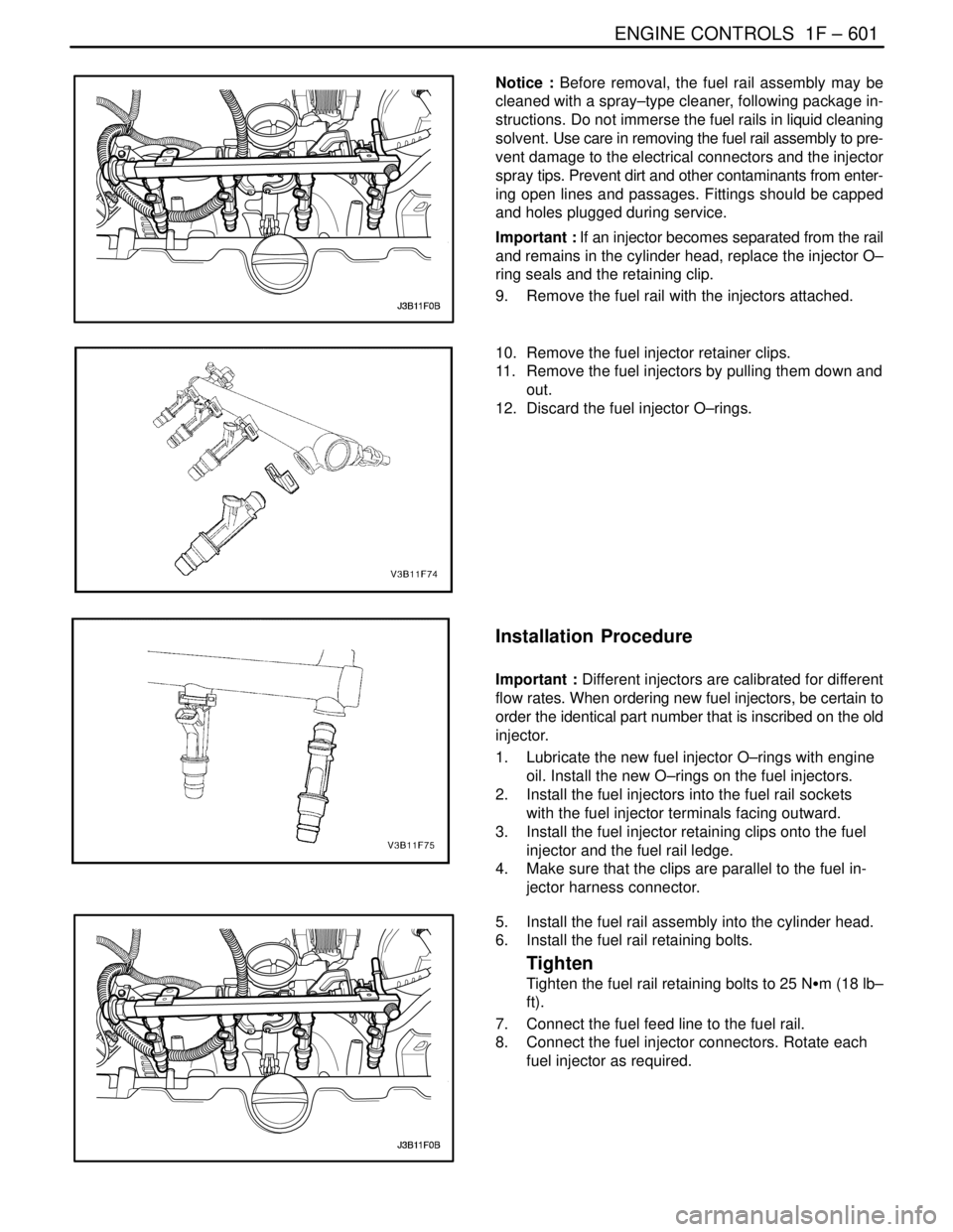
Notice : Before removal, the fuel rail assembly may be
cleaned with a spray–type cleaner, following package in-
structions. Do not immerse the fuel rails in liquid cleaning
solvent. Use care in removing the fuel rail assembly to pre-
vent damage to the electrical connectors and the injector
spray tips. Prevent dirt and other contaminants from enter-
ing open lines and passages. Fittings should be capped
and holes plugged during service.
Important : If an injector becomes separated from the rail
and remains in the cylinder head, replace the injector O–
ring seals and the retaining clip.
9. Remove the fuel rail with the injectors attached.
10. Remove the fuel injector retainer clips.
11. Remove the fuel injectors by pulling them down and
out.
12. Discard the fuel injector O–rings.
Installation Procedure
Important : Different injectors are calibrated for different
flow rates. When ordering new fuel injectors, be certain to
order the identical part number that is inscribed on the old
injector.
1. Lubricate the new fuel injector O–rings with engine
oil. Install the new O–rings on the fuel injectors.
2. Install the fuel injectors into the fuel rail sockets
with the fuel injector terminals facing outward.
3. Install the fuel injector retaining clips onto the fuel
injector and the fuel rail ledge.
4. Make sure that the clips are parallel to the fuel in-
jector harness connector.
5. Install the fuel rail assembly into the cylinder head.
6. Install the fuel rail retaining bolts.
Tighten
Tighten the fuel rail retaining bolts to 25 NSm (18 lb–
ft).
7. Connect the fuel feed line to the fuel rail.
8. Connect the fuel injector connectors. Rotate each
fuel injector as required.
Page 872 of 2643

1F – 626IENGINE CONTROLS
DAEWOO V–121 BL4
EXHAUST GAS RECIRCULATION
VA LV E
The Exhaust Gas Recirculation (EGR) system is used on
engines equipped with an automatic transaxle to lower
NOx (oxides of nitrogen) emission levels caused by high
combustion temperature. The EGR valve is controlled by
the engine control module (ECM). The EGR valve feeds
small amounts of exhaust gas into the intake manifold to
decrease combustion temperature. The amount of ex-
haust gas recirculated is controlled by variations in vacu-
um and exhaust back pressure. If too much exhaust gas
enters, combustion will not take place. For this reason,
very little exhaust gas is allowed to pass through the valve,
especially at idle.
The EGR valve is usually open under the following condi-
tions:
S Warm engine operation.
S Above idle speed.
Results of Incorrect Operation
Too much EGR flow tends to weaken combustion, causing
the engine to run roughly or to stop. With too much EGR
flow at idle, cruise, or cold operation, any of the following
conditions may occur:
S The engine stops after a cold start.
S The engine stops at idle after deceleration.
S The vehicle surges during cruise.
S Rough idle.
If the EGR valve stays open all the time, the engine may
not idle. Too little or no EGR flow allows combustion tem-
peratures to get too high during acceleration and load con-
ditions. This could cause the following conditions:
S Spark knock (detonation)
S Engine overheating
S Emission test failure
INTAKE AIR TEMPERATURE
SENSOR
The Intake Air Temperature (IAT) sensor is a thermistor,
a resistor which changes value based on the temperature
of the air entering the engine. Low temperature produces
a high resistance (4,500 ohms at –40°F [–40°C]), while
high temperature causes a low resistance (70 ohms at
266°F [130°C]).
The engine control module (ECM) provides 5 volts to the
IAT sensor through a resistor in the ECM and measures
the change in voltage to determine the IAT. The voltage will
be high when the manifold air is cold and low when the air
is hot. The ECM knows the intake IAT by measuring the
voltage.
The IAT sensor is also used to control spark timing when
the manifold air is cold.
A failure in the IAT sensor circuit sets a diagnostic trouble
code P0112 or P0113.
IDLE AIR CONTROL VALVE
Notice : Do not attempt to remove the protective cap to
readjust the stop screw. Misadjustment may result in dam-
age to the Idle Air Control (IAC) valve or to the throttle
body.
The IAC valve is mounted on the throttle body where it
controls the engine idle speed under the command of the
engine control module (ECM). The ECM sends voltage
pulses to the IAC valve motor windings, causing the IAC
valve pintle to move in or out a given distance (a step or
count) for each pulse. The pintle movement controls the
airflow around the throttle valves which, in turn, control the
engine idle speed.
The desired idle speeds for all engine operating conditions
are programmed into the calibration of the ECM. These
programmed engine speeds are based on the coolant
temperature, the park/neutral position switch status, the
vehicle speed, the battery voltage, and the A/C system
pressure (if equipped).
The ECM ”learns” the proper IAC valve positions to
achieve warm, stabilized idle speeds (rpm) desired for the
various conditions (park/neutral or drive, A/C on or off, if
equipped). This information is stored in ECM ”keep alive”
memories. Information is retained after the ignition is
turned OFF. All other IAC valve positioning is calculated
based on these memory values. As a result, engine varia-
tions due to wear and variations in the minimum throttle
valve position (within limits) do not affect engine idle
speeds. This system provides correct idle control under all
conditions. This also means that disconnecting power to
the ECM can result in incorrect idle control or the necessity
to partially press the accelerator when starting until the
ECM relearns idle control.
Engine idle speed is a function of total airflow into the en-
gine based on the IAC valve pintle position, the throttle
valve opening, and the calibrated vacuum loss through ac-
cessories. The minimum throttle valve position is set at the
factory with a stop screw. This setting allows enough air-
flow by the throttle valve to cause the IAC valve pintle to
be positioned a calibrated number of steps (counts) from
the seat during ”controlled” idle operation. The minimum
throttle valve position setting on this engine should not be
considered the ”minimum idle speed,” as on other fuel in-
jected engines. The throttle stop screw is covered with a
plug at the factory following adjustment.
If the IAC valve is suspected as the cause of improper idle
speed, refer to ”Idle Air Control System Check” in this sec-
tion.
MANIFOLD ABSOLUTE PRESSURE
SENSOR
The Manifold Absolute Pressure (MAP) sensor measures
the changes in the intake manifold pressure which result
from engine load and speed changes. It converts these to
a voltage output.
Page 875 of 2643

ENGINE CONTROLS 1F – 629
DAEWOO V–121 BL4
tentially interfere with the operation of the Exhaust Gas
Recirculation (EGR) valve and thereby turn on the MIL.
Small leaks in the exhaust system near the post catalyst
oxygen sensor can also cause the MIL to turn on.
Aftermarket electronics, such as cellular phones, stereos,
and anti–theft devices, may radiate electromagnetic inter-
ference (EMI) into the control system if they are improperly
installed. This may cause a false sensor reading and turn
on the MIL.
Environment
Temporary environmental conditions, such as localized
flooding, will have an effect on the vehicle ignition system.
If the ignition system is rain–soaked, it can temporarily
cause engine misfire and turn on the MIL.
Refueling
A new EOBD diagnostic checks the integrity of the entire
Evaporative (EVAP) Emission system. If the vehicle is re-
started after refueling and the fuel cap is not secured cor-
rectly, the on–board diagnostic system will sense this as
a system fault, turn on the MIL, and set DTC P0440.
Vehicle Marshaling
The transportation of new vehicles from the assembly
plant to the dealership can involve as many as 60 key
cycles within 2 to 3 miles of driving. This type of operation
contributes to the fuel fouling of the spark plugs and will
turn on the MIL with a set DTC P0300.
Poor Vehicle Maintenance
The sensitivity of EOBD diagnostics will cause the MIL to
turn on if the vehicle is not maintained properly. Restricted
air filters, fuel filters, and crankcase deposits due to lack
of oil changes or improper oil viscosity can trigger actual
vehicle faults that were not previously monitored prior to
EOBD. Poor vehicle maintenance can not be classified as
a ”non–vehicle fault,” but with the sensitivity of EOBD
diagnostics, vehicle maintenance schedules must be
more closely followed.
Severe Vibration
The Misfire diagnostic measures small changes in the
rotational speed of the crankshaft. Severe driveline vibra-
tions in the vehicle, such as caused by an excessive
amount of mud on the wheels, can have the same effect
on crankshaft speed as misfire and, therefore, may set
DTC P0300.
Related System Faults
Many of the EOBD system diagnostics will not run if the
engine controlmodule (ECM) detects a fault on a related
system or component. One example would be that if the
ECM detected a Misfire fault, the diagnostics on the cata-
lytic converter would be suspended until the Misfire fault
was repaired. If the Misfire fault is severe enough, the cat-
alytic converter can be damaged due to overheating andwill never set a Catalyst DTC until the Misfire fault is re-
paired and the Catalyst diagnostic is allowed to run to
completion. If this happens, the customer may have to
make two trips to the dealership in order to repair the ve-
hicle.
SERIAL DATA COMMUNICATIONS
Class II Serial Data Communications
Government regulations require that all vehicle manufac-
turers establish a common communication system. This
vehicle utilizes the ”Class II” communication system. Each
bit of information can have one of two lengths: long or
short. This allows vehicle wiring to be reduced by transmit-
ting and receiving multiple signals over a single wire. The
messages carried on Class II data streams are also priori-
tized. If two messages attempt to establish communica-
tions on the data line at the same time, only the message
with higher priority will continue. The device with the lower
priority message must wait. Themost significant result of
this regulation is that it provides scan tool manufacturers
with the capability to access data from any make or model
vehicle that is sold.
The data displayed on the other scan tool will appear the
same, with some exceptions. Some scan tools will only be
able to display certain vehicle parameters as values that
are a coded representation of the true or actual value. On
this vehicle the scan tool displays the actual values for ve-
hicle parameters. It will not be necessary to perform any
conversions from coded values to actual values.
ON–BOARD DIAGNOSTIC (EOBD)
On–Board Diagnostic Tests
A diagnostic test is a series of steps, the result of which is
a pass or fail reported to the diagnostic executive. When
a diagnostic test reports a pass result, the diagnostic
executive records the following data:
S The diagnostic test has been completed since the
last ignition cycle.
S The diagnostic test has passed during the current
ignition cycle.
S The fault identified by the diagnostic test is not cur-
rently active.
When a diagnostic test reports a fail result, the diagnostic
executive records the following data:
S The diagnostic test has been completed since the
last ignition cycle.
S The fault identified by the diagnostic test is current-
ly active.
S The fault has been active during this ignition cycle.
S The operating conditions at the time of the failure.
Remember, a fuel trim Diagnostic Trouble Code (DTC)
may be triggered by a list of vehicle faults. Make use of all
information available (other DTCs stored, rich or lean con-
dition, etc.) when diagnosing a fuel trim fault.
Page 877 of 2643

ENGINE CONTROLS 1F – 631
DAEWOO V–121 BL4
S Barometric Pressure (BARO)
S Intake Air Temperature (IAT)
S Throttle Position (TP)
S High canister purge
S Fuel trim
S A/C on
Trip
Technically, a trip is a key–on run key–off cycle in which all
the enable criteria for a given diagnostic are met, allowing
the diagnostic to run. Unfortunately, this concept is not
quite that simple. A trip is official when all the enable crite-
ria for a given diagnostic are met. But because the enable
criteria vary from one diagnostic to another, the definition
of trip varies as well. Some diagnostics are run when the
vehicle is at operating temperature, some when the ve-
hicle first starts up; some require that the vehicle be cruis-
ing at a steady highway speed, some run only when the
vehicle is at idle; some diagnostics function with the
Torque Converter Clutch (TCC) disabled. Some run only
immediately following a cold engine startup.
A trip then, is defined as a key–on run key–off cycle in
which the vehicle was operated in such a way as to satisfy
the enables criteria for a given diagnostic, and this diag-
nostic will consider this cycle to be one trip. However,
another diagnostic with a different set of enable criteria
(which were not met) during this driving event, would not
consider it a trip. No trip will occur for that particular diag-
nostic until the vehicle is driven in such a way as to meet
all the enable criteria
Diagnostic Information
The diagnostic charts and functional checks are designed
to locate a faulty circuit or component through a process
of logical decisions. The charts are prepared with the re-
quirement that the vehicle functioned correctly at the time
of assembly and that there are not multiple faults present.
There is a continuous self–diagnosis on certain control
functions. This diagnostic capability is complimented by
the diagnostic procedures contained in this manual. The
language of communicating the source of the malfunction
is a system of diagnostic trouble codes. When a malfunc-
tion is detected by the control module, a diagnostic trouble
code is set and the Malfunction Indicator Lamp (MIL) is illu-
minated.
Malfunction Indicator Lamp (MIL)
The Malfunction Indicator Lamp (MIL) is required by On–
Board Diagnostics (EOBD) that it illuminates under a strict
set of guide lines.
Basically, the MIL is turned on when the engine control
module (ECM) detects a DTC that will impact the vehicle
emissions.The MIL is under the control of the Diagnostic Executive.
The MIL will be turned on if an emissions–related diagnos-
tic test indicates a malfunction has occurred. It will stay on
until the system or component passes the same test, for
three consecutive trips, with no emissions related faults.
Extinguishing the MIL
When the MIL is on, the Diagnostic Executive will turn off
the MIL after three consecutive trips that a ”test passed”
has been reported for the diagnostic test that originally
caused the MIL to illuminate. Although the MIL has been
turned off, the DTC will remain in the ECM memory (both
Freeze Frame and Failure Records) until forty (40) warm–
up cycles after no faults have been completed.
If the MIL was set by either a fuel trim or misfire–related
DTC, additional requirements must be met. In addition to
the requirements stated in the previous paragraph, these
requirements are as follows:
S The diagnostic tests that are passed must occur
with 375 rpm of the rpm data stored at the time the
last test failed.
S Plus or minus ten percent of the engine load that
was stored at the time the last test failed. Similar
engine temperature conditions (warmed up or
warming up) as those stored at the time the last
test failed.
Meeting these requirements ensures that the fault which
turned on the MIL has been corrected.
The MIL is on the instrument panel and has the following
functions:
S It informs the driver that a fault that affects vehicle
emission levels has occurred and that the vehicle
should be taken for service as soon as possible.
S As a system check, the MIL will come on with the
key ON and the engine not running. When the en-
gine is started, the MIL will turn OFF.
S When the MIL remains ON while the engine is run-
ning, or when a malfunction is suspected due to a
driveability or emissions problem, an EOBD System
Check must be performed. The procedures for
these checks are given in EOBD System Check.
These checks will expose faults which may not be
detected if other diagnostics are performed first.
Data Link Connector (DLC)
The provision for communicating with the control module
is the Data Link Connector (DLC). The DLC is used to con-
nect to a scan tool. Some common uses of the scan tool
are listed below:
S Identifying stored DTCs.
S Clearing DTCs.
S Performing output control tests.
S Reading serial data.
Page 1014 of 2643

4–2WUSAGE AND CAPACITY OF FUSES IN FUSE BLOCK
1. ENGINE ROOM RELAY AND FUSE BLOCK
1) POSITION OF RELAY AND FUSE
2) USAGE OF FUSE IN ENGINE FUSE BLOCK
Power
Supply
ClassificationFuse
NoCapacityUsage
Ef130ABattery Main(F13~F16, F21~F24)
Ef260AEBCM, Oil Feeding Conenctor
Ef330ABlower Relay
30SBEf430AIgnition Switch–2
BAT (+)(Slow–BlownEf530AIgnition Switch–1
Fuse)Ef620ACooling Fan Low Relay
Ef730ADefog Relay
Ef830ACooling Fan HI Relay
IGN2 (15A)Ef920APower Window Switch
IGN1 (15)Ef1015AFuel Connector, ECM (MR–140), LEGR, EI
System
30Ef1110AECM, Main Relay (Sirius D4)
BAT(+)Ef1225AHead lamp Relay, ILLUM. Relay
Ef1315ABrake Switch
IGN2 (15A)Ef1420APower Window Switch
56 LIGHTEf1515AHead Lamp HI
30Ef1615AHorn Relay, siren, Hood Contact Switch
BAT(+)Ef1710AA/C Comp. Relay
IGN1 (15)Ef1815AFuel Pump
30 BAT(+)Ef1915ACluster, Key Remind S/W, Folding Mirror Unit, MAP
Lamp, Room Lamp, Trunk Open lamp, Trunk
Open S/W
56 LIGHTBlade TypeEf2010AHead Lamp Low
IGN1 (15)/FuseEf2115AEVAP Canister Purge Solenoid, HO2S, Cooling
Fan Relay
30 BAT(+)Ef2215Ainjector, EGR, EEGR
ILLUM. (58)Ef2310ALicense Plate Lamp, Chime Bell, Tail Lamp, Head
Lamp
30 BAT (+)Ef2415AFog Lamp Relay
IGN2 (15A)Ef2510AElectric OSRV Mirror
30 BAT (+)Ef2615ACentral Door Lock Unit
56 LIGHTEf2710AHead Lamp Low
ILLUM. (58)Ef2810AILLUM. Circuit, Head Lamp, Tail Lamp
SPAREEf2910ANot Used
Ef3015ANot Used
Ef3125ANot Used
Page 1016 of 2643

4–4WUSAGE AND CAPACITY OF FUSES IN FUSE BLOCK
3. POSITION OF CONTROL UNIT, RELAY AND PART NUMBER
1) ENGINE FUSE BLOCK
Part Name
Part No.Remarks
Front Fog Relay96190187
ILLUM. Relay96190187
Cooling Fan Low Relay96190189
Cooling Fan HI Relay96190189
A/C Comp. Relay96190187
Horn Relay96190187
Defog Relay96190189
Fuel Relay96190189
Main/Ignition Relay96190189
Power Window Relay96190189
Head Lamp Relay96190189
2) BEHIND DRIVER LEG ROOM CONNECTOR HOLDER
Part Name
Part No.Remarks
Rear Fog Relay96344573
PNP Relay96190189
Blink Unit96312545
Blower Relay96190189
3) DRIVER LEG ROOM
Part Name
Part No.Remarks
Chime Bell96459510
TCM (MR–140/HV–240)96342619
TCM (SIRIUS D4)96497032
4) BEHIND LEFT HEAD LAMP
Part Name
Part No.Remarks
Cooling Fan Control Relay96251271
5) UNDER LEFT PASSENGER LEG ROOM
Part Name
Part No.Remarks
Central Door Lock Unit96552824
6) FLOOR PANEL BELOW CONSOLE
Part Name
Part No.Remarks
Anti Theft Control Unit96407681Wes t Euro
96404668General
SDM96406712
7) BESIDE ENGINE FUSE BLOCK
Part Name
Part No.Remarks
EBCM96549742
Page 1399 of 2643

5A1 – 50IZF 4 HP 16 AUTOMATIC TRANSAXLE
DAEWOO V–121 BL4
TCC shudder should only occur during the APPLY and/or
RELEASE of the Lock up clutch.
While TCC Is Applying Or Releasing
If the shudder occurs while TCC is applying, the problem
can be within the transaxle or torque converter.
Something is not allowing the clutch to become fully en-
gaged, not allowing clutch to release, or is trying to release
and apply the clutch at the same time. This could be
caused by leaking turbine shaft seals, a restricted release
orifice, a distorted clutch or housing surface due to long
converter bolts, or defective friction material on the TCC
plate.
Shudder Occurs After TCC Has Applied :
In this case, most of the time there is nothing wrong with
the transaxle! As mentioned above, once the TCC has
been applied, it is very unlikely that will slip. Engine prob-
lems may go unnoticed under light throttle and load, but
become noticeable after TCC apply when going up a hill
or accelerating, due to the mechanical coupling between
engine and transaxle.
Important : Once TCC is applied there is no torque con-
verter assistance. Engine or driveline vibrations could be
unnoticeable before TCC engagement.
Inspect the following components to avoid misdiagnosis of
TCC shudder and possibly disassembling a transaxle and/
or replacing a torque converter unnecessarily :
S Spark plugs – Inspect for cracks, high resistance or
broken insulator.
S Plug wires – Lock in each end, if there is red dust
(ozone) or black substance (carbon) present, then
the wires are bad. Also look for a white discolor-
ation of the wire indicating arcing during hard accel-
eration.
S Distributor cap and rotor – look for broken or un–
crimped parts.
S Coil – look for black on bottom indication arcing
while engine is misfiring.
S Fuel injector – filter may be plugged.
S Vacuum leak – engine won’t get correct amount of
fuel. May run rich or lean depending on where the
leak is.S EGR valve – valve may let it too much unburnable
exhaust gas and cause engine to run lean.
S MAP sensor – like vacuum leak, engine won’t get
correct amount of fuel for proper engine operation.
S Carbon on intake valves – restricts proper flow or
air/fuel mixture into cylinders.
S Flat cam – valves don’t open enough to let proper
fuel/air mixture into cylinders.
S Oxygen sensor – may command engine too rich or
too lean for too long.
S Fuel pressure – may be too low.
S Engine mounts – vibration of mounts can be multi-
plied by TCC engagement.
S Axle joints – checks for vibration.
S TPS – TCC apply and release depends on the TPS
in many engines. If TPS is out of specification, TCC
may remain applied during initial engine starting.
S Cylinder balance – bad piston rings or poorly seal-
ing valves can cause low power in a cylinder.
S Fuel contamination – causes poor engine perfor-
mance.
TCM INITIALIZATION PROCEDURE
When one or more operations such as shown below are
performed, all learned contents which are stored in TCM
memory should be erased after the operations.
S When A/T H/W is replaced in a vehicle,
S When a used TCU is installed in other vehicle,
S When a vehicle condition is unstable (engine RPM
flare, TPS toggling and so on; at this kind of unsta-
ble conditions, mis–adaptation might be done).
1. Connect the Scan 100 with a DLC connector in a
vehicle.
2. Turn ignition switch ON.
3. Turn the power on for the Scan 100.
4. Follow the ”TCM LEARNED INITIALIZE” procedure
on the Scan 100 menu.
Notice : Before pushing ”Yes” Button for TCM initialization
on the Scan 100 screen, make sure that the condition is
as follows:
Condition :
1. Engine idle.
2. Select lever set ”P” range.
Page 2329 of 2643

9E – 30IINSTRUMENTATION/DRIVER INFORMATION
DAEWOO V–121 BL4
GENERAL DESCRIPTION
AND SYSTEM OPERATION
CIGAR LIGHTER
The cigar lighter is located in the front portion of the floor
console. To use the lighter, push it in completely. When the
lighter is hot, it will release itself from contact with the heat-
ing element. The lighter and the heating element can be
damaged if the lighter is not allowed to release itself fully
from the heating element.
ASHTRAY
The ashtray is located below the audio system. To access
the ashtray, pull it out from the center console. The ashtray
lamp will go on when the parking lamps or the headlamps
are turned on.
INSTRUMENT PANEL VENTS
The center and the side vents in the instrument panel can
be adjusted up and down and from side to side. The side
vents can also be aimed toward the side windows in order
to defog them.
GLOVE BOX
The glove box can be opened by pulling up on the latch
handle. The glove box must be removed in order to gain
access to the passenger’s side airbag module.
DIGTAL CLOCK
The digital clock is located in the instrument panel, above
the audio system. The clock is capable of a 12–hour or a
24–hour display.
INSTRUMENT CLUSTER
The instrument cluster is located above the steering col-
umn and in the instrument cluster trim panel. The instru-
ment cluster contains the instruments that provide the
driver with vehicle performance information. The instru-
ment cluster contains a speedometer, an odometer, a trip
odometer, a temperature gauge, a fuel gauge, and several
indicator lamps. For replacement of the indicator lamp
bulbs contained in the instrument cluster, refer to ”Instru-
ment Cluster Indicator Lamps Specifications” and”Instru-
ment Cluster Indicator Lamps” in this section.
SPEEDOMETER/ODOMETER/TRIP
ODOMETER
The speedometer measures the speed of the vehicle in
km/h (mph in some countries). It consists of an instrument
cluster gauge connected to the vehicle speed sensor
(VSS) on the transaxle output shaft.The odometer measures in kilometers (miles in some
countries) the total distance the vehicle has traveled since
it was manufactured. It consists of an instrument cluster
gauge connected to the VSS on the transaxle output shaft.
The trip odometer measures the distance the vehicle has
traveled since the odometer was last reset. It consists of
an instrument cluster gauge connected to the VSS on the
transaxle output shaft. The trip odometer can be reset to
zero at any time so that the driver can record the distance
traveled from any starting point.
FUEL GAUGE
The fuel gauge consists of an instrument cluster gauge
connected to a sending unit in the fuel tank.
The fuel gauge indicates the quantity of fuel in the tank
only when the ignition switch is turned to ON or ACC.
When the ignition is turned to LOCK or START, the pointer
may come to rest at any position.
TEMPERATURE GAUGE
The temperature gauge consists of an instrument cluster
gauge connected to a temperature sensor that is in con-
tact with the circulating engine coolant.
The temperature gauge indicates the temperature of the
coolant. Prolonged driving or idling in very hot weather
may cause the pointer to move beyond the center of the
gauge. The engine is overheating if the pointer moves into
the red zone at the upper limit of the gauge.
INSTRUMENT CLUSTER INDICATOR
LAMPS
The instrument cluster contains indicator lamps that indi-
cate the functioning of certain systems or the existence of
potential problems with the operation of the vehicle. The
indicator lamps are replaceable. For replacement of the in-
dicator lamps contained in the instrument cluster, refer to
”Instrument Cluster Indicator Lamps Specifications”
and”Instrument Cluster Indicator Lamps” in this section.
CHIME MODULE
The chime module is located above the instrument panel
fuse block and will sound in order to bring attention to one
or more of the following conditions:
S The lamps are on, the door is ajar, and the ignition
switch is not in ACC, ON, or START.
S The seat belt is unbuckled when the ignition switch
is in ON or START.
S The door is open when the ignition switch is in ON
or START.
S The key is left in the ignition switch when the igni-
tion is in LOCK and the door is open.