Head light DATSUN 210 1979 User Guide
[x] Cancel search | Manufacturer: DATSUN, Model Year: 1979, Model line: 210, Model: DATSUN 210 1979Pages: 548, PDF Size: 28.66 MB
Page 516 of 548
HALIDE
LEAK
DETECTOR
Since
the
propane
leak
detector
and
butane
leak
detector
are
the
same
in
respect
to
their
operation
this
section
describes
the
operation
of
the
propane
leak
detector
The
copper
screen
is
heated
by
the
Air
Conditioning
burning
of
propane
Refrigerant
gas
decomposes
to
color
the
flame
when
it
contacts
the
heated
screen
The
gas
to
be
checked
is
drawn
into
the
sampling
tube
and
sent
out
to
the
burner
A
refrigerant
leak
can
clearly
be
detected
by
variations
in
the
color
of
the
flame
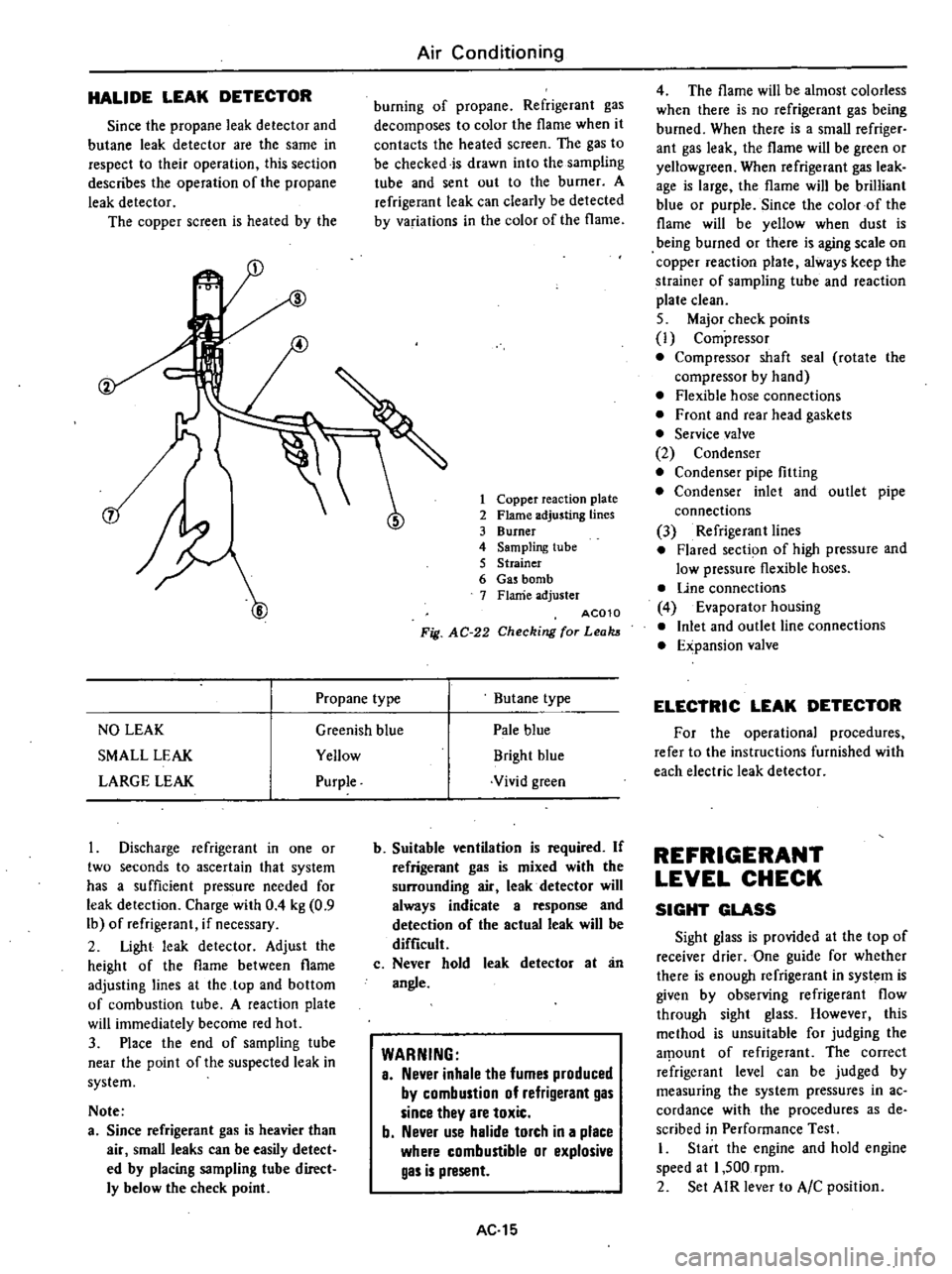
1
Copper
reaction
plate
2
Flame
adjusting
lines
3
Burner
4
Sampling
tube
5
Strainer
6
Gas
bomb
7
Flame
adjuster
AC010
Fig
AC
22
Checking
for
Leaks
4
The
flame
will
be
almost
colorless
when
there
is
no
refrigerant
gas
being
burned
When
there
is
a
small
refriger
ant
gas
leak
the
flame
will
be
green
or
yellowgreen
When
refrigerant
gas
leak
age
is
large
the
flame
will
be
brilliant
blue
or
purple
Since
the
color
of
the
flame
will
be
yellow
when
dust
is
being
burned
or
there
is
aging
scale
on
copper
reaction
plate
always
keep
the
strainer
of
sampling
tube
and
reaction
plate
clean
5
Major
check
points
l
Compressor
Compressor
shaft
seal
rotate
the
compressor
by
hand
Flexible
hose
connections
Front
and
rear
head
gaskets
Service
valve
2
Condenser
Condenser
pipe
fitting
Condenser
inlet
and
outlet
pipe
connections
3
Refrigerant
lines
Flared
section
of
high
pressure
and
low
pressure
flexible
hoses
Une
connections
4
Evaporator
housing
Inlet
and
outlet
line
connections
Expansion
valve
Propane
type
Butane
type
ELECTRIC
LEAK
DETECTOR
NO
LEAK
Greenish
blue
Pale
blue
For
the
operational
procedures
SMALL
LEAK
Yellow
Bright
blue
refer
to
the
instructions
furnished
with
LARGE
LEAK
Purple
Vivid
green
each
electric
leak
detector
Discharge
refrigerant
in
one
or
two
seconds
to
ascertain
that
system
has
a
sufficient
pressure
needed
for
leak
detection
Charge
with
0
4
kg
0
9
Ib
of
refrigeranl
if
necessary
2
Light
leak
detector
Adjust
the
height
of
the
flame
between
flame
adjusting
lines
at
the
top
and
bottom
of
combustion
tube
A
reaction
plate
will
immediately
become
red
hot
3
Place
the
end
of
sampling
tube
near
the
point
of
the
suspected
leak
in
system
Note
a
Since
refrigerant
gas
is
heavier
than
air
small
leaks
can
be
easily
detect
ed
by
placing
sampling
tube
direct
ly
below
the
check
point
b
Suitable
ventilation
is
required
If
refrigerant
gas
is
mixed
with
the
surrounding
air
leak
detector
will
always
indicate
a
response
and
detection
of
the
actual
leak
will
be
difficult
c
Never
hold
leak
detector
at
an
angle
WARNING
a
Never
inhale
the
fumes
produced
by
combustion
of
refrigerant
gas
since
they
are
toxic
b
Never
use
halide
torch
in
a
place
where
combustible
or
explosive
gas
is
present
AC
15
REFRIGERANT
LEVEL
CHECK
SIGHT
GLASS
Sight
glass
is
provided
at
the
top
of
receiver
drier
One
guide
for
whether
there
is
enough
refrigerant
in
syst
m
is
given
by
observing
refrigerant
flow
through
sight
glass
However
this
method
is
unsuitable
for
judging
the
aJTlount
of
refrigerant
The
correct
refrigeranl
level
can
be
judged
by
measuring
the
system
pressures
in
ac
cordance
with
the
procedures
as
de
scribed
in
Performance
Test
1
Start
the
engine
and
hold
engine
speed
al
1
500
rpm
2
Set
AIR
lever
to
AlC
position
Page 546 of 548
J
E
HEA
DLAMPIlH
fRQNT
COMO
uION
lAMP
IlH
c
D
HORN
I
fIlONTCOHIB
ATION
lAMPLH
Z
I
HEADLAMP
lH
fIlO
SlOE
MAIlKEII
l
PIIH
II
i
Jl
fllONT
SIDE
MARKER
LAMP
lH
BATTERY
fl
d
Wi
1
f
FUSlBlElINI
J
CO
OENSEII
C
Il
LrEFlhATOR
litn
J
HiERMM
TIlANSMITTUi
j
m
COMPIIESSO
MOOELS
BOOVU
1l1H
SUB
L
J
DISTIlIBUTOR
SPAllA
PLUGS
0
0
Ii
0
t
E
i
w
a
E
g
8
J
0
w
u
g
r
I
J
j
H
U
oo
i@
5
2
@
Ww
W
W
ai
o
ww
i
woO
a
i
Jwt
o
o
2
0
i
i
52
1
w
0
JwO
WJ
1979
FILAR
WIPEIl
SW
I
g
aml
ffll
CD
1o
i
CHECK
CONNECTOR
m
TOROON
r
O
L
GW
f
nttJ
p
ar
G
HAND
G
BIl
IUSW
SE
u
am
sw
J8
eI
8
HAZ
IlD
n
Gl
flASHER
UNITL
Y
G
TUIlN5IGN
l
flASHEIlUN
O
ow
w
IGHIIION
SW
LO
STEERINGlOCIISW
KICKOOWNSW
r
Ol
0
1
DOHS
L
d
CJ
CJ
R
I
I
STOPlAIOIP
SW
c
L
J
d
q
c
m
HAZARDSW
g
L
WIPER
WASHEII
SW
r
o
IIE
lURN
SlGNAl
HOIlN
SW
iE
lIGHTING
SW
DATSUN
210
I
II
I
W
PEII
BIIAIIE
SEAl
BEll
IoIOIOR
LEVU
TI
ElI
w
FUSE
BlOC
6
DJ
liDO
LAMP
W
l
l
HlP
i
1
iY
ow
0
L
ill
iJUlf
1IE
l1l
WWPIIESSUIIE
SW
WASHEII
MODElS
1f
II
Wm
I
TI
U
jJ
rm
fII
91n
l
j
Ii
W
I
w
j
S
e
000
Sv
WIRING
DIAGRAM
SEDAN
HATCHBACK
i
I
ow
ow
f
I
GiD
1
2
w
F
w
0
Wt
f
F
fo
e
l
lL
9
rr
hS
lHlAlllI
CONllIOl
lllUIOI
NATI
lI
I
i
l1iKiI
l
w
ijij
ijf
r
r
10
o
mm
WI
llj
H
n
lJ
6
Jffi
@
Fie
D
SOLENOID
1
IoIODElS
C3
t
11
I
lG
lG
B
LII
W
W
C
c
G
G
GY
0
I
Ii
II
I
BUZZEll
m
lm
1
RADIO
rj
S
J
F
OHI
cJD
L
SPEAKE
G
J
ASHT
AT
G
c
lllU
NATI
N
Gl
J
C
GAIIE11
R
J
UGHI
Gs
JTn
fllU
ATIl
r
CO
IlDLIIHEOSTA
J
aa
TAC
lllI
Jo
l
lAr
hI
4
I
TIINIIH
TUIINll1
3E1
I
o
G8
J
ReO
ow
0
COhlBIN
TI
NlIIHER
Il
IILO
II
DHOGGEII
sw
1
P