oil type DATSUN 210 1979 User Guide
[x] Cancel search | Manufacturer: DATSUN, Model Year: 1979, Model line: 210, Model: DATSUN 210 1979Pages: 548, PDF Size: 28.66 MB
Page 144 of 548
INSPECTION
Entire
system
I
Make
a
thorough
vjsual
check
of
E
G
R
control
system
If
necessary
wipe
away
oil
to
facilitate
inspection
If
any
hoses
are
cracked
or
broken
replace
2
With
engine
stopped
inspect
E
G
R
control
valve
for
any
indication
of
binding
or
sticking
by
moving
dia
phragm
of
control
valve
upwards
with
a
finger
3
With
engine
running
inspect
E
G
R
control
valve
and
thermal
vacu
um
valve
for
normal
operation
1
When
engine
coolant
tempera
tun
is
low
Make
sure
that
E
G
R
control
valve
does
not
operate
when
engine
speed
is
increased
from
idling
to
3
000
to
3
500
rpm
Place
a
finger
on
the
diaphragm
of
E
G
R
control
valve
to
check
for
valve
operation
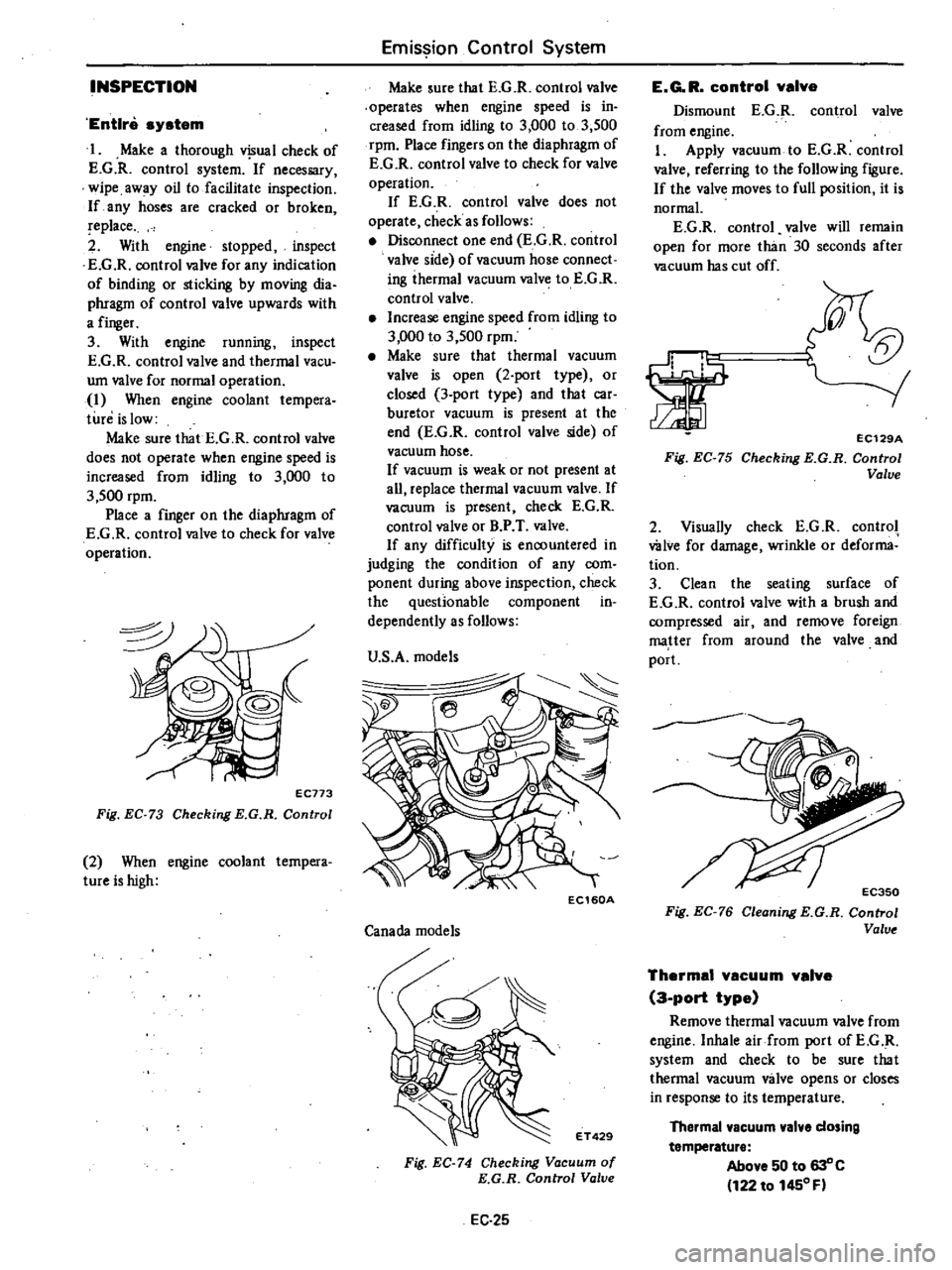
EC773
Fig
EC
73
Checking
E
G
R
Control
2
When
engine
coolant
tempera
tureishigh
Emission
Control
System
Make
sure
that
E
G
R
control
valve
operates
when
engine
speed
is
in
creased
from
idling
to
3
000
to
3
500
rpm
Place
fingers
on
the
diaphragm
of
E
G
R
control
valve
to
check
for
valve
operation
If
E
G
R
control
valve
does
not
operate
check
as
follows
Disconnect
one
end
E
G
R
control
valve
side
of
vacuum
hose
connect
ing
ihermal
vacuum
valve
to
E
G
R
control
valve
Increase
engine
speed
from
idling
to
3
000
to
3
500
rpm
Make
sure
that
thermal
vacuum
valve
is
open
2
port
type
or
closed
3
port
type
and
that
car
buretor
vacuum
is
present
at
the
end
E
G
R
control
valve
side
of
vacuum
hose
If
vacuum
is
weak
or
not
present
at
all
replace
thermal
vacuum
valve
If
vacuum
is
present
check
E
G
R
control
valve
or
B
P
T
valve
If
any
difficulty
is
encountered
in
judging
the
condition
of
any
com
ponent
during
above
inspection
check
the
questionable
component
in
dependently
as
follows
U
S
A
models
Ie
EC160A
Canada
models
ET429
Fig
EC
74
Checking
Vacuum
of
E
G
R
Control
Valve
EC
25
E
G
R
control
valve
Dismount
E
G
R
control
valve
from
engine
I
Apply
vacuum
to
E
G
R
control
valve
referring
to
the
following
figure
If
the
valve
moves
to
full
position
it
is
normal
E
G
R
control
valve
will
remain
open
for
more
than
30
seconds
after
vacuum
has
cut
off
5t
orr
rl
1
1
Fig
EC
75
EC129A
Checking
E
G
R
Control
Valve
2
Visually
check
E
G
R
control
wive
for
damage
wrinkle
or
deforma
tion
3
Clean
the
seating
surface
of
E
G
R
control
valve
with
a
brush
and
compressed
air
and
remove
foreign
matter
from
around
the
valve
and
port
Fig
EC
76
Cleoning
E
G
R
Control
Valve
Thermal
vacuum
valve
3
port
type
Remove
thermal
vacuum
valve
from
engine
Inhale
air
from
port
ofE
G
R
system
and
check
to
be
sure
that
thermal
vacuum
valve
opens
or
closes
in
response
to
its
temperature
Thermal
vacuum
valve
dosing
temperature
Above
50
to
630
C
122
to
1450
F
Page 163 of 548
CONSTRUCTION
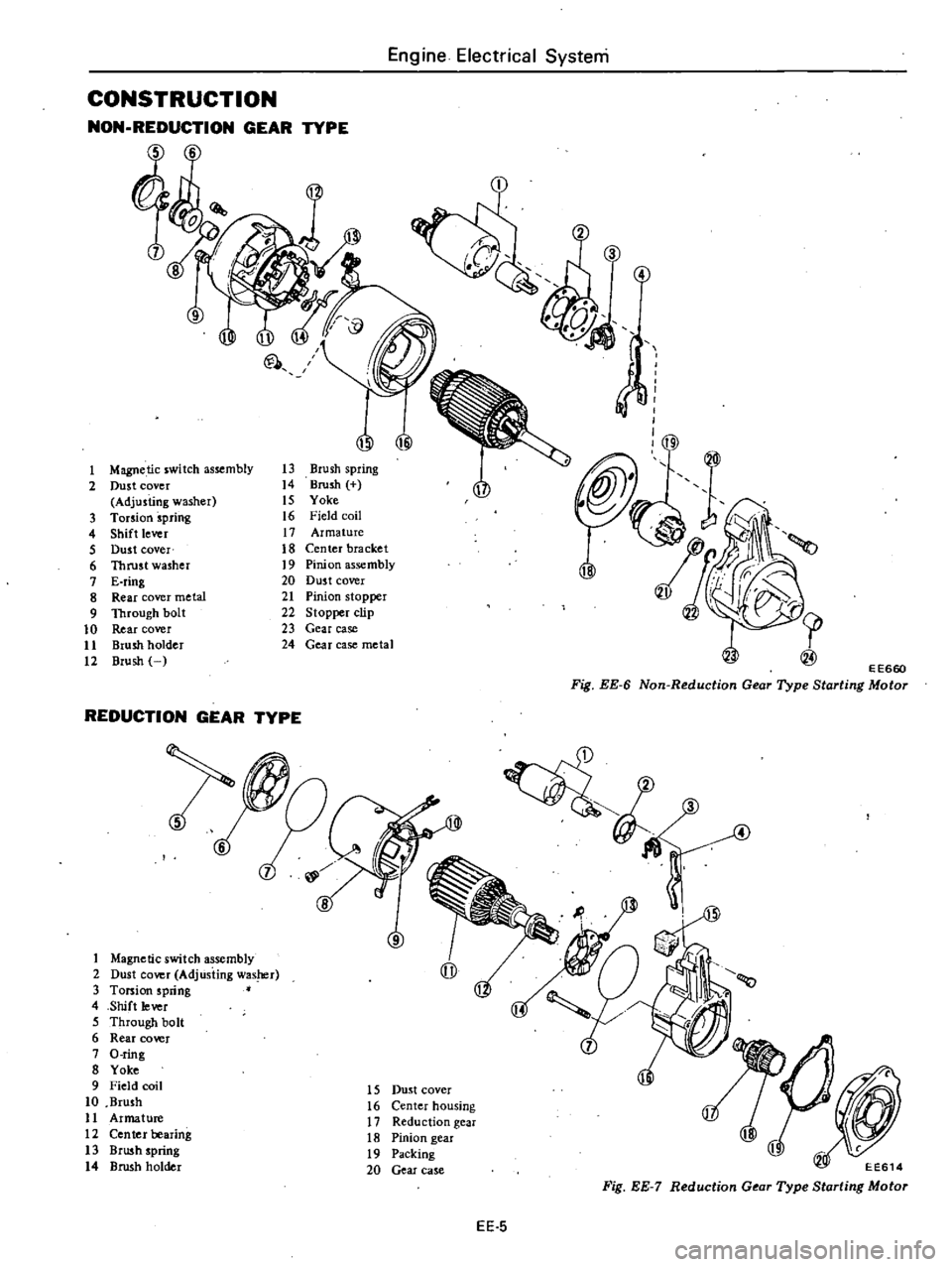
NON
REDUCTION
GEAR
TYPE
6
00
1
Magnetic
switch
assembly
2
Dust
cover
Adjusting
washer
3
Torsion
spring
4
Shift
lever
5
Dust
cover
6
Thrust
washer
7
E
ring
8
Rear
cover
metal
9
Through
bolt
10
Rear
cover
11
Brush
holder
12
Brush
U
Ul
@
13
Brush
spring
14
Brush
IS
Yoke
16
Field
coil
17
Armature
18
Center
bracket
19
Pinion
assembly
20
Dus
t
cover
21
Pinion
stopper
22
Stopper
clip
23
Gear
case
24
Gear
case
metal
REDUCTION
GEAR
TYPE
1
Magnetic
switch
assembly
2
Dust
cover
AdjUsting
was
r
3
Torsion
spring
4
Shift
lever
5
Through
bolt
6
Rear
cover
7
O
ring
8
Yoke
9
Field
coil
10
Brush
11
Armature
12
Ceo
tel
bearing
13
Brush
spring
14
Brush
holder
6
8
Engine
Electrical
Systeni
3
@
1
E
E660
Fig
EE
6
Non
Reduction
Gear
Type
Starting
Motor
4
4
15
Dust
cover
16
Center
housing
17
Reduction
gear
18
Pinion
gear
19
Packing
20
Gear
case
EE614
Fig
EE
7
Reduction
Gear
Type
Starting
Motor
EE
5
Page 164 of 548
REMOVAL
AND
INSTALLATION
Disconnect
battery
ground
cable
Disconnect
harness
connector
and
battery
cable
at
magnetic
switch
2
Remove
bolts
securing
starting
motor
to
transmission
case
Pull
start
iog
motor
forward
and
remove
it
3
Inst
1I
starting
motor
in
reverse
order
of
removal
DISASSEMBLY
NON
REDUCTION
GEAR
TYPE
I
Disconnect
connecting
plate
from
M
terminal
of
magnetic
switch
Re
move
two
screws
securing
magnetic
switch
and
remove
magnetic
switch
assembly
2
Remove
dust
cover
E
ring
and
thrust
washer
s
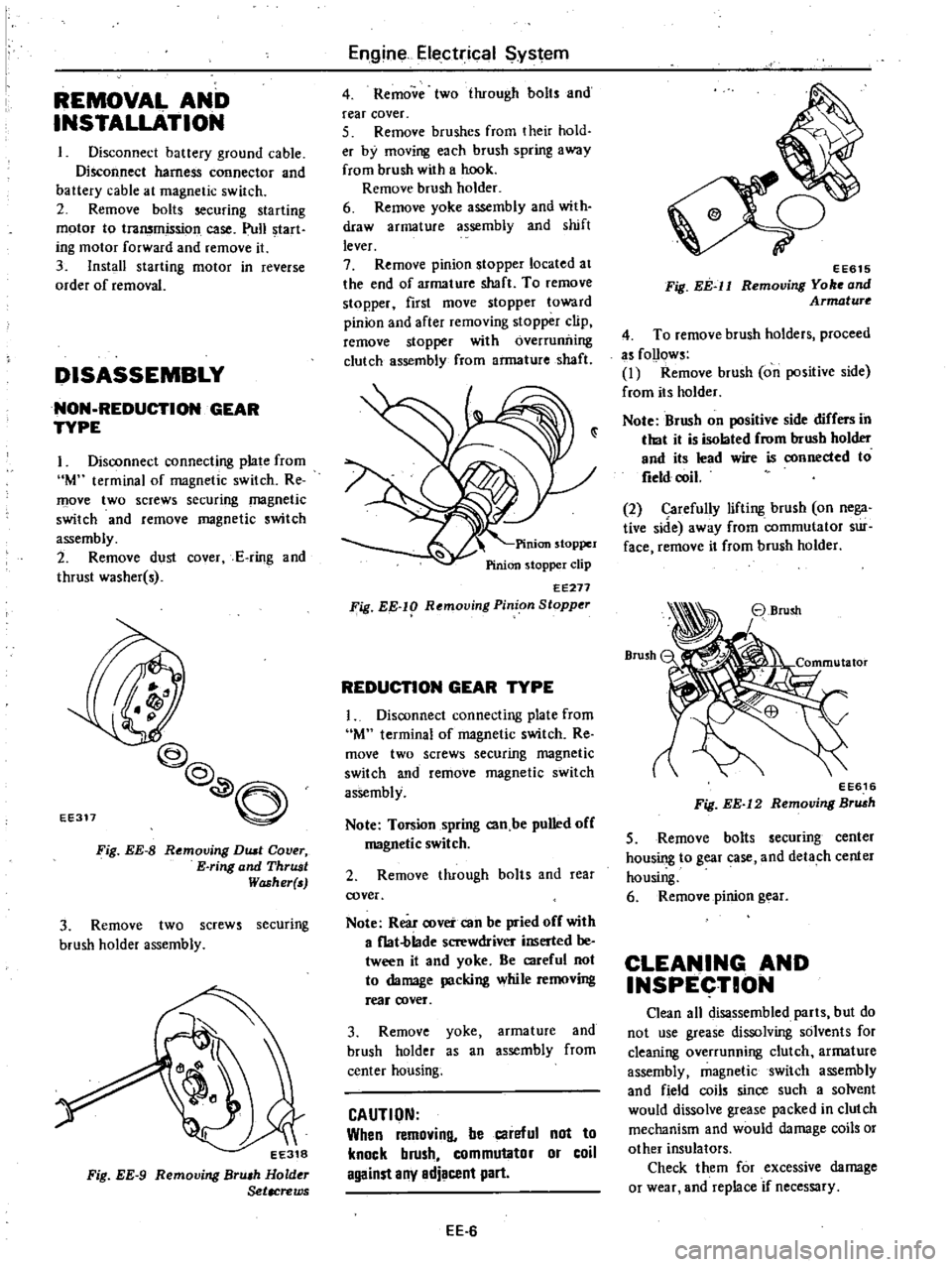
EE311
@@
O
Fig
EE
8
Removing
DUll
Cover
E
ring
and
ThrUJJt
Washer
3
Remove
two
screws
securing
brush
holder
assembly
EE318
Fig
EE
9
Removing
Bru
h
Hold
Setacrews
Engine
Electrical
ystem
4
Remove
two
ihrough
bolts
and
rear
cover
5
Remove
brushes
from
their
hold
er
by
moving
each
brush
spring
away
from
brush
with
a
hook
Remove
brush
holder
6
Remove
yoke
assembly
and
with
draw
armature
assembly
and
shift
lever
7
Remove
pinion
stopper
located
at
the
end
of
armature
shaft
To
remove
stopper
first
move
stopper
toward
pinion
and
after
removing
stopper
clip
remove
stopper
with
overruniling
clutch
assembly
from
armature
shaft
EE271
Fig
EE
lg
Rf
moving
Pinion
Stopper
REDUCTION
GEAR
TYPE
1
Disconnect
connecting
plate
from
M
terminal
of
magnetic
switch
Re
move
two
screws
securing
magnetic
switch
and
remove
magnetic
switch
assembly
Note
Torsion
spring
can
be
pulled
off
magnetic
switch
2
Remove
through
baIts
and
rea
cover
Note
Rear
cover
can
be
pried
off
with
a
f1at
blade
screwdriver
inserted
be
tween
it
and
yoke
Be
careful
not
to
damage
packing
while
removing
reaf
cover
3
Remove
yoke
armature
and
brush
holder
as
an
assembly
from
center
housing
CAUTION
When
removing
be
careful
not
to
knock
brush
commutator
or
coil
against
any
adjacent
part
EE
6
o
7
EE615
Fig
EE
ll
Removing
Yo
and
Armature
4
To
remove
brush
holders
proceed
as
follows
I
Remove
brush
on
positive
side
from
its
holder
Note
Brush
on
positive
side
differs
in
that
it
is
isolated
from
brush
holder
and
its
lead
wire
is
connected
to
field
coil
2
Carefully
lifting
brush
on
nega
tive
side
away
from
commutator
sur
face
remove
it
from
brush
holder
EE616
Fig
EE
12
Removing
Br
h
5
Remove
bolts
securing
center
housing
to
gear
case
and
detach
center
housing
6
Remove
pinion
gear
CLEANING
AND
INSPECTION
Clean
all
disassembled
parts
but
do
not
use
grease
dissolving
solvents
for
cleaning
overrunning
clutch
armature
assembly
magnetic
switch
assembly
and
field
coils
since
such
a
solvent
would
dissolve
grease
packed
in
clutch
mechanism
and
would
damage
coils
or
other
insulators
Check
them
for
excessive
damage
or
wear
and
replace
if
necessary
Page 165 of 548
TERMINAL
Check
terminal
for
damage
and
wear
and
replace
magnetic
switch
assembly
if
necessary
FIELD
COIL
Check
field
coil
for
insulation
If
the
insulation
of
oil
is
damaged
or
worn
it
should
be
replaced
Testing
field
coil
for
continuity
Connect
the
probe
of
a
circuit
tester
or
an
ohmmeter
to
field
coil
two
positive
terminal
of
positive
brush
holder
If
tester
shows
no
continuity
field
circuit
or
coil
is
open
Replace
it
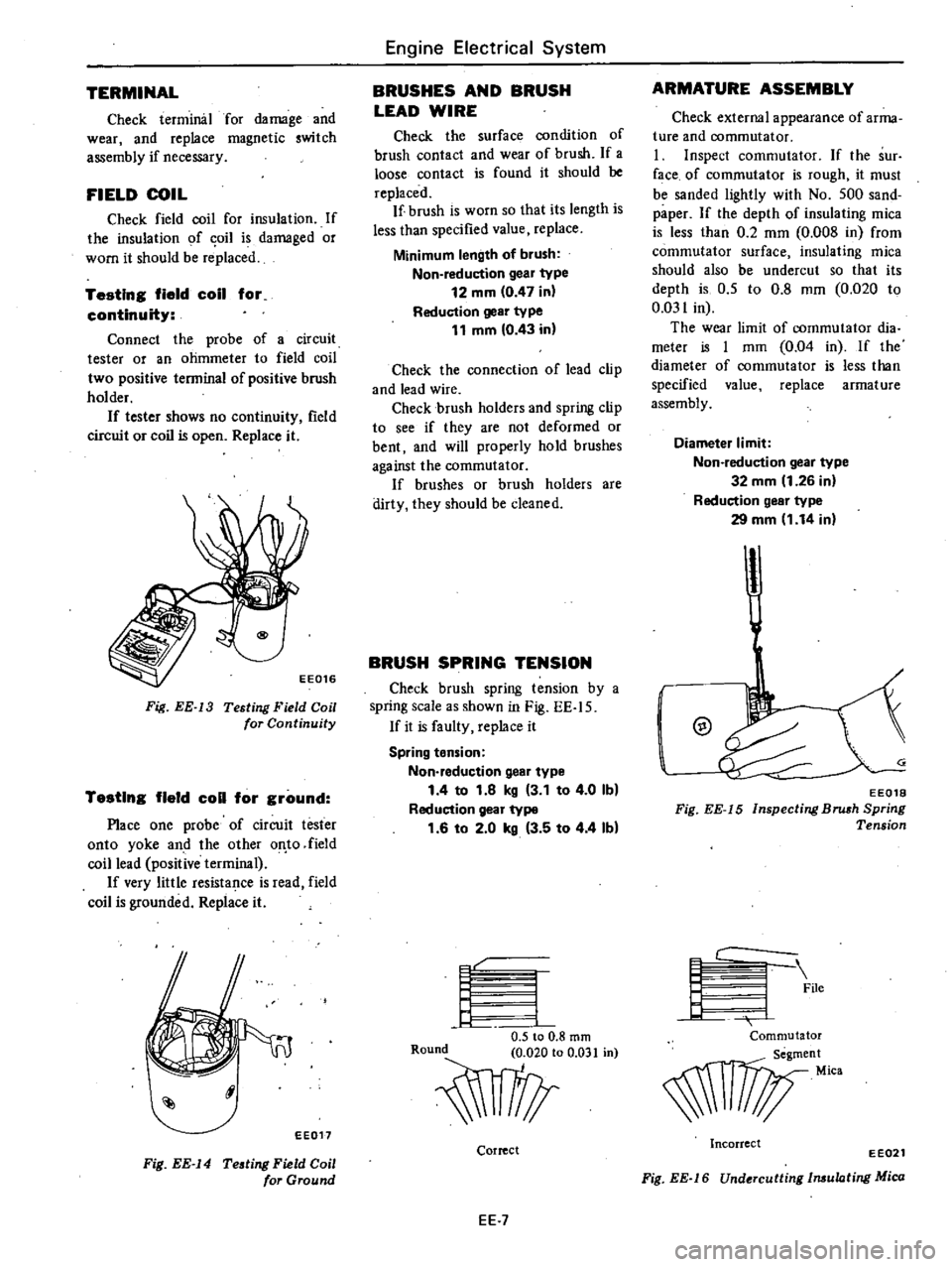
Fig
EE
13
Testing
Field
Coil
for
Continuity
Testing
field
coli
for
ground
Place
one
probe
of
circuit
tester
onto
yoke
and
the
other
of
to
field
coil
lead
positive
terminal
If
very
little
resistance
is
read
field
coil
is
grounded
Replace
it
I
EE017
Fig
EE
14
Testing
Field
Coil
for
Ground
Engine
Electrical
System
BRUSHES
AND
BRUSH
LEAD
WIRE
Check
the
surface
condition
of
brush
contact
and
wear
of
brush
If
a
loose
contact
is
found
it
should
be
replaced
If
brush
is
worn
so
that
its
length
is
less
than
specified
value
replace
Minimum
length
of
brush
Non
reduction
gear
type
12
mm
0
47
in
Reduction
gear
type
11
mm
0
43
in
Check
the
connection
of
lead
clip
and
lead
wire
Check
brush
holders
and
spring
clip
to
see
if
they
are
not
deformed
or
bent
and
will
properly
hold
brushes
against
the
commutator
If
brushes
or
brush
holders
are
dirty
they
should
be
cleaned
BRUSH
SPRING
TENSION
Check
brush
spring
tension
by
a
spring
scale
as
shown
in
Fig
EE
l
5
If
it
is
faulty
replace
it
Spring
tension
Non
reduction
geaf
type
1
4
to
1
8
kg
3
1
to
4
0
Ib
Reduction
gear
type
1
6
to
2
0
kg
3
5
to
4
4
Ib
I
r
4
1
0
5
to
0
8
rom
O
iO
Correct
EE
7
ARMATURE
ASSEMBLY
Check
external
appearance
of
arma
ture
and
oommutator
I
Inspect
commutator
If
the
sur
face
of
commutator
is
rough
it
must
be
sanded
lightly
with
No
500
sand
paper
If
the
depth
of
insulating
mica
is
less
than
0
2
mm
0
008
in
from
commutator
surface
insulating
mica
should
also
be
undercut
so
that
its
depth
is
0
5
to
0
8
mm
0
020
to
0
031
in
The
wear
limit
of
commutator
dia
meter
is
I
mm
0
04
in
If
the
diameter
of
commutator
is
less
than
specified
value
replace
armature
assembly
Diameter
limit
Non
reduction
gear
type
32
mm
1
26
in
Reduction
gear
type
29
mm
1
14
in
I
@
EE018
Fig
EE
15
Inspecting
Bnah
Spring
Tension
c
I
File
Commutator
nt
I
1
11
Mica
Incorrect
EE021
Fig
EE
16
Undercutting
Imulating
Mica
Page 166 of 548
2
Inspect
silldered
conneetibn
of
armature
lead
and
commutator
If
loose
connection
is
found
solder
it
using
resin
flux
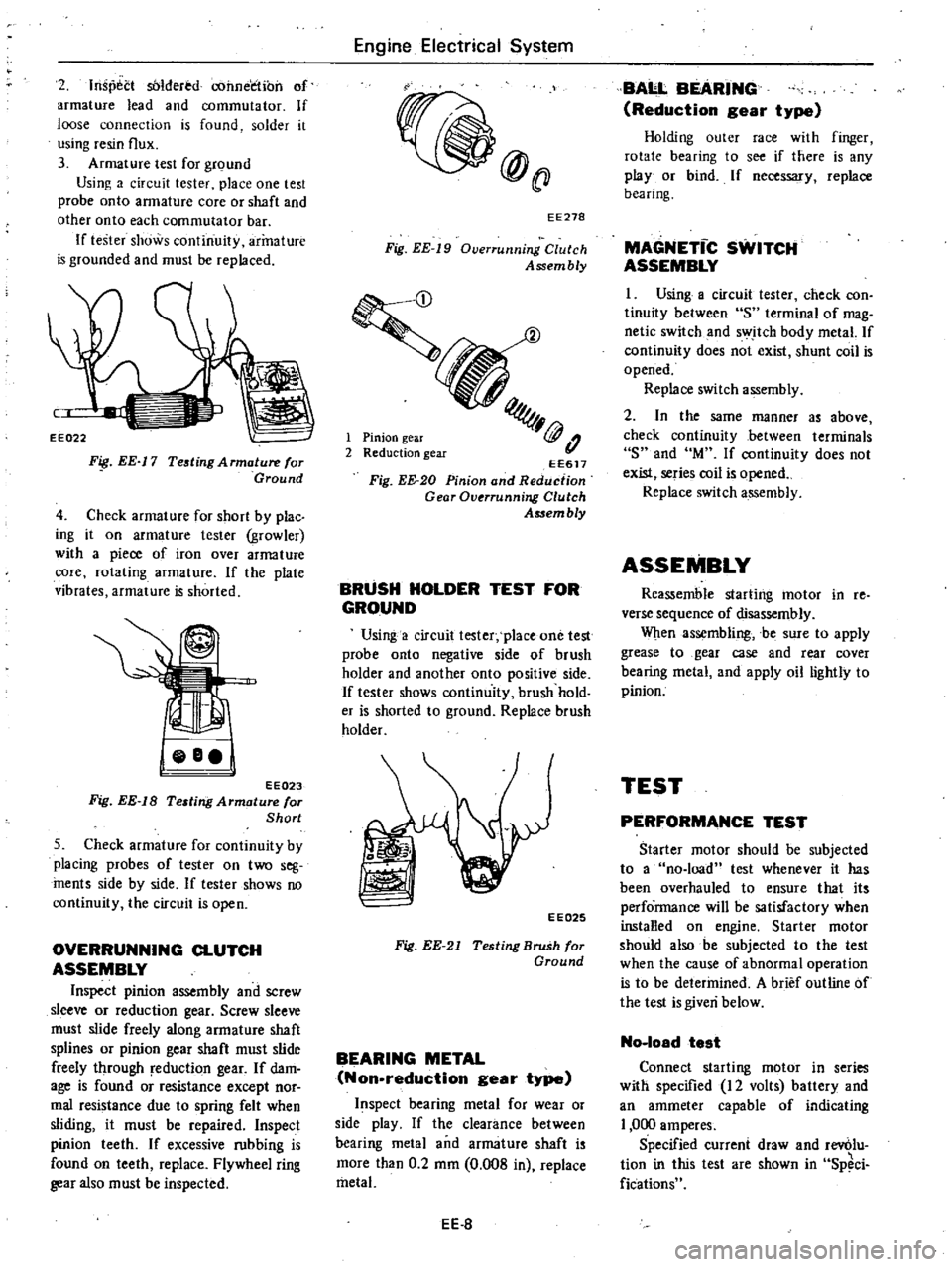
3
Armature
test
for
ground
Using
a
circuit
tester
place
one
test
probe
onto
armature
core
or
shaft
and
other
onto
each
commutator
bar
If
tester
shows
continuity
armature
is
grounded
and
must
be
replaced
L
L
I
EE022
F
EE
17
Teating
Armature
for
Ground
4
Check
armature
for
short
by
plac
ing
it
on
armature
tester
growler
with
a
piece
of
iron
over
arma
t
ure
core
rotating
armature
If
the
plate
vibrates
armature
is
shorted
jeBel
EE023
Fig
EE
18
Testing
Armature
or
Short
5
Check
armature
for
continuity
by
placing
probes
of
tester
on
two
seg
ments
side
by
side
If
tester
shows
no
continuity
the
circuit
is
open
OVERRUNNING
CLUTCH
ASSEMBLY
Inspect
pinion
assembly
and
screw
sleeve
or
reduction
gear
Screw
sleeve
must
slide
freely
along
armature
shaft
splines
or
pinion
gear
shaft
must
slide
freely
through
reduction
gear
If
dam
age
is
found
or
resistance
except
nor
mal
resistance
due
to
spring
felt
when
sliding
it
must
be
repaired
Inspect
pinion
teeth
If
excessive
rubbing
is
found
on
teeth
replace
Flywheel
ring
gear
also
must
be
inspected
Engine
Electrical
System
@
ll
EE278
Fig
EE
19
Overrunning
Clutch
Assembly
1
Pinion
gear
2
Reduction
gear
EE617
Fig
EE
20
Pinion
and
Reduction
Gear
Overrunni11C
Clutch
AS5em
bly
BRUSH
HOLDER
TEST
FOR
GROUND
Using
a
circuit
tester
place
one
test
probe
onto
negative
side
of
brush
holder
and
another
onto
positive
side
If
tester
shows
continuity
brush
hold
er
is
shorted
to
ground
Replace
brush
holder
EE025
Fig
EE
21
Testing
Brush
for
Ground
BEARING
METAL
Non
reduction
gear
type
spect
bearing
metal
for
wear
or
side
play
If
the
clearance
between
bearing
metal
and
armature
shaft
is
more
than
0
2
mm
0
008
in
replace
metal
EE
8
BAI
L
BEARING
Reduction
gear
type
Holding
outer
race
with
finger
rotate
bearing
to
see
if
there
is
any
play
or
bind
If
necessary
replace
bearing
MAGNETic
SWITCH
ASSEMBLY
I
Using
a
circuit
tester
check
con
tinuity
between
S
terminal
of
mag
netic
switch
and
switch
body
metal
If
continuity
does
not
exist
shunt
coil
is
opened
Replace
switch
assembly
2
In
the
same
manner
as
above
check
continuity
between
terminals
S
and
M
If
continuity
does
not
exist
series
coil
is
opened
Replace
switch
assembly
ASSEMBLY
Reassemble
starting
motor
in
re
verse
sequence
of
disassembly
When
assembling
be
sure
to
apply
grease
to
gear
case
and
rear
cover
bearing
metal
and
apply
oil
lightly
to
pinion
TEST
PERFORMANCE
TEST
Starter
motor
should
be
subjected
to
a
no
load
test
whenever
it
has
been
overhauled
to
ensure
that
its
perfo
rmance
will
be
satisfactory
when
installed
on
engine
Starter
motor
should
also
be
subjected
to
the
test
when
the
cause
of
abnormal
operation
is
to
be
determined
A
brief
outline
of
the
test
is
given
below
No
loadtest
Connect
starting
motor
in
series
willi
specified
12
volts
battery
and
an
ammeter
capable
of
indicating
1
000
amperes
Specified
current
draw
and
rev6lu
tion
in
this
test
are
shown
in
Sp
ci
Cications
Page 167 of 548
Starting
motor
S
DIAGNOSES
OF
TEST
I
Low
speed
with
no
load
and
high
current
draw
may
result
from
the
following
I
Tight
dirty
or
worn
bearings
2
Bent
armature
shaft
or
loosened
field
probe
3
Shorted
armature
Check
armature
further
4
A
grounded
armature
or
field
a
Remove
input
terminal
b
Raise
two
negative
side
brushes
from
commutator
c
Using
a
circuit
tester
place
one
probe
onto
input
terminal
and
the
other
onto
yoke
d
If
tester
indicates
continuity
raise
the
other
two
brushes
and
check
field
and
armature
separately
to
deter
mine
whether
field
or
armature
is
grounded
2
Failure
to
operate
with
high
cur
rent
draw
may
be
caused
by
the
following
I
A
grounded
or
open
field
coil
Inspect
the
connection
and
trace
circuit
with
a
circuit
tester
2
Armature
coil
does
not
operate
Inspect
commutator
for
excessive
burning
In
this
case
arc
may
occur
on
damaged
commutator
when
motor
is
operated
with
no
load
3
Burned
out
commutator
bar
Weak
brush
spring
tension
broken
Engine
Electrical
System
Switch
Battery
Vultmeter
Ammeter
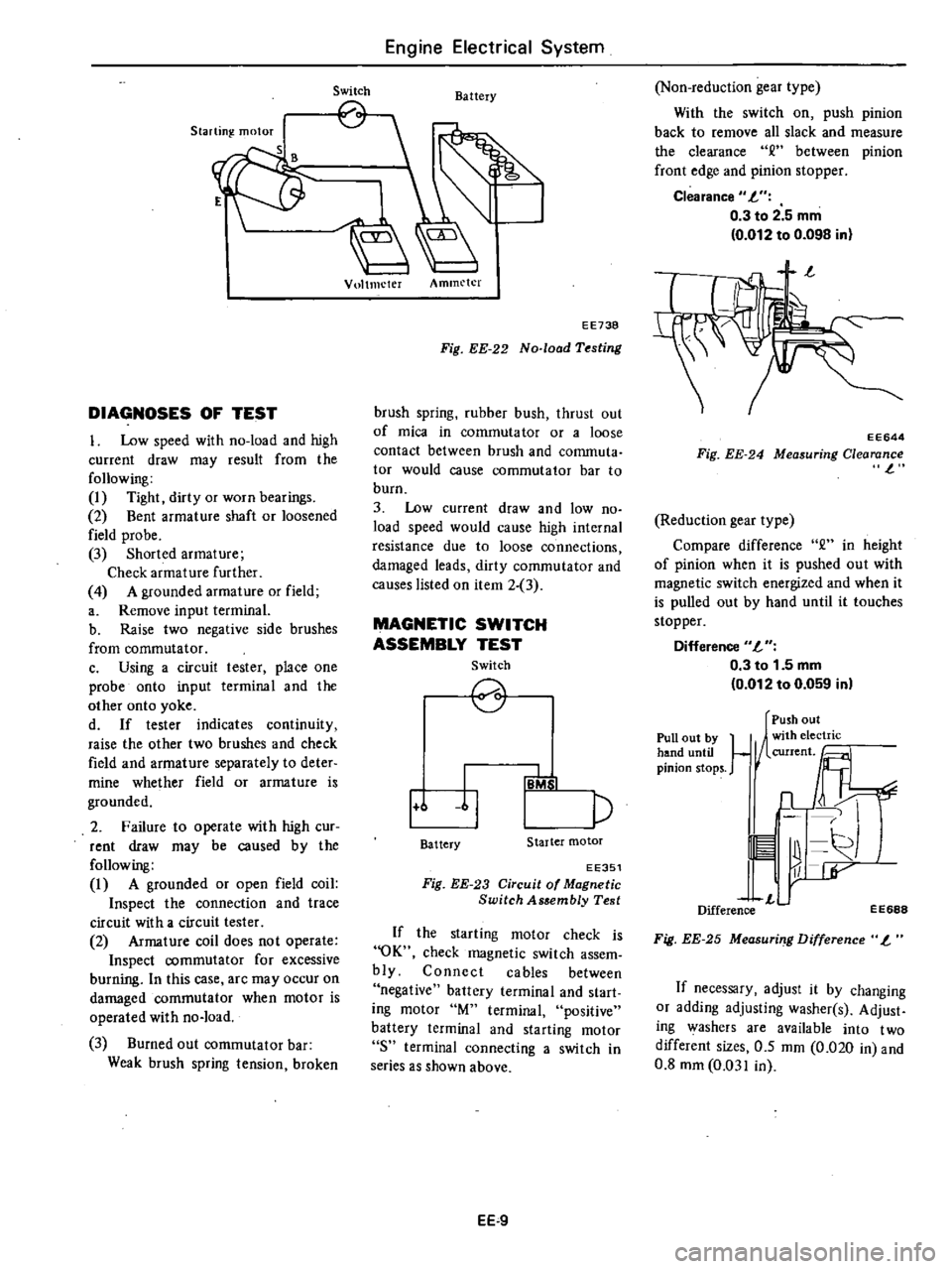
EE738
Fig
EE
22
No
load
Testing
brush
spring
rubber
bush
thrust
out
of
mica
in
commuta
tor
or
a
loose
contact
between
brush
and
conunuta
tor
would
cause
commutator
bar
to
burn
3
Low
current
draw
and
low
no
load
speed
would
cause
high
internal
resistance
due
to
loose
connections
damaged
leads
dirty
commutator
and
causes
listed
on
item
2
3
MAGNETIC
SWITCH
ASSEMBLY
TEST
Switch
2
1
6
11
p
IB
b
I
Battery
Starter
motor
EE351
Fig
EE
23
Circuit
of
Magnetic
Switch
Assembly
Test
If
the
starting
motor
check
is
OK
check
magnetic
switch
assem
bly
Connect
cables
between
negative
battery
terminal
and
start
ing
motor
M
terminal
positive
battery
terminal
and
starting
motor
8
terminal
connecting
a
switch
in
series
as
shown
above
EE
9
Non
reduction
gear
type
With
the
switch
on
push
pinion
back
to
remove
all
slack
and
measure
the
clearance
between
pinion
front
edge
and
pinion
stopper
Clearance
L
0
3
to
2
5
mm
0
012
to
0
098
in
EE644
Fig
EE
24
Measuring
Clearance
l
Reduction
gear
type
Compare
difference
2
in
height
of
pinion
when
it
is
pushed
out
with
magnetic
switch
energized
and
when
it
is
pulled
out
by
hand
until
it
touches
stopper
Difference
L
0
3
to
1
5
mm
0
012
to
0
059
in
Pull
out
by
hand
until
pinion
stops
Push
out
1
1
n
11
r
L
Difference
EE688
Fig
EE
25
Measuri
g
Difference
L
If
necessary
adjust
it
by
changing
or
adding
adjusting
washer
s
Adjust
ing
washers
are
available
into
two
different
sizes
0
5
mm
0
020
in
and
0
8
mm
0
031
in
Page 171 of 548
DESCRIPTION
The
alternator
incorporates
an
Ie
voltage
regulator
which
maintains
volt
age
within
the
specified
range
and
prevents
output
voltage
from
rising
higher
than
the
specified
value
Except
for
the
Ie
circuit
alternator
parts
are
essentially
the
same
as
those
of
the
conventional
type
alternator
Service
procedures
outlined
in
this
section
are
restricted
to
information
on
other
than
the
voltage
regulator
In
the
alternator
a
magnetic
field
is
CD
Engine
Electrical
System
ALTERNATOR
produced
by
the
rotor
which
consists
of
alternator
shaft
field
coil
pole
pieces
and
slip
rings
The
slip
rings
pressed
in
the
shaft
conduct
only
a
small
field
current
Output
current
is
generated
in
the
armature
coils
located
in
the
stator
The
stator
has
three
windings
and
generates
three
phase
alternating
current
Silicon
diodes
act
like
a
one
way
valve
for
electricity
so
that
charging
current
passes
easily
but
reverse
current
is
shut
out
In
this
alternator
pack
type
silicon
diodes
are
used
as
main
diodes
Nine
diodes
three
negative
three
positive
and
three
sub
diodes
are
installed
in
positive
and
negative
plates
as
an
assembly
These
diodes
are
direct
soldered
at
their
tips
and
constructed
with
posi
tive
and
negative
conjunction
They
are
mounted
on
the
two
plates
which
combine
the
function
of
heat
dissipating
plate
and
positive
negative
terminals
and
are
light
in
weight
and
easy
to
service
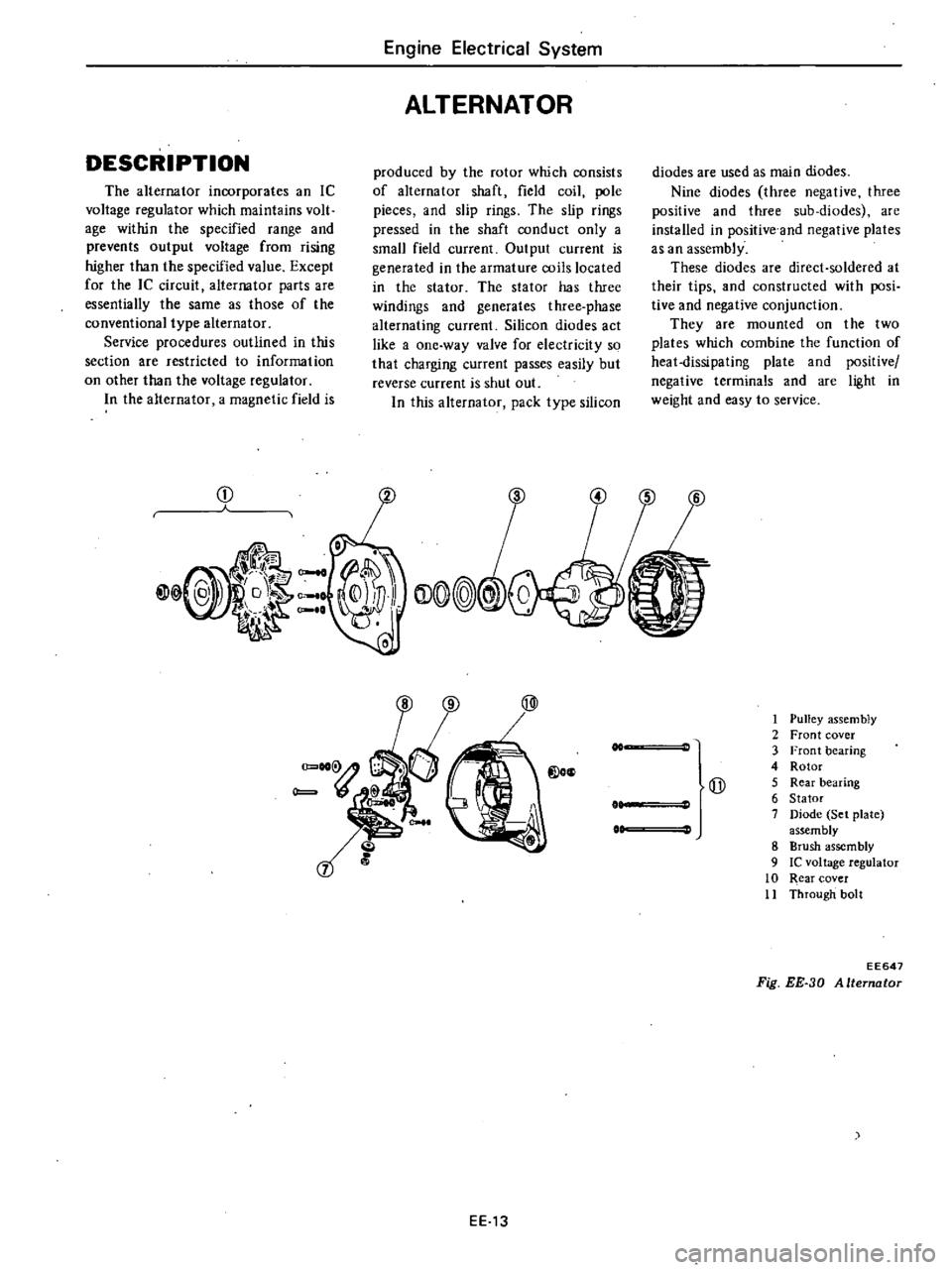
EE13
1
Pulley
assem
bly
2
Front
cover
3
Front
bearing
4
Rotor
Qj
5
Rear
bearing
6
Stator
7
Diode
Set
plate
assembly
8
Brush
assembly
9
Ie
voltage
regulator
10
Rear
cover
11
Through
bolt
EE647
Fig
EE
30
Alternator
Page 176 of 548
DESCRIPTION
The
regulator
consists
essentially
of
in
egrated
circuits
incorporating
tran
sistors
These
transistors
int
errupt
and
admit
current
flow
to
the
alternator
rotor
coil
thus
maintaining
its
output
voltage
at
a
constant
value
Unlike
in
a
mechanical
type
regulator
an
electron
ic
relay
employing
transistors
is
uti
lized
These
transistors
are
enclosed
in
a
very
compact
sealed
case
The
electronic
relay
is
soldered
to
the
Brush
Ie
regulator
R
J
DIO
F
i
ZD
Tn
Engipe
Electrjcal
Syst
em
REGULATOR
brush
assembly
inside
the
alternator
Should
any
problem
with
the
relay
arise
it
should
be
replaced
together
with
the
brush
assembly
In
the
charge
warning
lamp
circuit
a
diode
is
at
tached
to
the
stator
coil
to
monitor
generating
voltage
at
the
stator
so
that
when
the
monitored
voltage
and
charging
voltage
are
equal
during
re
charging
the
charge
warning
lamp
is
turned
off
Accordingly
a
charge
warning
relay
is
not
employed
in
this
circuit
s
r
t
E
F
L
S
B
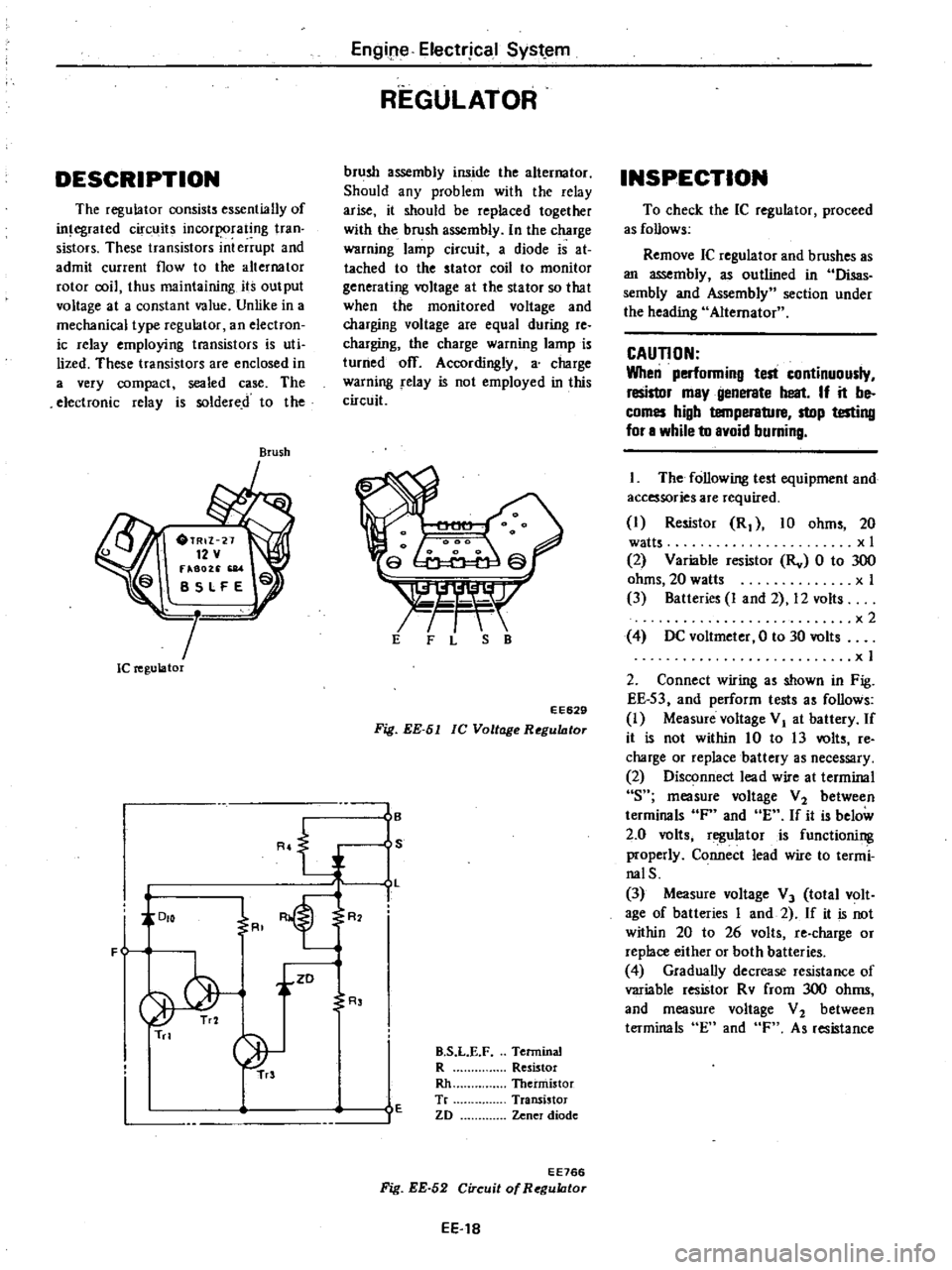
EE629
Fig
EE
51
lC
Voltage
RegultJtor
I
B
S
L
I
R
R
E
B
S
L
E
F
Terminal
R
Resistor
Rh
Thermistor
Tr
Transistor
ZD
Zener
diode
EE766
Fig
EE
52
Circuit
of
RegultJtor
EE
18
INSPECTION
To
check
the
IC
regulator
proceed
as
follows
Remove
IC
regulator
and
brushes
as
an
assembly
as
outlined
in
Disas
sembly
and
Assembly
section
under
the
heading
Alternator
CAUTION
When
performing
test
continuously
resistor
may
generate
heat
If
it
be
comes
high
temperature
stop
testing
for
a
while
to
avoid
burning
The
following
test
equipment
and
accessories
are
required
I
Resistor
R
10
ohms
20
watts
x
I
2
Variable
resistor
Rv
0
to
300
ohms
20
watts
x
I
3
Batteries
I
and
2
12
volts
x2
4
DC
voltmeter
0
to
30
volts
x
I
2
Connect
wiring
as
shown
in
Fig
EE
S3
and
perform
tests
as
follows
I
Measure
voltage
VI
at
battery
If
it
is
not
within
10
to
13
volts
re
charge
or
replace
battery
as
necessary
2
Disconnect
lead
wire
at
terminal
s
measure
voltage
V
2
between
terminals
F
and
E
If
it
is
below
2
0
volts
regulator
is
functioning
properly
Connect
lead
wire
to
termi
nalS
3
Measure
voltage
V
3
total
volt
age
of
batteries
I
and
2
If
it
is
not
within
20
to
26
volts
re
charge
or
replace
either
or
both
batteries
4
Gradually
decrease
resistance
of
variable
resistor
Rv
from
300
ohms
and
measure
voltage
V
2
between
terminals
En
and
F
As
resistance
Page 178 of 548
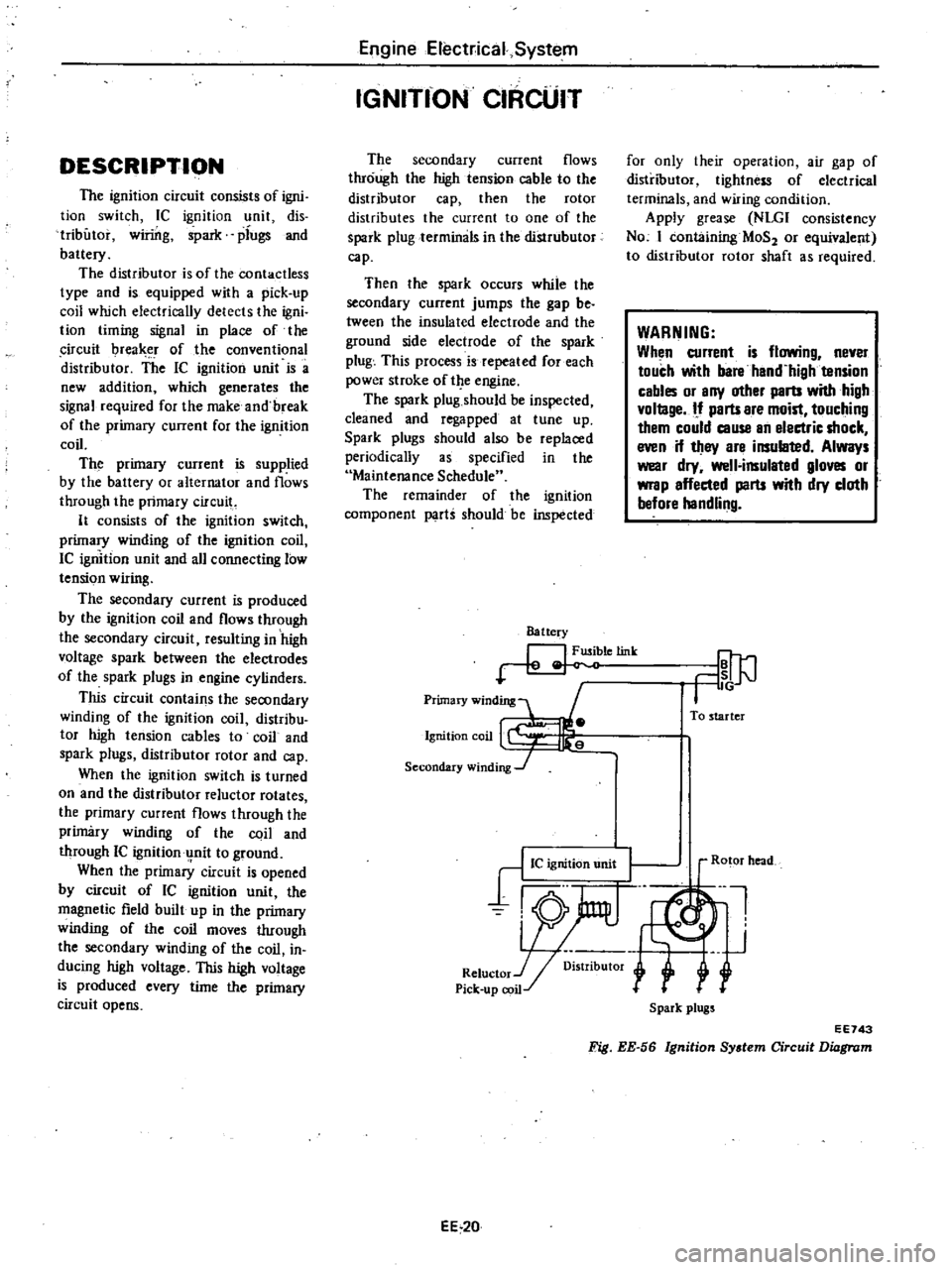
DESCRIPTION
The
ignition
circuit
consists
of
igni
tion
switch
Ie
ignition
unit
dis
tributor
winng
ipark
plugs
and
battery
The
distributor
is
of
the
contactless
type
and
is
equipped
with
a
pick
up
coil
which
electrically
detects
the
igni
tion
timing
signal
in
place
of
the
ircuit
I
rea
r
of
the
conventional
distributor
The
IC
ignition
unit
is
a
new
addition
which
generates
the
signal
required
for
the
make
and
break
of
the
primary
current
for
the
ignition
coil
The
primary
current
is
supplied
by
the
battery
or
alternator
and
flows
through
the
primary
circuit
It
consists
of
the
ignition
switch
primary
winding
of
the
ignition
coil
IC
ignition
unit
and
all
connecting
low
tension
wiring
The
secondary
current
is
produced
by
the
ignition
coil
and
flows
through
the
secondary
circuit
resulting
in
high
voltage
spark
between
the
electrodes
of
the
spark
plugs
in
engine
cylinders
This
circuit
contains
the
secondary
winding
of
the
ignition
coil
distribu
tor
high
tension
cables
to
coil
and
spark
plugs
distributor
rotor
and
cap
When
the
ignition
switch
is
turned
on
and
the
distributor
reluctor
rotates
the
primary
current
flows
through
the
primary
winding
of
the
coil
and
through
IC
ignitionu
nit
to
ground
When
the
primary
circuit
is
opened
by
circuit
of
IC
ignition
unit
the
magnetic
field
built
up
in
the
primary
winding
of
the
coil
moves
through
the
secondary
winding
of
the
coil
in
ducing
high
voltage
This
high
voltage
is
produced
every
time
the
primary
circuit
opens
EngineElect
ical
System
IGNITfON
CIRCUIT
The
secondary
current
flows
through
the
high
tension
cable
to
the
distributor
cap
then
the
rotor
distributes
the
current
to
one
of
the
spark
plug
terminals
in
the
distrubutor
cap
Then
the
spark
occurs
while
the
secondary
current
jumps
the
gap
be
tween
the
insulated
electrode
and
the
ground
side
electrode
of
the
spark
plug
This
process
is
repeated
for
each
power
stroke
of
t
e
engine
The
spark
plug
should
be
inspected
cleaned
and
regapped
at
tune
up
Spark
plugs
should
also
be
replaced
periodically
as
specified
in
the
Maintenance
Schedule
The
remainder
of
the
ignition
component
parti
should
be
inspected
Battery
letink
Primary
winding
1
Ignition
coil
Secondary
winding
J
for
only
their
operation
air
gap
of
distributor
tightness
of
electrical
terminals
and
wiring
condition
Apply
grease
NLGI
consistency
No
I
containing
MaS
or
equivalent
to
distributor
rotor
shaft
as
required
WARNING
When
current
is
flowing
never
touch
with
bare
hand
high
tension
cables
or
any
other
parts
with
high
vollage
If
parts
are
moist
touching
them
could
cause
an
electric
shock
even
if
they
are
insulated
Always
wear
dry
well
insulated
gloves
or
wrap
affected
parts
with
dry
cloth
before
handling
To
starter
EE
20
Ro
or
head
Ul
J
r
Spark
plugs
EE743
Fig
EE
56
Ignition
System
Circuit
Diagram
Page 180 of 548
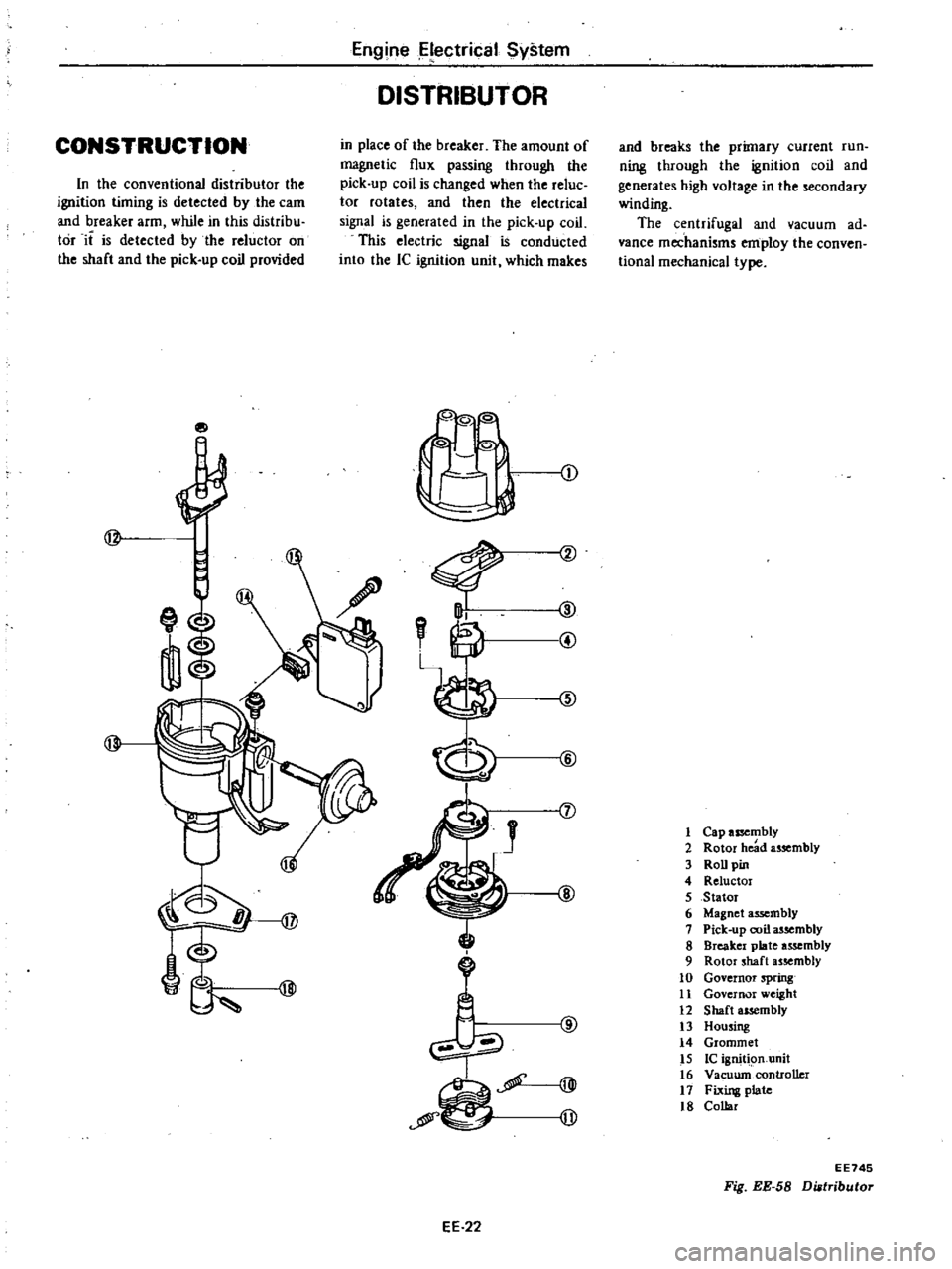
Engine
E
ectrical
System
DISTRIBUTOR
CONSTRUCTION
in
place
of
the
breaker
The
amount
of
magnetic
flux
passing
through
the
pick
up
coil
is
changed
when
the
reluc
tor
rotates
and
then
the
electrical
signal
is
generated
in
the
pick
up
coil
This
electric
ignal
is
conducted
into
the
Ie
ignition
unit
which
makes
In
the
conventional
distributor
the
ignition
timing
is
detected
by
the
earn
and
breaker
arm
while
in
this
distribu
tor
it
is
detected
by
the
reluctor
on
the
shaft
and
the
pick
up
coil
provided
and
breaks
the
primary
current
run
ning
through
the
ignition
coil
and
generates
high
voltage
in
the
secondary
winding
The
centrifugal
and
vacuum
ad
vance
mechanisms
employ
the
conven
tional
mechanical
type
I
l
Q
J
1
C
@
@
ID
ID
J
I
Cap
assembly
2
Rotor
head
assembly
3
RoD
pin
4
ReluctoI
@
5
Stator
6
Magnet
assembly
7
Pick
up
coil
assembly
8
Breaker
plate
assembly
9
Rotor
shaft
assembly
10
Governor
spring
11
Governor
weight
12
Shaft
assembly
13
Housing
14
Grommet
15
Ie
igniq
n
unit
@f
rw
16
VacuwncontroUcr
17
Fixing
plate
t8
Collar
EE745
Fig
EE
58
Diatributor
EE
22