wheel bolt torque DATSUN 210 1979 User Guide
[x] Cancel search | Manufacturer: DATSUN, Model Year: 1979, Model line: 210, Model: DATSUN 210 1979Pages: 548, PDF Size: 28.66 MB
Page 327 of 548
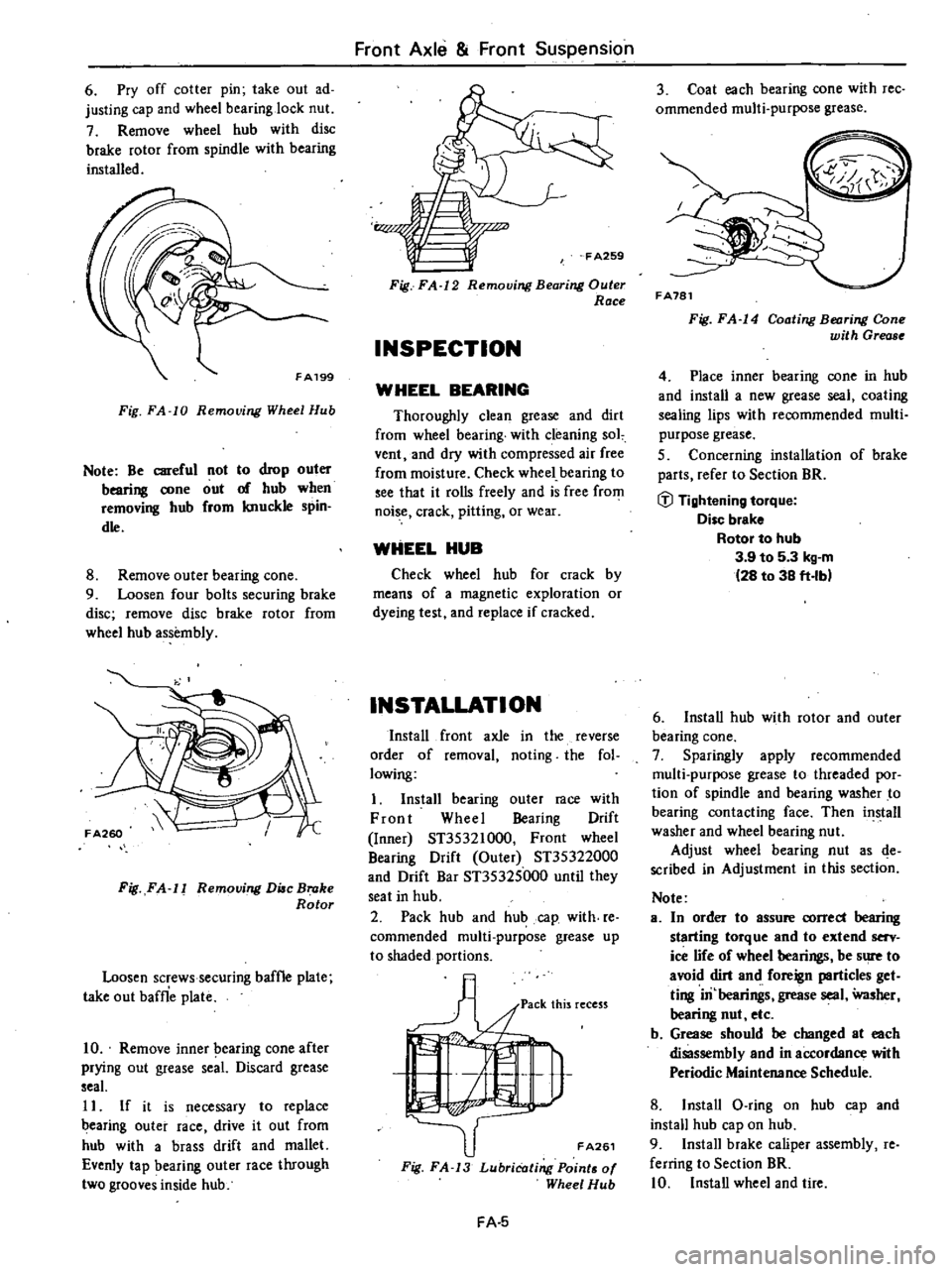
6
Pry
off
cotter
pin
take
out
ad
justing
cap
and
wheel
bearing
lock
nut
7
Remove
wheel
hub
with
disc
brake
rotor
from
spindle
with
bearing
installed
FA199
Fig
FA
10
Removing
Wheel
Hub
Note
Be
careful
not
to
drop
outer
bearing
DOne
out
of
hub
when
removing
hub
from
knuckle
spin
dle
8
Remove
outer
bearing
cone
9
Loosen
four
bolts
securing
brake
disc
remove
disc
brake
rotor
from
wheel
hub
assembly
Fig
FA
11
Removing
Due
Broke
Rotor
Loosen
screws
securing
baffle
plate
take
out
baffle
plate
10
Remove
inner
earing
cone
after
prying
out
grease
seaL
Discard
grease
seaL
11
If
it
is
necessary
to
replace
earing
outer
race
drive
it
out
from
hub
with
a
brass
drift
and
mallet
Evenly
tap
bearing
outer
race
through
two
grooves
inside
hub
Front
Axle
Front
Suspension
Fig
FA
12
Removing
Bearing
Outer
Race
INSPECTION
WHEEL
BEARING
Thoroughly
clean
grease
and
dirt
from
wheel
bearing
with
cleaning
sol
vent
and
dry
with
compressed
air
free
from
moisture
Check
wheel
bearing
to
see
that
it
rolls
freely
and
is
free
from
noise
crack
pitting
or
wear
WHEEL
HUB
Check
wheel
hub
for
crack
by
means
of
a
magnetic
exploration
or
dyeing
test
and
replace
if
cracked
INSTALLATION
Install
front
axle
in
the
reverse
order
of
removal
noting
the
fol
lowing
I
Install
bearing
outer
race
with
Front
Wheel
Bearing
Drift
Inner
ST35321000
Front
wheel
Bearing
Drift
Outer
ST35322000
and
Drift
Bar
ST35325000
until
they
seat
in
hub
2
Pack
hub
and
hub
cap
with
re
commended
multi
purpose
grease
up
to
shaded
portions
fA261
Fig
FA
13
LubriCating
Points
of
Wheel
Hub
FA
5
3
Coat
each
bearing
DOne
with
rec
ommended
multi
purpose
grease
FA781
Fig
FA
14
Coating
Bearing
Cone
with
Grease
4
Place
inner
bearing
cone
in
hub
and
install
a
new
grease
seal
coating
sealing
lips
with
recommended
multi
purpose
grease
5
Concerning
installation
of
brake
parts
refer
to
Section
BR
i
l
Tightening
tOlque
Disc
brake
Rotor
to
hub
3
9
to
5
3
kg
m
28
to
38
ft
lbl
6
Install
hub
with
rotor
and
outer
bearing
cone
7
Sparingly
apply
recommended
multi
purpose
grease
to
threaded
por
tion
of
spindle
and
bearing
washer
to
bearing
contacting
face
Then
install
washer
and
wheel
bearing
nut
Adjust
wheel
bearing
nut
as
de
scribed
in
Adjustment
in
this
section
Note
a
In
order
to
assure
DOrrect
bearing
starting
torque
and
to
extend
serv
ice
nfe
of
wheel
bearings
be
sure
to
avoid
dirt
and
foreign
particles
get
ting
iIi
bearings
grease
seal
Washer
bearing
nut
etc
b
Grease
should
be
changed
at
each
disassembly
end
in
aa
ordance
with
Periodic
Maintenance
Schedule
8
Install
O
ring
on
hub
cap
and
install
hub
cap
on
hub
9
Install
brake
caliper
assembly
re
ferring
to
Section
BR
10
Install
wheel
and
lire
Page 332 of 548

wheels
2
Remove
splaahboard
if
necessary
3
Back
off
nut
securing
tension
rod
to
bracket
and
remove
bolts
which
secure
tension
rod
to
lower
arm
Tension
rod
can
then
be
taken
out
4
Remove
nuts
securing
stabilizer
bar
to
connecting
rod
Note
Two
wrenches
are
n
1
in
this
B
5
Remove
bolts
and
nuts
securing
stabilizer
bar
bracket
in
position
Stabilizer
bar
can
then
be
iaken
o
t
CV
3
@
I
Lower
ann
5
Tension
rod
2
Stabilizer
bar
bracket
connecting
rod
6
Tension
rod
3
Stabilizer
bar
4
Stabilizer
bar
bracket
FA129
Fig
FA
31
Removing
Tension
Rod
and
Stabilizer
Bar
INSPECTION
I
Check
tension
rod
and
stabilizer
bar
for
evidence
of
deformation
or
cracks
if
necessary
replace
2
Check
rubber
parts
such
as
ten
sion
rod
and
stabilizer
bar
bushings
to
be
sure
they
are
not
deteriorated
or
cracked
if
1ecessary
replace
INSTAllATION
Install
tension
rod
and
stabilizer
bar
in
tJ
1e
reverse
order
of
removal
noting
the
following
I
Be
sure
stabilizer
bar
is
not
closer
to
either
side
but
is
located
at
the
middle
If
stabilizer
bar
is
new
use
the
following
procedure
to
center
the
stabilizer
bar
Position
arm
with
white
paipt
mark
toward
left
side
of
car
Front
Axle
Front
Suspension
Set
slabillz
rliar
mount
bushingS
So
that
outer
side
of
stabilizer
bar
bushing
is
brought
into
inner
side
of
marking
e
o
I
19
e
1
Marking
2
Bushing
3
Marking
4
While
painting
5
Marking
0
A
F
A667
Fig
FA
32
Centering
8lDbilize
Bar
2
Chec
to
be
sure
that
tension
rod
bushing
is
propelly
centered
in
its
seat
3
Be
sure
that
tension
rod
bracket
bolt
is
correctly
torqued
Note
a
Noting
direction
of
tension
rod
bushing
properly
center
bushing
in
tension
rod
bushing
washer
Fig
FA
33
Direclion
of
Tension
Rod
BUlhing
b
After
installation
make
sure
mini
mum
clearances
between
tension
rods
end
stabilizer
bar
are
equal
on
both
sides
c
Closely
observe
torq
ue
specification
when
tightening
tension
rod
bracket
retaining
bolts
d
First
tighten
tension
rod
on
bracket
side
to
specified
torque
setting
then
install
the
other
end
on
lower
arm
fJ
Tightening
tOlque
Tension
rod
bushing
installation
nut
4
5
to
5
11rg
33
to
37
ft
lbl
FA
10
Tension
rOd
to
Lower
ann
5
1
to
6
1
kg
m
137
to
44
ft
Ibl
Tension
rod
bracket
to
body
3
2
to
4
3
kg
m
23
to
31
ft
Ibl
Stabilizer
bar
bleck
t
1
6to2
11rg
112
to
15
ft
lbl
Stabilizel
bel
connecting
rod
1
6
to
2
1
kg
m
12
to
15
ft
lbl
LOWER
ARM
AND
LOWER
BALL
JOINT
The
lower
ann
is
connected
to
the
suspension
member
through
a
rubber
bwhing
end
to
the
strut
through
a
ball
joint
The
lower
ball
joint
is
assembled
at
the
factory
and
cannot
be
disassem
bled
REMOVAL
1
Block
rear
wheels
with
chocks
2
Jack
up
front
of
car
and
support
it
with
safety
stands
remove
wheel
3
Remove
splashboard
4
Separate
knuckle
arm
from
strut
5
Pry
colter
pin
off
and
separate
side
rod
fromknilckle
arm
using
Ball
Joint
Remover
HT72520000
FA661
Fig
FA
34
Remoliing8ideRod
Ball
Joint
6
Remove
tension
rod
and
stabilizer
bar
from
lower
ann
7
Remove
bolt
connecting
lower
ann
to
suspension
crossmember
Page 336 of 548

WHEEL
BEARING
Wheel
bearing
axial
play
Wheel
bearing
nut
tightening
torque
Return
angle
Rotation
starting
torque
With
new
grease
seal
With
used
grease
seal
At
wheel
hub
bolt
With
new
grease
seal
With
used
grease
seal
SUSPENSIONBA
JOINT
Turning
torque
New
parts
Used
parts
TIGHTENIN
TORQUE
LOWERBAl
L
JOINT
Ball
joint
socket
to
lower
arm
Ball
joint
to
knuckle
arm
Stud
nut
STRUT
Steering
knuckle
arm
to
strut
Strut
to
hoodledge
Piston
rod
self
locking
nut
Gland
packing
DISC
BRAKE
Rotor
to
hub
SIDE
ROD
Side
rod
ball
jOIDt
to
knuckle
arm
LOWER
ARM
Lower
arm
bolt
nut
Side
rod
adjusting
nut
TENSION
ROD
Tension
rod
bushing
installation
nut
Tension
rod
to
lower
arm
Tension
rod
bracket
to
body
Frpn
Axle
Front
Suspension
mm
in
0
0
kg
m
ft
lb
degree
3
0
to
3
5
22
to
25
900
kg
cm
in
lbr
kg
em
in
Ib
Less
than
7
0
6
1
1
0
to
4
5
0
9
to
3
9
kg
lb
kg
lb
Less
than
1
2
2
6
0
1
7
to
0
79
0
37
to
1
74
kg
cm
in
Ib
kg
cm
in
Ib
40
to
100
35
to
87
More
than
20
17
kg
m
ft
Ib
5
1
to
6
1
37
to
44
5
5
to
10
0
40
to
72
7
3
to
9
9
53
to
72
2
5
to
3
5
18
to
25
6
0
to
7
5
43
to
54
8
0
to
11
0
58
to
80
3
9
to
5
3
28
to
38
3
0
to
7
0
22
to
51
3
9
to
5
0
2810
36
8
0
to
10
0
58
to
72
4
5
to
5
1
33
to
37
5
1
to
6
1
37
to
44
3
2
to
4
3
23
to
31
FA
14
Page 344 of 548

REAR
AXLE
REAR
AXLE
ASSEMBLY
Remove
L
Block
front
wheels
with
chocks
2
Raise
rear
of
car
high
enough
to
pennit
working
underneath
and
place
stands
solidly
under
body
member
on
both
sides
RA544
Fig
RA
2
Supporting
Point
3
Support
under
center
of
dif
ferential
carrier
with
a
garage
jack
4
Remove
rear
wheels
5
Disconnect
propeller
shaft
by
re
moving
bolts
CD
securing
propeller
shaft
flange
to
companion
flange
of
differential
carrier
6
Disconnect
brake
hose
from
brake
tube
at
body
@
and
rear
cable
adjuster
@
Fig
RA
3
Removing
Propeller
Shaft
and
Brohe
Hose
CAUTION
e
When
disconnecting
brake
tube
use
suitable
tube
wrench
Never
use
open
end
or
adjustable
wrench
b
Cover
brake
hose
end
pipe
open
ings
to
prevent
entrance
of
dirt
Rear
Axle
Rear
Suspension
7
Remove
bolts
securing
shock
absorber
lower
ends
on
each
side
RA485
Fig
RA
4
Removing
Bolt
Securing
Shock
Absorber
Lower
End
Note
When
removing
shock
absorber
lower
end
from
bracket
squeeze
shock
absorber
and
lift
it
out
right
above
to
accommodate
em
bossment
inside
bracket
C
AA486
Fig
RA
5
Shock
Absorber
Lower
End
8
Lower
jack
slowly
and
remove
cojI
springs
on
each
side
after
they
are
fully
extended
AA546
Fig
RA
6
Removing
Coil
Spring
9
Raise
jack
to
its
original
position
10
Remove
bolts
CD
and
@
se
curing
upper
and
lower
links
at
axle
case
side
RA
3
Fig
RA
7
Disconnecting
Upper
Link
and
Lower
Link
II
Release
garage
jack
slowly
and
pull
it
out
toward
rear
of
car
In
tenetlon
Install
rear
axle
in
the
reverse
order
of
removal
CAUTION
a
When
installing
brake
tubes
use
Flare
Nut
Torque
Wrench
GG94310000
b
Before
tightening
link
bushing
nuts
temporarily
attach
upper
and
lower
links
to
axle
case
Alter
jacking
up
center
of
differential
carrier
until
upper
Bnd
lower
links
are
almost
horizontal
securely
tighten
link
bushing
nuts
c
When
supporting
car
weight
at
Cl
nter
of
differential
carrier
do
not
put
a
load
in
car
j
Tightening
torque
Brake
tube
flare
nut
1
5
to
1
8
kg
m
11
to
13
ft
lb
Propeller
shaft
to
companion
flange
connecting
nut
2
4
to
3
3
kg
m
17
to
24
ft
Ibl
Shock
absorber
lower
end
nut
7
0
to
8
0
kg
m
51
to
58
ft
Ibl
lower
link
fixing
nut
7
0
to
8
0
kg
m
51
to
58
ft
Ib
Upper
link
fixing
nut
7
0
to
8
0
kg
m
51
to
58
ft
lb
Page 346 of 548
V
CD
l
t
177t
ID
@
A
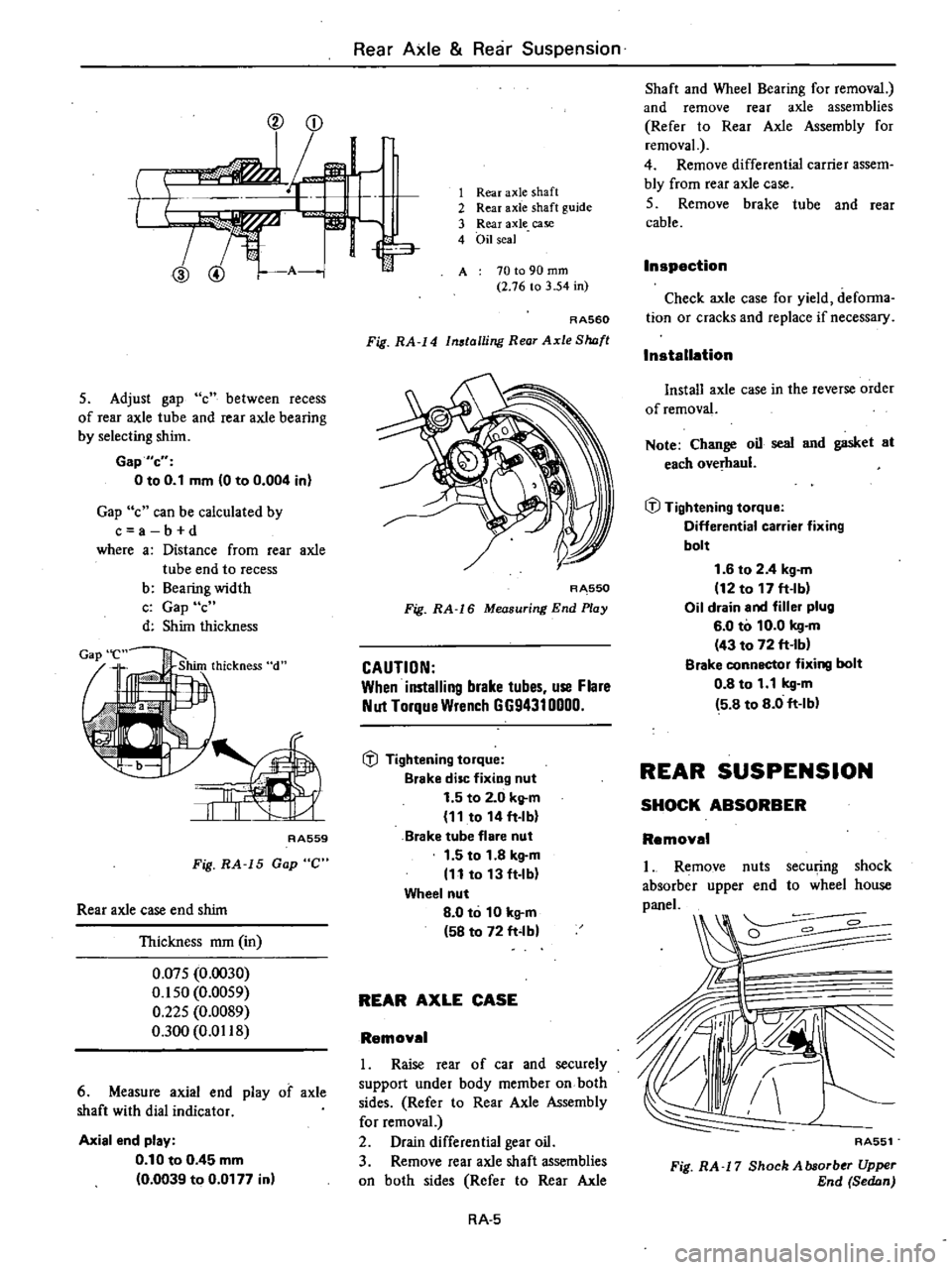
5
Adjust
gap
c
between
recess
of
rear
axle
tube
and
rear
axle
bearing
by
selecting
shinto
Gap
e
o
to
0
1
mm
0
to
0
004
in
Gap
c
can
be
calculated
by
c
a
b
d
where
a
Distance
from
rear
axle
tube
end
to
recess
b
Bearing
width
c
Gap
c
d
Shint
thickness
RA559
Fig
RA
15
Gap
C
Rear
axle
case
end
shim
Thickness
mm
in
om5
0
0030
0
1
50
0
0059
0
225
0
0089
0
300
0
0118
6
Measure
axial
end
play
of
axle
shaft
with
dial
indicator
Axial
end
plav
0
10
to
0
45
mm
0
0039
to
0
0177
in
Rear
Axle
Rear
Suspension
1
Rear
axle
shaft
2
Rear
axle
shaft
guide
3
Rear
axle
case
4
Oil
seal
I
ill
A
70
to
90
mm
2
76
to
3
54
in
A
A560
Fig
RA
14
Installing
Rear
Axle
Slwft
R
550
Fig
RA
16
Measuring
End
Play
CAUTION
When
installing
brake
1ubes
use
Flare
Nul
Torque
Wrench
GG94310000
ifl
Tightening
torque
Brake
disc
fixing
nut
1
5
to
2
0
kg
m
11
to
14
ft
lb
Brake
tube
flare
nut
1
5
to
1
8
kg
m
11
to
13
ft
lb
Wheel
nut
8
0
to
10
kg
m
58
to
72
ft
lb
REAR
AXLE
CASE
Remove
I
Raise
rear
of
car
and
securely
support
under
body
member
on
both
sides
Refer
to
Rear
Axle
Assembly
for
removal
2
Drain
differential
gear
oil
3
Remove
rear
axle
shaft
assemblies
on
both
sides
Refer
to
Rear
Axle
RA
5
Shaft
and
Wheel
Bearing
for
removal
and
remove
rear
axle
assemblies
Refer
to
Rear
Axle
Assembly
for
removal
4
Remove
differential
carrier
assem
bly
from
rear
axle
case
5
Remove
brake
tube
and
rear
cable
Inspection
Check
axle
case
for
yield
deforma
tion
or
cracks
and
replace
if
necessary
Installetion
Install
axle
case
in
the
reverse
order
of
removal
Note
Change
oil
seal
and
gasket
at
each
ove
haul
ifl
Tightening
tOlque
Differential
carrier
fixing
bolt
1
6
to
2
4
kg
m
12
to
17
ft
lbl
Oil
drain
and
filler
plug
6
0
to
10
0
kg
m
43
to
72
ft
lbl
Blake
connector
fixing
bolt
0
8
to
1
1
kg
m
5
8
to
8
0
ft
Ibl
REAR
SUSPENSION
SHOCK
ABSORBER
Removal
1
Remove
nuts
secu
ng
shock
absorber
upper
end
to
wheel
house
paneL
RA551
Fig
RA
17
Shock
Absorber
Upper
End
Sedan
Page 347 of 548

I
AA552
Fig
RA
18
Shock
A
bllOrber
Upper
End
2
Remove
bolt
securing
shock
ab
sorber
lower
end
and
remove
shock
absorber
Note
When
removing
shock
ebsorber
lower
end
from
bracket
Iueeze
shock
absorber
end
lift
it
out
right
aJ
o
J
to
accommodate
emb
ss
ment
inside
bracket
c
RA486
Fig
RA
19
Shock
Absorber
Lower
End
Brocket
Inspection
I
Test
shock
absorber
and
compare
with
specification
given
in
Service
Data
and
Specifications
Replace
if
nece
ry
2
Check
for
cracks
Also
check
pis
ton
rod
for
straightness
3
Check
all
rubber
parts
for
wear
cracks
damage
or
deformation
Re
place
if
necessary
Installation
Install
shock
absorber
in
the
reverse
order
of
removal
Note
Tighten
shock
absorber
upper
end
nut
to
specification
until
it
is
fully
tightened
to
thread
end
of
pis
ton
rod
Then
securely
tighten
lock
nut
Rear
Axle
Rear
Suspension
@
Tightening
tonlU1l
Shock
absorber
upper
end
nut
1
5
to
2
0
kg
m
11
to
14
ft
b
Shock
absorber
lower
end
n1
t
7
0
to
8
0
k
l
m
51
to
58
ft
bl
CAUTION
I
Be
careful
not
to
damage
or
bend
piston
rod
during
operation
b
Do
not
open
or
heat
gas
filled
type
shock
absorbers
COIL
SPRING
Removal
Block
front
wheels
with
chocks
2
Raise
rear
of
car
high
enough
to
permit
working
underneath
and
place
stands
solidly
under
body
member
on
both
sides
3
Support
under
center
of
dif
ferential
carrier
with
a
garage
jack
4
Remove
rear
wheels
5
Remove
bolts
securing
shock
absorber
lower
ends
on
each
side
C
J
1
v
I
JJJ
RA485
Fig
RA
20
RemoviTIII
Bolt
Securing
Shock
Abwrber
Lower
End
6
Lower
jack
slowly
and
remove
coil
springs
on
each
side
after
they
are
fully
extended
RA546
Fig
RA
21
Removing
Coil
Spring
RA
6
Inspection
1
Check
coil
spring
for
yield
defor
mation
or
cracks
2
Test
spring
and
compare
with
specifications
given
in
Service
Data
and
Specifications
3
Check
all
rubber
parts
for
wear
cracks
damage
or
deformation
Re
place
if
necessary
InsteDatlon
Install
coil
spring
in
the
reverse
order
ofremoval
CAUTION
Correctly
fit
open
end
on
spring
seat
CD
Tightening
torque
Shock
absorber
lowel
end
nut
7
010
8
0
kg
51
to
58
ft
b
LINK
ASSEMBLY
Removal
It
is
possible
to
remove
one
link
assembly
alone
When
removing
more
than
two
link
assemblies
remove
axle
assembly
first
Refer
to
Rear
Axle
Assembly
for
removal
Remove
upper
link
or
lower
link
alone
by
removing
bolt
on
each
end
Fig
RA
22
Removing
Upper
Link
RA553
Fig
RA
23
Remouing
Lower
Link
Page 350 of 548

TIGHTENING
TORQUE
Brake
tube
connector
flare
nut
Brake
disc
fixing
nut
PropelJer
shaft
to
companion
flange
connecting
nut
Wheel
nut
Drain
and
filler
ptug
Differential
carrier
to
axle
case
bolt
Shock
absorber
upper
end
nut
Shock
absorber
lower
end
nut
Upper
link
fixing
bolt
Upper
link
fixing
nut
Lower
link
fixing
nut
Rear
Axle
Rear
Suspension
kg
m
ft
Ib
kg
m
ft
lb
kg
m
ft
tb
kg
m
ft
lb
kg
m
ft
Ib
kg
m
ft
lb
kg
m
ft
lb
kg
m
ft
lb
kg
m
ft
lb
kg
m
ft
lb
kg
m
ft
Ib
RA
9
1
5
to
1
8
II
to
13
1
5
to
2
0
II
to
14
2
4
to
3
3
17
to
24
8
0
to
10
0
58
to
72
6
0
to
10
0
43
to
72
1
6
to
2
4
12
to
17
1
5
to
2
0
II
to
14
7
0
to
8
0
51
to
58
7
0t08
0
51
to
58
7
0
to
8
0
51
to
58
7
0
to
8
0
51
to
58
Page 351 of 548
Rear
Axle
Rear
Suspension
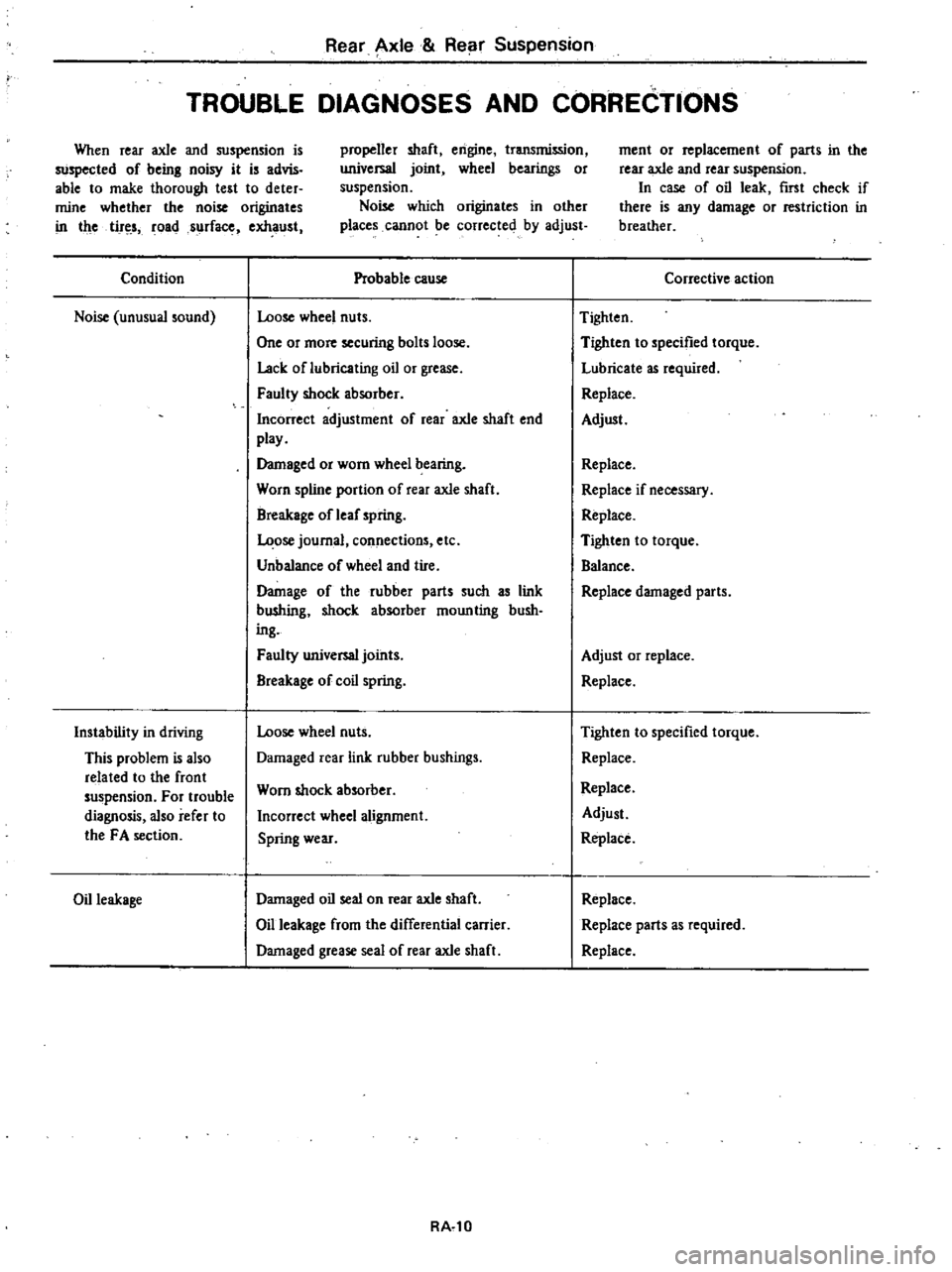
TROUBLE
DIAGNOSES
AND
CORRECTIONS
When
rear
axle
and
suspension
is
suspected
of
being
noisy
it
is
advis
able
to
make
thorough
test
to
deter
mine
whether
the
noise
originates
in
the
tir
s
roads
rfac
exhaust
propeller
shaft
engine
transmission
universal
joint
wheel
bearings
or
suspension
Noise
which
originates
in
other
places
cannot
be
corrected
by
adjust
Condition
Noise
unusual
sound
Instability
in
driving
This
problem
is
also
related
to
the
front
suspension
For
trouble
diagnosis
also
refer
to
the
FA
section
Oil
leakage
Probable
cause
Loose
wheel
nuts
One
or
more
securing
bolts
loose
Lack
oflubricating
oil
or
grease
Faulty
shock
absorber
Incorrect
adjustment
of
rear
axle
shaft
end
play
Damaged
or
worn
wheel
bearing
Worn
spline
portion
of
rear
axle
shaft
Breakage
of
leaf
spring
ose
journal
connections
etc
Unbalance
of
wheel
and
tire
Damage
of
the
rubber
parts
such
as
link
bU
hing
shock
absorber
moun
ting
bush
ing
Faulty
universal
joints
Breakage
of
coil
spring
Loose
wheel
nuts
Damaged
rear
link
rubber
bushings
Worn
shock
absorber
Incorrect
wheel
alignment
Spring
wear
Damaged
oil
seal
on
rear
axle
shaft
Oil
leakage
from
the
differential
carrier
Damaged
grease
seal
of
rear
axle
shaft
RA
l0
ment
or
replacement
of
parts
in
the
rear
axle
and
rear
suspension
In
case
of
oil
leak
first
check
if
there
is
any
damage
or
restriction
in
breather
Corrective
action
Tighten
Tighten
to
specified
torque
Lubricate
as
required
Replace
Adjust
Replace
Replace
if
necessary
Replace
Tighten
to
torque
Balance
Replace
damaged
parts
Adjust
or
replace
Replace
Tighten
to
specified
torque
Replace
Replace
Adjust
Replace
Replace
Replace
parts
as
required
Replace
Page 355 of 548
L
@
fl
JJ
l
f
m
ff
v
1
II
2
I
I
II
B
s1
r
Dip
other
end
of
hose
into
brake
fluid
bled
in
a
container
3
Pepress
brake
pedal
two
or
three
times
and
then
keep
pedal
fully
de
pressed
4
With
brake
pedal
fully
depressed
open
bleeder
valve
to
exhaust
air
Note
a
Carefully
monitor
brake
fluid
level
at
master
cylinder
during
bleeding
operation
BRAKE
PEDAL
REMOVAL
I
Remove
snap
pin
installed
at
the
end
of
clevis
pin
Draw
out
clevis
pin
and
separate
push
rod
or
operating
rod
from
brake
pedal
2
Remove
bolt
and
E
ring
securing
fulcrum
pin
and
draw
out
fulcrum
pin
Then
brake
pedal
can
be
taken
out
along
with
return
coil
spring
Brake
System
b
Do
not
reuse
brake
fluid
drained
during
bleeding
operation
c
Bleed
air
in
the
following
sequence
Master
cylinder
Rear
wheel
front
wheel
d
Be
careful
not
to
splash
brake
fluid
on
painted
areas
5
Close
bleeder
valve
quickly
as
brake
pedal
is
on
down
stroke
6
Allow
brake
pedal
to
return
slow
ly
with
bleeder
screw
closed
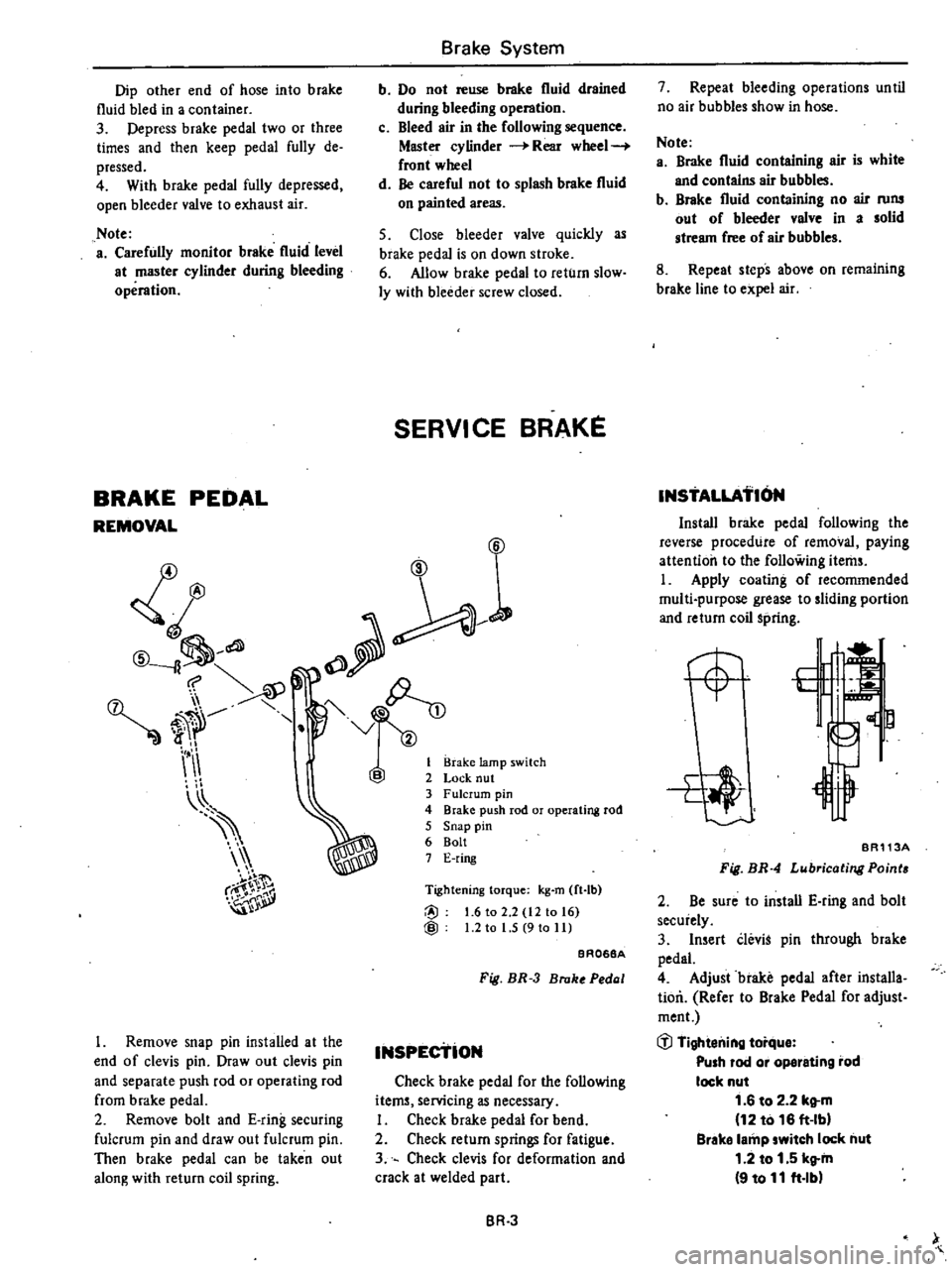
SERVI
CE
BRAKE
fJ
Brake
lamp
switch
Lock
nut
Fulcrum
pin
Brake
push
rod
or
operating
rod
Snap
pin
Bolt
E
ring
Tightening
torque
kg
m
ft
Ib
@
1
6
to
2
2
12
10
16
@
1
2
to
l
S
9
to
II
BROS8A
Fig
BR
3
Broke
Pedal
INSPEctioN
Check
brake
pedal
for
the
following
items
servicing
as
necessary
I
Check
brake
pedal
for
bend
2
Check
return
springs
for
fatigue
3
Check
clevis
for
deformation
and
crack
at
welded
part
BR
3
7
Repeat
bleeding
operations
until
no
air
bubbles
show
in
hose
Note
a
Brake
fluid
containing
air
is
white
and
contalns
air
bubbles
b
Brake
fluid
containing
no
air
rons
out
of
bleeder
valve
in
a
solid
stream
free
of
air
bubbles
8
Repeat
steps
above
on
remaining
brake
line
to
expel
air
INSTALLATION
Install
brake
pedal
following
the
reverse
procedure
of
removal
paying
attention
to
the
following
items
I
Apply
coating
of
recommended
multi
purpose
grease
to
sliding
portion
and
return
coil
spring
BA113A
Fit
BR
4
Lubricating
Point
2
Be
sure
to
install
E
ring
and
bolt
securely
3
Insert
CleviS
pin
through
brake
pedal
4
Adjust
brake
pedal
after
installa
tion
Refer
to
Blake
Pedal
for
adjust
ment
j
Tightening
torque
Push
rod
or
op8leting
rod
lock
nut
1
6
to
2
2
kltm
12
to
16
ft
Ibl
Brake
lamp
switch
lock
nut
1
2
to
1
5
kltin
9
to
11
ft
lb
Page 358 of 548
If
leakage
oCcurs
at
end
around
joints
re
tighten
Of
if
necessary
re
place
faulty
parts
INSTALLATION
Pay
particular
attention
to
follow
ing
instructions
when
installing
brake
lines
I
Leave
a
sulfident
space
between
brake
lines
and
adjacent
parts
so
that
brake
lines
are
completely
free
from
vibration
during
driving
2
Be
careful
not
to
warp
or
twist
brake
lines
3
When
installing
brake
tube
keep
a
certain
distance
between
tube
and
adjacent
parts
as
follows
Tube
to
rotating
parts
30
mm
1
18
in
Tube
to
moving
parts
10
mm
10
39
in
Tube
to
other
palls
5
mm
10
20
in
4
Always
fasten
brake
tubes
with
mounting
clips
where
necessary
On
rear
axle
case
are
two
double
dips
which
should
be
used
to
secure
brake
tubes
in
manner
described
be
low
Bend
short
clip
straight
up
With
brake
tube
on
long
clip
bend
clip
up
and
around
tube
Finally
wrap
short
clip
around
tube
to
secure
the
in
slallation
f
J
i
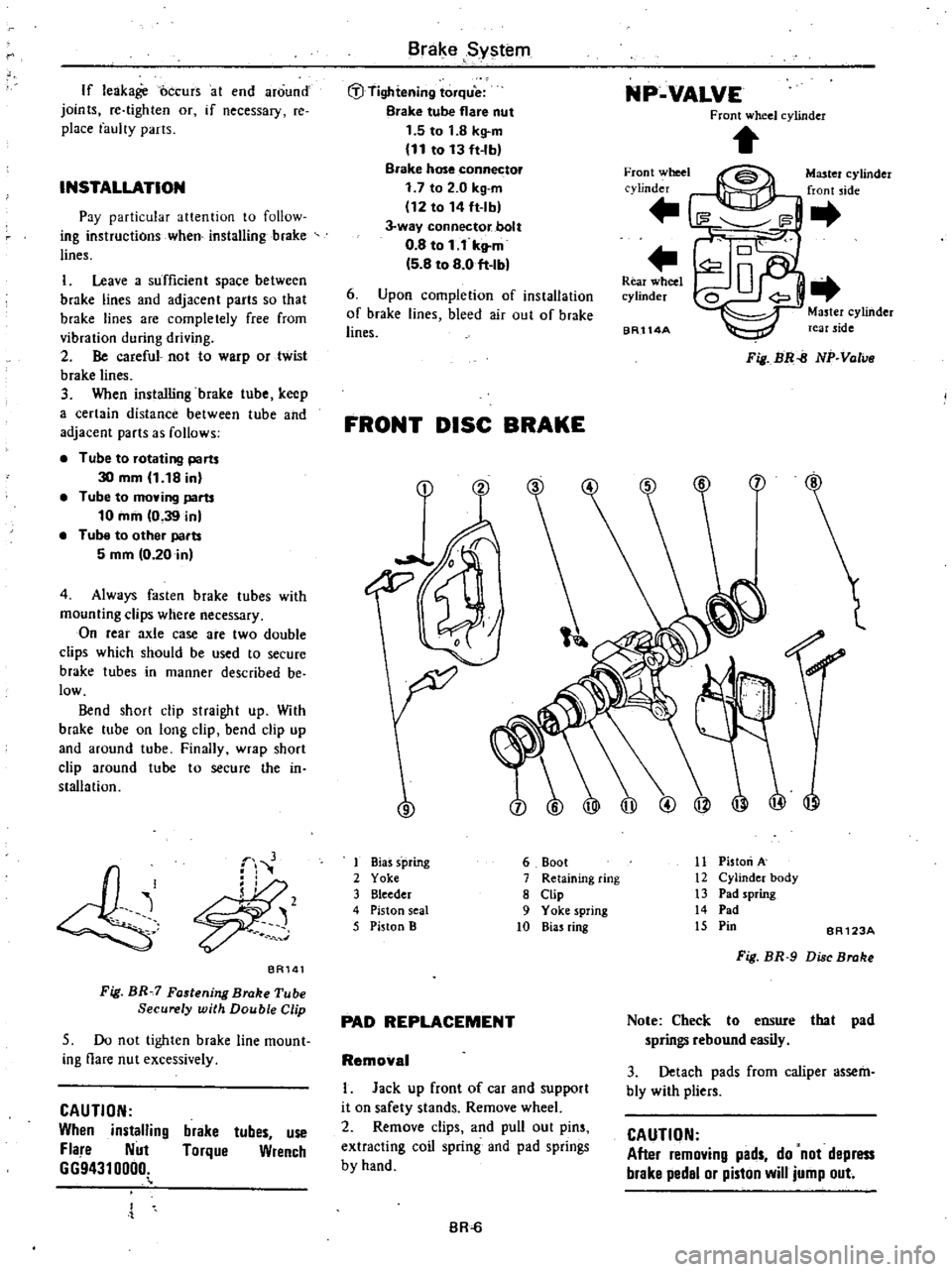
2
BA141
Fig
BR
7
Fastening
Brake
Tube
Securely
with
Double
Clip
5
Do
not
tighten
brake
line
mount
ing
flare
nut
excessively
CAUTION
When
installing
Fla
e
Nut
6694310000
brake
tubes
use
Torque
Wrench
Brake
System
t
D
Tightening
torque
Brake
tube
flare
nut
1
5
to
1
8
kg
m
11
to
13
ft
lb
Brake
hose
connector
1
7
to
2
0
kg
m
112
to
14
ft
lb
J
way
connector
bolt
0
8
to
1
1
kltm
5
8
to
8
0
ft
Ib
NP
VALVE
Front
wheel
cylinder
Front
wheel
cylinder
Master
cylinder
front
jde
6
Upon
completion
of
installation
of
brake
lines
bleed
air
out
of
brake
lines
Rear
wheel
cylinder
BR114A
Master
cylinder
rear
side
Fig
BR
B
NP
Valve
FRONT
DISC
BRAKE
9
ilJ
I
Bias
s
pring
2
Yoke
3
Bleeder
4
Piston
seal
5
Piston
B
11
Piston
A
12
Cylinder
body
13
Pad
spring
14
Pad
15
Pin
6
Boot
7
Retaining
ring
8
Clip
9
Yoke
spring
10
Bias
ring
BR123A
Fig
BR
9
Di
c
Broke
PAD
REPLACEMENT
Note
Check
to
ensure
that
pad
springs
rebound
easily
3
Detach
pads
from
caliper
assem
bly
with
pliers
Removal
I
Jack
up
front
of
car
and
support
it
on
safety
stands
Remove
wheel
2
Remove
clips
and
pull
out
pins
extracting
coil
spring
and
pad
springs
by
hand
CAUTION
After
removing
pads
do
not
depress
brake
pedal
or
piston
will
jump
out
BR