battery DATSUN 210 1979 Owner's Manual
[x] Cancel search | Manufacturer: DATSUN, Model Year: 1979, Model line: 210, Model: DATSUN 210 1979Pages: 548, PDF Size: 28.66 MB
Page 170 of 548
FUSIBLE
LINK
FUSIBLE
LINK
f
BATTERY
@@
V
R
@@
G
G
FUSleLE
ImrnI
LI
NK
MTI
I
En
g
n
l
Electrical
Syst
lOl
IGNITION
SWITCH
FUSE
lOA
o
v
FUSE
lOA
C
V
L@@
BAT
f
L
S
BI
I
I
sl
fRO
L
I
I
F
I
EI
i
K
a
ALTERNATOR
lE
Ie
VOLTAGE
REGULATOR
I
I
L
WR
I
1
d
I
t
J
t
IGNITION
WR
SWITCH
BW
U
0
AUTO
CHOKE
RELAY
G
1
WR
J
I
00
00
gg
1
00
VR
1
E
lDID
I
@
O
BAT
mID
W
J
WR
W
FUSE
BLOCK
CHARGE
WARNING
LAMP
5J
BL
Note
@
V
@
California
models
Non
Qilifomo
18
models
FU
models
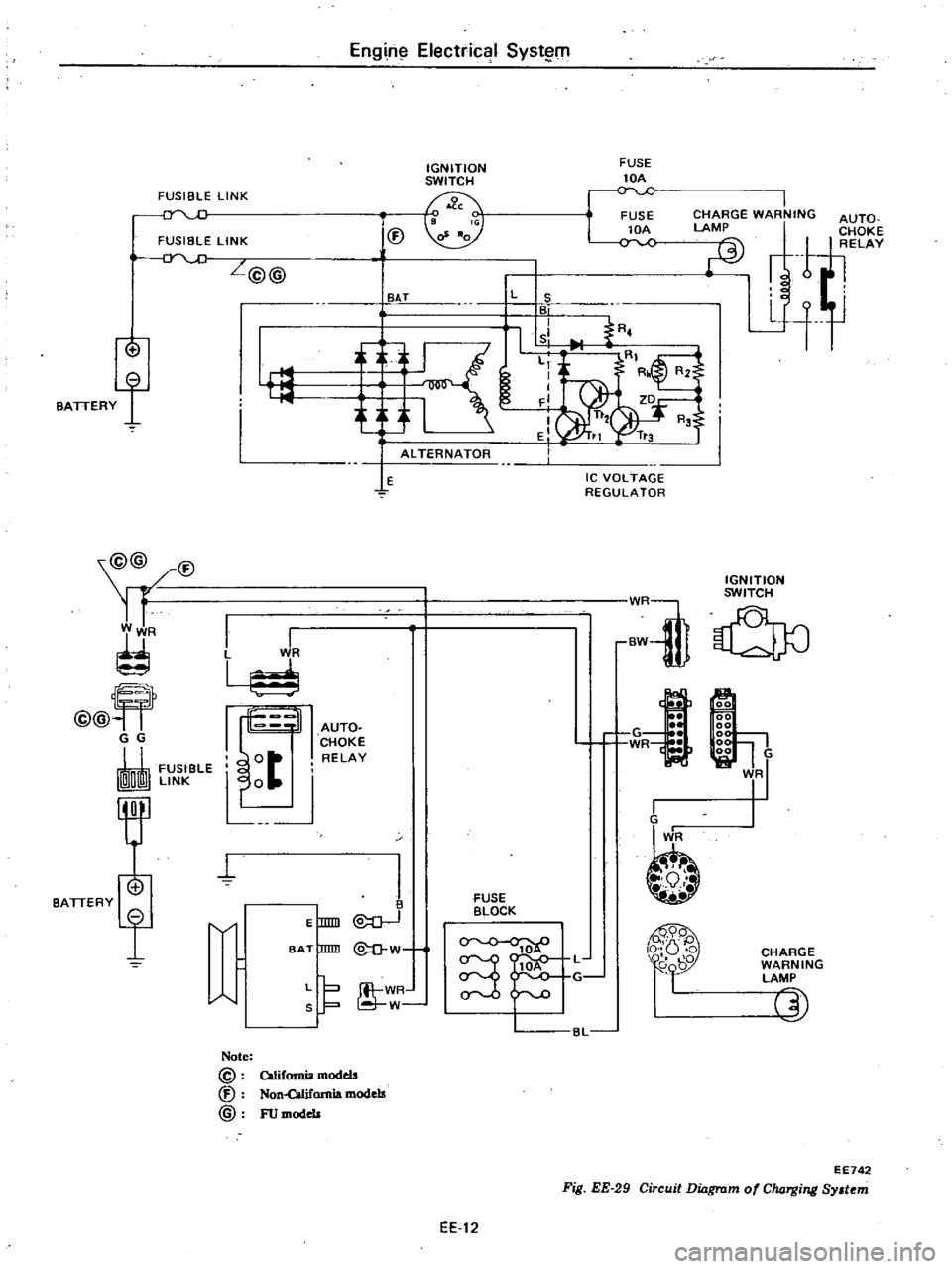
Fig
EE
29
Circuit
Dinrswr
EE742
mofCIuJ
Tg
ng
Sy
t
m
EE
12
Page 172 of 548
REMOVAL
1
Disconnect
battery
negative
cable
2
Disconnect
two
lead
wires
and
oonnector
from
alternator
3
Loosen
adjusting
bolt
4
Remove
alternator
drive
belt
5
Remove
parts
associated
with
alternator
from
engine
6
Remove
alternator
from
car
DISASSEMBLY
I
Remove
through
bolts
Separate
front
cover
with
rotor
from
rear
cover
with
stator
by
lightly
tapping
front
bracket
with
a
wooden
mallet
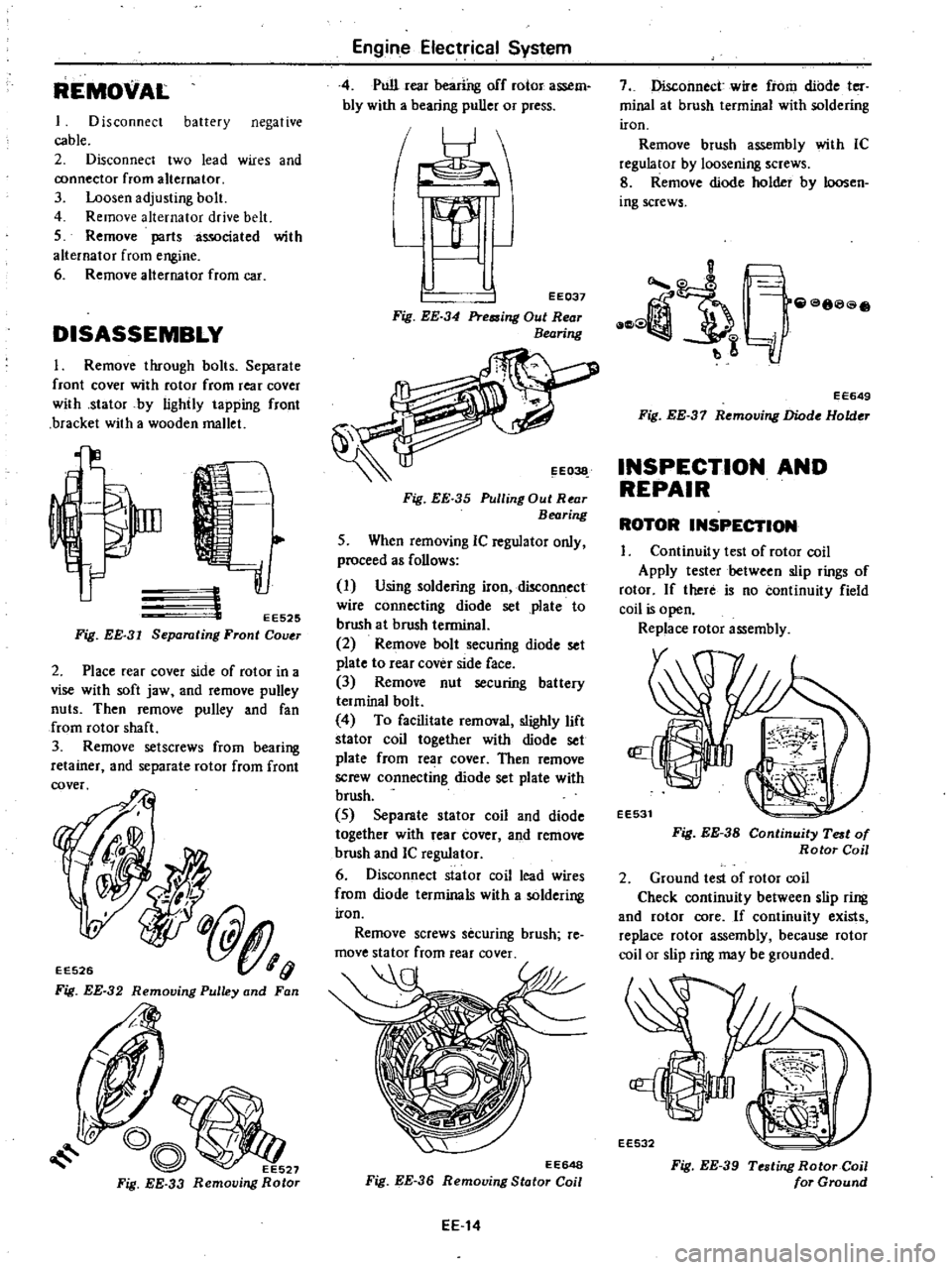
rnJ
J
i
EE525
Separating
Front
COI
T
Fig
EE
31
2
Place
rear
cover
side
of
rotor
in
a
vise
with
soft
jaw
and
remove
pulley
nuts
Then
remove
pulley
and
fan
from
rotor
shaft
3
Remove
setscrews
from
bearing
retainer
and
separate
rotor
from
front
EE526
Fig
EE
32
Removing
Pulley
and
Fan
tr
s
0
27
Fig
EE
33
Removing
Rotor
Engine
Electrical
System
4
Pull
rear
bearfug
off
rotor
assem
bly
with
a
bearing
puller
or
press
EE037
Fig
EE
34
Pressing
Out
Rear
Bearing
I
EO
Fig
EE
35
Pulling
Out
Rear
Bearing
5
When
removing
IC
regulator
only
proceed
as
follows
I
Using
soldering
iron
disconnect
wire
connecting
diode
set
plate
to
brush
at
brush
terminal
2
Remove
bolt
securing
diode
set
plate
to
rear
cover
side
face
3
Remove
nut
securing
battery
terminal
bolt
4
To
facilitate
removal
s1ighly
lift
stator
coil
together
with
diode
set
plate
from
re
r
cover
Then
remove
screw
connecting
diode
set
plate
with
brush
5
Separate
stator
coil
and
diode
together
with
rear
cover
and
remove
brush
and
IC
regulator
6
Disconnect
stator
coil
lead
wires
from
diode
terminals
with
a
soldering
iron
Remove
screws
securing
brush
re
move
stator
from
rear
cover
EE648
Fig
EE
36
Removing
Stator
Coil
EE
14
7
Disconnect
wire
from
diode
tor
minal
at
brush
terminal
with
soldering
iron
Remove
brush
assembly
with
IC
regulator
by
loosening
screws
8
Remove
diode
holder
by
loosen
ing
screws
acefii
li
E
E649
Fig
EE
37
Removing
Diode
Holder
INSPECTION
AND
REPAIR
ROTOR
INSPECTION
I
Continuity
test
of
rotor
coil
Apply
tester
between
slip
rings
of
rotor
If
there
is
no
continuity
field
coil
is
open
Replace
rotor
assembly
Fig
EE
38
Continuity
Test
of
Rotor
Coil
2
Ground
test
of
rotor
coil
Check
continuity
between
slip
ring
and
rotor
core
If
continuity
exists
replace
rotor
assembly
because
rotor
coil
or
slip
ring
may
be
grounded
EE532
Fig
EE
39
Te
ting
Rotor
Coil
for
Ground
Page 175 of 548
Engine
Electrical
System
6
Tighten
through
bolts
rfl
Tightening
torque
Through
bolts
60
to
70
kg
cm
52
to
61
in
lb
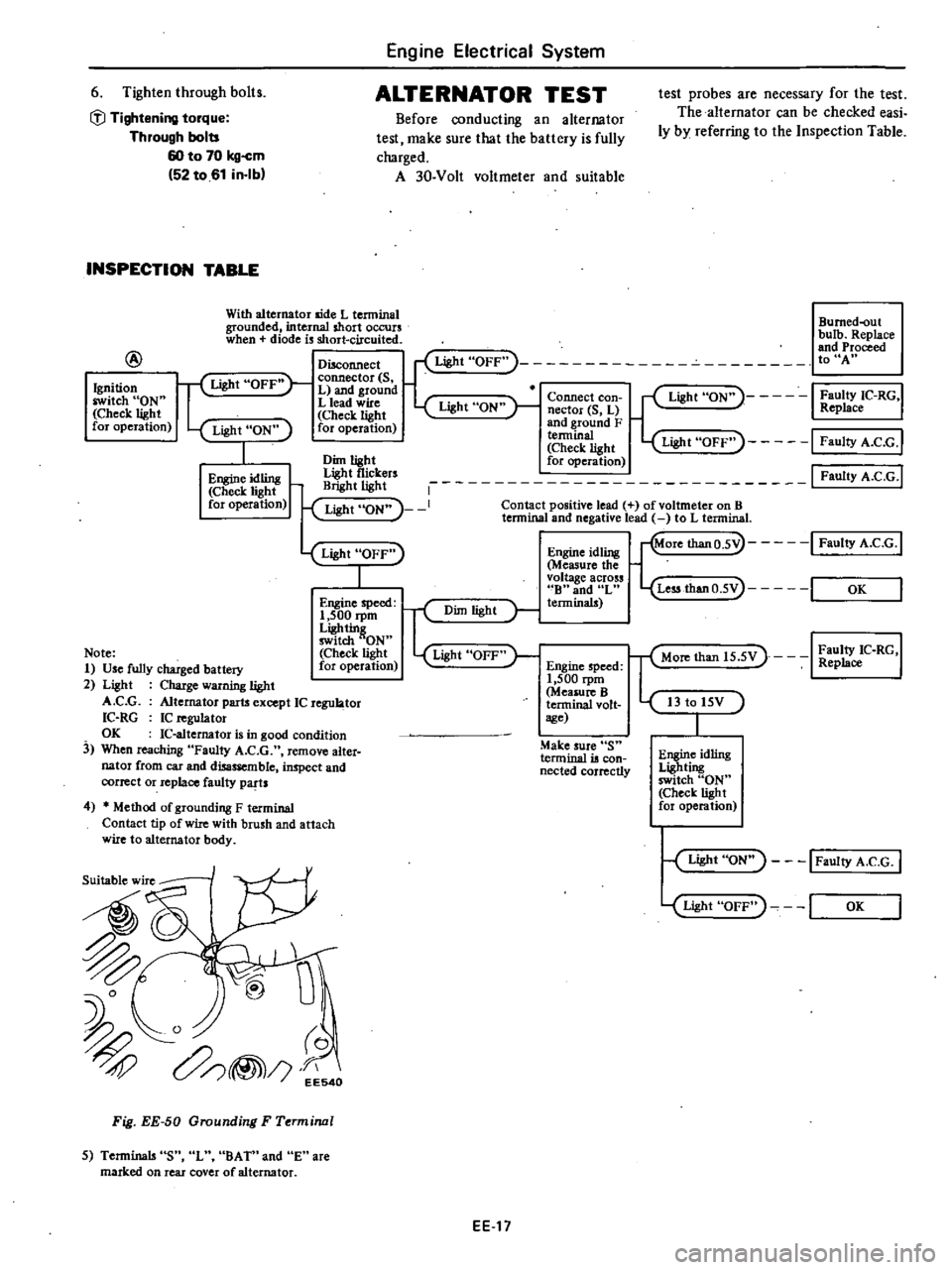
ALTERNATOR
TEST
Before
conducting
an
alternator
test
make
sure
that
the
battery
is
fully
charged
A
30
Volt
voltmeter
and
suitable
INSPECTION
TABLE
With
alternator
aide
L
tenninal
grounded
internal
short
occurs
when
diode
is
short
circuited
@
test
probes
are
necessary
for
the
test
The
alternator
can
be
checked
easi
ly
by
referring
to
the
Inspection
Table
Bumed
out
bulb
Replace
and
Proceed
toUA
Ignition
switch
ON
Check
light
for
operation
Disconnect
Light
OFF
f
Light
OFF
connector
S
L
and
ground
L
lead
wire
Light
ON
Check
light
for
operation
Light
ON
I
Faulty
IC
RG
Replace
Connect
con
nector
S
L
and
ground
F
a1light
Light
OFF
I
FaultyA
C
G
I
Dim
light
for
operation
tf
i
rs
1
I
Faulty
A
C
G
I
Light
ON
I
Contact
positive
lead
of
voltmeter
on
B
lennina
and
negative
lead
to
L
tenninal
Light
ON
1
Engine
idling
Check
light
for
operation
Light
OFF
I
Engine
idling
Measure
the
voltage
across
B
and
L
terminals
Engine
speed
1
500
rpm
Ligh
tin
switch
ON
Check
light
for
operation
r
Dim
light
Light
OFF
Note
1
Use
fully
charged
battery
2
Light
Charge
warning
light
A
C
G
Alternator
parts
except
IC
regu
tor
IC
RG
IC
n
guJator
OK
IC
altemator
is
in
good
condition
3
When
reaching
Faulty
A
C
G
remove
alter
nator
from
car
and
disassemble
inspect
and
correct
or
replace
faulty
parts
Engine
speed
1
500
rpm
Measure
B
terminal
volt
sge
Make
sure
S
terminal
is
con
nected
correctly
4
Method
of
grounding
F
terminal
Contact
tip
of
wire
with
brush
and
attach
wire
to
alternator
body
Suitable
wire
I
Fig
EE
50
Grounding
F
Terminal
5
Terminals
S
L
BA
Tn
and
E
are
marked
on
rear
cover
of
alternator
EEl7
More
thanO
5V
I
Faulty
A
e
G
1
Less
thanO
5V
I
OK
T
Mon
than
15
5V
I
Z
C
RG
I
I3
to
15V
Engine
idling
Lighting
switch
ON
Check
light
for
operation
Light
ON
I
Faulty
A
C
G
I
Light
OFF
I
OK
Page 176 of 548
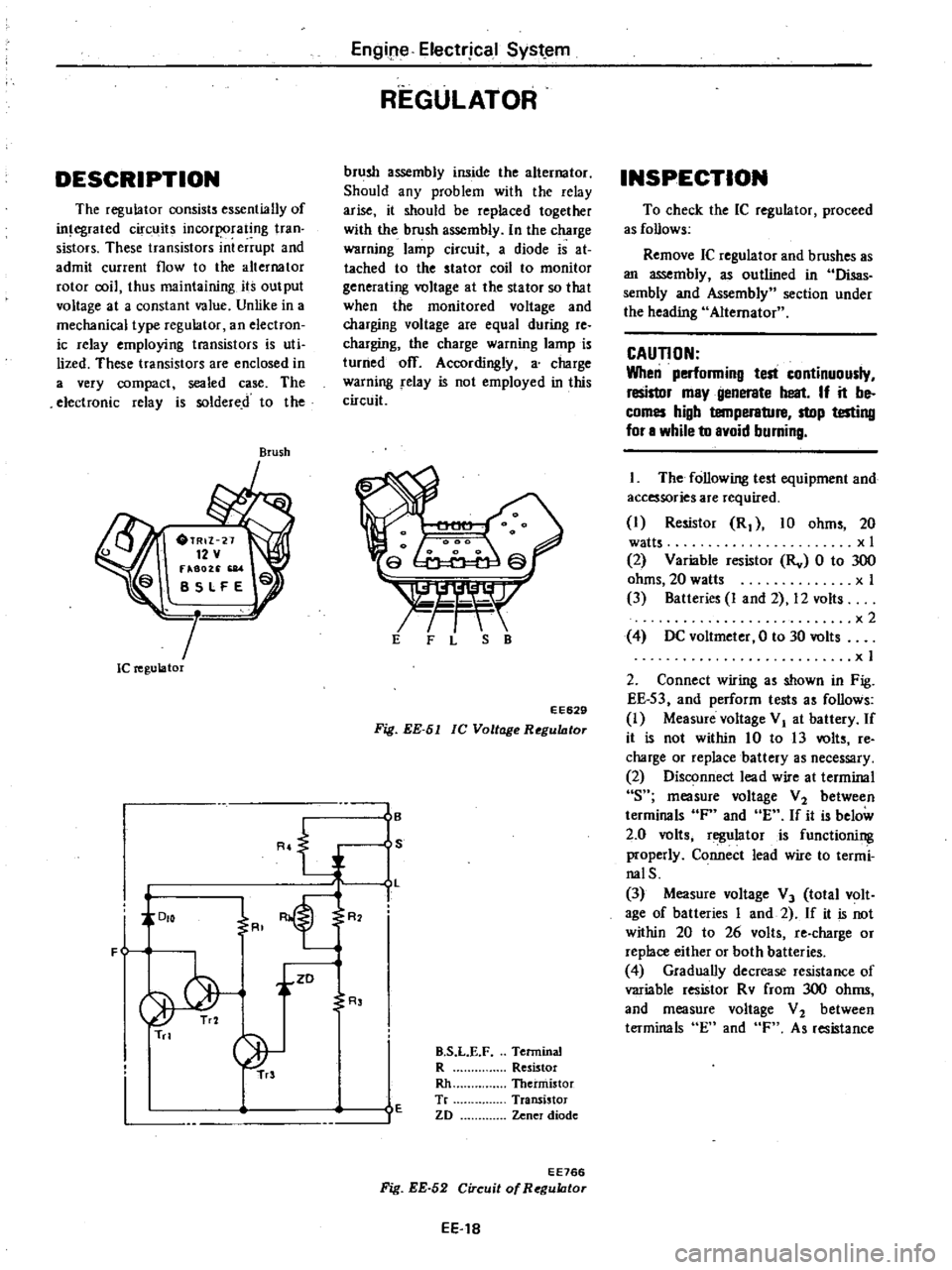
DESCRIPTION
The
regulator
consists
essentially
of
in
egrated
circuits
incorporating
tran
sistors
These
transistors
int
errupt
and
admit
current
flow
to
the
alternator
rotor
coil
thus
maintaining
its
output
voltage
at
a
constant
value
Unlike
in
a
mechanical
type
regulator
an
electron
ic
relay
employing
transistors
is
uti
lized
These
transistors
are
enclosed
in
a
very
compact
sealed
case
The
electronic
relay
is
soldered
to
the
Brush
Ie
regulator
R
J
DIO
F
i
ZD
Tn
Engipe
Electrjcal
Syst
em
REGULATOR
brush
assembly
inside
the
alternator
Should
any
problem
with
the
relay
arise
it
should
be
replaced
together
with
the
brush
assembly
In
the
charge
warning
lamp
circuit
a
diode
is
at
tached
to
the
stator
coil
to
monitor
generating
voltage
at
the
stator
so
that
when
the
monitored
voltage
and
charging
voltage
are
equal
during
re
charging
the
charge
warning
lamp
is
turned
off
Accordingly
a
charge
warning
relay
is
not
employed
in
this
circuit
s
r
t
E
F
L
S
B
EE629
Fig
EE
51
lC
Voltage
RegultJtor
I
B
S
L
I
R
R
E
B
S
L
E
F
Terminal
R
Resistor
Rh
Thermistor
Tr
Transistor
ZD
Zener
diode
EE766
Fig
EE
52
Circuit
of
RegultJtor
EE
18
INSPECTION
To
check
the
IC
regulator
proceed
as
follows
Remove
IC
regulator
and
brushes
as
an
assembly
as
outlined
in
Disas
sembly
and
Assembly
section
under
the
heading
Alternator
CAUTION
When
performing
test
continuously
resistor
may
generate
heat
If
it
be
comes
high
temperature
stop
testing
for
a
while
to
avoid
burning
The
following
test
equipment
and
accessories
are
required
I
Resistor
R
10
ohms
20
watts
x
I
2
Variable
resistor
Rv
0
to
300
ohms
20
watts
x
I
3
Batteries
I
and
2
12
volts
x2
4
DC
voltmeter
0
to
30
volts
x
I
2
Connect
wiring
as
shown
in
Fig
EE
S3
and
perform
tests
as
follows
I
Measure
voltage
VI
at
battery
If
it
is
not
within
10
to
13
volts
re
charge
or
replace
battery
as
necessary
2
Disconnect
lead
wire
at
terminal
s
measure
voltage
V
2
between
terminals
F
and
E
If
it
is
below
2
0
volts
regulator
is
functioning
properly
Connect
lead
wire
to
termi
nalS
3
Measure
voltage
V
3
total
volt
age
of
batteries
I
and
2
If
it
is
not
within
20
to
26
volts
re
charge
or
replace
either
or
both
batteries
4
Gradually
decrease
resistance
of
variable
resistor
Rv
from
300
ohms
and
measure
voltage
V
2
between
terminals
En
and
F
As
resistance
Page 178 of 548
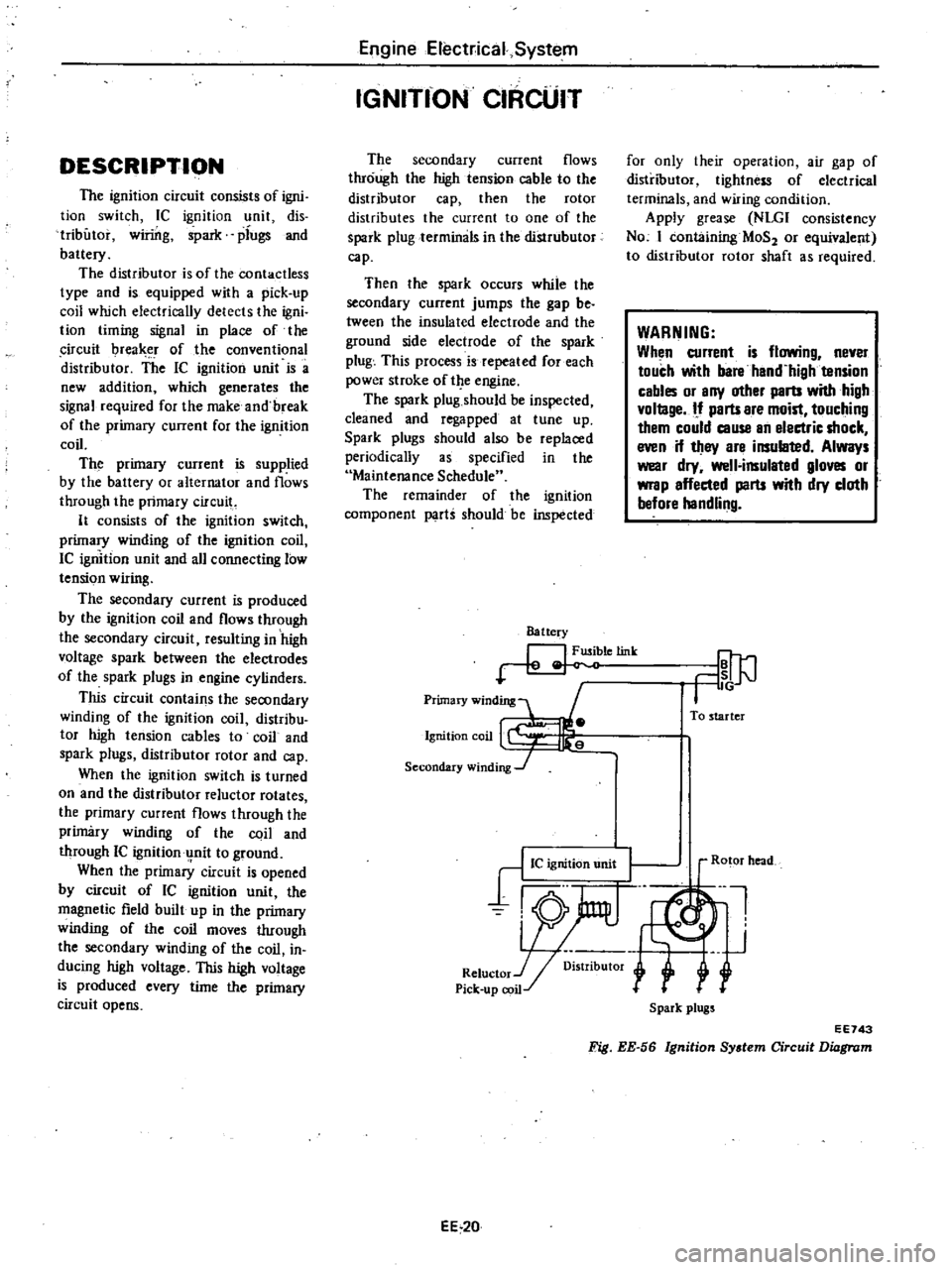
DESCRIPTION
The
ignition
circuit
consists
of
igni
tion
switch
Ie
ignition
unit
dis
tributor
winng
ipark
plugs
and
battery
The
distributor
is
of
the
contactless
type
and
is
equipped
with
a
pick
up
coil
which
electrically
detects
the
igni
tion
timing
signal
in
place
of
the
ircuit
I
rea
r
of
the
conventional
distributor
The
IC
ignition
unit
is
a
new
addition
which
generates
the
signal
required
for
the
make
and
break
of
the
primary
current
for
the
ignition
coil
The
primary
current
is
supplied
by
the
battery
or
alternator
and
flows
through
the
primary
circuit
It
consists
of
the
ignition
switch
primary
winding
of
the
ignition
coil
IC
ignition
unit
and
all
connecting
low
tension
wiring
The
secondary
current
is
produced
by
the
ignition
coil
and
flows
through
the
secondary
circuit
resulting
in
high
voltage
spark
between
the
electrodes
of
the
spark
plugs
in
engine
cylinders
This
circuit
contains
the
secondary
winding
of
the
ignition
coil
distribu
tor
high
tension
cables
to
coil
and
spark
plugs
distributor
rotor
and
cap
When
the
ignition
switch
is
turned
on
and
the
distributor
reluctor
rotates
the
primary
current
flows
through
the
primary
winding
of
the
coil
and
through
IC
ignitionu
nit
to
ground
When
the
primary
circuit
is
opened
by
circuit
of
IC
ignition
unit
the
magnetic
field
built
up
in
the
primary
winding
of
the
coil
moves
through
the
secondary
winding
of
the
coil
in
ducing
high
voltage
This
high
voltage
is
produced
every
time
the
primary
circuit
opens
EngineElect
ical
System
IGNITfON
CIRCUIT
The
secondary
current
flows
through
the
high
tension
cable
to
the
distributor
cap
then
the
rotor
distributes
the
current
to
one
of
the
spark
plug
terminals
in
the
distrubutor
cap
Then
the
spark
occurs
while
the
secondary
current
jumps
the
gap
be
tween
the
insulated
electrode
and
the
ground
side
electrode
of
the
spark
plug
This
process
is
repeated
for
each
power
stroke
of
t
e
engine
The
spark
plug
should
be
inspected
cleaned
and
regapped
at
tune
up
Spark
plugs
should
also
be
replaced
periodically
as
specified
in
the
Maintenance
Schedule
The
remainder
of
the
ignition
component
parti
should
be
inspected
Battery
letink
Primary
winding
1
Ignition
coil
Secondary
winding
J
for
only
their
operation
air
gap
of
distributor
tightness
of
electrical
terminals
and
wiring
condition
Apply
grease
NLGI
consistency
No
I
containing
MaS
or
equivalent
to
distributor
rotor
shaft
as
required
WARNING
When
current
is
flowing
never
touch
with
bare
hand
high
tension
cables
or
any
other
parts
with
high
vollage
If
parts
are
moist
touching
them
could
cause
an
electric
shock
even
if
they
are
insulated
Always
wear
dry
well
insulated
gloves
or
wrap
affected
parts
with
dry
cloth
before
handling
To
starter
EE
20
Ro
or
head
Ul
J
r
Spark
plugs
EE743
Fig
EE
56
Ignition
System
Circuit
Diagram
Page 179 of 548
FUSIBLE
LINK
BATTERY
VIR
9
rID
B
V
II
H
Engine
Electrical
System
1
II
1l
IGNITION
COIL
IIC
IGNITION
I
UNIT
O
J
DISTRIBUTOR
EE
21
B4J
QJ
jl
SPARK
PLUG
IGNITiON
SWITCH
EE744
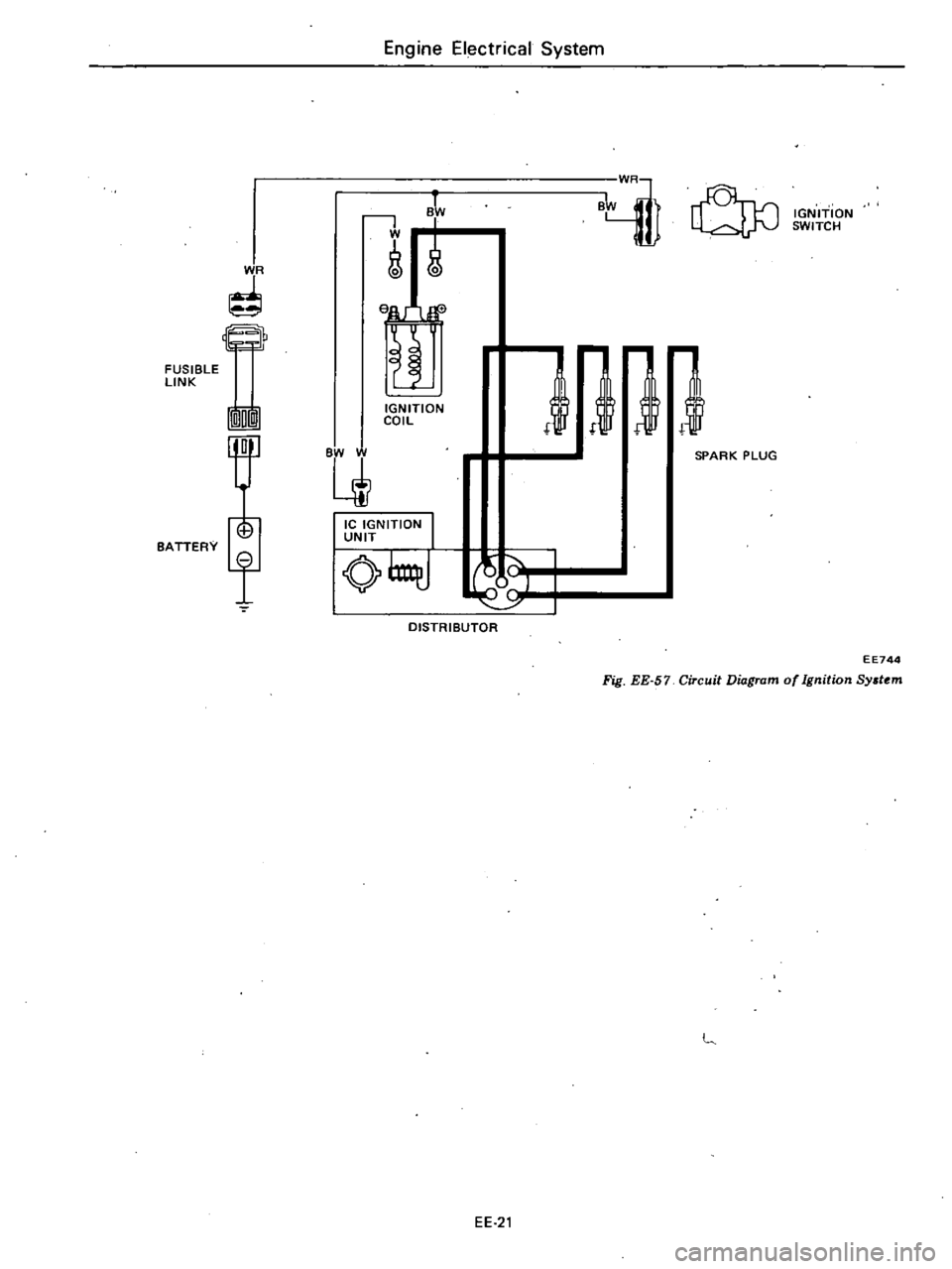
Fig
EE
57
Circuit
DiGgram
of
Ignition
Sy
tem
L
Page 182 of 548

ASSEMBLY
To
assemble
reverse
the
order
of
disassembly
Carefully
observe
the
fol
lowing
instructions
CAUTION
B
tfore
installi
lg
IC
ignition
unit
make
sure
mating
surfaces
of
IC
ignition
unit
and
distriblitor
are
clean
and
free
from
dust
sand
and
moisture
Align
match
marks
so
that
parts
are
assembled
to
their
original
posi
tions
2
Ensure
that
reluctor
is
properly
oriented
when
installing
on
shaft
Al
ways
drive
in
roll
pin
with
its
slit
toward
the
outer
end
of
shaft
See
Fig
EE
64
Be
sure
to
use
a
new
roll
pin
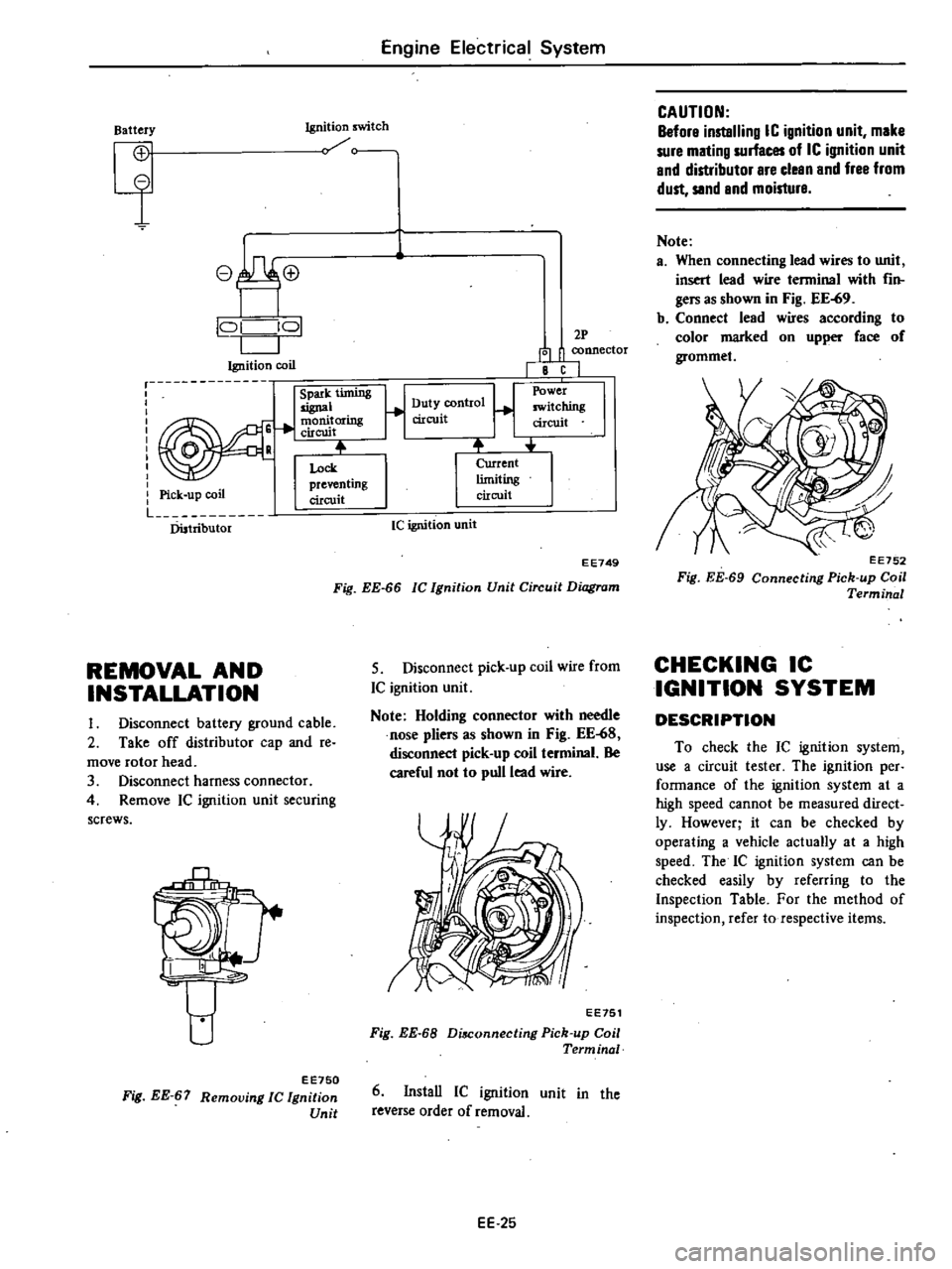
DESCRIPTION
The
IC
ignition
unit
utilizes
a
semi
conductor
IC
device
and
is
mounted
on
the
side
surface
of
the
distributor
The
IC
ignition
unit
has
the
fol
lOwing
circuits
Spark
timing
signal
monitoring
circuit
This
circuit
detects
the
ignition
signal
sent
from
the
distributor
pick
up
coil
and
amplifies
the
signal
2
Lock
preventing
circuit
This
circuit
cuts
off
the
ignition
coil
primary
current
when
the
ignition
switch
is
ON
and
the
engine
is
sta
tionary
If
the
ignition
coil
primary
current
is
allowed
to
flow
under
such
condi
tions
excessive
current
will
be
drawn
because
of
low
internal
resistance
of
the
ignition
coil
Engine
Electrical
System
r
5
EE747
Fig
EE
64
Driuing
in
Roll
Pin
3
When
installing
pinion
on
shaft
be
sure
to
install
pinion
gear
correctly
to
position
where
it
was
installed
4
Apply
grease
to
the
top
of
rotor
shaft
as
required
5
Check
the
operation
of
governor
before
installing
distributor
on
engine
Ie
IGNITION
UNIT
This
can
result
in
an
abnormal
temperature
rise
in
the
ignition
coil
or
discharged
battery
These
malfunc
tions
can
be
prevented
by
this
lock
preventing
circuit
3
Duty
control
circuit
This
circuit
controls
the
ratio
of
the
ignition
coil
primary
current
ON
OFF
time
periods
in
one
cycle
of
ignition
operation
111is
is
equivalent
to
the
dwell
angle
of
the
conventional
point
type
dis
tributor
In
order
to
provide
high
performance
spark
ruing
over
a
wide
range
of
driving
speeds
this
duty
can
be
controlled
by
the
source
voltage
and
the
ambient
temperature
as
well
as
by
the
engine
rpm
4
Power
switching
circuit
This
circuit
is
used
to
make
or
break
directly
the
primary
circuit
cur
EE
24
6
Properly
eenterstatOr
and
reluc
tor
before
tightening
Standard
air
gap
0
3
to
0
5
mm
0
012
to
0
020
in
0
3
to
0
5
mm
0
012
to
0
020
in
Fig
EE
65
EE748
Air
Gap
7
Adjust
ignition
timing
after
distri
butor
is
installed
on
engine
rent
of
the
ignition
coil
5
Current
limiting
circuit
This
circuit
controls
the
current
value
so
that
excessive
current
will
not
flow
through
the
power
switching
cir
cuit
To
ensure
efficient
operation
of
the
IC
ignition
unit
these
five
circuits
are
manufactured
in
one
assembly
as
shown
in
Fig
EE
66
The
semi
conductor
IC
is
utilized
for
all
these
circuits
except
the
power
switching
circuit
The
power
switching
circuit
uses
one
power
transistor
and
the
circuit
is
arranged
on
the
ceramic
substrate
together
with
resislors
capa
citors
and
diodes
Each
component
part
of
this
unit
is
highly
reliable
however
should
any
part
be
found
faulty
the
entire
as
sembly
musl
be
replaced
Page 183 of 548
Engine
Electrical
System
Battery
Ignition
switch
CG
1
e
@
P
L
JO
L
J
Ignition
coil
r
Spark
timing
signal
I
oni
1oring
Clfcwt
0
R
Lock
Pi
k
il
preventing
c
up
co
circuit
Ln
n
Distributor
2P
fJ
1I
connector
8C
H
uty
control
ClICUlt
Power
switching
circuit
Current
limiting
circuit
Ie
ignition
unit
EE749
Fig
EE
66
Ie
Ignition
Unit
Circuit
Diagram
REMOVAL
AND
INSTALLATION
5
Disconnect
pick
up
coil
wire
from
IC
ignition
unit
Note
Holding
connector
with
needle
nose
pliers
as
shown
in
Fig
EE
68
disconnect
pick
up
coil
terminal
Be
careful
not
to
pull
lead
wire
I
Disconnect
battery
ground
cable
2
Take
off
distributor
cap
and
re
move
rotor
head
3
Disconnect
harness
connector
4
Remove
Ie
ignition
unit
securing
screws
rf
I
I
EE751
Fig
EE
68
Di
Connecting
Pick
up
Coil
Term
inal
eE750
Fig
EE
67
Removing
Ie
Ignition
Unit
6
InstaU
IC
ignition
unit
in
the
reverse
order
of
removal
EE
25
CAUTION
Before
instelling
IC
ignition
unit
mike
sure
mlting
surfaces
of
IC
ignition
unit
end
distributor
Ire
cleen
and
free
from
dust
sand
and
moisture
Note
a
When
connecting
lead
wires
to
unit
insert
lead
wire
terminal
with
fin
ger
as
shown
in
Fig
EE
69
b
Connect
lead
wires
according
to
color
marked
on
upper
face
of
grommet
EE752
Fig
EE
69
Connecting
Pick
up
Coil
Terminal
CHECKING
IC
IGNITION
SYSTEM
DESCRIPTION
To
check
the
IC
ignition
system
use
a
circuit
tester
The
ignition
per
fannance
of
the
ignition
system
at
a
high
speed
cannot
be
measured
direct
ly
However
it
can
be
checked
by
operating
a
vehicle
actually
at
a
high
speed
The
IC
ignition
system
can
be
checked
easily
by
referring
to
the
Inspection
Table
For
the
method
of
inspection
refer
to
respective
items
Page 184 of 548

INSPECTION
TABLE
I
No
spark
occur
Check
high
tension
cable
NG
OK
Repair
and
lor
replace
ngine
Electrical
System
START
Check
sparking
performance
J
J
Sparks
oci
1u
IC
IGNITION
SYSTEM
OK
Check
power
supply
circuit
NG
Repair
and
or
replace
OK
Check
primary
circuit
Proceed
to
A
Proceed
to
A
NG
epair
an
or
replace
OK
Proceed
to
A
DISTRIBUTOR
ASSEMBLY
NG
lC
IGNITION
UNIT
AND
OR
PICK
UP
COIL
NG
Mealure
pick
up
coil
resistance
as
a
distributor
assembly
Except
approx
4000
Measure
igilition
coii
8terminalvoltage
Battery
voltage
t
OV
Measure
pick
up
coil
resistance
I
Ie
IGNITION
UNIT
NG
Except
approx
400n
Approx
400n
PICK
UP
COIL
NG
1
PICK
UP
COIL
OK
Replace
IC
IGNITION
Replace
I
UNI
NG
l
Meuure
pick
up
coil
resistance
Except
approx
4000
I
Check
sparking
performance
I
Replace
I
r
PICK
UP
COIL
NG
1
No
spark
occun
Sparks
occur
I
IC
IGNITION
flc
IGNITION
Proceed
to
A
Replace
UNIT
NG
i
UNIT
OK
Proceed
to
A
Replace
Proceed
to
A
CHECKING
PROCEDURE
Sparking
performance
check
L
Turn
ignition
switch
to
OFF
position
2
Disconnect
anti
dieseling
solenoid
valve
connector
to
cut
off
supply
of
fuel
to
engine
3
Disconnect
high
tension
cable
from
spark
plug
4
Keeping
high
tension
cable
end
4
to
5
mm
0
16
to
0
20
in
away
from
engine
block
rotate
starter
motor
and
check
whether
sparks
occur
across
the
clearance
JUDGMENT
Sparks
occur
IC
ignition
system
OK
In
this
case
IC
ignition
system
and
component
parts
need
not
be
checked
beyond
this
No
spark
occurs
IC
ignition
system
NG
In
case
of
NG
check
High
Tension
Cables
Nole
This
check
is
designed
to
deter
mine
only
ignition
spark
perform
ance
when
cranking
engine
If
test
results
are
satisfactory
Ibis
does
EE
26
I
Approx
400n
PICK
UP
COIL
OK
1C
IGNITION
UNIT
NG
I
Repair
and
or
replace
I
Proceed
to
A
Approx
400n
l
PICK
UP
COIL
OK
1
not
alwaY
indicate
performance
sufrlcienl
for
high
speed
operation
IOgh
tension
cable
check
Refer
to
Engine
Tune
up
for
Check
ing
Ignition
Wiring
Distributor
Cap
and
Rotor
JUDGMENT
If
high
tension
cable
is
OK
check
Power
SupplY
Circuit
If
high
tension
cable
is
NG
replace
cable
assembly
Page 185 of 548

Power
suppl
circuit
check
Make
sure
that
ignition
switch
is
in
OFF
position
2
Disconnect
Ie
ignition
unit
con
nector
from
unit
3
Turn
ignition
switch
to
ON
position
4
Measure
voltage
at
the
terminal
as
shown
in
Fig
EE
70
I
I
1
Fig
EE
70
EE734
Checking
Power
Supply
Circuit
5
Turn
ignition
switch
to
OFF
position
JUDGMENT
Battery
voltage
is
indicated
OK
In
this
case
check
Primary
Circuit
Battery
voltage
is
not
indicated
NG
In
case
of
NG
check
power
supply
wirings
fusible
link
ignition
switch
and
connecto
s
for
condition
and
con
tinuity
Primer
circuit
check
I
Make
sure
that
ignition
switch
is
in
0
FF
position
2
Disconnect
IC
ignition
unit
con
nector
from
unit
3
Turn
ignition
switch
to
ON
position
4
Measure
voltage
at
the
terminal
as
shown
in
Fig
EE
7I
1
I
r
1
EE735
Fig
EE
7I
Checking
Primary
Circuit
Engine
Electrical
System
5
Turn
ignition
switch
to
OFF
position
JUDGMENT
Battery
voltage
is
indicated
OK
In
this
case
proceed
to
the
step
for
IC
Ignition
Unit
and
Pick
up
Coil
Check
Battery
voltage
is
not
indicated
NG
If
NG
check
condition
and
con
tinuity
of
primary
circuit
wirings
and
connectors
If
results
of
these
inspec
tions
are
satisfactory
check
Ignition
Coil
Ignition
coil
check
I
Make
sure
that
ignition
switch
is
in
OFF
position
2
Disconnect
harness
connector
from
ignition
coil8terminal
3
Measure
resistance
between
and
8terminals
Resistance
1
range
C2J
j
EE567
Fig
EE
72
Checking
Ignition
Coil
Assem
bly
JUDGMENT
If
resistance
value
is
0
84
to
1
02n
OK
If
resistance
value
is
other
than
the
specified
value
NG
Ie
Ignition
unit
end
pick
up
coli
check
If
power
supply
circuit
primary
circuit
and
high
tension
cables
are
in
good
order
IC
ignition
unit
and
or
pick
up
coil
are
malfunctioning
I
Make
sure
that
ignition
switch
is
in
OFF
position
2
Remove
distributor
cap
and
ro
tor
EE
27
3
Measure
resistance
between
two
terminals
of
pick
up
coil
as
a
distribu
tor
assembly
with
a
circuit
tester
1
Tester
probes
2
Grommet
3
Ie
ignition
urnt
EE736
Fig
EE
73
Measuring
Pick
up
Coil
Resistance
4
Measure
resistance
by
reversing
polarity
of
circuit
tester
probes
JUDGMENT
Approx
400n
are
indicated
Pick
up
coil
OK
IC
ignition
unit
NG
In
this
case
replace
faulty
IC
igni
tion
unit
with
new
one
Approx
400n
are
not
indicated
Condition
cannot
be
judged
Thus
proceed
to
item
5
Note
If
resistance
is
approx
4OOn
no
further
inspection
is
required
replace
IC
ignition
unit
5
Make
sure
2
pin
IC
ignition
unit
connector
is
securely
connected
to
unit
6
Turn
ignition
switch
to
ON
position
7
Measure
voltage
at
ignition
coil
8
terminal
8
Turn
ignition
switch
to
OFF
position
CAUTION
Turn
ignition
switch
off
after
releasing
test
probe
of
circuit
tester
from
nega
tive
terminal
of
ignition
coil
Failure
to
do
this
could
result
in
damage
to
circuit
tester