battery DATSUN 210 1979 Owner's Guide
[x] Cancel search | Manufacturer: DATSUN, Model Year: 1979, Model line: 210, Model: DATSUN 210 1979Pages: 548, PDF Size: 28.66 MB
Page 186 of 548

JUDGMENT
OV
is
indicated
IC
ignition
unit
NG
But
condition
of
pick
up
coil
can
not
be
judged
Proceed
to
the
item
for
Pick
up
Coil
Check
Bat
tery
voltage
is
indicated
Condition
cannot
be
judged
Proceed
to
item
9
9
Remove
IC
ignition
unit
Refer
to
IC
ignition
Unit
for
re
moval
10
Measure
resistance
between
two
terminals
of
pick
up
coil
JUDGMENT
Approx
40011
are
indicated
The
ignition
coil
is
an
oil
filled
type
The
ignition
coil
case
is
filled
with
oil
which
has
good
insulating
and
heat
radiating
characteristics
The
ignition
coil
has
a
greater
ratio
between
the
primary
and
secondary
windings
to
step
up
battery
voltage
to
high
voltage
This
causes
stronger
sparks
to
jump
the
spark
plug
gap
The
cap
is
made
of
alkyd
resin
which
offers
high
resistance
to
electric
arc
and
increased
insulation
When
high
tension
cable
is
installed
to
ignition
coil
there
should
be
no
clearance
between
their
caps
Note
Do
not
disconnect
high
tension
cables
from
spark
plugs
during
en
gine
running
r
EE354
1
High
tension
cable
2
Rubber
cap
Fig
EE
74
Correct
Instalhltion
of
High
Tension
Cable
Engine
Electrical
System
Pick
up
coil
OK
IC
ignition
unit
NG
Approx
40011
are
not
indicated
Pick
up
coil
NG
Condition
of
IC
ignition
unit
can
not
be
judged
Proceed
to
item
11
II
Replace
faulty
pick
up
coil
with
new
one
12
Install
original
IC
ignition
unit
13
Check
parking
performance
JUDGMENT
Sparks
occur
IC
ignition
system
IC
ignition
unit
OK
No
spark
OCCUrs
IC
ignition
unit
NG
IGNITION
COIL
If
NG
replace
faulty
IC
ignition
unit
with
new
one
P1ck
up
coil
check
I
Make
sure
that
ignition
switch
is
in
OFF
position
2
Remove
IC
ignition
unit
Refer
to
IC
Ignition
Unit
for
removal
3
Measure
resistance
between
two
terminals
of
pick
up
coil
JUDGMENT
Approx
40011
are
indicated
OK
Approx
40011
are
not
indicated
NG
If
NG
replace
faulty
pick
up
coil
with
new
one
1
@
I
rJ
1
C
I
I
i
jllll
1
t
1
Rubber
cap
for
ignition
coil
2
Secondary
tenninal
3
Cap
4
Primary
terminal
5
Spring
6
Secondary
winding
EE
28
EE578
7
Primary
winding
8
Side
core
9
Insulator
10
Center
core
11
Segment
12
Case
Fig
EE
75
Ignition
Coit
Page 188 of 548

Engine
Electrical
System
SERVICE
DATA
AND
SPECII
ICATIONS
GENERAL
SPECIFICATIONS
BATTERY
Type
A
pplied
model
Capacity
V
AH
STARTING
MOTOR
Type
Applied
model
System
voltage
v
No
load
Terminal
voltage
v
Current
A
Revolution
rpm
ALTERNATOR
Type
Nominal
rating
Ground
pol
trity
Minimwn
revolution
under
no
load
When
14
volt
is
applied
Hot
output
current
PuUeyratio
Regulated
output
voltage
N50Z
NS70
U
S
A
Canada
U
S
A
Optional
12
60
12
65
SI14
160B
S1I4
163E
Non
reduction
gear
type
U
S
A
M
T
USA
A
T
US
A
M
T
Optional
12
11
5
Less
than
60
More
than
7
000
LR15049
V
A
1250
Negative
rpm
Less
than
1
000
A
rpm
More
than
40
2
500
50
5
000
2
06
v
144to15
0
EE
30
S1I4
253
Reduction
gear
type
Canada
U
S
A
Optional
11
Less
than
100
More
than
3
900
Page 189 of 548
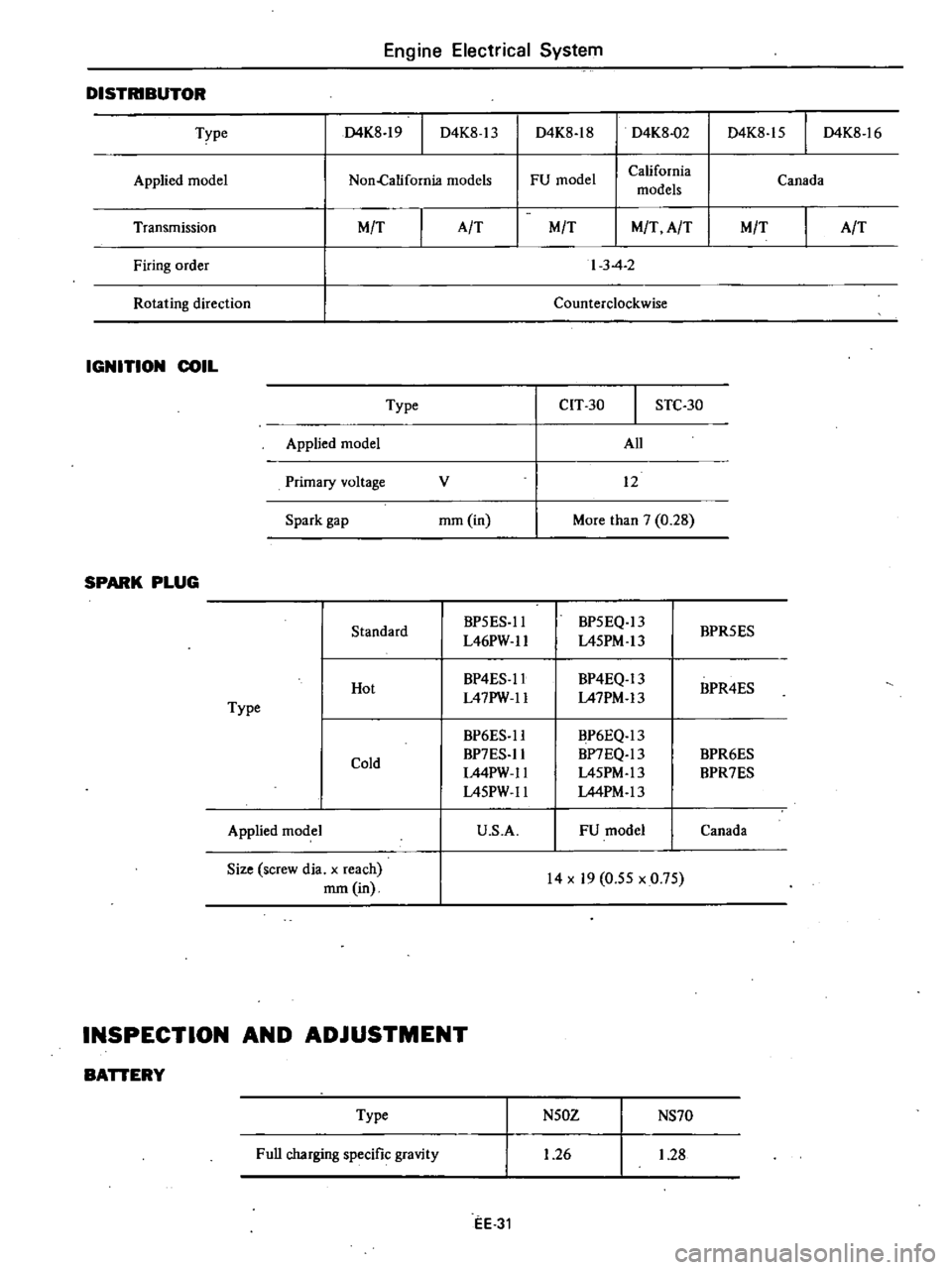
Engine
Electrical
System
DISTRIBUTOR
D4K8
18
D4K8
15
I
D4K8
16
Type
D4K8
19
I
D4K8
13
D4K8
02
Applied
model
FU
model
California
models
Canada
Non
California
models
Transmission
MfT
Firing
order
Rotating
direction
IGNITION
COIL
Type
Applied
model
Primary
voltage
Spark
gap
SPARK
PLUG
Standard
Hot
Type
Cold
Applied
model
Size
screw
dia
x
reach
mm
in
AfT
MfT
MfT
AfT
MfT
AfT
I
3
4
2
Counterclockwise
cn
30
STC
30
All
v
12
mm
in
More
than
7
0
28
BP5ES
II
BP5EQ
13
BPR5ES
L46PW
1I
L45PM
13
BP4ES
1I
BP4EQ
13
BPR4ES
L47PW
1I
L47PM
13
BP6ES
1I
BP6EQ
13
BP7ES
1I
BP7EQ
13
BPR6ES
L44PW
1I
L45PM
13
BPR7ES
L45PW
1I
L44PM
13
U
S
A
FU
model
Canada
14
x
19
0
55
x
0
75
INSPECTION
AND
ADJUSTMENT
BATTERY
Type
Full
charging
specific
gravity
N50Z
NS70
1
26
1
28
EE
31
Page 192 of 548
Engine
Electrical
System
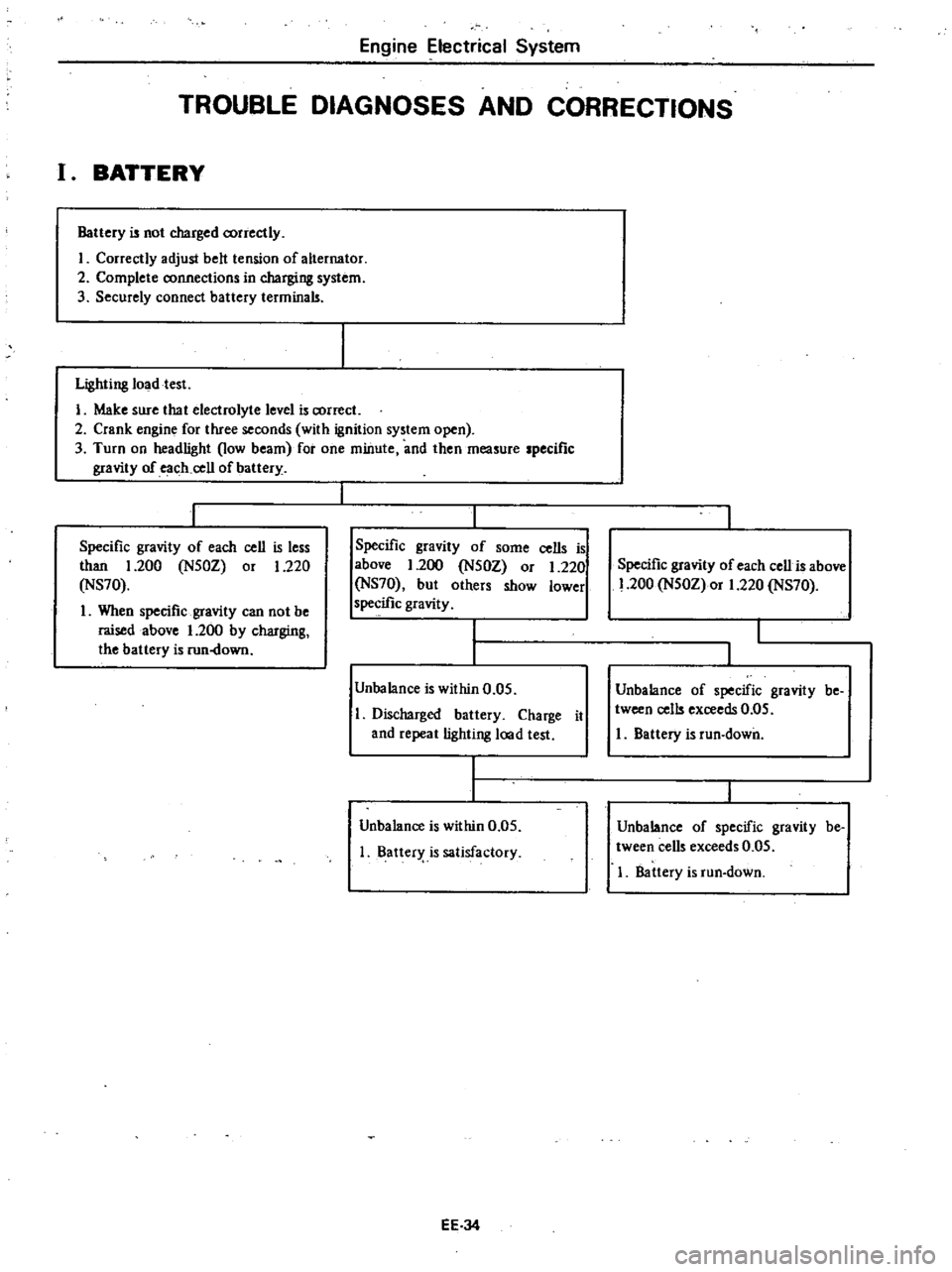
TROUBLE
DIAGNOSES
AND
CORRECTIONS
I
BATTERY
Battery
is
not
charged
correctly
I
Correctly
adjust
belt
tension
of
alternator
2
Complete
connections
in
charging
system
3
Securely
connect
battery
terminals
Lighting
Joadtest
I
Make
sure
that
electrolyte
level
is
correct
2
Crank
engine
for
three
seconds
with
ignition
system
open
3
Turn
on
headlight
low
beam
for
one
minute
and
then
measure
specific
gravity
of
each
cell
of
battery
Specific
gravity
of
each
cell
is
less
than
1
200
N50Z
or
1
220
NS70
1
When
specific
gravity
can
not
be
raised
above
1
200
by
charging
the
battery
is
run
down
Specific
gravity
of
some
cells
is
above
1
200
N50Z
or
1
220
NS70
but
others
show
lower
specific
gravity
Unbalance
is
within
0
05
Discharged
battery
Charge
it
and
repeat
lighting
lood
test
Unbalance
is
within
0
05
Batter
is
satisfactory
EE
J4
Specific
gravity
of
each
cell
is
above
1
200
N50Z
or
1
220
NS70
Unbalance
of
specific
gravity
be
tween
cells
exceeds
0
05
I
Battery
is
run
down
Unbalance
of
specific
gravity
be
tween
cells
exceeds
0
05
I
Battery
is
run
down
Page 193 of 548

Engine
Electrical
System
II
STARTING
MOTOR
Condition
Starting
motor
will
not
operate
Noisy
starting
motor
Starting
motor
cranks
lowly
Starting
motor
cranks
slowly
Starting
motor
operate
but
does
not
crank
engine
Starting
motor
will
not
disengage
even
if
ignition
switch
is
turned
off
Probable
cause
Discharged
battery
Damaged
solenoid
witch
Loose
connections
of
terminal
Damaged
field
coil
Damaged
brushes
Damaged
bearing
Damaged
annature
Loose
securing
bolt
Worn
pinion
gear
Poor
lubrication
Worn
commutator
Worn
brushes
Discharged
battery
Loose
connection
of
terminal
Worn
brushes
Locked
brushes
Loose
connections
of
terminal
Damaged
field
coil
Damaged
brushes
Damaged
bearing
Damaged
armature
Dirty
or
worn
commutator
Armature
rubs
field
coil
Damaged
splenoid
switch
Worn
pinion
Locked
pinion
guide
Worn
ring
gear
Damaged
sOlenoid
switch
Damaged
gear
teeth
EE
35
Corrective
action
Charge
or
repiace
battery
Repair
or
replace
solenoid
switch
Clean
and
tighten
terminal
Replace
yoke
Replace
brushes
Replace
bearing
Replace
armature
Tighten
Replace
Add
oil
Replace
Replace
Charge
Clean
and
tighten
Replace
Inspect
brush
pring
tension
or
repair
brush
holder
Clean
and
tighten
terminal
Replace
yoke
Replace
brushe
Replace
bearing
Replace
armature
Clean
and
repair
Repalce
assembly
Repair
or
replace
Replace
Repair
Replace
Repair
or
replace
Replace
damaged
gear
Page 199 of 548

REMOVAL
It
is
much
easier
to
remove
engine
and
transmission
as
a
single
unit
than
to
remove
alone
After
removal
engine
can
be
separated
from
the
transmission
assembly
WARNING
a
Place
wheel
chocks
in
fronl
of
front
wheels
and
in
rear
of
rear
wheels
b
Be
sure
to
hoist
engine
in
a
safe
manner
c
You
should
not
remove
engine
until
exhaust
system
has
com
pletely
cooled
off
Otherwise
you
may
burn
your
self
and
or
fire
may
break
out
in
fuel
line
Note
Fender
coven
should
be
used
to
protect
car
body
1
Disconnect
battery
ground
cable
from
battery
terminal
and
fusible
link
at
wire
connector
2
Remove
hood
as
follows
CAUTION
Have
an
assistant
help
you
so
as
to
prevent
damage
to
body
I
Mark
hood
hinge
locations
on
hood
to
facilitate
reinstallation
2
Support
hood
by
ltand
and
re
move
bolts
securing
it
to
hood
hinge
being
careful
not
to
let
hood
slip
when
bolts
are
removed
See
Fig
ER
2
3
Remove
hood
from
hood
hinge
f
Il
I
BF133A
Fig
ER
2
Removing
Hood
Remove
under
cover
Drain
radiator
coolant
and
engine
3
4
oil
5
Disconnect
upper
and
lower
hoses
from
radiator
and
disconnect
oil
cooler
hoses
automatic
transmission
only
6
Remove
four
bolts
securing
radia
Engine
Removal
Installation
tor
to
body
and
detach
radiator
after
removing
radiator
shroud
7
Remove
air
cleaner
assembly
from
carburetor
as
follows
1
Remove
fresh
air
duct
from
air
cleaner
2
Remove
hot
air
duct
from
air
cleaner
3
Loosen
air
cleaner
band
bolt
4
Disconnect
air
cleaner
to
air
pump
hose
at
air
cleaner
5
Disconnect
air
cleaner
ta
rocker
cover
hose
at
rocker
cover
6
Disconnect
air
cleaner
to
A
B
valve
hose
at
air
cleaner
7
Disconnect
air
cleaner
to
related
vacuum
hoses
at
air
cleaner
8
Disconnect
accelerator
control
wire
from
carburetor
9
Disconnect
the
following
cables
wires
and
hoses
Wire
to
auto
choke
heater
Wire
to
throttle
opener
cut
solenoid
or
throttle
switch
Wire
to
fuel
cut
solenoid
Wire
to
vacuum
switching
valve
High
tension
cable
between
igni
tion
coil
and
distributor
Battery
cable
to
starter
motor
Wire
to
distributor
Wire
to
thermal
transmitter
Wire
to
alternator
Engine
ground
cable
oil
pressure
switch
and
engine
harness
No
2
See
Fig
ER
3
o
1
Ground
cable
2
Engine
harness
No
2
3
Oil
pressure
switch
Fig
ER
3
EA368
Disconnecting
Cable
and
Wire
Fuel
hose
at
fuel
pump
and
fuel
return
hose
at
connection
Air
pump
air
cleaner
hose
Carbon
canister
hoses
Heater
inlet
and
outlet
hoses
if
so
equipped
ER
3
Vacuum
hose
of
brake
booster
at
intake
manifold
Air
conditioner
equipped
model
10
Remove
compressor
belt
To
remove
loosen
idler
pulley
nut
and
adjusting
bolt
1
Remove
air
pump
2
Remove
compressor
retaining
bolts
and
move
compressor
toward
fender
to
facilitate
removal
of
engine
Nole
Never
discharge
gas
from
com
pressor
while
work
is
being
per
formed
II
Compressor
EA478
Fig
ER
4
Location
of
Air
Compressor
3
Disconnect
vacuum
hose
of
air
conditioner
from
connector
of
intake
manifold
4
Remove
F
i
C
D
actuator
from
bracket
II
Remove
clutch
operating
cylin
der
from
clutch
housing
manual
trans
mission
only
dJ
Tightening
torque
Clutch
operating
cylinder
E
A3
to
clutch
housing
3
1
to
4
1
kg
22
to
30
ft
lbl
Fig
ER
5
Removing
Clutch
Operating
Cylinder
Page 201 of 548
INSTALLATION
Install
in
the
reverse
order
of
re
moval
observing
the
following
Note
When
inslal1ing
be
sure
to
check
thaI
electrical
harnesses
are
connected
ly
1
When
installing
first
secure
rear
engine
mounting
member
to
body
2
Refer
to
applicable
section
when
installing
and
adjusting
any
parts
Adjust
clutch
pedal
free
travel
Re
fer
to
Clutch
Pedal
Free
Travel
Section
CL
for
installation
and
adjustment
Adjust
accelerator
control
system
Refer
to
Engine
Control
System
Section
FE
for
adjustment
For
installation
of
air
conditioner
compressor
and
belt
adjustment
Refer
to
Idler
Pulley
and
Com
pressor
Drive
Belt
for
adjustment
of
belt
tension
3
When
installing
exhaust
front
tube
on
exhaust
manifold
be
sure
to
use
new
gasket
4
When
installing
hood
following
engine
installation
be
sure
that
it
is
properly
centered
and
that
hood
lock
operates
securely
Refer
to
Hood
See
tion
BF
for
adjustment
Engine
Removal
Installation
ENGINE
MOUNTING
INSULATOR
FRONT
INSULATOR
Removal
Disconnect
battery
ground
cable
2
Suspend
engine
with
wire
or
chain
3
Remove
front
engine
mounting
insulator
lower
and
upper
nuts
on
both
sides
4
Make
sure
that
wire
or
chain
used
to
suspend
engine
is
positioned
prqper
ly
so
that
no
load
is
applied
to
insulators
and
remove
nuts
complete
ly
5
Lift
up
engine
and
separate
in
sulators
from
engine
mounting
rack
ets
Inspection
If
there
is
damage
deterioration
or
separation
of
bounded
surface
re
place
Installation
Install
front
insulators
in
reverse
sequence
of
removal
noting
the
fol
lowing
1
Do
not
confuse
right
and
left
insulators
R
right
side
or
L
left
side
identification
mark
is
stamp
ed
on
each
insulator
2
Install
front
insulator
so
that
ER
5
position
pin
is
projected
upward
3
Tighten
the
bolts
and
nut
correct
ly
and
securely
See
Fig
ER
I
REAR
INSULATOR
Removal
l
Support
transmission
weight
with
ajack
2
Remove
nuts
securing
rear
engine
mounting
insulator
to
mounting
mem
ber
3
Remove
bolts
connecting
rear
en
gine
mounting
insulator
to
transmis
sion
reaf
extension
housing
4
Jack
up
the
transmission
a
little
and
remove
insulator
Inspection
If
there
is
damage
deterioration
or
separation
of
mating
surface
replace
Installation
Install
rear
engine
mounting
mem
ber
and
insulator
in
reverse
order
of
removal
noting
the
following
I
Install
insulator
in
place
so
that
direction
of
mounted
insulator
is
same
as
that
in
Fig
ER
2
Tighten
nuts
and
bolts
correctly
and
securely
As
for
tightening
torque
see
Fig
ER
l
Page 219 of 548
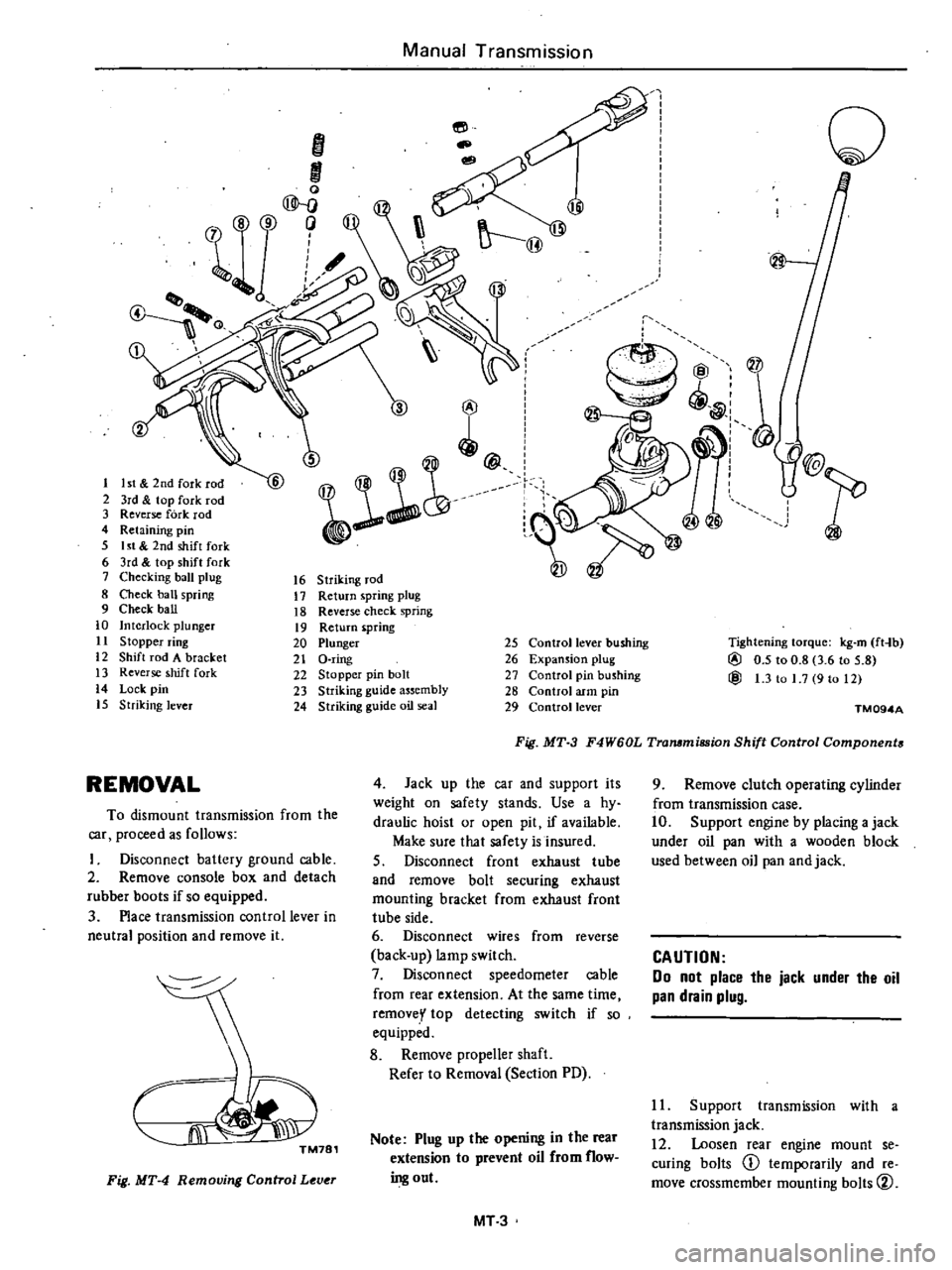
I
ht
2nd
fork
r
2
3rd
top
fork
rod
3
Reverse
fork
rod
4
Retaining
pin
5
I
t
2nd
shift
fork
6
3rd
top
shift
fork
7
Checking
ball
plug
8
Check
ban
spring
9
Check
ball
10
Interlock
plunger
11
S
topper
ring
12
Shift
rod
A
bracket
13
Reverse
shift
fork
14
Lock
pin
15
Striking
lever
Manual
Transmission
16
Striking
rod
17
Return
spring
plug
18
Reverse
check
spring
19
Return
pring
20
Plunger
21
D
ring
22
Stopper
pin
bolt
23
Striking
guide
assembly
24
Striking
guide
oil
seal
REMOVAL
To
dismount
transmission
from
the
car
proceed
as
follows
Disconnect
battery
ground
cable
2
Remove
console
box
and
detach
rubber
boots
if
so
equipped
3
Place
transmission
control
lever
in
neutral
position
and
remove
it
m
TM781
Fig
MT
4
Removing
Control
Lever
@
@
25
Control
lever
bushing
26
Expansion
plug
27
Control
pin
bushing
28
Control
arm
pin
29
Control
lever
o
Tightening
torque
kg
m
ft
lb
@
0
5
to
0
8
3
6
tn
5
8
@
1
3
to
1
7
9
to
12
Fig
MT
3
F4W60L
Tra11lmiBSion
Shift
Control
Components
TM094A
4
Jack
up
the
car
and
support
its
weight
on
safety
stands
Use
a
hy
draulic
hoist
or
open
pit
if
available
Make
sure
that
safety
is
insured
5
Disconnect
front
exhaust
tube
and
remove
bolt
securing
exhaust
mounting
bracket
from
exhaust
front
tube
side
6
Disconnect
wires
from
reverse
back
up
lamp
switch
7
Disconnect
speedometer
cable
from
rear
extension
At
the
same
time
removey
top
detecting
switch
if
so
equipped
8
Remove
propeller
shaft
Refer
to
Removal
Section
PO
Note
Plug
up
the
opening
in
the
rear
extension
to
prevent
oil
from
flow
ing
out
MT
3
9
Remove
clutch
operating
cylinder
from
transmission
case
10
Support
engine
by
placing
a
jack
under
oil
pan
with
a
wooden
block
used
between
oil
pan
and
jack
CAUTION
00
not
place
the
jack
under
the
oil
pan
drain
plug
11
Support
transmission
with
a
transmission
jack
12
Loosen
rear
engine
mount
se
curing
bolts
CD
temporarily
and
re
move
crossmember
mounting
bolts
V
Page 233 of 548
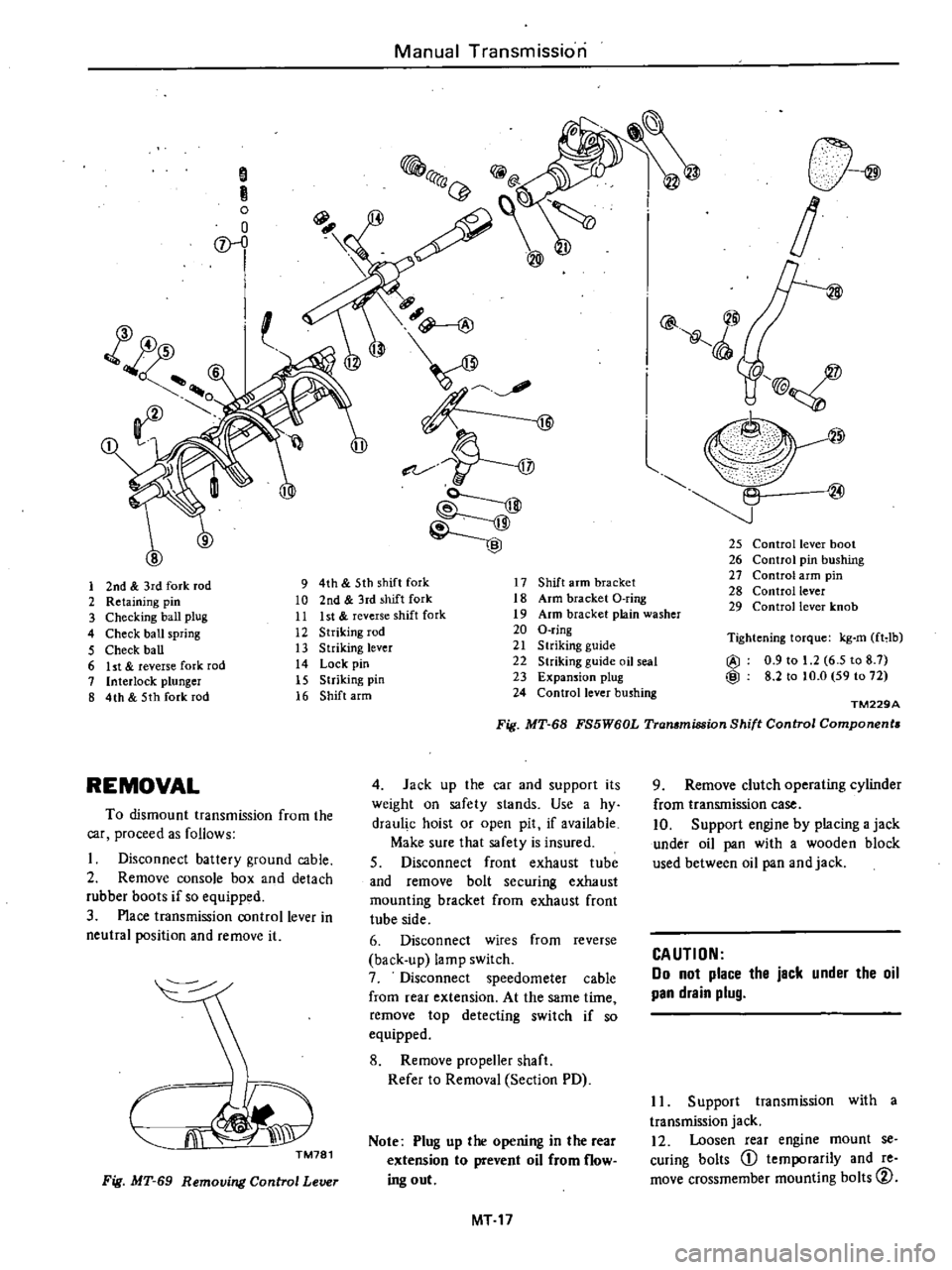
Manual
Transmission
S
R
o
o
D
l
@
@
l
@
l
25
Control
lever
boot
26
Control
pin
bushing
27
Control
arm
pin
28
Control
lever
29
Control
lever
knob
1
2nd
3rd
fork
rod
9
4th
5th
shift
fork
17
Shift
arm
bracket
2
Retaining
pin
10
2nd
3rd
shift
fork
18
Arm
bracket
O
ring
3
Checking
ball
plug
11
Ist
reverse
shift
fork
19
Arm
bracket
plain
washer
4
Check
ball
spring
12
Striking
rod
20
O
ring
5
Check
ball
13
Striking
lever
21
S
lriking
guide
6
ht
reverse
fork
rod
14
Lock
pin
22
Striking
guide
oil
seal
7
Interlock
plunger
15
Striking
pin
23
Expansion
plug
8
4th
5th
fork
rod
16
Shift
arm
24
Control
lever
bushing
Tightening
torque
kg
m
fHb
@
0
9
to
1
2
6
5
to
8
7
@
8
2
to
to
O
59
to
72
TM229A
Fig
MT
68
FS5W60L
Transmission
Shift
Control
Components
REMOVAL
4
Jack
up
the
car
and
supporl
its
weight
on
safety
slands
Use
a
hy
draul
c
hoist
or
open
pit
if
available
Make
sure
that
safety
is
insured
S
Disconnect
front
exhaust
tube
and
remove
bolt
securing
exhaust
mounting
bracket
from
exhaust
front
tube
side
6
Disconnect
wires
from
reverse
back
up
lamp
switch
7
Disconnect
speedometer
cable
from
rear
extension
At
the
same
time
remove
top
detecting
switch
if
so
equipped
8
Remove
propeller
shaft
Refer
to
Removal
Section
PD
To
dismount
transmission
from
the
car
proceed
as
follows
Disconnect
battery
ground
cable
2
Remove
console
box
and
detach
rubber
boots
if
so
equipped
3
Place
transmission
control
lever
in
neutral
position
and
remove
it
CJi
J
TM781
Note
Plug
up
the
opening
in
the
rear
extension
to
prevent
oil
from
flow
ing
out
Fig
MT
69
Removing
Control
Lever
MT
17
9
Remove
clutch
operating
cylinder
from
transmission
case
10
Support
engine
by
placing
a
jack
under
oil
pan
with
a
wooden
block
used
between
oil
pan
and
jack
CAUTION
Do
not
place
the
jack
under
the
oil
pan
drain
plug
II
Support
transmission
with
a
transmission
jack
12
Loosen
rear
engine
mount
se
curing
bolts
CD
temporarily
and
re
move
crossmember
mounting
bolts
CV
Page 277 of 548
Automatic
Transmission
REMOVAL
AND
INSTALLATION
TRANSMISSION
ASSEMBLY
When
dismounting
the
automatic
transmission
from
a
car
pay
attention
to
the
following
points
I
Before
dismounting
the
trans
mission
rigidly
inspect
it
by
aid
of
the
Trouble
shooting
Chart
and
dis
mount
it
only
when
coll5idered
to
be
necessary
2
Dismount
the
transmission
with
utmost
care
and
when
mounting
observe
the
tightening
torque
indi
cated
on
another
table
not
to
exert
excessive
force
REMOVAL
In
dismounting
automatic
transmis
sion
from
car
proceed
as
follows
I
Disconnect
battery
ground
cable
from
terminal
2
Disengage
torsion
shaft
from
ac
eelerator
linkage
3
Jack
up
vehicle
and
support
its
weight
on
safety
stands
Recommend
a
hydraulic
hoist
or
open
pit
be
utilized
if
available
Make
sure
that
safety
is
insured
4
Remove
propeller
shaft
Note
Pl
ll
up
the
openina
in
the
rear
extension
to
prevent
oil
from
flow
ing
out
S
Disconnect
front
exhaust
tube
6
Disconnect
selector
ra
8e
lever
from
manual
shaft
7
Disconnect
wire
connections
at
inhibitor
switch
8
Disconnect
vacuum
lube
from
vacuum
diaphragm
and
wire
connee
tions
at
downshift
solenoid
9
Disconnect
speedometer
cable
from
rear
exlension
10
Disconnect
oil
charging
pipe
II
Disconnect
oil
cooler
inlet
and
outlet
tubes
al
transmission
case
12
Support
engine
by
locating
a
jack
under
oil
pan
with
a
wooden
block
used
between
oil
pan
and
jack
Support
transmission
by
means
of
a
transmission
jack
CAUTION
Do
not
plecs
the
jack
under
the
oil
pin
dnin
plug
13
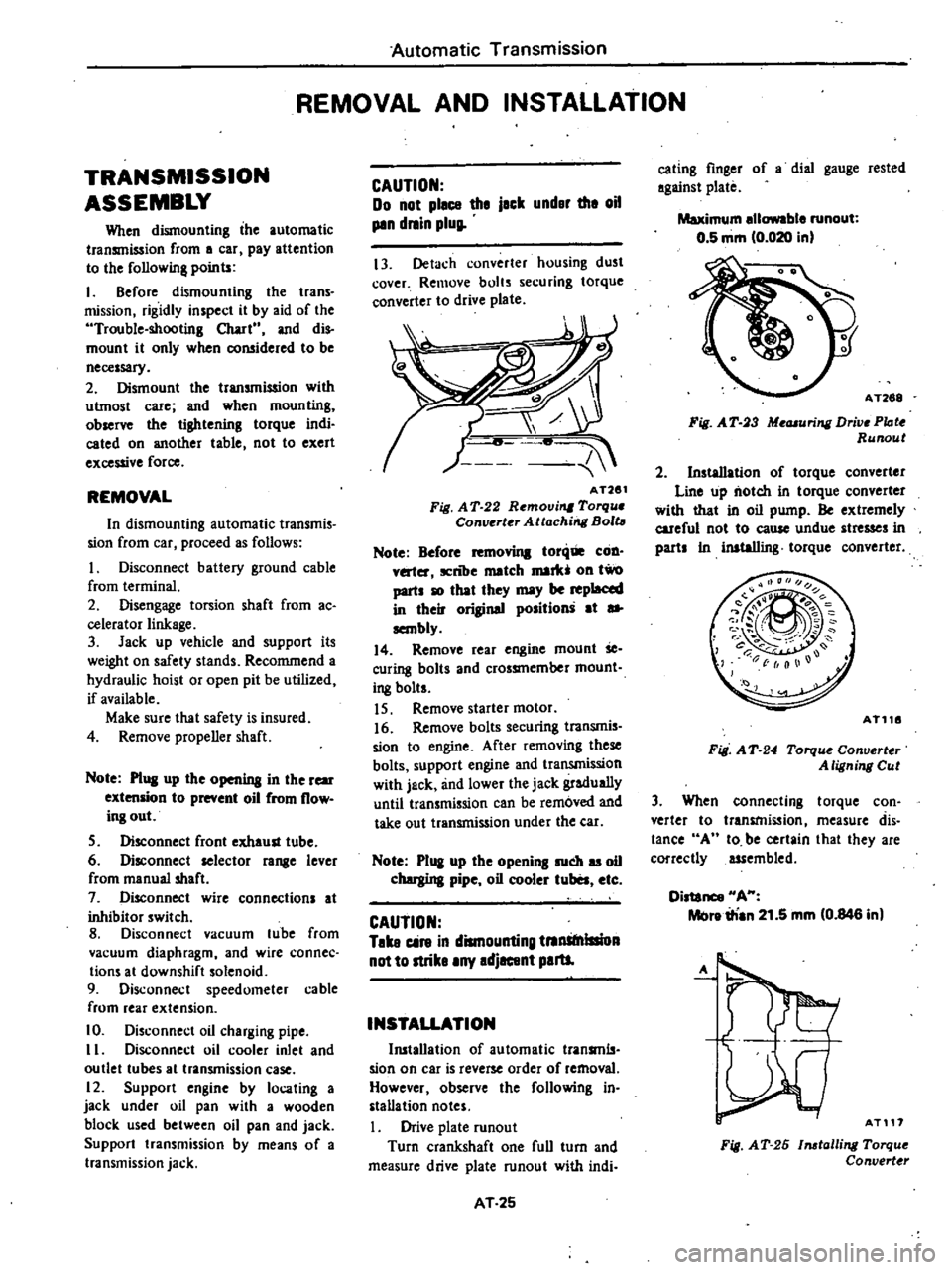
Detach
converter
housing
dust
cover
Remove
bolts
securing
torque
converter
to
drive
plate
AT261
Fig
A
T
22
Removi
Torqu
Converter
Attachirrg
Bolt
Note
Before
toni
COD
v
ter
ICnlJe
match
mark
011
two
parts
10
that
they
may
be
replaced
in
their
original
position
at
sa
sembly
14
Remove
rear
engine
mount
Se
curing
bolts
and
crossmember
mount
i
8
bolts
IS
Remove
starter
motor
16
Remove
bolts
securing
transmis
sion
to
engine
After
removing
these
bolts
support
engine
and
transmission
with
jack
and
lower
the
jack
gradually
until
transmission
can
be
removed
and
take
out
transmission
under
the
ear
Note
P1
I
up
the
opening
such
u
oil
chergina
pipe
oil
cooler
tuba
etc
CAUTION
Take
cin
in
dismounting
tnnStnlllioA
not
to
strike
any
adjacent
paru
INSTALLATION
Ill5tallation
of
automatic
transmls
sian
on
car
is
reverse
order
of
removal
However
observe
the
following
in
stallation
notes
Drive
plate
runout
Turn
crankshaft
one
full
turn
and
measure
drive
plate
runout
with
indi
AT
25
eating
finger
of
a
dial
gauge
rested
against
plate
Maximum
ellowable
runout
0
5
mm
0
020
in
AT268
Fig
A
T
3
Me
uring
Drive
PIote
Runout
2
Installation
of
torque
converter
Line
up
notch
in
torque
converter
with
that
in
oil
pump
Be
extremely
careful
not
to
eause
undue
stresses
in
parts
In
inataIIing
torque
converter
AT116
Fig
A
T
24
Torqu
Converter
A
ligning
Cut
3
When
connecting
torque
con
verter
to
transmission
measure
dis
tance
A
10
be
certain
that
they
are
correctly
assembled
Distance
HA
Melre
irian
21
5
mm
0
846
in
A
AT117
Fig
AT
26
1116talling
Torque
Convert
r