oil DATSUN 210 1979 Manual Online
[x] Cancel search | Manufacturer: DATSUN, Model Year: 1979, Model line: 210, Model: DATSUN 210 1979Pages: 548, PDF Size: 28.66 MB
Page 190 of 548

Engine
Electrical
System
STARTING
MOTOR
Type
S1I4
160B
I
Sl14
163E
S114
253
Outer
diameter
of
commutator
mm
in
More
than
32
1
26
More
than
29
L14
Minimum
length
of
brush
mm
in
12
0
47
II
0
43
Brush
spring
tension
kg
Ib
1
4
to
1
8
3
1
to
4
0
1
6to
2
0
3
5
to
4
4
Clearance
between
bearing
metal
and
armature
shaft
mm
in
Less
than
0
2
0
008
Clearance
R
between
pinion
front
edge
and
pinioIl
stopper
mm
in
0
3
to
2
5
0
012
to
0
098
Difference
T
in
height
of
pinion
nun
in
0
3
to
1
5
0
012
to
0
059
ALTERNATOR
Type
LRI5049
Minimum
length
of
brush
mm
in
More
than
7
5
0
295
Brush
spring
pressure
gr
oz
255
to
345
8
99
to
12
17
Slip
ring
outer
diameter
nun
in
More
than
30
1
18
DISTRIBUTOR
Air
gap
mm
in
D4K8
19
I
D4K8
l3
I
D4K8
18
I
D4K8
02
D4K8
15
I
D4K8
16
0
3
to
0
5
0
012
to
0
020
Type
Cap
il1s
ation
resistance
M
1
More
than
50
Rotor
head
insulation
resistance
Mil
More
than
50
Cap
carbon
point
length
mm
in
10
0
39
Vacuum
advance
0
105
4
13
0
170
6
69
0
80
3
15
0
105
4
13
0
70
2
76
0
170
6
69
Distributor
degree
distributor
9
250
3
225
12
265
9
300
15
300
6
5
300
mmHg
inHg
9
84
8
86
10
43
11
81
11
81
11
81
Centrifugal
advance
0
550
6
550
0
550
0
550
0
750
0
750
Distributor
degree
distributor
14
2
300
14
2
300
13
5
2
400
13
5
2
400
10
2
400
10
2
400
rpm
EE
32
Page 191 of 548

Engine
Electrical
System
IGNITION
COIL
Type
CIT
30
STC
30
Primary
resistance
at
200C
680F
U
0
84
to
1
02
Secondary
resistance
at
200C
680F
KU
8
2
to
12
4
SPARK
PLUG
BP5ES
ll
L46PW
ll
BP5EQ
13
L46PM
13
BPR5ES
BP4E
ll
L47PW
ll
BP4EQ
13
L47PM
13
BPR4ES
Type
BP6ES
I1
L44PW
I1
BP6EQ
13
L45PM
13
BPR6ES
BP7ES
II
L45PW
II
BP7EQ
13
L44PM
13
BPR7ES
Plug
gap
mm
in
1
0
to
1
1
1
1
to
1
3
0
8
to
0
9
0
039
to
0
043
0
043
to
0
051
0
031
to
0
035
TIGHTENING
TORQUE
Magnetic
switch
terminal
SI14
160B
S114
163E
S1l4
253
kg
em
in
Ib
Magnetic
switch
attaching
bolts
Starting
motor
Gear
case
attaching
bolts
Pulley
nut
Alternator
through
bolts
Spark
plug
kg
cm
in
Ib
75
to
100
65
to
87
115
to
160
100
to
139
38
to
51
3
to
44
kg
em
in
lb
kg
m
ft
Ib
kg
cm
in
Ib
kg
m
ft
Ib
64
to
85
56
to
74
4
5
to
6
0
33
to
43
60
to
70
52
to
61
1
5
to
2
5
II
to
18
EE
33
Page 193 of 548

Engine
Electrical
System
II
STARTING
MOTOR
Condition
Starting
motor
will
not
operate
Noisy
starting
motor
Starting
motor
cranks
lowly
Starting
motor
cranks
slowly
Starting
motor
operate
but
does
not
crank
engine
Starting
motor
will
not
disengage
even
if
ignition
switch
is
turned
off
Probable
cause
Discharged
battery
Damaged
solenoid
witch
Loose
connections
of
terminal
Damaged
field
coil
Damaged
brushes
Damaged
bearing
Damaged
annature
Loose
securing
bolt
Worn
pinion
gear
Poor
lubrication
Worn
commutator
Worn
brushes
Discharged
battery
Loose
connection
of
terminal
Worn
brushes
Locked
brushes
Loose
connections
of
terminal
Damaged
field
coil
Damaged
brushes
Damaged
bearing
Damaged
armature
Dirty
or
worn
commutator
Armature
rubs
field
coil
Damaged
splenoid
switch
Worn
pinion
Locked
pinion
guide
Worn
ring
gear
Damaged
sOlenoid
switch
Damaged
gear
teeth
EE
35
Corrective
action
Charge
or
repiace
battery
Repair
or
replace
solenoid
switch
Clean
and
tighten
terminal
Replace
yoke
Replace
brushes
Replace
bearing
Replace
armature
Tighten
Replace
Add
oil
Replace
Replace
Charge
Clean
and
tighten
Replace
Inspect
brush
pring
tension
or
repair
brush
holder
Clean
and
tighten
terminal
Replace
yoke
Replace
brushe
Replace
bearing
Replace
armature
Clean
and
repair
Repalce
assembly
Repair
or
replace
Replace
Repair
Replace
Repair
or
replace
Replace
damaged
gear
Page 195 of 548

Engine
Electrical
System
IV
IGNITION
CIRCUIT
When
engine
does
not
start
If
there
is
no
problem
in
fuel
system
ignition
system
should
be
checked
This
can
be
easily
done
by
detaching
a
high
tension
cable
from
distributor
starting
engine
and
ob
serving
oondition
of
spark
that
occurs
between
high
tension
cable
and
engine
block
After
checking
this
repair
as
necessary
tery
and
anti
dieseliilg
wlenoid
valve
connector
to
cuI
off
supply
of
fuel
10
engine
Then
observe
the
condition
of
sparks
while
starter
motor
is
in
operation
Note
Turn
ignilion
switch
off
and
disconnect
ground
cable
from
bat
Condition
Location
Probable
cause
Corrective
action
No
spark
at
all
Distributor
Breakage
of
lead
wire
on
low
tension
side
Repair
Poor
insulation
of
cap
and
rotor
head
Replace
Open
pick
up
coil
Replace
Air
gap
wider
than
specification
Adjust
Ignition
coil
Wire
breakage
or
short
circuit
of
coil
Replace
with
new
one
High
tension
cable
Wire
coming
off
Repair
Faulty
insulation
Replace
IC
ignition
unit
Faulty
IC
ignition
unit
Replace
Breakage
of
circuit
Replace
Detached
connection
Repair
Spark
length
Spark
plugs
Spark
plug
gap
too
wide
Correct
or
replace
More
than
6
mm
Too
much
carbon
Clean
or
replace
0
24
in
Broken
neck
of
insulator
Replace
Expiration
of
plug
life
Replace
Distributor
Air
gap
too
wide
Correct
IC
ignition
unit
Faulty
IC
ignition
unit
Replace
Breakage
of
circuit
Replace
Detached
connection
Repair
EE
37
Page 196 of 548

2
Engine
rotates
but
does
not
run
smoothly
This
may
be
caused
by
the
ignition
Condition
Location
Engine
misses
Distributor
Ignition
coil
High
tension
cable
Spark
plugs
IC
ignition
unit
Engine
causes
knocking
very
often
Distributor
Spark
plugs
Engine
does
not
deliver
enough
power
Distributor
Spark
plugs
Engine
Electrical
System
system
or
other
engine
conditions
not
related
to
ignition
system
Therefore
first
complete
inspection
of
ignition
system
should
be
carried
out
Probable
cause
Foreign
matter
onpicl
up
coil
Improper
air
gap
Leak
of
electricity
at
cap
and
rotor
head
Breakage
of
pick
up
coil
lead
wire
Worn
or
shaky
breaker
plate
Worn
or
shaky
distributor
driVing
shaft
Layer
short
circuit
or
inferior
quality
coil
Deterioration
of
insulation
with
cense
quenlleak
of
electricity
Fouled
Leak
of
electricity
at
upper
porcelain
insulator
Spark
plug
gap
too
narrow
Faulty
IC
ignition
unit
Breakage
of
circuit
Detached
connection
Improper
ignition
timing
too
advanced
Coming
off
or
breakage
of
governor
spring
Worn
pin
or
hole
of
governor
Burnt
too
much
Improper
ignition
timing
too
retarded
Improper
functioning
governor
Foreign
particles
stuck
in
air
gap
Fouled
EE
38
Corrective
action
Clean
Correct
Repair
or
replace
Replace
Replace
assembly
Replace
aSsembly
Replace
with
good
one
Replace
Clean
Repair
or
replace
Correct
or
replace
Replace
Replace
Repair
Correct
Correct
or
replace
Replace
Replace
Correct
Replace
assembly
Clean
Clean
Page 199 of 548

REMOVAL
It
is
much
easier
to
remove
engine
and
transmission
as
a
single
unit
than
to
remove
alone
After
removal
engine
can
be
separated
from
the
transmission
assembly
WARNING
a
Place
wheel
chocks
in
fronl
of
front
wheels
and
in
rear
of
rear
wheels
b
Be
sure
to
hoist
engine
in
a
safe
manner
c
You
should
not
remove
engine
until
exhaust
system
has
com
pletely
cooled
off
Otherwise
you
may
burn
your
self
and
or
fire
may
break
out
in
fuel
line
Note
Fender
coven
should
be
used
to
protect
car
body
1
Disconnect
battery
ground
cable
from
battery
terminal
and
fusible
link
at
wire
connector
2
Remove
hood
as
follows
CAUTION
Have
an
assistant
help
you
so
as
to
prevent
damage
to
body
I
Mark
hood
hinge
locations
on
hood
to
facilitate
reinstallation
2
Support
hood
by
ltand
and
re
move
bolts
securing
it
to
hood
hinge
being
careful
not
to
let
hood
slip
when
bolts
are
removed
See
Fig
ER
2
3
Remove
hood
from
hood
hinge
f
Il
I
BF133A
Fig
ER
2
Removing
Hood
Remove
under
cover
Drain
radiator
coolant
and
engine
3
4
oil
5
Disconnect
upper
and
lower
hoses
from
radiator
and
disconnect
oil
cooler
hoses
automatic
transmission
only
6
Remove
four
bolts
securing
radia
Engine
Removal
Installation
tor
to
body
and
detach
radiator
after
removing
radiator
shroud
7
Remove
air
cleaner
assembly
from
carburetor
as
follows
1
Remove
fresh
air
duct
from
air
cleaner
2
Remove
hot
air
duct
from
air
cleaner
3
Loosen
air
cleaner
band
bolt
4
Disconnect
air
cleaner
to
air
pump
hose
at
air
cleaner
5
Disconnect
air
cleaner
ta
rocker
cover
hose
at
rocker
cover
6
Disconnect
air
cleaner
to
A
B
valve
hose
at
air
cleaner
7
Disconnect
air
cleaner
to
related
vacuum
hoses
at
air
cleaner
8
Disconnect
accelerator
control
wire
from
carburetor
9
Disconnect
the
following
cables
wires
and
hoses
Wire
to
auto
choke
heater
Wire
to
throttle
opener
cut
solenoid
or
throttle
switch
Wire
to
fuel
cut
solenoid
Wire
to
vacuum
switching
valve
High
tension
cable
between
igni
tion
coil
and
distributor
Battery
cable
to
starter
motor
Wire
to
distributor
Wire
to
thermal
transmitter
Wire
to
alternator
Engine
ground
cable
oil
pressure
switch
and
engine
harness
No
2
See
Fig
ER
3
o
1
Ground
cable
2
Engine
harness
No
2
3
Oil
pressure
switch
Fig
ER
3
EA368
Disconnecting
Cable
and
Wire
Fuel
hose
at
fuel
pump
and
fuel
return
hose
at
connection
Air
pump
air
cleaner
hose
Carbon
canister
hoses
Heater
inlet
and
outlet
hoses
if
so
equipped
ER
3
Vacuum
hose
of
brake
booster
at
intake
manifold
Air
conditioner
equipped
model
10
Remove
compressor
belt
To
remove
loosen
idler
pulley
nut
and
adjusting
bolt
1
Remove
air
pump
2
Remove
compressor
retaining
bolts
and
move
compressor
toward
fender
to
facilitate
removal
of
engine
Nole
Never
discharge
gas
from
com
pressor
while
work
is
being
per
formed
II
Compressor
EA478
Fig
ER
4
Location
of
Air
Compressor
3
Disconnect
vacuum
hose
of
air
conditioner
from
connector
of
intake
manifold
4
Remove
F
i
C
D
actuator
from
bracket
II
Remove
clutch
operating
cylin
der
from
clutch
housing
manual
trans
mission
only
dJ
Tightening
torque
Clutch
operating
cylinder
E
A3
to
clutch
housing
3
1
to
4
1
kg
22
to
30
ft
lbl
Fig
ER
5
Removing
Clutch
Operating
Cylinder
Page 200 of 548
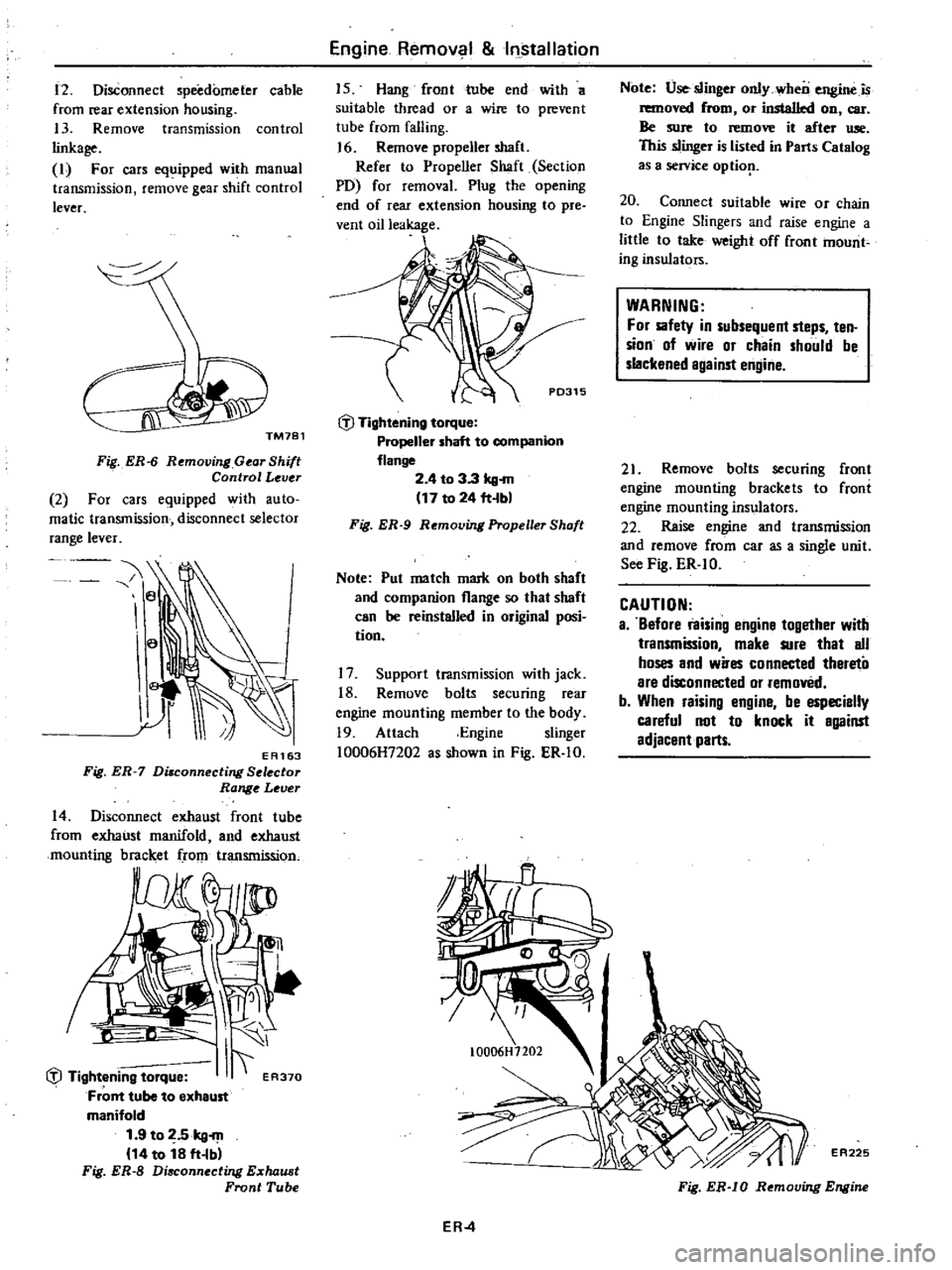
12
Disconnect
speedometer
cable
from
rear
extension
housing
13
Remove
transmission
control
linkage
I
For
cars
equipped
with
manual
transmission
remove
gear
shift
control
lever
Fig
ER
6
Removing
Gear
Shift
Control
Lever
2
For
cars
equipped
with
auto
matic
transmission
disconnect
selector
range
lever
e
a
EA163
Fig
ER
7
Di8connecting
Selector
Range
Lever
14
Disconnect
exhaust
front
tube
from
exhaust
manifold
and
exhaust
mounting
bracket
rom
transmission
I
liJ
Tightening
torque
I
ER370
Front
tube
to
exheust
manifold
1
9
to
2
5kg
m
14
to
18
ft
Ibl
Fig
ER
S
Disconnecting
E
chaust
Front
Tube
Engine
Remov
1
Installation
15
Hang
front
tube
end
with
a
suitable
thread
or
a
wire
to
prevent
tube
from
falling
J
6
Remove
propeller
shaft
Refer
to
Propeller
Shaft
Section
PO
for
removal
Plug
the
opening
end
of
rear
extension
housing
to
pre
vent
oil
leakage
P0315
liJ
Tightening
torque
Propeller
shaft
to
companion
flange
2
4
to
3
3
kg
m
17
to
24
ft
bl
Fig
ER
9
Removing
Propeller
Shaft
Note
Pul
me
tch
mark
on
both
shaft
and
companion
flange
so
that
shoft
can
be
reinstalled
in
original
posi
tion
17
Support
transmission
with
jack
18
Remove
bolts
securing
rear
engine
mounting
member
to
the
body
19
Attach
Engine
slinger
10006H7202
as
shown
in
Fig
ER
IO
Note
Use
slinger
only
wheo
engine
is
removed
from
or
installed
on
car
Be
sure
to
remove
it
efter
Ulle
This
slinger
is
listed
in
Parts
Cet
log
as
a
service
optiop
20
Connect
suitable
wire
or
chain
to
Engine
Slingers
and
raise
engine
a
little
to
take
weight
off
front
mount
ing
insulators
WARNING
For
sofety
in
subsequent
steps
ten
sion
of
wire
or
chain
should
be
slackened
against
engine
21
Remove
bolts
securing
front
engine
mounting
brackets
to
froni
engine
mounting
insulators
22
Reise
engine
and
transmission
and
remove
from
car
as
a
single
unit
See
Fig
ER
IO
CAUTION
a
Before
raising
engine
10gether
with
transmission
make
sure
that
all
hoses
and
wires
connected
thereto
are
disconnected
or
removed
b
When
raising
engine
be
especially
careful
not
to
knock
it
against
adjacent
parts
ER
4
EA225
Fig
ER
IO
Removing
Engine
Page 206 of 548
INSPEctiON
Check
clutch
pedal
parts
for
the
following
items
correcting
neces
sary
I
Bent
pedal
2
Weakened
return
spring
3
Worn
or
deformed
clevis
pin
and
fulcrum
bwhings
4
Cracks
at
welded
part
INSTAl1
ATION
To
install
clutch
pedal
reverse
the
order
of
removal
Observe
the
follow
ing
I
Apply
coating
of
recommended
multi
purpose
grease
to
sliding
por
tions
and
return
spring
Lt
of
I
ii
CL352
Fig
CL
5
Lubricating
Point
2
Fit
return
spring
in
hole
in
pedal
bracket
and
securely
fit
E
ring
in
slit
of
fulcrum
pin
3
Insert
clevis
pin
through
clutch
pedal
from
left
to
right
side
4
After
installing
clutch
pedal
check
the
clutch
pedal
height
AdjUst
if
necessary
Refer
to
Adjwtment
CLUTCH
MASTER
CYLINDER
REMOVAL
I
Remove
snap
pin
from
clevis
pin
2
Pull
out
clevis
pin
3
Disconnect
clutch
tube
from
mas
ter
cylinder
4
Remove
master
cylinder
Clutch
CAUTION
When
disconnecting
clutch
tube
use
suitable
flare
nut
wrench
Never
use
an
open
end
wrench
or
adjus1able
wrench
DISASSEMBLY
Note
When
disconnecting
dutch
tube
be
sure
to
receive
draioillll
clutch
fluid
into
a
container
Use
of
rags
is
also
suggested
to
keep
adja
cent
parts
and
area
clean
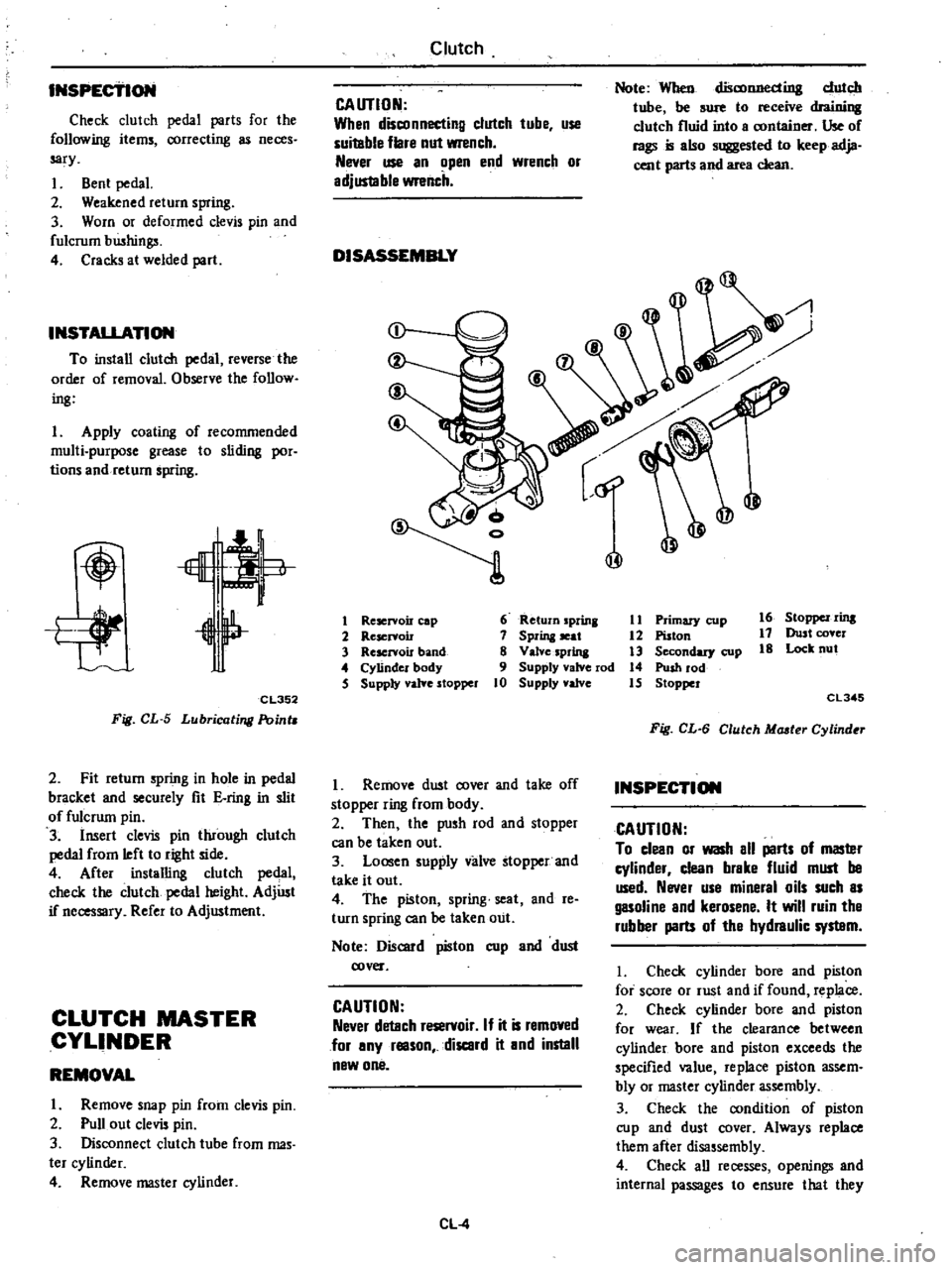
@
@
1
Reservoir
cap
6
Return
prina
11
Primary
cup
16
StOppel
rins
2
Reservoir
7
Sprina
seat
12
Piston
17
Dust
cover
3
Rescrvou
band
8
Valve
sprina
3
Secondary
cup
18
Lock
nut
4
Cylinder
body
9
Supply
valve
rod
14
Push
rod
5
Supply
yalYe
stopper
10
Supply
valve
15
Stopper
CL345
Fig
CL
6
Clutch
Mcuter
Cylind
r
I
Remove
dwt
cover
and
take
off
stopper
ring
from
body
2
Then
the
push
rod
and
stopper
can
be
taken
out
3
Loosen
supply
valve
stopper
and
take
it
out
4
The
piston
spring
seat
and
reo
turn
spring
can
be
taken
out
Note
Discard
piston
cup
and
dust
cover
CAUTION
Never
detach
reservoir
If
it
is
removed
for
any
reason
discard
it
and
instill
new
one
CL
4
INSPECTION
CAUTION
To
clean
or
wash
all
parts
of
masler
cylinder
clean
brake
fluid
must
be
used
Never
use
mineral
oils
such
as
gasoline
and
kerosene
It
will
ruin
tha
rubber
parts
of
tha
hydraulic
syslBm
I
Check
cylinder
bore
and
piston
for
score
or
rust
and
if
found
replace
2
Check
cylinder
bore
and
piston
for
wear
If
the
clearance
between
cylinder
bore
and
piston
exceeds
the
specified
value
replace
piston
assem
bly
or
master
cylinder
assembly
3
Check
the
condition
of
piston
cup
and
dust
cover
Always
replace
them
after
disassembly
4
Check
all
recesses
openings
and
internal
passages
to
ensure
that
they
Page 207 of 548
are
clean
and
free
from
foreign
matter
Cearance
between
cylinder
bore
and
piston
Leu
than
0
15
mm
0
0059
in
ASSEMBLY
Assemble
clutch
master
cylinder
in
the
reverse
order
of
disassembly
Ob
serve
the
following
I
Dip
piston
cup
in
brake
fluid
before
installing
Make
sure
that
it
is
correctly
faced
in
position
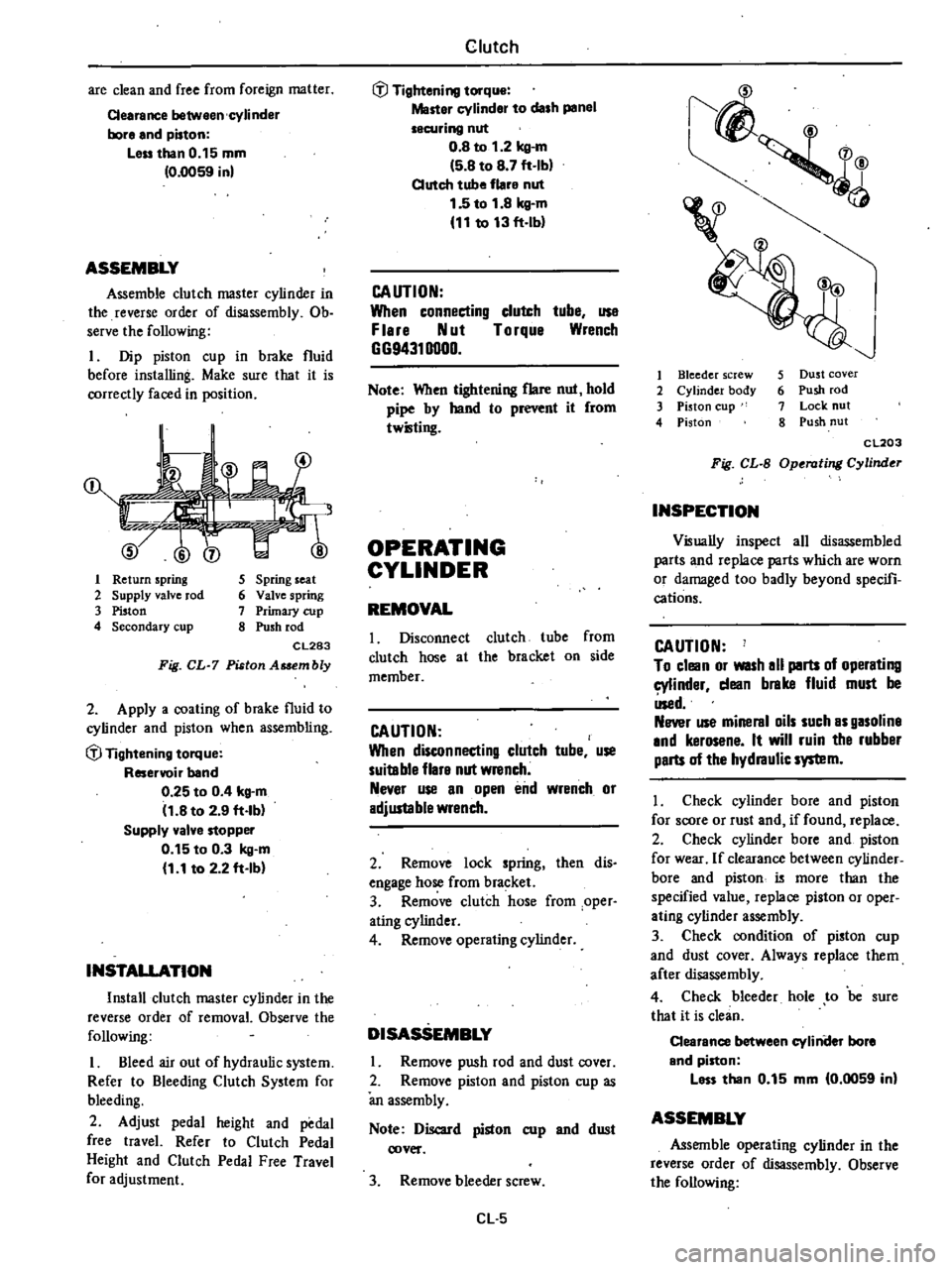
1
Return
spring
2
Supply
valve
rod
3
Piston
4
Secondary
cup
5
Spring
seat
6
Valve
spring
7
Primary
cup
8
Push
rod
CL283
Fig
CL
7
Piston
Asaembly
2
Apply
a
coating
of
brake
fluid
to
cylinder
and
piston
when
assembling
if
Tightening
torque
Reservoir
band
0
25
to
0
4
kg
m
11
8
to
2
9
ft
lb
Supply
valve
stopper
0
15
to
0
3
kg
m
1
1
to
2
2
ft
Ib
INSTALLATION
Install
clutch
master
cylinder
in
the
reverse
order
of
removal
Observe
the
following
I
Bleed
air
out
of
hydraulic
system
Refer
to
Bleeding
Clutch
System
for
bleeding
2
Adjust
pedal
height
and
pedal
free
travel
Refer
to
Clutch
Pedal
Height
and
Clutch
Pedal
Free
Travel
for
adjustment
Clutch
if
Tightening
torque
Master
cylinder
to
dash
panel
securing
nut
0
8
to
1
2
kg
m
5
8
to
8
7
ft
Ib
Clutch
tube
flare
nut
1
5
to
1
8
kg
m
11
to
13
ft
lb
CAUTION
When
connecting
clutch
tube
use
F
lere
Nut
Torque
Wrench
GG94310000
Note
When
tightening
flare
nut
hold
pipe
by
hand
to
r
it
from
twilling
OPERATING
CYLINDER
REMOVAL
I
Disconnect
clutch
tube
from
clutch
hose
at
the
bracket
on
side
member
CAUTION
When
disconnecting
clutch
tube
use
suitable
flare
nut
wrench
Never
use
an
open
end
wrench
or
adjustable
wrench
2
Remove
lock
spring
then
dis
engage
hose
from
bracket
3
Remove
clutch
hose
from
oper
ating
cylinder
4
Remove
operating
cylinder
DISASSEMBLY
Remove
push
rod
and
dust
cover
2
Remove
piston
and
piston
cup
as
an
assembly
Note
Discard
piston
cup
and
dust
cover
3
Remove
bleeder
screw
Cl
5
1
4
v
I
Bleeder
screw
2
Cylinder
body
3
Piston
cup
4
Piston
5
Dust
cover
6
Push
rod
7
Lock
nut
8
Push
nut
CL203
Fig
CL
B
Operating
Cylinder
INSPECTION
Visually
inspect
all
disassembled
parts
and
replace
parts
which
are
worn
or
damaged
too
badly
beyond
specifi
cations
CAUTION
To
clean
or
WISh
all
parts
of
operating
cylinder
dean
brake
fluid
must
be
Used
Never
use
mineral
oils
such
as
gasoline
and
kerosene
It
will
ruin
the
rubber
parts
of
the
hydraulic
system
I
Check
cylinder
bore
and
piston
for
score
or
rust
and
if
found
replace
2
Check
cylinder
bore
and
piston
for
wear
If
clearance
between
cylinder
bore
and
piston
i5
more
than
the
specified
value
replace
piston
or
oper
ating
cylinder
assembly
3
Check
condition
of
piston
cup
and
dust
cover
Always
replace
them
after
disassembly
4
Check
bleeder
hole
to
be
sure
that
it
is
clean
Clearance
between
cyliniler
bore
and
piston
less
than
0
15
mm
0
0059
in
ASSEMBLY
Assemble
operating
cylinder
in
the
reverse
order
of
disassembly
Observe
the
following
Page 209 of 548
CLUTCH
DISC
AND
COVER
REMOVAL
1
Remove
transmission
from
en
gine
Refer
to
Removal
Section
MT
2
Insert
Clutch
Aligning
Bar
ST20610000
4
speed
tranSmission
or
KV30100IOO
5
speed
transmission
into
clutch
disc
hub
until
it
will
no
longer
gd
It
is
important
to
support
weight
of
clutch
disc
in
the
steps
that
follow
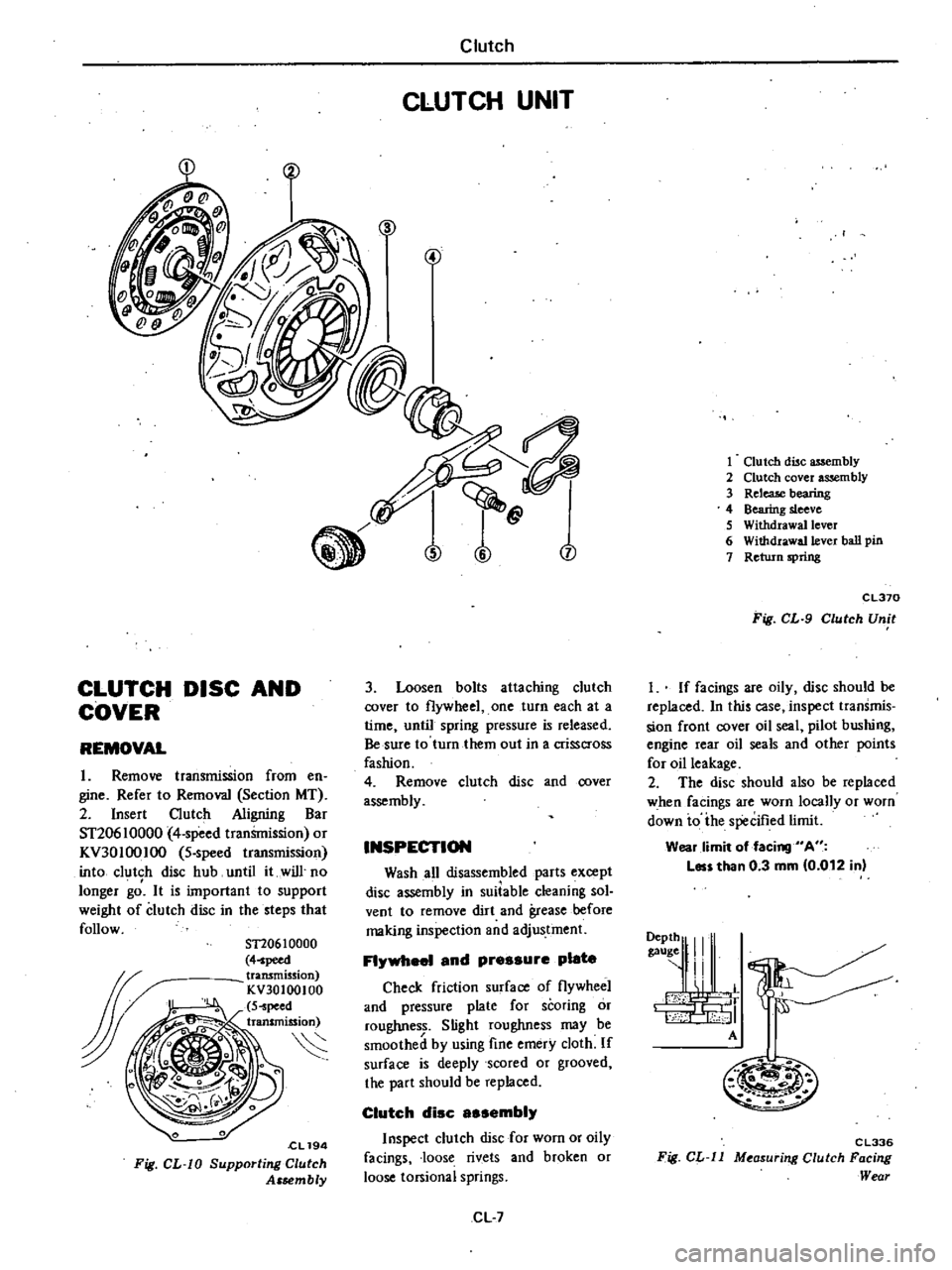
ST20610000
4
peed
transmission
KV30100100
S
peed
transmission
S
cL194
Fig
CL
W
Supporting
Clutch
Assembly
Clutch
CLUTCH
UNIT
n
j
3
Loosen
bolts
attaching
clutch
cover
to
flywheel
one
turn
each
at
a
time
until
spring
pressure
is
released
Be
sure
to
turn
them
out
in
a
crisscross
fashion
4
Remove
clutch
disc
and
cover
assembly
INSPECTION
Wash
all
disassembled
parts
except
disc
assembly
in
suiiable
cleaning
sol
vent
to
remove
dirt
and
grease
before
making
inspection
and
adjustment
FI
1
and
pressure
plate
Check
friction
surface
of
flywheel
and
pressure
plate
for
scoring
or
roughness
Slight
roughness
may
be
smoothed
by
using
fine
emery
cloth
If
surface
is
deeply
scored
or
grooved
the
part
should
be
replaced
Clutch
disc
sembi
Inspect
clutch
disc
for
worn
or
oily
facings
loose
rivets
and
broken
or
loose
torsional
springs
CL
7
1
Clutch
disc
assembly
2
Clutch
cover
assembly
3
ReleaJe
bearing
4
Bearing
sleeve
S
Withdrawal
lever
6
Withdrawa11ever
ball
pin
7
Return
spring
CL370
Fig
CL
9
Clutch
Unit
I
If
facings
are
oily
disc
should
be
replaced
In
this
case
inspect
transmis
sion
front
cover
oil
seal
pilot
bushing
engine
rear
oil
seals
and
other
points
for
oil
leakage
2
The
disc
should
also
be
replaced
when
facings
are
worn
locally
or
worn
down
io
ihe
specified
limit
Wear
limit
of
facing
A
Les
than
0
3
mm
0
012
in
9111
I
A
M
m
C
L336
Fig
CL
ll
M
asur
ng
Clutch
Facing
Wear