oil DATSUN 210 1979 Workshop Manual
[x] Cancel search | Manufacturer: DATSUN, Model Year: 1979, Model line: 210, Model: DATSUN 210 1979Pages: 548, PDF Size: 28.66 MB
Page 76 of 548
Not
Pump
rotors
and
body
are
not
serv
iced
separatdy
If
pump
rotors
or
body
are
damaged
or
worn
replace
ment
of
the
entire
oil
pump
assembly
isnecessary
OIL
PRESSURE
REGULATOR
VALVE
The
oil
pressure
regulator
valve
is
not
adjustable
At
the
released
posi
tion
the
valve
permits
the
oil
to
by
pass
through
the
passage
in
the
pump
cover
to
the
inlet
side
of
the
pump
Check
regulator
valve
spring
to
ensure
that
spring
tension
is
correct
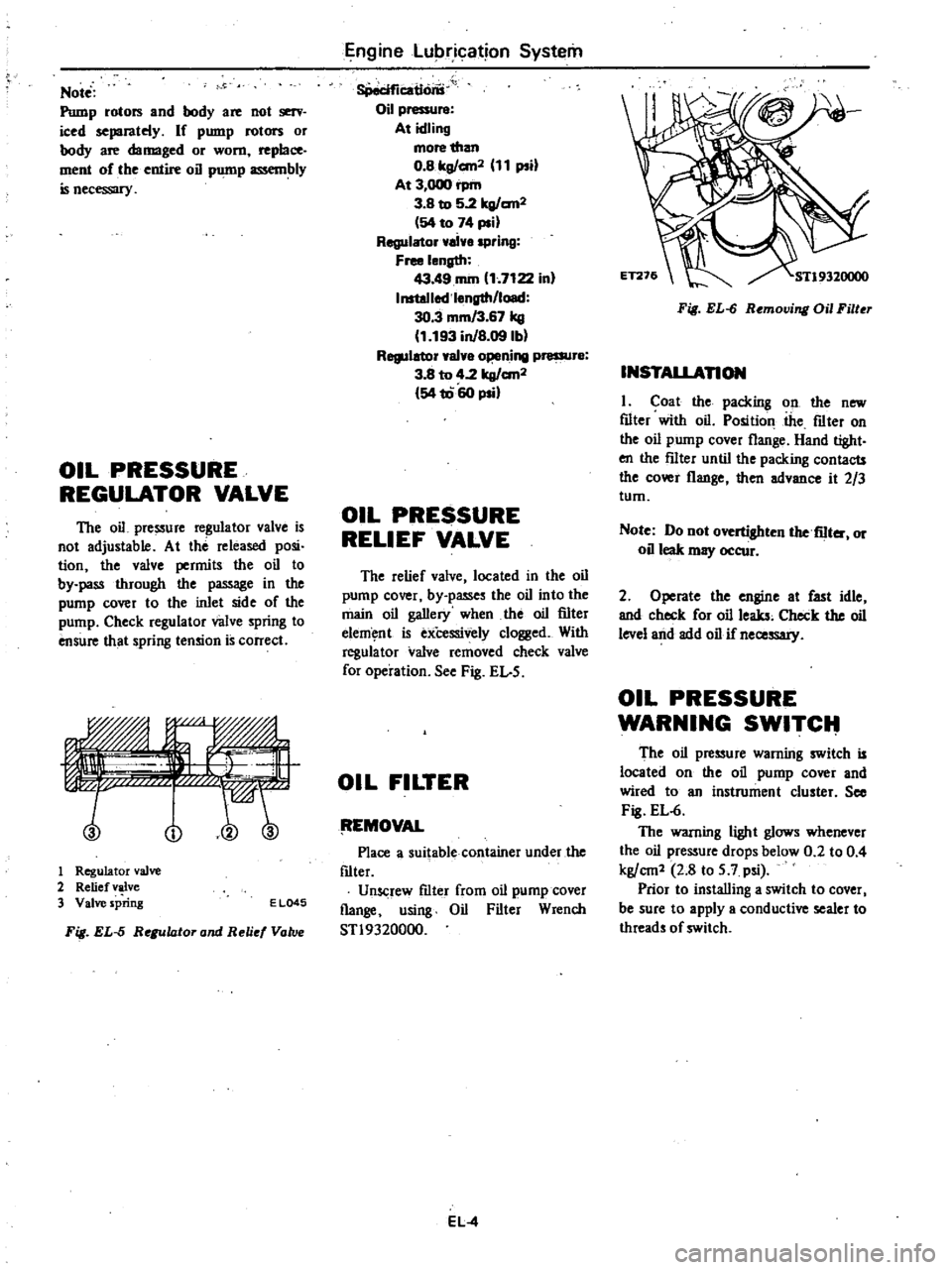
no
1
Regulator
valve
2
Relief
valve
3
Valve
spring
E
L045
Fig
EL
5
Regulator
and
Reli
Vatv
Engine
Lubrication
System
8Peciflcatlons
Oil
pressure
At
idling
more
than
O
Blrg
an2
11
psi
At
3
000
rpm
3
B
to
5
2lrg
an2
54
to
74
psi
Regulator
ai
spring
Free
length
43
49
rom
1
7122
in
InstoJlod
l
ngth
load
30
3
mm
3
67
kg
1
193
inJB
09lbl
Regulator
val
o
ning
pressur
3
8
to
4
2
lrg
an2
54
1060
psi
OIL
PRESSURE
RELIEF
VALVE
The
relief
valve
located
in
the
oil
pump
cover
by
passes
the
oil
into
the
main
oil
gallery
when
the
oil
filter
elem
nt
is
exCessively
clogged
With
regula
tor
valve
removed
check
valve
for
operation
See
Fig
EL
5
OIL
FILTER
tEMOVAL
Place
a
suitable
container
under
the
f1lter
Unscrew
f1lter
from
oil
pump
cover
flange
using
Oil
Filter
Wrench
STl9320000
EL
4
Fig
EL
6
Removing
Oil
Filter
INSTALLAnON
I
Coat
the
packing
on
the
new
f1lter
with
oil
Position
the
f1lter
on
the
oil
pump
cover
flange
Hand
tight
en
the
f11ter
until
the
packing
contacts
the
cover
flange
then
advance
it
2
3
tum
Note
Do
not
overtighten
the
fiIter
or
oil
leak
may
occur
2
Operate
the
engine
at
fast
idle
and
check
for
oil
leaks
Check
the
oil
level
and
add
oil
if
necessary
OIL
PRESSURE
WARNING
SWITCIt
The
oil
pressure
warning
switch
is
located
on
the
oil
pump
cover
and
wired
to
an
instrument
cluster
See
Fig
EL
6
The
warning
light
glows
whenever
the
oil
pressure
drops
below
0
2
to
0
4
kg
cm1
2
8
to
5
7
psi
Prior
to
installing
a
switch
to
cover
I
be
sure
to
apply
a
conductive
sealer
to
threads
of
switch
Page 77 of 548

Engine
Lubrication
System
SERVICE
DATA
AND
SPECIFICATIONS
Oil
pump
Standard
Wear
limit
Rotor
side
clearance
nun
in
0
04
to
0
08
0
20
0
0079
Rotor
to
bottom
cover
0
0016
to
0
0031
Rotor
tip
clearance
mm
in
less
than
0
20
0
0079
0
12
0
0047
Outer
rotor
to
body
clearance
nun
in
0
15
to
0
21
0
50
0
0197
0
0059
to
0
0083
Oil
pressure
regulator
valve
Oil
pressure
a
t
idling
Oil
pressure
at
3
000
rpm
Regulator
valve
spring
Free
length
Installed
length
load
kg
cm2
psi
kg
cm2
psi
more
than
0
8
II
3
8
to
5
2
54
to
74
nun
in
nun
kg
in
lb
43
49
I
7122
30
3
3
67
1
193
8
09
Tightening
torque
Oil
pump
securing
bolts
Oil
pump
cover
bolt
Regulator
valve
cap
nut
kg
m
ft
lb
kg
m
ft
lb
kg
m
ft
lb
0
9
to
I
4
6
5
to
10
1
0
39
to
0
52
2
8
to
3
8
4
0
to
5
0
29
to
36
TROUBLE
DIAGNOSES
AND
CORRECTIONS
Condition
Probable
cause
Corrective
action
Oil
leakage
Damaged
or
cracked
body
cover
Oil
leakage
from
gasket
Oil
leakage
from
regulator
valve
Oil
leakage
from
blind
plug
Replace
Replace
Tighten
or
replace
Replace
Decreased
oil
pressure
Leak
of
oil
in
engine
oil
pan
Dirty
oil
strainer
Damaged
or
worn
pump
rotors
Faulty
regulator
Used
of
poor
quality
engine
oil
Correct
Clean
or
replace
Replace
Adjust
or
replace
Replace
Noise
Excessive
backlash
in
pump
rotors
Replace
EL
5
Page 78 of 548

Engine
Lubrication
System
SPECIAL
SERVICE
TOOLS
Kent
Moore
No
I
Kent
Moore
No
Tool
number
tool
name
Reference
Pile
or
Fig
No
Tool
number
tool
name
Reference
page
or
Fig
No
STl9320000
Oil
filter
wrench
J2S664
Fig
EL
6
EL
6
Page 81 of 548
2
Loosen
belt
then
remove
fan
blade
from
torque
coupling
and
torque
coupling
and
pulley
from
hub
Air
conditioning
system
equipped
models
only
4
Remove
pump
assembly
and
gas
ket
from
front
cover
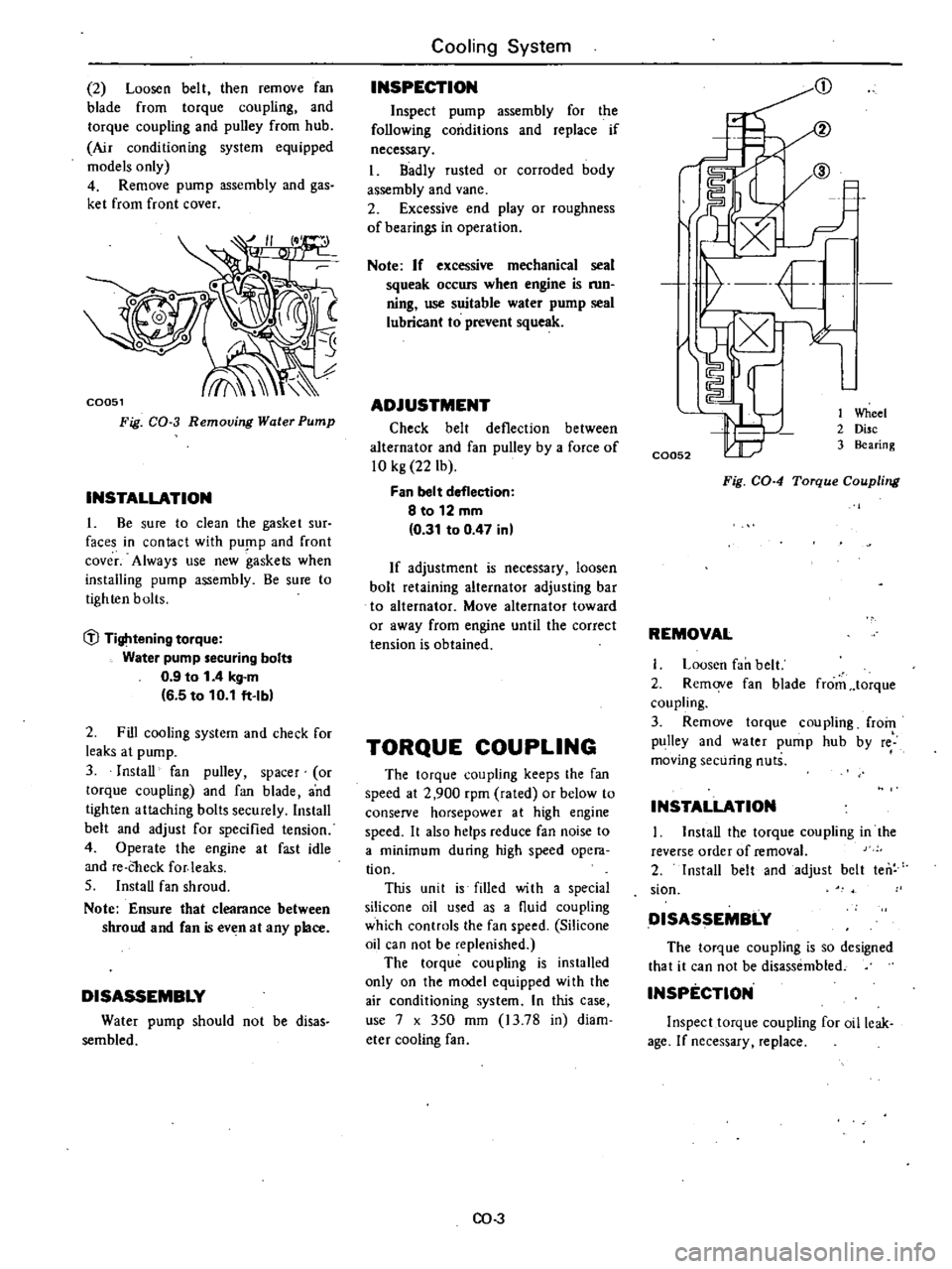
C0051
Fig
CO
3
Removing
Water
Pump
INSTALLATION
1
Be
sure
to
clean
the
gasket
sur
faces
in
contact
with
pU
flP
and
front
cover
Always
use
new
gaskets
when
installing
pump
assembly
Be
sure
to
tighten
bolts
i
l
Tightening
torque
Water
pump
securing
bolts
0
9
to
1
4
kg
m
6
5
to
10
1
ft
Ib
2
Fill
cooling
system
and
check
for
leaks
at
pump
3
InstaD
fan
pulley
spacer
or
torque
coupling
and
fan
blade
and
tighten
attaching
bolts
securely
Install
belt
and
adjust
for
specified
tension
4
Operate
the
engine
at
fast
idle
and
re
Check
for
leaks
S
Install
fan
shroud
Note
Ensure
that
clearance
between
shroud
and
fan
even
at
any
place
DISASSEMBLY
Water
pump
should
not
be
disas
sembled
Cooling
System
INSPECTION
Inspect
pump
assembly
for
the
following
conditions
and
replace
if
necessary
I
Badly
rusted
or
corroded
body
assembly
and
vane
2
Excessive
end
play
or
roughness
of
bearings
in
operation
Note
If
excessive
mechanical
seal
squeak
occurs
when
engine
is
mn
ning
use
suitable
water
pump
seal
lubricant
to
prevent
squeak
ADJUSTMENT
Check
belt
deflection
between
alternator
and
fan
pulley
by
a
force
of
10
kg
22
Ib
Fan
belt
deflection
8
to
12
mm
0
31
to
0
47
in
If
adjustment
is
necessary
loosen
bolt
retaining
alternator
adjusting
bar
to
alternator
Move
alternator
toward
or
away
from
engine
until
the
correct
tension
is
obtained
TORQUE
COUPLING
The
torque
coupling
keeps
the
fan
speed
at
2
900
rpm
rated
or
below
to
conserve
horsepower
at
high
engine
speed
It
also
helps
reduce
fan
noise
to
a
minimum
during
high
speed
opera
tion
This
unit
is
filled
with
a
special
silicone
oil
used
as
a
fluid
coupling
which
controls
the
fan
speed
Silicone
oil
can
not
be
replenished
The
torque
coupling
is
installed
only
on
the
model
equipped
with
the
air
conditioning
system
In
this
case
use
7
x
350
mm
13
78
in
diam
eter
cooling
fan
CO
3
C0052
t
Wheel
2
Disc
3
Bearing
Fig
CO
4
Torque
Coupling
REMOVAL
Lousen
fan
belt
2
Remove
fan
blade
from
torque
coupling
3
Remove
torque
coupling
from
pulley
and
water
pump
hub
by
re
moving
securing
nuts
INSTALLATION
I
InstaD
the
torque
coupling
in
the
reverse
order
of
removal
2
Install
belt
and
adjust
belt
ten
sian
DISASSEMBLY
The
torque
coupling
is
so
designed
that
it
can
not
be
disassembled
INSPECTION
Inspect
torque
coupling
for
oil
leak
age
If
necessary
replace
Page 82 of 548
Cooling
System
TEM
COUPLlNG
Non
Califomia
model
equipped
with
air
conditioning
Tem
coupling
is
a
type
of
fan
coupling
which
is
provided
with
a
temperature
control
system
The
conventional
coupling
always
slips
the
fan
at
a
high
speed
under
a
constant
ratio
regardless
of
the
engine
cooling
requirement
The
slipping
ratio
of
the
Tem
coupling
however
is
properly
changed
with
the
cooling
requirement
ON
denotes
that
cooling
is
required
and
the
fan
operates
up
to
about
2
900rpm
When
high
cooling
is
not
required
during
cold
season
with
the
engine
warmed
up
etc
the
oper
ation
is
placed
under
OFF
condition
and
the
fan
slips
at
about
2
050
rpm
The
coiled
bimetal
thermostat
installed
on
the
front
center
portion
of
the
Tem
coupling
detects
temperature
of
air
passing
through
the
radiator
The
air
temperature
is
directly
relative
to
the
engine
coolant
tempera
ture
and
the
inside
slide
valve
is
opened
or
closed
as
required
and
thus
the
ON
OFF
control
is
performed
When
the
air
temperature
rises
the
bimetal
is
expanded
and
the
valve
is
opened
silicone
oil
is
forwarded
to
the
groove
that
transmits
torque
and
the
system
is
placed
under
ON
con
dition
When
the
valve
closes
silicone
oil
is
not
supplied
to
the
groove
oil
in
the
groove
is
accumulated
on
the
Tem
coupling
periphery
due
to
the
centrifu
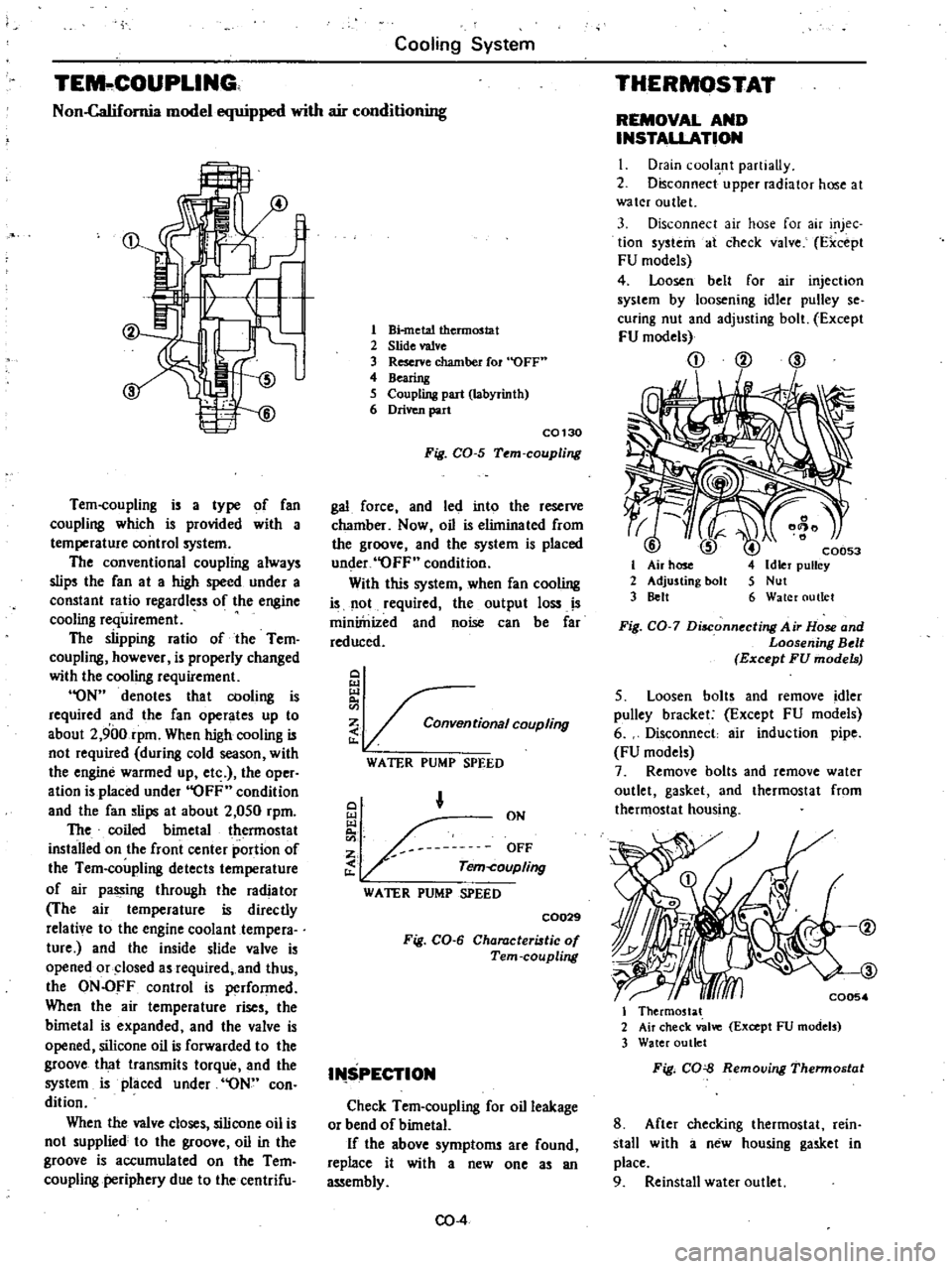
1
Bi
metal
thermostat
2
Slide
valve
3
Reserve
chamber
fOl
OFF
4
Bearing
5
Coupling
part
labyrinth
6
Driven
part
C0130
Fig
CO
5
Tem
coupling
gal
force
and
led
into
the
reserve
chamber
Now
oil
is
eliminated
from
the
groove
and
the
system
is
placed
under
OFF
condition
With
this
system
when
fan
cooling
is
not
required
the
output
loss
IS
miniinized
and
noise
can
be
far
reduced
Q
i
tionalCOUPling
WATER
PUMP
SPEED
Q
ON
OFF
Tem
coupling
WATER
PUMP
SPEED
C0029
Fig
CO
6
Characteristic
of
Tern
coupling
I
SPECTION
Check
Tem
coupling
for
oil
leakage
or
bend
of
bimetaL
If
the
above
symptoms
are
found
replace
it
with
a
new
one
as
an
assembly
CO
4
THERMOSTAT
REMOVAL
AND
INSTALLATION
I
Drain
cool
nt
partiaUy
2
Disconnect
upper
radiator
hose
at
water
outlet
3
Disconnect
air
hose
for
air
injec
tion
systein
at
check
valve
Fxcept
FU
models
4
Loosen
belt
for
air
injechon
system
by
loosening
idler
pulley
se
curing
nut
and
adjusting
bolt
Except
FU
models
CD
@
ID
I
2
3
C0053
Idler
pulley
Nut
Water
outlet
Fig
CO
7
Disconnecting
Air
Hose
and
Loosening
Belt
Except
FU
models
5
Loosen
bolts
and
remove
idler
pulley
bracket
Except
FU
models
6
Disconnect
air
induction
pipe
FU
models
7
Remove
bolts
and
remove
water
outlet
gasket
and
thermostat
from
thermostat
housing
I
Thermostat
2
Air
check
valve
Except
FU
models
3
Water
outlet
Fig
CO
Removing
Thennostat
8
After
checking
thermostat
rein
stall
with
a
new
housing
gasket
in
place
9
Reinstall
water
outlet
Page 83 of 548
10
Replenish
coolant
and
check
for
leaks
INSPECTION
I
Submerge
thermostat
in
hot
water
SOC
90F
above
the
specified
temperature
Refer
to
Service
Data
and
Specifications
2
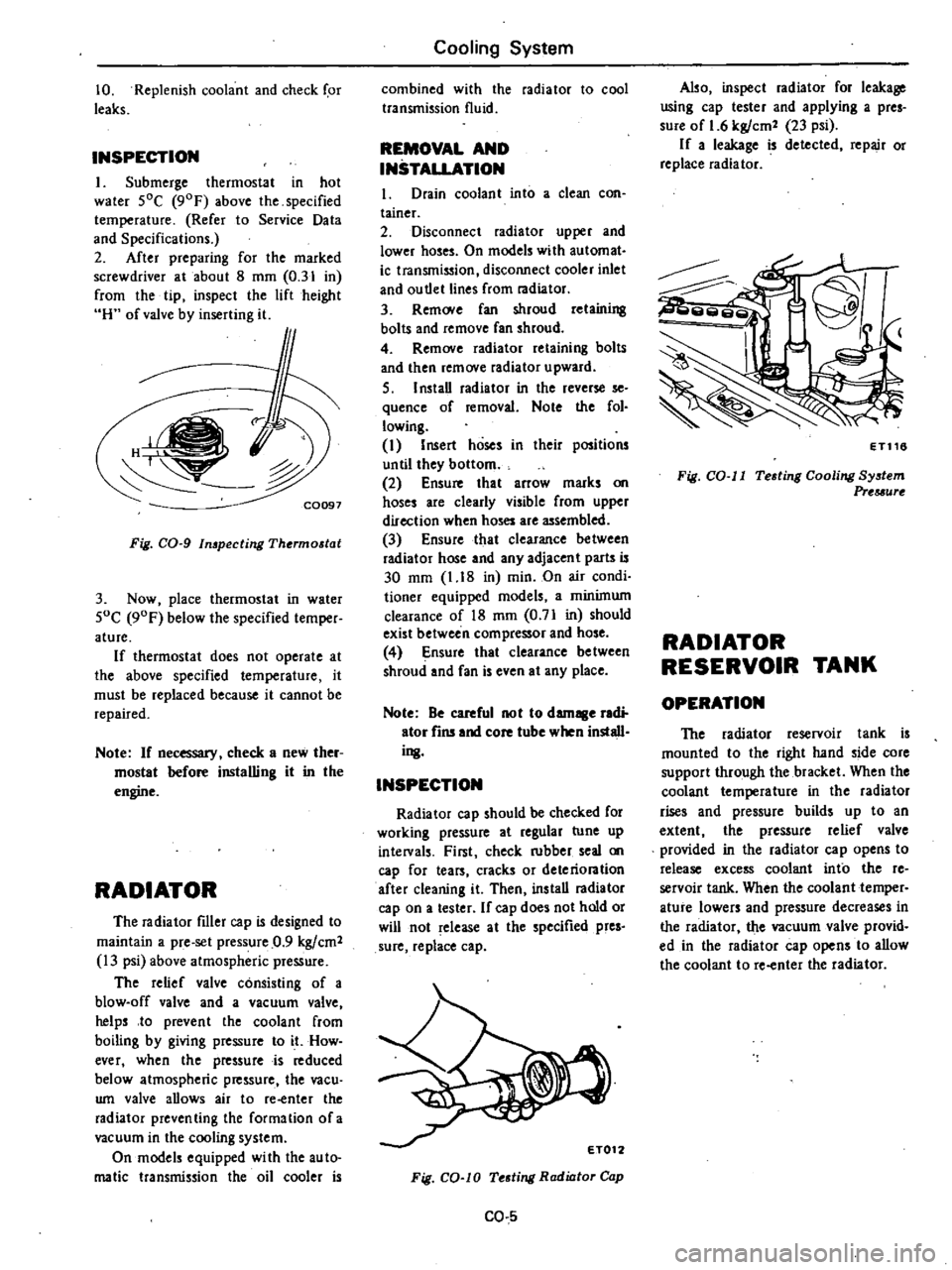
After
preparing
for
the
marked
screwdriver
at
about
8
mm
0
31
in
from
the
tip
inspect
the
lift
height
H
of
valve
by
inserting
it
f
C0097
Fig
CO
g
In
pecting
Thermostat
3
Now
place
thermostat
in
water
SoC
90F
below
the
specified
temper
ature
If
thermostat
does
not
operate
at
the
above
specified
temperature
it
must
be
replaced
because
it
cannot
be
repaired
Note
If
necessary
check
a
new
ther
mostat
before
installing
it
in
the
engine
RADIATOR
The
radiator
filler
cap
is
designed
to
maintain
a
pre
set
pressure
0
9
kgfcm2
13
psi
above
atmospheric
pressure
The
relief
valve
consisting
of
a
blow
off
valve
and
a
vacuum
valve
helps
to
prevent
the
coolant
from
boiling
by
giving
pressure
to
it
How
ever
when
the
pressure
is
reduced
below
atmospheric
pressure
the
vacu
wn
valve
allows
air
to
re
enter
the
radiator
preventing
the
formation
ofa
vacuum
in
the
cooling
system
On
models
equipped
wi
th
the
au
to
malic
transmission
the
oil
cooler
is
Cooling
System
combined
with
the
radiator
to
cool
transmission
fluid
REMOVAL
AND
INSTALLATION
1
Drain
coolant
into
a
clean
con
tainer
2
Disconnect
radiator
upper
and
lower
hoses
On
models
with
automat
ic
transmission
disconnect
cooler
inlet
and
ou
tlet
lines
from
radiator
3
Rem
Ne
fan
shroud
retaining
bolts
and
remove
fan
shroud
4
Remove
radiator
retaining
bolts
and
then
remove
radiator
upward
S
I
nstaD
radiator
in
the
reverse
se
quence
of
removal
Note
the
fol
lowing
I
Insert
hoses
in
their
positions
until
they
bottom
2
Ensure
that
arrow
marks
on
hoses
are
clearly
visible
from
upper
direction
when
hoses
are
assembled
3
Ensure
that
clearance
between
radiator
hose
and
any
adjacent
parts
is
30
mm
1
18
in
min
On
air
condi
tioner
equipped
models
a
minimum
clearance
of
18
mm
0
71
in
should
exist
between
compressor
and
hose
4
Ensure
that
clearance
be
tween
shroud
and
fan
is
even
at
any
place
Note
Be
careful
not
to
damage
radi
ator
fins
and
core
tube
when
install
ing
INSPECTION
Radiator
cap
should
be
checked
for
working
pressure
at
regular
tune
up
intelVals
First
check
rubber
seal
on
cap
for
tears
cracks
or
deteriontion
after
cleaning
it
Then
ins
taD
radiator
cap
on
a
tester
If
cap
does
not
hold
or
will
not
release
at
the
specified
pres
sure
replace
cap
Fig
CO
lO
Testing
Radiator
Cap
CO
5
Also
inspect
radiator
for
leakage
using
cap
tester
and
applying
a
pres
sure
of
1
6
kgfcm2
23
psi
If
a
leakage
is
detected
repair
or
replace
radiator
ET116
Fig
CO
II
Testing
Cooling
System
Prtuurt
RADIATOR
RESERVOIR
TANK
OPERATION
The
radiator
reservoir
tank
is
mounted
to
the
right
hand
side
core
support
through
the
bracket
When
the
coolant
temperature
in
the
radiator
rises
and
pressure
builds
up
to
an
extent
the
pressure
relief
valve
provided
in
the
radiator
cap
opens
to
release
excess
coolant
into
the
re
servoir
tank
When
the
coolant
temper
ature
lowers
and
pressure
decreases
in
the
radiator
the
vacuum
valve
provid
ed
in
the
radiator
cap
opens
to
allow
the
coolant
to
re
enter
the
radiator
Page 84 of 548

u
V
O
I
MAX
Ii
1i
i
iT
1
I
I
11
1
i
MINij
o
f
G
p
rl
MAX
ii
i
p
It
ot
MINi
II
L
Cooling
System
l
CQ074
Pressure
relief
valve
opens
f
C007S
Vacuum
valve
opens
INSPECTION
1
Check
the
amount
of
coolant
in
the
reservoir
tank
If
the
coolant
level
is
below
the
MIN
level
remove
the
re
servoirtank
ruler
cap
and
add
enough
oolant
to
reach
MAX
level
If
the
reservoir
tank
is
empty
check
the
coolantlevel
in
the
radiator
If
the
coolant
in
the
radiator
is
insuf
ficient
pour
it
into
radiator
up
to
the
radiator
cap
and
also
pour
it
into
the
reservoir
tank
until
MAX
level
If
the
coolant
in
the
reservoir
tank
d
ecreases
abnormally
rapid
check
for
a
leak
in
the
cooling
system
REMOVAL
AND
INSTALLATION
1
Reservoir
tank
is
only
inserted
to
reservoir
tank
bracket
and
can
be
easily
removed
To
install
reservoir
tank
reverse
the
order
of
remova
Fig
CO
12
Opefation
of
ReserVoir
Tank
SERVICE
DATA
AND
SPECIFICATIONS
Thermostat
Valve
opening
temperature
Oc
OF
Maximum
valve
lift
mmjOC
in
oF
Radiator
Type
Manual
transmission
Automatic
tralUJ1lission
Cap
relief
pressure
kg
cm2
psi
Testing
pressure
kg
cm
2
psi
Fan
Fan
belt
deflection
mm
in
cO
6
Temperate
type
Frigid
type
Tropical
type
82
180
88
190
76
5
I
70
8
95
8
loo
8
90
0
3
I
203
0
31j2
i
2
0
31
194
Corrugated
fm
type
Corrugated
fm
type
equipped
with
oil
cooler
0
9
I
3
1
6
23
8
to
12
0
31
to
0
47
Page 85 of 548
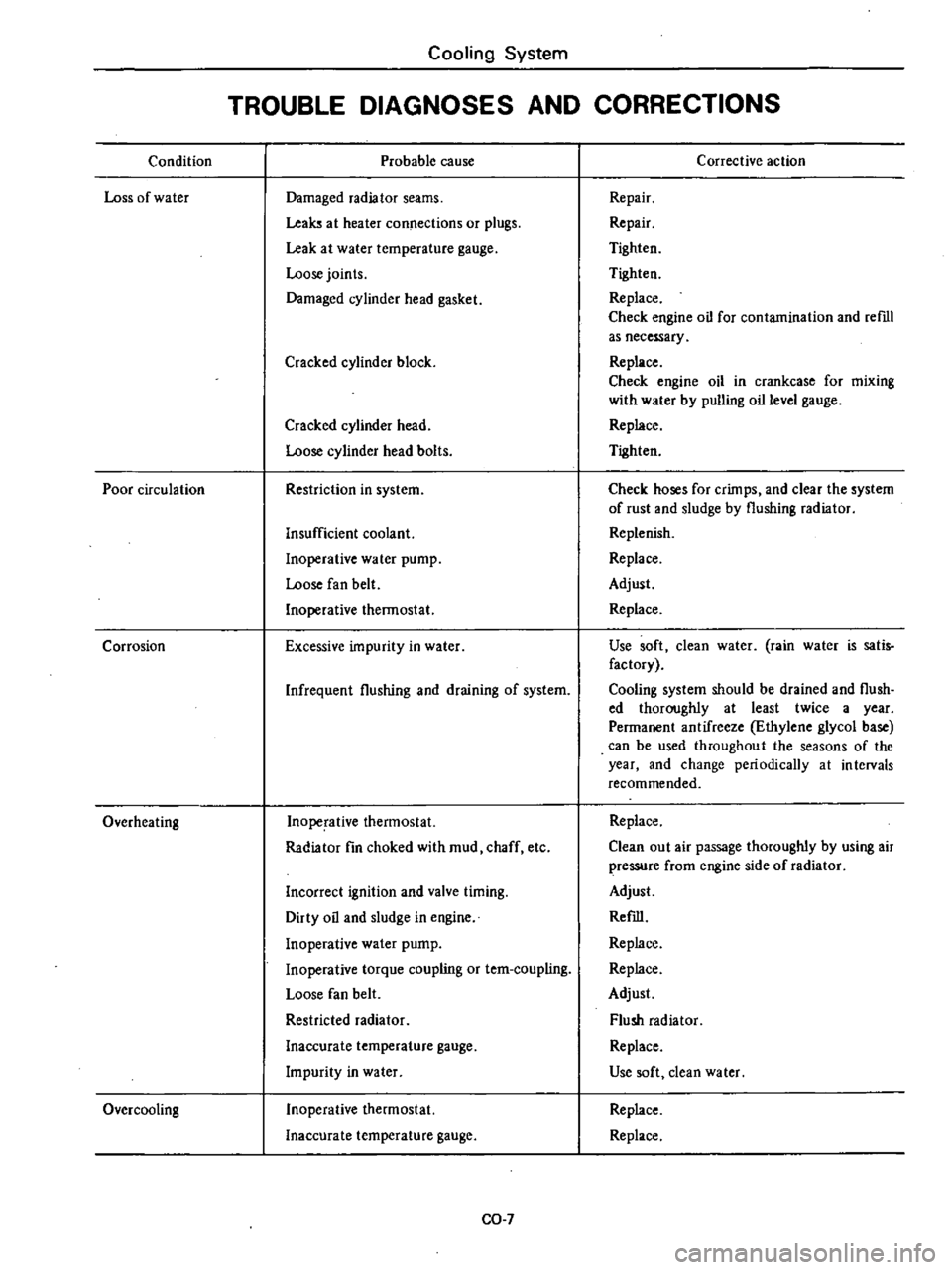
Condition
Loss
of
water
Poor
circulation
Corrosion
Overheating
Over
cooling
Cooling
System
TROUBLE
DIAGNOSES
AND
CORRECTIONS
Probable
cause
Damaged
radiator
seams
Leaks
at
heater
connections
or
plugs
Leak
at
water
temperature
gauge
Loose
joints
Damaged
cylinder
head
gasket
Cracked
cylinder
block
Cracked
cylinder
head
Loose
cylinder
head
bolts
Restriction
in
system
Insufficient
coolant
Inoperative
water
pump
Loose
fan
belt
Inoperative
thermostat
Excessive
impurity
in
water
Infrequent
flushing
and
draining
of
system
Inoperative
thermostat
Radiator
fin
choked
with
mud
chaff
etc
Incorrect
ignition
and
valve
timing
Dirty
oil
and
sludge
in
engine
Inoperative
water
pump
Inoperative
torque
coupling
or
tem
coupling
Loose
fan
belt
Restricted
radiator
Inaccurate
temperature
gauge
Impurity
in
water
Inoperative
thermostat
Inaccurate
temperature
gauge
CO
7
Corrective
action
Repair
Repair
Tighten
Tighten
Replace
Check
engine
oil
for
contamination
and
reml
as
necessary
Replace
Check
engine
oil
in
crankcase
for
mixing
with
water
by
pulling
oil
level
gauge
Replace
Tighten
Check
hoses
for
crimps
and
clear
the
system
of
rust
and
sludge
by
flushing
radiator
Replenish
Replace
Adjust
Replace
Use
soft
clean
water
rain
water
is
satis
factory
Cooling
system
should
be
drained
and
flush
ed
thoroughly
at
least
twice
a
year
Permanent
antifreeze
Ethylene
glycol
base
can
be
used
throughout
the
seasons
of
the
year
and
change
periodically
at
intervals
recommended
Replace
Clean
out
air
passage
thoroughly
by
using
air
pressure
from
engine
side
of
radiator
Adjust
Refill
Replace
Replace
Adjust
Flush
radiator
Replace
Use
soft
dean
water
Replace
Replace
Page 92 of 548
5
The
pressure
gauge
indicates
static
fuel
pressure
in
the
line
The
gauge
reading
should
be
within
the
specified
value
Fuel
pump
pressure
0
21
to
0
27
kg
em2
3
0
to
3
8
pli
I
Note
If
the
fuel
in
the
carburetor
float
chamber
has
run
out
and
engine
has
stopped
remove
clip
and
pour
fuel
into
carburetor
Fasten
clip
securely
and
repeat
static
pres
sure
test
If
pressure
is
not
within
the
specifi
ed
limit
remove
pump
as
an
assembly
CAPACITY
TEST
The
capacity
test
is
conducted
only
when
static
pressure
is
within
the
specification
To
conduct
this
test
proceed
as
follows
1
Disconnect
pressure
gauge
from
T
connector
and
in
its
vacant
place
install
a
suitable
container
as
a
fuel
sump
2
Start
engine
and
run
at
1
000
pm
3
Pump
should
deliver
the
specified
amouni
of
fuel
If
little
or
no
fuel
flows
from
open
end
of
pipe
it
is
an
indication
that
fuel
line
is
clogged
or
pump
is
mal
functioning
Fuel
pump
capacity
450
cc
27
46
eu
inl
min
at
1
000
rpm
REMOVAL
AND
INSTALLATION
Note
When
disconnecting
fuel
lines
use
a
container
to
receive
fuel
remaining
in
fuel
hoses
I
Disconnect
inlet
and
outlet
fuel
hoses
from
fuel
pump
2
Remove
fuel
pump
3
To
install
reverse
the
order
of
removal
Engine
Fuel
DISASSEMBLY
@@
@@
@
@@
1
Remove
screws
and
detach
upper
and
lower
bodies
2
Remove
screws
and
take
off
cap
and
cap
gasket
from
upper
body
3
Remove
inlet
and
outlet
connee
tors
4
Remove
valve
retainer
screws
and
take
off
valve
retainer
S
To
remove
diaphragm
press
down
its
center
against
spring
force
With
diaphragm
pressed
down
ilt
it
until
end
of
pull
rod
touches
inner
wall
of
body
Then
release
diaphragm
to
unhook
push
rod
Note
Be
careful
not
to
damage
dia
phragm
or
oil
seal
INSPECTION
Check
all
components
for
cracks
EF
7
I
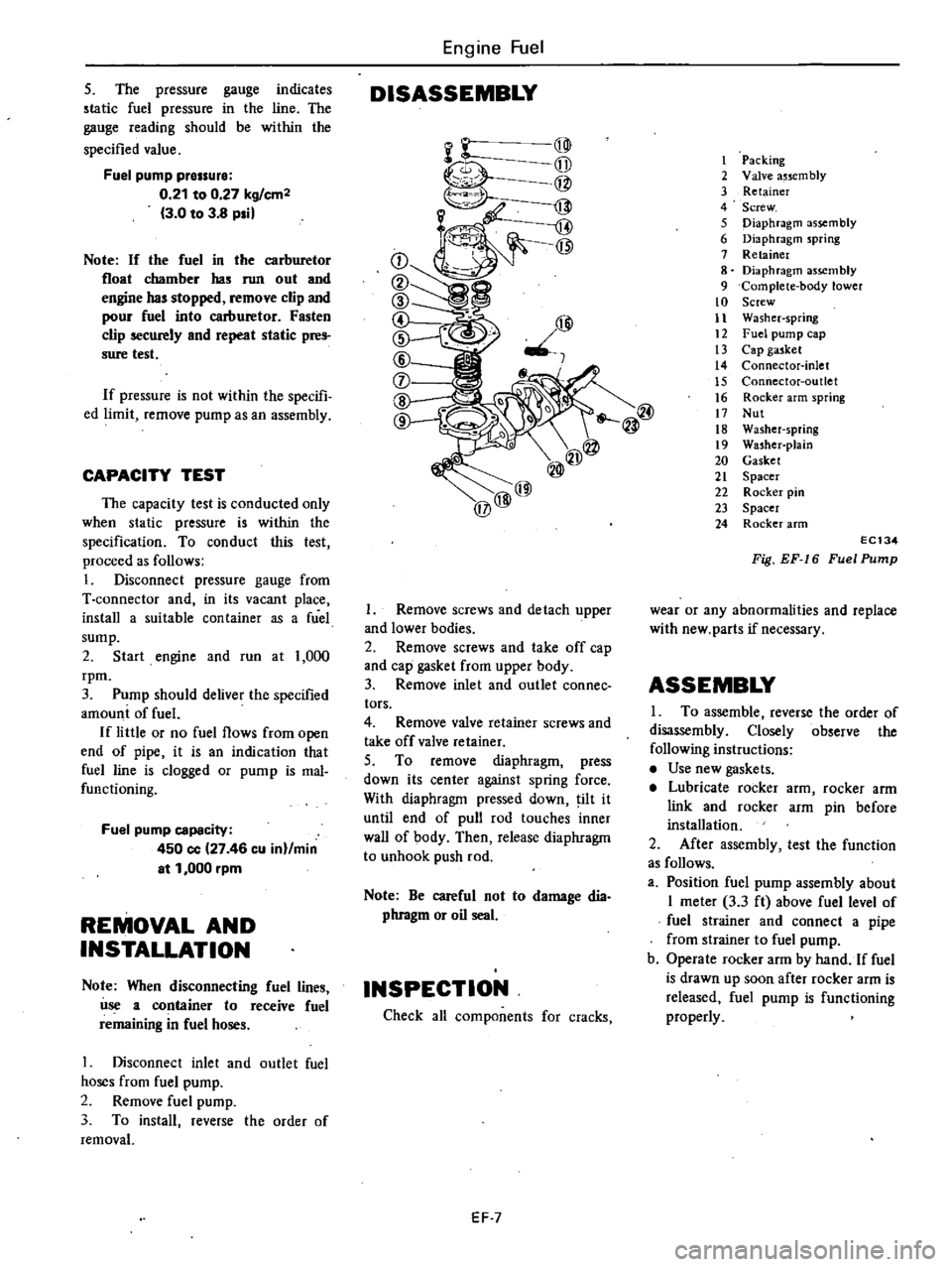
Packing
2
Valve
a5scm
bly
3
Retainer
4
Screw
5
Diaphragm
assembly
6
Diaphragm
spring
7
Retainer
8
Diaphragm
assembly
9
Complete
body
lower
10
Screw
11
Washer
spring
12
Fuel
pump
cap
13
Cap
gasket
14
Connector
inlet
15
Connector
outlet
16
Rocker
arm
spring
17
Nut
18
Washer
spring
19
Washer
pJain
20
Gasket
21
Spacer
22
Rocker
pin
23
Spacer
24
Rocker
arm
EC134
Fig
EF
16
Fuel
Pump
wear
or
any
abnormalities
and
replace
with
new
parts
if
necessary
ASSEMBLY
I
To
assemble
reverse
the
order
of
disassembly
Closely
observe
the
following
instructions
Use
new
gaskets
Lubricate
rocker
arm
rocker
arm
link
and
rocker
arm
pin
before
installation
2
After
assembly
test
the
function
as
follows
a
Position
fuel
pump
assembly
about
I
meter
3
3
ft
above
fuel
level
of
fuel
strainer
and
connect
a
pipe
from
strainer
to
fuel
pump
b
Operate
rocker
arm
by
hand
If
fuel
is
drawn
up
soon
after
rocker
arm
is
released
fuel
pump
is
functioning
properly
Page 96 of 548
throttle
opener
solenoid
valve
The
throttle
opener
solenoid
valve
is
actuated
and
the
servo
diaphragm
chamber
is
opened
to
the
atmosphere
In
this
case
the
seIVo
diaphragm
does
not
opera
te
Engine
Fuel
Automatic
transmission
models
As
long
as
the
shift
lever
is
in
the
N
or
p
position
the
inhibitor
switch
on
the
transmission
is
turned
on
and
the
throttle
opener
solenoid
valve
is
actuated
Under
this
condition
the
seIVo
diaphragm
does
not
operate
because
of
the
same
reason
as
men
tioned
for
the
manual
transmission
model
ON
Car
peed
betow
t6
km
h
to
mph
OFF
Car
peed
above
16
km
h
to
mph
To
intake
manifold
j
lJl
11
1
ti
i
ljn
L
o
1
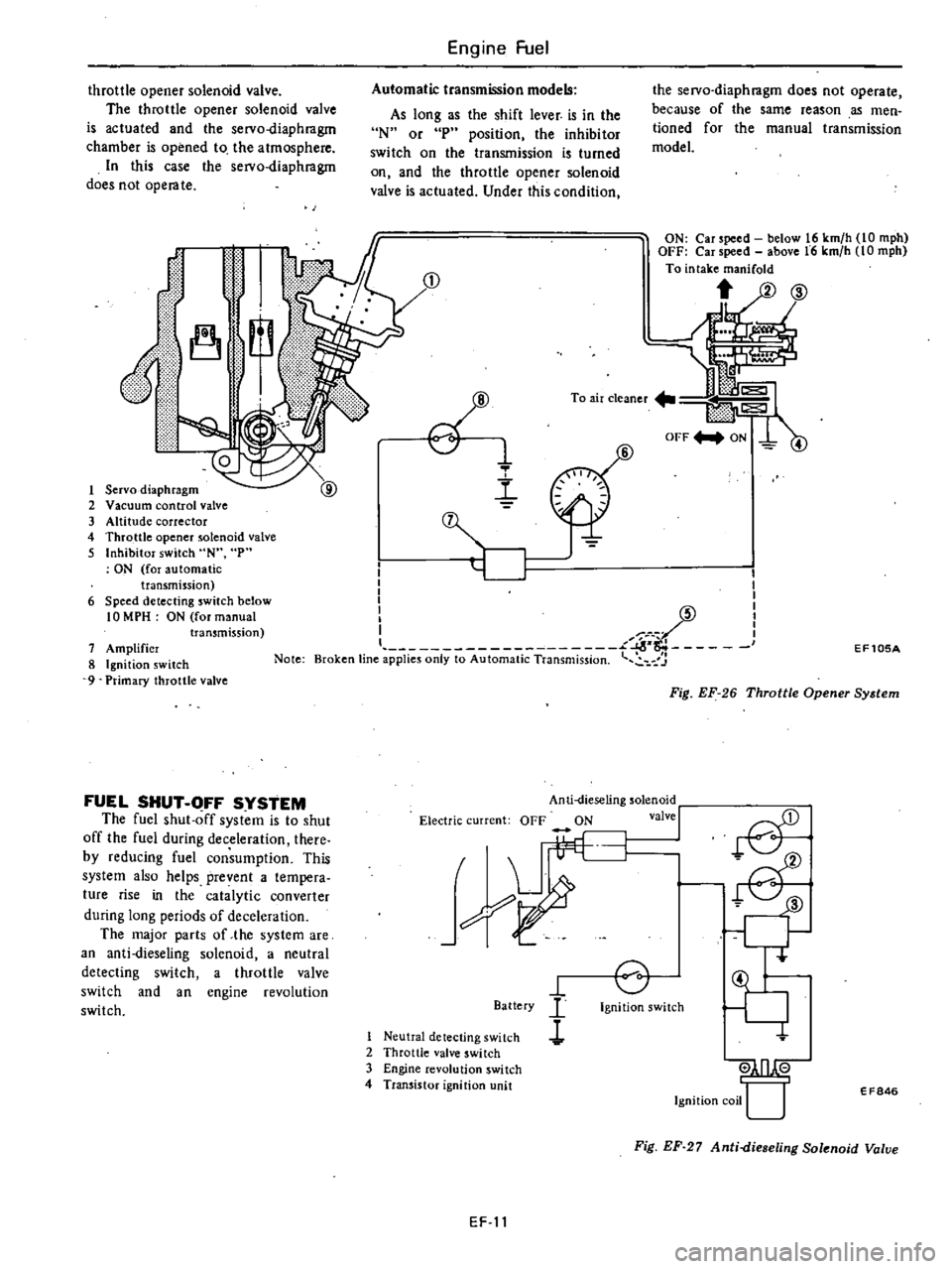
Servo
diaphragm
2
Vacuum
control
valve
3
Altitude
corrector
4
Throttle
opener
solenoid
valve
5
Inhibitor
switch
N
p
ON
for
automatic
transmission
6
Speed
detecting
switch
below
10
MPH
ON
for
manual
transmission
7
Amplifier
8
Ignition
switch
9
Primary
throttle
valve
Note
FUEL
SHUT
OFF
SYSTEM
The
fuel
shut
off
system
is
to
shut
off
the
fuel
during
deceleration
there
by
reducing
fuel
consumption
This
system
also
helps
prevent
a
tempera
ture
rise
in
the
catalytic
converter
during
long
periods
of
deceleration
The
major
parts
of
the
system
are
an
anti
dieseling
solenoid
a
neutral
detecting
switch
a
throttle
valve
switch
and
an
engine
revolution
switch
e
1
l
6
I
I
I
I
I
I
I
I
I
l
L
I
Broken
tine
applies
only
to
Automatic
Transmission
7
Anti
dieseling
solenoid
Electric
current
OFF
ON
valve
I
I
h
L
Battery
I
Neutral
detecting
switch
l
2
Throttle
valve
switch
3
Engine
revolution
switch
4
Transistor
ignition
unit
o
Ignition
switch
EF105A
Fig
EF
26
Throttle
Opener
System
ill
Ignition
coil
U
EF846
Fig
EF
27
Anti
dieseling
Solenoid
Valve
EF
11