lock DATSUN 510 1968 Service Owner's Guide
[x] Cancel search | Manufacturer: DATSUN, Model Year: 1968, Model line: 510, Model: DATSUN 510 1968Pages: 252, PDF Size: 12.2 MB
Page 71 of 252
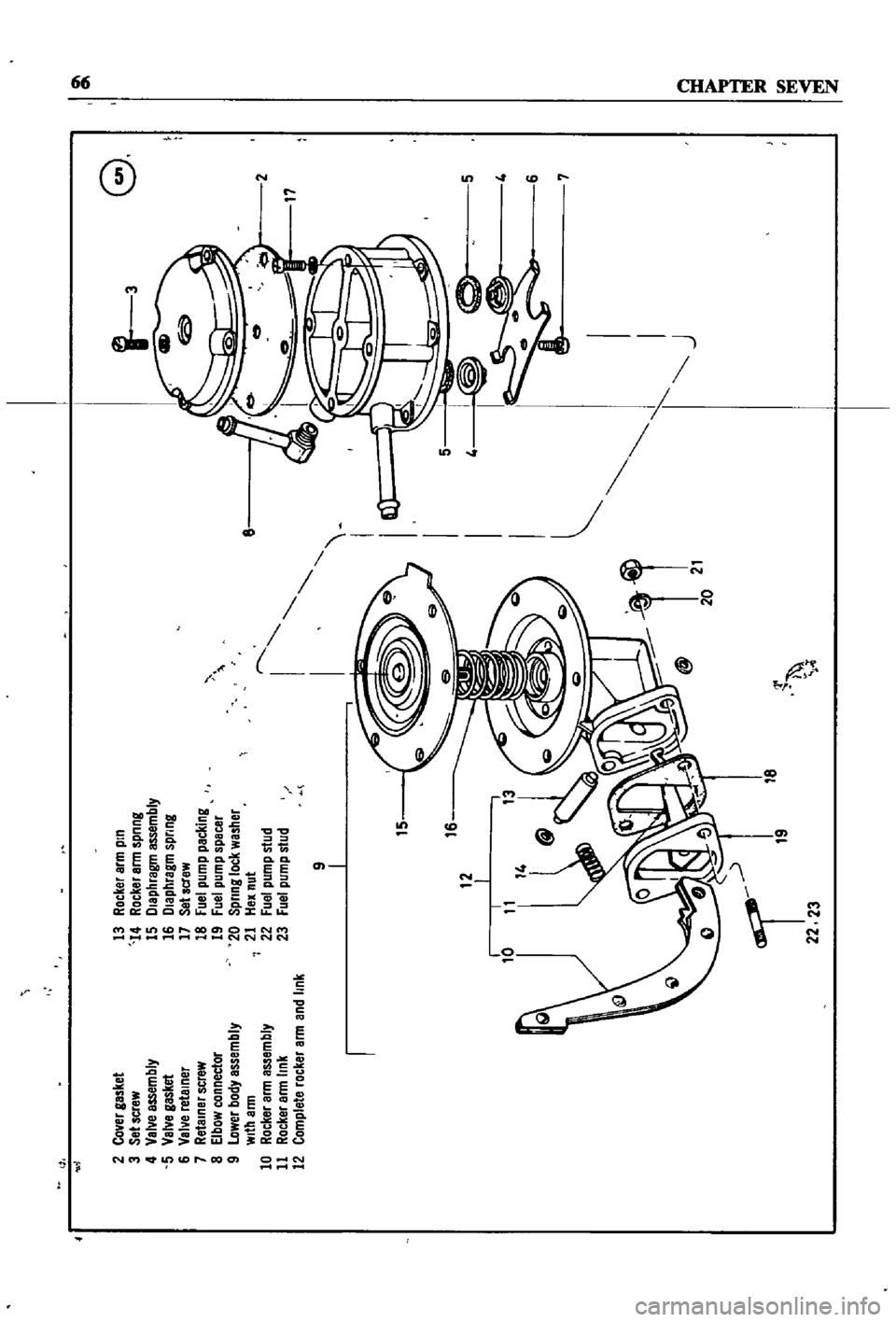
01
01
G
1
3
2
Co
er
gasket
3
Set
screw
4
Val
e
assembly
5
Val
e
gasket
6
Val
e
retelner
7
Retainer
screw
8
Elbow
connector
9
lower
body
assembly
With
arm
10
Rocker
arm
assembly
11
Rocker
arm
link
12
Complete
rocker
arm
and
link
13
Rocker
arm
pin
14
Rocker
arm
spnng
15
Dlephragm
assembly
16
Diaphragm
spring
17
Sehcrew
18
Fuel
pump
pecking
19
Fuel
pump
spacer
20
Spnng
lock
washer
21
Hex
nut
22
Fuel
pump
stud
23
Fuel
pump
stud
2
17
r
I
I
I
I
I
I
I
I
I
J
9
I
I
15
I
0
5
I
16
1i
20
21
g
tI
i
I
lb
18
22
23
r
Page 75 of 252
70
CHAPTER
SEVEN
CD
1
Float
seat
2
Roat
3
Roat
stopper
4
Needle
valve
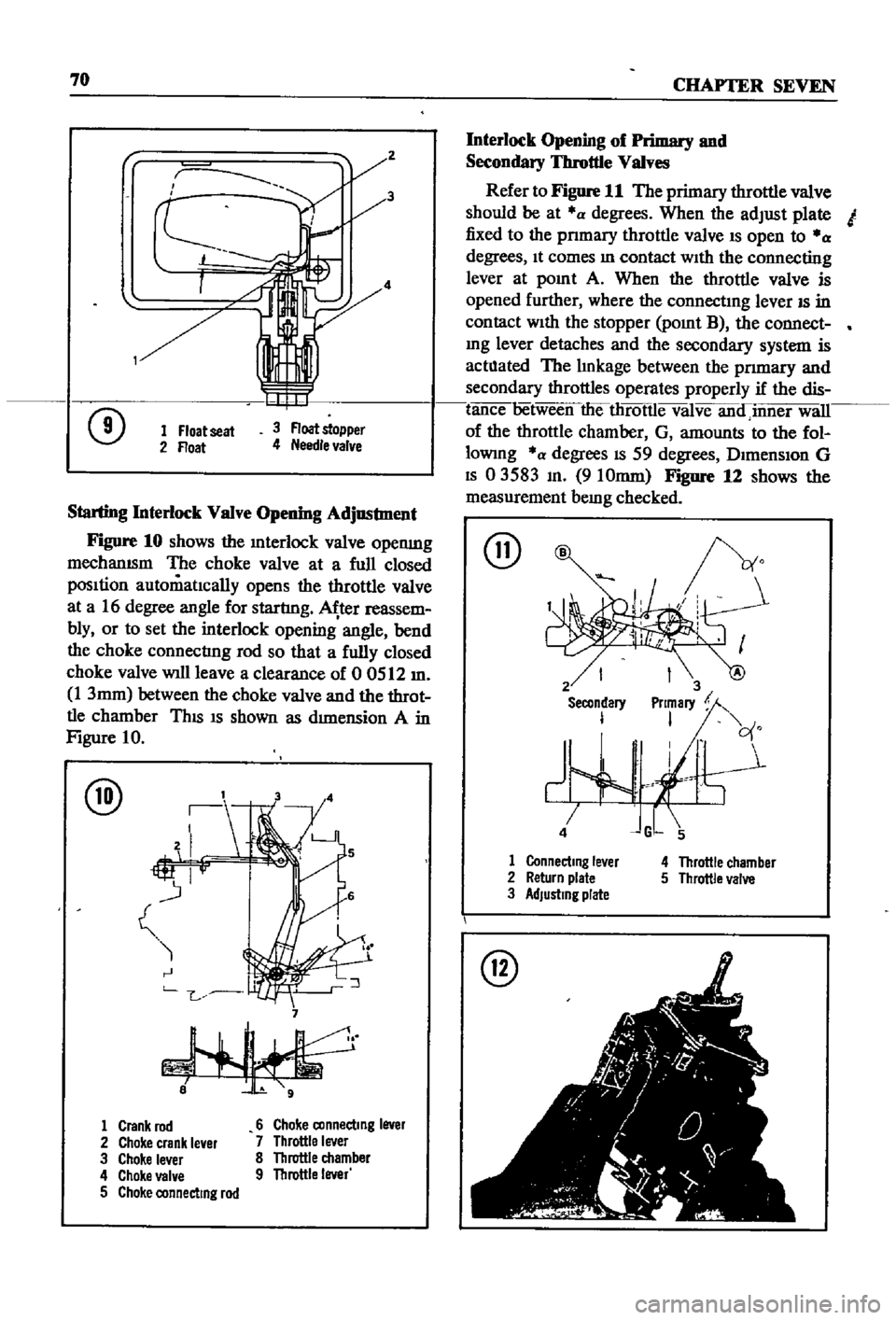
Starting
Interlock
Valve
Opening
Adjustment
Figure
10
shows
the
Interlock
valve
openmg
mechanISm
The
choke
valve
at
a
full
closed
pOSItion
automatIcally
opens
the
throttle
valve
at
a
16
degree
angle
for
startlng
ter
reassem
bly
or
to
set
the
interlock
opening
angle
bend
the
choke
connectlng
rod
so
that
a
fully
closed
choke
valve
will
leave
a
clearance
of
0
0512
m
1
3mm
between
the
choke
valve
and
the
throt
tle
chamber
ThIS
IS
shown
as
dImension
A
in
Figure
10
@
7
1
Crank
rod
6
Choke
connecting
lever
2
Choke
crank
le
er
7
Throttle
lever
3
Choke
lever
8
Throttle
chamber
4
Choke
VBI
e
9
Throttle
lever
5
Choke
connecting
rod
Interlock
Opening
of
Primary
and
Secondary
Throttle
Valves
Refer
to
Figure
11
The
primary
throttle
valve
should
be
at
a
degrees
When
the
adjust
plate
I
fixed
to
the
pnmary
throttle
valve
IS
open
to
a
degrees
It
comes
In
contact
WIth
the
connecting
lever
at
pOInt
A
When
the
throttle
valve
is
opened
further
where
the
connectIng
lever
IS
in
contact
With
the
stopper
POInt
B
the
connect
mg
lever
detaches
and
the
secondary
system
is
actllated
The
lInkage
between
the
pnmary
and
secondary
throttles
operates
properly
if
the
dis
tance
6etween
theilirotlle
valve
anainner
will
of
the
throttle
chamber
G
amounts
to
the
fol
lowmg
a
degrees
IS
59
degrees
DImenSIon
G
IS
03583
In
910mm
Figure
12
shows
the
measurement
bemg
checked
@
2
Secondary
I
1
Connecting
le
er
2
Return
plate
3
Adjusting
plate
4
Throttle
chamber
5
Throttle
valve
I
1
I
r
t
i
t
r
1
I
j
I
00
I
r
@
Page 76 of 252
FUEL
SYSTEM
71
Dash
Pot
Adjustment
The
adjustment
of
the
dash
pot
IS
done
by
warmmg
up
the
engme
properly
and
checkIng
If
the
throttle
lever
touches
th
dash
pot
stem
as
the
engine
reaches
1
800
and
2
000
rpm
under
no
load
conditIons
Proper
contact
between
the
throttle
lever
and
the
dash
pot
stem
produces
a
normal
dash
pot
performance
Should
a
normal
mcrease
m
engme
speed
not
occur
adjust
the
dash
pot
as
follows
1
Loosen
the
dash
pot
locknuts
2
Rotate
the
dash
pot
nght
and
then
left
3
Adjust
the
dash
pot
so
that
the
throttle
lever
hIts
the
stem
between
1
800
and
2
000
rpm
4
Fasten
the
lock
nuts
securely
5
The
clearance
between
the
throttle
valve
and
the
throttle
chamber
wall
should
be
0
0709
m
0
8mm
or
10
degrees
In
throttle
valve
angle
MAJOR
CARBURETOR
SERVICE
PROCEDURES
A
carburetor
m
good
operatIng
condition
will
delIver
the
pr
per
gasolme
and
aIr
ratIos
for
all
engme
runnmg
speeds
A
gradual
declme
In
smoothness
response
and
power
Will
occur
as
the
carburetor
slIps
from
adjustment
and
Its
delI
cate
parts
become
dirty
and
worn
Overhaul
should
only
be
attempted
by
an
expenenced
mechanic
Accurate
calIbratIon
of
passages
and
dIS
charge
hole
reqUIre
that
extreme
care
be
taken
In
dISassembly
cleanmg
and
reassembly
Use
only
a
hIgh
grade
carburetor
cleaner
and
com
pressed
arr
to
clean
parts
and
passages
Never
use
wire
or
other
pOInted
Instruments
for
clean
ing
CalIbratIon
of
the
carburetor
will
be
af
fected
The
procedures
below
are
generally
true
for
all
models
As
an
aId
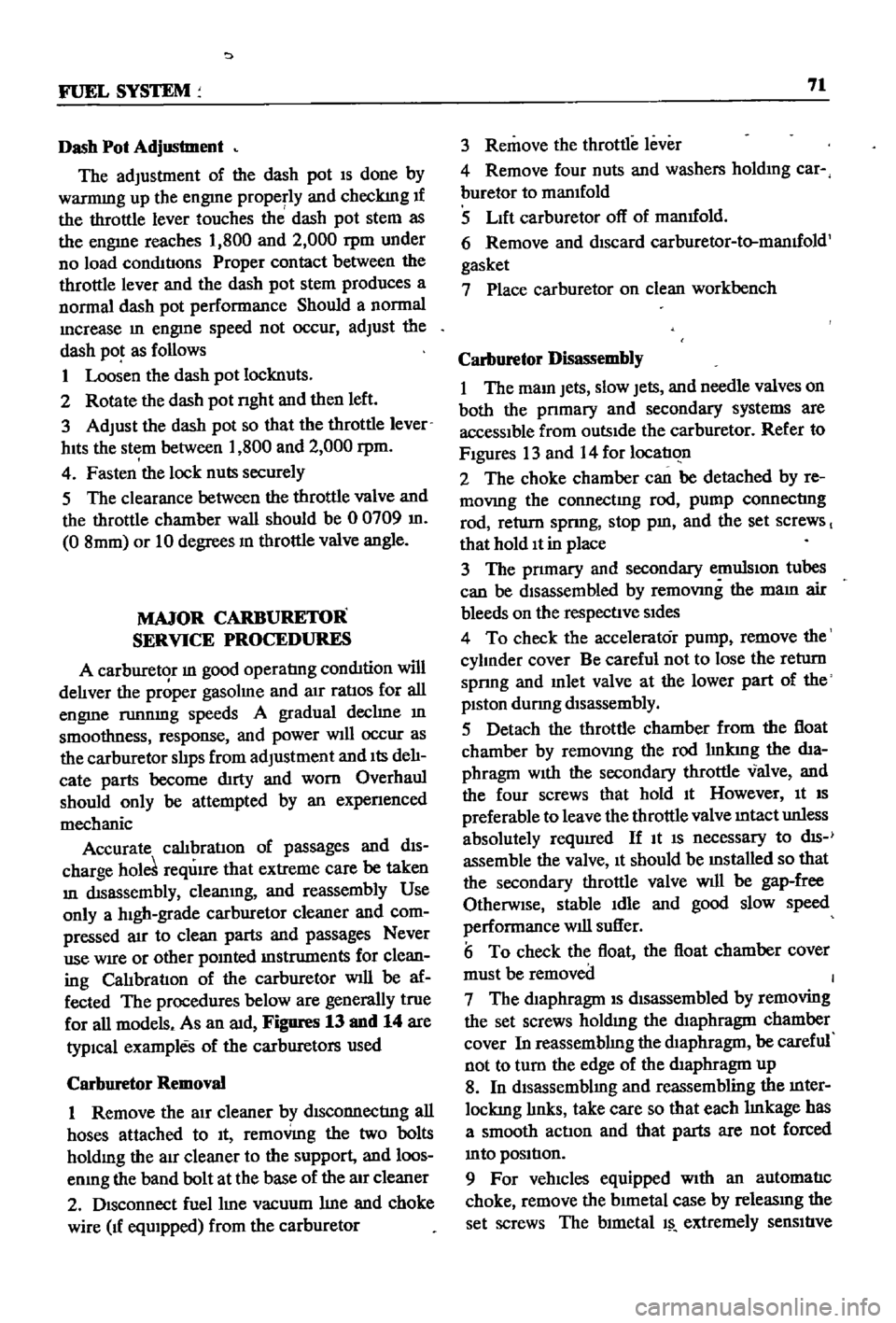
Figures
13
and
14
are
typIcal
examples
of
the
carburetors
used
Carburetor
Removal
1
Remove
the
au
cleaner
by
dIsconnectIng
all
hoses
attached
to
It
remoVmg
the
two
bolts
holdmg
the
aIr
cleaner
to
the
support
and
loos
enmg
the
band
bolt
at
the
base
of
the
aIr
cleaner
2
DIsconnect
fuellme
vacuum
Ime
and
choke
wire
u
eqUIpped
from
the
carburetor
3
Remove
the
throttle
lever
4
Remove
four
nuts
and
washers
holdmg
car
buretor
to
manIfold
5
Lift
carburetor
off
of
manuold
6
Remove
and
dIscard
carburetor
to
manuold
gasket
7
Place
carburetor
on
clean
workbench
Carburetor
Disassembly
1
The
maIn
Jets
slow
Jets
and
needle
valves
on
both
the
pnmary
and
secondary
systenIS
are
accessIble
from
outsIde
the
carburetor
Refer
to
FIgures
13
and
14
for
locatI
n
2
The
choke
chamber
can
be
detached
by
re
mOVIng
the
connectIng
rod
pump
connectIng
rod
return
sprmg
stop
pm
and
the
set
screws
I
that
hold
It
in
place
3
The
pnmary
and
secondary
emulSIon
tubes
can
be
disassembled
by
remOVIng
the
mam
air
bleeds
on
the
respectIve
SIdes
4
To
check
the
accelerator
pump
remove
the
cylInder
cover
Be
careful
not
to
lose
the
return
spnng
and
Inlet
valve
at
the
lower
part
of
the
pIston
durmg
dIsassembly
5
Detach
the
throttle
chamber
from
the
float
chamber
by
remOVIng
the
rod
lInkIng
the
dia
phragm
WIth
the
secondary
throttle
valve
and
the
four
screws
that
hold
It
However
It
IS
preferable
to
leave
the
throttle
valve
mtact
unless
absolutely
reqUired
If
It
IS
necessary
to
dlS
assemble
the
valve
It
should
be
Installed
so
that
the
secondary
throttle
valve
will
be
gap
free
OtherwIse
stable
Idle
and
good
slow
speed
performance
will
suffer
is
To
check
the
float
the
float
chamber
cover
must
be
removed
I
7
The
dIaphragm
IS
dIsassembled
by
removing
the
set
screws
holdmg
the
dIaphragm
chamber
cover
In
reassemblIng
the
diaphragm
be
careful
not
to
turn
the
edge
of
the
dIaphragm
up
8
In
dlsassemblmg
and
reassembling
the
mter
lockIng
lInks
take
care
so
that
each
lInkage
has
a
smooth
actIon
and
that
parts
are
not
forced
mto
pOSItIon
9
For
vehIcles
equipped
With
an
automatIc
choke
remove
the
brmetal
case
by
releasmg
the
set
screws
The
bimetal
1l
extremely
senSItIve
Page 81 of 252
76
CHAPTER
SEVEN
Carburetor
Assembly
Assembly
is
the
reverse
of
dISassembly
Make
certam
all
gaskets
are
mounted
flat
Be
careful
not
to
use
force
In
assembly
Make
certam
that
all
Interlock
lInks
operate
smoothly
FUEL
TANK
Description
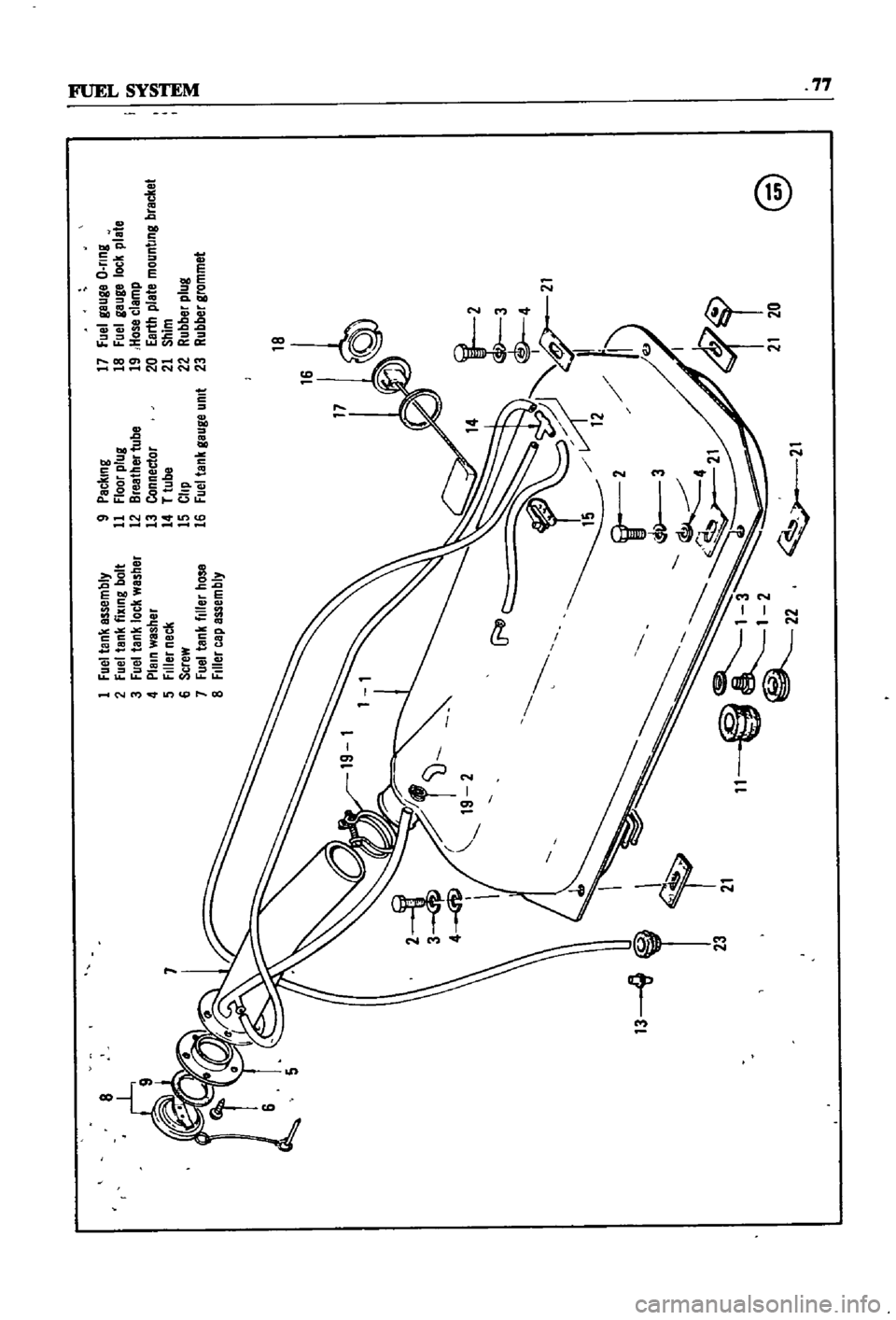
FIgures
15
16
17
and
18
are
exploded
views
of
the
fuel
tanks
used
on
the
sedan
and
wagons
Figure
15
IS
for
sedans
through
model
year
1969
Figure
16
applIes
to
sedans
from
1970
With
evaporative
control
system
F
q
nre
17
shows
the
statIon
wagon
through
1969
Figure
18
applIes
to
the
statIon
wagon
WIth
evaporative
control
system
f
m
1970
The
fuel
tank
for
the
pIck
up
is
shown
m
Figure
19
A
fuel
return
system
from
the
carburetor
to
the
fuel
tank
keeps
fuel
from
becommg
over
heated
m
the
carburetor
float
chamber
When
the
normal
level
m
the
float
chamber
IS
exceeded
a
pressure
valve
opens
and
returns
the
excess
fuel
to
the
tank
Removal
Sedans
1
Remove
drain
plug
m
bottom
of
fuel
tank
and
drain
the
fuel
into
a
suitable
safe
contamer
2
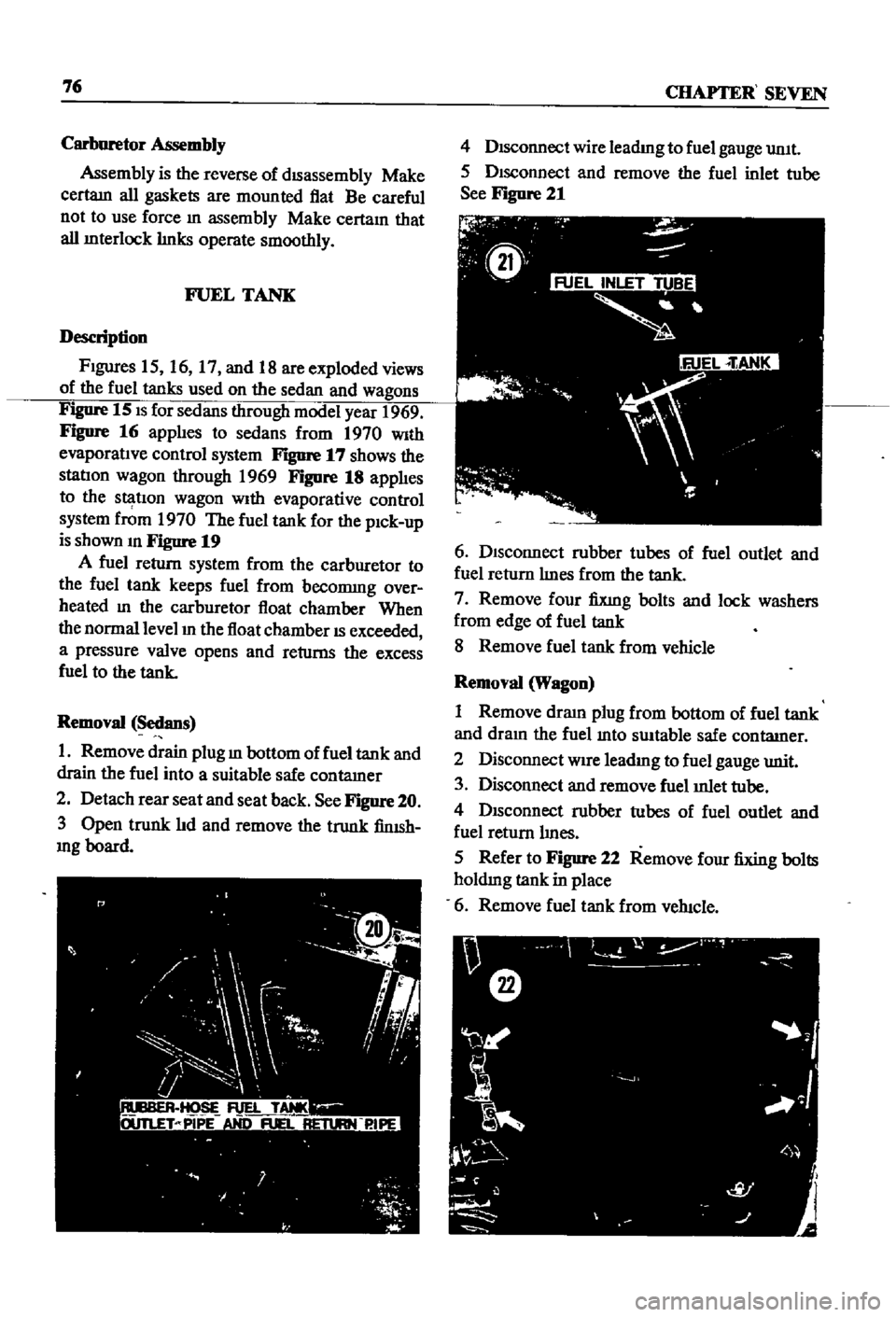
Detach
rear
seat
and
seat
back
See
Figure
20
3
Open
trunk
lId
and
remove
the
trunk
finISh
mg
board
4
DIsconnect
wire
leadmg
to
fuel
gauge
umt
5
DIsconnect
and
remove
the
fuel
inlet
tube
See
Figure
21
6
DIsconnect
rubber
tubes
of
fuel
outlet
and
fuel
return
lInes
from
the
tank
7
Remove
four
fixmg
bolts
and
lock
washers
from
edge
of
fuel
tank
8
Remove
fuel
tank
from
vehicle
Removal
Wagon
1
Remove
draIn
plug
from
bottom
of
fuel
tank
and
dram
the
fuel
mto
swtable
safe
contatner
2
Disconnect
WIre
leadIng
to
fuel
gauge
unit
3
Disconnect
and
remove
fuel
mlet
tube
4
DISconnect
rubber
tubes
of
fuel
outlet
and
fuel
return
lInes
5
Refer
to
Figure
22
Remove
four
fixing
bolts
holdmg
tank
in
place
6
Remove
fuel
tank
from
veh1c1e
Page 82 of 252
8
1
Fuel
tank
Bssembly
2
Fue
tank
fixing
bolt
3
Fuel
tank
lock
washBr
4
Plain
washer
5
Filler
neck
6
Screw
7
Fuel
tank
filler
hOS8
8
Filler
cap
Bssembly
9
Packing
11
Floor
plug
12
BrBather
tube
13
Connector
14
T
tube
15
Clip
16
Fuel
tank
gauge
umt
17
Fuel
gaUgB
O
nng
18
Fuel
gauge
lock
plate
19
Hose
clamp
20
Earth
plate
mounting
bracket
21
Shim
22
Rubber
plug
23
Rubber
grommB
7
13
Id
@
t
I
l
I
1
Page 88 of 252
23
29
30
i
@
24
t
I
1
Accelerator
pedal
ann
I
assembly
2
Accelerator
pedal
brecket
3
Packing
4
Snap
ling
5
Washer
17
ll
O
II
C
I
6
foot
rest
7
Screw
8
Bolt
9
Accelerator
pedel
stopper
bolt
10
Nut
11
Bell
crank
assembly
12
Bell
crank
bracket
20
L
13
Machme
screw
14
Screw
mechme
15
Lock
washer
12
From
Oct
ber
1969
I
16
Nylon
bushmg
1314
17
Snap
ling
If
3
0
18
Ball
Jomt
assembly
19
Ball
Jomt
assembly
15
20
Lock
nut
21
Accelerator
rod
boot
22
Balllomt
assembly
23
TorSIon
shaft
24
Accelerator
shaft
spring
25
PlaIR
washer
9
26
Colter
pm
do
27
Return
spllng
28
Accelerator
shalt
support
assembly
29
Bolt
II
30
Bolt
31
SPlIng
washer
32
Choke
control
wire
6
33
Choke
wile
knob
10
8
36
Rubber
grommet
7
I
I
er
Page 89 of 252
CHAPTER
EIGHT
COOLING
SYSTEM
The
coolIng
system
IS
of
the
closed
pressure
type
Coolant
flows
through
passages
In
the
cyl
mder
head
and
block
and
is
cooled
by
the
radIator
water
pump
and
thermostat
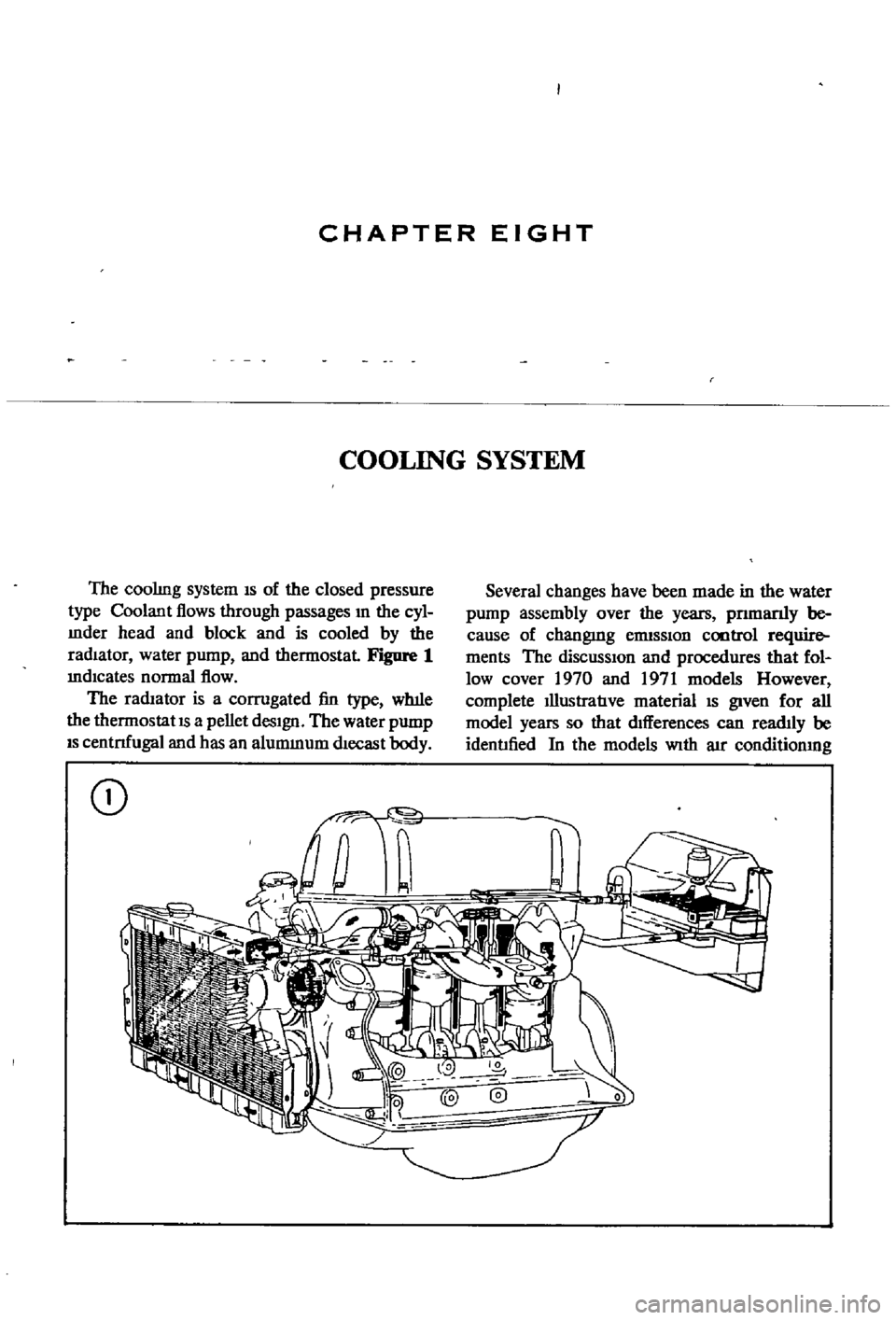
Figure
1
mdlcates
normal
flow
The
radIator
is
a
corrugated
fin
type
wh1le
the
thermostat
IS
a
pellet
desIgn
The
water
pump
IS
centnfugal
and
has
an
alummum
dlecast
body
CD
Several
changes
have
been
made
in
the
water
pump
assembly
over
the
years
pnmanly
be
cause
of
changmg
ennSSlon
cootrol
require
ments
The
diSCUSSIOn
and
procedures
that
fol
low
cover
1970
and
1971
models
However
complete
IllustratIve
material
IS
given
for
all
model
years
so
that
dIfferences
can
readIly
be
identIfied
In
the
models
With
aIr
conditionmg
Page 90 of 252
COOLING
SYSTEM
8S
and
In
those
with
exhaust
and
evaporatIve
emIS
sion
control
devIces
a
fan
clutch
IS
combIned
WIth
the
thermostat
to
detect
temperature
m
the
engme
compartlnent
When
the
temperature
nses
the
thermostat
detects
the
change
an
the
fan
clutch
engages
thereby
helpmg
to
cool
the
engme
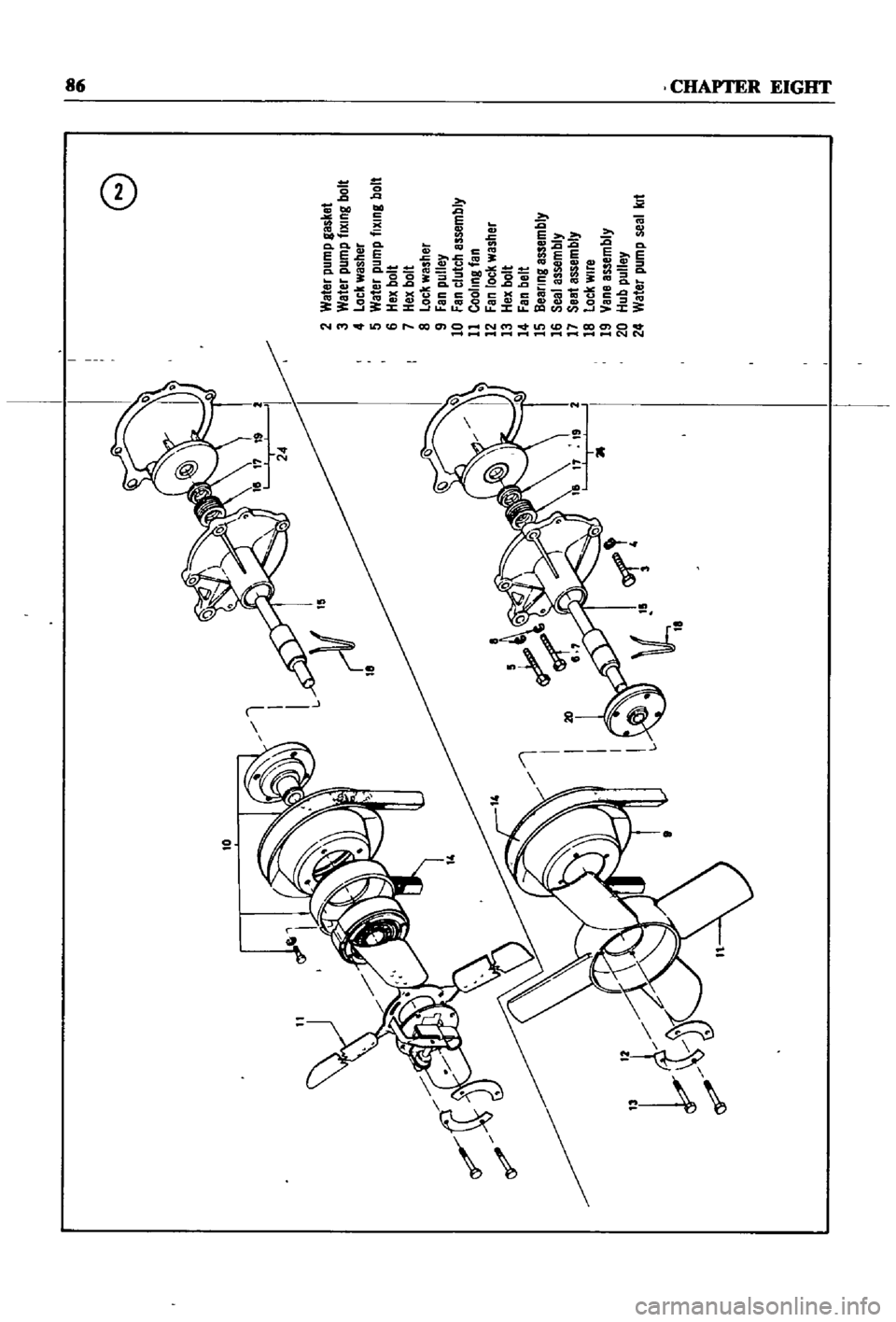
WATER
PUMP
Figure
2
page
86
IS
an
exploded
drawmg
of
the
water
pump
and
fan
assembly
for
1970
to
1971
The
top
half
of
the
IllustratIon
applIes
to
those
models
WIth
exhaust
and
evaporatIve
emiSSIOn
control
systems
The
bottom
half
covers
models
WIth
a
crankcase
emiSSIon
control
deVIce
only
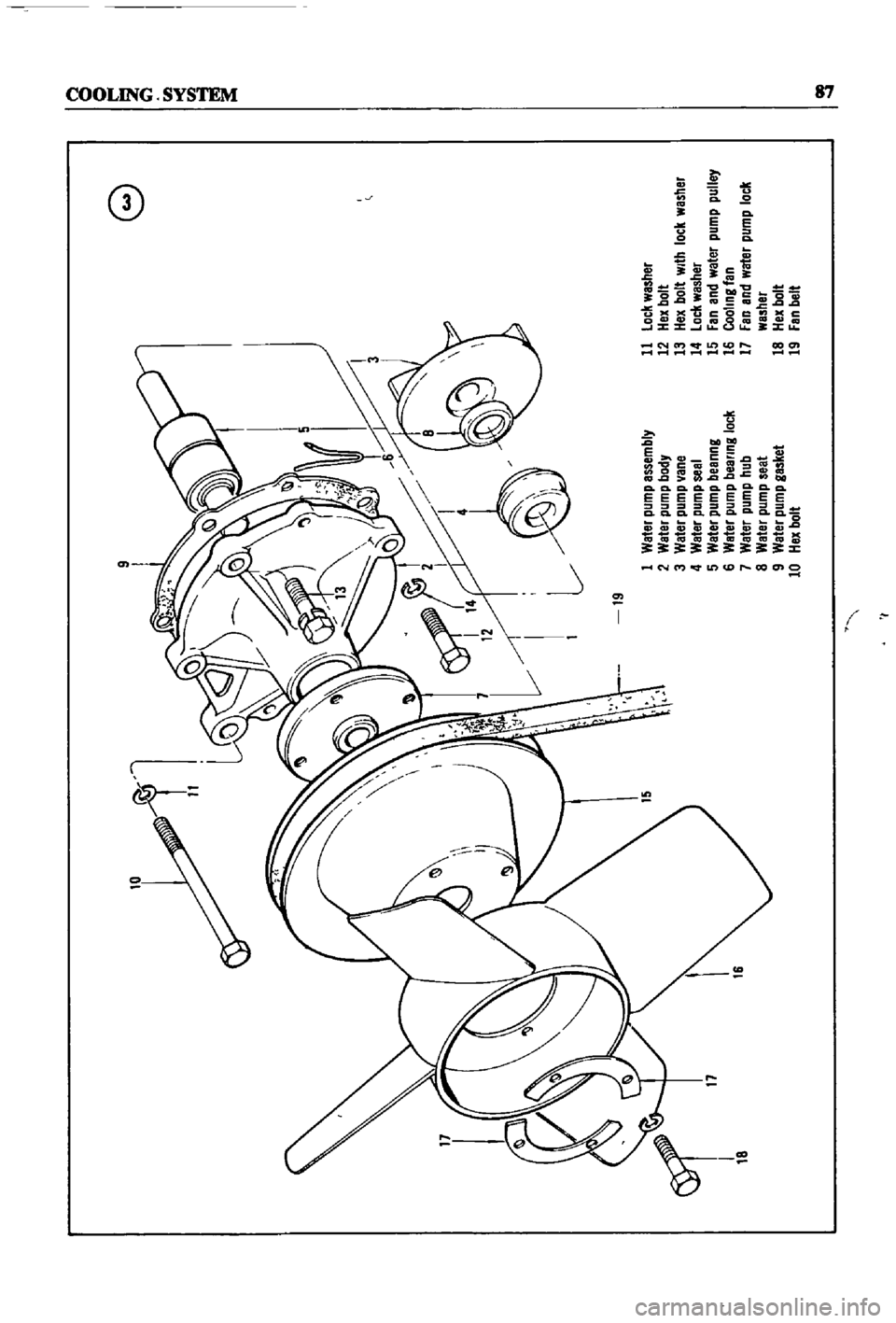
Figure
3
page
87
IS
an
exploded
drawmg
of
the
water
pump
and
fan
assembly
for
1968
models
Without
exhaust
or
evaporatIve
controls
Figure
4
page
88
shows
the
1968
model
With
emISSIon
control
deVIce
As
can
be
seen
from
the
illustratIons
most
dIfferences
eXISt
withIn
the
fan
clutch
assembly
Water
Pump
Removal
1
Remove
upper
and
lower
radIator
hoses
from
the
thermostat
housmg
and
cylmder
block
re
spectIvely
Dram
coolant
from
rad1ator
and
cylInder
block
2
Loosen
the
alternator
mountlng
bolt
and
the
adjustIng
bolt
on
the
alternator
mountIng
bracket
3
Move
the
alternator
toward
the
cylinder
block
untIl
slack
IS
eVIdent
10
the
fan
belt
Re
move
fa
belt
fro
alternator
water
pump
and
crankshaft
pulley
4
It
IS
difficult
to
remove
the
water
pump
from
the
front
housmg
With
the
radiator
and
top
shroud
10
place
so
remove
them
5
Remove
the
bolts
holdmg
the
fan
assembly
to
the
water
pump
and
remove
the
fan
assembly
6
Remove
the
bolts
holdmg
the
water
pump
to
the
front
housmg
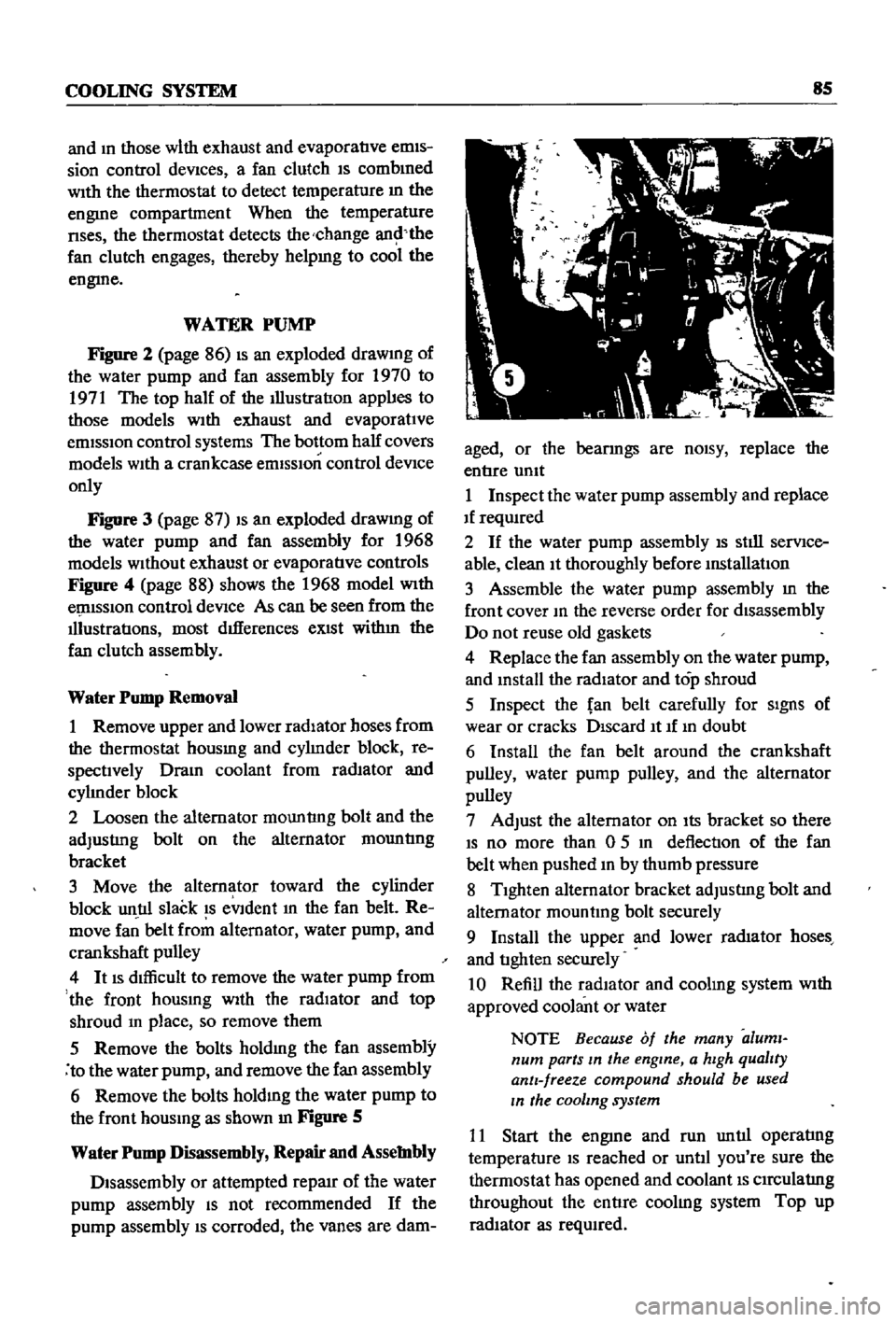
as
shown
In
Figure
S
Water
Pump
Disassembly
Repair
and
Assembly
Disassembly
or
attempted
repaIr
of
the
water
pump
assembly
IS
not
recommended
If
the
pump
assembly
IS
corroded
the
vanes
are
dam
aged
or
the
bearmgs
are
nOISY
replace
the
entIre
umt
1
Inspect
the
water
pump
assembly
and
replace
If
reqUIred
2
If
the
water
pump
assembly
IS
stIll
serVIce
able
clean
It
thoroughly
before
mstallatIon
3
Assemble
the
water
pump
assembly
m
the
front
cover
10
the
reverse
order
for
disassembly
Do
not
reuse
old
gaskets
4
Replace
the
fan
assembly
on
the
water
pump
and
mstall
the
radiator
and
top
shroud
5
Inspect
the
fan
belt
carefully
for
SIgnS
of
wear
or
cracks
DIscard
It
If
10
doubt
6
Install
the
fan
belt
around
the
crankshaft
pulley
water
pump
pulley
and
the
alternator
pulley
7
Adjust
the
alternator
on
Its
bracket
so
there
IS
no
more
than
0
5
10
deflection
of
the
fan
belt
when
pushed
10
by
thumb
pressure
8
TIghten
alternator
bracket
adjustIng
bolt
and
alternator
mountmg
bolt
securely
9
Install
the
upper
and
lower
rad1ator
hoses
and
tIghten
securely
10
Refill
the
radIator
and
coolmg
system
With
approved
coolant
or
water
NOTE
Because
of
the
many
aluml
num
parts
In
the
engine
a
hIgh
qualIty
antI
freeze
compound
should
be
used
In
the
cooling
system
11
Start
the
engme
and
run
untIl
operatIng
temperature
IS
reached
or
untIl
you
re
sure
the
thermostat
has
opened
and
coolant
IS
CIrCulatIng
throughout
the
entIre
coolIng
system
Top
up
radIator
as
reqUIred
Page 91 of 252
10
f
e
2
Weter
pump
gasket
3
Water
pump
tlXlng
bolt
4
Lock
washer
5
Water
pump
tlXlng
bolt
6
Hex
bolt
7
Hex
bolt
8
Lock
washer
9
Fan
pulley
10
Fan
clutch
assembly
11
Cooling
tan
12
Fan
lock
washer
13
Hex
bolt
14
Fan
belt
15
Dealing
assembly
16
Seal
assembly
17
Seatassembly
18
Lock
wire
19
Vane
assembly
20
Hub
pulley
24
Water
pump
seal
kit
Illl
t
l
Page 92 of 252
10
9
8
n
o
o
19
1
Water
pump
assembly
11
lock
washer
2
Water
pump
body
12
Hex
bolt
3
Water
pump
ane
13
Hex
bolt
With
lock
washer
4
Water
pump
seal
14
loc
l
washer
17
6
5
Water
pump
beanng
15
Fan
and
water
pump
pulley
6
Water
pump
bee
ring
lock
16
Cooling
tan
7
Water
pump
hub
17
Fan
and
water
pump
lock
8
Water
pump
seat
washer
9
Water
pump
gasket
18
Hex
bolt
10
Hex
bolt
19
Fen
belt
I
I