lock DATSUN B110 1973 Service Repair Manual
[x] Cancel search | Manufacturer: DATSUN, Model Year: 1973, Model line: B110, Model: DATSUN B110 1973Pages: 513, PDF Size: 28.74 MB
Page 468 of 513
ENGINE
REMOVAL
INSTAllATION
5
Disconnecting
clutch
wire
on
right
hand
drive
model
On
left
hand
drive
model
disconnect
hydraulic
line
from
the
clutch
slave
cylinder
Disconnect
the
clutch
wire
at
the
portion
of
the
withdrawal
lever
See
the
section
covering
the
clutch
6
Remove
the
exhaust
front
tube
ij
f
I
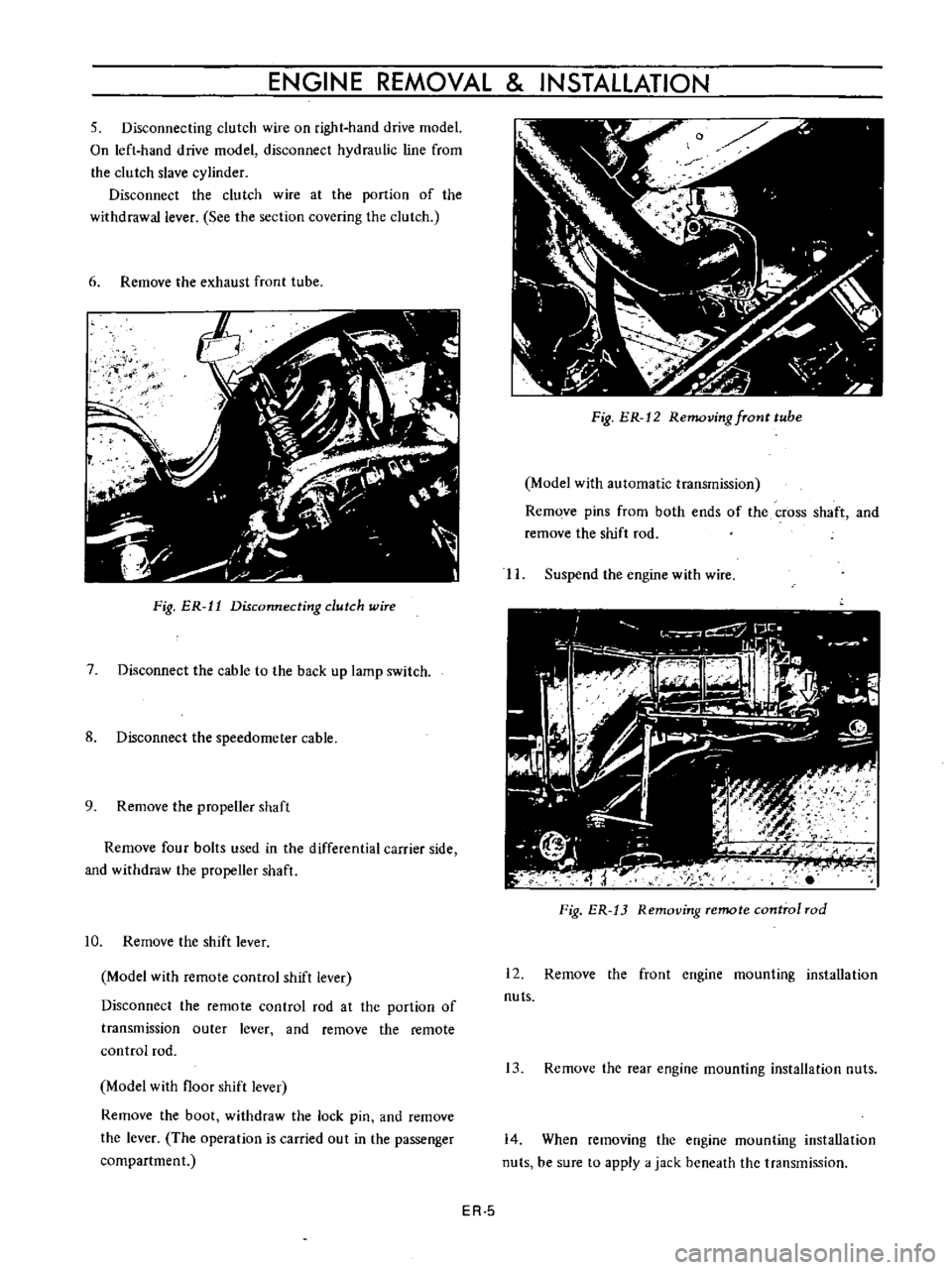
Fig
ER
11
Disconnecting
dutch
wire
7
Disconnect
the
cable
to
the
back
up
lamp
switch
8
Disconnect
the
speedometer
cable
9
Remove
the
propeller
shaft
Remove
four
bolts
used
in
the
differential
carrier
side
and
withdraw
the
propeller
shaft
10
Remove
the
shift
lever
Model
with
remote
control
shift
lever
Disconnect
the
remote
control
rod
at
the
portion
of
transmission
outer
lever
and
remove
the
remote
control
rod
Model
with
floor
shift
lever
Remove
the
boot
withdraw
the
lock
pin
and
remove
the
lever
The
operation
is
carried
out
in
the
passenger
compartment
Fig
ER
12
Removing
fTont
tube
Model
with
automatic
transmission
Remove
pins
from
both
ends
of
the
cross
shaft
and
remove
the
shift
rod
II
Suspend
the
engine
with
wire
Fig
ER
13
Removing
remote
control
rod
12
Remove
the
front
engine
mounting
installation
nuts
13
Remove
the
rear
engine
mounting
installation
nuts
14
When
removing
the
engine
mounting
installation
nuts
be
sure
to
apply
a
jack
beneath
the
transmission
ER
5
Page 476 of 513
CHASSIS
fulcrum
type
The
mechanical
type
clutch
control
system
consists
of
pendent
clutch
pedal
clutch
control
cable
and
with
drawallever
The
withdrawal
lever
is
of
an
outer
fulcrum
type
which
provides
a
great
lever
ratio
and
thus
force
required
in
depressing
clutch
pedal
is
reduced
CLUTCH
PEDAL
Hydraulic
clutch
Removal
Remove
the
return
spring
2
Loosen
the
lock
nut
of
the
master
cylinder
push
rod
and
disconnect
the
push
rod
end
3
Remove
the
lock
nut
and
washer
of
the
pedal
shaft
and
remove
the
pedal
lever
Inspection
Thoroughly
clean
all
disassembled
parts
indicated
below
and
carefully
check
them
for
wear
damage
and
other
abnormal
conditions
Repair
or
replace
them
with
new
ones
if
required
f
fS
C5
J
dJ
YII
10
1
@
c
i
@
j
1
4
K
Clutch
pedal
free
trrlel
30
mm
1
181
nl
00
@
P
IO
Pedal
head
rubber
2
Return
spring
3
Pedal
lever
bush
4
Fulcrum
pedal
pin
etc
Reinstallation
Reinstall
the
clutch
pedal
in
reverse
sequence
of
removal
Adjustment
I
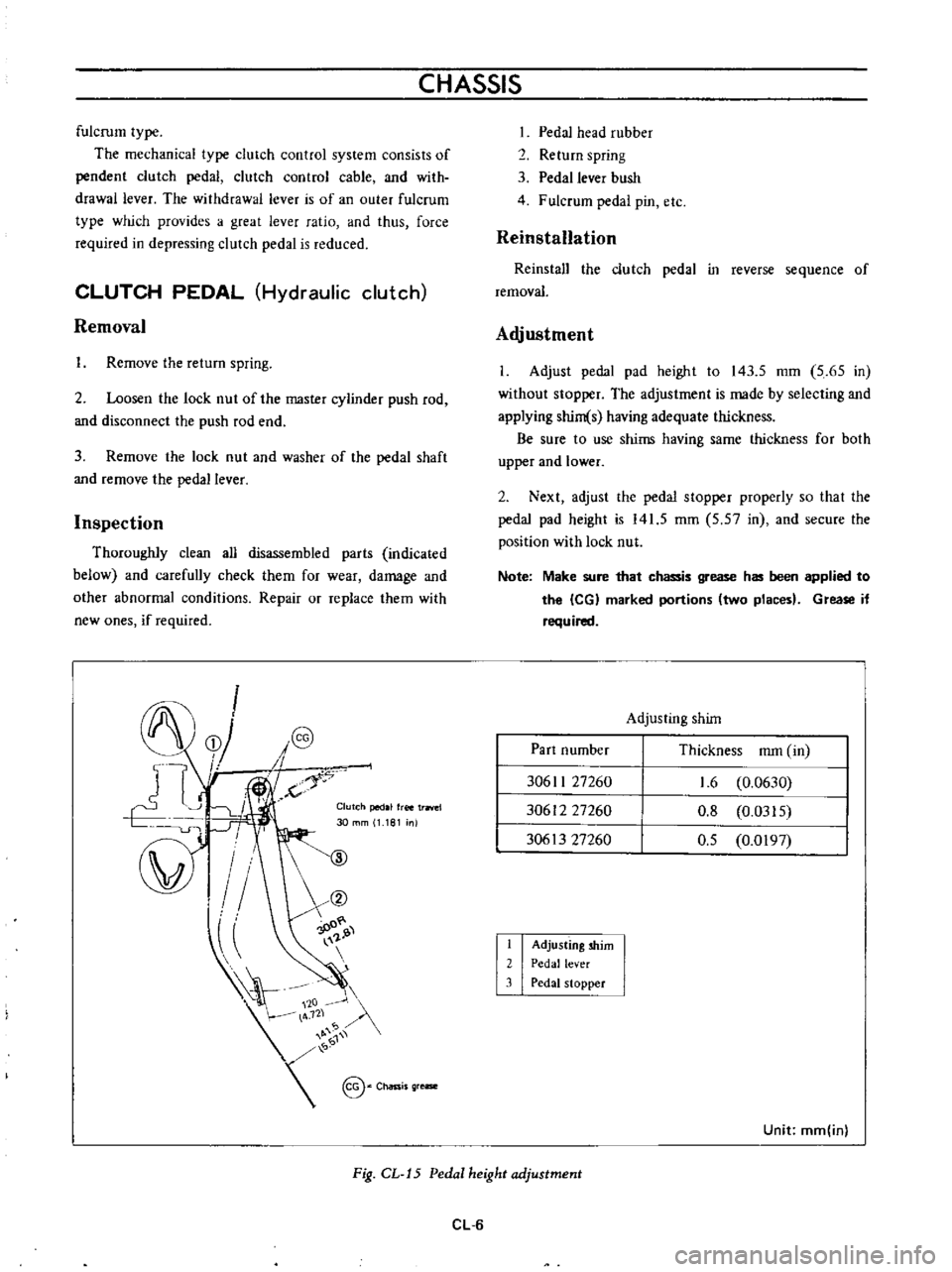
Adjust
pedal
pad
height
to
143
5
mm
5
65
in
without
stopper
The
adjustment
is
made
by
selecting
and
applying
shim
s
having
adequate
thickness
Be
sure
to
use
shims
having
same
thickness
for
both
upper
and
lower
2
Next
adjust
the
pedal
stopper
properly
so
that
the
pedal
pad
height
is
141
5
mm
5
57
in
and
secure
the
position
with
lock
nut
Note
Make
sure
that
chassis
grease
has
been
applied
to
the
leG
marked
portions
two
places
Grease
if
required
Adjusting
shim
Part
number
Thickness
mm
in
30611
27260
30612
27260
30613
27260
1
6
0
0630
0
8
0
0315
0
5
0
0197
I
2
3
Adjusting
shim
Pedal
lever
Pedal
stopper
Unit
mm
inl
Fig
CL
J5
Pedal
height
adjustment
CL
6
Page 477 of 513
CLUTCH
CLUTCH
PEDAL
AND
CLUTCH
CONTROL
CABLE
Mechanical
clutch
Removal
Loosen
the
control
cable
adjusting
nut
and
discon
nect
the
control
cable
from
the
withdrawal
lever
III
Adjusting
nut
2
I
Lock
nut
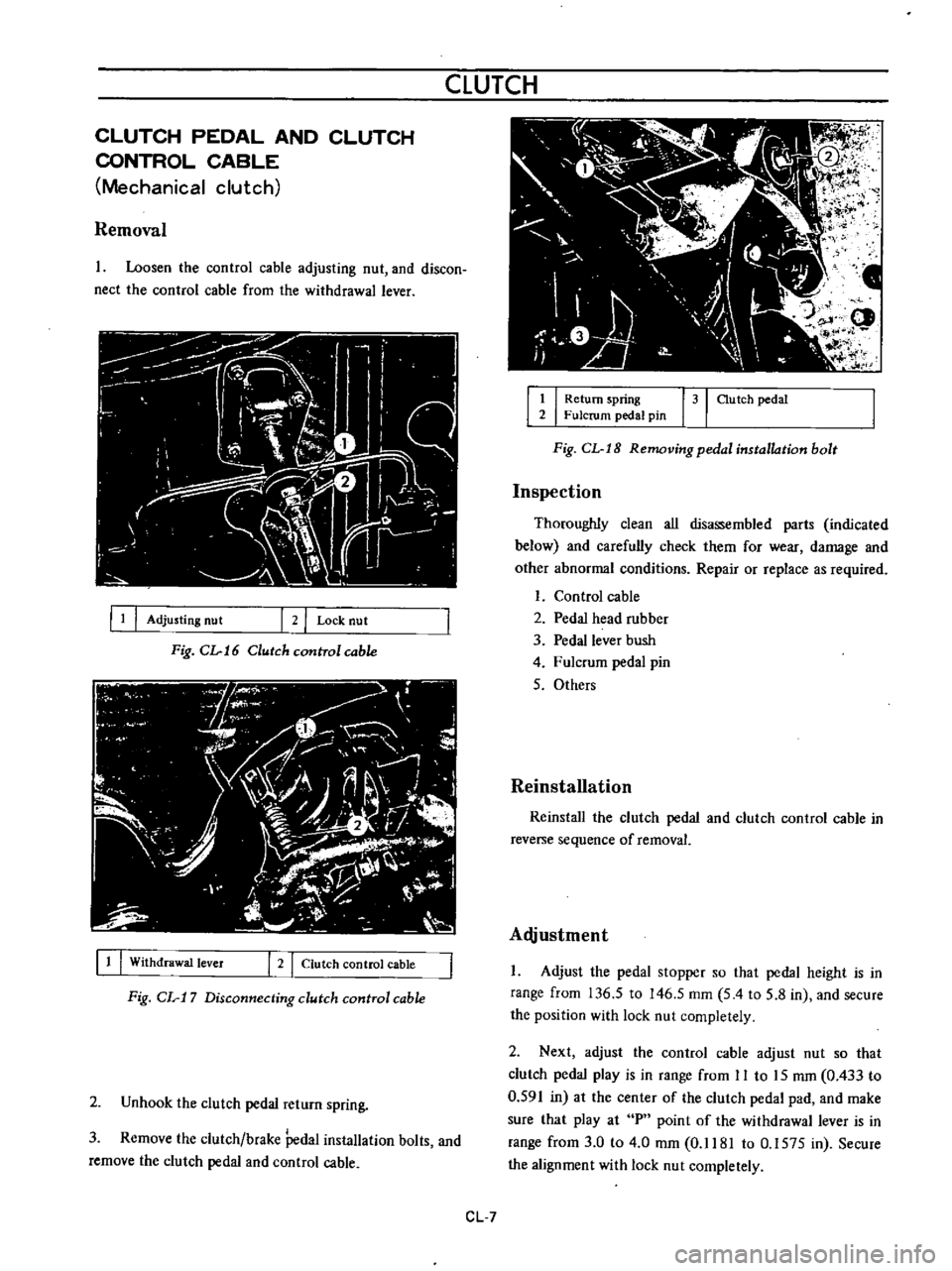
Fig
CL
16
Clutch
cunITol
cable
11
I
Withdrawal
lever
I
2
I
Clutch
control
cable
Fig
CL
17
Disconnecting
clutch
control
cable
2
Unhook
the
clutch
pedal
return
spring
3
Remove
the
clutch
brake
Pedal
installation
bolts
and
remove
the
clutch
pedal
and
control
cable
1
I
Return
spring
31
au
tch
pedal
2
Fulcrum
pedal
pin
Fig
CL
I8
Removing
pedal
installation
bolt
Inspection
Thoroughly
clean
all
disassembled
parts
indicated
below
and
carefully
check
them
for
wear
damage
and
other
abnormal
conditions
Repair
or
replace
as
required
Control
cable
2
Pedal
head
rubber
3
Pedal
lever
bush
4
Fulcrum
pedal
pin
5
Others
Reinstallation
Reinstall
the
clutch
pedal
and
clutch
control
cable
in
reverse
sequence
of
removal
Alljustment
Adjust
the
pedal
stopper
so
that
pedal
height
is
in
range
from
136
5
to
146
5
mm
5
4
to
5
8
in
and
secure
the
position
with
lock
nut
completely
2
Next
adjust
the
control
cable
adjust
nut
so
that
clutch
pedal
play
is
in
range
from
II
to
15
mm
0
433
to
0
591
in
at
the
center
of
the
clutch
pedal
pad
and
make
sure
that
play
at
P
point
of
the
withdrawal
lever
is
in
range
from
3
0
to
4
0
mm
0
1181
to
0
1575
in
Secure
the
alignment
with
lock
nut
completely
CL
7
Page 478 of 513
CHASSIS
i
I
I
I
II
I
I
J
u
IlllrP
Zll
I
ff
Pedal
play
11
to
15
I
0
433
to
0
591
I
W
p
da
stfO
l
e
1
P
point
end
play
l
e
A
1
C
3
0
to
A
O
Chassis
grease
20
0
1181
to
0
1575
I
Y
136
5
to
lA6
5
I
5
A
to
5
81
0
Note
Connect
the
control
cable
correctly
so
that
mark
cap
is
faced
upward
as
shown
in
the
following
figure
Make
sure
that
chassis
grease
has
been
I
2
3
Lock
nu
t
Adjusting
nut
Pedal
stopper
applied
to
the
CG
marked
positions
three
places
Apply
grease
if
required
@
300R
t2
8J
Unit
mm
in
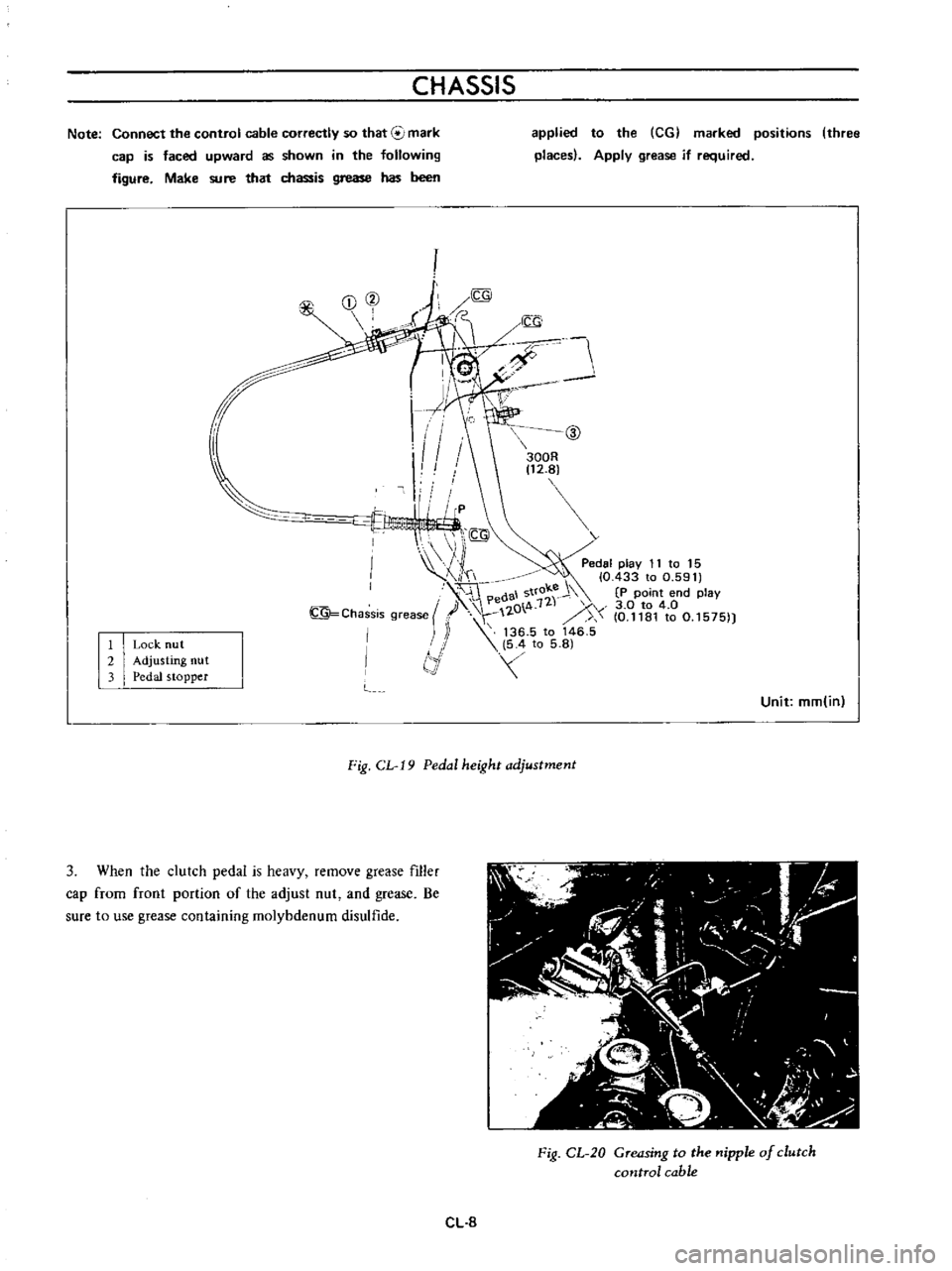
Fig
CL
19
Pedal
height
adjustment
3
When
the
clutch
pedal
is
heavy
remove
grease
filler
cap
from
front
portion
of
the
adjust
nut
and
grease
Be
sure
to
use
grease
containing
molybdenum
disulfide
Fig
CL
20
Greasing
to
the
nipple
of
clutch
control
cable
CL
8
Page 480 of 513
CHASSIS
2
Apply
brake
fluid
sufficiently
to
the
cylinder
and
piston
and
assemble
them
Reinstallation
Reinstall
the
master
cylinder
assembly
in
reverse
sequence
of
removal
and
adjust
as
follows
I
Adjust
the
pedal
height
by
changing
the
push
rod
length
2
B
eed
air
out
of
the
hydraulic
system
OPERATING
CYLINDER
Hydraulic
clutch
Removal
Remove
the
return
spring
2
Disconnect
the
clutch
line
from
the
operating
cyl
inder
3
Disconnect
the
push
rod
from
the
withdrawal
lever
4
Release
two
bolts
used
to
mount
the
operating
cylinder
to
the
clutch
housing
Disassembly
1
Remove
the
dust
cover
2
Remove
the
snap
ring
and
all
other
parts
can
be
disassembled
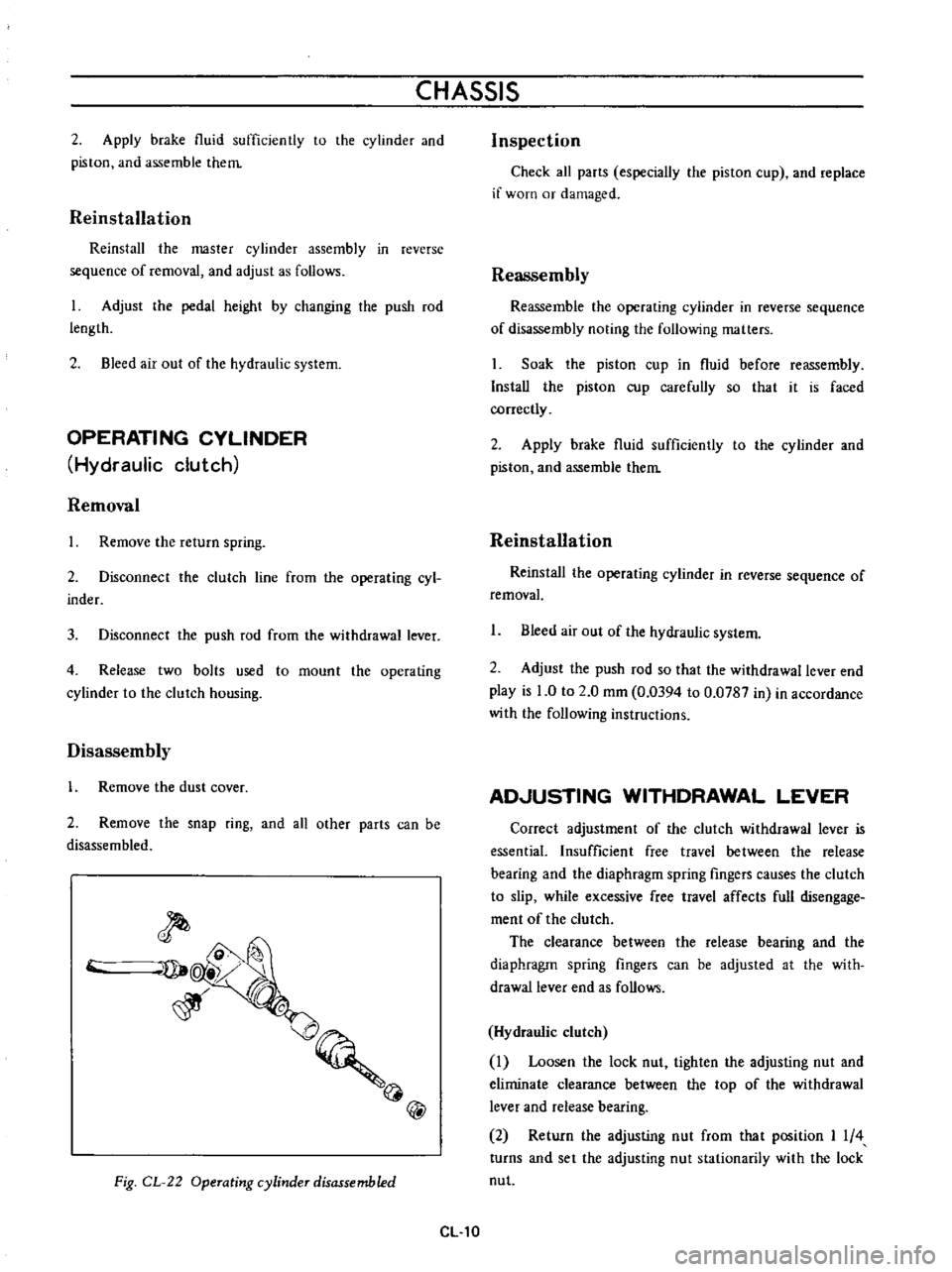
@
Fig
CL
22
Operating
cylinder
disassembled
CL
10
Inspection
Check
all
parts
especially
the
piston
cup
and
replace
if
worn
or
damaged
Reassembly
Reassemble
the
operating
cylinder
in
reverse
sequence
of
disassembly
noting
the
following
matters
Soak
the
piston
cup
in
fluid
before
reassembly
Install
the
piston
cup
carefully
so
that
it
is
faced
correctly
2
Apply
brake
fluid
sufficiently
to
the
cylinder
and
piston
and
assemble
them
Reinstallation
Reinstal
the
operating
cylinder
in
reverse
sequence
of
removal
1
Bleed
air
out
of
the
hydraulic
system
2
Adjust
the
push
rod
so
that
the
withdrawal
lever
end
play
is
0
to
2
0
mm
0
0394
to
0
0787
in
in
accordance
with
the
following
instructions
AD
USTING
WITHDRAWAL
LEVER
Correct
adjustment
of
the
clutch
withdrawal
lever
is
essential
Insufficient
free
travel
between
the
release
bearing
and
the
diaphragm
spring
fingers
causes
the
clutch
to
slip
while
excessive
free
travel
affects
full
disengage
ment
of
the
clutch
The
clearance
between
the
release
bearing
and
the
diaphragm
spring
fingers
can
be
adjusted
at
the
with
drawallever
end
as
follows
Hydraulic
clutch
Loosen
the
lock
nut
tighten
the
adjusting
nut
and
eliminate
clearance
between
the
top
of
the
withdrawal
lever
and
release
bearing
2
Return
the
adjusting
nut
from
that
position
I
4
turns
and
set
the
adjusting
nut
stationarily
with
the
lock
nut
Page 481 of 513
CLUTCH
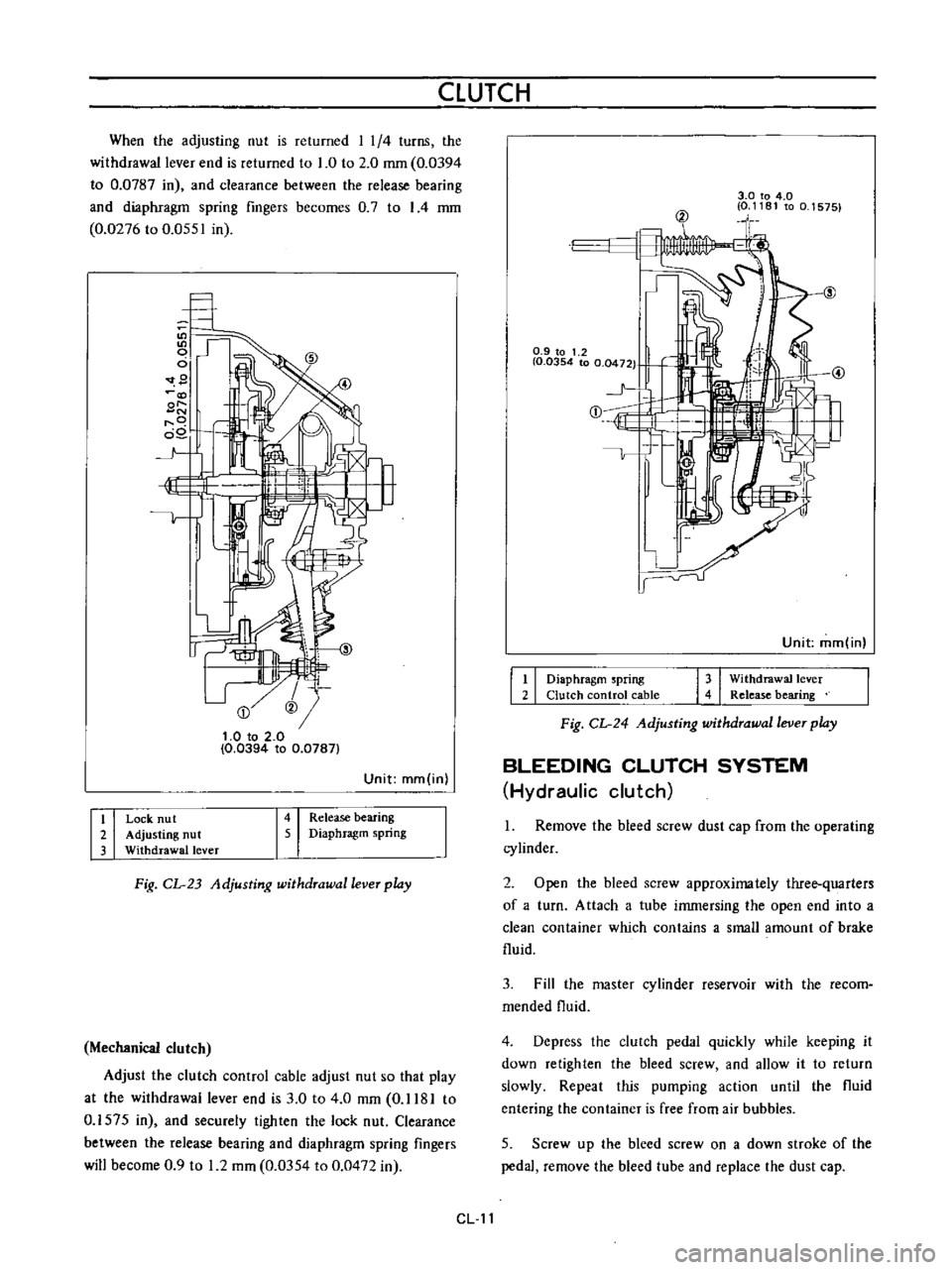
When
the
adjusting
nut
is
returned
I
1
4
turns
the
withdrawal
lever
end
is
returned
to
1
0
to
2
0
mm
0
0394
to
0
0787
in
and
clearance
between
the
release
bearing
and
diaphragm
spring
fingers
becomes
0
7
to
I
4
mm
0
0276
to
0
0551
in
9
@
t
O
to
2
0
0
0394
to
0
0787
Unit
mm
in
I
i
I
I
I
Release
bearing
Diaphragm
spring
Lock
nu
t
Adjusting
nut
Withdrawal
lever
Fig
CL
23
Adjusting
withdrawal
lever
play
Mechanical
clutch
Adjust
the
clutch
control
cable
adjust
nut
so
that
play
at
the
withdrawal
lever
end
is
3
0
to
4
0
mm
0
1181
to
0
1575
in
and
securely
tighten
the
lock
nut
Clearance
between
the
release
bearing
and
diaphragm
spring
fingers
will
become
0
9
to
1
2
mm
0
0354
to
0
0472
in
3
0
to
4
0
0
1181
to
0
1575
@
0
9
to
1
2
I
0
0354
to
0
0472
1
j
E
1
Unit
mm
in
I
I
I
I
Diaphragm
spring
Clutch
control
cable
Withdrawal
lever
Release
bearing
Fig
CL
24
Adjusting
withdrawal
lever
play
BLEEDING
CLUTCH
SYSTEM
Hydraulic
clutch
1
Remove
the
bleed
screw
dust
cap
from
the
operating
cylinder
2
Open
the
bleed
screw
approximately
three
quarters
of
a
turn
Attach
a
tube
immersing
the
open
end
into
a
clean
container
which
contains
a
small
amount
of
brake
fluid
3
Fill
the
master
cylinder
reservoir
with
the
recom
mended
fluid
4
Depress
the
clutch
pedal
quickly
while
keeping
it
down
retighten
the
bleed
screw
and
allow
it
to
return
slowly
Repeat
this
pumping
action
until
the
fluid
entering
the
container
is
free
from
air
bubbles
5
Screw
up
the
bleed
screw
on
a
down
stroke
of
the
pedal
remove
the
bleed
tube
and
replace
the
dust
cap
CL
11
Page 491 of 513
CHASSIS
To
prevent
the
oil
pan
from
damaging
insert
a
wooden
block
between
the
pan
and
jack
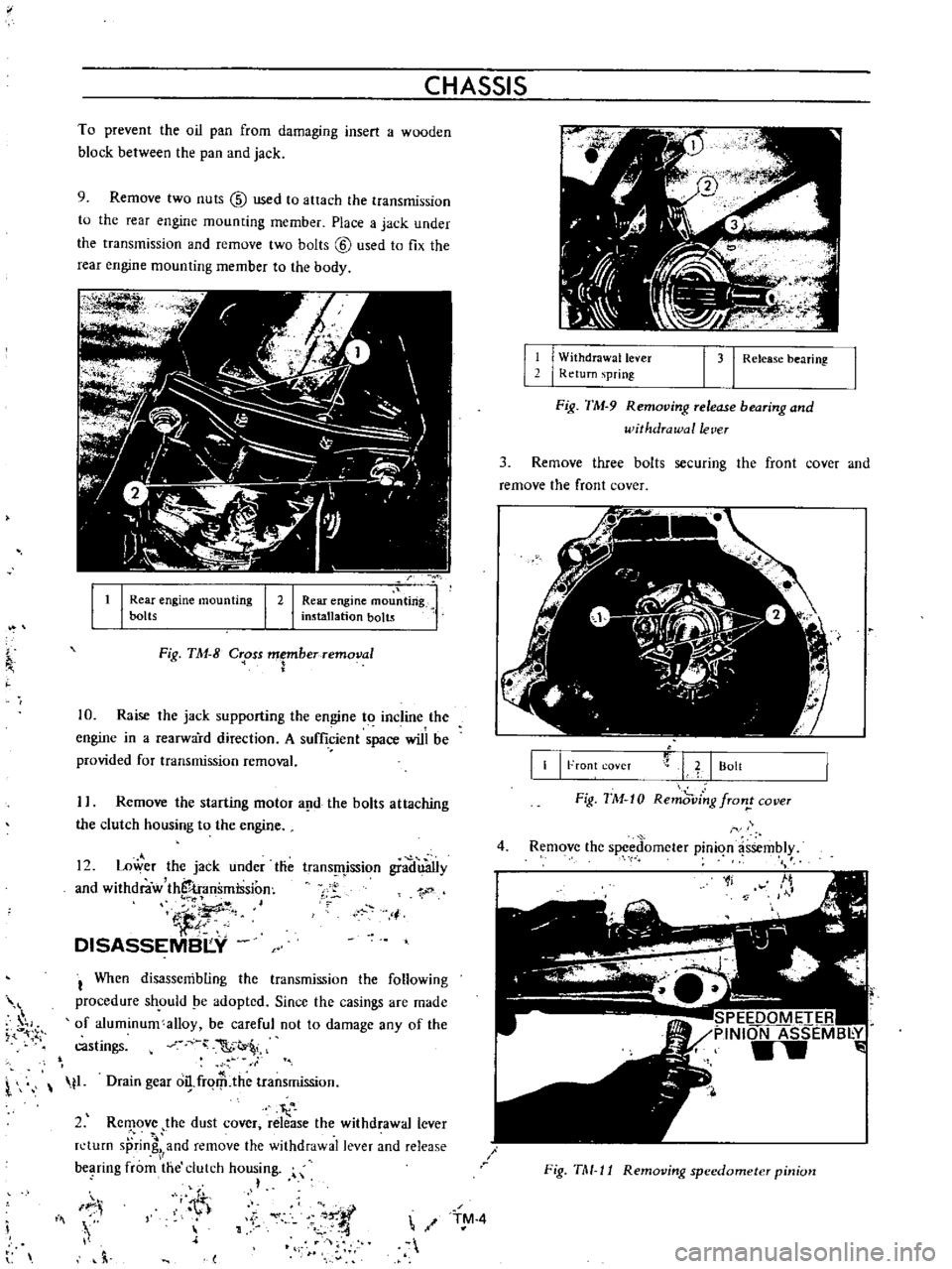
9
Remove
two
nuts
@
used
to
attach
the
transmission
to
the
rear
engine
mounting
member
Place
a
jack
under
the
transmission
and
remove
two
bolts
@
used
to
fix
the
rear
engine
mounting
member
to
the
body
It
I
Rear
engine
mou
ting
installation
bolts
I
Rear
engine
mounting
bolts
I
2
Fig
TM
8
C
oss
Fberremoval
10
Raise
the
jack
supporting
the
engine
to
incline
the
engine
in
a
rearward
direction
A
sufficient
space
will
be
provided
for
transmission
removal
I
Remove
the
starting
motor
a
d
the
bolts
attaching
the
clutch
housing
to
the
engine
12
Lower
the
jack
under
tlie
and
withdraw
thS
transmission
iJ
DISASSEMBI
Y
trans
fljssion
gradu3Ily
1
j
I
When
disassembling
the
transmission
the
following
procedure
sh
ould
pe
adopted
Since
the
casings
are
made
of
aluminum
alloy
be
careful
not
to
damage
any
of
the
castings
C
t
l
t1
Drain
gear
o
frqrP
the
transmission
I
2
Rc
ove
the
dust
cover
release
the
withdrawal
lever
n
turn
sprin
and
remove
the
withdrawal
lever
and
release
bC
lring
from
the
clutch
housing
h
IF
i
Iii
h
l
11
I
W
ithdrawallever
I
Return
spring
1
31
Release
bearing
Fig
TM
9
Removing
release
bearing
and
withdrawal
lever
3
Remove
three
bolts
securing
the
front
cover
and
remove
the
front
cover
II
I
Front
coveT
L
I
Bolt
Fig
TM
10
Remd
ving
fron
cover
4
Remove
the
spced
omcter
pinion
assembly
1f
SPEEDOMETER
PINION
ASSEMB
Y
w
Fig
TM
11
Removing
speedometer
pinion
TM
4
Page 500 of 513
j
TRANSMISSION
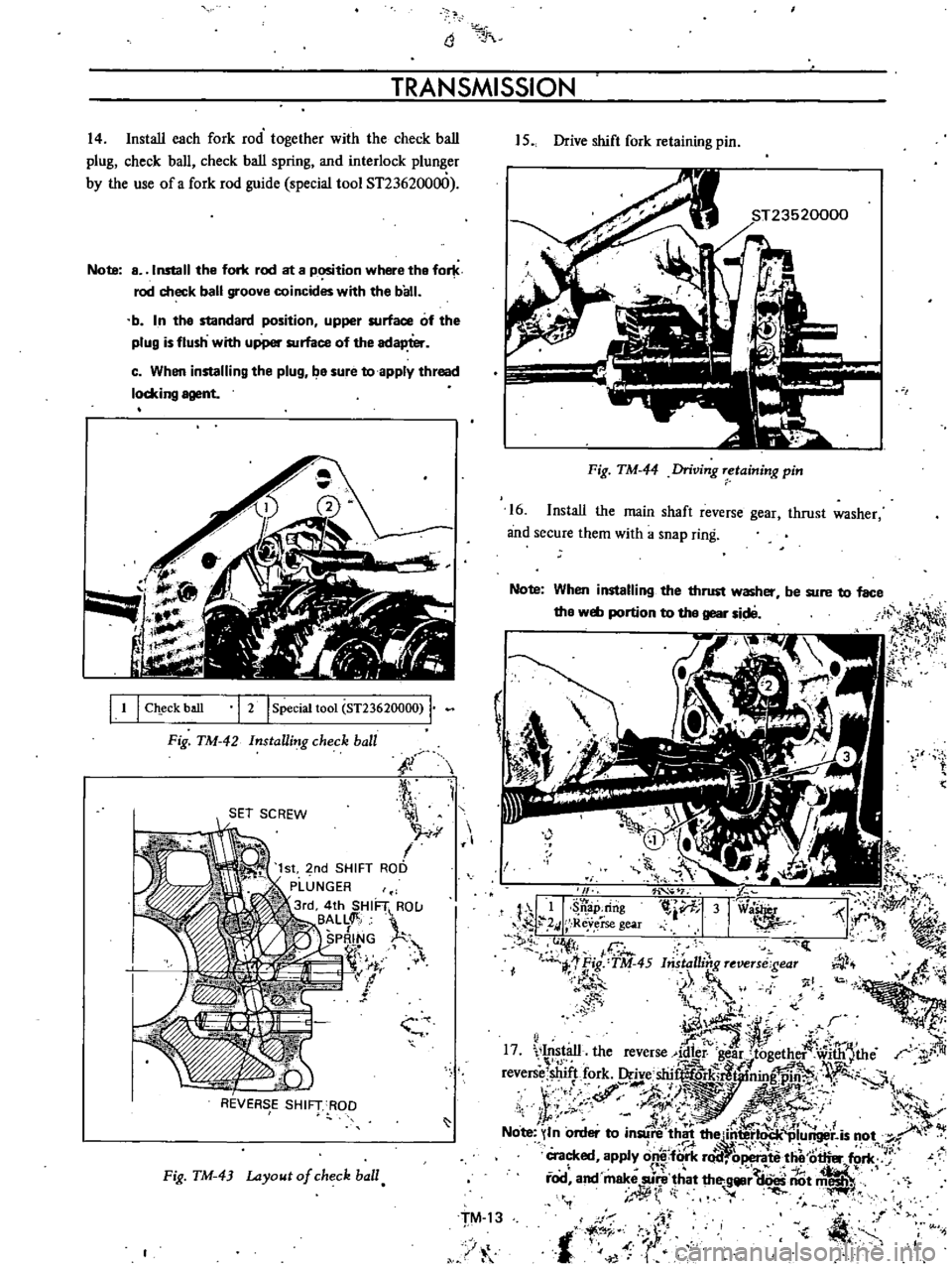
14
Install
each
fork
rod
together
with
the
check
ball
plug
check
ball
check
ball
spring
and
interlock
plu
er
by
the
use
of
a
fork
rod
guide
special
tool
ST236200
0
Note
a
Install
the
fori
rod
at
a
p
tion
where
tha
for
rod
check
ball
groove
coincides
with
the
ball
b
In
tha
standard
position
upper
surface
of
the
plug
is
flush
with
upper
surface
of
the
adapter
c
When
installing
the
plug
ba
sure
to
apply
thread
locking
agent
I
1
I
Ch
eck
ball
I
2
I
Special
toot
ST23620000
Fig
TM
42
InstaUing
check
ball
i
l
SET
SCREW
J
r
r
I
1st
2nd
SHIFT
ROD
PLUNGER
3rd
4th
SHIF1
RO
U
BALL
lt
SPRING
r
if
If
f
J
REVERSE
SHIFT
ROD
Fig
TM
43
Layout
of
check
ball
15
Drive
shift
fork
retaining
pin
Fig
TM
44
Driving
retaining
pin
16
Install
the
main
shaft
reverse
gear
thrust
washer
and
secure
them
with
a
snap
ring
Note
When
installing
the
thrust
washer
tha
web
portion
to
the
gear
sid8
be
sure
to
face
I
J
ll
it
ij
I
r
7
I
t
Lt
l
i
JI
h
l
p
II
Si
ap
dng
l
iVf
31
via
I
i
i
2
I
Reverse
gear
rll
f
F
O
1
Ii
ct
I
C
I
jf
1
Fig
TM
45
bista
ling
reveTS
gear
fJ
i
tJ
i
J
I
1
i
4
1
a
ot
j
l
i1i
o
f
tJ
r
w
i6
J
t
F
I
f
1
it
IV
I
17
1
t
1
the
reverse
@Isr
e
r
tilgether
wi1
tJthe
r
shift
k
Oc
shi
k
7i
fN
revers
lO
r
r
1
mg
1
1
f
i
J
4t
z
1
if
f
St
J
f
l
p
t
A
J
t
M
ff
J
1
A
Note
In
order
to
in
re
t
1h
f
t
li
u
r
is
O
cracked
apply
onl
fo
rk
r
id
ope
te
thet6t1ier
fori
J
t
i
fod
an
make
sU
r
e
that
th
gljllr
aoes
nOt
miiSli
J
o
I
t
J
t
if
z
TM
13
1
t
Page 509 of 513
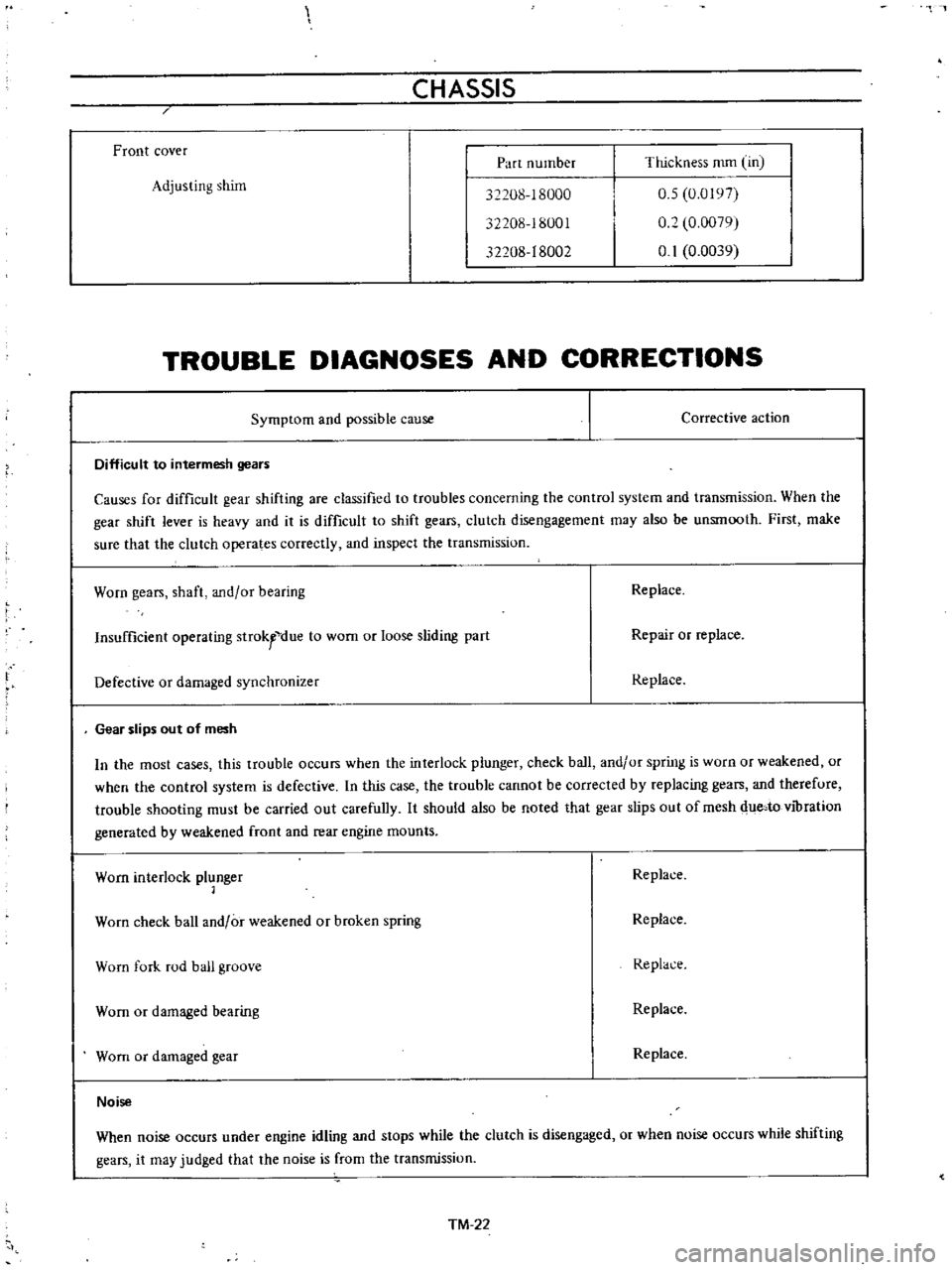
CHASSIS
Front
cover
Part
number
Thickness
mm
Un
Adjusting
shim
32208
18000
32208
18001
32208
18002
0
5
0
0197
0
2
0
0079
0
1
0
0039
TROUBLE
DIAGNOSES
AND
CORRECTIONS
Symptom
and
possible
cause
Corrective
action
Difficult
to
intermesh
gears
Causes
for
difficult
gear
shifting
are
classified
to
troubles
concerning
the
control
system
and
transmission
When
the
gear
shift
lever
is
heavy
and
it
is
difficult
to
shift
gears
clutch
disengagement
may
also
be
unsmooth
First
make
sure
that
the
clutch
operates
correctly
and
inspect
the
transmission
Worn
gears
shaft
and
or
bearing
Replace
Insufficient
operating
strokfdue
to
wom
or
loose
sliding
part
Repair
or
replace
Defective
or
damaged
synchronizer
Replace
Gear
slips
out
of
mesh
In
the
most
cases
this
trouble
occurs
when
the
interlock
plunger
check
ball
and
or
spring
is
wuro
or
weakened
or
when
the
control
system
is
defective
In
this
case
the
trouble
cannot
be
corrected
by
replacing
gears
and
therefure
trouble
shooting
must
be
carried
out
carefully
It
should
also
be
noted
that
gear
slips
out
of
mesh
due
to
vibration
generated
by
weakened
front
and
rear
engine
mounts
Worn
interlock
plunger
1
Replace
Worn
check
ball
and
or
weakened
or
broken
spring
Replace
Worn
fork
rod
ball
groove
Replace
Worn
or
damaged
bearing
Replace
Worn
or
damaged
gear
Replace
Noise
When
noise
occurs
under
engine
idling
and
stops
while
the
clutch
is
disengaged
or
when
noise
occurs
while
shifting
gears
it
may
judged
that
the
noise
is
from
the
transmissiun
TM
22