lock DATSUN B110 1973 Service Owners Manual
[x] Cancel search | Manufacturer: DATSUN, Model Year: 1973, Model line: B110, Model: DATSUN B110 1973Pages: 513, PDF Size: 28.74 MB
Page 313 of 513
ENGINE
Adjusting
carburetor
idle
rpm
mixture
ratio
Idle
mixture
adjustment
requires
the
use
of
a
CO
meter
When
preparing
to
adjust
idle
mixture
it
is
essential
to
have
the
meter
thoroughly
warmed
and
calibrated
Warm
up
the
engine
sufficiently
2
Continue
engine
operation
for
one
minute
under
idling
speed
3
Adjust
throttle
adjusting
screw
so
that
engine
speed
is
800
rpm
in
NO
position
for
automatic
transmission
4
Check
ignition
timing
if
necessary
adjust
it
to
the
specifications
Ignition
timing
SO
800
rpm
S
Adjust
idle
adjusting
screw
so
that
CO
percentage
is
1
5
t
O
S
6
Repeat
the
adjustments
as
described
in
steps
3
and
S
above
so
that
CO
percentage
is
I
i
t
O
S
at
800
rpm
Cautions
a
On
automatic
transmission
equipped
model
check
must
be
done
in
the
0
position
Be
sure
to
apply
parking
brake
and
to
lock
both
front
and
rear
wheels
with
wheel
chocks
b
Hold
brake
pedal
while
stepping
down
on
accelerator
pedal
Otherwise
car
will
rush
out
dangerously
7
On
automatic
transmission
equipped
model
make
sure
that
the
adjustment
has
been
made
with
the
selector
lever
in
N
position
And
then
check
the
specifications
with
the
lever
in
D
position
Insure
that
CO
percent
and
idle
speed
are
as
follows
Idle
rpm
CO
percentage
with
lever
in
D
position
6S0
I
S
t
O
S
If
necessary
adjust
by
progressively
turning
throttle
adjusting
screw
and
idle
adjusting
screw
until
correct
adjustments
are
made
Notes
a
Do
not
attempt
to
screw
down
the
idle
adjusting
screw
completely
to
avoid
damage
to
the
tip
which
will
tend
to
cause
malfunctions
b
After
idle
adjustment
has
been
made
shift
the
lever
to
N
or
p
position
for
automatic
transmission
c
Remove
wheel
chocks
before
starting
the
car
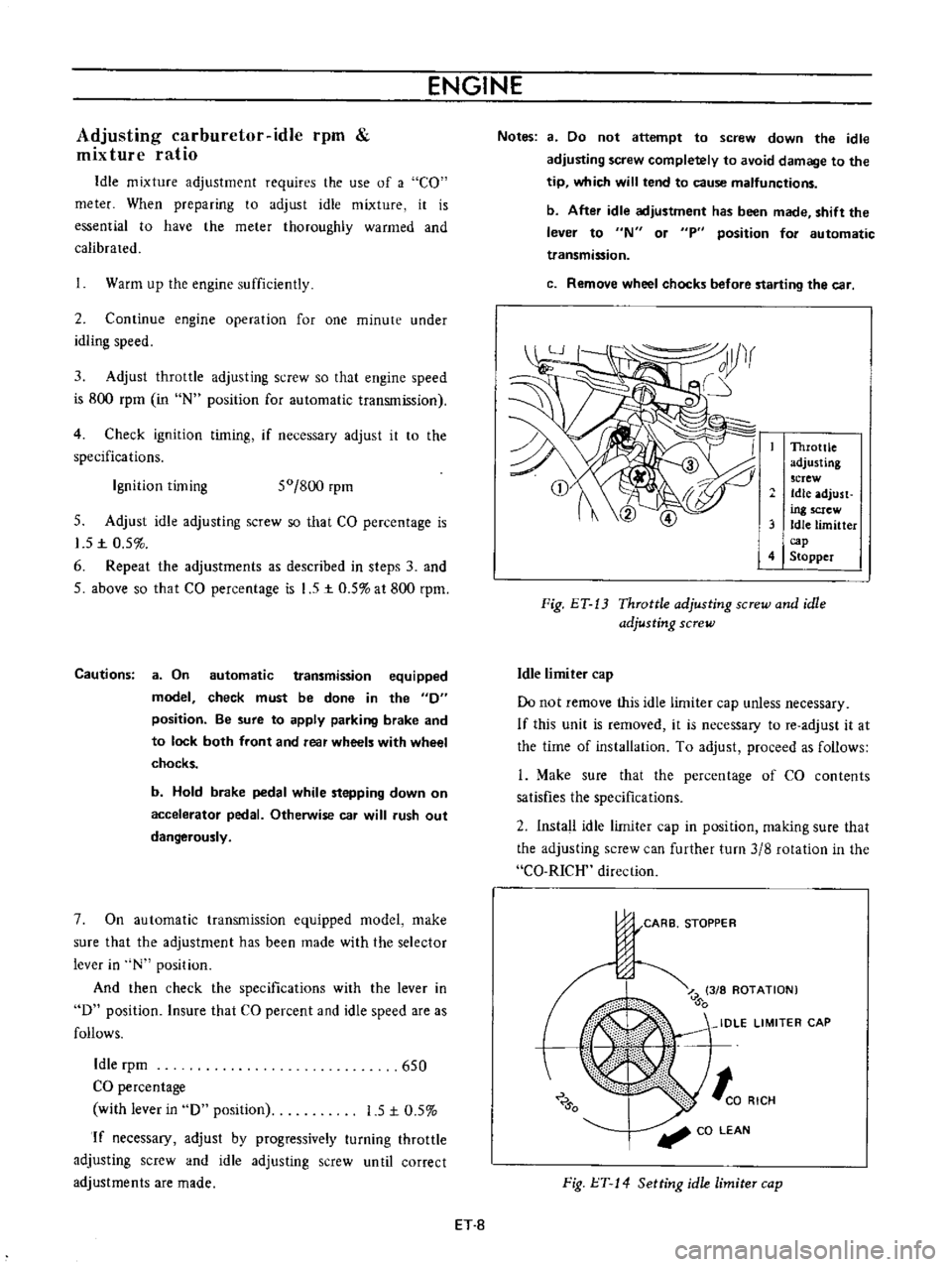
Throttle
adjusting
screw
Idle
adjust
ing
screw
3
Idle
limitter
cap
4
Stopper
Fig
ET
13
Throttle
adjusting
screw
and
idle
adjusting
screw
Idle
limiter
cap
Do
not
remove
this
idle
limiter
cap
unless
necessary
If
this
unit
is
removed
it
is
necessary
to
re
adjust
it
at
the
time
of
installation
To
adjust
proceed
as
follows
L
Make
sure
that
the
percentage
of
CO
contents
satisfies
the
specifications
2
Install
idle
limiter
cap
in
position
making
sure
that
the
adjusting
screw
can
further
turn
3
8
rotation
in
the
CO
RICH
direction
CARB
STOPPER
J
Z
3
8
ROTATION
0
IDLE
LIMITER
CAP
0
to
RICH
CO
LEAN
Fig
l
T
14
Setting
idle
limiter
cap
ET
8
Page 314 of 513
EMISSION
CONTROL
AND
TUNE
UP
Checking
and
adjusting
dash
pot
automatic
transmission
model
only
Check
operation
of
dash
pot
It
should
not
be
cracked
or
bound
It
is
also
essential
to
check
to
be
certain
that
it
is
in
correct
adjustment
L
Check
to
be
sure
that
dash
pot
contacts
stopper
lever
when
engine
speed
reaches
1
900
to
2
000
rpm
2
Engine
should
be
slowed
down
from
3
000
to
1
000
rpm
within
a
few
seconds
Readjust
dash
pot
or
replace
it
with
a
new
one
if
it
fails
to
meet
the
above
conditions
Checking
carburetor
return
spring
Check
throttle
return
spring
for
sign
of
damage
wear
or
squareness
Discard
spring
if
found
with
any
of
above
excessively
beyond
use
Checking
choke
mechanism
choke
valve
and
linkage
1
Check
choke
valve
and
mechanism
for
free
operation
and
clean
or
replace
if
necessary
A
binding
condition
may
have
developed
from
petro
leum
gum
for
motion
on
choke
shaft
or
from
damage
2
Check
bimetal
cover
setting
position
The
index
mark
of
bimetal
cover
is
usually
aligned
at
the
middle
point
of
the
scale
Note
When
somewhat
over
choked
turn
bimetal
caver
clockwise
slightly
3
Prior
to
starting
check
to
be
sure
that
choke
valve
closes
automatically
when
pressing
down
on
accelerator
pedal
Should
it
fail
to
close
automatically
the
likelihood
is
that
fast
idle
cam
is
out
of
proper
adjustment
or
that
bimetal
is
not
properly
adjusted
calling
for
adjustment
Refer
to
Carburetor
in
Section
EF
Page
EF
15
Checking
anti
dieseling
solenoid
If
engine
will
not
stop
when
ignition
switch
is
turned
off
this
indicates
a
striking
closed
solenoid
valve
shutting
off
supply
of
fuel
to
engine
If
harness
is
in
good
condition
replace
solenoid
as
a
unit
To
replace
proceed
as
follows
Removal
and
installation
of
anti
dieseling
solenoid
Removal
Solenoid
is
cemented
at
factory
Use
special
tool
STl
91
50000
to
remove
a
solenoid
When
this
tool
is
not
effective
use
a
pair
of
pliers
to
loosen
body
out
of
position
lnstalltion
I
Before
installing
a
solenoid
it
is
essential
to
clean
all
threaded
parts
of
carburetor
and
solenoid
Supply
screws
in
holes
and
turn
them
in
two
or
three
pitches
2
First
without
disturbing
the
above
setting
coat
all
exposed
threads
with
adhensive
the
Stud
Lock
of
LOCTlTE
or
equivalent
Then
torque
screws
to
35
to
55
kg
cm
30
to
48
in
lb
using
a
special
tool
STl9150000
After
installing
anti
dieseling
solenoid
leave
the
carbu
retor
more
than
12
hours
without
operation
3
After
replacement
is
over
start
engine
and
check
to
be
sure
that
fuel
is
not
leaking
and
that
anti
dieseling
solenoid
is
in
good
condition
Notes
a
Do
not
allow
adhesive
getting
on
valve
Failure
to
follow
this
caution
would
result
in
improper
valve
performance
or
clogged
fuel
passage
b
I
n
installing
valve
use
caution
not
to
hold
body
directly
Instead
use
special
tool
tighten
ing
nuts
as
required
ET
9
Page 319 of 513
ENGINE
Adjusting
throttle
opener
setting
engine
speed
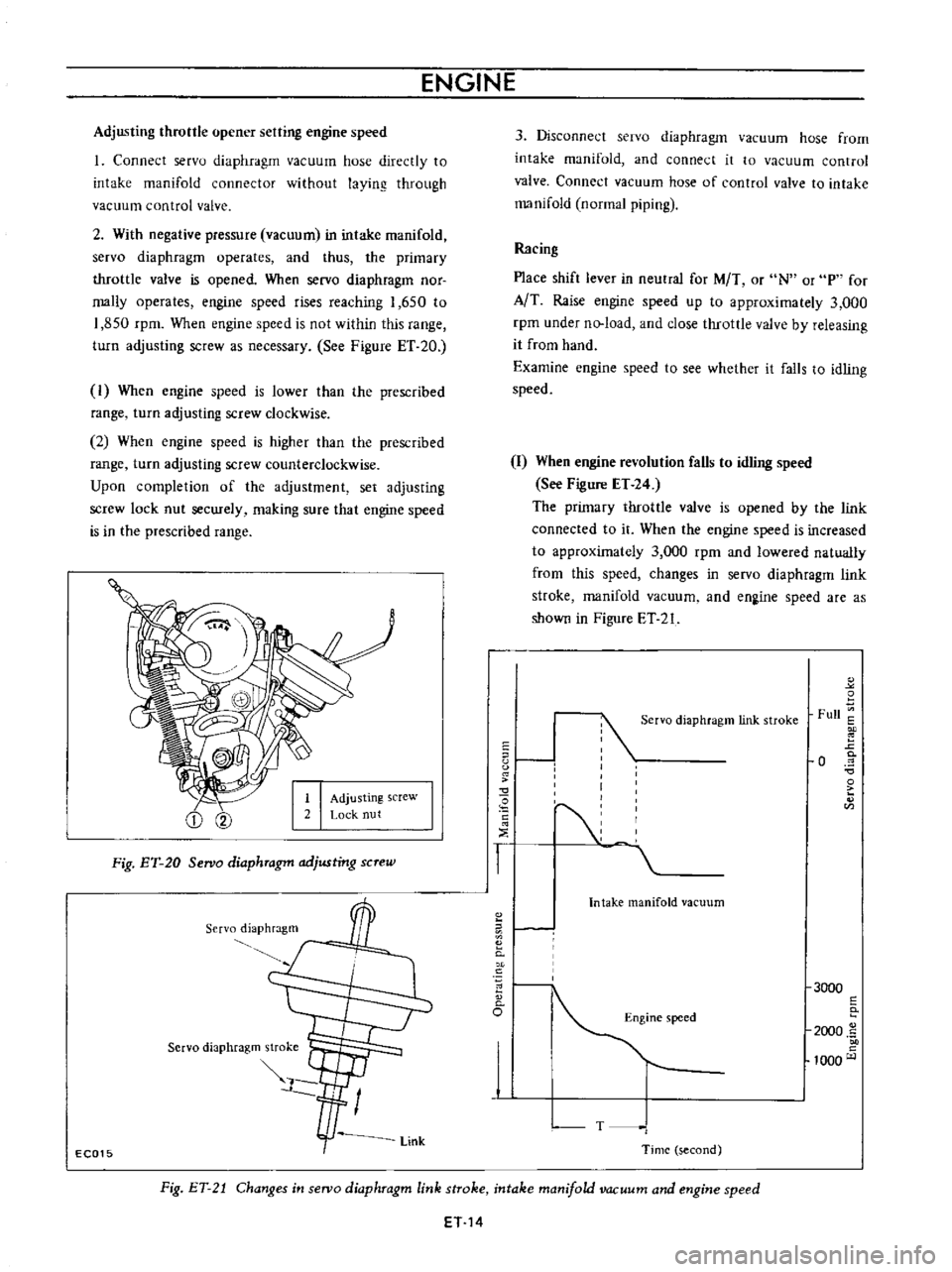
1
Connect
servo
diaphragm
vacuum
hose
directly
to
intake
manifold
connector
without
laying
through
vacuum
control
valve
2
With
negative
pressure
vacuum
in
intake
manifold
servo
diaphragm
operates
and
thus
the
primary
throttle
valve
is
opened
When
servo
diaphragm
nor
mally
operates
engine
speed
rises
reaching
1
650
to
1
850
rpm
When
engine
speed
is
not
within
this
range
turn
adjusting
screw
as
necessary
See
Figure
ET
20
l
When
engine
speed
is
lower
than
the
prescribed
range
turn
adjusting
screw
clockwise
2
When
engine
speed
is
higher
than
the
prescribed
range
turn
adjusting
screw
counterclockwise
Upon
completion
of
the
adjustment
set
adjusting
screw
lock
nut
secwely
making
sure
that
engine
speed
is
in
the
prescribed
range
@
II
I
AdJustmg
screw
2
Lock
nut
Fig
ET
20
Servo
diaphragm
adjusting
screw
Servo
diaphragm
Servo
diaphragm
stroke
Link
EC015
3
Disconnect
servo
diaphragm
vacuum
hose
from
intake
manifold
and
connect
it
to
vacuum
control
valve
Connect
vacuum
hose
of
control
valve
to
intake
manifold
normal
piping
Racing
Place
shift
lever
in
neutral
for
MfT
or
N
or
p
for
AlT
Raise
engine
speed
up
to
approximately
3
000
rpm
under
no
load
and
close
throttle
valve
by
releasing
it
from
hand
Examine
engine
speed
to
see
whether
it
falls
to
idling
speed
I
When
engine
revolution
rails
to
idling
speed
See
Figure
ET
24
The
primary
throttle
valve
is
opened
by
the
link
connected
to
it
When
the
engine
speed
is
increased
to
approximately
3
000
rpm
and
lowered
natually
from
this
speed
changes
in
servo
diaphragm
link
stroke
manifold
vacuum
and
en
ine
speed
are
as
shown
in
Figure
ET
21
o
u
u
0
2
Se
o
diaphragm
link
stroke
I
u
2
Full
0
o
Intake
manifold
vacuum
u
c
E
c
O
3000
c
e
Engine
speed
2000
g
i
c
1000
T
j
Time
second
Fig
ET
21
Changes
in
servo
diaphragm
link
stroke
intake
manifold
vacuum
and
engine
speed
ET
14
Page 321 of 513
ENGINE
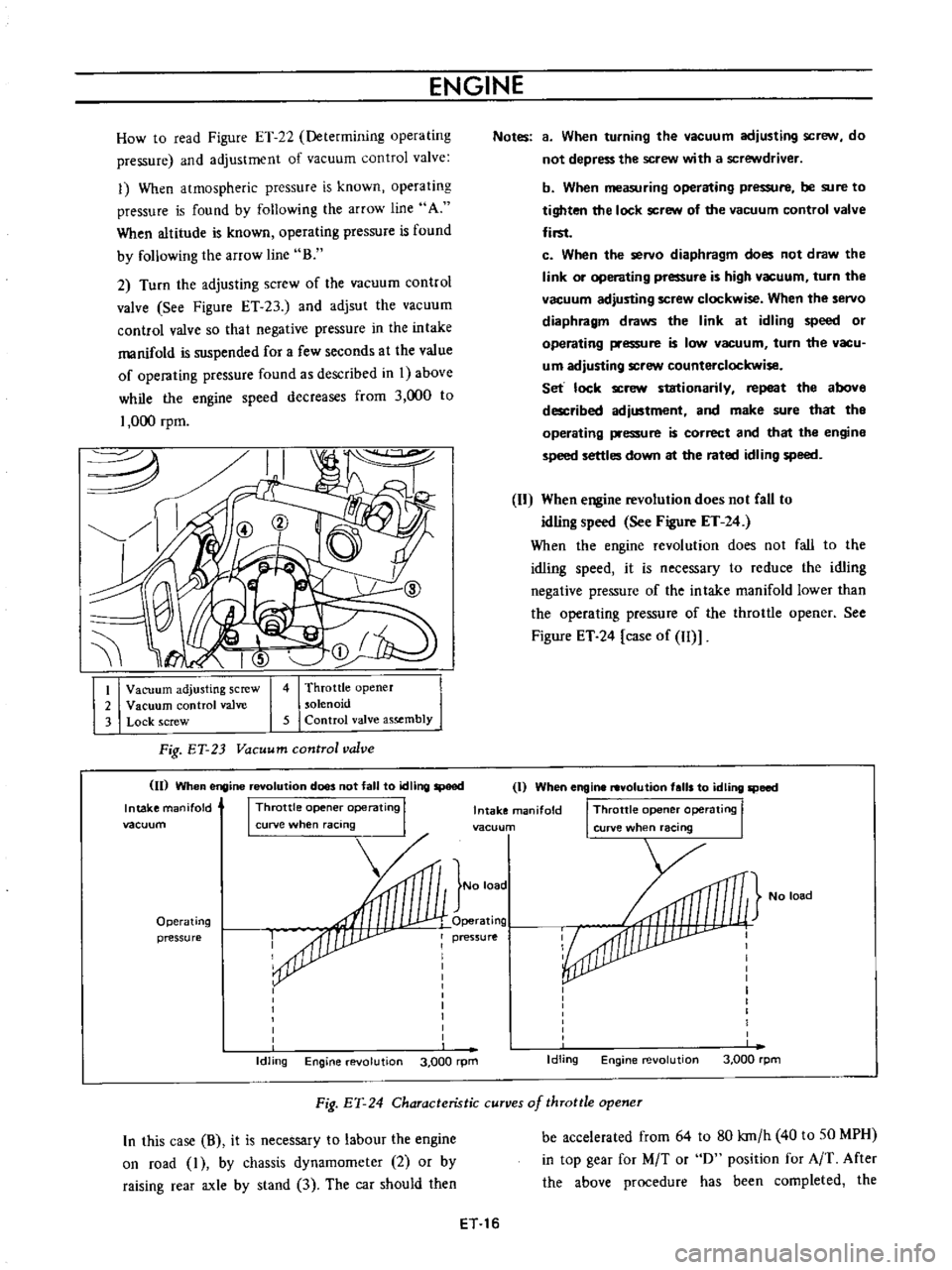
How
to
read
Figure
ET
22
Determining
operating
pressure
and
adjustment
of
vacuum
control
valve
1
When
atmospheric
pressure
is
known
operating
pressure
is
found
by
following
the
arrow
line
A
When
altitude
is
known
operating
pressure
is
found
by
following
the
arroW
line
B
2
Turn
the
adjusting
screw
of
the
vacuum
control
valve
See
Figure
ET
23
and
adjsut
the
vacuum
control
valve
so
that
negative
pressure
in
the
intake
manifold
is
suspended
for
a
few
seconds
at
the
value
of
operating
pressure
found
as
described
in
I
above
while
the
engine
speed
decreases
from
3
000
to
1
000
rpm
I
Vacuum
adjusting
screw
2
Vacuum
control
valve
3
Lock
screw
4
Throttle
opener
solenoid
5
Control
valve
assembly
Fig
ET
23
Vacuum
control
valve
II
When
engine
revolution
does
not
fall
to
tdling
speed
Intake
manifold
I
Throttle
opene
operating
I
vacuum
curve
when
racing
Operating
pressure
Idling
Engine
evolution
3
000
rpm
Notes
a
When
turning
the
vacuum
adjusting
scre
N
do
not
depress
the
screw
with
a
screwdriver
b
When
measuring
operating
pressure
be
sure
to
tighten
the
lock
screw
of
the
vacuum
control
valve
first
c
When
the
servo
diaphragm
does
not
draw
the
link
or
operating
pressure
is
high
vacuum
turn
the
vacuum
adjusting
screw
clockwise
When
the
servo
diaphragm
draws
the
link
at
idling
speed
or
operating
pressure
is
low
vacuum
turn
the
vacu
um
adjusting
screw
counterclockwise
Set
lock
screw
stationarily
repeat
the
above
described
adjustment
and
make
sure
that
tho
operating
pressure
is
correct
and
that
the
engine
speed
settles
down
at
the
rated
idling
speed
When
engine
revolution
does
not
CaU
to
idling
speed
See
Figure
ET
24
When
the
engine
revolution
does
not
fall
to
the
idling
speed
it
is
necessary
to
reduce
the
idling
negative
pressure
of
the
intake
manifold
lower
than
the
operating
pressure
of
the
throttle
opener
See
Figure
ET
24
case
of
Il
Il
I
When
engine
revolution
falls
to
idling
speed
Intake
manifold
I
Throttle
opene
operating
I
vacuun
curve
when
racing
No
load
No
load
Operating
pressure
I
I
I
I
I
I
I
I
I
Idling
Engine
revolution
3
000
rpm
Fig
EY
24
Characteristic
curves
of
throttle
opener
In
this
case
B
it
is
necessary
to
labour
the
engine
on
road
I
by
chassis
dynamometer
2
or
by
raising
rear
axle
by
stand
3
The
car
should
then
be
accelerated
from
64
to
80
kro
h
40
to
SO
MPH
in
top
gear
for
M
T
or
0
position
for
A
T
After
the
above
procedure
has
been
completed
the
ET
16
Page 322 of 513
EMISSION
CONTROL
AND
TUNE
UP
accelerator
pedal
is
released
During
the
testing
measure
the
throttle
opener
operating
pressure
to
see
whether
it
is
in
the
predetermined
value
or
not
See
Figure
ET
25
Adjustment
is
exactly
the
same
as
that
in
the
case
I
When
engine
revolution
falls
to
idling
speed
Page
ET
14
Vacuum
gauge
Intake
man
fol
p
ci
J
v
1
Road
test
r
Vacuum
gauge
7I
t
i
2
Chassis
dynamometer
Vacuum
gauge
y
3
Raise
up
rear
axle
housing
by
stand
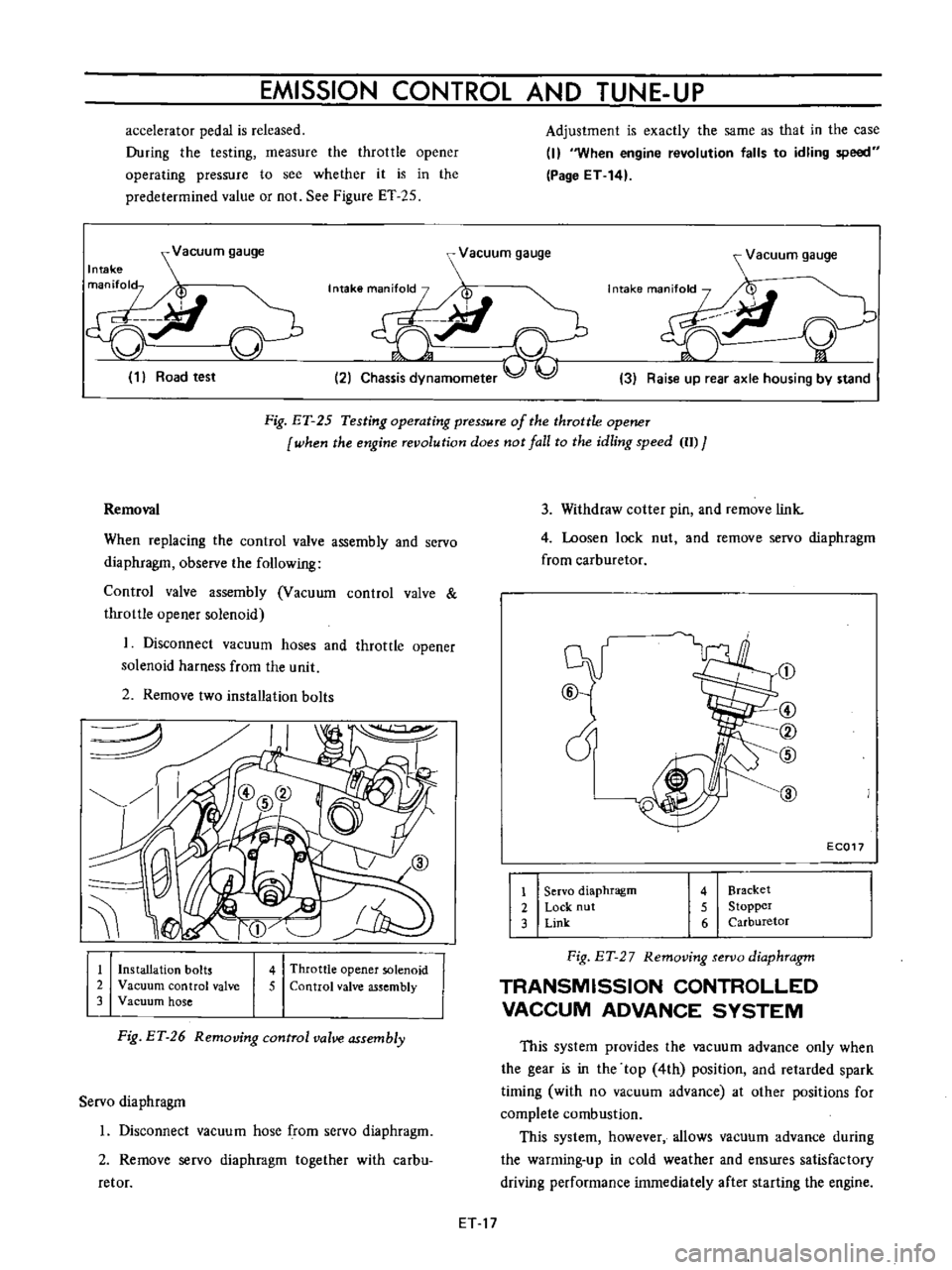
Fig
ET
25
Testing
operating
pressure
of
the
throttle
opener
when
fhe
engine
revolufion
does
not
lall
fo
fhe
idling
speed
II
J
3
Withdraw
cotter
pin
and
remove
link
4
Loosen
lock
nut
and
remove
servo
diaphragm
from
carburetor
Removal
When
replacing
the
control
valve
assembly
and
servo
diaphragm
observe
the
following
Control
valve
assembly
Vacuum
control
valve
throttle
opener
solenoid
1
Disconnect
vacuum
hoses
and
throttle
opener
solenoid
harness
from
the
unit
2
Remove
two
installation
bolts
J
@
cY
@
1
Servo
diaphragm
2
Lock
nut
3
Link
@
CV
@
EC017
4
Bracket
5
Stopper
6
Carburetor
1
Installation
bolts
2
Vacuum
control
valve
3
Vacuum
hose
4
Throttle
opener
solenoid
5
Control
valve
assembly
Fig
ET
2
7
Removing
servo
diaphragm
TRANSMISSION
CONTROLLED
VACCUM
ADVANCE
SYSTEM
Fig
ET
26
Removing
control
valve
assembly
This
system
provides
the
vacuum
advance
only
when
the
gear
is
in
the
top
4th
position
and
retarded
spark
timing
with
no
vacuum
advance
at
other
positions
for
complete
combustion
This
system
however
allows
vacuum
advance
during
the
warming
up
in
cold
weather
and
enswes
satisfactory
driving
performance
immediately
after
starting
the
engine
Servo
diaphragm
1
Disconnect
vacuum
hose
from
servo
diaphragm
2
Remove
servo
diaphragm
together
with
carbu
retor
ET
17
Page 325 of 513
ENGINE
Caution
lock
the
front
and
rear
wheels
by
fully
pulling
the
parking
brake
lever
before
con
ducting
this
test
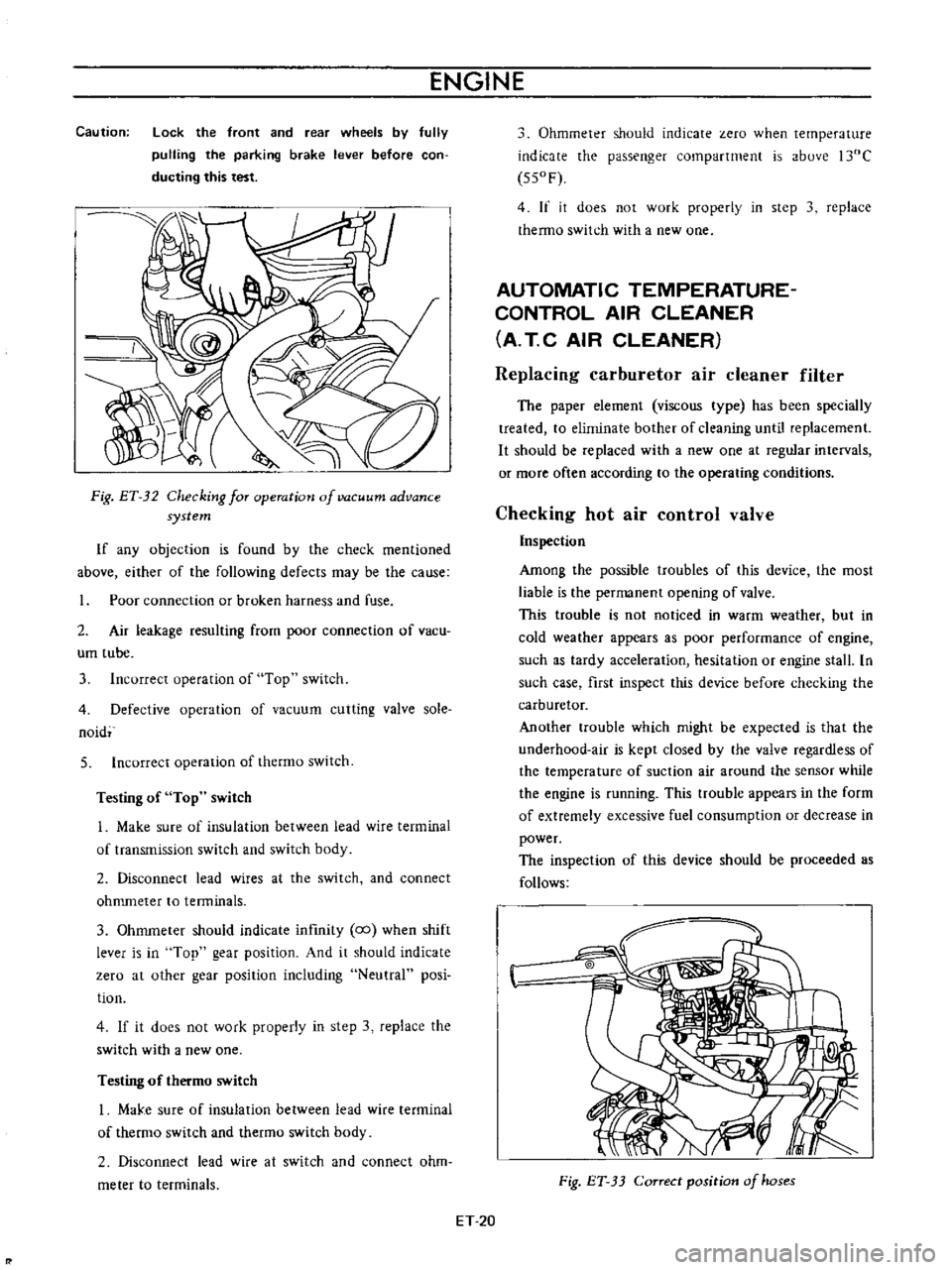
Fig
ET
32
Checking
for
operation
of
vacuum
advance
system
If
any
objection
is
found
by
the
check
mentioned
above
either
of
the
following
defects
may
be
the
cause
Poor
connection
or
broken
harness
and
fuse
2
Air
leakage
resulting
from
poor
connection
of
vacu
um
tube
3
Incorrect
operation
of
Top
switch
4
Defective
operation
of
vacuum
cutting
valve
sole
naid
5
Incorrect
operation
of
thermo
switch
Testing
of
Top
switch
1
Make
sure
of
insulation
between
lead
wire
terminal
of
transmission
switch
and
switch
body
2
Disconnect
lead
wires
at
the
switch
and
connect
ohmmeter
to
tenninals
3
Ohmmeter
should
indicate
infmity
co
when
shift
lever
is
in
Top
gear
position
And
it
should
indicate
zero
at
other
gear
position
including
Neutral
posi
tion
4
If
it
does
not
work
properly
in
step
3
replace
the
switch
with
a
new
one
Testing
of
thermo
switch
I
MaJ
e
sure
of
insulation
between
lead
wire
terminal
of
thermo
switch
and
thetmo
switch
body
2
Disconnect
lead
wire
at
switch
and
connect
ohm
meter
to
terminals
Ohmmeter
should
indicate
zero
when
temperature
indicate
the
passenger
compartment
is
above
l30C
550F
4
If
it
does
not
work
properly
in
step
3
replace
thermo
switch
with
a
new
one
AUTOMATIC
TEMPERATURE
CONTROL
AIR
CLEANER
A
T
C
AIR
CLEANER
Replacing
carburetor
air
cleaner
filter
The
paper
element
viscous
type
has
been
specially
treated
to
eliminate
bother
of
cleaning
until
replacement
It
should
be
replaced
with
a
new
one
at
regular
intervals
or
more
often
according
to
the
operating
conditions
Checking
hot
air
control
valve
Inspection
Among
the
possible
troubles
of
this
device
the
most
liable
is
the
permanent
opening
of
valve
This
trouble
is
not
noticed
in
warm
weather
but
in
cold
weather
appears
as
poor
performance
of
engine
such
as
tardy
acceleration
hesitation
or
engine
stall
In
such
case
first
inspect
this
device
before
checking
the
carburetor
Another
trouble
which
might
be
expected
is
that
the
underhood
air
is
kept
closed
by
the
valve
regardless
of
the
temperature
of
suction
air
around
the
sensor
while
the
engine
is
running
This
ttOuble
appears
in
the
form
of
extremely
excessive
fuel
consumption
or
decrease
in
power
The
inspection
of
this
device
should
be
proceeded
as
follows
Fig
ET
33
Correct
position
of
hoses
ET
20
Page 329 of 513
ENGINE
3
Connect
a
3
way
connector
a
manometer
and
a
cock
or
an
equivalent
3
way
change
cock
to
the
end
of
the
vent
line
4
Supply
fresh
air
into
the
vapor
vent
line
through
the
cock
little
by
little
until
the
pressure
becomes
368
mm
Aq
14
5
in
Aq
5
Shut
the
cock
completely
and
leave
it
that
way
6
After
2
5
minutes
measure
the
height
of
the
liquid
in
the
manometer
7
Variation
of
height
should
remain
within
254
mmAq
1
0
in
Aq
8
When
the
filler
cap
does
not
close
completely
the
height
should
drop
to
zero
in
a
short
time
9
If
the
height
does
not
drop
to
zero
in
a
short
time
when
the
filler
cap
is
removed
it
is
the
cause
of
the
stuffy
hose
Note
In
case
the
vent
line
is
stuffy
the
breathing
in
fuel
tank
is
not
thoroughly
made
thus
causing
insufficient
delivery
of
fuel
to
engine
or
vapor
lock
It
must
therefore
be
repaired
or
replaced
3
way
connector
Cock
Air
Manometer
Vapor
liquid
seearator
Flow
guide
valve
E
CQ29
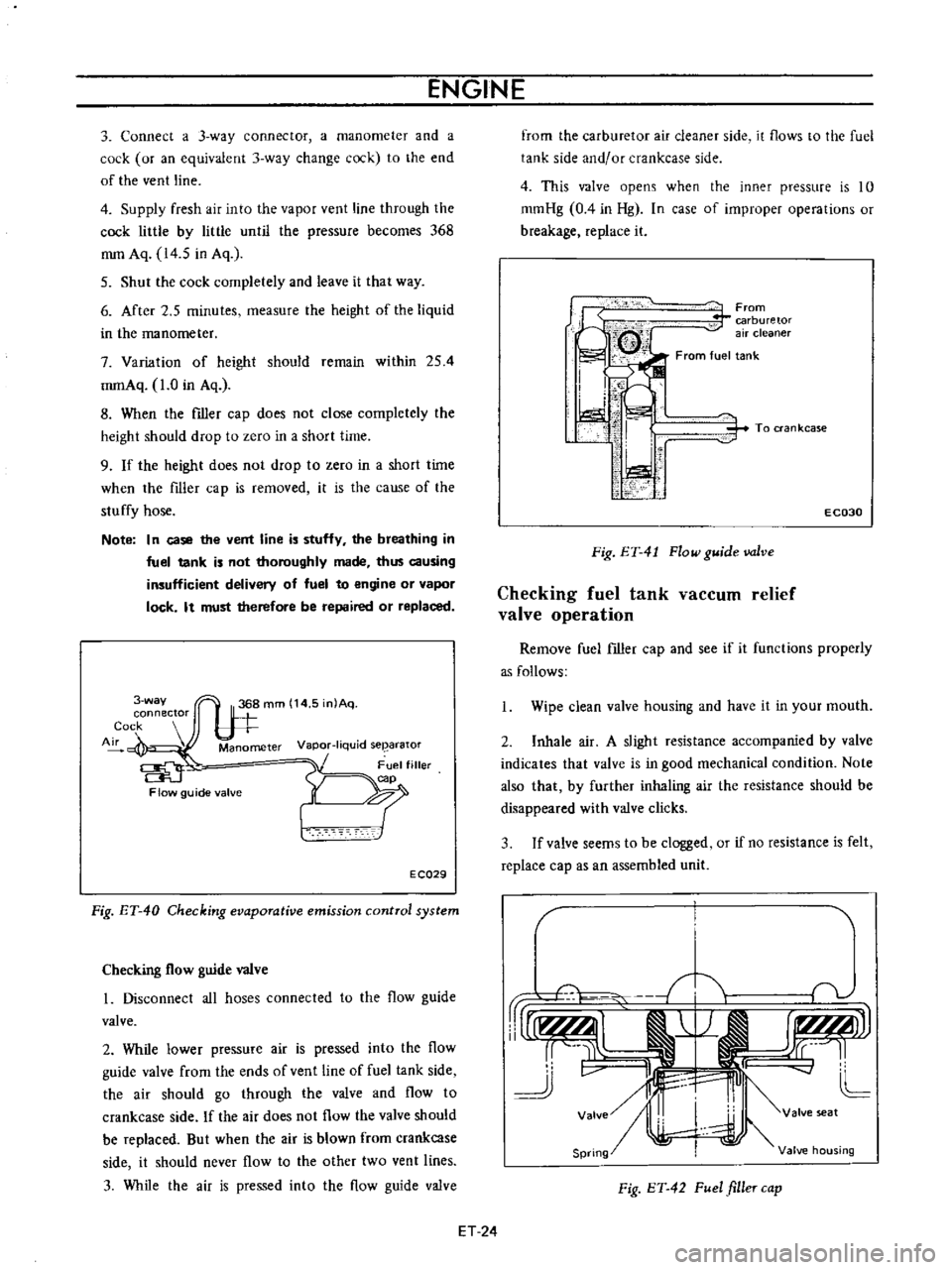
Fig
ET
40
Checking
evaporative
emission
control
system
Checking
flow
guide
valve
I
Disconnect
all
hoses
connected
to
the
flow
guide
valve
2
While
lower
pressure
air
is
pressed
into
the
flow
guide
valve
from
the
ends
of
vent
line
of
fuel
tank
side
the
air
should
go
through
the
valve
and
flow
to
crankcase
side
If
the
air
does
not
flow
the
valve
should
be
replaced
But
when
the
air
is
blown
from
crankcase
side
it
should
never
flow
to
the
other
two
vent
lines
3
While
the
air
is
pressed
into
the
flow
guide
valve
from
the
carburetor
air
cleaner
side
it
flows
to
the
fuel
tank
side
and
or
crankcase
side
4
This
valve
opens
when
the
inner
pressure
is
10
mmHg
0
4
in
Hg
In
case
of
improper
operations
or
breakage
replace
it
From
carburetor
air
cleaner
From
fuel
tank
i
I
I
ti
i
i
1
1
i
To
ran
kcase
E
C030
Fig
ET
41
Flow
guide
valve
Checking
fuel
tank
vaCCUID
relief
valve
operation
Remove
fuel
filler
cap
and
see
if
it
functions
properly
as
follows
Wipe
clean
valve
housing
and
have
it
in
your
mouth
2
Inhale
air
A
slight
resistance
accompanied
by
valve
indicates
that
valve
is
in
good
mechanical
condition
Note
also
that
by
further
inhaling
air
the
resistance
should
be
disappeared
with
valve
clicks
3
If
valve
seems
to
be
clogged
or
if
no
resistance
is
felt
replace
cap
as
an
assembled
unit
T
1i
v
rUr1f
AlI
j
r
I
r
tLMJJl
rr
L
cc
11
J
v
II
4J
L
Valve
I
valve
seat
Spring
Valve
housing
Fig
ET
42
Fuel
filler
cap
ET
24
Page 337 of 513
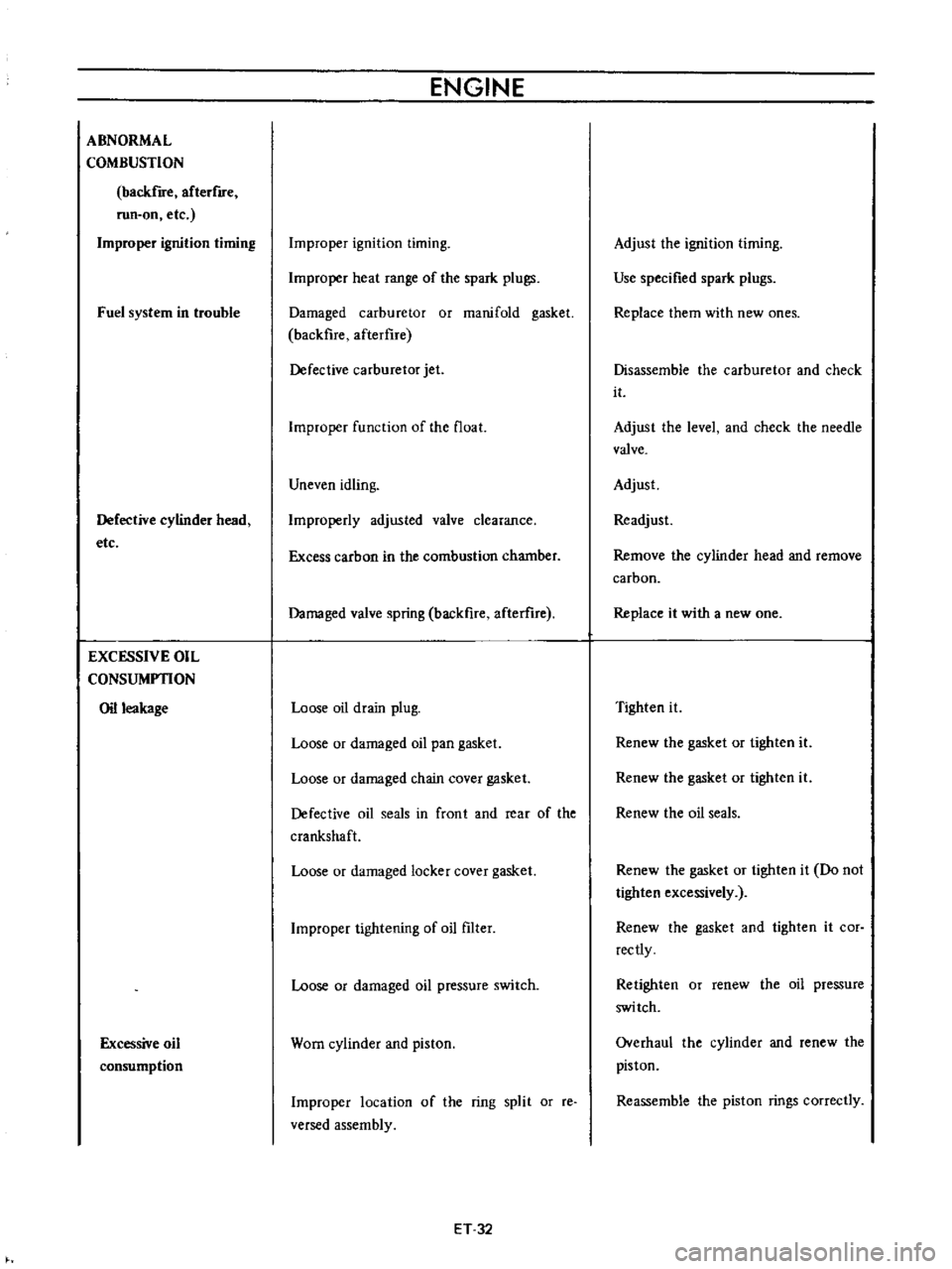
ABNORMAL
COMBUSTION
backfire
afterflfe
run
on
etc
Improper
ignition
timing
Fuel
system
in
trouble
Defective
cylinder
head
etc
EXCESSIVE
OIL
CONSUMPTION
Oil
leakage
Excessive
oil
consumption
ENGINE
Improper
ignition
timing
Improper
heat
range
of
the
spark
plugs
Damaged
carburetor
or
manifold
gasket
backfire
afterflre
Defective
carburetor
jet
Improper
function
of
the
float
Uneven
idling
Improperly
adjusted
valve
clearance
Excess
carbon
in
the
combustion
chamber
Damaged
valve
spring
backfire
afterure
Loose
oil
drain
plug
Loose
or
damaged
oil
pan
gasket
Loose
or
damaged
chain
cover
gasket
Defective
oil
seals
in
front
and
rear
of
the
crankshaft
Loose
or
damaged
locker
cover
gasket
Improper
tightening
of
oil
filter
Loose
or
damaged
oil
pressure
switch
Worn
cylinder
and
piston
Improper
location
of
the
ring
split
or
reo
versed
assembly
ET
32
Adjust
the
ignition
timing
Use
specified
spark
plugs
Replace
them
with
new
ones
Disassemble
the
carburetor
and
check
it
Adjust
the
level
and
check
the
needle
valve
Adjust
Readjust
Remove
the
cylinder
head
and
remove
carbon
Replace
it
with
a
new
one
Tighten
it
Renew
the
gasket
or
tighten
it
Renew
the
gasket
or
tighten
it
Renew
the
oil
seals
Renew
the
gasket
or
tighten
it
Do
not
tighten
excessively
Renew
the
gasket
and
tighten
it
cor
rectly
Retighten
or
renew
the
oil
pressure
switch
Overhaul
the
cylinder
and
renew
the
piston
Reassemble
the
piston
rings
correctly
Page 338 of 513
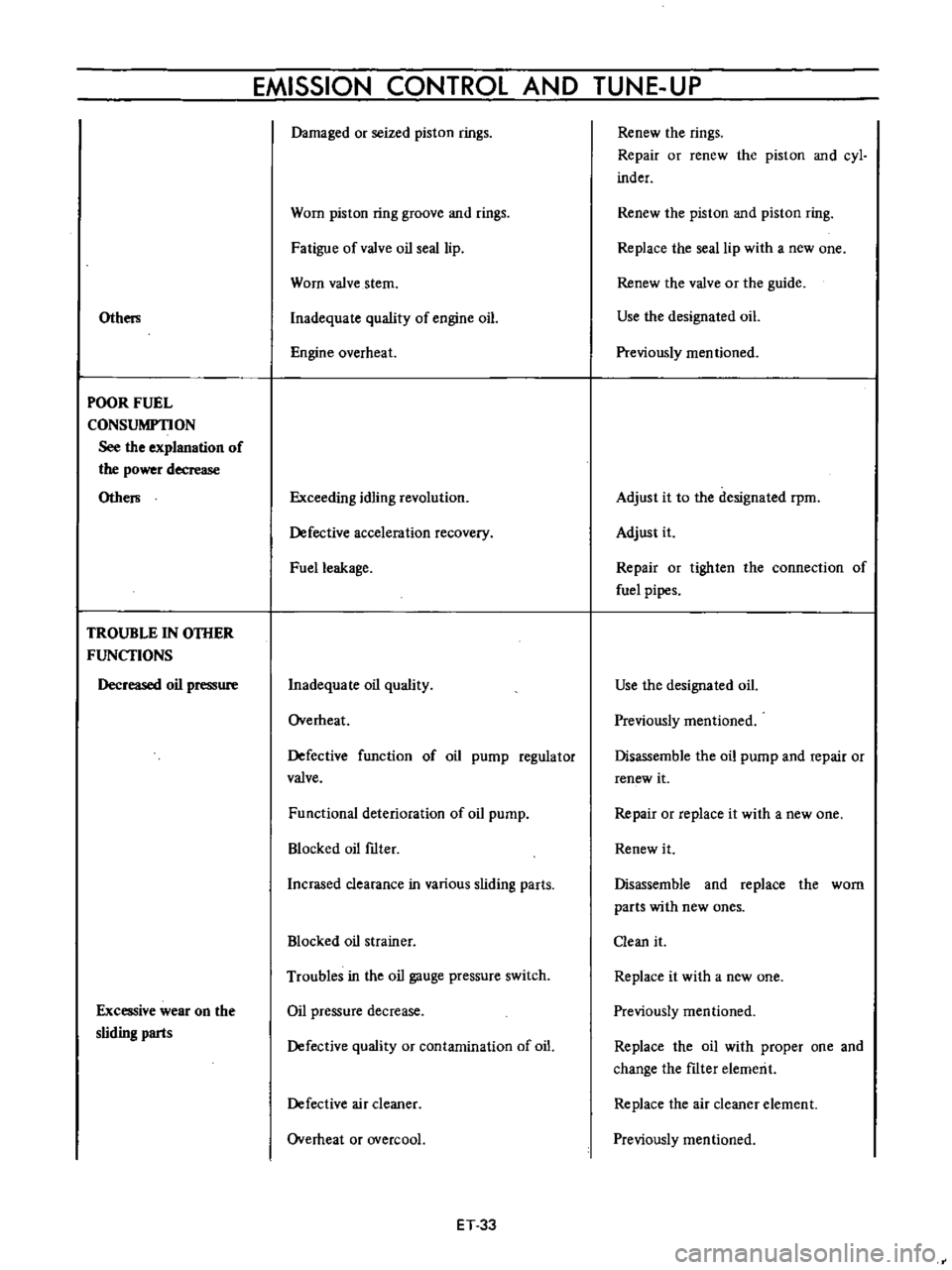
EMISSION
CONTROL
AND
TUNE
UP
Othm
POOR
FUEL
CONSUMPTION
See
the
explanation
of
the
power
decrease
Othe
TROUBLE
IN
OTHER
FUNCfIONS
Decreased
oil
pressure
Excessive
wear
on
the
sliding
parts
Damaged
or
seized
piston
rings
Worn
piston
ring
groove
and
rings
Fatigue
ofvalve
oil
seal
lip
Worn
valve
stem
Inadequate
quality
of
engine
oiL
Engine
overheat
Exceeding
idling
revolution
Defective
acceleration
recovery
Fuel
leakage
Inadequa
Ie
oil
quality
Overheat
Defective
function
of
oil
pump
regulator
valve
Functional
deterioration
of
oil
pump
Blocked
oil
ftIter
nerased
clearance
in
various
sliding
parts
Blocked
oil
strainer
Troubles
in
the
oil
gauge
pressure
switch
Oil
pressure
decrease
Defective
quality
or
contamination
of
oil
Defective
air
cleaner
Overheat
or
overcoal
ET
33
Renew
the
rings
Repair
or
renew
the
piston
and
cyl
inder
Renew
the
piston
and
piston
ring
Replace
the
seal
lip
with
a
new
one
Renew
the
valve
or
the
guide
Use
the
designated
oiL
Previously
mentioned
Adjust
it
to
the
designated
rpm
Adjust
it
Repair
or
tighten
the
connection
of
fuel
pipes
Use
the
designated
oil
Previously
mentioned
Disassemble
the
oil
pump
and
repair
or
renew
it
Repair
or
replace
it
with
a
new
one
Renew
it
Disassemble
and
replace
the
worn
parts
with
new
ones
Clean
it
Replace
it
with
a
new
one
Previously
mentioned
Replace
the
oil
with
proper
one
and
change
the
ftIter
elemerit
Replace
the
air
cleaner
element
Previously
mentioned
Page 341 of 513
ENGINE
MECHANICAL
GENERAL
DESCRIPTION
CONTENTS
ENGINE
CYLINDER
BLOCK
CRAN
KSHAFT
PISTON
AND
CONNECTING
ROD
CYLINDER
HEAD
EM
EM
2
EM
2
EM
2
EM
2
CAMSHAFT
VALVE
MECHANISM
CAMSHAFT
DRIVE
MANIFOLD
EM
3
EM
3
EM
3
EM
3
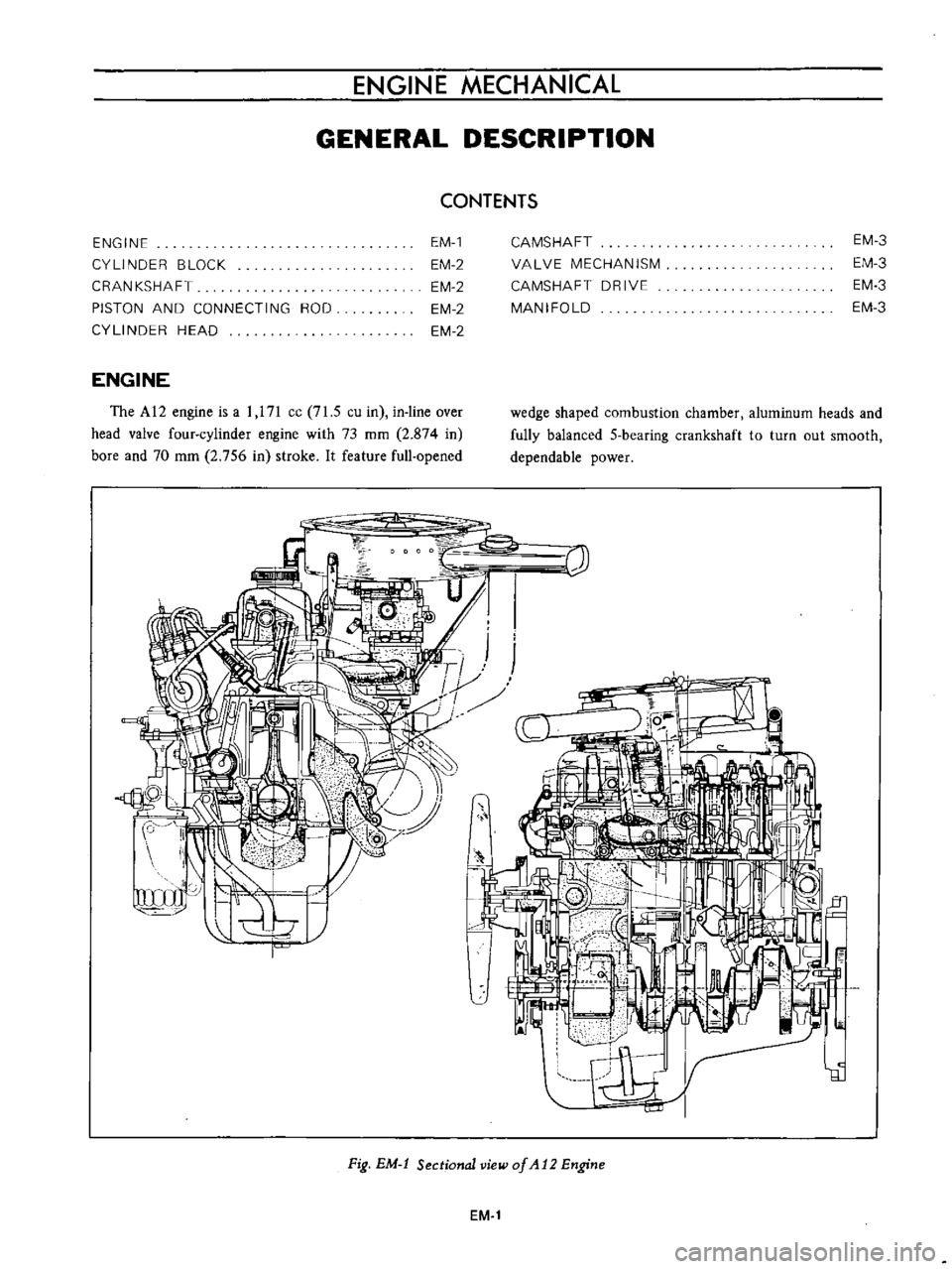
ENGINE
The
AI2
engine
is
a
1
171
cc
71
5
cu
in
in
line
over
head
valve
four
cylinder
engine
with
73
mm
2
874
in
bore
and
70
mm
2
756
in
stroke
It
feature
full
opened
wedge
shaped
combustion
chamber
aluminum
heads
and
fully
balanced
5
bearing
crankshaft
to
turn
out
smooth
dependable
power
c
Ii
I
l
1
nun
y
r
r
Fig
EM
t
Sectional
view
of
At2
Engine
EM
1