lock DATSUN B110 1973 Service Repair Manual
[x] Cancel search | Manufacturer: DATSUN, Model Year: 1973, Model line: B110, Model: DATSUN B110 1973Pages: 513, PDF Size: 28.74 MB
Page 362 of 513
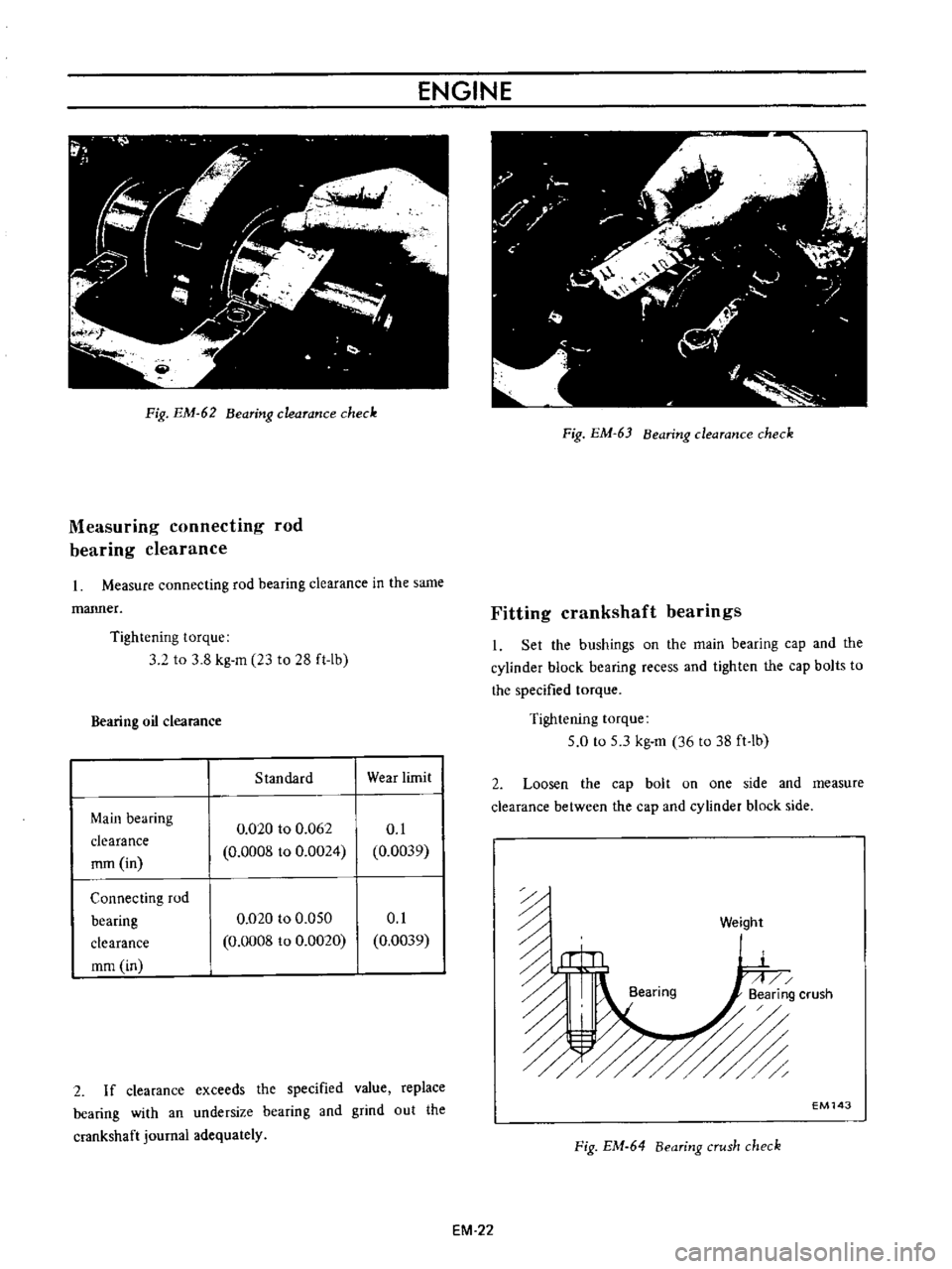
ENGINE
Pig
EM
62
Bearing
clearance
check
Measuring
connecting
rod
bearing
clearance
Measure
connecting
rod
bearing
clearance
in
the
same
manner
Tightening
torque
3
2
to
3
8
kg
m
23
to
28
ft
Ib
Bearing
oil
clearance
Standard
Wear
limit
Main
bearing
clearance
rom
in
0
020
to
0
062
0
0008
to
0
0024
0
1
0
0039
Connecting
rod
bearing
clearance
mm
in
0
020
to
0
050
0
0008
to
0
0020
0
1
0
0039
2
If
clearance
exceeds
the
specified
value
replace
bearing
with
an
undersize
bearing
and
grind
out
the
crankshaft
journal
adequately
Fig
EM
63
Bearing
clearance
check
Fitting
crankshaft
bearings
I
Set
the
bushings
on
the
main
bearing
cap
and
the
cylinder
block
bearing
recess
and
tighten
the
cap
bolts
to
the
specified
torque
Tightening
torque
5
0
to
5
3
kg
m
36
to
38
ft
lb
2
Loosen
the
cap
bolt
on
one
side
and
measure
clearance
between
the
cap
and
cylinder
block
side
n
n
u
ii
Bearing
6
Weight
EM143
Fig
EM
64
Bearing
crush
check
EM
22
Page 363 of 513
ENGINE
MECHANICAL
3
Ascertain
that
the
clearance
is
within
double
the
figure
listed
below
If
it
is
not
replace
the
bearing
4
Handle
the
connecting
rod
bearing
in
the
same
manner
Connecting
rod
cap
tightening
torque
3
2
to
3
8
kg
m
23
to
28
ft
lb
Bearing
crush
All
main
bearing
mm
in
o
to
0
03
0
to
0
0012
All
connecting
rod
bearing
mm
in
0
Ql5
to
0
040
0
0006
to
0
0016
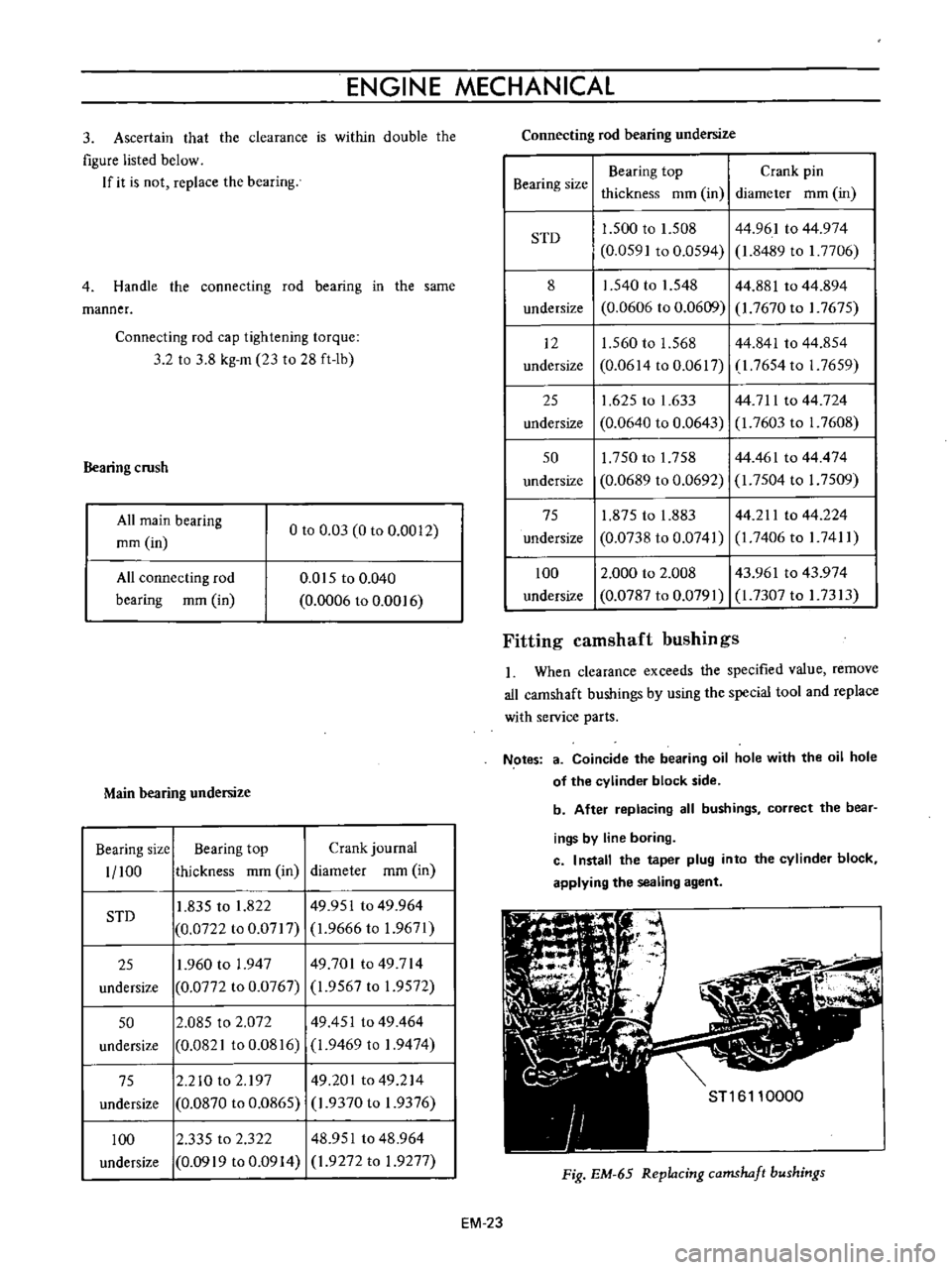
Main
bearing
undersize
Bearing
size
Bearing
top
Crank
journal
1
100
thickness
mm
in
diameter
mm
in
STD
1
835
to
1
822
49
951
to
49
964
0
0722
to
0
0717
1
9666
to
1
9671
25
1
960
to
1
947
49701
to
49
714
undersize
0
0772
to
0
0767
1
9567
to
1
9572
50
2
085
to
2
072
49451
to
49
464
undersize
0
0821
to
0
0816
1
9469
to
1
9474
75
2
210
to
2
197
49
201
to
49
214
undersize
0
0870
to
0
0865
1
9370
to
1
9376
100
2
335
to
2
322
48
951
to
48
964
undersize
0
0919
to
0
0914
1
9272
to
1
9277
Connecting
rod
bearing
undersize
Bearing
top
Crank
pin
Bearing
size
thickness
mm
in
diameter
mm
in
1
500
to
1
508
44
961
to
44
974
0
0591
to
0
0594
1
8489
to
I
7706
8
1
540
to
1
548
44
881
to
44
894
undersize
0
0606
to
0
0609
1
7670
to
I
7675
STD
12
1
560
to
1
568
44
841
to
44
854
undersize
0
0614
to
0
0617
I
7654
to
I
7659
25
1
625
to
1
633
44
711
to
44
724
undersize
0
0640
to
0
0643
1
7603
to
I
7608
50
I
750
to
1
758
44
461
to
44
474
undersize
0
0689
to
0
0692
1
7504
to
I
7509
75
1
875
to
1
883
44
211
to
44
224
undersize
0
0738
to
0
0741
1
7406
to
I
7411
100
2
000
to
2
008
43
961
to
43
974
undersize
0
0787
to
0
0791
1
7307
to
I
7313
Fitting
camshaft
bushings
When
clearance
exceeds
the
specified
value
remove
all
camshaft
bushings
by
using
the
special
tool
and
replace
with
service
parts
Notes
3
Coincide
the
bearing
oil
hole
with
the
oil
hole
of
the
cylinder
block
side
b
After
replacing
all
bushings
correct
the
bear
ings
by
line
boring
c
I
nstall
the
taper
plug
into
the
cylinder
block
applying
the
sealing
agent
Fig
EM
65
Replacing
camshaft
bushings
EM
23
Page 366 of 513
ENGINE
ST130300
1
EM156
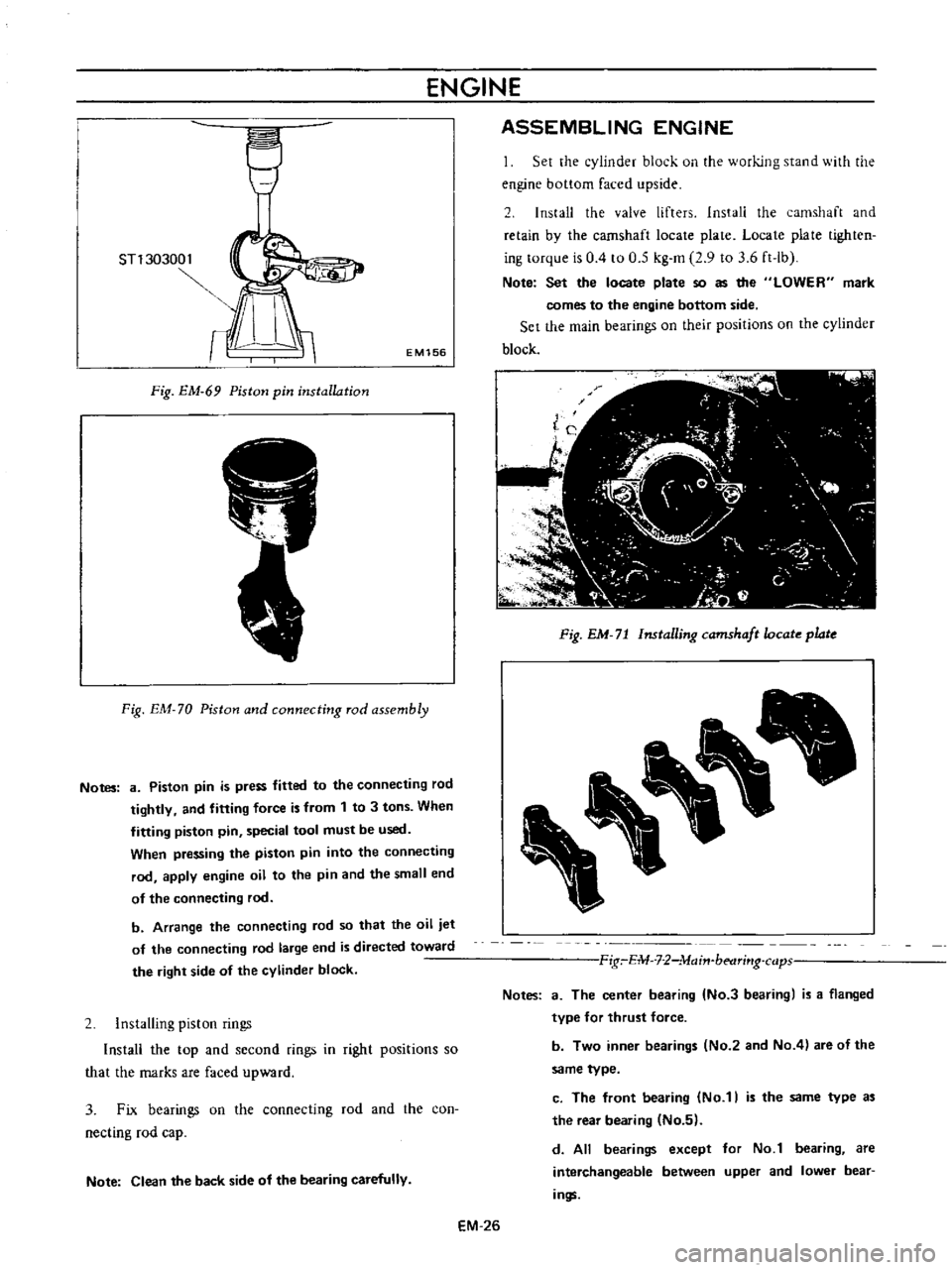
Fig
EM
69
Piston
pin
installation
Fig
EM
70
Piston
and
connecting
rod
assembly
Notes
8
Piston
pin
is
press
fitted
to
the
connecting
rod
tightly
and
fitting
force
is
from
1
to
3
tons
When
fitting
piston
pin
special
tool
must
be
used
When
pressing
the
piston
pin
into
the
connecting
rod
apply
engine
oil
to
the
pin
and
the
small
end
of
the
connecting
rod
b
Arrange
the
connecting
rod
so
that
the
oil
jet
of
the
connecting
rod
large
end
is
directed
toward
the
right
side
of
the
cylinder
block
2
Installing
piston
rings
Install
the
top
and
second
fings
in
right
positions
so
that
the
marks
are
faced
upward
3
Fix
bearings
on
the
connecting
rod
and
the
con
necting
rod
cap
Note
Clean
the
back
side
of
the
bearing
carefully
ASSEMBLING
ENGINE
Set
the
cylinder
block
on
the
working
stand
with
the
engine
bottom
faced
upside
2
Install
the
valve
lifters
Install
the
camshaft
and
retain
by
the
camshaft
locate
plate
Locate
plate
tighten
ing
torque
is
0
4
to
0
5
kg
m
2
9
to
3
6
ft
lb
Note
Set
the
locate
plate
so
as
the
LOWER
mark
comes
to
the
engine
bottom
side
Set
the
main
bearings
on
their
positions
on
the
cylinder
block
Fig
EM
71
Installing
camshaft
ocate
plate
Fig
E1U
7
2
lvlajn
betlrj
lg
cap
Notes
a
The
center
bearing
No
3
bearing
is
a
flanged
type
for
thrust
force
b
Two
inner
bearings
No
2
and
No
4
are
of
the
same
type
c
The
front
bearing
No
1
is
the
same
type
a
the
rear
bearing
No
5
d
All
bearings
except
for
No
1
bearing
are
interchangeable
between
upper
and
lower
bear
ings
EM
26
Page 367 of 513
ENGINE
MECHANICAL
3
Apply
engine
oil
to
the
main
bearing
surfaces
on
both
sides
of
the
cylinder
block
and
cap
Install
the
crankshaft
4
Install
the
main
bearing
cap
and
tighten
the
bolts
with
specified
torque
Tightening
torque
5
0
to
6
0
kg
m
36
to
43
ft
lb
Notes
a
Arrange
the
parts
so
that
the
arrow
mark
on
the
bearing
cap
is
faced
toward
the
front
of
the
engine
b
Prior
to
tightening
the
bearing
cap
bolts
place
the
bearing
cap
at
a
proper
position
by
shifting
the
crankshaft
in
the
axial
direction
c
Tighten
the
bearing
cap
bolts
gradually
in
separating
two
to
three
stages
and
outwardly
from
the
center
beari
ng
d
After
securing
the
bearing
cap
bolts
ascertain
that
the
crankshaft
can
be
easily
rotated
5
Make
sure
that
the
crankshaft
end
play
is
correct
Crankshaft
end
play
0
05
to
0
15
rom
0
0020
to
0
0059
in
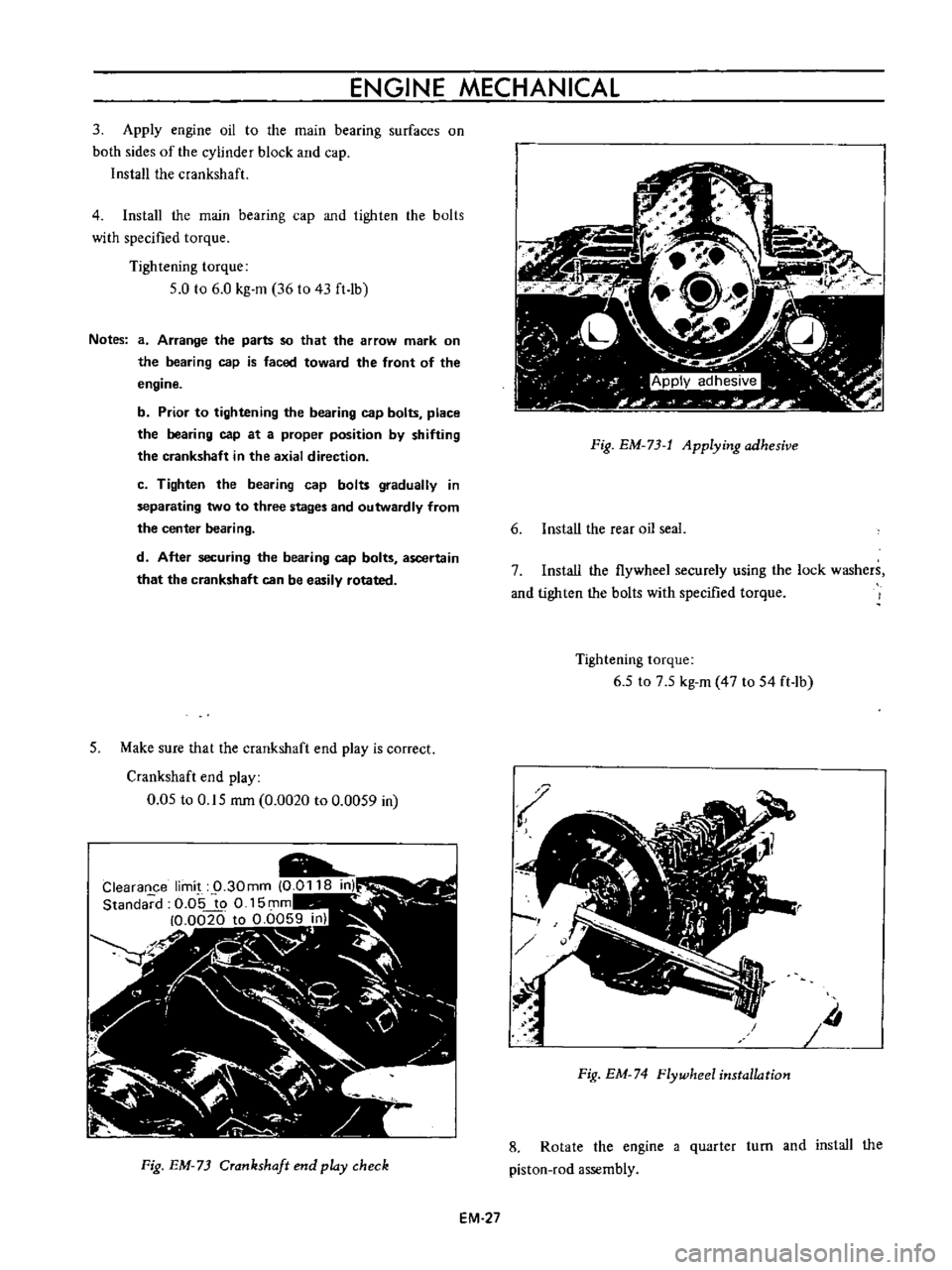
Fig
EM
73
Crankshaft
end
play
check
EM
27
Fig
EM
73
t
Applying
adhesive
6
Install
the
rear
oil
seal
7
Install
the
flywheel
securely
using
the
lock
washers
and
tighten
the
bolts
with
specified
torque
Tightening
torque
6
5
to
7
5
kg
m
47
to
54
ft
lb
Iii
Fig
EM
74
Flywheel
installation
8
Rotate
the
engine
a
quarter
turn
and
install
the
piston
rod
assembly
Page 370 of 513
ENGINE
17
Install
the
oil
strainer
and
the
oil
pan
using
the
gasket
Apply
sealing
agent
on
hath
surfaces
of
the
gasket
especially
on
the
front
and
rear
portions
of
the
oil
pan
Oil
pan
tightening
torque
0
4
to
0
6
kg
m
I
9
to
4
3
ft
lbJ
I
R
I
nvcrt
the
engine
and
install
the
cylinder
head
assembly
and
gasket
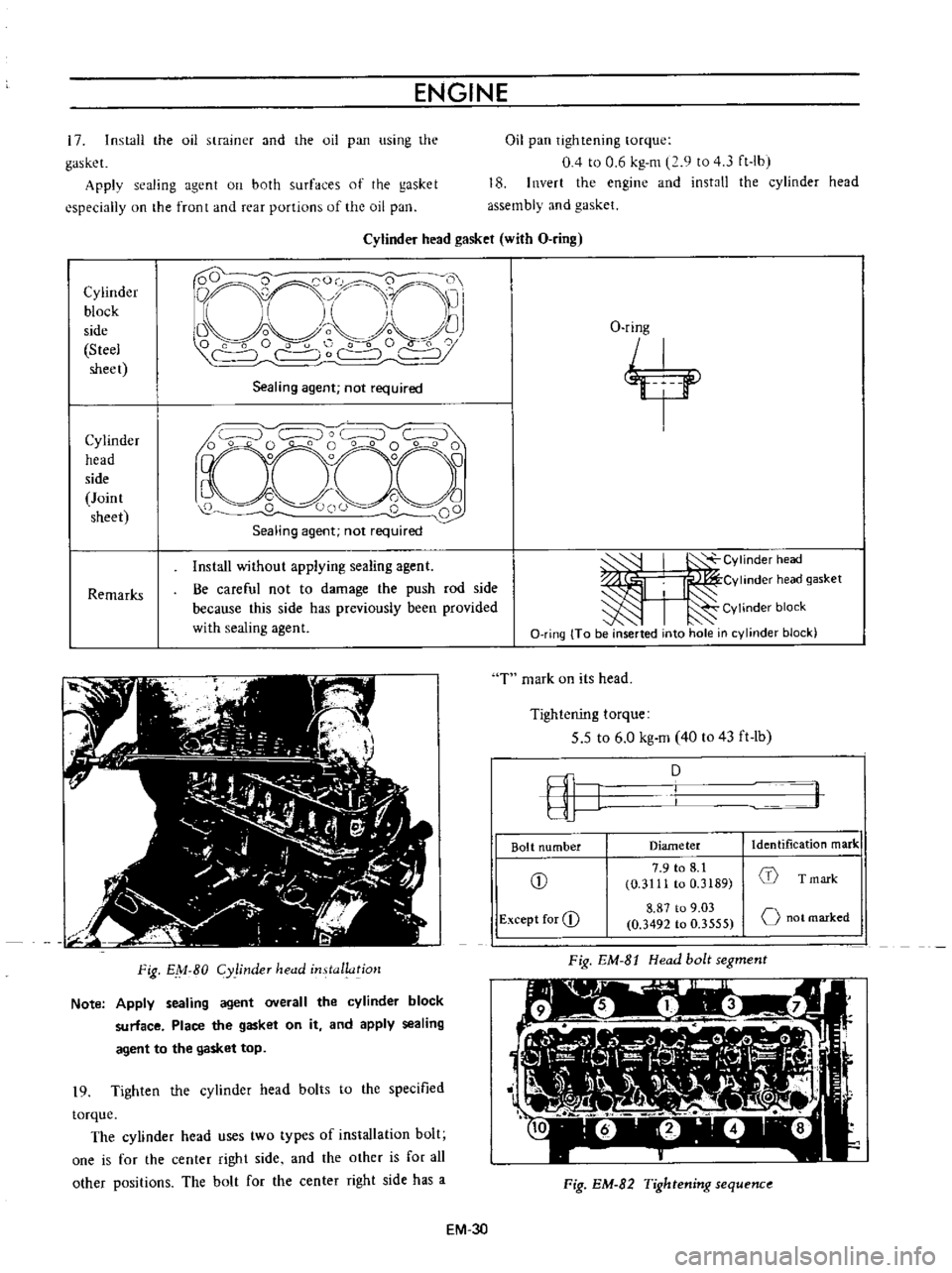
Cylinder
head
gasket
with
O
ring
Cylinder
block
side
Steel
sheet
D
QCO
0
0
i
O
1
nrr
11
I
Li
I
I
Vo
o
f
C
C
r
c
Sealing
agent
not
required
Cylinder
head
side
Joint
sheet
Remarks
Install
without
applying
sealing
agent
Be
careful
not
to
damage
the
push
rod
side
because
this
side
has
previously
been
provided
with
sealing
agent
Fig
EM
80
Cy
linder
head
installatjo
1
Note
Apply
sealing
agent
overall
the
cylinder
block
surface
Place
the
gasket
on
it
and
apply
sealing
agent
to
the
gasket
top
19
Tighten
the
cylinder
head
bolts
to
the
specified
torque
The
cylinder
head
uses
two
types
of
installation
bolt
one
is
for
the
center
right
side
and
the
other
is
for
all
other
positions
The
bolt
for
the
center
right
side
has
a
O
ring
j
I
Y
J
CYlinder
head
I
I
Cvlinderheadgasket
I
Cylinder
block
O
ring
To
be
inserted
into
hole
in
cylinder
block
T
mark
on
its
head
Tightening
torque
5
5
to
6
0
kg
m
40
to
43
ft
lb
fI
J
D
Bolt
number
Diameter
Identification
mark
CD
7
9
to
8
1
1
0
3111
to
0
3189
T
mark
Except
for
CD
8
87
to
9
03
o
not
marked
0
3492
to
0
3555
Fig
EM
8t
Head
bolt
segment
l
Fig
EM
82
Tightening
sequenc
EM
3D
Page 383 of 513
LUBRICATION
CIRCUIT
Oil
drawn
from
the
oil
pan
through
the
inlet
screen
and
tube
to
the
inlet
side
of
the
oil
pump
is
delivered
by
th
oil
pump
through
the
outlet
portion
of
the
oil
pump
and
the
oil
gallery
to
the
inlet
side
of
the
full
flow
oil
filter
and
to
the
main
oil
gallery
The
main
oil
gallery
supplies
oil
to
the
crankshaft
main
bearings
and
drilled
passages
in
the
crankshaft
and
thus
oil
is
fed
directly
from
the
main
bearings
to
the
connecting
rod
bearings
Oil
injected
from
jet
holes
on
connecting
rods
lubri
cates
the
cylinder
walls
and
pistion
pins
The
oil
distributed
from
the
main
gallery
enters
the
chain
teosioner
and
the
pad
is
held
against
the
chain
by
oil
pressure
and
spring
The
oil
also
lubricates
the
timing
chain
through
the
jet
hole
located
near
the
chain
Furthermore
lubricant
is
supplied
to
each
camshaft
bearing
through
each
crankshaft
main
bearing
and
finally
to
the
011
gallery
in
the
rocker
shaft
through
the
center
camshaft
bearing
The
rocker
arm
and
valve
are
lubricated
by
the
oil
through
the
oil
gallery
in
the
rockershaft
To
this
oil
gallery
lubricant
is
supplied
through
the
center
camshaft
bearing
as
shown
in
Figure
EL
I
OIL
PUMP
Description
The
oil
pump
assembly
is
installed
on
the
bottom
of
the
cylinder
block
and
driven
by
the
distributor
drive
shaft
assembly
The
oil
pump
is
of
a
rotor
type
The
oil
pressure
is
regulated
by
the
regulator
valve
camshaft
Removal
Engine
in
vehicle
Drain
engine
oil
2
Remove
the
frunt
stabilizer
3
Remove
the
splash
shield
board
4
Detach
the
oil
pump
body
together
with
drive
gear
spindle
ENGINE
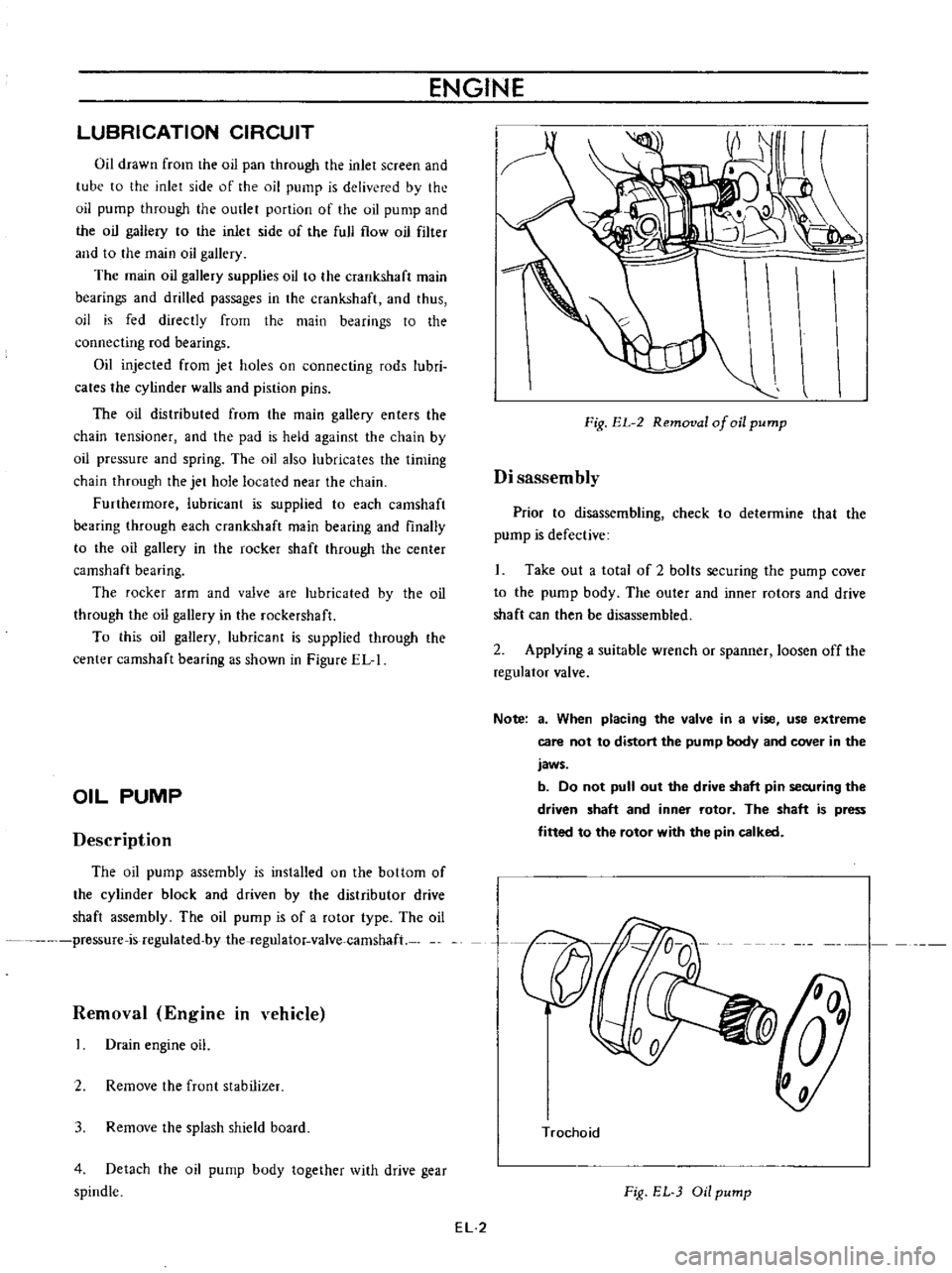
Fig
EL
2
Removal
of
oil
pump
Disassembly
Prior
to
disassembling
check
to
determine
that
the
pump
is
defective
Take
out
a
total
of
2
bolts
securing
the
pump
cover
to
the
pump
body
The
outer
and
inner
rotors
and
drive
shaft
can
then
be
disassembled
2
Applying
a
suitable
wrench
or
spanner
loosen
off
the
regulator
valve
Note
a
When
placing
the
valve
in
a
vise
use
extreme
care
not
to
distort
the
pump
body
and
cover
in
the
jaws
b
Do
not
pull
out
the
drive
shaft
pin
securing
the
driven
shaft
and
inner
rotor
The
shaft
is
press
fitted
to
the
rotor
with
the
pin
calked
n
Trochoid
Fig
EL
Oil
pump
EL
2
Page 387 of 513
COOLING
SYSTEM
COOLING
SYSTEM
CONTENTS
DESCRIPTION
WATER
PUMP
Removal
THERMOSTAT
Removal
Inspection
CO
1
CO
2
CO
2
CO
2
CO
2
CO
2
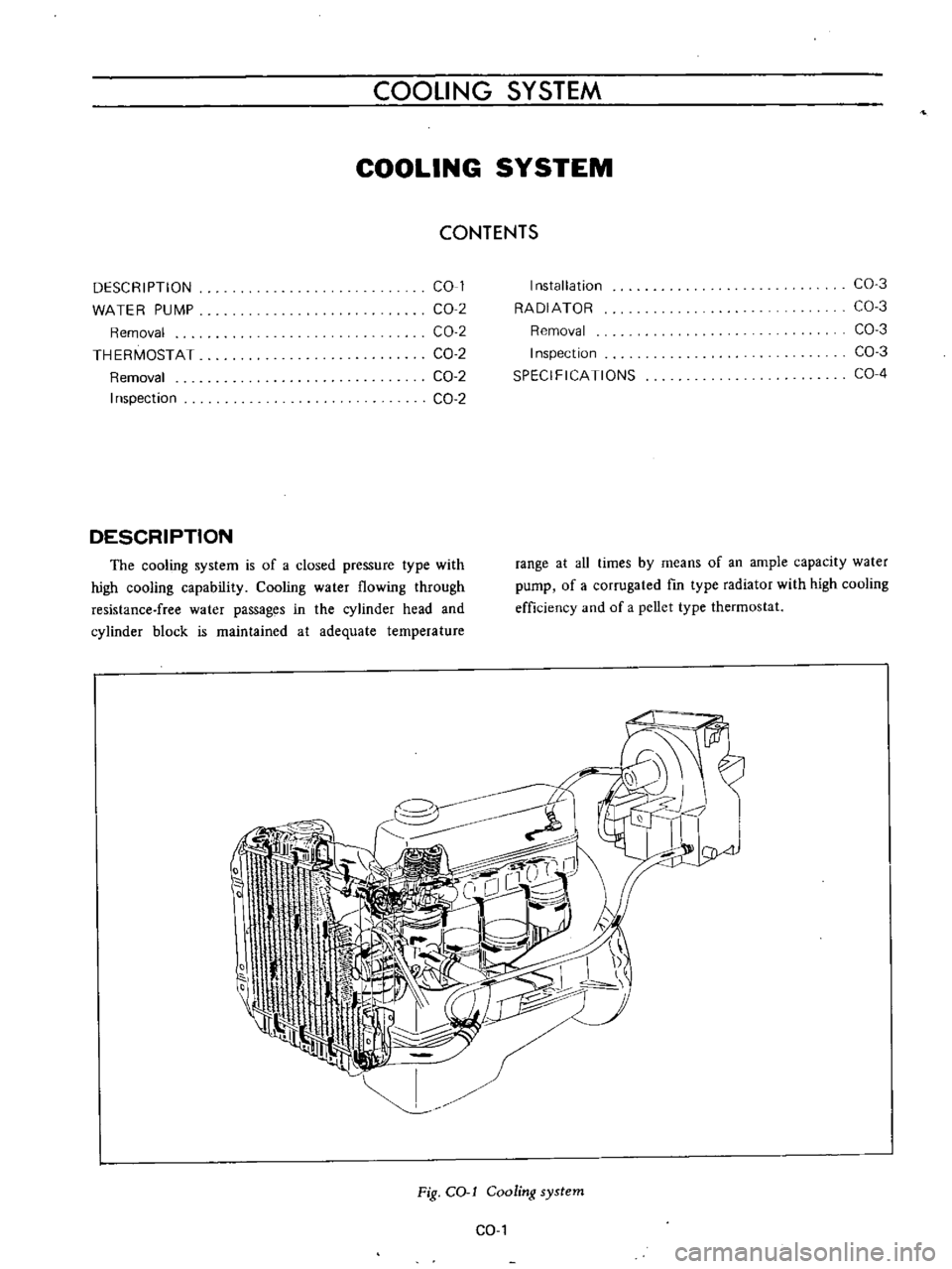
DESCRIPTION
The
cooling
system
is
of
a
closed
pressure
type
with
high
cooling
capability
Cooling
water
flowing
through
resistance
free
water
passages
in
the
cylinder
head
and
cylinder
block
is
maintained
at
adequate
temperature
Installation
RADIATOR
Removal
Inspection
SPECIFICATIONS
CO
3
CO
3
CO
3
CO
3
CO
4
range
at
aU
times
by
means
of
an
ample
capacity
water
pump
of
a
corrugated
fm
type
radiator
with
high
cooling
efficiency
and
of
a
pellet
type
thermostat
I
I
I
0
Jrl
oA
Fig
COol
Cooling
system
CO
I
Page 399 of 513
ENGINE
INSPECTION
Check
the
upper
and
lower
bodies
for
cracks
2
Check
the
valve
assembly
for
wear
of
the
valve
and
valve
spring
Blow
the
valve
assembly
by
breath
to
examine
its
function
3
Check
the
diaphragm
for
small
holes
cracks
and
wear
4
Check
the
rocker
arm
for
wear
at
the
portion
in
contact
with
the
camshaft
5
Check
the
rocker
arm
pin
for
wear
since
a
worn
pin
may
cause
oil
leakage
6
Check
all
other
components
for
any
abnormalities
and
replace
with
new
parts
as
required
ASSEMBLY
Assembly
is
done
in
reverse
order
of
disassembly
For
reassembly
and
reinstallation
the
following
matters
should
be
noted
Use
new
gasket
2
Lubricate
the
rocker
arm
link
rocker
arm
pin
and
lever
pin
before
installation
3
To
test
the
function
position
the
fuel
pump
assem
bly
about
I
meter
3
3
ft
above
fuel
level
with
a
pipe
connecting
the
fuel
pump
and
the
fuel
strainer
and
operate
the
rocker
afm
by
hand
If
fuel
is
drawn
up
soon
after
the
rocker
arm
is
released
the
function
of
the
pump
is
satisfactory
CARBURETOR
CONTENTS
DESCRIPTION
STRUCTURE
AND
OPERATION
EF
8
EF
9
EF
10
EF
11
EF
12
EF
12
EF
12
EF
14
EF
14
EF
15
EF
15
EF
16
EF
16
Primary
system
Secondary
system
Anti
dieseling
solenoid
valve
Float
system
Electric
automatic
choke
ADJUSTMENT
Idling
adjustment
Fuel
level
adjustment
Fast
idle
adjustment
Vacuum
break
adjustment
Choke
un
loader
adjustment
DESCRIPTION
The
carburetors
are
of
a
downdraft
type
which
is
designed
and
built
to
increase
power
and
fuel
economy
as
Bi
metal
setting
Adjustment
of
interlock
opening
of
primary
and
secondary
throttle
valves
Dash
pot
adjustment
MAJOR
SERVICE
OPERATIONS
Removal
Disassembly
Cleaning
and
inspection
Assembly
and
installation
JETS
SERVICE
DATA
AND
SPECIFICATIONS
TROUBLE
DIAGNOSES
AND
CORRECTIONS
EF
17
EF
18
EF
18
EF
19
EF
19
EF
19
EF
21
EF
22
EF
22
EF
22
EF
22
well
as
to
reduce
the
emission
of
exhaust
gases
These
carburetors
present
several
distinct
features
of
importance
to
the
car
owners
A
summary
of
features
is
as
follows
EF
8
Page 403 of 513
ENGINE
Step
system
The
construction
of
this
system
corresponds
to
the
idling
and
slow
system
of
the
primary
system
This
system
aims
at
the
power
filling
up
of
the
gap
when
fuel
supply
is
transferred
from
the
primary
system
to
the
secondary
system
The
step
port
is
located
near
the
auxiliary
valve
in
its
fully
closed
state
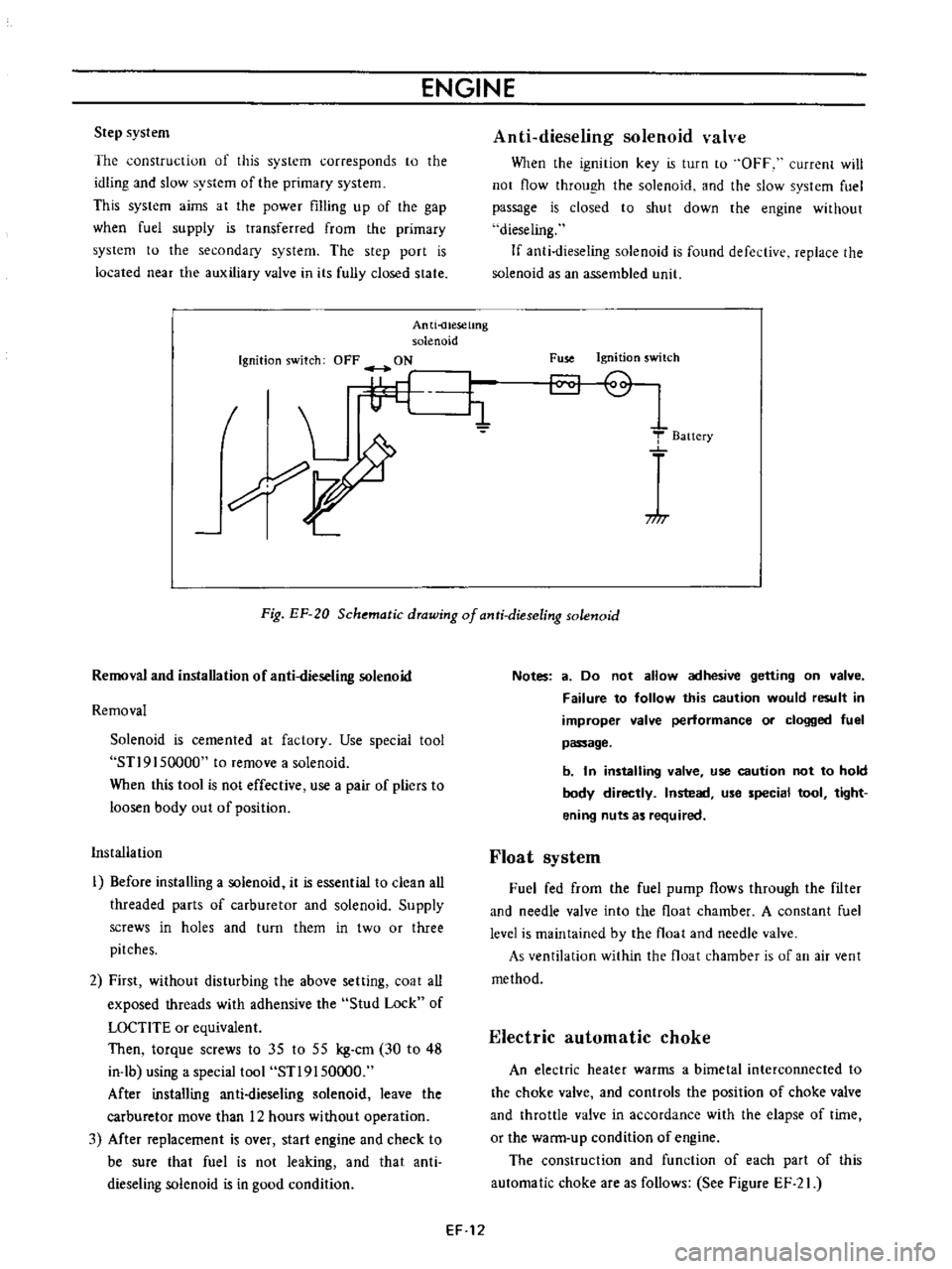
Anti
uesetmg
solenoid
Ignition
switch
OFF
ON
I
L
i1
7
I
Anti
dieseling
solenoid
valve
When
the
ignition
key
is
turn
to
OFF
current
will
not
flow
through
the
solenoid
and
the
slow
system
fuel
passage
is
closed
to
shut
down
the
engine
without
dieseling
If
anti
dieseling
solenoid
is
found
defective
replace
the
solenoid
as
an
assembled
llnit
Fuse
Ignition
switch
T
Baitery
717
Fig
EF
20
Schematic
drawing
of
anti
dieseling
solenoid
Removal
and
installation
of
anti
dieseling
solenoid
Removal
Solenoid
is
cemented
at
factory
Use
special
tool
STl9
I
50000
to
remove
a
solenoid
When
this
tool
is
not
effective
use
a
pair
of
pliers
to
loosen
body
out
of
position
Installation
I
Before
installing
a
solenoid
it
is
essential
to
clean
all
threaded
parts
of
carburetor
and
solenoid
Supply
screws
in
holes
and
turn
them
in
two
or
three
pitches
2
First
without
disturbing
the
above
setting
coat
all
exposed
threads
with
adhensive
the
Stud
Lock
of
LOCTlTE
or
equivalent
Then
torque
screws
to
35
to
55
kg
cm
30
to
48
in
lb
using
a
special
tool
STl9150000
After
installing
anti
dieseling
solenoid
leave
the
carburetor
move
than
12
hours
without
operation
3
Mter
replacement
is
over
start
engine
and
check
to
be
sure
that
fuel
is
not
leaking
and
that
anti
dieseling
solenoid
is
in
good
condition
Notes
a
Do
not
allow
adhesive
getting
on
valve
Failure
to
follow
this
caution
would
result
in
improper
valve
performance
or
clogged
fuel
passage
b
In
installing
valve
use
caution
not
to
hold
body
directly
Instead
use
special
tool
tight
ening
nuts
as
required
Float
system
Fuel
fed
from
the
fuel
pump
flows
through
the
filter
and
needle
valve
into
the
float
chamber
A
constant
fuel
level
is
maintained
by
the
float
and
needle
valve
As
ventilation
within
the
float
chamber
is
of
an
air
vent
method
Electric
automatic
choke
An
electric
heater
warms
a
bimetal
interconnected
to
the
choke
valve
and
controls
the
position
of
choke
valve
and
throttle
valve
in
accordance
with
the
elapse
of
time
or
the
warm
up
condition
of
engine
The
construction
and
function
of
each
part
of
this
automatic
choke
are
as
follows
See
Figure
EF
21
EF
12
Page 405 of 513
ENGINE
AD
JUSTMENT
Idling
adjustment
Idle
mixture
adjustment
requires
the
use
of
a
CO
meter
When
preparing
to
adjust
idle
mixture
it
is
essential
to
have
the
meter
thoroughly
warmed
and
calibrated
Warm
up
the
engine
sufficiently
2
Continue
engine
operation
for
one
minute
under
idling
speed
3
Adjust
throttle
adjusting
screw
so
that
engine
speed
is
800
rpm
in
N
position
for
automatic
transmission
4
Check
ignition
timing
if
necessary
adjust
it
to
the
specifications
Ignition
timing
50
800
rpm
5
Adjust
idle
adjusting
screw
so
that
ca
percentage
is
1
5
t
0
5
6
Repeat
the
adjustments
as
described
in
steps
3
and
5
above
so
that
ca
percentage
is
1
5
to
5
at
800
rpm
Cautions
a
On
automatic
transmission
equipped
model
check
must
be
done
in
the
0
position
Be
sure
to
apply
parking
brake
and
to
lock
both
front
and
rear
wheels
with
wheel
chocks
b
Hold
brake
pedal
while
stepping
down
on
accelerator
pedal
Otherwise
car
will
rush
out
dangerously
7
On
automatic
transmission
equipped
model
make
sure
that
the
adjustment
has
been
made
with
the
selector
lever
in
N
position
And
then
check
the
specifications
with
the
lever
in
D
position
Insure
that
CO
percent
and
idle
speed
are
as
follows
Idle
rpm
650
ca
percentage
with
lever
in
D
position
15
to
5
If
necessary
adjust
by
progressively
turning
throttle
adjusting
screw
and
idle
adjusting
screw
until
correct
adjustments
are
made
Notes
a
Do
not
attempt
to
screw
down
the
id
Ie
adjusting
screw
completely
to
avoid
damage
to
the
EF
14
tip
which
will
tend
to
cause
malfunctions
b
After
idle
adjustment
has
been
made
shift
the
lever
to
N
or
p
position
for
automatic
transmission
c
Remove
wheel
chocks
before
starting
the
car
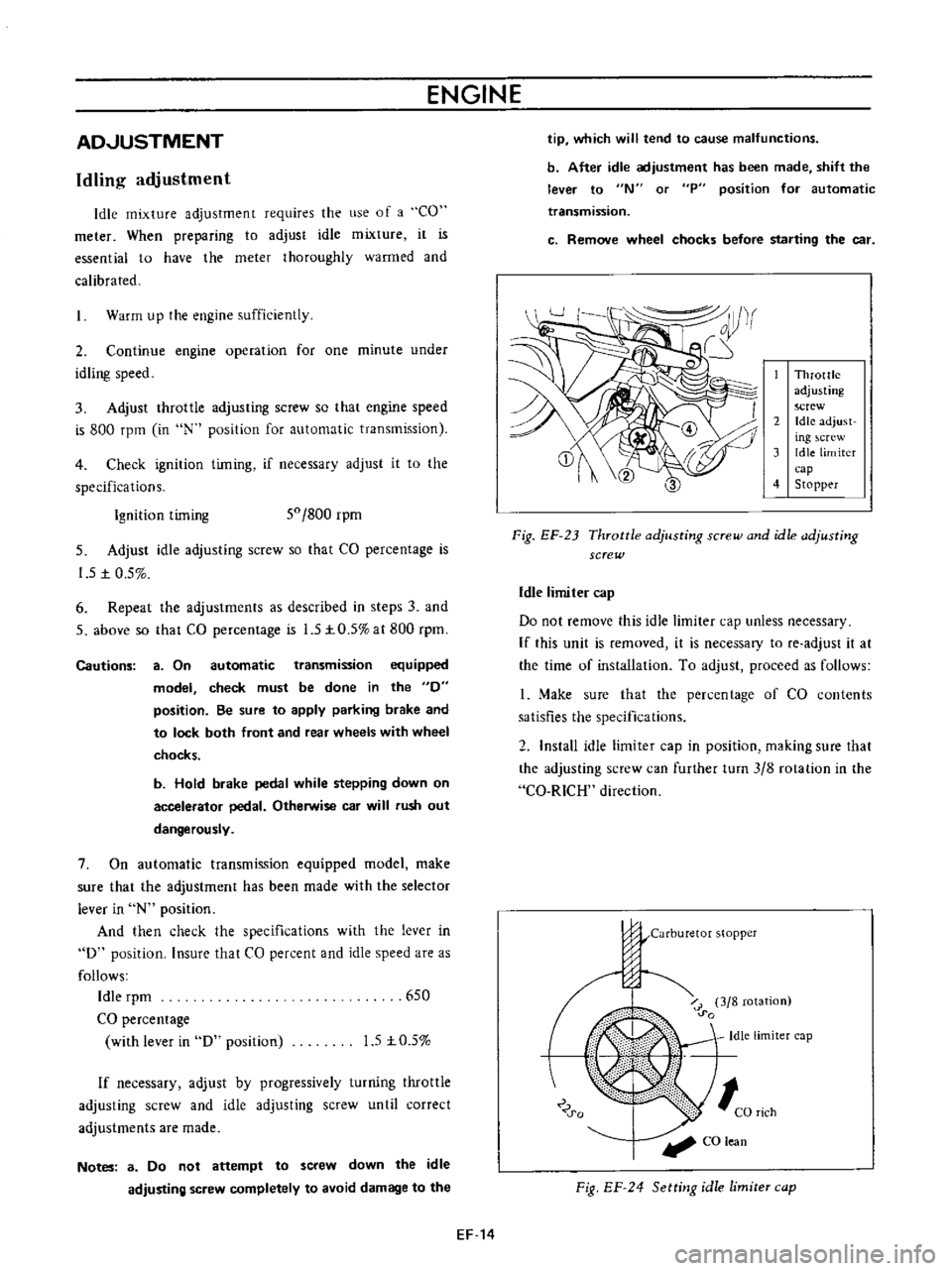
Throttle
adjusting
screw
2
Idle
adjust
ing
crew
3
Idle
limiter
cap
4
Stopp
r
Fig
EF
23
Throttle
adjusting
screw
and
idle
adjusting
screw
Idle
limiter
cap
Do
not
remove
this
idle
limiter
cap
unless
necessary
If
this
unit
is
removed
it
is
necessary
to
fe
adjust
it
at
the
time
of
installation
To
adjust
proceed
as
follows
1
Make
sure
that
the
percentage
of
CO
contents
satisfies
the
specifications
2
Install
idle
limiter
cap
in
position
making
sure
that
the
adjusting
screw
can
further
turn
3
8
rotation
in
the
Ca
RICH
direction
j
j
Carburetor
stopper
o
u
o
i
r
3
8
rotation
0
0
Idle
limiter
cap
0
0
CO
lean
Fig
EF
24
Setting
idle
limite
cap