ignition DATSUN B110 1973 Service Owner's Manual
[x] Cancel search | Manufacturer: DATSUN, Model Year: 1973, Model line: B110, Model: DATSUN B110 1973Pages: 513, PDF Size: 28.74 MB
Page 311 of 513
ENGINE
4
Install
a
timing
light
on
No
cylinder
spark
plug
wire
and
install
a
tachometer
5
Set
idling
speed
to
approximately
800
rpm
6
Check
ignition
timing
if
it
is
50BTDC
Before
Top
of
Dead
Center
by
the
use
of
timing
light
If
necessary
adjust
it
as
follows
Loosen
set
screw
to
such
an
extent
that
distributor
can
be
moved
by
hand
2
Adjust
ignition
timing
to
50BTDC
3
Lock
distributor
set
screw
and
make
sure
that
timing
is
correct
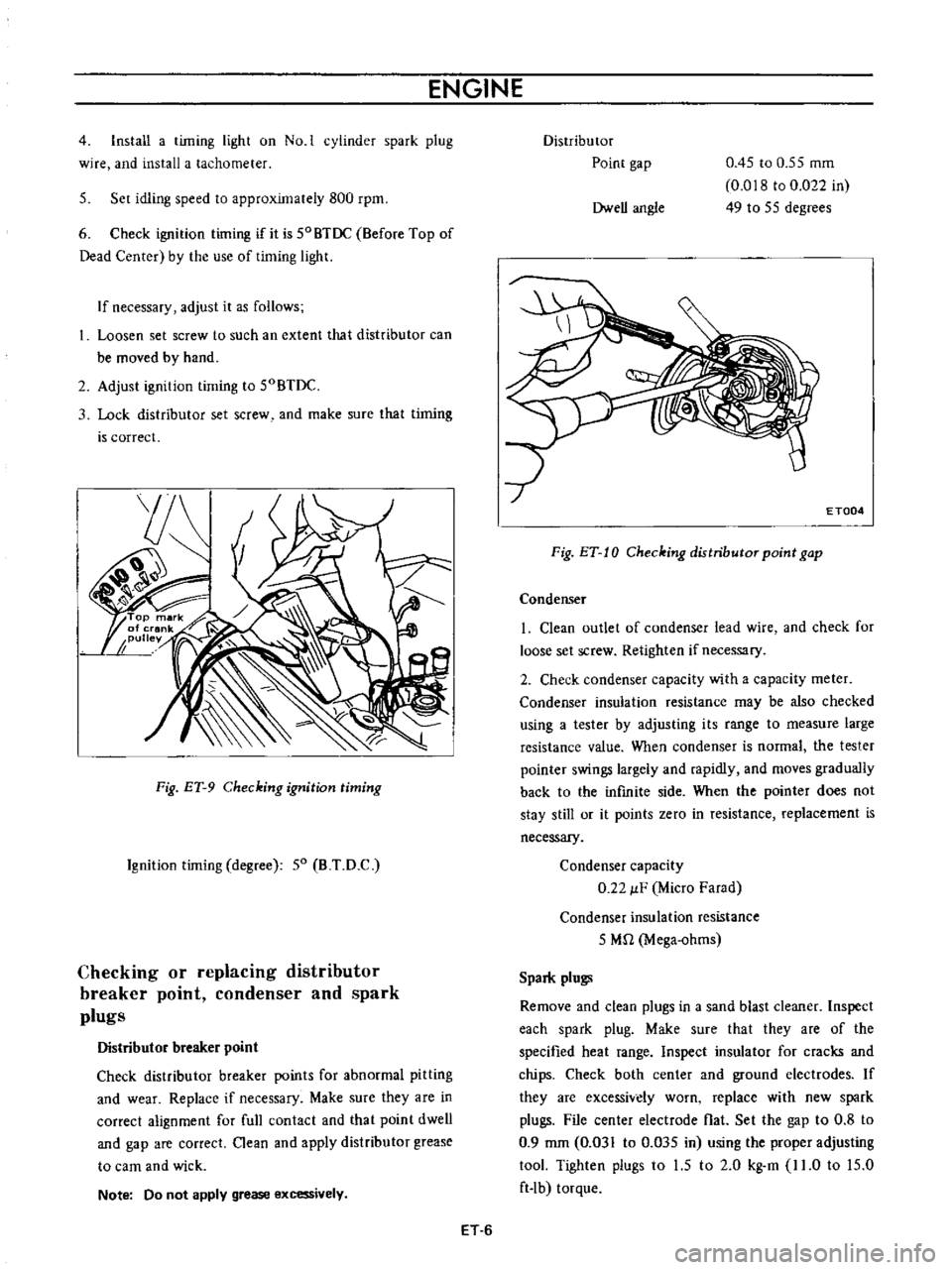
Fig
ET
9
Checking
ignition
timing
Ignition
timing
degree
50
B
T
D
C
Checking
or
replacing
distributor
breaker
point
condenser
and
spark
plugs
Distributor
breaker
point
Check
distributot
breaker
points
for
abnormal
pitting
and
wear
Replace
if
necessary
Make
sure
they
are
in
correct
alignment
for
full
contact
and
that
point
dwell
and
gap
are
correct
Clean
and
apply
distributor
grease
to
earn
and
wick
Note
Do
not
apply
grease
excessively
Distributor
Point
gap
0
45
to
0
55
mm
0
018
to
0
Q22
in
49
to
55
degrees
Dwell
angle
ET004
Fig
ET
10
Checking
distributor
point
gap
Condenser
I
Clean
outlet
of
condenser
lead
wire
and
check
for
loose
set
screw
Retighten
if
necessary
2
Check
condenser
capacity
with
a
capacity
meter
Condenser
insulation
resistance
may
be
also
checked
using
a
tester
by
adjusting
its
range
to
measure
large
resistance
value
When
condenser
is
normal
the
tester
pointer
swings
largely
and
rapidly
and
moves
gradually
back
to
the
infmite
side
When
the
pointet
does
not
stay
still
or
it
points
zero
in
resistance
replacement
is
necessary
Condenser
capacity
0
221LF
Micro
Farad
Condenser
insulation
resistance
5
Mn
Mega
ohms
Spark
plugs
Remove
and
clean
plugs
in
a
sand
blast
cleaner
Inspect
each
spark
plug
Make
sure
that
they
are
of
the
specified
heat
tange
Inspect
insulator
for
cracks
and
chips
Check
both
center
and
ground
electrodes
If
they
are
excessi
ely
worn
replace
with
new
spark
plugs
File
center
electrode
flat
Set
the
gap
to
0
8
to
0
9
rom
0
031
to
0
035
in
using
the
proper
adjusting
tool
Tighten
plugs
to
1
5
to
2
0
kg
m
11
0
to
15
0
ft
lb
torque
ET
6
Page 312 of 513
EMISSION
CONTROL
AND
TUNE
UP
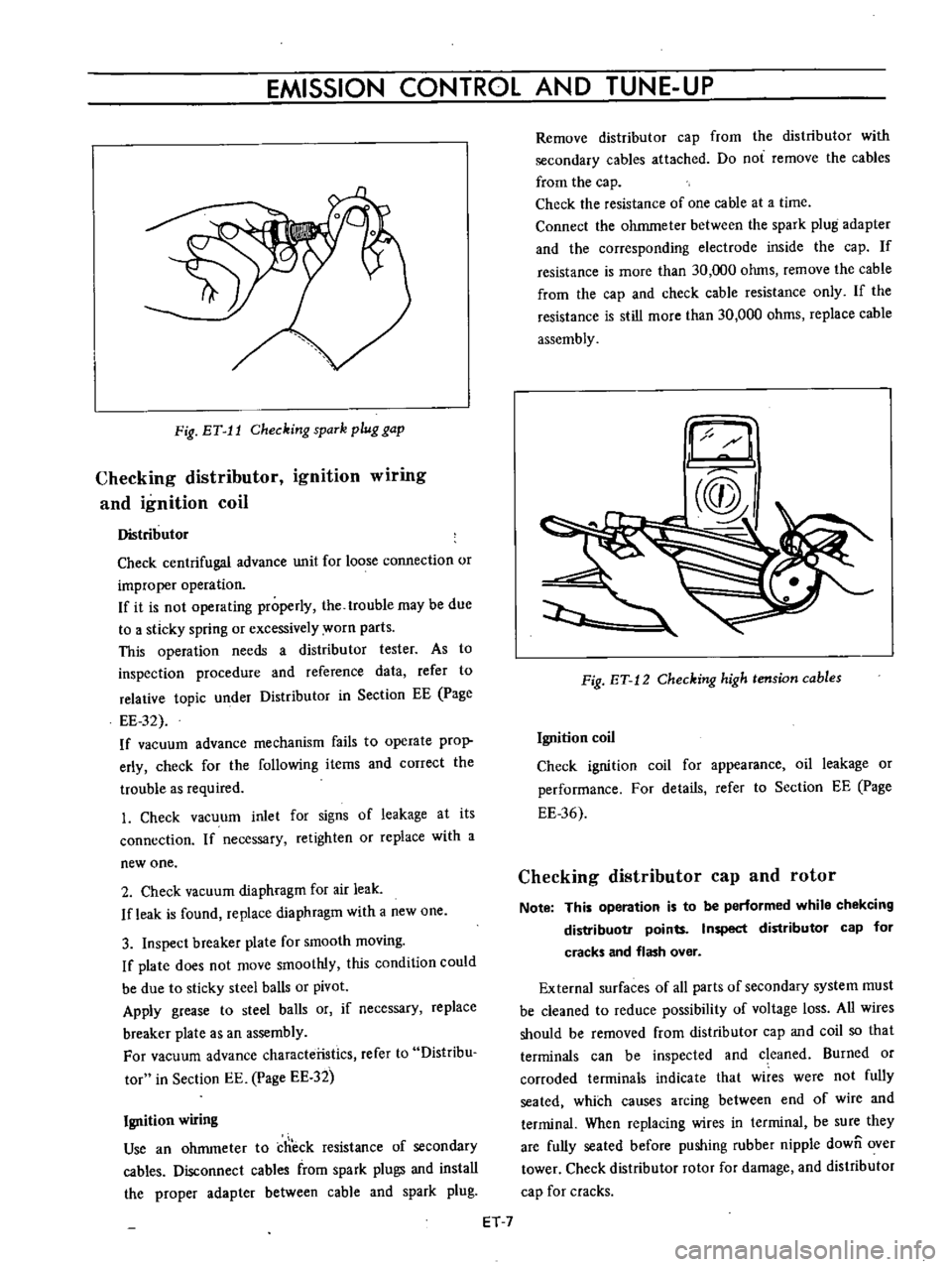
Fig
ET
11
Checking
spark
plug
gap
Checking
distributor
ignition
wiring
and
ignition
coil
Distributor
Check
centrifugal
advance
unit
for
loose
connection
or
improper
operation
If
it
is
not
operating
properly
the
trouble
may
be
due
to
a
sticky
spring
or
excessively
worn
parts
This
operation
needs
a
distributor
tester
As
to
inspection
procedure
and
reference
data
refer
to
relative
topic
under
Distributor
in
Section
EE
Page
EE
32
If
vacuum
advance
mechanism
fails
to
operate
proJr
erly
check
for
the
following
items
and
correct
the
trouble
as
required
1
Check
vacuum
inlet
for
signs
of
leakage
at
its
connection
If
necessary
retighten
or
replace
with
a
new
one
2
Check
vacuum
diaphragm
for
air
leak
If
leak
is
found
replace
diaphragm
with
a
new
one
3
Inspect
breaker
plate
for
smooth
moving
If
plate
does
not
move
smoothly
this
condition
could
be
due
to
sticky
steel
balls
or
pivot
Apply
grease
to
steel
balls
or
if
necessary
replace
breaker
plate
as
an
assembly
For
vacuum
advance
characteristics
refer
to
Distribu
tor
in
Section
EE
Page
EE
32
Ignition
wiring
Use
an
ohmmeter
to
check
resistance
of
secondary
cables
Disconnect
cables
from
spark
plugs
and
install
the
proper
adapter
between
cable
and
spark
plug
Remove
distributor
cap
from
the
distributor
with
secondary
cables
attached
Do
not
remove
the
cables
from
the
cap
Check
the
resistance
of
one
cable
at
a
time
Connect
the
ohmmeter
between
the
spark
plug
adapter
and
the
corresponding
electrode
inside
the
cap
If
resistance
is
more
than
30
000
ohms
remove
the
cable
from
the
cap
and
check
cable
resistance
only
If
the
resistance
is
still
more
than
30
000
ohms
replace
cable
assembly
T
I
II
Fig
ET
12
Checking
high
tension
cables
Ignition
coil
Check
ignition
coil
for
appearance
oil
leakage
or
performance
For
details
refer
to
Section
EE
Page
EE36
Checking
distributor
cap
and
rotor
Note
This
operation
is
to
be
performed
while
chekcing
distribuotr
points
Inspect
distributor
cap
for
cracks
and
flash
over
External
surfaces
of
all
parts
of
secondary
system
must
be
cleaned
to
reduce
possibility
of
voltage
loss
All
wires
should
be
removed
from
distributor
cap
and
coil
so
that
terminals
can
be
inspected
and
cleaned
Burned
or
corroded
terminals
indicate
that
wires
were
not
fully
seated
which
causes
arcing
between
end
of
wire
and
terminal
When
replacing
wires
in
terminal
be
sure
they
are
fully
seated
before
pushing
rubber
nipple
down
over
tower
Check
distributor
rotor
for
damage
and
distributor
cap
for
cracks
ET
7
Page 313 of 513
ENGINE
Adjusting
carburetor
idle
rpm
mixture
ratio
Idle
mixture
adjustment
requires
the
use
of
a
CO
meter
When
preparing
to
adjust
idle
mixture
it
is
essential
to
have
the
meter
thoroughly
warmed
and
calibrated
Warm
up
the
engine
sufficiently
2
Continue
engine
operation
for
one
minute
under
idling
speed
3
Adjust
throttle
adjusting
screw
so
that
engine
speed
is
800
rpm
in
NO
position
for
automatic
transmission
4
Check
ignition
timing
if
necessary
adjust
it
to
the
specifications
Ignition
timing
SO
800
rpm
S
Adjust
idle
adjusting
screw
so
that
CO
percentage
is
1
5
t
O
S
6
Repeat
the
adjustments
as
described
in
steps
3
and
S
above
so
that
CO
percentage
is
I
i
t
O
S
at
800
rpm
Cautions
a
On
automatic
transmission
equipped
model
check
must
be
done
in
the
0
position
Be
sure
to
apply
parking
brake
and
to
lock
both
front
and
rear
wheels
with
wheel
chocks
b
Hold
brake
pedal
while
stepping
down
on
accelerator
pedal
Otherwise
car
will
rush
out
dangerously
7
On
automatic
transmission
equipped
model
make
sure
that
the
adjustment
has
been
made
with
the
selector
lever
in
N
position
And
then
check
the
specifications
with
the
lever
in
D
position
Insure
that
CO
percent
and
idle
speed
are
as
follows
Idle
rpm
CO
percentage
with
lever
in
D
position
6S0
I
S
t
O
S
If
necessary
adjust
by
progressively
turning
throttle
adjusting
screw
and
idle
adjusting
screw
until
correct
adjustments
are
made
Notes
a
Do
not
attempt
to
screw
down
the
idle
adjusting
screw
completely
to
avoid
damage
to
the
tip
which
will
tend
to
cause
malfunctions
b
After
idle
adjustment
has
been
made
shift
the
lever
to
N
or
p
position
for
automatic
transmission
c
Remove
wheel
chocks
before
starting
the
car
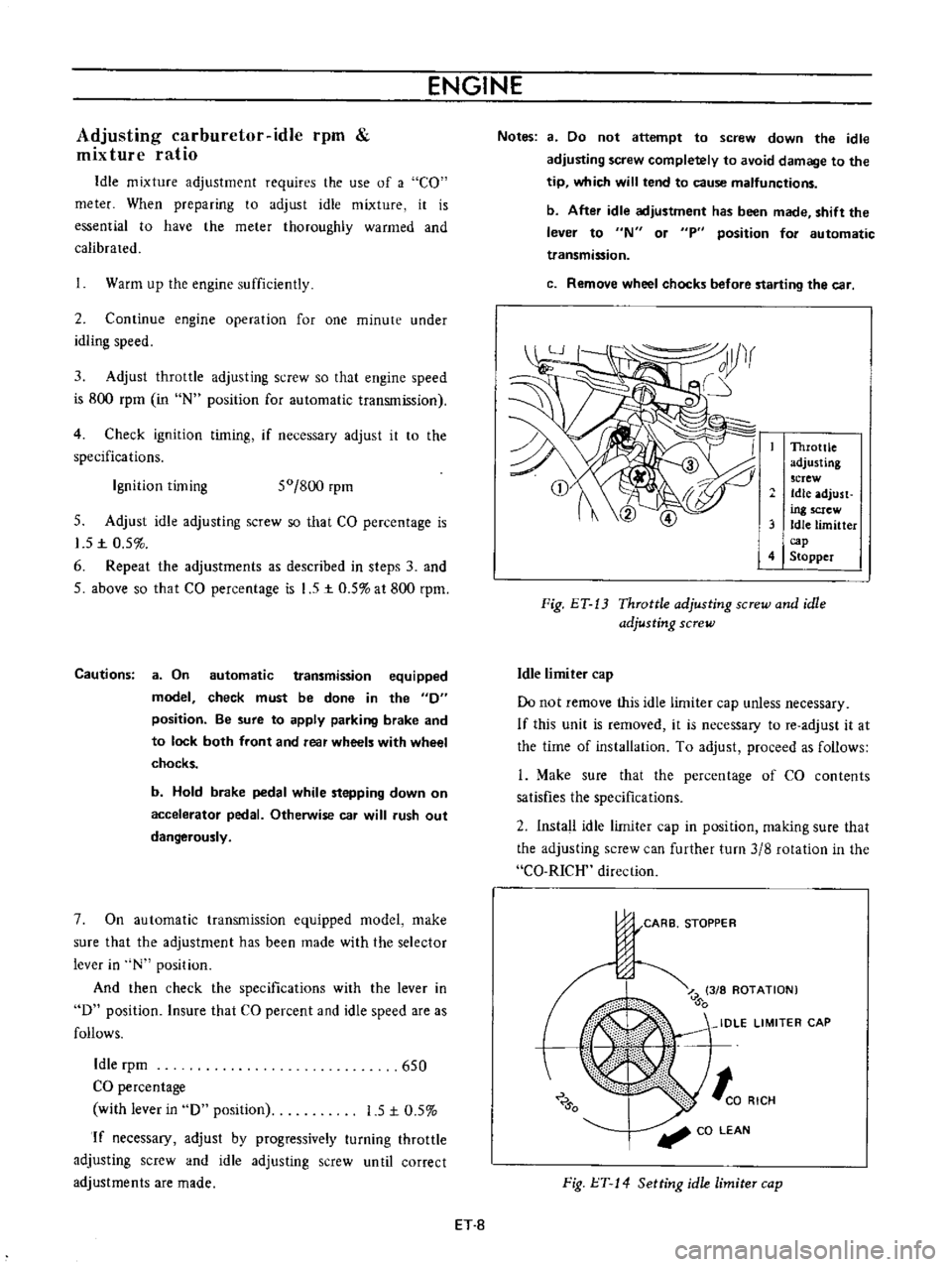
Throttle
adjusting
screw
Idle
adjust
ing
screw
3
Idle
limitter
cap
4
Stopper
Fig
ET
13
Throttle
adjusting
screw
and
idle
adjusting
screw
Idle
limiter
cap
Do
not
remove
this
idle
limiter
cap
unless
necessary
If
this
unit
is
removed
it
is
necessary
to
re
adjust
it
at
the
time
of
installation
To
adjust
proceed
as
follows
L
Make
sure
that
the
percentage
of
CO
contents
satisfies
the
specifications
2
Install
idle
limiter
cap
in
position
making
sure
that
the
adjusting
screw
can
further
turn
3
8
rotation
in
the
CO
RICH
direction
CARB
STOPPER
J
Z
3
8
ROTATION
0
IDLE
LIMITER
CAP
0
to
RICH
CO
LEAN
Fig
l
T
14
Setting
idle
limiter
cap
ET
8
Page 314 of 513
EMISSION
CONTROL
AND
TUNE
UP
Checking
and
adjusting
dash
pot
automatic
transmission
model
only
Check
operation
of
dash
pot
It
should
not
be
cracked
or
bound
It
is
also
essential
to
check
to
be
certain
that
it
is
in
correct
adjustment
L
Check
to
be
sure
that
dash
pot
contacts
stopper
lever
when
engine
speed
reaches
1
900
to
2
000
rpm
2
Engine
should
be
slowed
down
from
3
000
to
1
000
rpm
within
a
few
seconds
Readjust
dash
pot
or
replace
it
with
a
new
one
if
it
fails
to
meet
the
above
conditions
Checking
carburetor
return
spring
Check
throttle
return
spring
for
sign
of
damage
wear
or
squareness
Discard
spring
if
found
with
any
of
above
excessively
beyond
use
Checking
choke
mechanism
choke
valve
and
linkage
1
Check
choke
valve
and
mechanism
for
free
operation
and
clean
or
replace
if
necessary
A
binding
condition
may
have
developed
from
petro
leum
gum
for
motion
on
choke
shaft
or
from
damage
2
Check
bimetal
cover
setting
position
The
index
mark
of
bimetal
cover
is
usually
aligned
at
the
middle
point
of
the
scale
Note
When
somewhat
over
choked
turn
bimetal
caver
clockwise
slightly
3
Prior
to
starting
check
to
be
sure
that
choke
valve
closes
automatically
when
pressing
down
on
accelerator
pedal
Should
it
fail
to
close
automatically
the
likelihood
is
that
fast
idle
cam
is
out
of
proper
adjustment
or
that
bimetal
is
not
properly
adjusted
calling
for
adjustment
Refer
to
Carburetor
in
Section
EF
Page
EF
15
Checking
anti
dieseling
solenoid
If
engine
will
not
stop
when
ignition
switch
is
turned
off
this
indicates
a
striking
closed
solenoid
valve
shutting
off
supply
of
fuel
to
engine
If
harness
is
in
good
condition
replace
solenoid
as
a
unit
To
replace
proceed
as
follows
Removal
and
installation
of
anti
dieseling
solenoid
Removal
Solenoid
is
cemented
at
factory
Use
special
tool
STl
91
50000
to
remove
a
solenoid
When
this
tool
is
not
effective
use
a
pair
of
pliers
to
loosen
body
out
of
position
lnstalltion
I
Before
installing
a
solenoid
it
is
essential
to
clean
all
threaded
parts
of
carburetor
and
solenoid
Supply
screws
in
holes
and
turn
them
in
two
or
three
pitches
2
First
without
disturbing
the
above
setting
coat
all
exposed
threads
with
adhensive
the
Stud
Lock
of
LOCTlTE
or
equivalent
Then
torque
screws
to
35
to
55
kg
cm
30
to
48
in
lb
using
a
special
tool
STl9150000
After
installing
anti
dieseling
solenoid
leave
the
carbu
retor
more
than
12
hours
without
operation
3
After
replacement
is
over
start
engine
and
check
to
be
sure
that
fuel
is
not
leaking
and
that
anti
dieseling
solenoid
is
in
good
condition
Notes
a
Do
not
allow
adhesive
getting
on
valve
Failure
to
follow
this
caution
would
result
in
improper
valve
performance
or
clogged
fuel
passage
b
I
n
installing
valve
use
caution
not
to
hold
body
directly
Instead
use
special
tool
tighten
ing
nuts
as
required
ET
9
Page 316 of 513
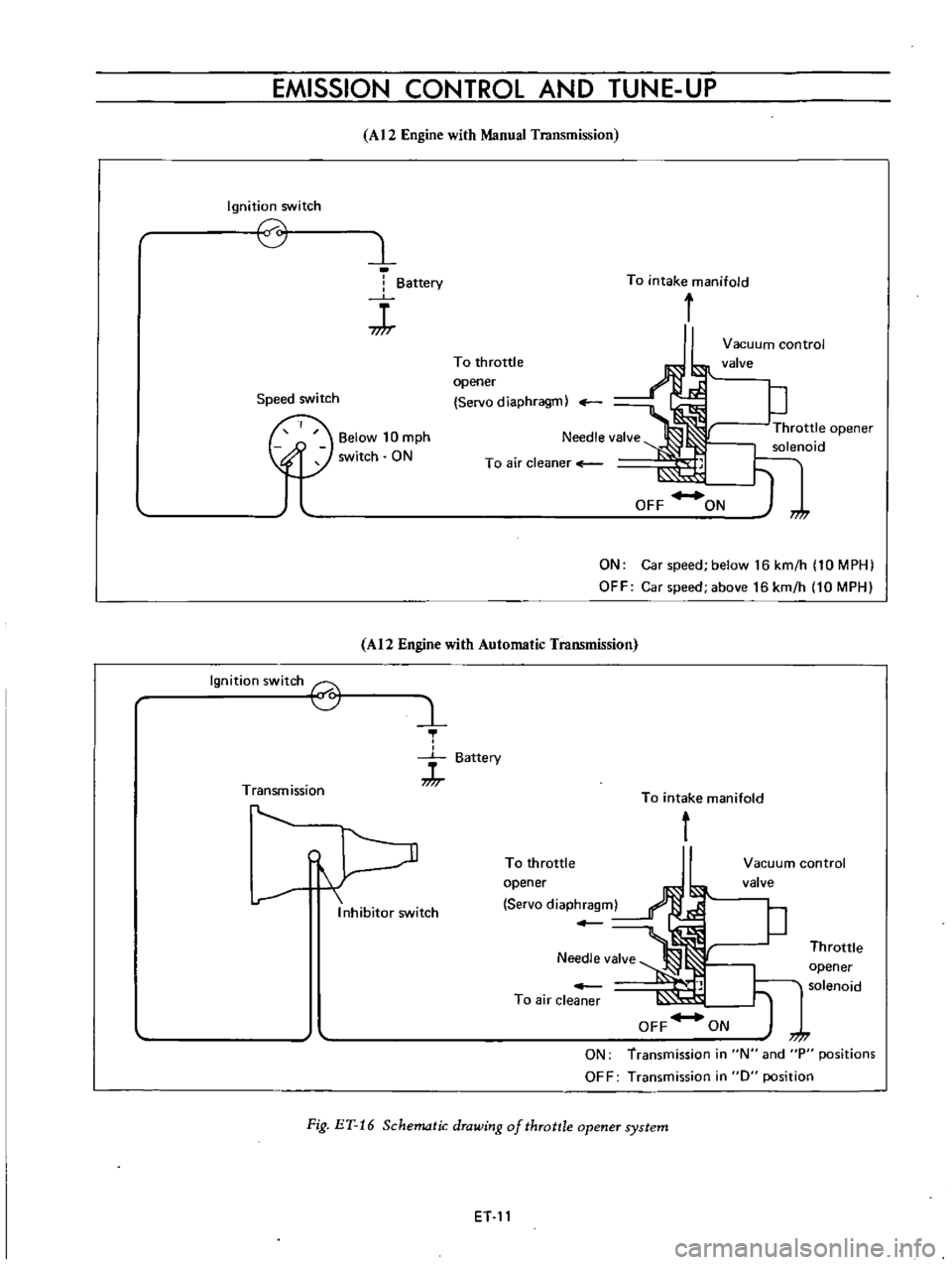
EMISSION
CONTROL
AND
TUNE
UP
Ignition
switch
0
Speed
switch
Ignition
switch
6
Transmission
A12
Engine
with
Manual
Transmission
l
Battery
J
Below
10
mph
switch
ON
To
throttle
opener
Servo
diaphragm
Needle
valve
To
air
cleaner
To
intake
manifold
f
Vacuum
control
valve
p
Throttle
opener
noid
ON
Car
speed
below
16
km
h
10
MPH
OFF
Car
speed
above
16
km
h
10
MPH
A12
Engine
with
Automatic
Transmission
Inhibitor
switch
1
J
Battery
To
intake
manifold
t
ET
11
OFF
ON
Fig
BY
16
Schematic
drawing
of
throttle
opener
system
To
throttle
opener
Servo
diaphragm
Vacuum
control
valve
P
Throttle
t
opener
solenoid
7
7
ON
transmission
in
N
and
P
positions
OFF
Transmission
in
0
position
Page 323 of 513
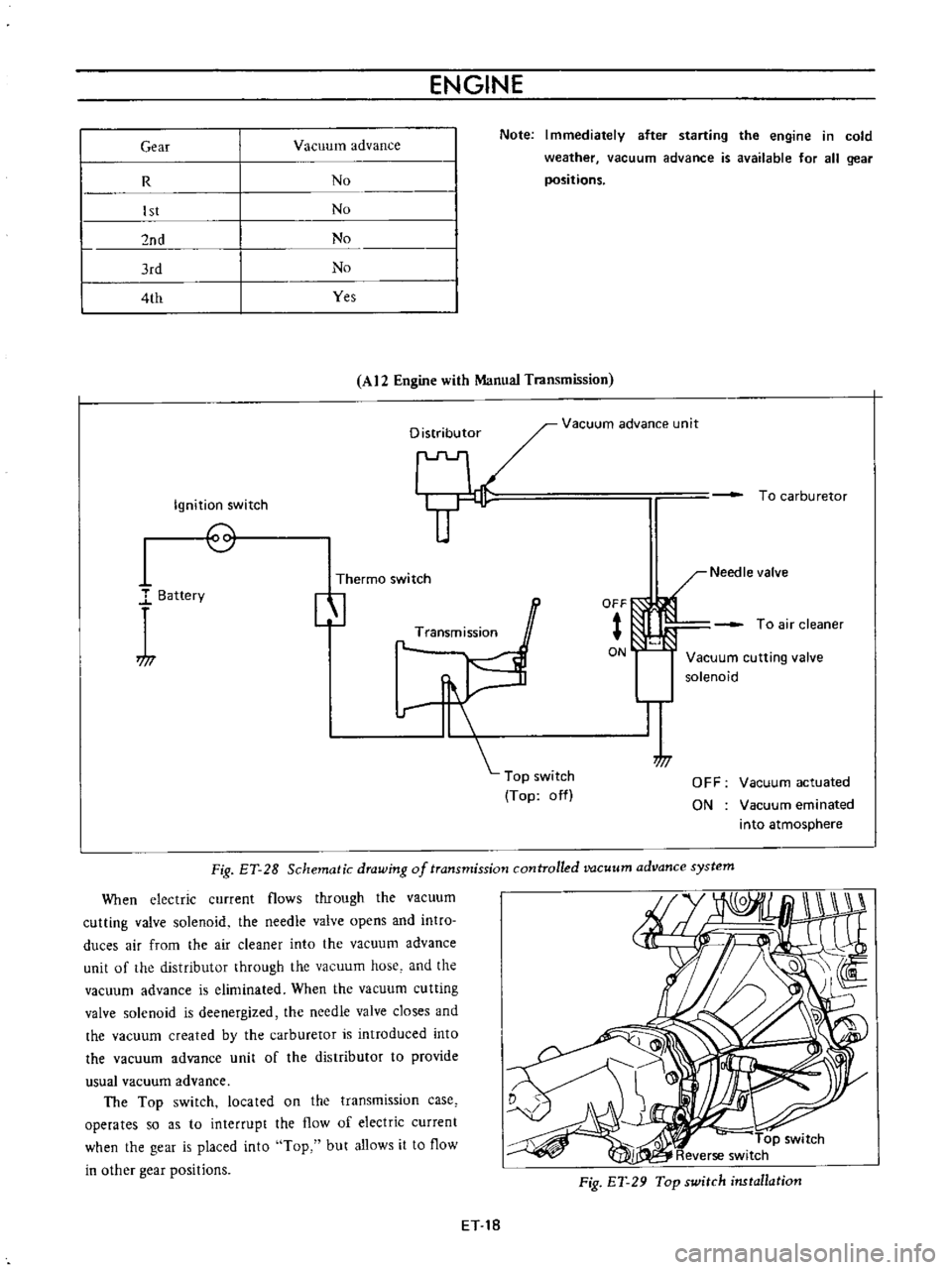
ENGINE
Gear
Vacuum
advance
Note
R
No
1st
No
2nd
No
3rd
No
4th
Yes
Immediately
after
starting
the
engine
in
cold
weather
vacuum
advance
is
available
for
all
gear
positions
A12
Engine
with
Manual
Transmission
Distributor
Ignition
switch
8
1
J
Battery
Thermo
switch
9
Transmission
L
r
l
r
Vacuum
advance
unit
To
carburetor
Needle
valve
OFF
l
To
air
cleaner
ON
Vacuum
cutting
valve
solenoid
Top
switch
Top
off
I
7
1
OFF
Vacuum
actuated
ON
Vacuum
eminated
into
atmosphere
Fig
ET
28
Schematic
drawing
of
transmission
controlled
vacuum
advance
system
When
electric
current
flows
through
the
vacuum
cutting
valve
solenoid
the
needle
valve
opens
and
intro
duces
air
from
the
air
cleaner
into
the
vacuum
advance
unit
of
the
distributor
through
the
vacuum
hose
and
the
vacuum
advance
is
eliminated
When
the
vacuum
cutting
valve
solenoid
is
deenergized
the
needle
valve
closes
and
the
vacuum
created
by
the
carburetor
is
introduced
into
the
vacuum
advance
unit
of
the
distributor
to
provide
usual
vacuum
advance
The
Top
switch
located
on
the
transmission
case
operates
so
as
to
interrupt
the
flow
of
electric
current
when
the
gear
is
placed
into
Top
but
allows
it
to
flow
in
other
gear
positions
Fig
ET
29
Top
switch
installation
ET
18
Page 330 of 513
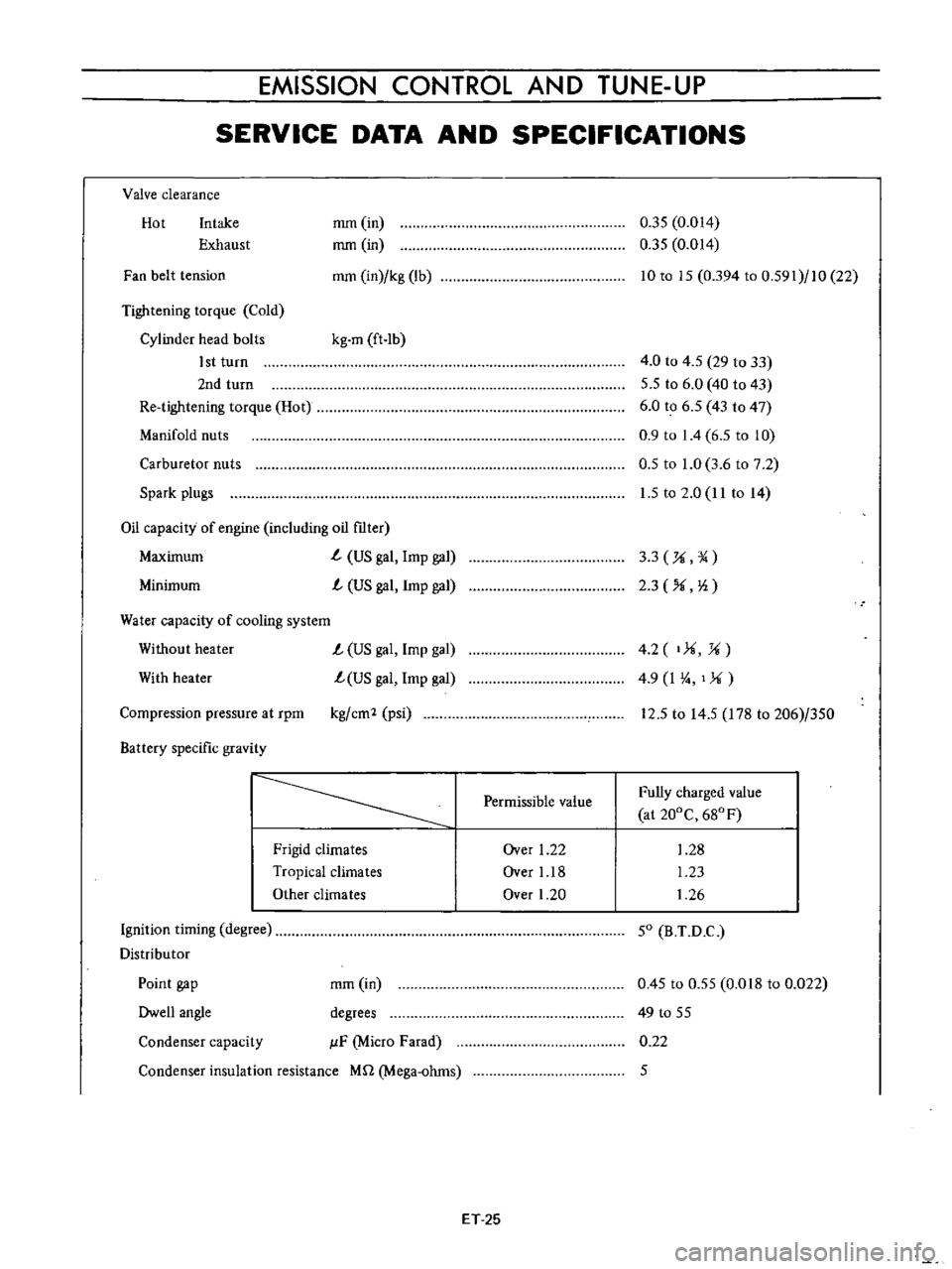
EMISSION
CONTROL
AND
TUNE
UP
SERVICE
DATA
AND
SPECIFICATIONS
Valve
clearance
Hot
Intake
Exhaust
mm
in
rom
in
rom
in
kg
lb
0
35
0
014
0
35
0
014
10
to
15
0
394
to
0
591
10
22
Fan
belt
tension
Tightening
torque
Cold
Cylinder
head
bolts
kg
m
ft
lb
1st
turn
2nd
turn
Re
tightening
torque
Hot
Manifold
nuts
Carburetor
nuts
4
0
to
4
5
29
to
33
5
5
to
6
0
40
to
43
6
0
to
6
5
43
to
47
0
9
to
I
4
6
5
to
10
0
5
to
1
0
3
6
to
7
2
1
5
to
2
0
II
to
14
Spark
plugs
Oil
capacity
of
engine
including
oil
ftIter
Maximum
L
US
gal
Imp
gal
L
US
gal
Imp
gal
3
3
U
14
2
3
Ii
Minimum
Water
capacity
of
cooling
system
Without
heater
L
US
gal
Imp
gal
With
heater
L
US
gal
Imp
gal
4
2
1
U
4
9
I
4
11
12
5
to
14
5
I78
to
206
350
Compression
pressure
at
rpm
kg
em
psi
Battery
specific
gravity
Permissible
value
Fully
charged
value
at
200C
680F
Frigid
climates
Tropical
climates
Other
elima
tes
Over
1
22
Over
1
18
Over
1
20
1
28
1
23
1
26
Ignition
timing
degree
Distributor
50
B
T
D
C
Condenser
capacity
mm
in
degrees
IlF
Micro
Farad
0
45
to
0
55
0
018
to
0
022
49
to
55
0
22
5
Point
gap
Dwell
angle
Condenser
insulation
resistance
Mil
Mega
ohms
ET
25
Page 332 of 513
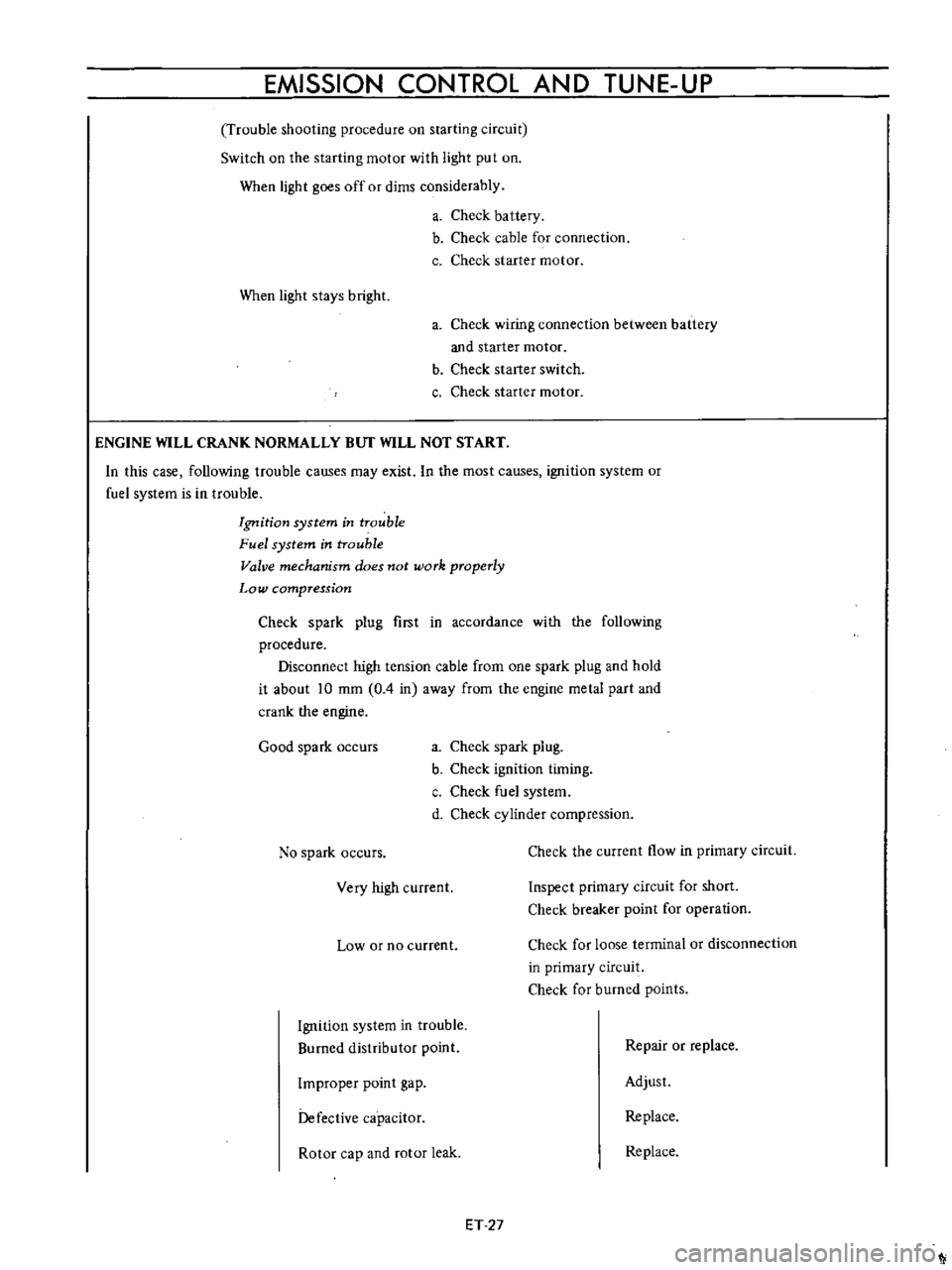
EMISSION
CONTROL
AND
TUNE
UP
Trouble
shooting
procedure
on
starting
circuit
Switch
on
the
starting
motor
with
light
put
on
When
light
goes
off
or
dims
considerably
a
Check
battery
b
Check
cable
for
connection
c
Check
starter
motor
When
light
stays
bright
a
Check
wiring
connection
between
battery
and
starter
motor
b
Check
starter
switch
c
Check
starter
motor
ENGINE
WILL
CRANK
NORMALLY
BUT
WILL
NOT
START
In
this
case
following
trouble
causes
may
exist
In
the
most
causes
ignition
system
or
fuel
system
is
in
trouble
Ignition
system
in
trouble
Fuel
system
in
trouble
Valve
mechanism
does
not
work
properly
Low
compression
Check
spark
plug
first
in
accordance
with
the
following
procedure
Disconnect
high
tension
cable
from
one
spark
plug
and
hold
it
about
10
rom
0
4
in
away
from
the
engine
metal
part
and
crank
the
engine
Good
spark
occurs
a
Check
spark
plug
b
Check
ignition
timing
Check
fuel
system
d
Check
cylinder
compression
No
spark
occurs
Check
the
current
flow
in
primary
circuit
Very
high
current
Inspect
primary
circuit
for
short
Check
breaker
point
for
operation
Low
or
no
current
Check
for
loose
terminal
or
disconnection
in
primary
circuit
Check
for
burned
points
Ignition
system
in
trouble
Burned
distributor
point
Repair
or
replace
Improper
point
gap
Adjust
Defective
capacitor
Replace
Rotor
cap
and
rotor
leak
Replace
ET
27
ti
Page 333 of 513
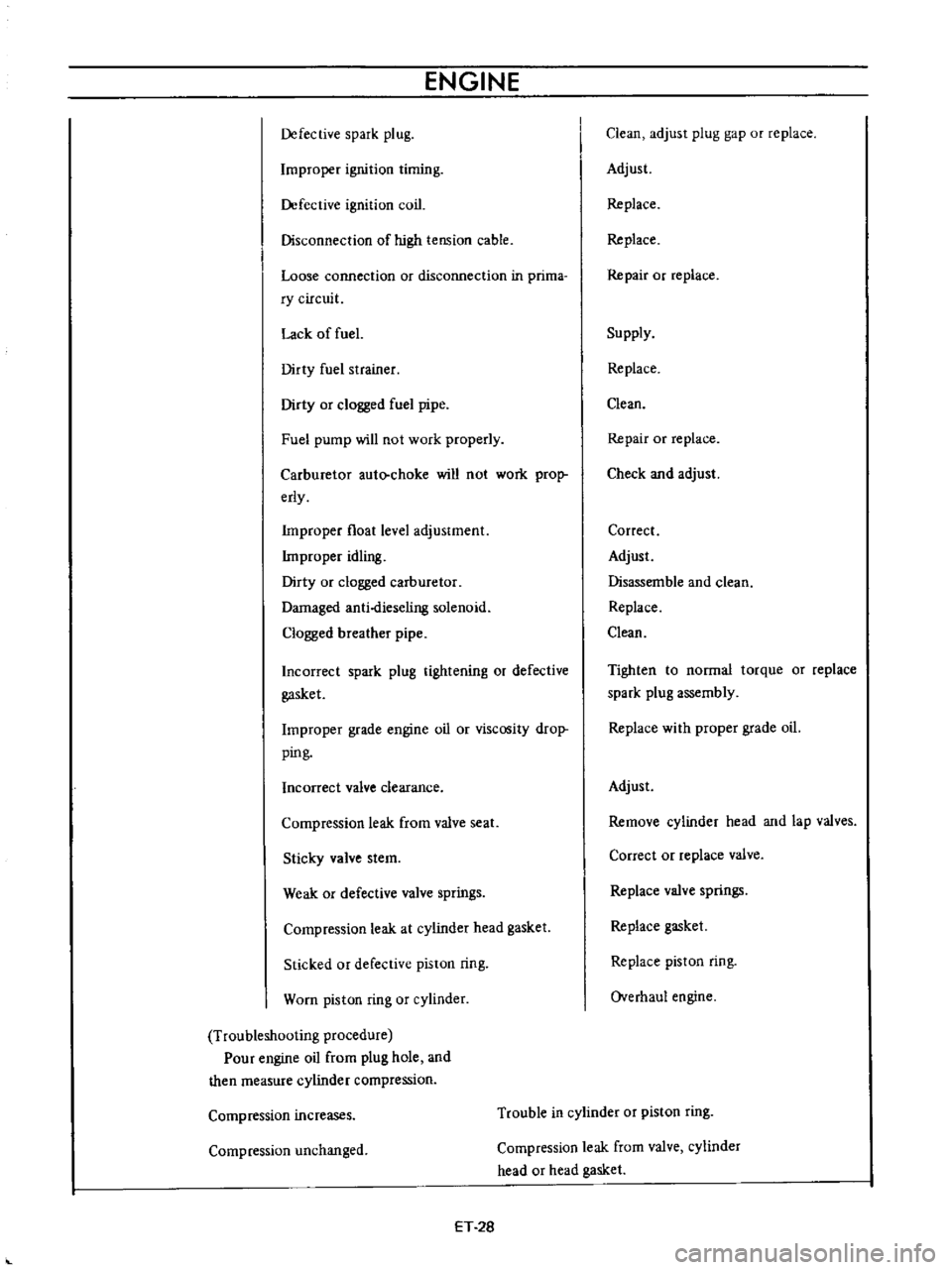
ENGINE
Defective
spark
plug
Improper
ignition
timing
Defective
ignition
coil
Disconnection
of
high
tension
cable
Loose
connection
or
disconnection
in
prima
ry
circuit
Lack
of
fuel
Dirty
fuel
strainer
Dirty
or
clogged
fuel
pipe
Fuel
pump
will
not
work
properly
Carburetor
auto
choke
will
not
work
prop
erly
Improper
float
level
adjustment
Improper
idling
Dirty
or
clogged
carburetor
Damaged
anti
dieseling
solenoid
Clogged
breather
pipe
Incorrect
spark
plug
tightening
or
defective
gasket
Improper
grade
engine
oil
or
viscosity
drop
ping
Incorrect
valve
clearance
Compression
leak
from
valve
seat
Sticky
valve
stem
Weak
or
defective
valve
springs
Compression
leak
at
cylinder
head
gasket
Sticked
or
defective
piston
ring
Worn
piston
ring
or
cylinder
Troubleshooting
procedure
Pour
engine
oil
from
plug
hole
and
then
measure
cylinder
compression
Clean
adjust
plug
gap
or
replace
Adjust
Replace
Replace
Repair
or
replace
Supply
Replace
Clean
Repair
or
replace
Check
and
adjust
Correct
Adjust
Disassemble
and
clean
Replace
Clean
Tighten
to
normal
torque
or
replace
spark
plug
assembly
Replace
with
proper
grade
oil
Adjust
Remove
cylinder
head
and
lap
valves
Correct
or
replace
valve
Replace
valve
springs
Replace
gasket
Replace
piston
ring
Overhaul
engine
Compression
increases
Trouble
in
cylinder
or
piston
ring
Compression
unchanged
Compression
leak
from
valve
cylinder
head
or
head
gasket
ET
28
Page 334 of 513
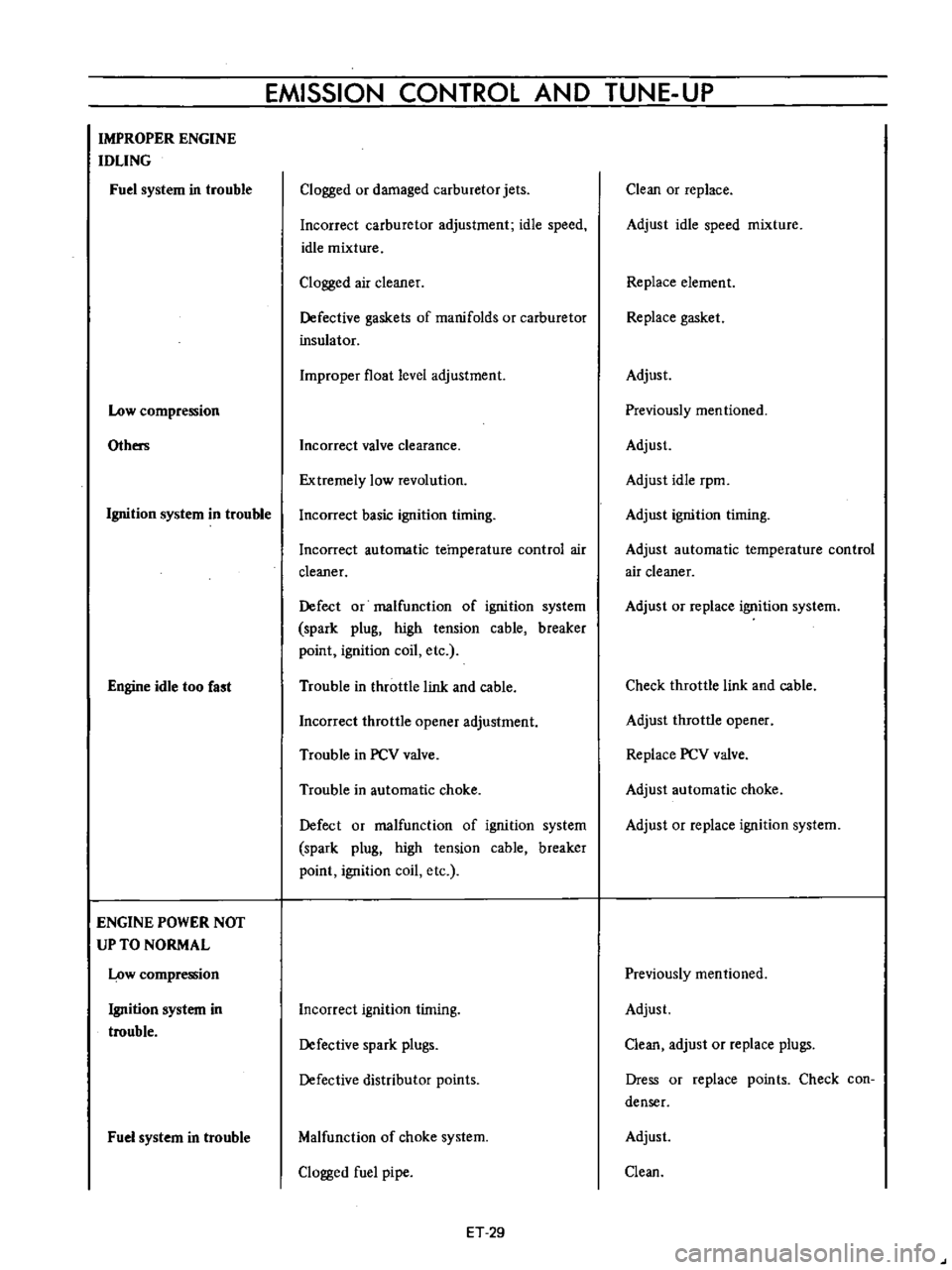
IMPROPER
ENGINE
IDLING
Fuel
system
in
trouble
Low
compression
Others
Ignition
system
in
trouble
Engine
idle
too
fa
t
ENGINE
POWER
NOT
UP
TO
NORMAL
4
w
compression
Ignition
system
in
trouble
Fuel
system
in
trouble
EMISSION
CONTROL
AND
TUNE
UP
Clogged
or
damaged
carburetor
jets
Incorrect
carburetor
adjustment
idle
speed
idle
mixture
Clogged
air
cleaner
Defective
gaskets
of
manifolds
or
carburetor
insulator
Improper
float
level
adjustment
Incorrect
valve
clearance
Extremely
low
revolution
Incorrect
basic
ignition
timing
Incorrect
automatic
teinperature
control
air
cleaner
Defect
or
malfunction
of
ignition
system
spark
plug
high
tension
cable
breaker
point
ignition
coil
etc
Trouble
in
throttle
link
and
cable
Incorrect
throttle
opener
adjustment
Trouble
in
PCV
valve
Trouble
in
automatic
choke
Defect
or
malfunction
of
ignition
system
spark
plug
high
tension
cable
breaker
point
ignition
coil
etc
Incorrect
ignition
timing
Defective
spark
plugs
Defective
distributor
points
Malfunction
of
choke
system
Clogged
fuel
pipe
ET
29
Clean
or
replace
Adjust
idle
speed
mixture
Replace
element
Replace
gasket
Adjust
Previously
mentioned
Adjust
Adjust
idie
rpm
Adjust
ignition
timing
Adjust
automatic
temperature
control
air
cleaner
Adjust
or
replace
ignition
system
Check
throttle
link
and
cable
Adjust
throttle
opener
Replace
PCV
valve
Adjust
automatic
choke
Adjust
or
replace
ignition
system
Previously
mentioned
Adjust
Clean
adjust
or
replace
plugs
Dress
or
replace
points
Check
con
denser
Adjust
Clean